NEWTON, John FrankBiblio.com
11 838 résultats
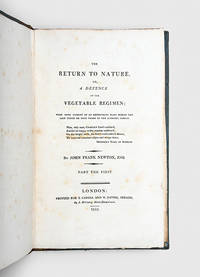
1811164685London: printed for T. Cadell and W. Davies by J. McCreery 1811. The root of the Shelleys' vegetarianism First edition of this pioneering work of vegetarianism in which the author advocates for the medical and intellectual benefits of a meat-free diet. It was a great influence on fellow vegetarian Percy Bysshe Shelley as well as on Mary Shelley's depiction of the Creature as a herbivore in Frankenstein. This is a particularly well-preserved copy in the original boards. Newton 1767-1837 promoted a diet of fruit vegetables raisins bread eggs milk and potatoes and he drank only distilled water because of his belief that the Thames was contaminated with animal fat. Unlike his mentor William Lambe 1765-1847 Newton was not a vegan. He inspired several significant figures to adopt a vegetarian diet including the physician John Snow 1813-1858 and Percy Shelley whose Vindication of Natural Diet 1813 echoed Newton's ideas. "It is from his meeting with John Newton in November 1812 that Shelley's proselytising vegetarianism dates. From Newton's book he drew many of his arguments" Crook and Guiton p. 77. The two men differed in the fact that Newton was mainly concerned with the scientific benefits rather than the moral implications of vegetarianism. "Though not a doctor Newton regarded The Return to Nature principally as a work of medicine; he had himself found relief from chronic asthma through vegetarianism and was anxious to impart to others the knowledge of its benefits in a number of diseases" ibid. However "in one of his most surprising and emphatic passages" Newton ventures into a diatribe against "the monster syphilis with all its gorgon terrors" and explains his hope that vegetarianism could cause it to "be driven from the earth" p. 131. This was expanded upon by Shelley in his own writing through his emphasis on the immorality of consuming flesh in all its guises along with his link between a carnivorous diet and alcoholism. He made use of the allegory of Prometheus; it was only through the unnatural theft of fire that humans gained the ability to transform meat from bloody flesh into something fit for consumption. Newton was also an occasional guest of Mary Shelley's father William Godwin a fellow proponent of the vegetarian diet. Presumably it was because Newton's ideas filtered through Shelley and Godwin that Mary Shelley decided to describe the Creature in Frankenstein as a vegetarian: "My food is not that of man; I do not destroy the lamb and the kid to glut my appetite; acorns and berries afford me sufficient nourishment. The picture I present to you is peaceful and human." The Return to Nature is rare in commerce particularly so in original boards. We can trace just one copy thus at auction which appeared over 50 years ago. Octavo. Uncut in original brown paper-backed blue boards printed paper spine label. Dedication leaf misbound following introduction. Head of spine crumpled corners worn light foxing to boards and contents but otherwise very crisp initial leaves creased at upper margin leaf A3 partially loose at lower cord and consequently standing proud: a very good copy. Nora Crook & Derek Guiton Shelley's Venomed Melody 2010. hardcover
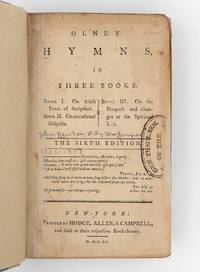
1790374363New York: Printed by Hodge Allen & Campbell and sold at their respective book-stores 1790. Second American edition. vi 1 8-348. 12mo. Recent paper backed boards. Repairs at gutter of title and first leaf. Bookplate and ink stamp of General Theological Seminary. Second American edition. vi 1 8-348. 12mo. Olney Hymns was published in London in 1779 but it was not until publication in the United States the they hymn flourished. The first American printing of Amazing Grace appeared within the New York 1787 edition of Olney Hymns Evans 20588 followed by the New York 1789 edition of the Psalms of David . for the Use of the Dutch Reformed Church Evans 21688. The present 1790 reprinting of the 1787 edition by Hodge Allen and Campbell followed with Amazing Grace appearing on pp. 48-9.<br /> <br /> ESTC records only two other examples of this 1790 edition AAS and NYHS and we find no example of either the first or second American Olney Hymns in the auction records for over a century. Evans 22734; ESTC W26651. On Amazing Grace see D. Bruce Hindmarsh "'Amazing Grace': The History of a Hymn and a Cultural Icon" in: Sing Them Over Again to Me: Hymns and Hymnbooks in America ed. Noll and Blumhofer 2006 Printed by Hodge, Allen, & Campbell, and sold at their respective book-stores unknown
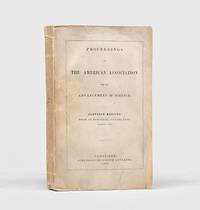
1858155260Cambridge: Joseph Lovering 1858. One of only two known papers by the author Uncommon first edition of the first article by a woman published in the Proceedings of the AAAS: a well-preserved copy in the original wrappers with the ownership signature of American ornithologist George N. Lawrence 1806-1895 listed as a member of the AAAS on p. xxxviii of this volume. The American scientist inventor and women's rights campaigner Eunice Newton Foote 1819-1888 is best remembered for her discovery of the absorption of thermal radiation by carbon dioxide and water vapour: namely the greenhouse effect. Her famous paper on the topic was presented to the AAAS in August 1856 read on her behalf by Joseph Henry first Secretary of the Smithsonian and published shortly after in the American Journal of Science and Arts. This is Foote's second paper which provides an early experimental description of the effect of a pressure-driven change on the static electricity of air with reference to observations by Humboldt Sabine and de Saussure. It was presented to the AAAS on 14 August 1857 again read by Joseph Henry on her behalf. Its first appearance in print was in the Proceedings; abbreviated versions later appeared in the American Journal of Science and Arts and in the Philosophical Magazine. In Mary Creese's landmark study of American and British women scientists from 1800 to 1900 she noted that of the approximately 3400 scientific publications authored by women in the period - less than 1% of the total published - there were "just 16 papers by American women in physics over the whole century. Only two pre-date 1889 and they are the two papers by Eunice Foote" Jackson p. 117. John Perlin author and visiting scholar at the UCSB Physics department which hosted a 2019 exhibition on Foote remarked that she was "the only woman to be published in serious physics journals until Madame Curie" quoted in Jacobs. Octavo. Five folding plates one engraved with astronomical illustrations the rest featuring diagrams and graphs and two engraved plates numerous illustrations in text. Original buff printed wrappers. Faint pencilled signature "Geo. N. Lawrence" along upper edge of front cover pencilled number at centre of spine. Wrappers expertly restored spine ends chipped contents crisp and clean: a very good copy. Roland Jackson "Eunice Foote John Tyndall and a Question of Priority" Notes and Records 74 2019 pp. 105-18; Tom Jacobs "More than a Historical Foote Note" UCSB's The Current 6 November 2019 available online. unknown
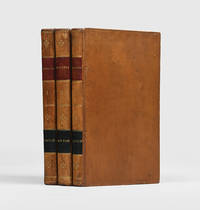
1819183664London: Printed for Sherwood Neely and Jones; and Davis and Dickson 1819. The Newtonian ascendancy A handsomely bound edition bringing together Newton's masterpiece with several works refining Newtonian theory and an early draft of the Principia itself. This translation of the Principia together with the Laws of the Moon's Motion by John Machin c. 1686-1751 is drawn from the first edition in English published in 1729. William Davis 1771-1807 originally brought out the three-volume edition in 1803 revising and extending Motte's translation to cover the remaining third of Newton's text. This is thus only the second edition of a complete translation of the Principia into English. No further edition was published until the "modernized" version brought out by the University of California Press in 1934 and no entirely new translation was made until 1999. This edition pairs these works with the Short Comment on and Defence of The Principia 1770 by William Emerson 1701-1782 and Newton's own System of the World written 1685. By the turn of the 19th century the Principia's theory of gravity had become widely accepted in scientific circles and Davis's edition "made this available to a number of generations of nineteenth-century students" ODNB. 3 vols octavo 212 x 127 mm. Engraved portrait frontispiece and 56 plates 8 of which folding. Extensive tables and formulae in the text. Contemporary calf spines lettered decorated and ruled in gilt and with red and black morocco labels covers panelled in blind light brown coated endpapers edges sprinkled brown. Spine ends restored. Light bumping and wear minor browning and offsetting to contents: a very good copy. Babson 22; Grey 25; Wallis 25. unknown
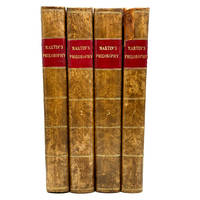
17715136166113<p><strong>NEWTON MARTIN Benjamin</strong><strong>.</strong> <em>Philosophia Britannica: Or A New and Comprehensive System of the Newtonian Philosophy Astronomy and Geography; In a Course of Twelve Lectures; With Notes; Containing the Physical Mechanical Geometrical and Experimental Proofs and Illustrations of All the Principal Propositions in Every Branch of Natural Science: Also a Particular Account of the Invention Structure Improvement and Uses of All the Considerable Instruments Engines and Machines; With New Calculations Relating to Their Nature Power and Operation.</em></p><p>London: Printed for W. Strahan; J. & F. Rivington; W. Johnston; Hawes & Co.; T. Carnan and F. Newbery; B. Collins; W. Frederick; and sold by the Author at his House in Fleet-Street 1771. Third edition. Complete in four volumes. Three text volumes plus a separate atlas volume of plates. Quarto. Approximately 8.5" x 5.5". Vol. I: xxx 333pp 3 ads; Vol. II: xiv 390pp 2 ads; Vol. III: x 405pp index. Atlas volume with 81 engraved copperplates the majority folding. Contemporary or near-contemporary half marbled calf over marbled boards with one repair to the upper spine of Vol. IV. Bindings sound and well-aligned. Engraved plates clean and strong with no losses; folds supple and correctly opening. Text generally clean throughout with manuscript annotations on the versos of the plates linking them to the relevant portions of text. Overall Very Good to Very Good.</p><p>Third and expanded edition of Benjamin Martin's monumental exposition of Newtonian natural philosophy combining physics astronomy geography mechanics and experimental science into a single unified system. The work includes extensive treatment of optics celestial motion gravitation hydrostatics pneumatics electricity and the mechanical powers alongside detailed explanations of contemporary scientific instruments and experimental apparatus. The separate atlas volume contains 81 finely engraved plates illustrating astronomical systems orreries telescopes microscopes air pumps electrical machines engines survey instruments and mechanical demonstrations.</p><p>This third edition represents the fully mature state of Martin's project as a practical synthesis of Newtonian science for broad professional use in the later eighteenth century. Unlike earlier editions which often survive without the full engraved apparatus this issue consolidates the theoretical text and the mechanical-visual program into a coherent instructional system. The separate atlas format allows for larger clearer mechanical and astronomical engravings than the inline plates of earlier printings making this edition particularly well suited for institutional reference in the history of science technology and scientific pedagogy.</p> Printed for W. Strahan; J. & F. Rivington; W. Johnston; Hawes & Co.; T. Carnan and F. Newbery; B. Collins; W. Frederick hardcover
1404JC028<p><strong>SIVE DE Reflexionibus Refractionibus Inflexionibus & Coloribus LUCIS </strong>LIBRI TRES. Authore Isaaco Newton Equite Aurio. Latine reddidit Samuel Clarke. S. T. P. Editio Secunda auctior. LONDINI. Impensis Gul. & Joh. Innys Regiae Societatis Typographorum ad Insignia Principis in Areâ Occidentali D. Pauli. MDCCIXI 1719.</p>_x000d_<p>In 4º de 195x12 cm com ix 415 págs. Encadernação da época inteira de pele com ferros a ouro na lombada e ferros a ouro rolados com motivos florais nas esquadrias das pastas e nos super-libris. Corte das folhas marmoreado. Acondicionado em estojo de pele.</p>_x000d_<p>Ilustrado com 12 gravuras desdobráveis abertas em chapa de metal com todas as figuras geométricas do estudo da reflexão da refracção e do estudo do arco-íris e das cores.</p>_x000d_<p>Exemplar com título de posse manuscrito e rasurado no pé da folha de rosto.</p>_x000d_<p>Segunda edição deste tratado um dos grandes livros da história da ciência.</p>_x000d_<p>Newton produziu muitas explicações para os mais variados problemas. Este livro Óptica de Newton fez pela Luz e pela Óptica o que o seu Principia tinha feito pela Gravidade ou seja colocou a Luz numa base científica diz E. W. Brown. Contém uma acumulação de fenômenos ópticos desde o seu primeiro trabalho uma pequena memória sobre Transação Filosófica 1672 até este livro editado 33 anos mais tarde.</p>_x000d_<p>EN In 4º 195x12 cm. ix 415 pags.</p>_x000d_<p>Contemporary full calf binding gilt at spine and gilt tooled at boards in floral frames. Marbled edges. Packed in case in the style of a tobacco case finished in full calf.</p>_x000d_<p>Illustrated with 12 folding plates containing the graphics from the study of the light reflection and refraction and the explanation of the rainbow.</p>_x000d_<p>Copy with ownership title erased at bottom of title page.</p>_x000d_<p>2nd Latin edition of Newton's 'Optics: or a Treatise of the Reflections Refractions Inflections and Colours of Light. London 1704'. One of the greatest books in the history of science.</p>_x000d_<p>Newton found out many explanations to many problems. This book Newtons Optics did for Optics and Light what his Principia did for Gravitation namely it gave Light a scientific basis says E.W. Brown. It contains an accumulation of optical phenomena from his first paper a short memoir in Philosophical Transaction 1672 to the above book Optics 33 years later.</p>_x000d_<p>Referências/References: </p>_x000d_<p>Gray 180; Babson 138; Wallis 180; British Lybrary: General Reference Collection 59.g.19</p> M-11-C-11 hardcover
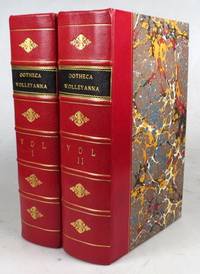
186449256London: Sold by R.H. Porter 1864 1902 1905 1907. Sole editions. Four parts bound in two volumes. Large 8vo. xl 525 3 527-532; vi 665 1 96 4 pp. Expertly bound in recent quarter red morocco over marbled boards spines with raised bands gilt lettered black labels lettered direct to another and with a gilt device repeated to the others the original printed wrappers to all four parts bound in at the rear of volume II adjacent to the first wrapper is a 3 pp. autograph letter signed from Newton addressed to "My dear Edge" on Magdalen College Cambridge headed paper parts II and III feature tipped in handwritten notes presenting them "with the editor's compliments" parts II and IV also come with letters from Newton to the original recipient's son finally the set is complemented with two pieces of interesting egg related printed ephemera. Photogravure portrait frontispiece 21 chromolithograph plates of bird eggs numbered I-XXI 16 lithograph plates tinted chromolithographic or uncoloured depicting birds nests and landscapes lettered A-P and a folding colour map of Lapland. John Wolley 1823-1859 was an ornithologist and egg collector first becoming interested in the subject whilst studying at Cambridge. Over time he became something of an expert on the Dodo and later on the Great Auk. His studies led to travels in Europe and Scandinavia and it was during one of these trips in the 1850s that he interviewed the men that had killed the last of the Great Auk species the previous decade. Wolley fell ill after one of these foreign trips and eventually passed away at the tender age of 36. On his demise his notes and remaining egg collection passed to his close friend Alfred Newton who painstakingly edited and published Wolley's notes over the next half century. Alfred Newton 1829-1907 became one of the pre-eminent ornithologists of the age being one of the founders of the British Ornithologists' Union in 1858 and ascending to the chair of Zoology and Comparative Anatomy at Cambridge in 1866 a post that he held until his death. In these later decades Newton also edited or contributed to many other important ornithological works such as editions of Yarrell's Birds the Encyclopaedia Britannica and his own Dictionary of Birds four volumes 1893-96 but his editorship of Wolley's work was by far his crowning achievement in print. The first letter is dated September 1864 and is evidently written to James Thomas Edge 1827-1894 originally James Thomas Hurt he took his mother's maiden name early in his adult life. Newton explains that he had asked Van Voorst to send Edge a copy of the work but that the publisher had ignored his instruction to inscribe the volume with his wishes. This omission prompted Newton's belated letter which had been delayed due to a summer long bird watching trip to Spitsbergen. The later letters are both addressed to Edge's son Thomas Lewis Kekewich Edge 1856-1931 the first of these references the senior Edge's collection - the importance of certain pieces within it and the need to ticket them. Newton's final letter is dated March 1907 just three months prior to his death. He is glad that Edge has had "the 4th and last part of this book and seems to like it" and commends an extract that Edge had quoted from his father's journal in a previous letter apparently confirming a conclusion John Wolley had also come to. Interestingly Wolley's father Francis also changed surname during his adult life - taking on his wife's maiden name. Prior to becoming a Wolley Francis' surname had been Hurt. Thus it transpires that as well as sharing a keen interest in ornithology and oology John Wolley and James Thomas Edge were second cousins. The ephemera comprises an 1865 printed sale notice from the auctioneer J.C. Stevens offering a "Rare & Remarkable Egg" of a bird "presumed to be quite extinct" which he states was "probably the Dinornis ingens of Owen". Richard Owen had been sent a fragment of an unusual bone that had been excavated in New Zealand in the late 1830s. After studying it for several years he came to the conclusion that it was almost certainly a part of a bone from a giant flightless bird which he named Dinornis novaezealandiae more commonly known by its Maori name of Moa which had long since been extinct. Also inserted is a 24 pp. sale catalogue of eggs dated 1858 offered by the same auctioneer the eggs collected by John Wolley himself in Lapland the previous year. A handsome set of a what is ordinarily an uncommon work this set rendered unique with its the family association letters from the editor and the related ephemera. London: Sold by R.H. Porter unknown
171938274London Impensis Gul. & Joh. Innys 1719 colophon: Londini: Ex Officina Gulielmi Bowyer 1718. 8vo. Contemp. full calf. Corners fronthinge and spineends professionally repaired. Inner hinges reinforced. Gilt lineborders on back. Titlelabel in red leather with gilt lettering. Old owners name stamped on titlepage small.Instead of htitle is bound "Catalogus Librorum prostantium apud Gul. & Joh. Innys" 1 leaf the Cataloque is furthermore bound at end but with a different typography. 2XI1415 pp. and 12 folded engraved plates. Very light brownning to a few margins. Printed on good paper in general fine and clean internally. <br/><br/><em>Scarce second Latin edition of Newton's "Optics: or a Treatise of the Reflections Refractions Inflections and Colours of Light. London 1704." one of the great books in the history of science. "Newton's Optics did for Light what his Principia had done for Gravitation namely placed it on a scientific basis." E.W. Brown. The translation was brought to light "At the request of Newton Dr. Samuel Clarke prepared a Latin edition of his Optics which appeared 1706 and he was generously presented by Sir Isaac with GBP 500 or GBP 100 for each of his five children as a token of the appreciation and gratitude of the author. DeMoivre is said to have secured and taken charge of this translation and to have spared neither time nor trouble in the task. Newton met him every evening at a coffe-house and when they have finished their work he took De Moivre home with him to spend the evening in philosophical conversation."Brewster in his "Newton" 1855"."In the accumulation of optical phenomena from his first paper the short memoir in Philosophical Transaction 1672 until the above book the Optics. 33 years later Newton had gathered explanations to many problems. The rainbow is fully explained and also "Newton's rings" produced by pressing the flat side of a plano-convex glass against a double convex lens of long focal lenght producing rings of alternating brightness and darkness; his explanation was not valid as he did not know optical interference. He speculated on the double refraction of Icelandic spar." Dibner in Heralds of Science No 148 - G.J. Gray No 180. </em> hardcover
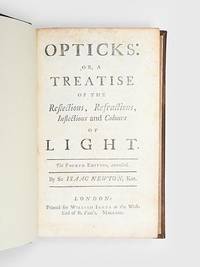
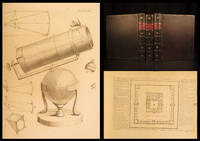
1730187897London: Printed for William Innys 1730. The definitive edition of Newton's second great work Fourth edition the final edition to be revised and approved by Newton himself. The Opticks is Newton's definitive study of light the basis for the corpuscular theory of light rays that remained dominant into the 19th century. The Opticks's greatest achievement is showing that colour is a mathematically definable property. Newton demonstrates that white light is a mixture of infinitely varied coloured rays and that each ray is definable by the angle through which it is refracted. Other topics include colour circles theories of the rainbow and the phenomenon now known as Newton's rings. In his later years Newton made a sustained effort to tidy up his scientific legacy. This edition of the Opticks was published three years after his death by his long-time publisher drawing on corrections "by the Author's own Hand" preface. In those three years Newtonian devotees had published the Optical Lectures 1728 that he had delivered at Cambridge in the 1660s making public a work that he had only circulated in manuscript among close friends. The Lectures employed a more mathematical analysis of colour theory than did the Opticks and Innys' fourth edition harmonizes the two works by cross-referencing philosophical propositions in the latter with geometrical demonstrations in the former. Octavo 195 x 123 mm pp. viii 382 2. Complete with terminal advertisement leaf and 12 folding plates. Wood-engraved initials head- and tailpieces. Twentieth-century calf spine ruled and decorated in blind and with red morocco label marbled endpapers edges sprinkled red. Minimal foxing to contents paper flaw to lower outer corner of K1 text unaffected plates crisp: a very good copy indeed. Babson 136; ESTC T69138; Gray 178; Wallis 178. unknown
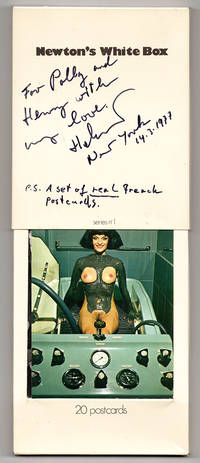
6004Paris: Xavier Moreau ca. 1975. 8vo 8†x 5†white paperboard box with slip-off lid. 20 color and black & white postcards 6†x 4.25†loosely inserted in an internal tray; titles in French printed on verso of postcards. Inscribed on front panel of lid in black ink: “For Polly and Henry with my love. Helmet New York. 14. 3. 1977. P. S. A set of real French postcards.â€. <p>A presentation copy of an early and exceedingly rare Newton publication comprising twenty erotic postcards reproducing his photographs inscribed to the noted fashion editor and stylist Polly Allen Mellen and her husband.</p> <br /> <br /> <p>First and only edition. This is one of only two examples that we have been able to trace. The other copy which appeared in the trade in 2014 was inscribed by Newton in 1976 to Rudi Gernreich 1922–1985—an innovator of twentieth century fashion best known for his scandalous “monokini†or topless female swimsuit. Although identified as “Series No. 1†on the lid no other series of Newton’s postcards is known.</p> <br /> <br /> <p>Born in Berlin Helmut Newton 1920–2004 was known for his radical edgy and provocative photography. As documented in these photos Newton preferred working outside the studio and often shot his models outdoors and in elegant mansions villas and hotels. Newton pushed the boundaries of the fashion industry of his day with his often-sinister erotically-charged imagery—leading some feminists to criticize his work. He began working for Vogue in the ‘50s and soon—like Richard Avedon and Norman Parkinson—became one of the magazine’s foremost photographers. While 1976 saw Newton’s first recorded publication White Women the present postcards are variously dated from 1971 to 1975 evidently indicating publication prior to White Women. Newton’s first group exhibition—at Emily Lowe Gallery New York City—and his first solo show at Galerie Nikon in Paris were both held in 1975. It is possible that White Box was published in connection with the latter. In any case it is not listed among the photographer’s known publications on the website of the Helmut Newton Foundation.</p> <br /> <br /> <p>Polly Allen Mellen 1924– is a fashion editor and stylist who worked for Harper's Bazaar under Diana Vreeland and later Vogue under Vreeland and Grace Mirabella—her career spanning over sixty years. She served as a nurse's aide during WWII and moved to New York in 1949. At Harper’s Bazaar she met her future longtime collaborator Richard Avedon who initially found Mellen “too noisy.†In time however Avedon would describe her as “the most creative sittings editor I ever worked with.†Nicolas Ghesquiere has suggested that Mellen’s work at Harper’s and later Vogue came to “define a new more modern ethos about clothes and how women wore them. With an almost playful daring the ethos brimmed with a kind of strong smart unabashedly celebratory feminine independence—as well as an artful element of provocation and extravagance—that Mellen herself embodied and drew upon in her collaborations†Ghesquiere Polly Mellen. Over the course of her career Mellen worked with such photographers as Newton Avedon Arthur Elgort Irving Penn Steven Meisel and Mario Testino. Polly and Henry Wigglesworth Mellen 1920–2014 married in 1965.</p> <br /> <br /> <p>No copies recorded in OCLC. Apart from the copy offered by Peter Harrington in 2014 we find no other copies recorded no sales records nor any other mention of White Box.</p> <br /> <br /> <p>REFERENCES: Ghesquiere Nicolas “Polly Mellen†2010 at Interview Magazine online; Warren Lynne. Encyclopedia of Twentieth-Century Photography Vol. 3 New York: Routledge 2006 p. 1159; “Helmut Newton†at the International Center of Photography online; “Polly Mellen styled the controversial Bathhouse Series & Nastassja Kinski†2014 at A.G. Nauta Couture online.</p> Paris: Xavier Moreau, [ca. 1975] unknown
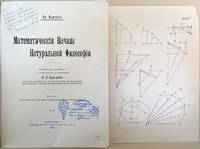
191546310Petrograd: M. M.Stasiulevicha 1915. <p>Newton Isaac 1643-1727. Matematicheskiye nachala natural'noy filosofii. Translated from Latin with notes and explanations by Aleksei N. Krylov. 2 vols. vi 276; 4 277-620pp. 36 plates. Petrograd: M. M. Stasyulevich 1915-16. Original printed wrappers spines restored edges of wrappers repaired front wrapper of Vol. 1 a bit creased a few tiny chips. Library stamps on titles and last pages of both volumes some ink lines in the margins. Very good.</p> <p> First Edition in Russian of Newton's Philosophiae naturalis principia mathematica 1687 made by Russian naval engineer and applied mathematician Aleksei Nikolaevich Krylov 1863-1945 who became internationally famous for his works on magnetic compasses ship floodability hydrodynamics and computational mathematics. He built the first machine in Russia for integrating ordinary differential equations and in 1931 published a paper on what is now called "Krylov subspace" dealing with computation of the characteristic polynomial coefficients of a given matrix.</p> <p> The first volume of Krylov's translation of the Principia unlike many Russian books of the period was printed on good-quality paper; the second volume however was printed on paper of lesser quality. The edition does not include information on the number of copies printed but it was likely a small edition. OCLC cites four copies in Western libraries-Stanford Huntington University of Oklahoma and Paris-BIUSJ-Mathematiques. Not in A Descriptive Catalogue of the Grace K. Babson Collection of the Works of Sir Isaac Newton.</p> . M. M.Stasiulevicha unknown
1870110127New York: Robert Carter and Brothers 1870. Rare early edition of this work by Newton. Octavo original cloth illustrated. Presentation copy inscribed by Moody on the front free endpaper "To John Syme D.L. Moody My dear Brother be useful be earnest be fruitful and the blessing of God will rest on you." In good condition. Signatures of the legendary evangelist are rare especially with such a lengthy inscription. Dwight Lyman Moody also known as D. L. Moody was an evangelist and publisher connected with the Holiness Movement who founded the Moody Church Northfield School and Mount Hermon School in Massachusetts Moody Bible Institute and Moody Publishers. One of his most famous quotes was “Faith makes all things possible. Love makes all things easy.“ Moody gave up his lucrative boot and shoe business to devote his life to revivalism working first in the Civil War with union troops through YMCA in the United States Christian commission. In Chicago he built one of the major evangelical centers in the nation which it is still active. Working with singer Ira Sankey he toured the country and Britain Europe drawing large crowds with a dynamic speaking style that preached God's love and friendship kindness and forgiveness rather than hellfire and condemnation. Robert Carter and Brothers hardcover
178225494<p><strong>1782 Isaac NEWTON Works OPTICS Ancient Kingdoms Gravity Mundi Systemate Horsley</strong></p><p><em>"Whence arises all that order and beauty we see in the world" </em></p><p>― Isaac Newton<em> Opticks</em></p><p>Few names in the course of the history of science have been as influential as Isaac Newton. His works such as '<em>Opticks'</em> summarized great discoveries and theories concerning light and color reflections color wheel invention of the telescope early theories of the rainbow and Newtonian rings – <strong><u>one of the greatest works on optics</u></strong>. '<em>Opticks'</em> in addition to his other famous treatises were published together in the 1782 collected works of Newton by Samuel Horsley. </p><p>This set of three volumes from the Horsley collected edition includes not only '<em>Opticks'</em> but works such as "<em>Chronology of Ancient Kingdoms</em>" correspondence with Boyle on gravity and "<em>De mundi systemate</em>" or "<em>Systems of the World".</em></p><p>Item number: #25493</p><p>Price: $4950</p><p>NEWTON Isaac</p><p><strong><em>Opera Quae Exstant Omnia</em></strong></p><p>Londini: Excudebat Joannes Nichols 1782-1785.</p><p><u>Details</u>: </p><p><!-- if !supportLists-->· <!--endif-->Collation: 3 volumes</p><p><!-- if !supportLists-->o <!--endif-->Vol. III – 10 174 5 180-242 3 246-437 8 4-48</p><p><!-- if !supportLists-->§ <!--endif-->plates no.2-11</p><p><!-- if !supportLists-->o <!--endif-->Vol. IV – 9 6-264 5 270-617p</p><p><!-- if !supportLists-->§ <!--endif-->12 plates</p><p><!-- if !supportLists-->o <!--endif-->Vol. V – 11 550p</p><p><!-- if !supportLists-->§ <!--endif-->3 folding plates</p><p><!-- if !supportLists-->· <!--endif-->Language: English</p><p><!-- if !supportLists-->· <!--endif-->Binding: Modern Leather; tight and secure</p><p><!-- if !supportLists-->· <!--endif-->Size: ~12in X 9.75in 30.5cm x 24.5cm</p><p>Our Guarantee:</p><p>Very Fast. Very Safe. Free Shipping Worldwide.</p><p>Customer satisfaction is our priority! Notify us with 7 days of receiving and we will offer a full refund without reservation!</p><p>163</p> Joannes Nichols hardcover
170247776Oxoniae Oxford E Theatro Sheldoniano 1702. Folio. Contemporary full calf raised bands rectangular blindtooled frames and central panel "mirror" on covers Cambridge-style binding. leather at joints cracked but cords intact so that covers not loose. Corners a bit bumped. Light wear to spine ends. Spine a bit rubbed. Pastedowns and flyleaves with browning. Title-page with large engraved vignette Sheldon Theater. 124942 pp. With numerous textdiagrams. Very light browning to titlepage and a few marginal brownspots to last leaf a fine clean copy printed on good paper with wide margins.On the verso of the title-page is pasted the book plate of Sir William Baird of Newbaith. He habitually pasted his armorial bookplate on the verso of the title-pages of the books in his large and fine library. <br/><br/><em>First edition of the first text book of astronomy based on Newtonian principles. Apart from its importance in the remodeling of astronomy in conformity with physical theory the work is of the utmost importance as a source book - it contains the FIRST PRINTING OF NEWTON'S PAPER ON LUNAR THEORY "Lunae Theoria Newtoniana" pp. 332-336 as well as the FIRST EXPOSITION OF NEWTON'S CLASSICAL SCHOLIA which Newton himself considered an important part of his philosophy.Gregory a Scottish mathematician who taught at Edinburgh and Oxford was one of Newton's closest friends and associates. Newton thought highly of his work and communicated for insertion it in his Lunar Theory. He also permitted Gregory to use the material of that which is known as his "Classical Scholia" which are incorporated into Gregory's preface. "Newtonian scholars have long been aware of a set of draft Scholia to Propositions IV to IX of Book III of the "Principia". These were composed in the 1690's as part of an unimplemented plan for a second edition of the work. Since they describe supposed anticipation of Newton's doctrines in the thought of Greco-Roman antiquity they have been known as the 'classical' Scholia. Newton's thoughts on these matters were not however kept completely concealed. HE PERMITTED DAVID GREGORY TO USE THE MATERIAL EXTENSIVELY in a long historical preface to his "Astronomiae Physicae & Geometricae Elementa" 1702 IF WITHOUT ATTRIBUTION. It was also available to Maclaurin for his much later work." McGuire & Rattansi in "Newton and the Pipes of Pan" 1966."It was the first textbook composed on gravitational principles and remodeling astronomy in conformity with physical theory. Newton thought highly of it and communicated for insertion in it p. 332 his 'lunar theory' long the guide of practical astronomers in determining the Moon's motions. The discussion in the preface in which the doctrine of gravitation was brought into credit on the score of its antiquity likewise emanated from Newton." DNB."His thick folio text on foundations of astronomy Astronomiae.elementa 1702 is a well-documented but unimaginative attempt to graft the gravitational synthesis propounded in the first book and especially the third book of Newton's Principia onto the findings of traditional astronomy. While respected as a source book it is now chiefly remembered for the remarks by Newton on the prisca sapientia of the ancients and their "knowledge" of the inverse-square law of universal gravitation and for the Latin version of Newton's short paper on lunar theory which it reproduces." DSB.Babson No. 71. - Houzeau & Lancaster 9240. </em> hardcover
198418973ENew York: Xavier Moreau 1984. First Edition. From the library of the great film director and art collector Billy Wilder signed and inscribed by the author / photographer Helmut Newton to Mr. Wilder and his wife Audrey. Inscribed on the title page: “For Billy and Audrey Wilder in admiration. Helmut Newton Hollywood 6.2.1985.†Oversize art book format. Fine copy in a fine dust jacket. A collection of sexy and provocative fashion photographs by Helmut Newton in full-color and in black & white. Accompanied by a chronological journal of text by Newton in which he describes the photo shoot’s setting the models the highs and the lows and his creative impressions. Billy Wilder’s legendary status in Hollywood as a director screenwriter and producer includes such classic films as Ninotchka Sunset Boulevard Double Indemnity The Lost Weekend Stalag 17 Some Like it Hot The Seven Year Itch The Apartment and The Fortune Cookie. The Newtons and the Wilders were close friends. Besides being one of the greatest film directors Wilder was one of the great collectors of modern art. In 1989 Wilder decided to auction a portion of his art collection which brought 32.6 million dollars. Xavier Moreau unknown
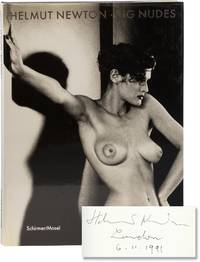
1990166006Munich: Schirmer / Mosel 1990. First Edition. Hardcover. First Edition. Boldly INSCRIBED by Helmut Newton on the title page: "For - / Congratulations !! / Helmut Newton / London / 6.11.1991."<br /> <br /> Fine and unread in a Near Fine lightly rubbed dust jacket.<br /> <br /> Oversize volume shipping billed at cost. Schirmer / Mosel unknown
182219114Glasgow: Andreae et Joannis M. Duncan 1822. FIRST GLASGOW EDITION. Numerous text diagrams and illustrations. Contemporary calf all covers with blind-stamped floral border within gilt floral borders within gilt-lined borders spines in compartments with gilt decoration spine labels; first few leaves of each volume spotted otherwise an excellent set. First Glasgow reprint of the first Jesuit edition printed in Geneva from 1739-1742. This edition of Newton’s Principia was edited by John Martin Frederick Wright of Trinity College who contributed additional commentary. Babson notes that Glasgow’s printing of this edition of the complete text was a great credit to the university whereas Cambridge was “satisfied with reprints of the first three sections of the first book.â€<br /> <br /> Babson 32; Gray 17; Wallis 17. Andreae et Joannis M. Duncan unknown
115619England late 18th century. . 100-leaf manuscript rectos and most versos filled wax seal remnants to front pastedown leaves wavy at the edges some spotting and marks to contents; contemporary calf-backed blue paper boards gilt floral tools to spine compartments binding marked and worn with spine cords partially exposed and loss of the blue paper morocco label lacking naphthalene smell good condition housed in a black cloth folding case.<br /> An unusual late 18th century manuscript on classical physics that cites Isaac Newton Blaise Pascal William Harvey Henry Power and others.<br /><br />The text approximately 200 pages presents an ordered and detailed account of a number of related topics: optics; hydrostatics and pneumatics; mechanics including simple machines such as the lever and screw the behaviour of descending bodies and pendulums; phosphorus and its chemical transformations; and fortifications and architecture. The notes are dense but generally neat and legible with carefully prepared diagrams so this seems to be a fair copy rather than a working notebook. <br /><br />Newton is cited in the section on light and colour: 'What Sir I.N. has said by way of in the last edit of his Opticks will appear to be an established truth from most if not all the following examples some of which he mentions himself". And Harvey in a short section on chemical transformations: "Harvey had says he the opportunity as well as the curiosity upon several occasions to examine the weight of when some of them taken up in places very distant from one another.'.<br /><br />The origin of much of the material is unclear though the long section on hydrostaticks was taken from Hydrostatical and Pneumatical Lectures by Roger Cotes 1682-1716 originally published privately in 1738 and with a second edition at Cambridge in 1747. <br /><br />Cotes was 'probably the most talented British mathematician of the generation after Newton'. He was nominated as the first Plumian professor of astronomy at Cambridge in 1706 and 'his appointment was favoured by his influential mentor Richard Bentley master of Trinity; by Newton's successor as Lucasian professor William Whiston who claimed to be in mathematics "a child to Mr Cotes" Whiston 133; and by Newton himself. In 1709 Cotes became heavily involved in the work for which he is best remembered namely the revisions for the second edition of Newton's Philosophia naturalis principia mathematica the first being out of print' Oxford Dictionary of National Biography. Cotes died young and Newton was reported to have said that 'if he had lived we might have known something'. A number of Cotes's lectures and mathematical analyses were published posthumously by his executor Robert Smith the Hydrostatical and Pneumatical Lectures being one of them. It is tempting to question whether other portions of the present manuscript are also based on Cotes's work and further academic scrutiny might be fruitful.<br /> England, late 18th century. hardcover
1964mon0000084822The Connecticut Historical Socie 1964T. hardcover. Like New. in x in x in. The Connecticut Historical Socie hardcover
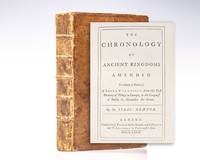
1728149863London: Printed for J. Tonson in the Strand and J. Osborn and T. Longman in Pater-noster Row 1728. First edition of Newton's ambitious attempt to reconstruct and rationalize the timelines of ancient history. Quarto bound in full contemporary Cambridge calf ruled and tooled in blind with speckled panels gilt turn-ins ordinary paper issue illustrated with 3 folding engravings. From the library of Harvard University professor Owen Gingerich. Owen Gingerich 1930–2023 was an American astronomer and historian of science renowned for his scholarship on early modern astronomy particularly his meticulous census of De revolutionibus that illuminated how Copernicus’s work was read and received in the sixteenth century. A longtime professor at Harvard and a senior astronomer at the Smithsonian Astrophysical Observatory Gingerich helped bridge scientific and humanistic inquiry demonstrating how historical context shapes the development and interpretation of scientific ideas. In very good condition. The Chronology of Ancient Kingdoms Amended published posthumously in 1728 was Isaac Newton’s ambitious attempt to reorganize and compress the timelines of ancient history by applying critical philology comparative mythology and astronomical calculation. Seeking to reconcile classical sources with biblical chronology Newton argued that the conventional dating of Egyptian Greek and Near Eastern kingdoms was excessively long and he used evidence such as eclipse records regnal lists and mythic genealogies to propose a shorter more unified ancient past. Although modern historians largely rejected Newton’s revised dates the work was significant for revealing the breadth of his intellectual pursuits beyond physics and mathematics and for illustrating how early Enlightenment thinkers employed scientific reasoning to interrogate historical and scriptural authority. Printed for J. Tonson in the Strand, and J. Osborn and T. Longman in Pater-noster Row unknown
17440811695Lausanne and Geneva: Apud Marcum-Michaelem Bousquet & Socios 1744. First Edition. Three-Quarter Leather. Very Good/No Dust Jacket. 64 Copper Engraved Plates 2 Letterpress Plates. 4to - over 9¾" - 12" tall. Three volumes bound in 3/4 leather over speckled paper boards red leather title bands with gilt titilng and ruling to spine 4to 3 Volumes: Vol. I: 8 xxviii 420 2pp.- Vol. II: 4 vi 423pp - Vol. III: 2 vi 566 1pp. Illustrated with 66 plates total; 64 copper plate engravings plus 2 letterpress tables. Titles in red and black each with engraved vignette of Newton’s portrait with allegorical frame of cherubs and scientific instruments - inscribed with motto "NOVIORA CECINIT". Published post-houmously as part of the larger 8 volume collected works of Newton. These three volumes comprise the gathering of many of Newton's most famous and notable works and are often considered as the first collected edition -- typically these volumes are considered complete unto themselves and commonly found separate. Condition: these three volumes have at one time been professionally preserved with the spines and outer hinges professionally reinforced and tactifully restored. General light shelfwear and rubbing to the boards edges corners rubbed with light bumping outer hinges restored revealing similar rubbing in the past. Bindings are tight with text pages showing just minor light browning typical of the era. A nice and collectible first edition of Newton's famous Opuscula Mathematica Philosophica et Philologica and a solid example of publishing output during the 'Age of Reason Apud Marcum-Michaelem Bousquet & Socios unknown
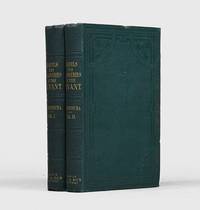
1865152733London: Day & Son Limited 1865. Presentation copy with letter First edition presentation copy inscribed on the front free endpaper of vol. I "Gaisford from the author Feb 1866" and with a 6-page autograph letter signed from the author loosely inserted. The letter headed British Museum 10 January 1852 details Newton leaving his position in the British Museum to take up a role as vice-consul at Mytilene. "My dear Sir you will probably be surprised to hear that I am going to leave the British Museum and also England. I have for some time wishes to exchange my present location for one where I could have more leisure time for literary pursuits & a warmer climate for my health has suffered from residence in London. After a good deal of deliberation I thought that if I could get a small Consulship in the Levant when the official duties were not very heavy I should be enabled to pursue archaeology by the study of remains in situ". Newton goes on to detail the circumstances of his being awarded the position. The recipient of the volumes was a member of the Gaisford family headed by the classical scholar and Dean of Christ Church Cathedral in Oxford Thomas Gaisford 1779-1855 to whom the letter is probably addressed Newton notes his hope to visit Oxford soon. Thomas Gaisford was deceased by the time of the book's presentation and consequently the recipient of the volumes is likely one of his seven children who would have paired them with the letter. The volumes originate from the Gaisford family home of Howth Castle near Dublin. Newton worked as vice-consul at Mytilene from 1852 to early 1853 then as acting consul at Rhodes from April 1853 to January 1854. In both positions he was authorized to undertake considerable archaeological excavations and purchases for the British Museum which he followed by excavations in Kalymnos in 1854 and 1855 financed by Lord Stratford de Redcliffe the British ambassador at Constantinople. The present book gives his account of these travels and excavations. On his return he became the first keeper of Greek and Roman Antiquities at the Museum in 1861. He was closely involved in the foundation of three highly influential archaeological institutions: the Society for the Promotion of Hellenic Studies to which he gave an inaugural address in June 1879; the Egypt Exploration Fund founded in 1882; and the British School at Athens opened in November 1886. 2 vols tall octavo. Folding map frontispiece to each 12 lithographic plates from photographs by Francis Bedford after drawings by Newton and his wife 20 plates one of which folding the majority etched after photographs by Colnaghi and Spackman 2 double- and 2 full-page maps one double- and 2 full-page plans numerous wood-engraved illustrations to the text. Original green pebble-grain cloth spines lettered in gilt blind panelling to covers pale yellow endpapers. Obituary of Newton mounted to front pastedown of vol. I with another for his friend Reginald Stuart Poole loosely inserted. Very light rubbing and peripheral bumping cloth still bright and fresh without wear and with joints and hinges intact light foxing to contents as usual some leaves unopened towards end of vol. I. An excellent copy. Atabey 869; Blackmer 1193; Gernsheim Incunabula of British Photographic Literature 284. hardcover
174039297Paris De Bure 1740. 4to. Contemporary half calf raised bands richly gilt spine and and red speckled edges. Leather title-label to spine. Corners neatly repaired. Title in red/black. 2 III-XXX 2 Errata 148 pp. many diagrams. The "Preface" and the first 18 leaves of the text with a foxing to lower margin and right corners. The "Preface" is an historical account of Newton's method "la sublime méthode" written by Buffon. Without the leaf "Extrait des Registres". <br/><br/><em>The influential first French edition of Newton's important work which constitutes the most extensive description of the mathematical method he used in his famous "Principia" the method of infinitesimals which was already written about 1671 but not published until 1736 i.e. posthumously with the title "Method of Fluxions and Infinite Series.". In this work "Newton stated clearly the fundamental problem of the calculus: the relation of quantities being given to find the relation of the fluxions of these and conversely. In conformity with this problem and the new notation Newton then gave examples of his method.In this book Newton introduced his characteristic notation and conceptions. He regarded his variable quantities as generated by the continuous motion of points lines and planes rather than as aggregates of infinitesimal elements the view which had appeared in "De analysi".The rate of generation Newton called a "fluxion" designating it by means of a letter with a dot over it a "pricked letter" the quantity generates he called a "fluent". Boyer The History of the Calculus.Colson in his preface to the first edition from 1736 says: "I gladly embraced the opportunity that was put into my hands of publishing this posthumous work because I found it had been composed with that view and design. And that my own Country-men might first enjoy the benefit of this publication I resolved upon giving it an English translation with some additional remarks of my own I thought it highly injurious to the memory and reputation of the real Author as well as invidious to the glory of our own Nation that so curious and useful a piece should be any longer suppress'd and confined to a few private hands which ought to be communicated to all the learned World for general Instruction.It was through the French translations of his works that Newton came to play the seminal role as the most important of mathematicians that he did in France and particularly the years around 1740 when the present work appeared in French for the first time were seminal to the scientific development in France where the likes of Voltaire had only just made the nation acquinted with the work of the great mathematician. Gray No 236. Babson No 173. </em> hardcover
1813143137London: Printed for G. Kearsley J. Walker J. Stockdale R. Lea E. Jeffery & 10 others 1813. A "vastly ambitious survey" First edition of this extensively illustrated Georgian encyclopedia a "vastly ambitious survey of human genius learning and industry" ODNB here presenting particularly nicely in contemporary red morocco. 12 vols octavo 232 x 145 mm. Illustrated throughout with engravings many with contemporary hand colouring. Contemporary red straight-grain morocco spines lettered and tooled in gilt covers with foliate border in gilt and blind gilt turn-ins grey endpapers gilt edges. Contemporary ownership signature to half-titles pencilled doodle to front free endpaper of vol. I. Bumping at head of contents of vol. IV. A very handsome set the bindings without wear and the contents clean. unknown
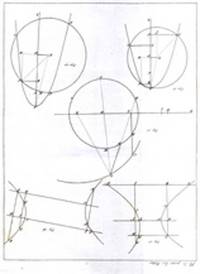
180211944Paris: Chez Bernard 1802. 2 volumes bound as one. First French edition. Extensively illustrated with folding engraved diagrams of geometric problems. 4to contemporary calf with gilt tooling on covers and spine. Red morocco lettering panel. Gilt stamp of the “Prix du College Royal D’Henry IV†on both covers. xxiv 252; 258 errata1 ad. A fine especially bright copy with a small tear to upper spine. A VERY SCARCE ISSUE OF THESE IMPORTANT MATHEMATICAL LECTURES. These algebraic lectures given by Newton at Cambridge were first published by William Whiston in 1707. Whiston “extracted from Newton a somewhat reluctant permission to print it. Among several new theorems on various points in algebra and the theory of equations Newton here enunciates the following important results. He explains that the equation whose roots are a solution of a given problem will have as many roots as their are different probable cases.He extends Descartes rules of signs to give limits to the number of imaginary roots.The most interesting theorem contained in the work is his attempt to find a rule analogous to that of Descartes for real roots by which the number of imaginary roots of a equation can be determined.†Later with the idea of stimulating annotations to the work Gravedsande published SPECIMIN COMMENTARII IN ARITHMETICAM UNIVERSLAEM; and Maclaurins’s ALGEBRA seems to have been written in response to this. Chez Bernard unknown