11 838 résultats
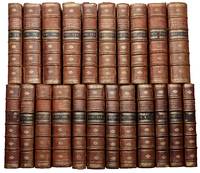
17326441London: Various printers to the Royal Society 1732. 1665-1732. <p>First edition of the first 426 issues an unbroken run from March 1665 to December 1732 of the world's oldest continuous scientific journal and the single most important record of the first announcement and communication of scientific discoveries and inventions PMM. It contains groundbreaking research by Newton - all 17 of his optical papers and therefore his first printed contribution to science - and by Halley Hooke Boyle Flamsteed Leeuwenhoek Cassini Hevelius Huygens and many others across astronomy physics chemistry mathematics medicine and natural history. Through Newton's optical papers of 1672-1676 the Transactions saw the first experimentally grounded proposal for the radical reform of a scientific theory to be advanced through a technical journal - a proposal that became the first to arouse international discussion and debate in print and within the pattern of public announcement discussion and professional consensus then established science has advanced ever since. Provenance: armorial bookplate of Sir Marcus Beresford 1st Earl of Tyrone 1694-1763; contemporary inscription at the end of one issue January 1692/3 noting its donation by Robert Hooke; manuscript corrections and notes on more than eighty pages with eight further pages on the measurement of the Earth bound in at the end.</p>. The World's Oldest Continuous Scientific Journal. <p>First edition of the first 426 issues an unbroken run from March 1665 to December 1732 of the world's oldest continuous scientific journal and the single most important record of the first announcement and communication of scientific discoveries and inventions PMM. It contains groundbreaking research by Newton - all 17 of his optical papers and therefore his first printed contribution to science - and by Halley Hooke Boyle Flamsteed Leeuwenhoek Cassini Hevelius Huygens and many others in astronomy physics chemistry mathematics medicine and natural history. Thomas Henry Huxley observed in his 1866 address On the Advisableness of Improving Natural Knowledge that if every book in the world apart from the Philosophical Transactions were destroyed the foundations of physical science would remain secure and the intellectual progress of the last two centuries largely recoverable. Long unbroken runs of the first four-and-a-half decades are now of the greatest rarity. ABPC and RBH record only two comparable sets at auction in the last three decades - Norman 1694 Christie's New York 15 June 1998 lot 716 $112500 and Macclesfield 1782 Sotheby's 25 October 2005 lot 1782 £96000 = $171400 - and a set of just the seven volumes containing Newton's papers on light realised $75600 at Christie's in October 2022.</p> <br /> <br /> <p>Provenance: armorial bookplate of Sir Marcus Beresford 1st Earl of Tyrone 1694-1763 Anglo-Irish peer and politician on the front pastedowns; contemporary inscription at the end of one issue January 1692/3 noting its donation by Robert Hooke; numerous manuscript corrections on more than sixty pages additional notes on about twenty pages and eight pages of manuscript notes on the measurement of the Earth bound in at the end.</p> <br /> <br /> <p>In November 1660 members of the Oxford Philosophical Club - John Wilkins John Wallis Robert Boyle Christopher Wren Robert Hooke among them - met a group of London natural philosophers at Gresham College and agreed to form a philosophical society that would meet weekly to exchange information and to conduct experiments. The society received its charter from the newly restored Charles II in 1662 and Henry Oldenburg a German-English diplomat and friend of Boyle was installed as one of its two secretaries. One of the charter's terms called for the exchange of information with other learned societies and Oldenburg almost at once began a sustained correspondence - with the Cimento Academy in Florence the Montmor Academy in Paris and after its foundation in 1666 the Académie Royale des Sciences - and with hundreds of working natural philosophers in places that had no scientific society of their own. Oldenburg was fluent in German Dutch French English and Latin and he was able to translate most foreign correspondence himself including Antoni van Leeuwenhoek's letters on his microscopical investigations and the communications of Johannes Hevelius of Gdansk and Marcello Malpighi of Bologna. After some years writing letters without salary Oldenburg decided to compile a monthly newsletter summarising a month's Royal Society activities and send it out to his correspondents in a single printing. On 6 March 1665 Old Style; 16 March by the Gregorian calendar then in use on the continent the first issue of the Philosophical Transactions appeared. It consisted of letter-excerpts reviews and summaries of recently published books and accounts of observations and experiments from European natural philosophers. Some of the pieces Oldenburg wrote himself summarising the minutes of Society meetings; others he translated or adapted from printed sources; still others were composite pieces assembled from the letters of several correspondents on a common subject. After his death in 1677 the journal passed through the hands of a succession of editors frequently also Secretaries of the Society - Edmond Halley and Hans Sloane the best-known among them - and through a succession of printers its form and content broadly reflecting the priorities of the current editor and to a degree of the Society. The Royal Society assumed financial responsibility for the journal only in 1752.</p> <br /> <br /> <p>Until the last third of the seventeenth century most original contributions to science appeared in books in which an author's own findings were embedded within a systematic exposition of a larger subject. The chartering of the Royal Society in 1662 and of the Académie Royale des Sciences in 1666 and the launching in 1665 of the Journal des Sçavans at Paris and the Philosophical Transactions at London gave institutional expression to a new conception of science as a cooperative enterprise: the immediate objective of the individual scientist became the experimental contribution to an eventual system of nature rather than the construction of the system itself and the journal article began to replace the book as the unit in which that contribution was made. Newton was the first to advance through this new medium an experimentally grounded proposal for the radical reform of a scientific theory and his proposal was the first to arouse international debate within the columns of a scientific journal. Through that exchange - in which all the participants modified their positions - a consensus of scientific opinion was produced; and within the same pattern of public announcement discussion and professional consensus science has advanced ever since Kuhn in Cohen Isaac Newton's Papers and Letters on Natural Philosophy 2nd ed. 1978 pp. 27-29.</p> <br /> <br /> <p>Newton's seventeen optical papers comprising his entire published optical contribution to the journal across the 1670s run as a single intellectual sequence: the seminal 1672 New Theory paper No. 80 pp. 3075-3087 introducing the prism experiment and the spectral analysis of white light; the catadioptrical-telescope paper No. 81; a series of exchanges with the French Jesuit Pardies Nos. 82 84 85 with Christiaan Huygens via an 'ingenious person from Paris' Nos. 96 97 and with the Liège Jesuits Linus and Lucas Nos. 110 121 123 128 - together more than half of the seventeen papers all responding to objections raised against the New Theory. Newton's answer to Hooke's objections No. 88 is the most polemical of the set prefiguring the priority dispute that would dominate the Principia years; the answer to Sir Robert Moray on behalf of the Royal Society No. 83 the most measured. Across the seven volumes containing them the papers transformed optics from a body of empirical reports into a quantitative experimental science driven by decisive testing among hypotheses and supplied the methodological core that Newton would eventually assemble decades later into the Opticks of 1704.</p> <br /> <br /> <p>These papers together constitute the first major contribution to science made through a technical journal - the medium that rapidly became the standard mode of communication among scientists - and as Christianson puts it if Newton had published nothing else the optical papers alone would guarantee him a place among the immortals of modern science Christianson In the Presence of the Creator 1984 p. 150. They yield further an insight into Newton's mental processes that the Principia and the Opticks - formal impersonal Olympian - conceal; it is in these early brief sometimes hasty letters to Oldenburg as in his notebooks and unpublished manuscripts that the creative scientist is to be found Kuhn in Cohen pp. 27-29.</p> <br /> <br /> <p>When Newton was first appointed Lucasian Professor at Cambridge in 1669 he chose optics for the subject of his first lectures and researches and by the end of that year he had worked out in detail the decomposition of a beam of white light into rays of different colours by means of a prism the complete explanation of the rainbow following from this discovery. These results formed the subject of his Lucasian lectures in 1669 1670 and 1671 and their principal conclusions were communicated to the Royal Society in February 1672 and printed soon afterwards in the Transactions No. 80. Before Newton light had been believed to be a homogeneous substance and colour was held to be produced by the mixture of light with darkness - the prism in the standard account supplying the darkness that coloured the light with all rays of white light striking the prism at the same angle being equally refracted. Newton's experiments led him to the radically different conclusion that white light is a mixture of rays of many distinct types each refracted at a slightly different angle and each responsible for producing one spectral colour. He set up a prism near his window at Trinity College and projected the spectrum onto a wall twenty-two feet away; to prove that the prism refracted light rather than colouring it he refracted the beam a second time back to white. The crucial experiment that confirmed the theory was to isolate a narrow ray of a single colour from the first spectrum and pass it through a second prism where no further elongation or separation occurred - a demonstration that each spectral ray was itself unmixed and uniformly refrangible. The reception of the paper was mixed. Many contemporaries simply ignored it; Mariotte in 1679 Pardies 1672 and Linus 1675 all claimed to have failed to replicate the basic experiments described. Rather than argue with them in detail Newton invited his critics to repeat his experiments with greater care; they did so without success. Others - Hooke among them who confirmed the experiments himself before a committee of the Royal Society in April 1676 - conceded the results but held that they could be accommodated by minor modification of existing theories making Newton's radical interpretation unnecessary. The controversy lasted six years after the paper's first appearance and left Newton conspicuously wary of publication.</p> <br /> <br /> <p>Newton's invention of the reflecting telescope reported in the issue immediately following his first optical paper No. 81 had in fact prompted the optical work rather than the other way round: the chromatic aberration of refracting lenses - their inability to bring different colours of light to a single focal point - was the original stimulus for Newton's investigation of the nature of light. Newton had sent Oldenburg his letter describing the telescope before his letter describing the new theory and had hoped to present the telescope as a practical test-piece for the theory. Oldenburg however printed the material in the reverse order the theory first followed by the description of the instrument. The telescope made a considerable impression at the Royal Society which promptly elected Newton a Fellow; a corresponding notice appeared in the Journal des Sçavans in February 1672 with emphasis on the instrument's compactness and it was the telescope rather than the theory of light that first made Newton's name known on the Continent Dilaura Bibliotheca Opticoria 1475-1925 2019 pp. 235-236.</p> <br /> <br /> <p>Newton published three non-optical papers in his lifetime all anonymously. His only published paper on chemistry Scala Graduum Caloris No. 270 April 1701 pp. 824-829 states what has since become known as Newton's law of cooling - that the rate at which a hot body loses heat is proportional to the difference between its temperature and that of its surroundings - and describes the construction of a thermometer capable of measuring temperatures up to almost 1000 °C. An Account of the Book entituled Commercium Epistolicum Collinii & Aliorum De Analysi promota No. 342 February 1715 pp. 173-224 is Newton's anonymous review of the Commercium epistolicum the official report of the committee appointed by the Royal Society to adjudicate in the dispute between Newton and Leibniz over priority in the invention of calculus - the most bitter and consequential priority dispute in the history of science; the Account purports to be impartial but was in fact written like the Commercium epistolicum itself by Newton. In the same volume No. 347 March 1716 pp. 399-400 appeared Newton's Problematis Mathematicis Anglis Nuper Propositi Solutio Generalis his response to a challenge problem set by Johann Bernoulli to the English mathematicians; tradition has it that Newton solved it in a single evening after returning from a day's work at the Mint. With the exception of this minor paper none of Newton's original work on gravitation or on mathematics was published in the Transactions. Edmond Halley's review of the Principia however appeared soon after its publication No. 186 pp. 291-297 - Halley was then the journal's editor - and is prefaced by an advertisement apologising for the fact that the Transactions had been delayed for some months because Halley had had the entire care of the Principia's own edition and had therefore as he put it been more serviceable to the Commonwealth of Learning in seeing Newton's book into print than he would have been in issuing his own periodical on time. Halley pointed out with justice that one of the most striking features of the Principia was Newton's great skill in using the new mathematics - by which Halley meant Newton's own method of infinite series.</p> <br /> <br /> <p>Edmond Halley 1656-1742 was one of the most original minds of his time and he made a long series of important contributions of his own to the Transactions. The best-known of them is Astronomiae cometicae synopsis No. 297 March 1705 pp. 1882-1899 the first printing of the theory according to which comets belong to the solar system and move in eccentric elliptical orbits; it was here that Halley set out his method of computing the motion of comets of establishing their periodicity in elliptical orbits and of identifying the comet that would bear his name DSB. The confirmation of the comet's return - in 1759 after Halley's death - was the first time that a body other than a planet had been shown to orbit the Sun the earliest successful observational test of Newtonian physics and a vivid demonstration of its explanatory power; the comet was named after Halley by the French astronomer Nicolas-Louis de Lacaille in 1759. Halley's other major contributions to the journal include his Methodus singularis No. 348 June 1716 pp. 454-464 in which he challenged the international astronomical community to use the transits of Venus across the Sun predicted for 1761 and 1769 to transform astronomy into a fully empirical science by measuring the Earth-Sun distance - a challenge that astronomers took up organising expeditions to the farthest corners of the globe and overcoming obstacles of every kind; A short History of the several New-Stars No. 346 December 1715 pp. 354-356 in which he observed that the new stars of 1572 and 1604 Tycho's and Kepler's stars were not the only changing stars on record that others had been observed in 1596 1600 1670 and 1686 some of them fading and reappearing and one of them - Mira - appearing to wax and wane with a regular 330-day period; An Account of several Nebulae or lucid Spots like Clouds No. 347 March 1716 pp. 390-392 in which Halley assembled the first list of known nebulae with their discoverers crediting the Great Nebula in Orion to Huygens the Andromeda nebula to Boulliau and the two spherical nebulae in Centaurus and Hercules to himself; 'Of the infinity of the sphere of fix'd stars & Of the number order and light of the fix'd stars' No. 364 April 1720 pp. 22-26 in which Halley posed what later generations would call Olbers's paradox a century before Olbers did; and outside astronomy his paper on the Breslaw life table No. 196 January 1692/3 pp. 596-610 which produced the first life table based on sound demographic data and gave the first correct calculation of annuities using essentially the methods still in use today - a paper of first importance in the history of statistics.</p> <br /> <br /> <p>John Flamsteed 1646-1719 was with Halley the most important English astronomer of his generation; his major works are the Historiae coelestis first published in 1712 without his consent by Halley and Newton and the Atlas coelestis published posthumously in 1729 but he also contributed more than thirty articles to the Transactions chiefly on observational astronomy. No other Astronomer Royal before Airy displayed anything like Flamsteed's concern for the reduction and manipulation of his own data: far from bequeathing the mass of raw observations that Bradley would he reduced and applied them himself DSB.</p> <br /> <br /> <p>Robert Boyle 1627-1691 contributed some thirty-seven papers to the Transactions Fulton p. 138 among them his influential questionnaire General Heads for the Natural History of a Country a number of major experimental essays that sometimes filled a whole issue and most revealingly An Experimental Discourse of Quicksilver growing hot with Gold No. 122 February 1675/6 pp. 515-533 - a paper on a kind of mercury that would incalesce when amalgamated with gold suggesting that Boyle had achieved the long-sought alchemical philosophical mercury capable of transmuting base metals. Boyle's trials went back to 1652 when he had received the recipe from his American mentor George Starkey; his decision to go public in 1676 signalled a newly intense period of alchemical activity on his part. The paper drew from Newton - himself a committed alchemical enthusiast - a letter to Oldenburg urging that such matters were not to be communicated without immense damage to the world if there should be any truth in the Hermetic writers; Oldenburg took the hint and the incalescence paper remained a one-off in the Transactions Hunter Alchemy in the Transactions Royal Society blog 1 July 2015.</p> <br /> <br /> <p>The Dutch microscopist Antoni van Leeuwenhoek 1632-1723 contributed 116 articles to the Transactions over the half-century 1673-1723; the most famous of them the letter on the protozoa No. 133 March 1677 pp. 821-831 gives the first detailed description of protists and bacteria in a range of environments. Leeuwenhoek is universally acknowledged as the father of microbiology: he discovered both protists and bacteria but more than being the first to see the microscopic world of his animalcules he was the first even to think of looking - certainly the first with the power to see. Using his own deceptively simple single-lensed microscopes he did not merely observe but conducted ingenious experiments exploring and manipulating his microscopic universe with a curiosity that belied his lack of any map or bearings. The verification of Leeuwenhoek's new world by the natural philosophers of the Royal Society set out the ground rules that still define experimental science today Lane The unseen world: reflections on Leeuwenhoek 1677 Philosophical Transactions B370 2015 pp. 1-10.</p> <br /> <br /> <p>Martin Lister 1639-1712 contributed in 1673 what is now regarded as the earliest journal article on palaeontology: A description of certain stones figured like plants No. 100 pp. 6181-6191 on the preservation of St Cuthbert's beads - crinoid remains - in the approximately 350-million-year-old Carboniferous limestones of northern England. The biological nature of fossils was then controversial: Kircher had argued that they formed by abiogenic plastic forces within the rock while Hooke and Steno had suggested they were the remains of living organisms. Lister was the first to explore how direct observation could decide between the two making observations about what modern geobiology calls taphonomy and biogenicity criteria - observations that presage current debates about the earliest signs of life on Earth and Mars Brasier Philosophical Transactions A373 2015 pp. 1-16. Other natural-historical papers scattered through the journal's first century - Account of a very odd monstrous calf Some experiments and observations on May-dew Some observations on strange swarms of insects - are in places fanciful but in many others acute; Hooke's own contributions which began in the very first issue March 1665 with A spot in one of the belts of Jupiter are sometimes held to include the first observation of the Great Red Spot still visible on Jupiter today.</p> <br /> <br /> <p>The early volumes also contain the record of the world's first experiments with blood transfusion conducted in England in the mid-1660s. The procedure - gruesome - was first carried out between dogs with arteries and veins in the animals' necks opened and blood transferred from one to another through quills most likely of goose feather inserted into the vessels and clamped with running knots; in the physician Richard Lower's account No. 20 pp. 353-358 the transfusion came to an end when the emittent dog fell into convulsions and died. Shortly afterwards Boyle published a remarkable set of questions about the likely effects of transfusion on the animal receiving blood No. 22 pp. 385-388 asking whether transfusion might change a dog of one breed into another alter its temperament render a fierce dog cowardly transmit satiety or hunger obliterate learned behaviours or make a dog forget its master - a sequence of questions which as recent commentators have noted read like an alchemical programme turned inward upon the living body. Researchers soon proposed transfusion into a human subject. Since the procedure generally killed the emittent a human-to-human transfusion was thought impossible and a sheep was settled upon as donor. The choice of human recipient fell in 1667 upon Arthur Coga - mentally unstable but sufficiently educated to report in Latin on the effects of the procedure - and the operation was performed by Lower and the physician Edmund King No. 30 pp. 557-559 who judged that Coga had received nine or ten ounces of sheep's blood. A few days afterwards Coga reported back to the Society in Latin and Samuel Pepys meeting him at a dinner party shortly thereafter found him to speak very reasonably though cracked a little in his head.</p> <br /> <br /> <p>Other contributors in these decades include Cassini on the satellites of Jupiter Huygens on mechanics and optics Malpighi Swammerdam Borelli Steno Fahrenheit and Redi whose experimental refutation of spontaneous generation appeared in the journal alongside a steady stream of domestic material from Harvey Wren Ray Petty Locke Wallis Winthrop Tyson Lancisi Leibniz and Hales. To turn the pages of these thirty-seven volumes is to watch the first two generations of a new scientific public discover how to work together - how to record observation propose hypothesis invite replication agree or disagree in print and build by open argument the provisional consensus that is the hallmark of modern science.</p> <br /> <br /> <p>References: Grolier/Horblit 95b - Macclesfield 1782 - Norman 1694 - PMM 148 Vol. 1 - Brasier Deep questions about the nature of early-life signals: a commentary on Lister 1673 Philosophical Transactions A373 2015 pp. 1-16 - Christianson In the Presence of the Creator 1984. Cohen ed. Isaac Newton's Papers and Letters on Natural Philosophy 2nd ed. 1978 - Dilaura Bibliotheca Opticoria 1475-1925 2019 - Fulton A Bibliography of the Honourable Robert Boyle 1932 - Lane The unseen world: reflections on Leeuwenhoek 1677 Philosophical Transactions B370 2015 pp. 1-10.</p> <br /> <br/> <br/> 37 vols. bound in 22 4to 215 × 165 mm containing all issues from March 1665 No. 1 through December 1732 No. 426 with 380 engraved plates 306 folding 176 woodcut illustrations and diagrams and 7 folding tables occasional damp-staining a few tears and small holes occasionally affecting a word or two a few headlines shaved the plate in No. 56 map of part of Languedoc with a 7 cm tear that in No. 60 apparatus shaved at head and that in No. 196 with bottom corner repaired with loss of about a quarter of the plate relating to the dissection of a rat. Uniformly bound in eighteenth-century probably mid-1730s sprinkled calf spines ruled and tooled in gilt in compartments with title and volume-number labels some joints cracking but firm a few labels missing slightly rubbed. Generally very clean and well-preserved. Various printers to the Royal Society unknown
188852264Durham NC & New York NY: W. Duke Sons & Co. Lithographed by Knapp & Co.; Schumacher & Etlinger 1888-1889. Three works in one vol. Oblong 4to. With 18 colour chromolithograph plates slight thumbing to fore-edges very minor spotting on first leaf. Original cloth-backed chromolithograph softcovers printed on thick paper stock cover art of Miss Sadler & Phoebe Russell on front cover in Yacht Colours violin on back cover minor shelfwear very minor creasing faint tide mark at spine still a VG copy. First edition of this trio of scarce and beautifully printed souvenir books issued by the Duke Sons & Co. tobacco company thanking their patrons for smoking Duke Cigarettes Cameo Cigarettes Turkish Cross-Cut Cigarettes and Cross Cut Cigarettes. The plates are composed of trading cards featuring the famed actresses and notable women across the world including Phoebe Russell Kate Blancke Mabel Jordan Estelle Clayton Zelie de Lussan for the American Canoe Association Royal Cork Yacht Club Seawanhaka Yacht Club Calshot Castle Yacht Club Oceanic Yacht Club New Brunswick Yacht Club and many others. The ball costumes feature stars dressed in a wide range of elaborate ball costumes with headdresses including those of parrots watermelon slices horns cricket ball & bat and even a woman with goldfish bowl and fish-themed jewelry. The third work featuring musical instruments was printed by a newly constituted Schumacher & Ettlinger Lithographers who had suffered a devastating fire just a few years before and includes a wide range of women musicians including a young African-American woman playing the banjo. Duke Sons & Co. headed by James Buchanan Duke was one of the founding members of the American Tobacco Company largely due to their ability to produce all cigarettes at a cheaper rate due to the invention of James Bonsack’s cigarette-rolling machine. W. Duke, Sons & Co., [Lithographed by Knapp & Co.; Schumacher & Etlinger], paperback
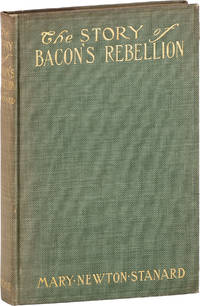
190781415Nashville: Neale Publishing Company 1907. First Edition. First printing. Small octavo 20cm. Sage green cloth titled in gilt on spine and front cover; to edge gilt; 1811pp. Spine cloth subtly faded else tight clean and unmarked with gilt still bright on spine and cover; Very Good. Neale Publishing Company unknown
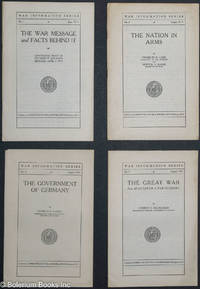
1917287586Washington DC: Committee on Public Information 1917. Pamphlet. Four issues Nos. 1-4 5.5x8.5 inches newsprint wraps with staple bindings. Minor shelf and edge wear some toning else in very good condition. Issue contents: 1: The war message and facts behind it annotated text of President Wilson's message April 2 1917. 2: The nation in arms by Franklin K. Lane and Newton D. Baker. 3: The government of Germany by Charles D. Hazen. 4: The great war from spectator to participant by Andrew C. McLaughlin. The Committee on Public Information was a short lived 1917-1919 independent agency of the government of the United States set up to by President Woodrow Wilson to build support domestically in the U.S. for WWI and U.S. policies for Europe post-war. Committee on Public Information unknown
0282060006.Gpaperback. Good. Access codes and supplements are not guaranteed with used items. May be an ex-library book. paperback
0331563622.Ghardcover. Good. Access codes and supplements are not guaranteed with used items. May be an ex-library book. hardcover
1527962237.Ghardcover. Good. Access codes and supplements are not guaranteed with used items. May be an ex-library book. hardcover
1330577906.Gpaperback. Good. Access codes and supplements are not guaranteed with used items. May be an ex-library book. paperback
B9781013688355Hardback. New. hardcover
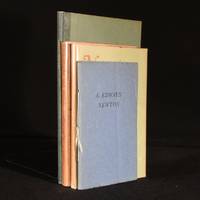
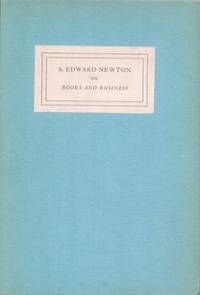
1933952T1New York; Philadelphia; Washington D.C.: Edie-Davidson Inc.; University of Pennsylvania Press; The Library of Congress 1933-1940. First edition. Cloth. Very Good Indeed/Very Good Indeed. 10" by 7.5"; 8.5" by 6"; 7.5" by 5". None. Four smart volumes from American author and book collector Alfred Edward Newton. Four volumes. Written by or with contributions from Alfred Edward Newton an American industrialist better known as an author and avid book collector. At the time of his death it was estimated that he had approximately ten thousand books in his collection focusing on English and American literary works. This collection contains: Now Even As Then 1933. Privately printed. With a frontispiece and four in-text images. The life and letters of wealthy American businessman and investor Timothy Bancroft. Introduction by Alfred Edward Newton. Bibliography and Pseudo-Bibliography 1936. Second printing. With a frontispiece. An engaging account of the personal pleasures of book collecting - a delightful and informative read. Newton on Blackstone 1937. First edition limited to two thousand copies numbered and signed by the author of which this is number one hundred and ninety-five. With a frontispiece. An essay on the life and works of Sir William Blackstone an English jurist justice and Tory politician most noted for his "Commentaries on the Laws of England". A Tribute to A. Edward Newton 1940. First edition limited to one thousand copies. With a frontispiece. Every Christmas for thirty-three years Newton sent aa small Christmas book to his friends as a symbol of the fellowship of a book-loving man. After his death the Library of Congress produced this work as a token of gratitude to this important man. Now Even As Then and Bibliography are bound in the original quarter cloth binding with Newton on Blackstone bound in the original full cloth and A. Edward Newton in the original paper wraps. Externally very smart with light wear to the extremities and minor fading to the spines. The odd small mark to the boards. Both Bibliography and Newton on Blackstone are bound with the original unclipped dust wrappers. Wrappers are also very smart with minor wear and sunning to the extremities. The odd small closed tear to the panel edges. Internally firmly bound. Pages are very bright and clean with the odd small spot or handling mark. Contemporary ink inscriptions to the front endpapers. Very Good Indeed Edie-Davidson Inc.; University of Pennsylvania Press; The Library of Congress hardcover
1921016898The Atlantic Monthly Press 1921. Book. Fine. Hardcover. 1st Edition. 8vo - over 7¾ - 9¾" tall. Fine copy in a Near Fine Plus Jacket. First Edition.Excellent Fresh Copy Of This Newton Classic. Very Rare In Jacket. The Atlantic Monthly Press Hardcover
0331983389.Ghardcover. Good. Access codes and supplements are not guaranteed with used items. May be an ex-library book. hardcover
1921mon0003485112Atlantic Monthly 1921-01-01. Hardcover. Good. 1.2000 8.2000 5.7000. Atlantic Monthly hardcover
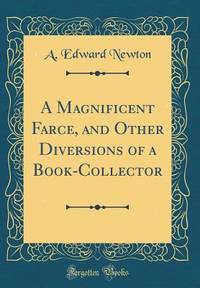
75-3426Boston MA: Atlantic Monthly Press 1921. 4to. Hard cover. 267 pp. Good with scratches on coverAlfred Edward Newton 1864-1940 one of the most prominent book collectors in the Philadelphia region was born inPhiladelphia on August 26 1864. His formal education was limited but an interest in books inspired his first collecting effortsin the 1880s. His early working life was haphazard: he began working as a grocery stock boy when he was still in his earlyteens spent a few years as a bookstore clerk tried and disliked banking and eventually joined the Cutter Electrical andManufacturing Company in 1895. Five years later he bought it and became president and remained with the company until hisretirement in 1932…….His interests however lay almost entirely in the realm of book collecting – he claimed nine-tenths of his energies were devotedto his library. He married Babette Edelheim daughter of fellow collector Carl Edelheim in 1890 and socially moved in a circle offellow collectors including Moncure Biddle William Elkins and Christopher Morley. His first book The Amenities of Book-Collecting was published by The Atlantic in 1918. It was an enormous success in the circle of bibliophiles throughout England and America and led Newton to a successful writing and speaking career. Additional books by Newton include A Magnificent Farce and Other Diversions of a Book-Collector 1921 The Greatest Book in the World and Other Papers 1925 This Book-Collecting Game 1928 A Tourist inSpite of Himself 1930 End Papers 1933 Derby Day andOther Adventures 1934 and Bibliography and Pseudo-Bibliography 1936. He also wrote two plays Doctor Johnson 1923 and Mr. Strahan's Dinner Party 1930 andmany brochures privately printed for his friends….He primarily collected British literature and was particularly drawn to Charles Dickens Anthony Trollope and SamuelJohnson. Although he had regular dealings with booksellers in the US and England many of his books came from his fellowPhiladelphian the antiquarian bookseller A. S. W.Rosenbach……Newton and his family lived at their estate Oak Knoll in Daylesford Pennsylvania. After a lingering illness Newton died in 1940 described by the Library of Congress as "the most famous and influential of American book collectors." Hisremarkable collection of rare books was auctioned off by Parke-Bernet in 1941 with his personal papers and his publishedwritings being donated to the Free Library by his son E. Swift Newton in 1954.From the collection of Frederick Ruffner. Boston, MA: Atlantic Monthly Press, 1921 hardcover
17-4132Boston Ma.: The Atlantic Monthly Press 1921. 8vo. 267 pp. Hardcovers. Good. Boston, Ma.: The Atlantic Monthly Press, 1921. hardcover
239209Atlantic Monthly Press 1921. First Edition. Hardcover. Near Fine. 8vo 1/4 brown cloth light brown paper-covered boards. Near Fine: corners and spine ends square a slight bit of rubbing on the gutters p.o. bookplate on the front pastedown. In a custom cloth dustjacket with gilt titles. Boldly inscribed and signed by Newton on the ffep. Atlantic Monthly Press hardcover
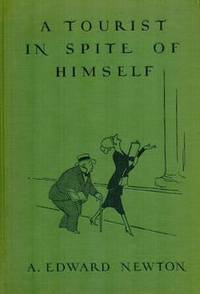
75-3427Boston MA: Little Brown and Co. 1930. 4to. Hard cover. 252 pp. Very Good.Alfred Edward Newton 1864-1940 one of the most prominent book collectors in the Philadelphia region was born inPhiladelphia on August 26 1864. His formal education was limited but an interest in books inspired his first collecting effortsin the 1880s. His early working life was haphazard: he began working as a grocery stock boy when he was still in his earlyteens spent a few years as a bookstore clerk tried and disliked banking and eventually joined the Cutter Electrical andManufacturing Company in 1895. Five years later he bought it and became president and remained with the company until hisretirement in 1932…….His interests however lay almost entirely in the realm of book collecting – he claimed nine-tenths of his energies were devotedto his library. He married Babette Edelheim daughter of fellow collector Carl Edelheim in 1890 and socially moved in a circle offellow collectors including Moncure Biddle William Elkins and Christopher Morley. His first book The Amenities of Book-Collecting was published by The Atlantic in 1918. It was an enormous success in the circle of bibliophiles throughout England and America and led Newton to a successful writing and speaking career. Additional books by Newton include A Magnificent Farce and Other Diversions of a Book-Collector 1921 The Greatest Book in the World and Other Papers 1925 This Book-Collecting Game 1928 A Tourist inSpite of Himself 1930 End Papers 1933 Derby Day andOther Adventures 1934 and Bibliography and Pseudo-Bibliography 1936. He also wrote two plays Doctor Johnson 1923 and Mr. Strahan's Dinner Party 1930 andmany brochures privately printed for his friends….He primarily collected British literature and was particularly drawn to Charles Dickens Anthony Trollope and SamuelJohnson. Although he had regular dealings with booksellers in the US and England many of his books came from his fellowPhiladelphian the antiquarian bookseller A. S. W.Rosenbach……Newton and his family lived at their estate Oak Knoll in Daylesford Pennsylvania. After a lingering illness Newton died in 1940 described by the Library of Congress as "the most famous and influential of American book collectors." Hisremarkable collection of rare books was auctioned off by Parke-Bernet in 1941 with his personal papers and his publishedwritings being donated to the Free Library by his son E. Swift Newton in 1954.From the collection of Frederick Ruffner. Boston, MA: Little, Brown and Co., 1930 hardcover
193089673Boston: Little Brown and Company 1930. First Edition; First Printing. Hardcover. Near Fine in boards. Bookplate on front pastedown. Minor marking to lower portion of back panel. ; 8vo 8" - 9" tall. Little, Brown, and Company hardcover
75-3415Apellicon Press 1930. 4to. Hard cover. 16 pp. Very Good. Limited edition of 325 copies signed by Newton.Alfred Edward Newton 1864-1940 one of the most prominent book collectors in the Philadelphia region was born inPhiladelphia on August 26 1864. His formal education was limited but an interest in books inspired his first collecting effortsin the 1880s. His early working life was haphazard: he began working as a grocery stock boy when he was still in his earlyteens spent a few years as a bookstore clerk tried and disliked banking and eventually joined the Cutter Electrical andManufacturing Company in 1895. Five years later he bought it and became president and remained with the company until hisretirement in 1932…….His interests however lay almost entirely in the realm of book collecting – he claimed nine-tenths of his energies were devotedto his library. He married Babette Edelheim daughter of fellow collector Carl Edelheim in 1890 and socially moved in a circle offellow collectors including Moncure Biddle William Elkins and Christopher Morley. His first book The Amenities of Book-Collecting was published by The Atlantic in 1918. It was an enormous success in the circle of bibliophiles throughout England and America and led Newton to a successful writing and speaking career. Additional books by Newton include A Magnificent Farce and Other Diversions of a Book-Collector 1921 The Greatest Book in the World and Other Papers 1925 This Book-Collecting Game 1928 A Tourist inSpite of Himself 1930 End Papers 1933 Derby Day andOther Adventures 1934 and Bibliography and Pseudo-Bibliography 1936. He also wrote two plays Doctor Johnson 1923 and Mr. Strahan's Dinner Party 1930 andmany brochures privately printed for his friends….He primarily collected British literature and was particularly drawn to Charles Dickens Anthony Trollope and SamuelJohnson. Although he had regular dealings with booksellers in the US and England many of his books came from his fellowPhiladelphian the antiquarian bookseller A. S. W.Rosenbach……Newton and his family lived at their estate Oak Knoll in Daylesford Pennsylvania. After a lingering illness Newton died in 1940 described by the Library of Congress as "the most famous and influential of American book collectors." Hisremarkable collection of rare books was auctioned off by Parke-Bernet in 1941 with his personal papers and his publishedwritings being donated to the Free Library by his son E. Swift Newton in 1954.From the collection of Frederick Ruffner. Apellicon Press, 1930 hardcover
75-3416Apellicon Press 1930. 4to. Hard cover. 16 pp. Very Good. Limited first edition of 325 copies signed by Newton.Alfred Edward Newton 1864-1940 one of the most prominent book collectors in the Philadelphia region was born inPhiladelphia on August 26 1864. His formal education was limited but an interest in books inspired his first collecting effortsin the 1880s. His early working life was haphazard: he began working as a grocery stock boy when he was still in his earlyteens spent a few years as a bookstore clerk tried and disliked banking and eventually joined the Cutter Electrical andManufacturing Company in 1895. Five years later he bought it and became president and remained with the company until hisretirement in 1932…….His interests however lay almost entirely in the realm of book collecting – he claimed nine-tenths of his energies were devotedto his library. He married Babette Edelheim daughter of fellow collector Carl Edelheim in 1890 and socially moved in a circle offellow collectors including Moncure Biddle William Elkins and Christopher Morley. His first book The Amenities of Book-Collecting was published by The Atlantic in 1918. It was an enormous success in the circle of bibliophiles throughout England and America and led Newton to a successful writing and speaking career. Additional books by Newton include A Magnificent Farce and Other Diversions of a Book-Collector 1921 The Greatest Book in the World and Other Papers 1925 This Book-Collecting Game 1928 A Tourist inSpite of Himself 1930 End Papers 1933 Derby Day andOther Adventures 1934 and Bibliography and Pseudo-Bibliography 1936. He also wrote two plays Doctor Johnson 1923 and Mr. Strahan's Dinner Party 1930 andmany brochures privately printed for his friends….He primarily collected British literature and was particularly drawn to Charles Dickens Anthony Trollope and SamuelJohnson. Although he had regular dealings with booksellers in the US and England many of his books came from his fellowPhiladelphian the antiquarian bookseller A. S. W.Rosenbach……Newton and his family lived at their estate Oak Knoll in Daylesford Pennsylvania. After a lingering illness Newton died in 1940 described by the Library of Congress as "the most famous and influential of American book collectors." Hisremarkable collection of rare books was auctioned off by Parke-Bernet in 1941 with his personal papers and his publishedwritings being donated to the Free Library by his son E. Swift Newton in 1954.From the collection of Frederick Ruffner. Apellicon Press, 1930 hardcover
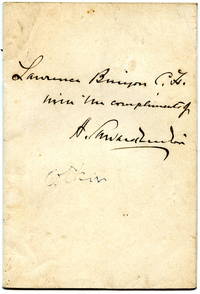
7728Christmas 1932. 12mo: ii 14 pp. Unpaginated. Frontispiece of Blake's celebrated print. Internally tight on lightly-aged and grubby paper and with the reverse of the frontispiece slightly discoloured. Staples a little rusty. In grubby white wraps. A signed presentation copy. Boldly written on the front wrap: 'Lawrence Binyon C.H. with the compliments of signed H. Edward Newton'. A characteristic production by the boisterous author of 'The Amenities of Book-Collecting'. At end: 'A. EDWARD NEWTON "Oak Knoll" Daylesford Berwyn P.O. Pennsylvania'. Christmas, 1932. paperback
1936000155Philadelphia: University of Pennsylvania Press 1936. 1st Edition . Hardcover. As New/Near Fine. 8vo - over 7¾ - 9¾" tall. Book in flawless condition Jacket in near fine condition with slight wear to top extremities and a slightly faded spine. A book about the pleasures of collecting and the "book collecting game". Unopened and unread. Price$2.00 is not clipped. <br/> <br/> University of Pennsylvania Press hardcover
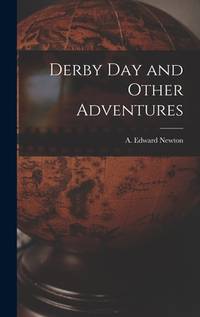
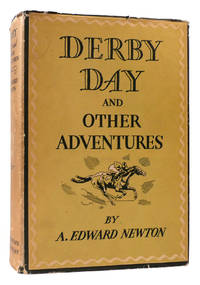
1934172726Boston: Little Brown & Company 1934. First Edition; First Printing. Hardcover. Very Good in a Very Good dust jacket. Owner personalization on FEP. Foxing along first few front end pages. Light stain on spine. Little, Brown & Company hardcover
1934000401Boston: Little Brown and Company 1934. Hardcover. Fine/Slip Case . 8vo - over 7¾ - 9¾" tall. This limited edition consists of 1129 numbered copies printed on all rag deckle-edged paper bound in boards with buckram back. These are the only copies which have been or will be inscribed by the author. Within the back cover is included a facsimile of the unpublished novelette "A leaf from an Unopened Volume" by Charlotte Bronte. A wonderful book with 1/4 binding in light beige cloth over green boards with a beautiful blind stamp in center of cover. Very minor rub to spine corner of front cover. Slipcase in VG condition with slight wear at bottom of case and corners otherwise sound. <br/> <br/> Little, Brown and Company hardcover
1934673Little Brown and Company Boston 1934. Hardcover. Condition: Fine. Limited Edition. SIGNED LIMITED EDITION #763/1129 is in very fine unmarked condition. Publishers slipcase is very good with slight wear to the extremities Silp case has nice paper label with the title and limitation #. Affixed to the to the rear paste-down is a sleeve with a facsimile copy of an un-published Charlotte Bronte manuscript. Book is quarter bound in tan cloth over light green boards with a fine blind stamp on the front cover.Book edges are untrimmed top edge is trimmed. Derby day is a book about a horse race established by The Earl of Derby in England not Kentucky. This fine book is filled with glossy photographs featuring the people mostly from high society in the early 20th century and their relationship with racing and social hob-nobbing of the time. Very collectible book by a highly collected author. Signed by Author<br /> Little Brown & Company