[Newton, Huey]; [Black Panther Party]Biblio.com
11 838 résultats
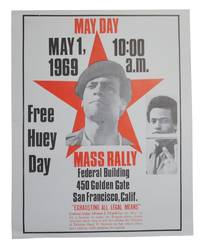
1969140945163San Francisco: Black Panther Party 1969. Original poster printed in black and red measuring 17 1/2" x 21 3/4". Untrimmed at left and right edges register marks still present. Near Fine very bright and clean with faint corner crease at bottom left. From the collection of a journalist/acivist who was involved in the defense of the Black Panthers.<br /> <p>A visually striking poster announcing a May Day rally to force the US government to grant Black Panther Party co-founder Huey P. Newton release on bail. The text at the bottom reads: "Exhausting all legal means. Federal Judge Alfonso J. Zirpoli has set May 1st for a hearing to make the Reagan-Alioto power structure show why it will not release the Minister of Defense Huey P Newton on bail which Huey has a right to while pending his appeal. [Black Panther Party] unknown
187221704St. Paul: H.E. Newton & Co 1872. First edition 8vo pp. 20 ads 415; folding map of Minnesota folding advertisement plate on heavy stock lithograph plate printed on both sides on heavy stock advertisements for local enterprises on paste-downs and free endpapers; orig. brown morocco-backed printed paper-covered boards rubbed also with ads; some wear but generally good and sound. H.E. Newton & Co unknown
115619England late 18th century. . 100-leaf manuscript rectos and most versos filled wax seal remnants to front pastedown leaves wavy at the edges some spotting and marks to contents; contemporary calf-backed blue paper boards gilt floral tools to spine compartments binding marked and worn with spine cords partially exposed and loss of the blue paper morocco label lacking naphthalene smell good condition housed in a black cloth folding case.<br /> An unusual late 18th century manuscript on classical physics that cites Isaac Newton Blaise Pascal William Harvey Henry Power and others.<br /><br />The text approximately 200 pages presents an ordered and detailed account of a number of related topics: optics; hydrostatics and pneumatics; mechanics including simple machines such as the lever and screw the behaviour of descending bodies and pendulums; phosphorus and its chemical transformations; and fortifications and architecture. The notes are dense but generally neat and legible with carefully prepared diagrams so this seems to be a fair copy rather than a working notebook. <br /><br />Newton is cited in the section on light and colour: 'What Sir I.N. has said by way of in the last edit of his Opticks will appear to be an established truth from most if not all the following examples some of which he mentions himself". And Harvey in a short section on chemical transformations: "Harvey had says he the opportunity as well as the curiosity upon several occasions to examine the weight of when some of them taken up in places very distant from one another.'.<br /><br />The origin of much of the material is unclear though the long section on hydrostaticks was taken from Hydrostatical and Pneumatical Lectures by Roger Cotes 1682-1716 originally published privately in 1738 and with a second edition at Cambridge in 1747. <br /><br />Cotes was 'probably the most talented British mathematician of the generation after Newton'. He was nominated as the first Plumian professor of astronomy at Cambridge in 1706 and 'his appointment was favoured by his influential mentor Richard Bentley master of Trinity; by Newton's successor as Lucasian professor William Whiston who claimed to be in mathematics "a child to Mr Cotes" Whiston 133; and by Newton himself. In 1709 Cotes became heavily involved in the work for which he is best remembered namely the revisions for the second edition of Newton's Philosophia naturalis principia mathematica the first being out of print' Oxford Dictionary of National Biography. Cotes died young and Newton was reported to have said that 'if he had lived we might have known something'. A number of Cotes's lectures and mathematical analyses were published posthumously by his executor Robert Smith the Hydrostatical and Pneumatical Lectures being one of them. It is tempting to question whether other portions of the present manuscript are also based on Cotes's work and further academic scrutiny might be fruitful.<br /> England, late 18th century. hardcover
195011613New York: Herbert Reichner 1950 One of 750 copies printed by the Anthoensen Press. . Terra cotta cloth with front cover and spine stamped in gilt. Octavo. Frontisportrait ten plates one folding. Light shelfwear. Near fine. Without the very scarce second volume. Herbert Reichner, hardcover
19261312<p><b>NEWTON Isaac. ADAMS Edward Dean. </b><i>A Portrait Bust of Sir Isaac Newton by Josiah Wedgwood the English Potter. </i>12mo original blue boards paper label frontispiece half-title title pp. 10 1 plate uncut. New York: Privately Printed by Bartlett Orr Press for the Engineering Foundation January 1926. <br /></p><p>Only Edition. Presented by Adams a noted engineer to great American mechanical engineer Ambrose Swasey see <b>DAB</b>: "To Ambrose Swasey. This record of a search in hopes that it may be as interesting to him as it was in its conduct to his sincere friend and well wisher. Edward Dean Adams June 10 1927." Frontispiece of the Newton bust which had been in the possession of Adams for over sixty years. With large Swasey ex-libris on rear pastedown depicting the "36 inch Lick Telescope" the observatory having been built by him. Not in <b>Babson</b>. <b>OCLC </b>locates four copies. No copies for sale online as of this date 1/28/22. Fine.</p> Engineering Foundation hardcover
199843806AB1998. First US Edition. Reading Addison-Wesley 1998. Octavo. 402 pages. Original Hardcover with dustjacket in protective Mylar. Excellent close to new condition. Michael White is a British writer based in Sydney Australia. Born in 1959 he studied at King's College London 1977-1982 and was a Chemistry lecturer at d'Overbroeck's College Oxford 1984-1991. He has been a science editor of British GQ a columnist for the Sunday Express in London and 'in a previous incarnation' he was a member of Colour me Pop. Colour Me Pop featured on the "Europe in the Year Zero" EP in 1982 with Yazoo and Sudeten Creche and he was then a member of the group The Thompson Twins 1982. He moved to Australia in 2002 and was made an Honorary Research Fellow at Curtin University in 2005. He is the author of thirty-five books: these include the international best-sellers Stephen Hawking: A Life in Science; Leonardo: The First Scientist; Tolkien: A Biography; and C. S. Lewis: The Boy Who Chronicled Narnia. His first novel Equinox - thriller an occult mystery reached the Top Ten in the bestseller list in the UK and has been translated into 35 languages. A recent non-fiction book is Galileo: Antichrist a biography of the great scientist and religious radical. Novels following Equinox include: The Medici Secret The Borgia Ring and The Art of Murder. Wikipedia. hardcover
180033248BB1800 . Paris: Brunot um 1800 16°. 208 S. 4 Tafeln Pappband Rücken beschabt; Ecken leicht bestossen; gut erhalten unknown
1970S10566Cambridge MA:: MIT Press 1970. 1970. 8vo. viii 351 pp. Index. Metallic silver cloth white-stamped spine dust-jacket; front jacket torn spine ends chipped. Ownership signature. Near fine in good jacket. ISBN: 0262160358 MIT Press, (1970). hardcover
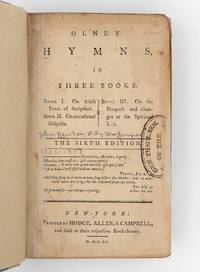
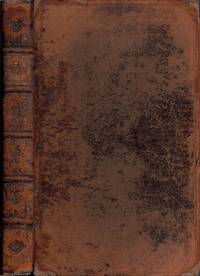
1790374363New York: Printed by Hodge Allen & Campbell and sold at their respective book-stores 1790. Second American edition. vi 1 8-348. 12mo. Recent paper backed boards. Repairs at gutter of title and first leaf. Bookplate and ink stamp of General Theological Seminary. Second American edition. vi 1 8-348. 12mo. Olney Hymns was published in London in 1779 but it was not until publication in the United States the they hymn flourished. The first American printing of Amazing Grace appeared within the New York 1787 edition of Olney Hymns Evans 20588 followed by the New York 1789 edition of the Psalms of David . for the Use of the Dutch Reformed Church Evans 21688. The present 1790 reprinting of the 1787 edition by Hodge Allen and Campbell followed with Amazing Grace appearing on pp. 48-9.<br /> <br /> ESTC records only two other examples of this 1790 edition AAS and NYHS and we find no example of either the first or second American Olney Hymns in the auction records for over a century. Evans 22734; ESTC W26651. On Amazing Grace see D. Bruce Hindmarsh "'Amazing Grace': The History of a Hymn and a Cultural Icon" in: Sing Them Over Again to Me: Hymns and Hymnbooks in America ed. Noll and Blumhofer 2006 Printed by Hodge, Allen, & Campbell, and sold at their respective book-stores unknown
174435969London: J. Osborn and J. Rivington 1744. Hardcover. Very Good. Hardcover. Second Edition which contains a previously unpublished copy of a letter to the author with a copy of the answering letter. Written by Richard Newton 1676 - 1753 the Presbyter of the English Church in response to Henry Wharton's "Defense of Pluralities" 1692. Bound in full tan leather boards with maroon and gilt title label to spine. Most of spine label is no longer present but several gilt letters remain. The leather on both hinges is cracked but the cords remain intact and the boards are still securely attached. Rubbing and wear to spine edges and corners. A few very light spots of foxing to first and last few pages else clean and bright. 402 pages. REL/081722. J. Osborn and J. Rivington hardcover
1733293624London: Printed for J. Strahan 1733. Softcover. Very Good. Second edition. 52pp. Disbound. Some staining good only. Authorship attributed to Richard Newton as per Mansell v. 417 p. 500. Printed for J. Strahan unknown
1156171733. 271 1 s. Samtidig helskinnb. Bindets ytterkanter oppskrapet og med sår. Falsene med brist. De første sidene med en fuktskjold i venste marg. Brunplettet. Noen svake bretter. Enkelte fingermerker. . unknown
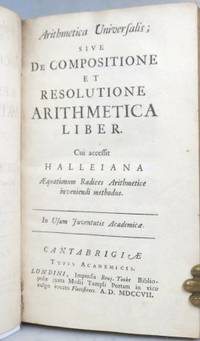
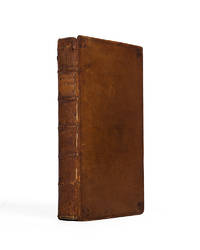
170751058Cantabrigiæ Cambridge: Typis academicis; Londini London impensis Benj. Tooke 1707. First edition. 8vo. viii 343 1 pp. 19th century full diced calf spine with raised bands gilt lettered black label blind tooled borders to the boards ownership inscription of a William Fitton dated June 1800 to the half title another contemporary owner's inscription - that of a Philip Crampton the date cropped "180" mathemetical annotations to the front and rear leaves and in the margins at intervals within. Joints skilfully repaired some mild soiling to the front and rear leaves an attractive copy. A mathemetical text composed entirely in Latin by Newton and edited by William Whiston who had succeeded him as the Lucasian professor of Mathematics at Cambridge University in 1702. The two had become acquainted during the previous decade and Newton was impressed enough with his acolyte that he invited him to lecture at the university when he was occupied with his other work. It was Whiston who persuaded Newton to publish some of his lectures on algebra but Newton was dissatisfied with Whiston's editing and additions to the text - to the extent that he considered buying the entire stock of the book to prevent its appearance in public. That clearly didn't happen although Newton succeeded in having the book published anonymously and its relative scarcity in commerce suggests a truncated print run. The first ownership inscription is that of the Irish geologist William Fitton 1780-1861. The son of a Dublin lawyer his paternal grandfather had been a mathematical instrument maker. Fitton began his studies at Trinity College Dublin in 1794 and earned his B.A. in 1799 but continued studying there until 1803. He went on to study medicine at Edinburgh University becoming a doctor in 1810 and continued his medical studies in London and Cambridge during the following six years. Fitton's interest in geology and mineralogy were his true passions and after marrying into a wealthy family he was able to devote his studies exclusively to these subjects. He subsequently served as secretary and later as president of the Geological Society published numerous reviews and papers plus a small number of books including 'A Geological Sketch of the Vicinity of Hastings' in 1833. Fitton was awarded the Wollaston Medal the society's highest prize in 1852. The other inscription is almost certainly that of Sir Philip Crampton 1777-1858 an Irish surgeon who awarded many honours and held various senior positions in a long and illustrious career: "elected FRS in 1812. In 1813 he was appointed surgeon-general to the forces in Ireland and he was surgeon to the queen in Ireland a member of the senate of the Queen's University of Ireland and four times president of the Royal College of Surgeons in Ireland in 1811 1820 1844 and 1855. In 1839 he was created baronet" ODNB. Cantabrigiæ [Cambridge]: Typis academicis; Londini [London], impensis Benj. Tooke unknown
116359Cambridge & London Typis Academicis; Benj. Tooke 1707. . First edition; 8vo 20 x 12.5 cm; contemporary ownership inscription in ink to front endpapers contents fresh; contemporary sprinkled calf ruled in blind with floral tools in the corners red speckled edges spine lettered in gilt but rubbed with loss of the gilt joints ends of spine and hinges professionally conserved very good condition; 343 pp.<br /> First edition of Newton's treatise on algebra his 'most often read and republished mathematical work' Whiteside.<br /><br />'Sometime between the autumn of 1683 and early winter of 1684 Newton according to the statues of the Lucasian Chair deposited with the university his Lucasian Lectures on Algebra. The lectures bear dates from 1673 to 1683 but these were added in retrospect and it is highly unlikely that they were ever delivered to Cambridge students. From one point of view Arithmetica Universalis can be seen as a fulfilment of the program outlined by Descartes in Géometrie because it teaches how problems especially geometrical problems but also arithmetical and mechanical ones can be translated into the language of algebra which is here seen as the tool for problematic analysis; on the other hand Arithmetica Universalis contains two criticisms directed at Descartes' those being the preference for Apollonian geometry over Cartesian algebra in solving indeterminate problems and the argument that Descartes relied too heavily on algebraic criteria Guicciardini Isaac Newton on Mathematical Certainty and Method pp 61-62.<br /><br />By 1707 Newton had moved to London and his successor mathematician William Whiston took it upon himself to edit and publish the text. It is unclear how much say Newton had in this but he was unhappy with various aspects of the editing and typesetting and refused to have his name on the title page though in the end most of Whiston's changes would be retained in the 1722 edition seen through the press by Newton himself Cohen 'The Case of the Missing Author' in Isaac Newton's Natural Philosophy pp. 35-38.<br /> Cambridge & London, Typis Academicis; Benj. Tooke, 1707. unknown
1021134910.Ghardcover. Good. Access codes and supplements are not guaranteed with used items. May be an ex-library book. hardcover
1730788711730. NEWTON William. The Life of the Right Reverend Dr. White Kennett Late Lord Bishop of Peterborough. With Several Original Letters of the Late Archbishop of Canterbury Dr. Tennison the Late Earl of Sunderland Bishop Kennett &c. and Some Curious Original Papers and Records Never before Publish'd. London: Printed for S. Billingsley 1730. 1st ed. xx2881 postscript 1 advertisement pp. 19th-century paneled calf raised spine bands gilt-chamfered edges. Hinges tender but holding else a very good copy. Sabin 37449. European Americana 730/164. Kennett was the author of the first English bibliography of the New World the Bibliothecae Americanae Primordia published in 1713. He had many American connections and interests and this work includes an account of the Society for the Propagation of the Gospel in America. unknown
1950S6657New York:: Herbert Reichner 1950. 1950. 258 x 177 mm. 8vo. xiv 228 pp. Frontis. illus. index. Brick-red cloth. Ownership signature of Martha Teach Gnudi. Fine. 606 items. Herbert Reichner, 1950. hardcover
2002S6135Boston:: Burndy Library 2002. 2002. 8vo. xxvii 95 pp. Frontis. port. figs. index. Gilt-stamped brick red cloth. NEW. First edition designed and printed by the Stinehour Press. Burndy Library, 2002. hardcover
0333907353.Ghardcover. Good. Access codes and supplements are not guaranteed with used items. May be an ex-library book. hardcover
172819285London: S. Palmer 1728. FIRST EDITION. With engraved title-vignette of an observatory within a border of instruments 12 folding plates and historiated initials all engraved by J. Pine after J. Grison including the arms of Sir Robert Walpole to whom the work is dedicated. Complete with subscriber’s list including Isaac Newton’s 12 books. Half-calf over marbled boardsspine with gilt decorations and morocco label. An absolutely exquisite wide-margined copy preserved in a slipcase. First edition. Pemberton’s ability in mathematical problems impressed Newton and consequently he asked him to edited the third and definitive edition of his Principia mathematica 1726. The preface contains Pemberton’s recollections of Newton especially in his old age. However this work is most notable for its explanation of Newtonia philosophy. Pemberton 1694-1771 studied under Boerhaave at Leiden and was attached to St. Thomas’ Hospital in London. <br /> <br /> Babson 98; Gray 132. S. Palmer unknown
2012PMV513001EParis: RMN-Grand Palais 2012. Hardcover. Good/Not issued. 213 x 247 x 30 cm. Hardcover • Illustrations en noir et en couleurs couverture illustrée • <b><i>French text original</i></b> • Printed 2012. RMN-Grand Palais hardcover
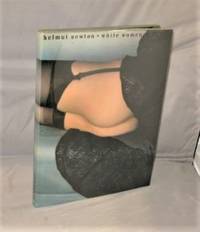
197627458<p>New York:: Stonehill 1976. First Printing of the First US Edition. A Fine copy with a discreet name on the flyleaf in a Fine unclipped dust jacket. White Women Helmut Newton's legendary first work appeared more than twenty years ago. With its superior mixture of aesthetics technical perfection and bourgeois decadence it has lost nothing of its potency and attractiveness. Newton's work encompasses a wealth of themes also embodying facets of the mass-media world of glamour masquerade and show. Using subtle yet striking images--like those of Paloma Picasso Veruschka Elsa Peretti Karl Lagerfeld David Hockney and Charlotte Rampling--Newton embraces the delicate natural beauty of the naked female body. White Women is a masterpiece of erotic visual literature.</p> Stonehill, hardcover
197625359New York:: Stonehill 1976. Second Printing of the First US Edition. A Fine copy in a Fine price-clipped dust jacket. White Women Helmut Newton's legendary first work appeared more than twenty years ago. With its superior mixture of aesthetics technical perfection and bourgeois decadence it has lost nothing of its potency and attractiveness. Newton's work encompasses a wealth of themes also embodying facets of the mass-media world of glamour masquerade and show. Using subtle yet striking images--like those of Paloma Picasso Veruschka Elsa Peretti Karl Lagerfeld David Hockney and Charlotte Rampling--Newton embraces the delicate natural beauty of the naked female body. White Women is a masterpiece of erotic visual literature. Stonehill, unknown
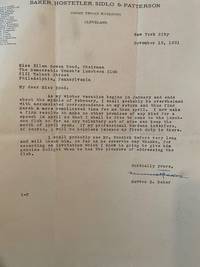
1940List1819V.P. 1940. With fifty-eight letters from Newton Baker 1924-1937. Generally fine condition. Ellen Gowen Hood was active in the Democratic party at both the local and national levels. An obituary from the Philadelphia Daily News in 1970 described her as “one of the earliest local advocates of women in politics.†She was the chairman of the Democratic Women’s Luncheon Club of Philadelphia for 20 years and had regular correspondence with women such as Edith Bolling Wilson and Eleanor Roosevelt. <br /> <br /> Democratic women’s clubs became active across the country after the 19th amendment passed in 1920 and the democratic party sought to mobilize women voters. As chairman of the Democratic Women’s Luncheon Club of Philadelphia Hood organized events with prominent political speakers and then had the speeches printed in book format. Without Hood’s side of the correspondence we don’t get insight into her philosophy of women’s participation in politics. We do however get a sense for the role that the club played in the Democratic Party. Baker was a periodic guest of the luncheon club and in his letters he praised the organization saying “I think I have never addressed a more intelligent or obviously influential audience†and "I think there is no more useful forum anywhere. They print the addresses made at their luncheons and give them a wide circulation throughout the country so that their pamphlets are now in libraries and in the hands of studious and thoughtful people everywhere." As an avid supporter of Wilsonian ideas and the League of Nations Hood’s political intention with the club seems more focused on bringing speakers that would highlight those causes than specifically speaking to women’s participation in politics.<br /> <br /> The letters from Baker to Hood reveal their shared political beliefs and goals. Their letters are ongoing conversations about the League of Nations and the World Court; the Democratic Conventions in 1924 1928 and 1932; and how democrats should govern following the Great Depression and prohibition. Baker frequently recommends essays and speeches for Hood to read and also helps connect her with potential speakers for the Luncheon Club. He addresses her as a political peer and we also get a sense of her professional persistence and savvy -- in nearly every letter for twenty years Baker responds to her requests for him to come and speak at the club.<br /> <br /> The letters give insight into Baker’s political beliefs as they evolve through the 1920s and 1930s. In the 20s-30s he writes as his thinking on the League of Nations changes from strongly feeling that the United States should join to discouraging it until there is complete support. In one letter Baker describes in confidence one of the only times he disagreed with President Wilson as Secretary of War -- when Wilson sent American troops to North Russia at the end of World War I. In a few memorable letters from 1932 Baker writes about his experience of the 1932 democratic convention and his sense of relief when he was not chosen for nomination.<br /> <br /> The letters also exhibit Baker’s writing style and his tendency to wax poetic about democratic politics. For example speaking about the limitations of the Democratic Party he writes “The trouble about it all is that nobody has yet invented anything better for the long run and the steady pull than democracy and so we just have to be patient with it as we are with the small misdoings of our children and take our joy out of the sure forecast of their fine performance when they have matured.â€<br /> <br /> Other correspondences in the collection include letters from Edith Bolling Wilson Eleanor Roosevelt Secretary of State Cordell Hull historian and diplomat Claude Bowers and Bess Truman. There are also several letters from Ralph Hayes Baker’s wartime secretary in the war department and a central figure in Baker’s 1932 presidential campaign. These letters go into detail about Baker’s role at the 1932 convention his legacy on labor issues and a rumor that he was Jewish.<br /> <br /> Overall the collection provides insight into Democratic Women’s Clubs of the period. We suspect the Baker letters to exist in duplicate at his archive but the collection still provides a succinct opportunity for research on the subject. <br /> <br /> Please contact us for a full inventory. unknown
1947428Racine Wis: Whitman Publishing Co 1947. Staplebound. Very good. Ruth E. NEWTON. 4to; 11pp with back wrapper last page of story; linen-like color illustrated paper wrapper title author and publisher on front; 11 pages of color illustration followed by text; a few light creases to front wrapper and light scuffing of paper; very good. Unauthorized Peter Rabbit story. Whitman Publishing Co unknown