311 résultats
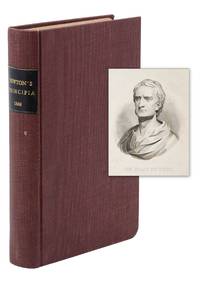
1848140949208New York: Daniel Adee 1848. First American Edition. Very Good. First American edition first printing with date 1848 on title page and publisher's address listed as 107 Fulton-Street. 4 v-viii 9-581 pp. illustrated with engraved frontispiece protected by tissue guard. Recently bound in maroon buckram title label to spine. Very Good with light wear to covers and slight bumping to lower corners; title label beginning to lift at one corner. Band of paper residue to front free endpaper. Light toning and moderate foxing to textblock edges and contents dampstain to outer textblock edge and outer margin throughout. Cohen pp. 347-352.<br /> <br /> <p>The first American edition of the foundational physics text first published in Latin in 1687. Andrew Motte's 1729 translation was reprinted in 1803 and 1819 in Britain but subsequent 19th century editions were printed only in the United States and Germany. The New York-based publisher Daniel Adee deposited a copyright for the Principia in 1846 then printed five issues between 1848 and 1850. A contemporary notice in the Scientific American declared:<br /> <br /> <p>"For a long time the 'Principia' was kept far out of the reach of the mere English Scholar as if Newton had written it exclusively for the classical student and philosopher. It was a scarce book when printed in the Latin language; it is now thanks to the spirit of an American publisher printed in our mother tongue and should find a place in every family library. Daniel Adee unknown
18481803065Daniel Adee 1848. 1st Edition. Hardcover. Near Fine/No Jacket. Near fine TRUE first American edition 1st issue as stated on the title page. Some water stains on page edges. Previous owner's bookplate on front pastedown. Rubbing on outside spine and corners and at bottom of spine. Tape at endpapers and pastedowns along gutters. Housed in custom-made slip case. Daniel Adee hardcover
18481803065Daniel Adee 1848. 1st Edition. Hardcover. Near Fine/No Jacket. Near fine TRUE first American edition 1st issue as stated on the title page. Some water stains on page edges. Previous owner's bookplate on front pastedown. Rubbing on outside spine and corners and at bottom of spine. Tape at endpapers and pastedowns along gutters. Housed in custom-made slip case. Daniel Adee hardcover books
184865054New York: Published by Daniel Adee 176 Fulton Street Turney & Lockwood's Stereo 1848. First American edition later printing. The first edition was published in 1687. Frontispiece portrait taken from the bust in the Royal Observatory of Greenwich diagrams in text. 8vo. Original green cloth. Head of spine carefully restored some rubbing some light browning mostly at front and back a very good copy of this important work. In a leather-tipped green cloth open-end box. Bookplate of O. Stuck on endpapers. First American edition later printing. The first edition was published in 1687. Frontispiece portrait taken from the bust in the Royal Observatory of Greenwich diagrams in text. 8vo. The first English edition of Newton's "Principia" was translated by Andrew Motte a mathematician who with his brother Benjamin the publisher had edited the abridged "Philosophical transactions." This first English edition was published in 1729 from the third and definitive Latin edition of 1726. Newton's "A Treatise of the System of the World" was first published in English in 1728. The American edition bears a dedication and an introduction directed to teachers "If to educate means not so much to store the memory with symbols and facts as to bring forth the faculties of the soul and to develope them to the full by healthy nurture and a hardy discipline then what so effective to the accomplishment of that end as the study of Geometrical Synthesis . Let the Principia then be gladly welcomed into every Hall where a True Teacher presides." Copyright 1846 but first published 1848; the present copy is printed from stereotype plates wear to terminal page number. "The greatest work in the history of science . the "Principia" provided the great systhesis of the cosmos proving finally its physical unity . for the first time a single mathematical law could explain the motion of objects on earth as well as the phenomena of the heavens" PMM. Babson 23; Gray 26; Karpinski p. 491; Horblit 78; PMM 161 Published by Daniel Adee, 176 Fulton Street [Turney & Lockwood's Stereo unknown books
1830124608London: Newton Son & Berry c. 1830-1836. Fine pair of rare early 19th century celestial and terrestrial table globes published by Newton Son & Berry. Both the celestial and terrestrial globe measure 12 inches in diameter with a calibrated brass meridian ring and 19 inch mahogany horizon ring decorated with mounted hand colored decorations. Mounted on ebonized oak stands. Each globe is comprised of 12 richly detailed hand-colored gores with polar calottes the terrestrial globe detailing the earth's landmasses major countries and cities and the celestial showing the major stars in various sizes related to their brightness displayed with a table of magnitudes. Major constellations and all twelve zodiac signs are illustrated with detailed hand-colored drawings. The cartouche on the celestial globe is inscribed "Newton's New & Improved Celestial Globe On which all the Stars Nebulae & Clusters contained in the extensive Catalogue of the late E. Wollaston E.R.S. are accurately laid down their Right Ascensions and Declinations having been recalculated for the Year 1830 by W. Newton. Manufactured by Newton Son & Berry Chancery Lane London Published 1836." In near fine condition with some light restoration. Each globe measures 19 inches tall. The sphericity of the Earth was established by Greek astronomers in the 3rd century BC with the earliest terrestrial globe appearing during that period. The earliest known globe was constructed by Crates of Mallus in Cilicia now Cukurova in modern-day Turkey in the mid-2nd century B.C.E. Now known as the Erdapfel the earliest extant terrestrial globe was produced in 1492 by German mapmaker navigator and merchant Martin Behaim in Nuremberg Germany. Traditionally globes were manufactured by gluing a printed paper map onto a sphere often made from wood. Newton, Son & Berry unknown books
1831017877London United Kingdom: James Nisbet 1831. Book. Good. Hardcover. 1st Edition. First UK Edition THUS A New edition with the citations translated and notes by P. Borthwick Esq 1831. xvi 250 pages. A good copy in quarter bound marble boards Wear to spine and extremities of boards Tightly bound with copious notes and marginalia - clear and concise. Explanations of the text by the previous owner which do not affect the readability of the text. Slightly musty. James Nisbet Hardcover
183121773London: James Nisbet &T. Stevenson Cambridge 1831. 8vo 23.5 cm; 9". 1 f. xii 250 pp. <br><br>Third edition. In addition to being a physicist mathematician and natural philosopher Sir Isaac Newton was something of a Biblical scholar as well as shown by the present exegesis on apocalyptic texts. His analysis generally reads as being practical in nature as the New Catholic Encyclopedia X 428 says "Newton's writings on apocalyptical prophecies were not mystical or millenarian in any sense but more exercises in deciphering cryptograms." They comport with our sense of him as someone who believed in the scientific method!<br>Â Â Â Â "A new edition with the citations translated and notes by P. Borthwick . . . of Downing College Cambridge. Publisher's quarter green cloth with paper-covered boards. Rebacked in sympathetic cloth and new paper label antique style applied. Boards show age-stains and wear but are solid. Old library pressure-stamp on title-page. In an open back slipcase of green library cloth; spine of box with author title and call number in gilt. => A nice copy sound for reading. James Nisbet, &T. Stevenson, Cambridge hardcover books
1806056634Edinburgh: J. Johnson 72 St. Paul's Curch-Yard 1806. Eigth Edition . Hardcover. Very Good Plus. Small Octavo. LONDON : 1806. First published in 1779. 280 hymns by Newton 68 by Cowper. Hardback. Cloth spine; marbled boards; printed paper-label. All edges gilt. Bright tight and clean. Neat contemporary owner name to fly-leaf. No internal markings. Minor wear only. VERY GOOD INDEED. xvi 332 pages. Index. Will be well-packed for posting/shipping. Sm.8vo. Rosley Books for Antiquarian books Cumberland Everyman Keswick Inklings Literature Rarities Theology and History. SCARCE. <br/> <br/> J. Johnson, 72 St. Paul's Curch-Yard hardcover
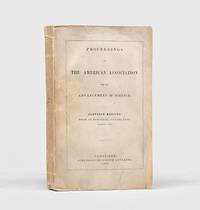
1858155260Cambridge: Joseph Lovering 1858. One of only two known papers by the author Uncommon first edition of the first article by a woman published in the Proceedings of the AAAS: a well-preserved copy in the original wrappers with the ownership signature of American ornithologist George N. Lawrence 1806-1895 listed as a member of the AAAS on p. xxxviii of this volume. The American scientist inventor and women's rights campaigner Eunice Newton Foote 1819-1888 is best remembered for her discovery of the absorption of thermal radiation by carbon dioxide and water vapour: namely the greenhouse effect. Her famous paper on the topic was presented to the AAAS in August 1856 read on her behalf by Joseph Henry first Secretary of the Smithsonian and published shortly after in the American Journal of Science and Arts. This is Foote's second paper which provides an early experimental description of the effect of a pressure-driven change on the static electricity of air with reference to observations by Humboldt Sabine and de Saussure. It was presented to the AAAS on 14 August 1857 again read by Joseph Henry on her behalf. Its first appearance in print was in the Proceedings; abbreviated versions later appeared in the American Journal of Science and Arts and in the Philosophical Magazine. In Mary Creese's landmark study of American and British women scientists from 1800 to 1900 she noted that of the approximately 3400 scientific publications authored by women in the period - less than 1% of the total published - there were "just 16 papers by American women in physics over the whole century. Only two pre-date 1889 and they are the two papers by Eunice Foote" Jackson p. 117. John Perlin author and visiting scholar at the UCSB Physics department which hosted a 2019 exhibition on Foote remarked that she was "the only woman to be published in serious physics journals until Madame Curie" quoted in Jacobs. Octavo. Five folding plates one engraved with astronomical illustrations the rest featuring diagrams and graphs and two engraved plates numerous illustrations in text. Original buff printed wrappers. Faint pencilled signature "Geo. N. Lawrence" along upper edge of front cover pencilled number at centre of spine. Wrappers expertly restored spine ends chipped contents crisp and clean: a very good copy. Roland Jackson "Eunice Foote John Tyndall and a Question of Priority" Notes and Records 74 2019 pp. 105-18; Tom Jacobs "More than a Historical Foote Note" UCSB's The Current 6 November 2019 available online. unknown
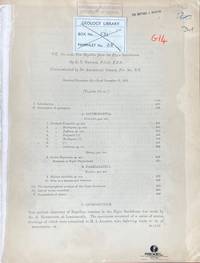
189443361Royal Society of London 1894. Phil. Trans. Ser. B vol. 184. Good/No Jacket. Paper covers Library label and stamps deleted owner's stamp on first page. Plates intact. Royal Society of London unknown
189442325London Harrison and Sons 1894. 4to. No wrappers as extracted from "Philosophical Transactions" Vol. 184 - Series B Vol. 185 - Part I Series B. Pp. 431-503 and 16 plates pp.573-607 and 4 plates. Both papers fine and clean. <br/><br/><em>First printing of 2 of Newton's most importent monographs describing the reptilian remains from the Permotriassic rocks at Elgin Scotland. In these two researche "Newton lacked the actual bones to work with; he had only their cavities in sandstone from which after great labor he obtainesd and fitted together caasts of gutta-percha. He discovered Diconydonts and pareiasaurs for the first time in Europe showing how closely they resembled the descriptions of those found in Karroo Formation of South Africa."DSB.In 1893 Newton was elected a fellow of the Royal Society. He was president of the Paleontological Society from 1921 to 1928 and president of the Geologist's Association 1896-1898. </em> unknown
188942627London Harrisn and Sons 1889. 4to. No wrappers as extracted from "Philosophical Transactions" 1888 Vol. 179 - Series B. Pp. 503-537 textillustr. and 2 lithographed plates. Fine and clean. <br/><br/><em>First appearance of this importent paper describing for the first time a new species of the Jurassic flying reptile.The skull was collected in the 1880s by D.W. Purdon who is honoured in the specific name "Scaphognatus Purdoni s Newton nmd it. It was recognizd as a distinct genus only decades later in 1919 by Gustav von Arthaber. </em> unknown
1853226360John Murray 1853 Poole plus offprints; extracted form The Archaeological Jounal; and Sussex Archaeological Collections. Good. 1853. Hardcover. hardback 8vo the three listed titles bound in with numerous other extracts from various archaeological journals and proceedings on diverse subjects 26;20;20pp plus various paginations one engraved plate 2 woodcuts and a folding map all of Pevensey Castle some browning no inscriptions marbled boards and quarter-cloth boards bumped and rubbed Good condition. . John Murray, 1853 (Poole) plus offprints; extracted form The Archaeological Jounal; and Sussex ,Archaeological Collections, hardcover
186556517Newport R.I.: Thursday morning Sept. 14 1865. 4to approx. 10" x 8" approx. 20 lines and 200 words in ink; folds and with the original stamped cover "Steam Boat" and with a Providence roundstamp and the stamp of the "American Steamboat Company Sept. 14 1865 steamer City of Newport." Light soiling and spotting of the envelope but generally near fine. Written just after the end of the Civil War Newton begins by apologizing he will not be able to attend a meeting because of "my constant engagements for the past two weeks in closing up the affairs of the Naval Academy . I regret to say that it has been impossible for me to attend the State Committee . to listen to Mr. Bradford's report of the convention which is doubtless very satisfactory judging from the little that I have gathered from the papers and I feel grieved that I have lost the opportunity of interchanging views . upon the prospect of bright hope for better days now dawning . Write me if not too much trouble the most interesting points of your conversation . My regards to Bradford Steere and all good friends in the bonds of democratic truth and love." Miller was a resident of Bristol a member of the Rhode Island Historical Society where he is known to have delivered several papers worked with the U.S. Coast and Geodetic Survey on charts of Narragansett Bay and later was one of the founders of the Bristol and Warren Water Works. Thursday morning, Sept. 14 unknown
186556517Newport R.I.: Thursday morning Sept. 14 1865. 4to approx. 10" x 8" approx. 20 lines and 200 words in ink; folds and with the original stamped cover "Steam Boat" and with a Providence roundstamp and the stamp of the "American Steamboat Company Sept. 14 1865 steamer City of Newport." Light soiling and spotting of the envelope but generally near fine. Written just after the end of the Civil War Newton begins by apologizing he will not be able to attend a meeting because of "my constant engagements for the past two weeks in closing up the affairs of the Naval Academy . I regret to say that it has been impossible for me to attend the State Committee . to listen to Mr. Bradford's report of the convention which is doubtless very satisfactory judging from the little that I have gathered from the papers and I feel grieved that I have lost the opportunity of interchanging views . upon the prospect of bright hope for better days now dawning . Write me if not too much trouble the most interesting points of your conversation . My regards to Bradford Steere and all good friends in the bonds of democratic truth and love." Miller was a resident of Bristol a member of the Rhode Island Historical Society where he is known to have delivered several papers worked with the U.S. Coast and Geodetic Survey on charts of Narragansett Bay and later was one of the founders of the Bristol and Warren Water Works. <br/><br/> Thursday morning, Sept. 14 unknown books
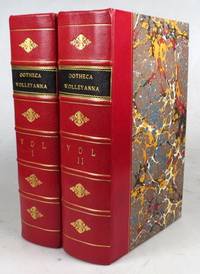
186449256London: Sold by R.H. Porter 1864 1902 1905 1907. Sole editions. Four parts bound in two volumes. Large 8vo. xl 525 3 527-532; vi 665 1 96 4 pp. Expertly bound in recent quarter red morocco over marbled boards spines with raised bands gilt lettered black labels lettered direct to another and with a gilt device repeated to the others the original printed wrappers to all four parts bound in at the rear of volume II adjacent to the first wrapper is a 3 pp. autograph letter signed from Newton addressed to "My dear Edge" on Magdalen College Cambridge headed paper parts II and III feature tipped in handwritten notes presenting them "with the editor's compliments" parts II and IV also come with letters from Newton to the original recipient's son finally the set is complemented with two pieces of interesting egg related printed ephemera. Photogravure portrait frontispiece 21 chromolithograph plates of bird eggs numbered I-XXI 16 lithograph plates tinted chromolithographic or uncoloured depicting birds nests and landscapes lettered A-P and a folding colour map of Lapland. John Wolley 1823-1859 was an ornithologist and egg collector first becoming interested in the subject whilst studying at Cambridge. Over time he became something of an expert on the Dodo and later on the Great Auk. His studies led to travels in Europe and Scandinavia and it was during one of these trips in the 1850s that he interviewed the men that had killed the last of the Great Auk species the previous decade. Wolley fell ill after one of these foreign trips and eventually passed away at the tender age of 36. On his demise his notes and remaining egg collection passed to his close friend Alfred Newton who painstakingly edited and published Wolley's notes over the next half century. Alfred Newton 1829-1907 became one of the pre-eminent ornithologists of the age being one of the founders of the British Ornithologists' Union in 1858 and ascending to the chair of Zoology and Comparative Anatomy at Cambridge in 1866 a post that he held until his death. In these later decades Newton also edited or contributed to many other important ornithological works such as editions of Yarrell's Birds the Encyclopaedia Britannica and his own Dictionary of Birds four volumes 1893-96 but his editorship of Wolley's work was by far his crowning achievement in print. The first letter is dated September 1864 and is evidently written to James Thomas Edge 1827-1894 originally James Thomas Hurt he took his mother's maiden name early in his adult life. Newton explains that he had asked Van Voorst to send Edge a copy of the work but that the publisher had ignored his instruction to inscribe the volume with his wishes. This omission prompted Newton's belated letter which had been delayed due to a summer long bird watching trip to Spitsbergen. The later letters are both addressed to Edge's son Thomas Lewis Kekewich Edge 1856-1931 the first of these references the senior Edge's collection - the importance of certain pieces within it and the need to ticket them. Newton's final letter is dated March 1907 just three months prior to his death. He is glad that Edge has had "the 4th and last part of this book and seems to like it" and commends an extract that Edge had quoted from his father's journal in a previous letter apparently confirming a conclusion John Wolley had also come to. Interestingly Wolley's father Francis also changed surname during his adult life - taking on his wife's maiden name. Prior to becoming a Wolley Francis' surname had been Hurt. Thus it transpires that as well as sharing a keen interest in ornithology and oology John Wolley and James Thomas Edge were second cousins. The ephemera comprises an 1865 printed sale notice from the auctioneer J.C. Stevens offering a "Rare & Remarkable Egg" of a bird "presumed to be quite extinct" which he states was "probably the Dinornis ingens of Owen". Richard Owen had been sent a fragment of an unusual bone that had been excavated in New Zealand in the late 1830s. After studying it for several years he came to the conclusion that it was almost certainly a part of a bone from a giant flightless bird which he named Dinornis novaezealandiae more commonly known by its Maori name of Moa which had long since been extinct. Also inserted is a 24 pp. sale catalogue of eggs dated 1858 offered by the same auctioneer the eggs collected by John Wolley himself in Lapland the previous year. A handsome set of a what is ordinarily an uncommon work this set rendered unique with its the family association letters from the editor and the related ephemera. London: Sold by R.H. Porter unknown
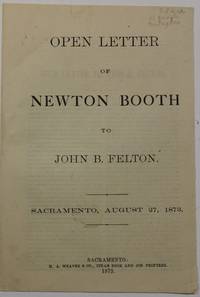
187339795Sacramento: H.A. Weaver & Co. Steam Book and Job Printers 1873. 7 1 blank pp. Last page prints the People's Union Independent Anti-Monopoly Ticket for State Senate and Assemblymen. Very Good.<br /> <br /> Booth was elected Governor of California in 1871 campaigning as a Republican and with support from African Americans. In 1875 he resigned his office and with the help of the Anti-Monopoly Party was elected U.S. Senator from California. Booth had supported Lincoln in 1860. Felton also a Republican and the Mayor of Oakland had criticized Booth for an allegedly insufficient anti-monopoly stance. The offended Booth responded with this Open Letter accusing Felton of joining "hired assassins of character" of suffering from "mental obliquity" and failing to be "generous candid fair or truthful."<br /> Not in Rocq Cowan Drury. OCLC 21739281 3- Yale UC Berkeley Hayes Pres. Lib. 228685535 1- Huntington as of January 2024. H.A. Weaver & Co., Steam Book and Job Printers unknown
1878ZB466986Washington 1878. 8 pp. extracted from a larger binding overall good. - If you are reading this this item is actually physically in our stock and ready for shipment once ordered. We are not bookjackers. Buyer is responsible for any additional duties taxes or fees required by recipient's country. Washington unknown
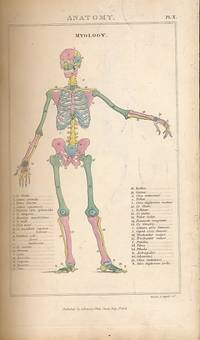
181361937London: Printed for G. Kearsley J. Walker J. Stockdale R. Lea et al. 1813. Large 8vo. In 13 volumes 12 volumes of text with plates bound separately in extra volume. Uniformly bound in contemporary black half calf over dark green cloth. Gilt decoration & blind-stamped panels to spines. Marbled endpapers. Some rubbing & wear to spines & corners. Boards clean. All internally clean. All bindings firm. With 370 plates. Small tear to one plate. Plates plain without any colour in this copy. . Very Good. Half Calf. 1813. Printed for G. Kearsley, J. Walker, J. Stockdale, R. Lea, et al. 1813 unknown
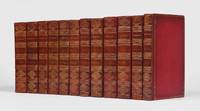
1813143137London: Printed for G. Kearsley J. Walker J. Stockdale R. Lea E. Jeffery & 10 others 1813. A "vastly ambitious survey" First edition of this extensively illustrated Georgian encyclopedia a "vastly ambitious survey of human genius learning and industry" ODNB here presenting particularly nicely in contemporary red morocco. 12 vols octavo 232 x 145 mm. Illustrated throughout with engravings many with contemporary hand colouring. Contemporary red straight-grain morocco spines lettered and tooled in gilt covers with foliate border in gilt and blind gilt turn-ins grey endpapers gilt edges. Contemporary ownership signature to half-titles pencilled doodle to front free endpaper of vol. I. Bumping at head of contents of vol. IV. A very handsome set the bindings without wear and the contents clean. unknown
1813g3686bLondon: G Kearsley; J Walker; J Stockdale; &c. G : in good condition. Rebacked. Cover rubbed. Some foxing. 1813. First Edition. Brown hardback half-leather cover. 240mm x 160mm 9" x 6". 186 plates. 186 plates 10 hand-coloured 2 fold-out. Heavy item - shipping supplement may apply for overseas. . G Kearsley; J Walker; J Stockdale; &c hardcover
18134567London: Printed for G. Kearsley et al. 1813. Lg. 8vo. Unpaginated. 12 vols. Double column text. Illustrated with 355 copper engraved plates 1 a map of which 171 are nicely hand-colored 2 folding. Orig. brown cloth over boards paper spine labels rubbed uncut. Hinges split or splitting but holding nicely. Occasional chipping & fraying at extremities of spine. Hand lettered volume nos. added to tops of spines. Plates with some foxing the color plates only occasionally foxed. The plates are mostly machinery steam engines printing presses hot air balloons ship building etc.; and scientific instruments microscopes telescopes etc. and some printed music. The color plates are of birds mammals reptiles insects fossils flowers etc. Printed for G. Kearsley et al. hardcover books
1813313293London: Printed for G. Kearsley et al. 1813. First edition. Lacking all plates. 12 vols. 8vo. Bound in half contemporary brown calf gilt spines marbled boards and edges lacking plates else very good. First edition. Lacking all plates. 12 vols. 8vo. Printed for G. Kearsley et al. unknown books
1900mon0002927656Generic 1900-01-01. Hardcover. Good. . Generic hardcover
1900008782Washington D.C: Government Printing Office 1900. Book. Very good- condition. Hardcover. First Edition. Octavo 8vo. 204 pages of text. Hardcover binding with moderate darkening of spine and overall slight sheflwear. Illustrated with 30 black & white photographs and 10 black & white figures. Inner front hinge weakened. Government Printing Office Hardcover books