Newton HelmutABAA

709 résultats
199824064New York: Scalo. Very Good in Very Good dust jacket. 1998. First Edition; First Printing. Hardcover. 3931141896 . Red cloth lettered along the spine. Rear corners bumped. The dust jacket is slightly rubbed. A collection of Newtons images for fashion magazines such as Elle Amica and Vogue with anecdotes and inspiration behind the work. ; 543 pages . Scalo hardcover books
1937142416New York: Dodd Mead 1937. First Edition. First Edition. Details early cases by the FBI and other federal agencies aimed toward younger readers. Photo-illustrated throughout. <br/><br/>Near Fine in a Very Good dust jacket. Vintage bookstore stamp to the front pastedown. Jacket has a vertical crease to the spine with light nicking to the extremities and cell tape reinforcement to the verso of the heel and crown. Dodd, Mead unknown books
1978150184N.p.: N.p. 1978. Vintage borderless black and white photograph of actors John Travolta and Olivia Newton-John circa 1978. With the stamps of photographer Bill Holz and TV Radio Talk agency on the verso along with holograph ink annotations regarding layout. <br/><br/>Newton-John and Travolta starred together in "Grease" 1978 breakthrough appearances for both actors. <br/><br/>8 x 10 inches. Very Good plus with holograph pencil annotations on the recto regarding cropping. N.p. unknown books
1990WRCLIT70275Sydney: Hoysts Distribution 1990. Narrow folio 25.75 x 13.5"; 65 x 34 cm. Color pictorial daybill. Folded as issued a few faint creases very good or better. A color daybill poster issued to promote the Australian release of Curtis Hanson's film based on a screenplay by David Koepp starring James Spader and Rob Lowe. The image is a photograph of the protagonists with a prominent credit line to Newton. Hoysts Distribution unknown books
1744109523Lausanne and Geneva: Aoud Marcum-Michaelem Bousquet & Socios 1744. First edition of the first collected edition of <span class="match">Newton</span>'s writings which has been hailed as "a fine piece of bookmaking" Babson. Quarto bound in contemporary velum contains 64 folding engraved plates; 2 folding letterpress tables. In very good condition. Small stamps to the spine and title pages. Rare in contemporary binding. English mathematician astronomer theologian author and physicist Sir Isaac Newton is widely considered one of the most influential scientists of all time and a key figure in the scientific revolution. In one of his most important works Philosophiae Naturalis Principia Mathematica Newton formulated the the laws of motion and universal gravitation that formed the dominant scientific viewpoint until being superseded by the theory of relativity. Aoud Marcum-Michaelem Bousquet & Socios unknown books
174492332Lausanne and Geneva: Aoud Marcum-Michaelem Bousquet & Socios 1744. First edition of the first collected edition of <span class="match">Newton</span>'s writings which has been hailed as "a fine piece of bookmaking" Babson. Quarto bound in contemporary velum contains 64 folding engraved plates; 2 folding letterpress tables. In very good condition wide margins. Rare in contemporary binding. English mathematician astronomer theologian author and physicist Sir Isaac Newton is widely considered one of the most influential scientists of all time and a key figure in the scientific revolution. In one of his most important works Philosophiae Naturalis Principia Mathematica Newton formulated the the laws of motion and universal gravitation that formed the dominant scientific viewpoint until being superseded by the theory of relativity. Aoud Marcum-Michaelem Bousquet & Socios unknown books
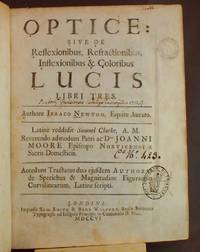
17045582London: Sam. Smith and Benj. Walford Printers to the Royal Society 1704. Hardcover. Near Fine. 4to. 24.2 x 18.8 cm. 2 ff. 144 pp. 211 pp 1 pp. with 19 folding engraved plates. Bound in contemporary English paneled calf. Minor ribbing to binding. Only very minor marginal traces of use. Very genuine. Excellent. First edition first issue of this landmark in science by Sir Isaac Newton 1642-1727 here in a remarkably well preserved unrestored example. "The work summarized Newton's discoveries and theories concerning light and color: the spectrum of the sunlight the degrees of refraction associated with different colors the color circle the first in the history of color theory the invention of the reflecting telescope the first workable theory of the rainbow and experiments on what would later be called 'interference effects' in conjunction with Newton's rings . . . The first edition of the Opticks ends with two mathematical treatises in Latin written to establish his priority over Leibnitz in the invention of the calculus" Norman 1588. Babson 132; Dibner 148; Horblit 79b; PMM 172; Norman 1588; Wallis 174. <br/> <br/> Sam. Smith and Benj. Walford, Printers to the Royal Society hardcover books
1704157612London: Smith & Walford 1704. First. hardcover. very good. Also Two Treatises of the Species and Magnitude of Curvilinear Figures. 4 parts in 1 volume. Title page printed in red & black within a double-ruled border. Illustrated with 19 folding copperplate engravings.4 144 211 1pp. In the second sequence p. 120 is marked 112 and there are blank pages between 137-8 and 138-9. Thick 4to contemporary blind-tooled panelled calf expertly rebacked in matching leather contemporary signature on title dated 1704; last several pages have marginal dampstains otherwise a remarkably clean crisp copy. London: Smith & Walford 1704.<br/><br/> First edition first issue - with the author not named on title page. The work contains: The First Book of Opticks The Second Book of Opticks The Thrid Book of Opticks Tertii Ordinis: Enumeratio Linearum Tractatus de Quadratura Curvarum. The main work is in English the 2 treatises pages 138-211 are in Latin. Babson 132; Gray 174; Horblit 79b; PMM 172; Norman 1588; Dibner 148; Wallis 174.<br/><br/> Smith & Walford unknown books
1220Twelve folding engraved plates. 4 p.l. 382 pp. one leaf of ads. 8vo cont. calf small portions of ends of spine & one corner carefully repaired spine gilt red morocco lettering piece on spine. London: W. Innys 1730. Fourth edition and the final edition to be revised by Newton of this great classic. It contains the complete set of 31 Queries which reveal some of Newton's most influential and speculative writing. Fine crisp copy. Contemporary armorial bookplate of Edward Powell. ❧ Babson 136. unknown books
1209Twelve folding engraved plates. 1 leaf of ads 1 p.l. xi 1 415 pp. 1 p. of ads. 8vo 18th-cent. speckled calf carefully rebacked by Aquarius double gilt fillet round sides spine richly gilt red morocco lettering piece on spine. London: G. & J. Innys 1719. Second edition in Latin and an influential book on the Continent. Newton published this edition in Latin to reach the Continental audience which had been little influenced by his optical experiments. The edition served its purpose and caused numerous demonstrations of his theory of colors to be performed in Paris. Newton's optical theories began to spread significantly outside Great Britain as a result of this book. See Westfall's Never at Rest pp. 794-95. A very good copy with the signature dated 14 Mar. 1822 of Stephen Peter Rigaud 1774-1839 historian of science astronomer and Savilian professor of geometry at Oxford. Stamp of the Radcliffe Observatory on verso of title. With the bookplate of William A. Cole the distinguished collector and bibliographer of chemistry. ❧ Babson 138. unknown books
1740S13116Lausannae & Geneva: Marci-Michaelis Bousquet & Sociorum 1740. 1740. 4to. iv xxxii 363 1 pp. Half-title engraved frontispiece portrait of Newton engr. Jean-Louis Daudet after Vanderbank 12 engraved folding plates title vignette of 4 cherubs and a female figure each using an optical instrument representing learning optics/perspective drawn by Delamoncein and engraved by Daudet head & tail pieces and woodcut initial letters drawn by Papillon index; first 11 leaves browned. Contemporary full vellum green leather gilt-stamped spine label edges with decorative red freckling as designed by the binder; foot of spine with faint ink marking "11-". Paper unevenly browned. Verso of title with small ink annotation "=1135="; rear pastedown with another notation "á 20.Luglio 1801." Very good. Third Latin edition edited by Bousquet with a dedication to Joannes Bernoulli. This edition contains the full array of 31 querries. / "Newton's contributions to the science of optics :: his discovery of the unequal refractions of rays of different color his theory of color and his investigations of 'Newton's rings' to mention only a few of the most noteworthy :: place him among the premier contributors to that science. . . . Today we recognize that his work on optics offers unique rewards in its exciting innovative conjunction of physical theory experimental investigation and mathematics and in the revealing glimpse that it provides of a crucial period in the evolution of experimental science." :: Alan E. Shapiro The Optical Papers of Isaac Newton: Volume 1 1984 p. xi. / Jean-Louis Daudet 1695-1756 who made the frontispiece and title vignette was an engraver and print publisher active in Lyon inherited business from his father Etienne Joseph Daudet. He flourished from 1722 till his death in 1756. Thereafter the business continued by his widow in association with his son-in-law Louis Martin Roch Joubert until 1773. / "Newton famously declared that it is not the business of science to make hypotheses. However it's well to remember that this position was formulated in the midst of a bitter dispute with Robert Hooke who had criticized Newton's writings on optics when they were first communicated to the Royal Society in the early 1670's. The essence of Newton's thesis was that white light is composed of a mixture of light of different elementary colors ranging across the visible spectrum which he had demonstrated by decomposing white light into its separate colors and then reassembling those components to produce white light again. However in his description of the phenomena of color Newton originally included some remarks about his corpuscular conception of light perhaps akin to the cogs and flywheels in terms of which James Maxwell was later to conceive of the phenomena of electromagnetism. Hooke interpreted the whole of Newton's optical work as an attempt to legitimize this corpuscular hypothesis and countered with various objections." / "Newton quickly realized his mistake in attaching his theory of colors to any particular hypothesis on the fundamental nature of light and immediately back-tracked arguing that his intent had been only to describe the observable phenomena without regard to any hypotheses as to the cause of the phenomena. Hooke and others continued to criticize Newton's theory of colors by arguing against the corpuscular hypothesis causing Newton to respond more and more angrily that he was making no hypothesis he was describing the way things are and not claiming to explain why they are. This was a bitter lesson for Newton and in addition to initiating a life-long feud with Hooke went a long way toward shaping Newton's rhetoric about what science should be. . ." / "The first edition of The Opticks 1704 contained only 16 queries but when the Latin edition was published in 1706 Newton was emboldened to add seven more which ultimately became Queries 25 through 31 when in the second English edition he added Queries 17 through 24. Of all these one of the most intriguing is Query 28 which begins with the rhetorical question "Are not all Hypotheses erroneous in which Light is supposed to consist of Pression or Motion propagated through a fluid medium" In this query Newton rejects the Cartesian idea of a material substance filling in and comprising the space between particles. Newton preferred an atomistic view believing that all substances were comprised of hard impenetrable particles moving and interacting via innate forces in an empty space as described further in Query 31." :: Newton's Cosmological Queries :: MathPages. / Grace K. Babson Sir Isaac Newton 1950 141; George J. Gray A Bibliography of the Works of Sir Isaac Newton 182; Wallis 182. See: Printing and the Mind of Man 172. Marci-Michaelis Bousquet & Sociorum, 1740. hardcover books
1740012680Lausanne & Geneve.: Marci-Michaelis Bousquet & Sociorum 1740. All edges stained red. Spine labelled near top. Half-title page present. Portrait frontispiece. Title-page with vignette printed in red and black. Errata page at end of text. Engraved head and tail pieces. Illuminated first letters of sections. Front free endpaper has missing piece at top corner. Endpaper are browned. Very faint suggestion of erasure at top of title-page. Wide margins and clean text throughout. Old water-staining to bottom of first 30 pages See photo. Twelve fold-out plates all intact and clean. This treatise on optics was first published in English in 1704 the first Latin edition published in 1706. Sir Isaac Newton 1643-1727 was an English physicist mathematician astronomer alchemist philosopher and theologian. He is most well-known for his "Philosophiae Naturalis Principia Mathematica" published in 1687 laying the ground work for most classical mechanics. He built the first practical reflecting telescope and he developed a theory of color based on the observation that a prism decomposes white light into many colors that form the visible light spectrum. He expanded on these theories in "Opticks". We find 20 libraries worldwide holding the book. ABPC shows a total of 7 copies sold at auction in the past 32 years. ii half-title blank frontispiece and title-page xxxii 1-363 errata 12 folding plates ii. Collated complete 10 May 2011. See "Printing And The Mind Of Man" 172. New Edition. Full Vellum. Moderate General Soiling. Quarto. Marci-Michaelis Bousquet & Sociorum Hardcover books
17066324London: Samuel Smith & Benjamin Walford 1706. First Latin edition. Very Good/The Latin edition of Newton's 1704 Opticks was intended for the broader pan-European "Republic of Letters" and it was the first printing to carry Newton's name on the title. This is the edition that inspired Emelie du Chatelet and Voltaire and through them the whole of Europe. It is a compendium of Newton's main discoveries concerning light and color including the spectrum of sunlight the color circle the reflecting telescope and interference effects that is the so-called 'Newton's rings'. In expansion of the 1704 English text the Latin edition presents seven added "Quaestiones" which are partly devoted to Newton's support for the "corpuscular" or particle theory of light. The collation of this copy corresponds to the copy in the Babson Collection catalogue with "Pp" consisting of a single leaf and with pages 21-24 repeated in the Tractatus. . Quarto 26 cm; 14 348 2 24 2 24 21-43 1 pages 19 folded leaves of engraved plates with errata corrigenda and addenda. Ss1 a cancel. In original calf with blind-ruled border rebacked with corners built up. Spine with gilding and leather title label. Speckled edges. Old library stamps on title page along with early ownership inscriptions. References: Bowes and Bowes #179; Babson Collection 137; Norman 1589. Samuel Smith & Benjamin Walford, hardcover books
16932188Oxford: Oxford University Press 1693. First collected edition. Contemporary calf. Very Good. SCARCE FIRST EDITION OF THE COLLECTED WORKS of one of Newton's most important precursors John Wallis Savilian Professor 1649-1703 containing the first printed appearance of Newton's ideas on fluxions. A staunch promoter of English mathematicians Wallis repeatedly urged Newton to publish his theories before others laid claim to he work for the sake of "your Reputation & that of the nation" Gjertsen Newton Handbook 605. While Newton resisted for many years in 1693 Wallis published several letters from Newton in Vol. II of his Opera thereby introducing the concept of fluxional notation-pricked and dotted letters. In the preface to Vol. I 1695 Wallis refers briefly to Newton's claim to the discovery of Fluxions while Vol II 1693 has the first full account of Newton's invention of calculus. The third volume of Wallis's Opera contains previously unpublished correspondence between Newton and Leibniz the most important items of which are Newton's Epistola prior and Epistola posterior. "These two lengthy letters were sent to Leibniz in 1676 to acquaint him with the main lines of Newton's mathematical development. Epistola prior beginning with the binomial theorem went on to describe Newton's work on series. The second letter also contains much discussion on infinite series. It is best known however for Newton's reference to powerful and general methods he had developed for the drawing of tangents the determination of maxima and minima and the quadrature of curves. These he added he preferred to conceal within a quite insoluble anagram. A second and even longer anagram concealed Newton's claim to be able to solve fluxional equations. The solutions to both were publicly disclosed by Wallis 1699" ibid 189. Vol. 2 of the Opera also contains pp. 669-78 De Postulato Quinto; et Definitione Quinta; Lib. 6. Euclidis; disputatio geometrica Wallis's important attempt to prove the parallel postulate of Euclid also published here for the first time. "John Wallis gave a lecture on this topic. on the evening of 11 July 1663. He had been inspired by Nasr-Eddin's attempt on it which he referred to in his lecture to examine the question himself and his analysis is remarkable both for its originality and its caution. Indeed his view of the matter was to be much more profound than many a later writer's" Fauvel & Gray The History of Mathematics 510. This magnificent and comprehensive edition of Wallis's collected works was financed by and printed at Oxford University. In addition to several 'firsts' including those described above these volumes contain reprints of virtually all of Wallis's great books including the Arithmetica infinitorum and Mechanica Vol. 1 an augmented Latin edition of the Treatise of Algebra Vol. II and bilingual editions of a number of ancient Greek texts including Ptolemy's Harmonics Aristarchus's On the magnitudes and distances of the sun and moon and Archimedes's Sand-reckoner Vol. III. In addition to numerous other mathematical works the four volumes include his most popular work Grammaticae lingua anglicanae his "Treatise of Speech which formed a useful theoretical foundation for his pioneering attempts to teach deaf-mutes how to speak" DSB as well as an important tract on cryptography in which he records the methods he developed while deciphering for Cromwell the coded messages of Charles I. Wing W596 W566 W597. Babson 184. Roberts and Trent 345. see J.F. Scott The Mathematical Work of John Wallis London 1938; M. Baron The Origins of the Infinitesmal Calculus Oxford 1969 205-213; Richard Westfall The Life of Isaac Newton Cambridge 1993 207-209ff. Opera Mathematica. Volumen primum -Tertium - Opera quaedam miscellanea. Oxford: Sheldonian Theatre University Press 1695 1693 1699. Four volumes bound in three. Folio contemporary full paneled calf rebacked to style. Complete with four engravings on three leaves and three portraits Vols. I & II with the same portrait by Loggan dated 1678 and engraved by Burghers; Vol 3 by Sonmans dated 1698 and engraved by Burghers. With large bookplate inside each front cover reading "The Gift of Mr. Thomas Heatley Citizen and Iron-monger of London to the Mathematical School in Christ's Hospital Anno Dom. 1700". A very clean copy with only occasional light browning and foxing very handsomely bound. ONE OF THE MONUMENTS IN THE HISTORY OF MATHEMATICS. RARE. . Oxford University Press unknown books
2006150618Portland OR: Nazraeli Press and Joy of Giving Something Inc 2006. First edition. Hardcover. First printing of only 500 copies. Newton's first book a collection of 27 color and black and white images. A fine copy in a fine dust jacket. Nazraeli Press and Joy of Giving Something, Inc unknown books
186556517Newport R.I.: Thursday morning Sept. 14 1865. 4to approx. 10" x 8" approx. 20 lines and 200 words in ink; folds and with the original stamped cover "Steam Boat" and with a Providence roundstamp and the stamp of the "American Steamboat Company Sept. 14 1865 steamer City of Newport." Light soiling and spotting of the envelope but generally near fine. Written just after the end of the Civil War Newton begins by apologizing he will not be able to attend a meeting because of "my constant engagements for the past two weeks in closing up the affairs of the Naval Academy . I regret to say that it has been impossible for me to attend the State Committee . to listen to Mr. Bradford's report of the convention which is doubtless very satisfactory judging from the little that I have gathered from the papers and I feel grieved that I have lost the opportunity of interchanging views . upon the prospect of bright hope for better days now dawning . Write me if not too much trouble the most interesting points of your conversation . My regards to Bradford Steere and all good friends in the bonds of democratic truth and love." Miller was a resident of Bristol a member of the Rhode Island Historical Society where he is known to have delivered several papers worked with the U.S. Coast and Geodetic Survey on charts of Narragansett Bay and later was one of the founders of the Bristol and Warren Water Works. <br/><br/> Thursday morning, Sept. 14 unknown books
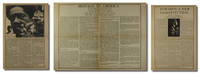
197026575Oakland: Black Panther Party 1970. Single newsprint tabloid sheet folded in two to make 4 pages. The first page reprints Cleaver's 'On the Constitution' the inner two pages "Message to America' by the Black Panther Party across the full sheet and the rear Huey Newton's "Towards a New Constitution'. Paper tanned as usual. horizontal fold as issued else a nice example. None located in OCLC. <br/><br/> [Black Panther Party] unknown books
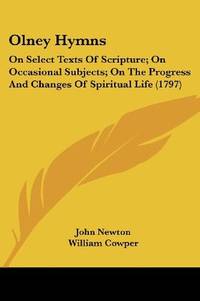
1339210Kessinger Publishing. Softcover. Octavo; Reprint of "A New Edition" published by J. Johnson London 1797; G; Paperback; Spine yellow with black print; Cover is clean and bright; Text block has lightly cocked spine penciled notation throughout crimping to top edge of two paper-clipped pages; Cover title: "Olney Hymns on Select Texts of Scripture on Occasional Subjects on the Progress and Changes of Spiritual Life"; xvi 332 pages. 1339210. FP New Rockville Stock. Kessinger Publishing unknown books
1928012229NY: Bowling Green Press 1928. 1st Edition Limited. Hardcover. As New. Limited edition #348 of 750 copies. As new still wrapped in glassine in publsiher's plain cardboard box top missing sides. Numbered and signed on the colophon by pressman Edward Stern. Bowling Green Press hardcover books
197856654NY:: Abrams. Good. 1978. Paperback. 0810914662 . Portfolio of photographs by David Finn. First edition paperback. Portfolio of seventeen loose folded sheets with black and white photographs throughout. Damp mark on title page somewhat musty else good in a good damp mark on rear oversize pictorial cover. . Abrams, paperback books
1977163453New York: Harry N. Abrams Inc 1977. First edition. Large softcover. A collection of 17 folded sheets 3 of which have text by Douglas Newton and the remaining ones with striking black and white images by David Finn. Sheets in fine condition and housed in a very near fine photographically illustrated cardstock folder. Harry N. Abrams, Inc unknown books
1978RFINOCE00EFHarry N. Abrams 1978. Very Good. Finn David. Oceanic Images. Newton Douglas. New York: Harry N. Abrams 1978. Illustrated. Folio. Book condition: Very good prints with slightly bumped and rubbed edges. Paper folio is in good condition with a short closed tear in spine and half inch chips missing from spine ends. Edges are rubbed and bumped and corners are rubbed away. Flaps are slightly askew. Remnants of former retailer's stickers on rear. Harry N. Abrams unknown books
171160paperback. Portfolio of photographs by David Finn tall slim folio stiff photographic wrappers. New York: Harry Abrams 1977. Very Good.<br/><br/> unknown books
183121773London: James Nisbet &T. Stevenson Cambridge 1831. 8vo 23.5 cm; 9". 1 f. xii 250 pp. <br><br>Third edition. In addition to being a physicist mathematician and natural philosopher Sir Isaac Newton was something of a Biblical scholar as well as shown by the present exegesis on apocalyptic texts. His analysis generally reads as being practical in nature as the New Catholic Encyclopedia X 428 says "Newton's writings on apocalyptical prophecies were not mystical or millenarian in any sense but more exercises in deciphering cryptograms." They comport with our sense of him as someone who believed in the scientific method!<br>Â Â Â Â "A new edition with the citations translated and notes by P. Borthwick . . . of Downing College Cambridge. Publisher's quarter green cloth with paper-covered boards. Rebacked in sympathetic cloth and new paper label antique style applied. Boards show age-stains and wear but are solid. Old library pressure-stamp on title-page. In an open back slipcase of green library cloth; spine of box with author title and call number in gilt. => A nice copy sound for reading. James Nisbet, &T. Stevenson, Cambridge hardcover books
193511577N.P.: Privately printed 1935. paper self wrappers. Newton A. Edward. tall 16mo. paper self wrappers. 8 pages. Issued to people interested in joining the Trollope Society of which Newton was founder Fleck A.38. The purpose of the Society was to place all of Trollope's works back in print at reasonable prices. Fine copy of a scarce piece. Privately printed unknown books