64 résultats
179943865Halle, Rengerschen Buchhandlung, 1799. Without wrappers. In ""Annalen der Physik. Herausgegeben von Ludwig Wilhelm Gilbert"", Bd. 2, Erstes Stück. (The entire issue offered). Titlepage to vol. 2. Pp. 1-118 a. 2 folded engraved plates. Cavendish's paper: pp. 1-62. (the torsion balance of Michell shown on the plates).
179948206(Halle, Rengerschen Buchhandlung, 1799). Without wrappers. In ""Annalen der Physik. Herausgegeben von Ludwig Wilhelm Gilbert"", Bd. 2, Erstes Stück. (The entire issue offered). 1-118 a. 2 folded engraved plates. Cavendish's paper: pp. 1-62. (the torsion balance of Michell shown on the plates).
174046843(Paris, L'Imprimerie Royale, 1740). 4to. Without wrappers. Extracted from ""Mémoires de l'Academie des Sciences. Année 1737"". Pp. 205-227 a. 2 folded engraved plates.
175946432(Berlin, Haude et Spener, 1759). 4to. No wrappers, as issued in ""Mémoires de L'Academie Royale des Sciences et belles-Lettres"", tome XIII, 1757. With titlepage to the year 1757 with engraved titlevignette and pp. 125-159 and 1 folded engraved plate. A Stamp to titlepage.
176844804(Berlin, Haude et Spener, 1768) 4to. No wrappers, as issued in ""Mémoires de l'Academie Royale des Sciences et Belles-Lettres"", tome XXII, Année 1766. Pp. 119-170 , pp. 171-201 and 2 folded engraved plates., pp. 202-212 and 1 folded engraved plate.
176850190(Berlin, Haude et Spener, 1768). 4to. No wrappers, as issued in ""Mémoires de l'Academie Royale des Sciences et Belles-Lettres"", tome XXII, Année 1766. Pp. 119-170 , pp. 171-201 and 2 folded engraved plates., pp. 202-212 and 1 folded engraved plate. With the section title-page to ""Classe Mathématique"".
176944803(Berlin, Haude et Spener, 1769) 4to. No wrappers, as issued in ""Mémoires de l'Academie Royale des Sciences et Belles-Lettres"", tome XVIII, Année 1762. Pp. 195-225 and 1 folded engraved plate. + Pp. 226-248.
176945125(Berlin, Haude et Spener, 1769). 4to. No wrappers, as issued in ""Mémoires de l'Academie Royale des Sciences et Belles Lettres"", Année 1767, tome XXIII, pp. 131-164 a. 1 engraved plate.
176949807(Berlin, Haude et Spener, 1769). 4to. No wrappers, as issued in ""Mémoires de l'Academie Royale des Sciences et Belles Lettres"", Année 1767, tome XXIII, pp. 131-164 a. 1 engraved plate.
176948878(Berlin, Haude et Spener, 1769). 4to. No wrappers as issued in ""Memoires de l'Academie Royale des Sciences et Belles Lettres"". tome XVIII, 1762. With halftitle ""Classe de Mathematique"" (2) pp. + pp. 117-142. Clean and fine.
175945126(Berlin, Haude et Spener, 1759). 4to. No wrappers, as issued in ""Mémoires de l'Academie Royale des Sciences et Belles Lettres"", Année 1757, tome XIII, pp. a. 1 engraved plate.
176949805(Berlin, Haude et Spener, 1769). 4to. No wrappers as issued in ""Memoires de L'Academie Royale des Sciences et Belles Lettres"", tome XXIII, pp. 165-310. Clean and fine.
177244755Berlin, C.F. Voss, 1772. 4to. Without wrappers as extracted from ""Nouveaux Mémoires de l'Academie Royale des Sciences et Belles-Lettres"", Annee 1770. With titlepage to 1770 with engraved vignette. Pp. 327-342.
179943872(Halle, Rengerschen Buchhandlung, 1799). Without wrappers. In ""Annalen der Physik. Herausgegeben von Ludwig Wilhelm Gilbert"", Bd. 1 Viertes Stück und Bd. 2, Drittes Stück. (The entire issues offered). Pp. 379-518 a. 2 folded engravd plates + pp. 249-368 a. 2 folded engraved plates. Rumford's papers: pp. 436-463 a. pp. 249-286.
175924732AFranckfurt [am Main], Johann August Raspe, 1759. Kl. 8°. 3 Bl., 422 Seiten, 1 Bl. Mit Kupfer-Frontispiz und gestochenem Titel. Halbleder der Zeit mit rotem Lederrückenschild und mit lederverstärkten Ecken. (Einband berieben, Exlibrisschild auf Innendeckel, Papier gebräunt). [3 Warenabbildungen]
1767486393Ohne Ort u. Verlag, 1767. 23 Bl., 432 S. Mit gestochener Titelvignette. Interimspappband d. Zeit (berieben, Ecken u. Kanten stark bestoßen, Rücken am Kopf eingerissen). [2 Warenabbildungen]
1774482941Riga u. Leipzig, Hartknoch, 1774. 4 Bl., 407 S. Pappband d. Zeit (berieben, bestoßen u. fleckig, Gelenke mit kl. Wurmspuren). [2 Warenabbildungen]
17138808ABParis, Jean Mariette, 1713. 25 x 20 cm. (5) Bl., 293 (1) S., (6) Bl. Mit 33 [von 38] Kupfertafeln und zahlreichen Holzschnitten und Vignetten. Die (fehlenden) 5 Tafeln (A1-A5) sind als gute Farbkopien beigefügt. Leder. Alter beschabter und beriebener Einband mit neuem Leder ergänzt. Rücken unter Verwendung des alten erneuert. [9 Warenabbildungen] Nouvelle Edition. Ordentlicher Zustand nach Restaurierung. Seiten teils angefleckt u. m. Eck-Knicken. Tafeln angefleckt, Ausklapptafeln m. Quetschfalten u. teils angerändert. Tafeln verso teils mit gärtnerischen Handzeichnungen in Blei. Zwei Tafeln mit amateurhafter alter
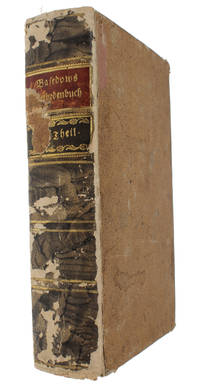
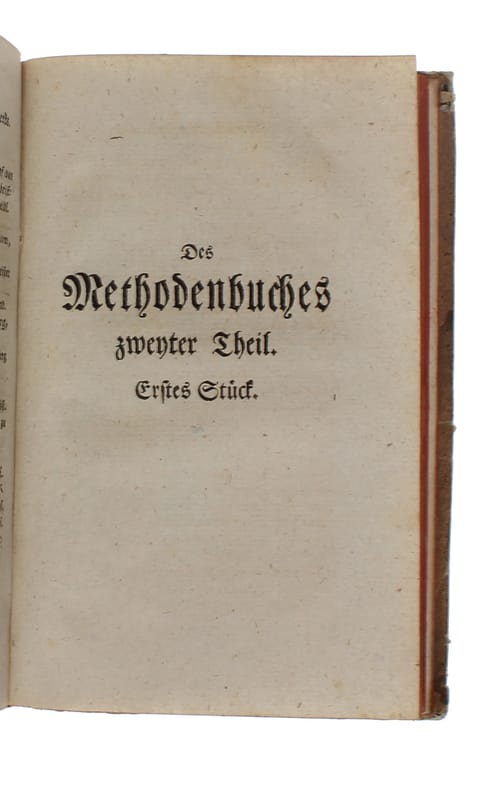
177050344Altona und in der Cramerischen Handlung in Bremen 1770. 8vo. Contemp. marbled boards. The marbled paper on covers gone scratches to marbled paper on spine. Binding fully intact. Title-and tomelabels in leather with gilt lettering. A stamp on foot of title-page. 6XXIV56032;VIII112 pp. Some scattered brownspots mainly to "Verbesserungen des ersten Theiles" and to title-pages. <br/><br/><em>Very scarce first edition of Basedow's main work in educational theory meant to explain his "Elementarwerk".He was strongly influenced by Rousseau's ideas on education in Emile and he proposed the reform of schools and of the common methods of instruction the establishment of an institute for qualifying teachers and solicited subscriptions for the printing of a new illustrated book Elementarwerk "Elementary Book" where his principles were to be explained at length assisted by "Das Methodenbuch".Basedow was called to Denmark in 1753 to become professor at Soroe Akademi where he stayed for 8 years. He was dismissed to Altona in 1761 caused by his theological views going against the prevailing orthodoxy. While he stayed in Soroe he published his "Praktische Philosophie für alle Stände" 1758. </em> hardcover
177050344Altona, und in der Cramerischen Handlung in Bremen, (1770). 8vo. Contemp. marbled boards. The marbled paper on covers gone, scratches to marbled paper on spine. (Binding fully intact). Title-and tomelabels in leather with gilt lettering. A stamp on foot of title-page. (6),XXIV,560,32"VIII,112 pp. Some scattered brownspots, mainly to ""Verbesserungen des ersten Theiles"" and to title-pages.
1799627576Frankfurt u. Leipzig, 1799. XVI, 512 S., 2 Bl. Marmorierter Pappband d. Zeit (berieben, Ecken u. Kapitale bestoßen, Rückenschild mit kl. Fehlstellen). [2 Warenabbildungen]
179961569Leipzig, Weidmann, 1799. 8°. Mit einer gefalt. Kupfertafel. VI, 74 S., Ppbd. d. Zt. m. dreiseitig gespränkeltem Rotschnitt.
179943865Halle Rengerschen Buchhandlung 1799. Without wrappers. In "Annalen der Physik. Herausgegeben von Ludwig Wilhelm Gilbert" Bd. 2 Erstes Stück. The entire issue offered. Titlepage to vol. 2. Pp. 1-118 a. 2 folded engraved plates. Cavendish's paper: pp. 1-62. the torsion balance of Michell shown on the plates. <br/><br/><em>First German edition of Cavendish's famous paper in which he calculated the weight of the earth and determined its mass. He also as the first observed gravitational motion of minute portions of matter. He estimates the earth's mass to 66 x 10 to the potential of 24 kg. The original paper "Experiments to determine the Density of the Earth" appeared in Philosophical Transaction 1798."Cavendish published five papers between 1784 and 1809.With one exception they were comparatively minor productions.The exception was his determination of the density of the earth or weighing of the world in 1798 by means of John Michell's torsion balance. The apparatus consisted of two lead balls on either end of a suspended beam; these movable balls were attracted by a pair of stationary lead balls. Cavendish calculated the the force of attraction between the balls fro the observed period of oscillation of the balance and deduced the density of the earth from the force. He found it to be 5.48 times that of water. Cavendish was the first to observe gravitational motions induced by comparatively minute portions of ordinary matter.By weighing the world he rendered the law of gravitation complete. The law was no longer a proportionally statement but a quantitatively exact one; this was the most importent addition to the science of gravitation since Newton."DSB III p. 158. </em> unknown
179948206Halle Rengerschen Buchhandlung 1799. Without wrappers. In "Annalen der Physik. Herausgegeben von Ludwig Wilhelm Gilbert" Bd. 2 Erstes Stück. The entire issue offered. 1-118 a. 2 folded engraved plates. Cavendish's paper: pp. 1-62. the torsion balance of Michell shown on the plates. <br/><br/><em>First German edition of Cavendish's famous paper in which he calculated the weight of the earth and determined its mass. He also as the first observed gravitational motion of minute portions of matter. He estimates the earth's mass to 66 x 10 to the potential of 24 kg. The original paper "Experiments to determine the Density of the Earth" appeared in Philosophical Transaction 1798."Cavendish published five papers between 1784 and 1809.With one exception they were comparatively minor productions.The exception was his determination of the density of the earth or weighing of the world in 1798 by means of John Michell's torsion balance. The apparatus consisted of two lead balls on either end of a suspended beam; these movable balls were attracted by a pair of stationary lead balls. Cavendish calculated the the force of attraction between the balls fro the observed period of oscillation of the balance and deduced the density of the earth from the force. He found it to be 5.48 times that of water. Cavendish was the first to observe gravitational motions induced by comparatively minute portions of ordinary matter.By weighing the world he rendered the law of gravitation complete. The law was no longer a proportionally statement but a quantitatively exact one; this was the most importent addition to the science of gravitation since Newton."DSB III p. 158.The issue contains further papers by Ritter Chladni et al. </em> unknown
174046843Paris L'Imprimerie Royale 1740. 4to. Without wrappers. Extracted from "Mémoires de l'Academie des Sciences. Année 1737". Pp. 205-227 a. 2 folded engraved plates. <br/><br/><em>First appearance of this extremely importent paper in which Clairaut directly confirms the rotation and the orbital movement of the Earth around the Sun and giving an indirect proof of the axiom that the velocity of light does not depend on whether the light source moves away or toward the observer. The Earth does move after all !!In 1728 James Bradley trying to measure the stellar parallax discovered stellar aberration - the angular displacement of the apparent direction of starlight due to the earth's motion - and attributed it to the combined effect of the finite velocity of light and the earth's orbital velocity. But Bradley had not given any theoretical proof but Clairaut did in the offered paper.Aberration is "the apparent change in direction of a source of light caused by an observers component of motion perpendicular to the impinging rays. During this time the telescope has moved a short distance causing the photons to reach a spot on the focal plane displayed from the former image position. This discovery provided the first direct physical confirmation of the Copernican theory. A second importent application of aberration has been its clear-cut demonstration that as is axiomatic to special relativity light reaching the earth has a velocity unaffected by the relative motion of the source toward or away from earth."McGraw-Hill "Concise Encyclopedia.". </em> unknown