209 résultats
197621944London: The Wellcome Institute for the History of Medecine 1976. First edition. 1 vols. Large 4to. Cloth. Fine. First edition. 1 vols. Large 4to. The Wellcome Institute for the History of Medecine unknown books
1741224902Halle: Waysenhaus 1741. Collation; 1 a-c8A-pppp8. 7 ff. 1-1232 pp. 56 ff. index. 1 vols. 8vo. Contemporary vellum soiled foot of spine worn some browning of text. A few faint contemporary ink markings in prelims. A fresh sound copy. Collation; 1 a-c8A-pppp8. 7 ff. 1-1232 pp. 56 ff. index. 1 vols. 8vo. Mid-eighteenth-century edition of this popular German medical work by Christian Friedrich Richter 1676-1711 medical doctor and theologian and medical director of the Halle orphanages.<br/><br/>From the library of Dr. Ernst L. Wynder co-author of the first large-scale study of smoking and lung cancer JAMA 143:329 and FOUNDING EDITOR of the journal Preventive Medicine. cf. Blake 381 12th ed. Leipzig same year; Hirsch/H. IV 799 Waysenhaus] unknown books
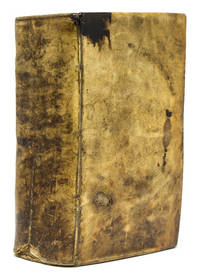
183056621Cincinnati OH: Robinson and Fairbank 1830. First edition the issue with four plates but with the horse plate of "Wyandot" rather than "Consul Cox's Arab". 12mo. xii 13-367 pp. Illustrated four plates frontispiece lacking small fold down portion at top two engraved by W. Woodruff a Philadelphia engraver who moved to Cincinnati after 1824 Stauffer. Includes the chapter "Blooded Horses in the West" by Daniel Gano pp. 345-362 the first history of the thoroughbred in Kentucky and Ohio; also includes "The Horse" pp. 70-104 "Diseases of Animals" pp. 320-339 illustrated with a folding plate showing the anatomy of a horse and "The Grape and Manufacture of Wine" pp. 292-309 among many sections. A second edition was published in 1832 under the title "The Farmer's Guide and Western Agriculturalist." Sabin 102962 "4 plates 3 folding". American Imprints 5411. Henderson "Early American Sport" p. 41. Rink "Technical Americana" 1360. Morgan "Ohio Imprints" 2086. Not in Thomson or Coleman. NUC "4 plates part folding". Several signatures pulled persistent foxing a little text loss to one leaf from a printing flaw but a good solid copy with the defect to one plate noted. Contemporary calf rubbed spine ends a little frayed gilt title and ornaments on spine. #2812. OCLC presently records 37 institutions holding a copy of "The Western Agriculturist" and we have found several others from other sources. Surveying those libraries 31 responses we found multiple copies in several for a total of 35 but twelve copies were reported as being defective i.e. lacking plates or portions of plates or text nine copies were reported as actually being either microfilm versions or photocopies and seven others were reported to be ghosts i.e. the institution's copy was either lost or had never actually been in the collection. Of the seven copies reported as being complete four reported four plates a frontispiece memorializing the Hamilton County Public Library plates of an Improved Durham Short Horn cow the horse "Consul Cox's Arab" and a plate illustrating the anatomy of the horse Library of Congess Kentucky Transylvania Cincinnati/Hamilton County Public and three Columbia Western Reserve Cincinnati/Hamilton County Public reported three plates the Durham cow and anatomy plates as described above and a frontispiece portrait of the horse Wyandot. <br/><br/> Robinson and Fairbank unknown books
53656in an extensive fragment of an autograph report signed 5 January 1863 at Nashville Tennessee. 4to. Four pages approximately 750 words illustrated with a rough sketch map of the positions of the Union divisions at the battle comprising the final three pages of a seven page report with an extra leaf inserted. Folded several short splits at folds. Quite legible and very good. McArthur a Union surgeon who was responsible for establishing a hospital in Nashville gives a detailed first-hand account of the developments of the battle on its first day 31 December 1862 describing the chaos on the Union right its destruction and flight "a stampede more ludicrous and unmanageable than that of Bull Run" and assigns blame to General Richard W. Johnson commanding a division under McCook who "was taken by surprise while his troops were eating and his artillery horses drinking . and upon Gen. Johnson rests the blame of this shameful retreat & loss of life." Attending to his medical duties that day McArthur reports "making provision for the wounded in establishing Hospitals for the accommodation of those already injured and extracting balls dressing wounds and performing some capital operations required from the casualties of the day in which your humble servant played no inconsiderable part amputating two limbs &c &c . later I have stood at amputating table two days and two nights and am constantly working to make the ill soldiers comfortable. I am striving to establish a U.S. Hospital at Nashville." A stirring report on the heat of battle. <br/><br/> unknown books
190926971Paris France: Compagnie Des Eaux Minerales Economiques 1909. A photograph album composed of 29 heavy cardstock leaves each titled with a French hospital with a mounted photograph of the interns of 1908-09. On the mounts printed below the images are the surname-identification of the new doctors along with a quote from a famous medical personage. Photographic studio not identified aside from the printed notice in the surround of "Cliche Femina." Our research indicates that these albums were produced by the Compagnie des Eaux Minerales. as promotional devices; the cover titles are further personalized and include the name of one of the graduates A Monsieur Corylles actually Coryllos from the Hopital Cochin Paris. Dr. Coryllos 1880-1938 was an eminent thoracic surgeon and pioneer in the use of the mobile field hospital saving lives during military conflicts Every photograph black and white silver gelatin process; approx. 4 ¾" x 6" size is characterized by extraordinary clarity and very professionally taken; several of them presenting the graduating physician's candid expressions of humor - one posing with a monkey on his back another lugging a huge travel-box by a rope over his shoulders many with pet dogs & cats one with what appears to be a monstrous lizard; in another three men sit astride sheep and a goat; other portraits promoting expressions of extreme gravitas. The Hopital Des Enfants Malades with two women identified Mlle. Bouteil and Mme. Debre; the Hopital de la Pitie with Mme. Long; Mlle. Dechaux at Hopital Claude-Bernard Aubervilliers; two of the images from the Hopital Bichat & Hopital Beaujon with unidentified women posed with the groups. The images appear to have been taken on the grounds and building forecourts of these medical establishments including: Hopital Andral & Bastion 27 et 29; Beaujon; Berck Sur-Mer; Hospice de Bicetre; Bichat; Boucicaut; Bretonneau; Broca; Broussais; de la Charite; Claude-Bernard Aubervilliers; Cochin; Cochin Annexe; Maison Dubois; des Infantes Assistes; des Infantes Malades; Herold; Hotel-Dieu; Hospice D'Ivry; Laennec; Lariboisiere; La Maternite; Necker; de la Pitie; Saint-Antoine; Saint-Louis; Hospice de la Salpetriere; Tenon; and Hopital Trousseau. Heavy oblong format covers about 8 pounds shipping weight. Approx. 11" x 14" size; gilt titled green pebbled cloth & leather corners; binding damaged worn spine covering gone; all photographs in very good condition. First Edition. Hard Cover. Good. Compagnie Des Eaux Minerales Economiques hardcover books
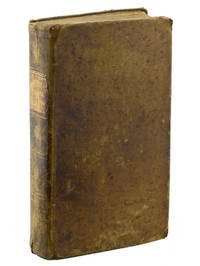
183419309Madisonville Tennessee: Printed at the Office of Henderson & Johnston Edwards & Henderson--Printers 1834. Fourth edition. Sheep rubbed with a small chip at the head of the spine; foxed as usually found; rear free endpaper excised; a very good copy. Large 8vo contemporary likely original sheep brown leather label gilt rules and lettering xv 1 604 pages. The great populist domestic medical guide of Jacksonian America with much on herbal remedies as well as advice on child birth wound care etc. from the Savannah Georgia native and Madisonville Tennessee physician John C. Gunn 1795-1863. See the Atwater catalog summary of Rosenberg's introduction to the facsimile of the 1830 first edition for more on Gunn's work and its contrast to Buchan. This edition includes the added section on epidemic cholera. A so-called second edition was also published in Madisonville in 1834; the first edition was published in Knoxville in 1830 followed by a Knoxville second edition in 1833 and a so-called Madisonville fourth edition in 1833 preceding the Madisonville second edition of 1834. American Imprints Inventory Tennessee 291; Atwater 1461 this edition. Printed at the Office of Henderson & Johnston, Edwards & Henderson--Printers, unknown books
1947M4841New York:: Henry Schuman 1947-1972. 1947. Twenty volumes. 255 x 178 mm. Tall 8vos. Various paginations. Illus. Navy buckram gilt spines. Bookplate of Elmer Belt. Very good. Includes volumes 2 4-10 12-17 19-22 25 27. The JOURNAL OF THE HISTORY OF MEDICINE AND ALLIED SCIENCES is devoted to work relating to all aspects of the history of medicine public health dentistry nursing pharmacy veterinary medicine etc. Edited by George Rosen the numerous contributors include many famous historians of medical history: Ralph Major Carl Bridenbaugh Herbert Klickstein Max Neuburger Walther Riese Charles Singer etc. Henry Schuman], 1947-1972. hardcover books
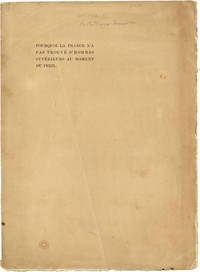
187147582Rome: Forzani et C. 1871. First Edition. Folio 33cm.; publisher's tan printed card wrappers; 18pp. Wrapper lightly soiled faint vertical creasing a few tiny chips to spine ele Very Good internally fresh and fine save the crease. Polemical attack on the state of the French university system written in March 1871 two months after the end of the disastrous for the French Franco-Prussian War. As Pasteur argues whereas in Germany universities proliferated across the country France "stymied by revolution was always occupied with the sterile search for a better form of government giving only distracted attention to her institutions of higher learning" p. 9 our translation. At the root of all this was the regime of Napoleon I who in the early years of the 19th century neglected the country's twenty-eight extant institutions of higher learning in favor of his Université de France a disastrously centralized state-run institution that he established in 1808. The University suffered greatly during the Restoration and with it the quality of education so that by 1868 only £8000 were being spent for "true academic purposes" across the country cf. W. Chandler Roberts et al "Journal of the Society for Arts Vol. 32 no. 1655 August 8 1884 p. 905 creating a lacuna of learned and innovative thinkers to match Germany's. Perhaps in order to combat this downward trend Pasteur later founded the Pasteur Institute in 1887 serving as its director until his death in 1895. <br/><br/>This appears to be the only separate appearance of Pasteur's tract published abroad and distributed to various foreign leading scientific figures among these "Darwin's Bulldog" Thomas Henry Huxley who makes mention of this work in an address delivered in October of that same year. The essay appeared again in print in 1947 following an even more disastrous encounter with Germany in a collection titled "Pour l'Avenir de la Science Française." This publication quite scarce with four physical copies noted in OCLC as of February 2020. COPAC adds one copy at the LEC Library UK. Forzani et C. unknown books
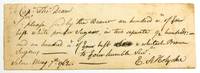
1762305478Salem MA 1762. 2 pp. pen and ink on paper. 6-1/2 x 2-1/2 inches 3-1/2 x 4-3/4 inches. Old fold minor soiling stains very good. 2 pp. pen and ink on paper. 6-1/2 x 2-1/2 inches 3-1/2 x 4-3/4 inches. AN EARLY PIONEER OF SMALL POX VACCINATION. These items offer a quaint glimpse of a beloved New England Physician. Edward Augustus Holyoke 1728-1829 the son of Rev. Edward Holyoke 1689-1769 and Margaret Appleton was born in Marblehead Massachusetts on August 1 1728. Holyoke moved with his family to Cambridge when his father was appointed president of Harvard and graduated from the college in 1746. After a brief tenure as a school teacher he apprenticed himself to a physician in Ipswich. He later opened his own practice in Salem where he gained his greatest notoriety as an early pioneer in small pox treatment and prevention during an outbreak in 1777. During his lifetime he would serve as president of the Massachusetts Medical Society was awarded the first M.D. degree given by Harvard Medical School and spent six years as president of the American Academy of Arts and Sciences. Holyoke continued to practice medicine in Salem until 1821 and was honored by the town during a tribute at the Essex House on his 100th birthday. <br/><br/>1. Autograph Document Signed. To Capt. Thos. Dean. Reading: "Sir please send by the bearer an hundred w. of your best white powder sugar in two separate 1/2 hundreds: - and an hundred w. of your best & whitest Brown Sugar - to your humble sevt. E.A. Holyoke"<br/><br/>2. Prescription listing four ingredients including "camomilla" and "gentian" with the directions: "Steep in one quart maderah & take a glass every noon. unknown books
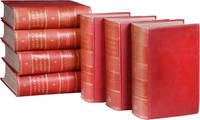
190751831Philadelphia: Lea & Febridge 1907-1910. First Edition. First printings. Seven large octavo volumes 24cm. Publisher's red cloth boards titled in gilt on spines; lavender endpapers; plates; illus. Very mild external wear; rear free endpaper lacking in vol. 7 else a complete unusually well-preserved set in the original publisher's cloth. The last major authorial undertaking by Osler 1849-1919 a massive compilation of medical and scientific papers by the most eminent physicians of the period chosen to reflect "a new era" in medicine. Osler took care to include works from outside the English-speaking world as noted in the Publisher's Note to Volume 1: ".it is more necessary in medicine than in any other sphere of human effort that the world-knowledge should be placed at the command of all. Physicians of the dominant language English have just cause for satisfaction in realizing that this is now to be accomplished in their own tongue and under the leadership of one of the best fitted by common consent to develop this idea in its most complete and fruitful manner. Lea & Febridge unknown books
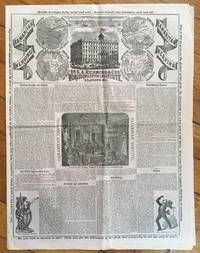
1882293St. Joseph Mo 1882. Very good. 8pp. Newspaper folio. Previously folded. Very minor loss at intersection of folds slightly affecting text. Minor wear at edges. Unopened at top edge. A wonderfully illustrated and rare newspaper promotional for S.A. Richmond & Co.'s patent medicine Samaritan Nervine. Samuel Richmond came to St. Joseph Missouri in the late 1870s and established this "World Epileptic Institute" mostly to sell his elixir which was in fact diluted nightshade. His elaborate advertisements of which this is an example claimed that it not only cured cases of epilepsy but also treated ill-behaved children and sexually dysfunctional elderly men and soothed many other maladies of the nerves. Eventually he was attacked in print by a local newspaper at which point he promptly shot the editor and after being found not guilty by reason of insanity removed to Tuscola Illinois where he continued to produce the potion. This newsprint advertisement provides a vigorous defense of Richmond's product supported by numerous lengthy testimonials. Several illustrations also depict the grounds and offices of his epilepsy institute including strangely though perhaps not surprisingly the press room. OCLC locates only copy at the University of Rochester. unknown books
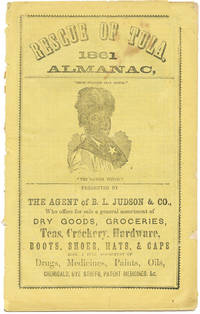
1860WRCAM41779New York: B.L. Judson & Co. 1860. 24pp. Original yellow printed wrappers. Spine mostly perished. Some chipping and tears to wrappers. Very minor soiling. Good. A rare patent-medicine almanac reprinting the story of an herbalist's rescue of Tula the Aztec princess likely fabricated to promote the sale of Judson's various medicaments. Originally printed in 1859 by the same publisher the almanac recounts the story of the "wealthy herbalist Dr. Cunard who with a trapper named Du Bois or Hawk Eye spent seven years trapping and travelling throughout the Far West. The doctor had a number of unusual experiences not the least of which was his single-handed defiance of the Navajo Tribe as they were about to burn Tula the Aztec princess at the stake. This was accomplished by capitalizing on the fortuitous imminence of a total eclipse of which the good doctor knew after consulting his handy little almanac. The Navajo chief was as confounded as Merlin in an earlier day and promptly gave up not only Tula but also his secret mountain-herb recipe. A trapper's testimonial direct from St. Louis concludes this 'True Account'" - Eberstadt. The almanac seems to have been published for only about four years 1860- 63 although the advertisement/story does appear in a few other almanacs as well. OCLC locates only one copy of the 1861 almanac and only one of most of the others as well at the Rochester Museum and Science Center. Rare and interesting. EBERSTADT 127:215 ref. B.L. Judson & Co. unknown books
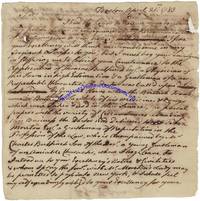
4545GUY CARLETON 1ST BARON DORCHESTER 1724-1808. Carleton was the British colonial governor of Quebec before and at the beginning of the American Revolution. He retired in 1778 but he was brought back to North America in 1782 to oversee the evacuation of New York by British troops and loyalists. AL. 2pgs. 7 ¾†x 7 ¾â€. April 21 1783. Boston. A handwritten unsigned letter addressed to Sir Guy Carleton as Commander in Chief of All the Forces of His Britannic Majesty in North America. The anonymous author seeks reimbursement for a doctor named Thomas Bulfinch who had his entire stock of medicines taken by the British for their use in Boston. Carleton was the in New York City: “Sir I had the honour to receive Excellency’s very polite letter in consequence of my recommendation of Mr. Livingston to your notice; I fear your Excellency will think me trouble some in my frequent addresses to you but I must beg your indulgence in suffering me to solicit your countenance to the application of Thomas Bulfinch Esqr. a physician of respectable character; the doctor was call’d upon by General Howe when the British Troops were in Boston for the whole of his medicines & drugs which were taken & used in their service the several papers with the variety of circumstances attending this business the doctor has dedicated to Mr. Peter Morton Esqr. a gentleman of reputation in the profession of the law who is accompanied by Mr. Charles Bulfinch son of the Doc’r a young gentleman of an amiable character whom I beg leave to introduce to your Excellency’s notice & civilities & whom I pray the fav. with Mr. Morton’s Lady may be permitted to pass into New York & I shall feel myself exceedingly oblig’d to your Excellency for your countenance & support to Mr. Morton & Mr. Bulfinch in the prosecution of this Business with possible that the Doc’r may meet a Reimbursement and I shall be happy to have an oppo’y to demonstrate my readiness on all occasions to convince you of my disposition to make similar returns & with what truth I am Sir Your Excellency’s Most Obed’t humble Serv’t.†Charles Bulfinch 1763-1844 the doctor’s son mentioned in this letter would go on to become an important architect and he was the second Architect of the United States Capital. His son Thomas Bulfinch 1796-1867 is well-known as the author of Bulfinch’s Mythology. The letter is in fair condition with cross-outs repaired folds and dark ink. unknown books
18003053211800. With illustrations of 3 horses with focal points on horse highlighted in red. 170 x 1070 mm. Some overall wear. With illustrations of 3 horses with focal points on horse highlighted in red. 170 x 1070 mm. unknown books
1695D6964Venice: apud Ioannem Hertz 1695. Hardcover. Very Good. Folio 330 x 220mm. 4 616pp. 30; 1 92pp. i. e. 90. Copper-plate engraved printers device of Hertz to tiltle. Title printed in red and black. Double column. Contemporary vellum. Ex Libris Prosperi Selli Medicinae et Chirurgiae above pictorial wood-engraved ex-libris by Leo Wyatt for Lord Norwich on pastedown. <br/><br/>Dolaeus surgical encyclopedia his opus magnus which was widely popular. Reissued several times as in this copy of 1695 the scarce first edition was printed in 1605. Dolaeus belonged to the iatrochemical school of Paracelsus and van Helmont a branch of both chemistry and medicine. His opus magnus was this surgical encyclopedia and as indicated on the title is based on the principles of Galen Paracelsus van Helmont Willis Sylvius and Descartes. The encyclopedic entries deal with all manner of surgical diseases including hernia cancer abscesses ulcers gangrene and afflictions of the sense organs teeth and genitalia. A physician to the German nobility Dolaeus became rich and famous through his secret liquor antivariolosus presumably a remedy for smallpox; he also anticipated Cheyne in his dietary treatment of gout. Part 2 has special title page: Johannis Dolaei . Tractatus varii. Page 31 part 2 has half title: Joh. Jacobi Waldschmidt . et Johannis Dolaei . Dissertationes epistolicae de rebus medicis et philosophicis. NLM/Krivatsy 3315 apud Ioannem Hertz hardcover books
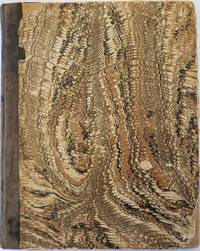
151271840s handwritten pharmaceutical notebook. Pennsylvania. Original marbled boards and cloth spine; Measures 4.5" x 8" inches. 79 handwritten pages in ink and pencil 1-69 hand-numbered; 150 pages total. The meticulous note-taker records copious medical recipes for various ailments and illnesses as well as the date source and doctor from whom the treatment method was acquired thus giving an amazingly precise and detailed record of contemporary medical knowledge and treatment protocol. Under "Uterine Hemorrhage" for example the writer notes first the ingredients then the administration then the source: "Rx Sulphate of Alum 3iij; sulphate of Magnesia 3xij; aromatic sulphuric Acid 3ij; water 3xig M. Dose 3j every four hours. If pain exists griss acetate of Morphia should be added to the whole.--Dr. Grettan of Killough Scot.- Bos. Med. Jour. May 1 1842." Entries are included for "Tic Douloureux" "Angina Pectoris" "Hysteria" "Opthalmic Diseases" "Sore Nipples" "Consumption" "Cancer" "Sea Sickness" "Gonorrhea" "Cholera" "Gout" "Antidotes for Poisons" and many more. Some of the entries go on for several pages with detailed notes about the application of various prescriptions. Also includes entries for "Writing Ink" "Hair Dye" "Ginger Beer" "Poor Man's Hand Soap" "A Very Brilliant Red Ink" and other such household amenities. In good condition. Boards showing through marbled covers at corners minor bumping to corners. Age-related toning and spotting to pages which are otherwise neat and without wrinkles or creases. Comes with 7 handwritten prescription slips. <br/><br/>18th century pharmacists were medical practitioners who treated patients directly. However the field of pharmacology was unregulated and otherwise-effective prescriptions were often corrupted by inaccurate dosages or ersatz ingredients. The founding of the Philadelphia College of Pharmacy PCP in the 1800s is recognized as a radical first step forward in the development of a system of pharmaceutical practice in the United States. On March 13 1821 68 pharmacists signed the Constitution of the first pharmaceutical association in the United States in the Carpenters' Hall the same room as where the founding fathers signed the Declaration of Independence. The symbolism of the Carpenters' Hall backdrop was clear: American pharmacy would be following in the footsteps of the founding fathers and their constitutional framework. The PCP constitution included a strict code of ethics that would expel anyone from the college who adulterated medications and provided for a committee of inspection to verify the purity safety and effectiveness of medicines and a committee of equity to arbitrate disputes between member pharmacists. In 1824 the PCP published "carefully determined formulas" for the fabrication of formerly "secret-formula" patent medicines imported from the UK an essential step toward self-sufficient pharmaceutical manufacturing in the U.S. WSU History of Pharmacy. unknown books
185519521New York: Pruden & Roberts Printers 51 Beekman street 1855. First edition. Some light soiling; in very good condition. Single leaf printed recto and verso 13.75 x 7.88 inches. Benton b. 1808 here advertises his recent relocation of his medical offices from Brooklyn to Manhattan as well as a series of lectures and demonstrations on the powers of electricity--"And in keeping with the philosophy illustrated by Experiments those who have witnessed them with one accord agree that No Theatre or Band of Minstrels can equal the sport or amusement and all in keeping with good order not objectionable to the most fastidious. The Hearing Sight Taste Smell or any of the senses disturbed the Mental or Muscular Power controlled and all are Relieved at the pleasure of the operator." Benton also notes for visitors consulting at his offices "Examinations by Clairvoyants for disease which have astonished those who have witnessed them can be had if desired." The numerous press notices included here go as late as Oct. 30 1854 and the dates of performance indicate an 1855 performance. Benton noted in the 1855 New York census as a New York City resident eventually moved upstate appearing in directories in Lansingburgh N. Y. as an electric physician as late as 1882. Not noted in Atwater. Not found on OCLC. Pruden & Roberts, Printers, 51 Beekman street, unknown books
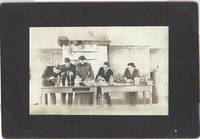
16189Original vintage photograph of a female teacher directing male medical students dissecting a cadaver c. 1890. Black and white 3"x5" with back matting. One woman surrounded by four men lean over a table with a skeleton. Behind them is a chalkboard with anatomical pull down charts. Although women had participated in the informal practice of medicine for hundreds of years the United States and most industrialized nations did not allow women into the formal practice of medicine until the latter half of the 19th century. This female doctor was part of the first generation formally accepted by medical institution. She wears a medal indicating her importance and perhaps former military involvement. Early photographs of women in medicine are very rare photograph of surgery or dissection much rarer. <br/><br/>Women practiced in the medical field for hundreds of years until new licenser rules established in the Victorian era provided a means for their exclusion. The story of how women reclaimed their role in medicine is one of resourcefulness and determination. In 1849 the first American woman graduated medical school. The path was difficult; few medical schools would accepted them and the reception was not always welcoming. Female doctors were called not only to prove their ability to practice medicine but to justify their unique necessity to the field. Of all the specialties the most embattled for women is surgery; early on they faced a challenge obtaining education training and facilities. A perennial argument was that cadaver dissection necessary to training was inappropriate for the delicate female disposition. However this Victorian-era photograph showing a woman capably participating in cadaver dissection proves that in the words of Dr. Mary Putnam Jacobi the best known female doctor in 1891 "It is perfectly evident.that the opposition to women physicians has rarely been based upon any sincere conviction that women could not be instructed in medicine but upon an intense dislike to the idea that they should be. unknown books
1598D6965Venice: apud haeredes Melchioris Sessae 1598. First Venice Edition. Hardcover. Very Good. Folio 310 x 210mm. 2175pp. 1 301pp. 2 12pp. 175pp. 1. Contemporary dark brown goatskin title and preliminaries lacking and supplied in early manuscript with illustrated printers device some browning and staining least severe after page 9. 17th-century inscriptions on rear endpaper for Index Capitum a medical students description of the various parts. Pictorial wood-engraved ex-libris by Leo Wyatt for Lord Norwich on front endpaper. <br/><br/>First Venice Edition of Capivaccios philosophical practica in Galenic teachings a pillar for medical students of the Renaissance. First edition printed in Frankfurt in 1594 under the title Practica Medicina. Capivaccios lectures were posthumously edited by Johann Hartmann Beyer. This is the first Venice edition of these lectures on the healing sciences by one of the leading Italian medical practitioners of his time is edited by Giovanni Bernardo Sessa. Capivaccio died at Padua in 1589 where he had taught at the university for 27 years. He was a specialist in venereal diseases for which he had developed certain successful cures guarding his secrets jealously from colleagues. Capivaccio applied a philosophical approach to his practica so much so that it is doubtful if it was ever much used as a vade mecum. By writing at such great lengths it is clear Capivaccio wished to educate students rather than give them a handbook. Apart from the wish to restore Galenic teachings and to educate students one motive for Capivaccios practica may have been to bolster the claims of university doctors over the central providers of medical expertise in the Renaissance namely priests wise-women magicians herbalists and travelling empirics. This work important to the reform of the practice of medicine and to the wider concept of dogmatism or rationalism in medicine the Renaissance physician could use Capivaccios work to locate the causes of diseases as well as its signs. NLM/Durling 816. apud haeredes Melchioris Sessae hardcover books
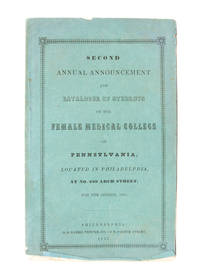
18512970Philadelphia: G.S. Harris 1851. First edition. Very Good . Original blue printed paper wraps printed to front. Some chipping and creasing to edges but overall intact and undamaged despite being quite delicate. Light scattered foxing throughout. Ownership signature of the college's original dean N.R. Mosely struck out at the top of the Faculty list on page 4; pencil ticks next to the names of several students listed in the catalogue on page 6. Exceptionally rare OCLC lists copies of this Announcement at only 2 institutions.<br/><br/>Only one year after Dr. Elizabeth Blackwell graduated valedictorian and became the first female M.D. in the U.S. the Female Medical College of Pennsylvania opened its doors. Located in Philadelphia it was the only the second school to open with the mission of training women in medicine -- having been preceded by the New England Female Medical College two years earlier in 1848. Founded by Quaker abolitionist and Underground Railroad activists who believed that women could make exceptional doctors "the college provided rare opportunities for women to teach perform research manage a medical school and with the eventual establishment of the Woman's Hospital in 1861 learn and practice in a hospital setting. It was the longest-lasting all-women medical school in the nation until it became coeducational in 1970" Mandell. The present Announcement predates these growths however showing the roots from which they emerged. One year running and the faculty remain largely male because there has yet to be an inaugural graduating class this would come in 1852; but already a female student Hannah E. Longshore is listed as a Demonstrator in Anatomy. Indeed Longshore and her sister Anna would both be part of the inaugural class of the college with the latter going on the author Discourses to Women in Medical Subjects 1897. Indeed the majority of women listed in this catalogue went on to become doctors even when it took time -- as it did for Hannah W. Ellis and Susanna H. Ellis both listed among the graduates of the 1865 class. 12 pages in all this scarce pamphlet contains Officers Corporators Faculty and Students of the school; an Announcement on the school's missions and accomplishments; information on Specialties available; Terms of enrollment; and a list of required Textbooks. It also conveys the excitement optimism and pride of those involved. "The Faculty of the Female Medical College of Pennsylvania are inspired by very different feelings from those that attended their efforts one year ago. Then they were about to enter into an untried path to engage in a great experiment.But that which was an experiment is an experiment no longer.give a woman knowledge commensurate with her natural qualifications enable her to go forth healing the sick and comforting the afflicted and she will bless the world." A rare survivor documenting that pivotal moment when women had been given the chance to prove their intellect rose to the challenge and made the future of the next female students more secure. Very Good . G.S. Harris unknown books
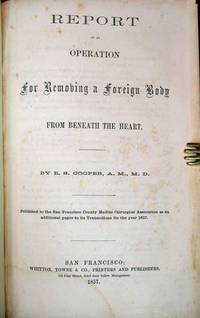
185737456San Francisco: Whitton Towne & Co. Printers and Publishers 1857. 1st printing Cordasco 50-0405; Cowan II p. 143; Greenwood 813. Modern marbled paper wrappers. Light old faded evidence of damping mostly in margins. Foxing. A VG copy. 9 1 blank pp. Old print-out of an ABE book listing laid-in. 8-7/8" x 5-3/4" <br/><br/>Cooper a renowned physician of his day founder of the first medical college on the Pacific Coast at the University of the Pacific. This paper describes a 'daring' procedure wherein Cooper removed a 'slug of iron' from one B. T. Beal of Springfield Tuolumne County. Seems Mr Beal and a few friends "in a frolicksome mood resolved to burst an old gun and accordingly loaded it with about eighteen inches of powder to which they connected a slow match and then endeavored to seek security by flight." He failed. The 'slug of iron' entered Mr Beal below the left armpit and lodged under his heart 'upon the vertical column' where it remained for 74 days until Dr Cooper removed it. The patient recovered said improvement in health to such a degree "as not to be recognized by medical men present at the operation". No copies at auction these last 30 years per ABPC & Am Ex; we know of one copy sold a couple years ago through the trade. A rare item known as one of the earliest published accounts of a California surgical procedure. Whitton Towne & Co., Printers and Publishers unknown books
177910470Yverdon .et Paris: P. Fr. Didot le jeune. and Méquignon l'aîné 1779. First edition. xii 130 2 pp. 1 vols. 12mo. Contemporary quarter leather and boards slightly rubbed fine copy bound with two other titles see below. First edition. xii 130 2 pp. 1 vols. 12mo. Three Rare Treatises: Rabies Breast-Feeding Public Health. Rare treatise on Rabies by this surgeon physician 1742-1832 and author of several medical treatises including a six volume History of Anatomy and Surgery Paris 1770-73. Bound with two other works:<br/><br/>2 Levret André 1703-1780. Observations sur l'Alaitement des Enfans.132pp. 8vo Paris: Chez Méquignon 1781. First Edition. Rare work by this obstetrician and pediatrician who according to Garrison-Morton "improved the obstetric forceps and was a famous teacher in Paris." Not in NLM; not in NUC nor RLIN.<br/><br/>3 Maret Hugues 1726-1786. Mémoire dans lequel on cherche à déterminer quelle influence les mœurs des François ont sur leur santé.4 159 3 pp. 8vo Amiens: chez la veuve Godard 1772. First Edition. NLM 18th-C. p. 287. Fascinating essay on a subject much in the news today. NLM 18th-C. p. 359 P. Fr. Didot le jeune... and Méquignon l'aîné unknown books
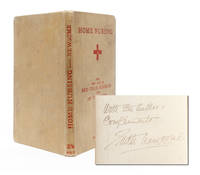
19163202London: The Scientific Press 1916. First edition. Very Good . Scarce first edition of a Red Cross manual designed both for emergency workers and women in the home. Original publisher's cloth binding titled in red on spine and front board. Boards a bit rubbed and soiled corners bumped. Faint offsetting to the endpapers. Inscribed by Edith Newsome on the front pastedown: "With the Author's Compliments Edith Newsome. 16.10.23." A scarce book institutionally and in trade OCLC reports only 11 copies in libraries this being the only one currently on the market. <br/><br/>Edith Newsome's first major work on nursing produced after she realized that her Red Cross lecture series could not provide complete enough information to train "those who have so nobly responded to the 'call of duty'; to do all that is in their power to tend and succour the brave men of our nation by proving themselves valuable and intelligent helpers." Indeed Newsome's work was released two years into World War I -- the first modern war which brought with it a horrifying number of previously unknown injuries and ailments. In addition to professional nurses women enrolled to assist as Volunteer Aid Detachments VADs because there simply were not enough women with medical educations to serve the nation's need. The present work is a stirring acknowledgement of this. Comprehensive in training VADs and new nurses in field operations it also contains information for women in the home who confronted infection illness or injury and served as domestic caretakers for men returning from the front. Very Good . The Scientific Press unknown books
18263100861826. 37 ff. written on rectos only. 4to. Wrappers titled in manuscript. Covers worn and stained with some wear and chipping to the text. 37 ff. written on rectos only. 4to. Unpublished manuscript on the ancient Egyptian and Greek roots of medicine by the early American physician Charles Alfred Lee 1801-1872. Lee graduated from Williams College in 1822 and received his M.D. at Berkshire Medical College. He was connected with the Northern Dispensary of New York City chair of materia medica and general pathology at Geneva Medical College New York and taught at a series of eastern United States medical schools. Lee helped found the New York Journal of Medicine and the Collateral Sciences in 1843 and in 1850 he co-founded the Buffalo Medical School. His most famous work was the American edition of Dr. James Copeland's Dictionary of Practical Medicine 1848. He published several medical textbooks including the popular Human Physiology for the Use of Elementary Schools 1843. He also edited Bacchus: an Essay on the Nature Causes Effects and Cure of Intemperance 1840 by Ralph Grindrod.<br/>The present manuscript which appears to be unpublished is a survey of early Egyptian and Greek medicine and draws from sources quoted in the original Greek. unknown books
1676D6961Lyons: Sumptibus Joannis Antonii Huguetan 1676. Hardcover. Very Good. 6 vols. in 3 folio 350 x 220mm. Vol. 1: 38 306pp. 6 309-808pp. 32; Vol. 2: 16 363pp. 5 363-786pp. 18; Vol. 3: 12 696pp. 12. Titles in red and black. Woodcut printers device of Huguetan showing Ptolemy left and Euclid right either side of an astronomical device known as an armillary sphere. The text is in Latin with the central motto translating as the universality of things is like dust in the hand of God. The IAH monogram at bottom is for the 17th century French printer Jean-Antoine Huguetan. Complete with the portrait and half-title Vol. 1 and numerous woodcut initials head- and tail- pieces. Contemporary vellum rebacked some browning throughout marginal worming lightly worn. Contemporary ownership inscription by doctor above pictorial wood-engraved ex-libris by Leo Wyatt for Lord Norwich on front endpaper in all volumes. Two contemporary Latin manuscripts laid in after p. 408 one two pages signed by joannes cont on hypochondriacs the other concerning a cure. <br/><br/>Sennerts complete works three volumes in six parts printed by Huguetan. Sennert was an influential German professor notable for his contributions to medicine and atomic theory. Daniel Sennert born in Breslau was a student and the professor of medicine at the University of Wittenberg the intellectual center of Lutheranism. He was a renowned physician and an extremely prolific and influential writer whose popularity in his time is clear from the many editions of his works many of which were translated into English. These are Sennerts complete works in six parts each with a separate dated title page printed in red and black. His Opera was first published in Paris in 1641 and this edition expanded . with the omission of Tabulae institutionum and the addition of Vita Danielis Sennerti Judicia virorum clarissimorum Methodus discendi medicinam De curatione infantium De arthritide Tragopodagra Luciani in Greek and Latin Exoterica Epitome librorum de febribus Epistolarum medicinalium una cum responsorii D. Michaelis Doringei centuriae duae. The Epitome is reprinted from the Epitome edited by Claude Bonnet-- Krivatsy. This edition is regarded as the best. Among Sennerts many achievements he was the first to introduce chemistry as a subject of the medical curriculum and to make a serious effort to harmonize the Galenic doctrines of medicine with those of Paracelsus. Besides giving early accounts of scarlatina and rubella Sennert added to the knowledge of scurvy dysentery and alcoholism. He was an able clinician but a believer in witchcraft.-- Garrison-Morton 61. Scarcely found on the market these volumes are a complete set of Sennerts studies and 17th century medicine. Sennert was known to apply astrology to medicine and the supernatural origins of disease. NLM/Krivatsy 109 Sumptibus Joannis Antonii Huguetan hardcover books