209 résultats
15655777<p><b><i>"FOR MANY YEARS THE MOST IMPORTANT WORK ON THE MEDICINAL PLANTS OF THE NEW WORLD"</i></b></p><p>8vo 13.4 x 9.1 cm 132 ff. with woodcut border to title page and woodcut initials. Bound in later stiff vellum title stamped on spine gift inscription on the front flyleaf to a certain 'Carmen Ballina' dated 1922 now covered in paper. Only minor wear and rubbing to binding. 'Tassa' price of 51 maravedis entered in manuscript on title page as issued early signature of a certain 'Henrique Correa' at fol. aiiir the occasional contemporary annotation in the text minor occasional dampstaining very minor occasional marginal worming.<br /></p><p>Very rare first edition 1565 – virtually unacquirable for the past half century or more – of the first printed work devoted to the botanical and medicinal discoveries made in the Americas a treatise which through its later expansions and numerous translations would remain "for many years the most important work on the medicinal plants of the New World" Garrison & Morton. The <i>Dos libros</i> was written by the renowned physician Nicolás Monardes 1493-1588 in Seville then the center of the Spanish printing industry and the only port from which ships were authorized to sail to and from the New World. Born in 1493 in the very year Columbus returned from his first voyage Monardes thus both occupied a front row seat for first decades of the 'Columbian Exchange' and was ideally positioned to disseminate his findings to a wider European indeed global audience.</p><p>Monardes shared much with his contemporary Garcia d'Orta 1501-68 the Portuguese physician stationed in India and famed for his <i>Coloquios dos simples e drogas e consas medicinais da India</i> Goa 1563: "Just as d'Orta gave the learned world of the West the first accurate accounts of various Asian medicinal and commercial plants so did Monardes with those of America … Monardes like Garcia d'Orta has a strong claim to be regarded as one of the fathers of the science of pharmacognosy. Both of them compiled what were virtually complete monographs on many important items of our actual <i>materia medica</i> which were then unknown or only inaccurately known to the Western World Boxer pp. 23-24. Even the diffusion of these two authors throughout the learned world of early modern Europe shared a common source in the Latin versions made of them by the Flemish physician and botanist Charles de L'Ecluse Carolus Clusius 1526-1609 who published them together for the first time at Antwerp by Plantin in 1574 and afterwards.</p><p>Monardes eagerly capitalized on his unique position in Seville to acquire botanical news specimens and seeds from the New World cultivating his own garden of American plants and distributing cuttings to correspondents throughout Spain and Europe. In 1553 he established a transatlantic business partnership with a colleague in Tierra Firme and over the next three decades Monardes' three sons and four daughters emigrated to Tierra Firme and New Spain thus providing him with a network which would prove invaluable in collecting information for the 1565 <i>Dos libros</i> and in expanding the treatise in its 1571 and 1574 editions published as <i>Segunda Parte</i> and <i>Primera y Segunda y Tercera Partes de la Historia Medicinal</i>. In the <i>Dos libros</i> Monardes describes more than two dozen botanical remedies sarsaparilla copal and other aromatic balsams guaiacum lignum vitae etc. their medicinal applications native nomenclature and where they were to be found Mexico City Jalisco Michoacán Cuba Santo Domingo San Juan Cartagena Honduras Peru Nicaragua. Fascinatingly he views this specialized information through the broader lens of early American exploration discussing the voyages of Columbus and Hernán Cortés Monardes' near contemporary the spread of New World diseases among the first conquistadors and assessing the value of America's medicinal riches against her wealth of gold and silver.</p><p>In his first printed work <i>Dialogo llamado pharmacodilosis o declaracion medicinal</i> Seville 1536 Monardes noted that he was skeptical of the therapeutic value of plants from the New World but "his change of heart between 1536 and 1565 about the value of American <i>materia medica</i> was a gradual process and was due to his own experience" Boxer p. 22. Monardes "took great care after about 1536 to examine those plants imported and/or transplanted into Spain – a self-imposed task facilitated by the unrivaled position of Seville as the sole <i>entrepôt</i> for Spanish trade with the New World … just as d'Orta cultivated Asian plants in his gardens and orchards at Goa and Bombay so Monardes had a botanical garden with native and exotic plants at Sevilla" Boxer 22.</p><p>In addition to Clusius' Latin translation of Monardes <i>De simplicibus medicamentis ex Occidentli India delatis</i> 1574 first Latin edition an English translation appeared in 1577 by John Frampton under the title <i>Joyful newes out of the newe found world. </i>Italian French and German translations followed with the work going through 19 editions during Monardes' lifetime and 14 after his death.</p><p>In the present 1565 first edition of the <i>Dos libros</i> Monardes challenged European travelers and residents in the Americas to "'<i>investigate and experiment with the many kinds of medicines that the Indians sell in their markets or Tianguez; it would be a thing of great utility and profit to see and know their properties and to experiment with their varied and great effects which the Indians make public and manifest through the great experiences they make of them among themselves'"</i> Monardes quoted from Bleichmar <i>Visual Voyages</i> p. 51. But tapping into native knowledge of medicinal matters apparently proved more difficult than Monardes had anticipated: In the 1571 <i>Segunda Parte</i> he notes that the increasing Amerindian hostility to the European presence in the Americas was provoking them to keep their medicinal/botanical practices secret to the point of providing misleading information to colonists seeking local remedies and consequently his 1565 <i>Dos Libros</i> had in fact become the primary source for Indian medicinal knowledge even among Europeans stationed and living in the Americas among the native populace see Bleichmar <i>Visual Voyages</i> p. 51.</p><p>Monardes' other published works include the 1539 <i>De secanda vena in pleuriti inter Grecos et Arabes concordia</i> and his 1540 <i>De rosa et partibus eius</i>. His treatise on the medicinal properties of the bezoar stone is appended to the present <i>Dos libros</i>.</p><p>OCLC locates U.S. examples of this 1565 <i>Dos Libros</i> of Monardes at the National Library of Medicine John Carter Brown Wisconsin Hunt Botanical SMU and NYPL.</p><p> Alden European Americana 565/45; Medina BHA 194; JCB vol. 1 no. 240; Palau 175485; Wellcome 4390; USTC 340089; Garrison & Morton 1817; ; Hunt 106 1569 ed.; Sabin 49936 the 2nd ed.; F. Guerra <i>Nicolás Bautista Monardes</i>; D. Bleichmar <i>Visual Voyages: Images of Latin American Nature from Columbus to Darwin</i>; J. Jiménez-Castellanos y Calvo-Rubio <i>Historia medicinal de las cosas</i>… Seville Padilla 1988; D. Bleichmar "Books Bodies and Fields: Sixteenth-Century Transatlantic Encounters with New World <i>Materia Medica</i>" in L. Schiebinger and C. Swan eds. <i>Colonial Botany: Science Commerce and Politics</i> pp. 83–99; J. M. López Piñero "Las 'Nuevas Medicinas' Americanas en la Obra 1565-1574 de Nicolás Monardes" <i>Asclepio</i> vol. 42 no. 1 1990 pp. 3-67; A. Barrera "Local Herbs Global Medicines: Commerce Knowledge and Commodities in Spanish America" in P. Smith and P. Findlen eds. <i>Merchants and Marvels: Commerce Science and Art in Early Modern Europe</i> pp. 163-81; J. D. Sauer "Changing Perception and Exploitation of New World Plants in Europe" in F. Chiappelli ed. <i>First Images of America</i> vol. 2 pp.-813-32; F. Egmond <i>The World of Carolus Clusius: Natural History in the Making 1550-1610</i>; A. Ubrizy and J. Heniger "Carolus Clusius and American Plants" <i>Taxon</i> vol. 32 no 3 1983 pp. 424-35; C. R. Boxer <i>Two Pioneers of Tropical Medicine: Garcia d'Orta and Nicolás Monardes</i> Wellcome Lecture Series No. 1 1963.</p> Sebastian Trugillo hardcover books
187460344Tuskaloosa AL: Alabama Insane Hospital 1874. Newspaper. 11 3/4 x 9 ¼ inches. 7 Issues: vol. 1 nos. 1-3 vol. 2 nos. 5 and 8 and vol. 3 nos. 9 and 10 each issue containing four pages apparently 21 issues in five volumes were published through 1876. This was the third magazine produced by patients in an American asylum the first in the south. The other two were the Asylum Journal Vermont Asylum for the Insane 1842-46 and the Opal New York Asylum 1850-1860. The content much of it dealing with the inner workings of the asylum and its needs includes articles from Darwinism to Spiritualism and engages arguments with the definitions of insanity and the treatments then in practice. Some of the articles are tinged with humor toward the hospital's employees from poetry on the perils of working as a nurse in a hospital for the insane to running an ad for a wife for an official of the hospital. Owen p. 993 No. 21 only his copy. OCLC locates two runs National Library of Medicine: Vol.1 no. 3 and Vol. 2 no. 5; Alabama Department of Archives and History: Vol. 1 nos. 1 &2 ; Vol. 2 nos. 7 & 8; Vol. 3 nos. 9 & 10; Vol. 4 no. 16; Vol. 5 nos. 17 & 18; Vol. 8 no. 21. The Alabama Insane Hospital was conceived under the influence of Dorothea Dix instrumental in the selection of Dr. Peter Bryce as its first superintendent in 1860 and Thomas Story Kirkbride its architect. Bryce 1834-1892 who had studied progressive ideas of treating the insane in Europe would head the institution until his death. The perennially underfunded hospital would prove self sufficient employing the patients to provide food heat and this newspaper both the editorial work and the printing process among other services reflecting the progressive belief of the time that activity settled the mind. Bryce and the hospital became known for innovative treatment of the mentally ill using a "therapeutic approach to treatment so called for its supposed ability to lead patients to an understanding and acceptance of 'right behavior'." The hospital accepted African-American patients including one who had been owned by Dr. Bryce but despite its progressive reputation in treatment the hospital showed the prejudices of the time by separating the patients by race. <br/><br/> Alabama Insane Hospital unknown books
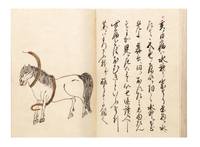
7052Seven vols. 8vo 218 x 160 mm. orig. wrappers each with an individual title label on upper cover new stitching. Japan: all late Edo. A fascinating collection of texts on equine medicine all bound in a similar fashion: Vol. 1: Manuscript label on upper cover entitled "Basho hijutsu den" "Horse Book Secret Methods Passed On". Nine brush & ink illus. in the text. 31 folding leaves. This text is concerned with exercising horses in each season and includes "32 Rules of Exercise." At the end we find a date of 1825 the name of the person who provided this information Seizaimon Sekiguchi and the name of the copier Hanemon Hasegawa. Vol. 2: Manuscript label on upper cover entitled "Basho yakuho den" "Horse Book Medicine Passed On". 12 most unusual brush ink & wash drawings. 23 folding leaves. Each illustration depicts an unwell horse and 12 symbols of ill health demons snake ogre monkey female deity Buddhist practitioner archer bird etc. relating to the horse's disease with recipes for medicines. These illustrations are all finely colored. The rest of the text is devoted to how to maintain a horse's health in each of the four seasons. At the end there is the date 1596 and the information was given by Ichiraku Obata who lives in Kyoto. Vol. 3: Manuscript label on upper cover entitled "Basho hiden shu" "Collection of Horse Medicine Secrets Passed On". Seven brush & ink illus. in various colors. 15 folding leaves. This manuscript is concerned with methods of keeping a horse healthy while travelling. Herbal medicine recipes are given. At the end we find the following names: Ogasawara Taizen Taifu Ofusa Yawata Takeyori Ason and Kunai Taifu. Vols. 4 & 5: Manuscript label on each upper cover entitled "Basho ryoji den" "Horse Book Diagnoses & Treatments Passed On". 18; 13 folding leaves. Vol. 4 ends with the date 1858 and the statement that "Sokyu passed on this information to Ittai Sekiguchi." Vol. 5 ends with the same date and a note that "Aikyu who lives in Ecchu in today's Toyama Prefecture gave this information to Sekiguchi." Vol. 6: Manuscript label on each upper cover entitled "Basho juniyaku" "Horse Book. 12 Medicines. A Part". Ten folding leaves. The text describes symptoms of various illnesses and provides 12 herbal medicine recipes. We believe the next part is contained in Vol. 7. Vol. 7: The label is no longer present but the beginning of the text states that there are 12 ingredients for medicines described. 17 folding leaves. The text is concerned with diseases common in each of the four seasons and the theory of the five organs and six intestines. In fine condition. Vol. 4 and 5 each have some marginal worming. unknown books
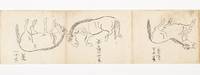
698630 black & white brush & ink drawings of diseased horses. Scroll 130 x 27630 mm. 94 joined sheets with several extension flaps which fold down with additional text recently & expertly backed. Omi Province today's Shiga Province: the most modern date we find in the scroll is 1809. A remarkably long scroll 90 feet; this is the most comprehensive old Japanese encyclopedia of horse diseases and their treatments we have encountered. The text includes recipes for medicines and acupuncture techniques as well as numerous case histories. There are references in this scroll to texts being copied in 1611. Each of the 94 sheets is numbered. It is obvious this was once a codex in at least two volumes that has been converted into an enormously long scroll. The accompanying title label was clearly the upper wrapper of the codex. At the beginning of this scroll are 30 brush & ink drawings of diseased horses representations of case histories adapted from the Inner Classic of the Yellow Emperor written about 2700 B.C. The case histories discuss rare diseases digestive problems drinking too much cold water kidney diseases heart problems lung problems wounds to the head diseases of the spleen parasitical worms breathing problems including asthma constipation cramping intestinal blocking food poisoning lack of appetite nervous horses brain diseases "black sweat" chills etc. Each case history concludes with pharmaceutical recipes. Sheets 51 to 94 contain sections on specific topics and include eye diseases tongue diagnosis diagnosis based on the condition of the tail setting of broken bones medicines to treat blood clots the six meridians the 18 meridians acupuncture treatments for tumors with a long list of pressure points and explanations of their relationships to tumors and other diseases etc. At the very end of this scroll we find the date "1809" with the name "Akatsu." In fine condition preserved in a box. unknown books
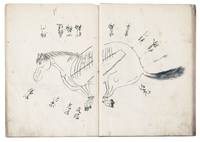
6987Many fine drawings some double-page some single-page a few heightened in wash of several colors. 47 folding leaves. Large 8vo 298 x 217 mm. orig. wrappers wrappers somewhat soiled new stitching. Japan: early to mid-Edo. A fine and well-illustrated equine medicine manuscript based on the traditional Chinese veterinary medical theories of the five organs liver heart spleen lung and kidney their seven related personality traits anger fear disgust happiness sadness surprise and contempt and eight elements of pulse condition at the six locations. There is also a substantial section on the use of moxibustion for treating the liver heart lung kidney and other organs. The illustrations are very striking. The first two depict a horse splayed on his back with moxibustion locations marked. These are followed by one image of a horse splayed on his stomach again with marked moxibustion points. Following this are three images of a horse lying on his side feet tied together with names and locations of pressure points. Next we encounter five images of various aspects of the five organs and their related pressure points with names. The final three images are side views of a horse with pressure points marked for acupuncture. There are instructions on how long the needles should be and how deeply inserted. The considerable text discusses the above-mentioned theories of traditional Chinese veterinary medicine. Very good condition. Our manuscript has worming touching both text and image but is entirely legible. unknown books
44211<p>Japan and Western Medicine. Oranda jin Geka ryoji no zu Dutch Surgery in Nagasaki. Original pen ink and watercolor drawing on light brown-toned silk with 4 vertical lines of Japanese characters in the upper left corner. Japan: late 18th or early 19th century. 483 x 363 mm. mounted as a scroll at a modern date on light grey silk backed with paper with a half-round hanging rail with braided ribbon attached at the top and a suspension bar at the foot measuring 914 x 443 mm. overall; preserved in a custom-made wooden box. A few tiny pinholes in upper corners of image but fine with the coloring fresh and bright.</p> <p> This striking image showing an amputation carried out by a Dutch surgeon in Japan was most likely painted in the late eighteenth or early nineteenth century during Japan's self-imposed period of national isolation. The hand-painted image is related but by no means identical to a Nagasaki woodblock print titled "Surgery by a Dutch Physician" one of many popular souvenir prints depicting scenes unique to Nagasaki which at the time was the sole point of contact between Japan and the outside world. See our reproduction of the print. It may be that our scroll is the original of the image; however it is also possible that both hand-painted and woodcut versions of the image were produced simultaneously.</p> <p> Western surgery came to Japan in the sixteenth and seventeenth centuries via the Portuguese who in 1543 became the first Europeans to make direct contact with Japan and the Dutch who became the only European nation allowed to trade with Japan after Japan's expulsion of the Portuguese in 1639. Surgeons attached to the Dutch East India Company established practices at the island of Dejima in Nagasaki Bay which led to the formation of several Japanese schools of surgery based on European methods. "This aspect of Western medicine known as K m -ry geka or ‘Surgery of the Red-Haired' has had a profound effect on the development of surgical practice in Japan" Van Gulik p. 37. Van Gulik "Dutch surgery in Japan" in Red-Hair Medicine: Dutch-Japanese Medical Relations ed. Beukers et al. pp. 37-50. </p> <p>. unknown books
1861300850London John Murray 1861. 1861. First edition. 8vo. Full gilt stamped dark green morocco by Riviere & Son rich gilt inner filets and dentelles; t.e.g. One volume extended to two by the addition of 135 extra engraved plates and views including eight hand colored together with the original 17 plates totaling 152 plates altogether. 2 volumes. 1st Edition. Hardcover. Fine/No Jacket. London, John Murray, 1861. hardcover books
184958811Cincinnati OH: Various publishers 1849. First editions. 1 "An Address on the Bonds of Professional Union Delivered before the Medical Association of Adams Brown and Clermont Counties O. at Batavia October 30 1847." Cincinnati: Atlas Job Room Print 1847. 27 pp. OCLC locates three copies National Library of Medicine Cincinnati History Library Countway; 2 "Valedictory Address on the Sources and Benefits of Professional Earnestness Delivered March 3 1849 to the Graduates of the Medical College of Ohio." Cincinnati: Printed at the office of the "Western Lancet" 1849. 15 pp.; 3 On the Formation of Professional Character: An Introductory Lecture Delivered Nov. 4th 1844." Cincinnati: Printed by R.P. Donogh 1844. 15 pp. American Imprints 44-2945; 4 "An Introductory Address Delivered to the Students of the Medical College of Ohio November 3 1847." Cincinnati: Collins & Van Wagner Printers 1847. 16 pp. OCLC locates five copies Rochester Medical Clendening Medical National Library of Medicine Cincinnati History Library Cincinnati Public; 5 "An Introductory Lecture on the Reciprocal Obligations of the Medical Profession and Society Delivered November 2 1846." Cincinnati: Printed by Looker & Co. 1846. 28 pp. American Imprints 46-3181. OCLC locates 8 copies; 6 "Clinical Lecture on Cholera" caption title. Cincinnati 1849. 8 pp. OCLC locates two copies Chicago Cincinnati History Library; 7 Manuscript copy of the address delivered by Dr. John C. Warren at an October 23 1849 meeting of the Boston area members of the American Medical Association occasioned by the death of Dr. Harrison. 4to. 5 pp. approximately 750 words. Harrison fell victim to the cholera epidemic that was discussed in the final pamphlet in this volume. Some foxing but a lovely presentation of a career's work from a son to his mother. Presentation binding of contemporary black morocco gilt boards framed with quadruple thin gilt rules floral ornaments at each corner spine with gilt rules on raised bands marbled endpapers all edges gilt. #5997. Harrison 1796-1849 a native of Louisville Kentucky studied medicine there and at the University of Pennsylvania returning home to begin his practice at the newly founded Louisville Hospital in 1820. He was appointed to his position at the Medical College of Ohio in 1841 edited the medical periodical "Western Lancet" and served as vice-president of the American Medical Association. For a longer biographical sketch see Kelly and Burrage "American Medical biographies" 1920 pp. 497-498. Dr. Warren's address reads in part: "This gentleman was one of the ablest practitioners in the United States. In the West he was considered as without a superior . while warm & decided in discussion he was not dogmatical and gave an agreeable influence to all he said by the openness and amenity of the manner in which he said it . the respect for him of the profession and community is derived from the noble manner in which he contended against the fatal epidemic of cholera . he continued to expose himself to the disease till he was destroyed by it." Also laid in is a 1961 letter of presentation from one Harrison descendant to another. <br/><br/> Various publishers hardcover books
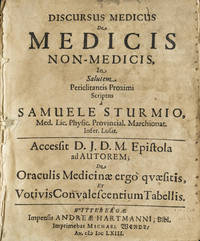
1684264562v.p. Strasbourg Heidelberg Marburg Wittenberg etc. 1684. 1 vols. 4to. Later vellum-backed boards. Front joint split some foxing browning marginal stains. 1 vols. 4to. A collection of 26 medical dissertations mostly published in Strasbourg 1637-1684 related to various topics including dysentery gunshot wounds the plague kidney stones psychological ailments sleeplessness surgery on tumors tooth rot and other maladies. The book includes a manuscript index note at the beginning of the volume and each pamphlet is numbered in manuscript. <br/>Most of the titles are quite rare OCLC showing 3-5 institutions as holding the individual titles. The variety of topics suggests that a physician documenting current research or academic activity in medical studies in Strasbourg compiled the volume. The unique French title in the collection closes the volume and discusses the use of the earliest eau de toilette L'eau de la Reine de Hongrie as an antiseptic tonic for the plague. <br/><br/>The following is a list of the titles herein:<br/>STURMIO S. Discursus medicus de medicis non medicis in salutem periclitantis proximi. Wittenberg 1663. 16 42 pp.<br/>LOMBARDIUS C. Centum Theses de Officio Medici. Marburg 1655. 44 pp.<br/>HEINTZ J. Disputatio inauguralis medica De affectibus soporosis. Strasbourg1677. 40 pp.<br/>ISRAEL J. Dissertatio inauguralis medica de ligatione vulgo von Nestel Knopffen. Heidelberg1672. 24 pp. OCLC: Cornell and NML.<br/>KUEFFER W. C. Galaktologian Seu Dissertationem De Lacte Inauguralem Sub Auspicio Divino . Strasbourg1672. 8 40 pp. OCLC: only Cornell in North America.<br/>WILLIUS J.V. Disputatio medica inauguralis de dysenteria. Strasbourg 1640. 16 pp.<br/>WILLIUS J.V. Auxiliante pacis authore affectuum vehementissimum vehementissimorum affectuum effectum et causam Iram dissertatione. Strasbourg 1671. 4 44 pp.<br/>TACKIUS J.M. Disputatio inauguralis Medica Juvenem Phthisi Incipiente Laborantem. Giessen 1684. 16 pp.<br/>NIEMAND H. Disputatio medica inauguralis de suffusione. Strasbourg 1676. 2 28 pp.<br/>BIX J.U. Sphygmographia; seu Dissertatio De pulsu inauguralis. Strasbourg 1677. 28 pp. <br/>HERTEBRODT J.M. Dissertatio inauguralis medica de peste. Strasbourg 1667. 16 pp. <br/>NICOLAI H. Disputatio Inauguralis Medica. De Vulneribus Sclopetorum. Strasbourg1675. 4 40 pp.<br/>WIDT J.R. S.S. Triade Fortvnante Et Praesidente Phthisiologia Decreto Et Avthoritate Magnifici Nobilissimi Gratiosissmi Collegii Medici Universitatis Argentinensis. Strasbourg 1637. 32 pp.<br/>SEBISCH J.A. Disputatio cheirurgica de tumoribus praeter naturam in genere. Strasbourg 1669. 2 40 2 pp.<br/>SALTZMANN L. Disputatio inauguralis medica qua abscessum internum insignis magnitudinis. Strasbourg 1671. 28 pp.<br/>SCHERBIUS C. Disputatio medica inauguralis de renum calculo. Ultrajecti 1669. 16 pp OCLC: BL only.<br/>PHILIPPUS JACOBUS. Disputatio medica inauguralis. Strasbourg 1673 8 56 pp.<br/>MAPP M. and SCHEID J.V. Zetematon peri phusog dekas h. e. De flatibus quaestiones decem.Strasbourg 1675. 2 34 pp.<br/>SCHEID J.V. Visus vitiatus ejusque demonstratio mathematico-medica. Strasbourg 1677. 8 70 2 pp.<br/>MAPP M. Disputatio de fistula genae terminata ad dentem cariosum. Strasbourg 1675. 28 pp.<br/>WIETZEL J.C. Disputatio inauguralis medica De morsibus et puncturis animalium. Strasbourg 1676. 30 pp.<br/>SCHERPFF M. Disputatio medica inauguralis exhibens febrem petechialem. Strasbourg 1676. 8 28 pp.<br/>SENCKENBERG J.H. Disputatio medica inauguralis De ptyelismo. Strasbourg 1676. 28 pp.<br/>DULCKEN J.H. Disputatio Inauguralis De Nakir Id est Nakir Arabum.Heidelberg 1684. 20 pp.<br/>AMELUNG J.C. Der Röm. Käyserl. Majestät Und Churfürstl. Durchl. zu Sachsen Allergnädigst- Und Gnädigst-ertheiltes Privilegium. Leipzig 1680. 12 pp.<br/> Les vertus de l'eau de la reine d'Hongrie. Paris c1670s. 3pp. unknown books
1676D6961Lyons: Sumptibus Joannis Antonii Huguetan 1676. Hardcover. Very Good. 6 vols. in 3 folio 350 x 220mm. Vol. 1: 38 306pp. 6 309-808pp. 32; Vol. 2: 16 363pp. 5 363-786pp. 18; Vol. 3: 12 696pp. 12. Titles in red and black. Woodcut printers device of Huguetan showing Ptolemy left and Euclid right either side of an astronomical device known as an armillary sphere. The text is in Latin with the central motto translating as the universality of things is like dust in the hand of God. The IAH monogram at bottom is for the 17th century French printer Jean-Antoine Huguetan. Complete with the portrait and half-title Vol. 1 and numerous woodcut initials head- and tail- pieces. Contemporary vellum rebacked some browning throughout marginal worming lightly worn. Contemporary ownership inscription by doctor above pictorial wood-engraved ex-libris by Leo Wyatt for Lord Norwich on front endpaper in all volumes. Two contemporary Latin manuscripts laid in after p. 408 one two pages signed by joannes cont on hypochondriacs the other concerning a cure. <br/><br/>Sennerts complete works three volumes in six parts printed by Huguetan. Sennert was an influential German professor notable for his contributions to medicine and atomic theory. Daniel Sennert born in Breslau was a student and the professor of medicine at the University of Wittenberg the intellectual center of Lutheranism. He was a renowned physician and an extremely prolific and influential writer whose popularity in his time is clear from the many editions of his works many of which were translated into English. These are Sennerts complete works in six parts each with a separate dated title page printed in red and black. His Opera was first published in Paris in 1641 and this edition expanded . with the omission of Tabulae institutionum and the addition of Vita Danielis Sennerti Judicia virorum clarissimorum Methodus discendi medicinam De curatione infantium De arthritide Tragopodagra Luciani in Greek and Latin Exoterica Epitome librorum de febribus Epistolarum medicinalium una cum responsorii D. Michaelis Doringei centuriae duae. The Epitome is reprinted from the Epitome edited by Claude Bonnet-- Krivatsy. This edition is regarded as the best. Among Sennerts many achievements he was the first to introduce chemistry as a subject of the medical curriculum and to make a serious effort to harmonize the Galenic doctrines of medicine with those of Paracelsus. Besides giving early accounts of scarlatina and rubella Sennert added to the knowledge of scurvy dysentery and alcoholism. He was an able clinician but a believer in witchcraft.-- Garrison-Morton 61. Scarcely found on the market these volumes are a complete set of Sennerts studies and 17th century medicine. Sennert was known to apply astrology to medicine and the supernatural origins of disease. NLM/Krivatsy 109 Sumptibus Joannis Antonii Huguetan hardcover books
18263100861826. 37 ff. written on rectos only. 4to. Wrappers titled in manuscript. Covers worn and stained with some wear and chipping to the text. 37 ff. written on rectos only. 4to. Unpublished manuscript on the ancient Egyptian and Greek roots of medicine by the early American physician Charles Alfred Lee 1801-1872. Lee graduated from Williams College in 1822 and received his M.D. at Berkshire Medical College. He was connected with the Northern Dispensary of New York City chair of materia medica and general pathology at Geneva Medical College New York and taught at a series of eastern United States medical schools. Lee helped found the New York Journal of Medicine and the Collateral Sciences in 1843 and in 1850 he co-founded the Buffalo Medical School. His most famous work was the American edition of Dr. James Copeland's Dictionary of Practical Medicine 1848. He published several medical textbooks including the popular Human Physiology for the Use of Elementary Schools 1843. He also edited Bacchus: an Essay on the Nature Causes Effects and Cure of Intemperance 1840 by Ralph Grindrod.<br/>The present manuscript which appears to be unpublished is a survey of early Egyptian and Greek medicine and draws from sources quoted in the original Greek. unknown books
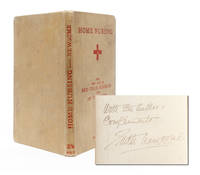
19163202London: The Scientific Press 1916. First edition. Very Good . Scarce first edition of a Red Cross manual designed both for emergency workers and women in the home. Original publisher's cloth binding titled in red on spine and front board. Boards a bit rubbed and soiled corners bumped. Faint offsetting to the endpapers. Inscribed by Edith Newsome on the front pastedown: "With the Author's Compliments Edith Newsome. 16.10.23." A scarce book institutionally and in trade OCLC reports only 11 copies in libraries this being the only one currently on the market. <br/><br/>Edith Newsome's first major work on nursing produced after she realized that her Red Cross lecture series could not provide complete enough information to train "those who have so nobly responded to the 'call of duty'; to do all that is in their power to tend and succour the brave men of our nation by proving themselves valuable and intelligent helpers." Indeed Newsome's work was released two years into World War I -- the first modern war which brought with it a horrifying number of previously unknown injuries and ailments. In addition to professional nurses women enrolled to assist as Volunteer Aid Detachments VADs because there simply were not enough women with medical educations to serve the nation's need. The present work is a stirring acknowledgement of this. Comprehensive in training VADs and new nurses in field operations it also contains information for women in the home who confronted infection illness or injury and served as domestic caretakers for men returning from the front. Very Good . The Scientific Press unknown books
177910470Yverdon .et Paris: P. Fr. Didot le jeune. and Méquignon l'aîné 1779. First edition. xii 130 2 pp. 1 vols. 12mo. Contemporary quarter leather and boards slightly rubbed fine copy bound with two other titles see below. First edition. xii 130 2 pp. 1 vols. 12mo. Three Rare Treatises: Rabies Breast-Feeding Public Health. Rare treatise on Rabies by this surgeon physician 1742-1832 and author of several medical treatises including a six volume History of Anatomy and Surgery Paris 1770-73. Bound with two other works:<br/><br/>2 Levret André 1703-1780. Observations sur l'Alaitement des Enfans.132pp. 8vo Paris: Chez Méquignon 1781. First Edition. Rare work by this obstetrician and pediatrician who according to Garrison-Morton "improved the obstetric forceps and was a famous teacher in Paris." Not in NLM; not in NUC nor RLIN.<br/><br/>3 Maret Hugues 1726-1786. Mémoire dans lequel on cherche à déterminer quelle influence les mœurs des François ont sur leur santé.4 159 3 pp. 8vo Amiens: chez la veuve Godard 1772. First Edition. NLM 18th-C. p. 287. Fascinating essay on a subject much in the news today. NLM 18th-C. p. 359 P. Fr. Didot le jeune... and Méquignon l'aîné unknown books
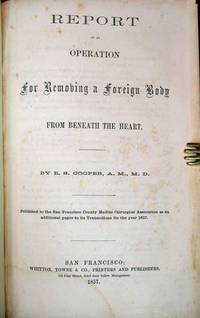
185737456San Francisco: Whitton Towne & Co. Printers and Publishers 1857. 1st printing Cordasco 50-0405; Cowan II p. 143; Greenwood 813. Modern marbled paper wrappers. Light old faded evidence of damping mostly in margins. Foxing. A VG copy. 9 1 blank pp. Old print-out of an ABE book listing laid-in. 8-7/8" x 5-3/4" <br/><br/>Cooper a renowned physician of his day founder of the first medical college on the Pacific Coast at the University of the Pacific. This paper describes a 'daring' procedure wherein Cooper removed a 'slug of iron' from one B. T. Beal of Springfield Tuolumne County. Seems Mr Beal and a few friends "in a frolicksome mood resolved to burst an old gun and accordingly loaded it with about eighteen inches of powder to which they connected a slow match and then endeavored to seek security by flight." He failed. The 'slug of iron' entered Mr Beal below the left armpit and lodged under his heart 'upon the vertical column' where it remained for 74 days until Dr Cooper removed it. The patient recovered said improvement in health to such a degree "as not to be recognized by medical men present at the operation". No copies at auction these last 30 years per ABPC & Am Ex; we know of one copy sold a couple years ago through the trade. A rare item known as one of the earliest published accounts of a California surgical procedure. Whitton Towne & Co., Printers and Publishers unknown books
1598D6965Venice: apud haeredes Melchioris Sessae 1598. First Venice Edition. Hardcover. Very Good. Folio 310 x 210mm. 2175pp. 1 301pp. 2 12pp. 175pp. 1. Contemporary dark brown goatskin title and preliminaries lacking and supplied in early manuscript with illustrated printers device some browning and staining least severe after page 9. 17th-century inscriptions on rear endpaper for Index Capitum a medical students description of the various parts. Pictorial wood-engraved ex-libris by Leo Wyatt for Lord Norwich on front endpaper. <br/><br/>First Venice Edition of Capivaccios philosophical practica in Galenic teachings a pillar for medical students of the Renaissance. First edition printed in Frankfurt in 1594 under the title Practica Medicina. Capivaccios lectures were posthumously edited by Johann Hartmann Beyer. This is the first Venice edition of these lectures on the healing sciences by one of the leading Italian medical practitioners of his time is edited by Giovanni Bernardo Sessa. Capivaccio died at Padua in 1589 where he had taught at the university for 27 years. He was a specialist in venereal diseases for which he had developed certain successful cures guarding his secrets jealously from colleagues. Capivaccio applied a philosophical approach to his practica so much so that it is doubtful if it was ever much used as a vade mecum. By writing at such great lengths it is clear Capivaccio wished to educate students rather than give them a handbook. Apart from the wish to restore Galenic teachings and to educate students one motive for Capivaccios practica may have been to bolster the claims of university doctors over the central providers of medical expertise in the Renaissance namely priests wise-women magicians herbalists and travelling empirics. This work important to the reform of the practice of medicine and to the wider concept of dogmatism or rationalism in medicine the Renaissance physician could use Capivaccios work to locate the causes of diseases as well as its signs. NLM/Durling 816. apud haeredes Melchioris Sessae hardcover books
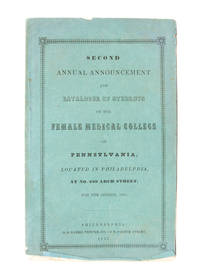
18512970Philadelphia: G.S. Harris 1851. First edition. Very Good . Original blue printed paper wraps printed to front. Some chipping and creasing to edges but overall intact and undamaged despite being quite delicate. Light scattered foxing throughout. Ownership signature of the college's original dean N.R. Mosely struck out at the top of the Faculty list on page 4; pencil ticks next to the names of several students listed in the catalogue on page 6. Exceptionally rare OCLC lists copies of this Announcement at only 2 institutions.<br/><br/>Only one year after Dr. Elizabeth Blackwell graduated valedictorian and became the first female M.D. in the U.S. the Female Medical College of Pennsylvania opened its doors. Located in Philadelphia it was the only the second school to open with the mission of training women in medicine -- having been preceded by the New England Female Medical College two years earlier in 1848. Founded by Quaker abolitionist and Underground Railroad activists who believed that women could make exceptional doctors "the college provided rare opportunities for women to teach perform research manage a medical school and with the eventual establishment of the Woman's Hospital in 1861 learn and practice in a hospital setting. It was the longest-lasting all-women medical school in the nation until it became coeducational in 1970" Mandell. The present Announcement predates these growths however showing the roots from which they emerged. One year running and the faculty remain largely male because there has yet to be an inaugural graduating class this would come in 1852; but already a female student Hannah E. Longshore is listed as a Demonstrator in Anatomy. Indeed Longshore and her sister Anna would both be part of the inaugural class of the college with the latter going on the author Discourses to Women in Medical Subjects 1897. Indeed the majority of women listed in this catalogue went on to become doctors even when it took time -- as it did for Hannah W. Ellis and Susanna H. Ellis both listed among the graduates of the 1865 class. 12 pages in all this scarce pamphlet contains Officers Corporators Faculty and Students of the school; an Announcement on the school's missions and accomplishments; information on Specialties available; Terms of enrollment; and a list of required Textbooks. It also conveys the excitement optimism and pride of those involved. "The Faculty of the Female Medical College of Pennsylvania are inspired by very different feelings from those that attended their efforts one year ago. Then they were about to enter into an untried path to engage in a great experiment.But that which was an experiment is an experiment no longer.give a woman knowledge commensurate with her natural qualifications enable her to go forth healing the sick and comforting the afflicted and she will bless the world." A rare survivor documenting that pivotal moment when women had been given the chance to prove their intellect rose to the challenge and made the future of the next female students more secure. Very Good . G.S. Harris unknown books
1695D6964Venice: apud Ioannem Hertz 1695. Hardcover. Very Good. Folio 330 x 220mm. 4 616pp. 30; 1 92pp. i. e. 90. Copper-plate engraved printers device of Hertz to tiltle. Title printed in red and black. Double column. Contemporary vellum. Ex Libris Prosperi Selli Medicinae et Chirurgiae above pictorial wood-engraved ex-libris by Leo Wyatt for Lord Norwich on pastedown. <br/><br/>Dolaeus surgical encyclopedia his opus magnus which was widely popular. Reissued several times as in this copy of 1695 the scarce first edition was printed in 1605. Dolaeus belonged to the iatrochemical school of Paracelsus and van Helmont a branch of both chemistry and medicine. His opus magnus was this surgical encyclopedia and as indicated on the title is based on the principles of Galen Paracelsus van Helmont Willis Sylvius and Descartes. The encyclopedic entries deal with all manner of surgical diseases including hernia cancer abscesses ulcers gangrene and afflictions of the sense organs teeth and genitalia. A physician to the German nobility Dolaeus became rich and famous through his secret liquor antivariolosus presumably a remedy for smallpox; he also anticipated Cheyne in his dietary treatment of gout. Part 2 has special title page: Johannis Dolaei . Tractatus varii. Page 31 part 2 has half title: Joh. Jacobi Waldschmidt . et Johannis Dolaei . Dissertationes epistolicae de rebus medicis et philosophicis. NLM/Krivatsy 3315 apud Ioannem Hertz hardcover books
151271840s handwritten pharmaceutical notebook. Pennsylvania. Original marbled boards and cloth spine; Measures 4.5" x 8" inches. 79 handwritten pages in ink and pencil 1-69 hand-numbered; 150 pages total. The meticulous note-taker records copious medical recipes for various ailments and illnesses as well as the date source and doctor from whom the treatment method was acquired thus giving an amazingly precise and detailed record of contemporary medical knowledge and treatment protocol. Under "Uterine Hemorrhage" for example the writer notes first the ingredients then the administration then the source: "Rx Sulphate of Alum 3iij; sulphate of Magnesia 3xij; aromatic sulphuric Acid 3ij; water 3xig M. Dose 3j every four hours. If pain exists griss acetate of Morphia should be added to the whole.--Dr. Grettan of Killough Scot.- Bos. Med. Jour. May 1 1842." Entries are included for "Tic Douloureux" "Angina Pectoris" "Hysteria" "Opthalmic Diseases" "Sore Nipples" "Consumption" "Cancer" "Sea Sickness" "Gonorrhea" "Cholera" "Gout" "Antidotes for Poisons" and many more. Some of the entries go on for several pages with detailed notes about the application of various prescriptions. Also includes entries for "Writing Ink" "Hair Dye" "Ginger Beer" "Poor Man's Hand Soap" "A Very Brilliant Red Ink" and other such household amenities. In good condition. Boards showing through marbled covers at corners minor bumping to corners. Age-related toning and spotting to pages which are otherwise neat and without wrinkles or creases. Comes with 7 handwritten prescription slips. <br/><br/>18th century pharmacists were medical practitioners who treated patients directly. However the field of pharmacology was unregulated and otherwise-effective prescriptions were often corrupted by inaccurate dosages or ersatz ingredients. The founding of the Philadelphia College of Pharmacy PCP in the 1800s is recognized as a radical first step forward in the development of a system of pharmaceutical practice in the United States. On March 13 1821 68 pharmacists signed the Constitution of the first pharmaceutical association in the United States in the Carpenters' Hall the same room as where the founding fathers signed the Declaration of Independence. The symbolism of the Carpenters' Hall backdrop was clear: American pharmacy would be following in the footsteps of the founding fathers and their constitutional framework. The PCP constitution included a strict code of ethics that would expel anyone from the college who adulterated medications and provided for a committee of inspection to verify the purity safety and effectiveness of medicines and a committee of equity to arbitrate disputes between member pharmacists. In 1824 the PCP published "carefully determined formulas" for the fabrication of formerly "secret-formula" patent medicines imported from the UK an essential step toward self-sufficient pharmaceutical manufacturing in the U.S. WSU History of Pharmacy. unknown books
185519521New York: Pruden & Roberts Printers 51 Beekman street 1855. First edition. Some light soiling; in very good condition. Single leaf printed recto and verso 13.75 x 7.88 inches. Benton b. 1808 here advertises his recent relocation of his medical offices from Brooklyn to Manhattan as well as a series of lectures and demonstrations on the powers of electricity--"And in keeping with the philosophy illustrated by Experiments those who have witnessed them with one accord agree that No Theatre or Band of Minstrels can equal the sport or amusement and all in keeping with good order not objectionable to the most fastidious. The Hearing Sight Taste Smell or any of the senses disturbed the Mental or Muscular Power controlled and all are Relieved at the pleasure of the operator." Benton also notes for visitors consulting at his offices "Examinations by Clairvoyants for disease which have astonished those who have witnessed them can be had if desired." The numerous press notices included here go as late as Oct. 30 1854 and the dates of performance indicate an 1855 performance. Benton noted in the 1855 New York census as a New York City resident eventually moved upstate appearing in directories in Lansingburgh N. Y. as an electric physician as late as 1882. Not noted in Atwater. Not found on OCLC. Pruden & Roberts, Printers, 51 Beekman street, unknown books
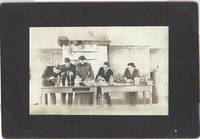
16189Original vintage photograph of a female teacher directing male medical students dissecting a cadaver c. 1890. Black and white 3"x5" with back matting. One woman surrounded by four men lean over a table with a skeleton. Behind them is a chalkboard with anatomical pull down charts. Although women had participated in the informal practice of medicine for hundreds of years the United States and most industrialized nations did not allow women into the formal practice of medicine until the latter half of the 19th century. This female doctor was part of the first generation formally accepted by medical institution. She wears a medal indicating her importance and perhaps former military involvement. Early photographs of women in medicine are very rare photograph of surgery or dissection much rarer. <br/><br/>Women practiced in the medical field for hundreds of years until new licenser rules established in the Victorian era provided a means for their exclusion. The story of how women reclaimed their role in medicine is one of resourcefulness and determination. In 1849 the first American woman graduated medical school. The path was difficult; few medical schools would accepted them and the reception was not always welcoming. Female doctors were called not only to prove their ability to practice medicine but to justify their unique necessity to the field. Of all the specialties the most embattled for women is surgery; early on they faced a challenge obtaining education training and facilities. A perennial argument was that cadaver dissection necessary to training was inappropriate for the delicate female disposition. However this Victorian-era photograph showing a woman capably participating in cadaver dissection proves that in the words of Dr. Mary Putnam Jacobi the best known female doctor in 1891 "It is perfectly evident.that the opposition to women physicians has rarely been based upon any sincere conviction that women could not be instructed in medicine but upon an intense dislike to the idea that they should be. unknown books
18003053211800. With illustrations of 3 horses with focal points on horse highlighted in red. 170 x 1070 mm. Some overall wear. With illustrations of 3 horses with focal points on horse highlighted in red. 170 x 1070 mm. unknown books
1947M4841New York:: Henry Schuman 1947-1972. 1947. Twenty volumes. 255 x 178 mm. Tall 8vos. Various paginations. Illus. Navy buckram gilt spines. Bookplate of Elmer Belt. Very good. Includes volumes 2 4-10 12-17 19-22 25 27. The JOURNAL OF THE HISTORY OF MEDICINE AND ALLIED SCIENCES is devoted to work relating to all aspects of the history of medicine public health dentistry nursing pharmacy veterinary medicine etc. Edited by George Rosen the numerous contributors include many famous historians of medical history: Ralph Major Carl Bridenbaugh Herbert Klickstein Max Neuburger Walther Riese Charles Singer etc. Henry Schuman], 1947-1972. hardcover books
187147582Rome: Forzani et C. 1871. First Edition. Folio 33cm.; publisher's tan printed card wrappers; 18pp. Wrapper lightly soiled faint vertical creasing a few tiny chips to spine ele Very Good internally fresh and fine save the crease. Polemical attack on the state of the French university system written in March 1871 two months after the end of the disastrous for the French Franco-Prussian War. As Pasteur argues whereas in Germany universities proliferated across the country France "stymied by revolution was always occupied with the sterile search for a better form of government giving only distracted attention to her institutions of higher learning" p. 9 our translation. At the root of all this was the regime of Napoleon I who in the early years of the 19th century neglected the country's twenty-eight extant institutions of higher learning in favor of his Université de France a disastrously centralized state-run institution that he established in 1808. The University suffered greatly during the Restoration and with it the quality of education so that by 1868 only £8000 were being spent for "true academic purposes" across the country cf. W. Chandler Roberts et al "Journal of the Society for Arts Vol. 32 no. 1655 August 8 1884 p. 905 creating a lacuna of learned and innovative thinkers to match Germany's. Perhaps in order to combat this downward trend Pasteur later founded the Pasteur Institute in 1887 serving as its director until his death in 1895. <br/><br/>This appears to be the only separate appearance of Pasteur's tract published abroad and distributed to various foreign leading scientific figures among these "Darwin's Bulldog" Thomas Henry Huxley who makes mention of this work in an address delivered in October of that same year. The essay appeared again in print in 1947 following an even more disastrous encounter with Germany in a collection titled "Pour l'Avenir de la Science Française." This publication quite scarce with four physical copies noted in OCLC as of February 2020. COPAC adds one copy at the LEC Library UK. Forzani et C. unknown books
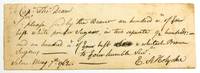
1762305478Salem MA 1762. 2 pp. pen and ink on paper. 6-1/2 x 2-1/2 inches 3-1/2 x 4-3/4 inches. Old fold minor soiling stains very good. 2 pp. pen and ink on paper. 6-1/2 x 2-1/2 inches 3-1/2 x 4-3/4 inches. AN EARLY PIONEER OF SMALL POX VACCINATION. These items offer a quaint glimpse of a beloved New England Physician. Edward Augustus Holyoke 1728-1829 the son of Rev. Edward Holyoke 1689-1769 and Margaret Appleton was born in Marblehead Massachusetts on August 1 1728. Holyoke moved with his family to Cambridge when his father was appointed president of Harvard and graduated from the college in 1746. After a brief tenure as a school teacher he apprenticed himself to a physician in Ipswich. He later opened his own practice in Salem where he gained his greatest notoriety as an early pioneer in small pox treatment and prevention during an outbreak in 1777. During his lifetime he would serve as president of the Massachusetts Medical Society was awarded the first M.D. degree given by Harvard Medical School and spent six years as president of the American Academy of Arts and Sciences. Holyoke continued to practice medicine in Salem until 1821 and was honored by the town during a tribute at the Essex House on his 100th birthday. <br/><br/>1. Autograph Document Signed. To Capt. Thos. Dean. Reading: "Sir please send by the bearer an hundred w. of your best white powder sugar in two separate 1/2 hundreds: - and an hundred w. of your best & whitest Brown Sugar - to your humble sevt. E.A. Holyoke"<br/><br/>2. Prescription listing four ingredients including "camomilla" and "gentian" with the directions: "Steep in one quart maderah & take a glass every noon. unknown books
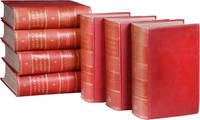
190751831Philadelphia: Lea & Febridge 1907-1910. First Edition. First printings. Seven large octavo volumes 24cm. Publisher's red cloth boards titled in gilt on spines; lavender endpapers; plates; illus. Very mild external wear; rear free endpaper lacking in vol. 7 else a complete unusually well-preserved set in the original publisher's cloth. The last major authorial undertaking by Osler 1849-1919 a massive compilation of medical and scientific papers by the most eminent physicians of the period chosen to reflect "a new era" in medicine. Osler took care to include works from outside the English-speaking world as noted in the Publisher's Note to Volume 1: ".it is more necessary in medicine than in any other sphere of human effort that the world-knowledge should be placed at the command of all. Physicians of the dominant language English have just cause for satisfaction in realizing that this is now to be accomplished in their own tongue and under the leadership of one of the best fitted by common consent to develop this idea in its most complete and fruitful manner. Lea & Febridge unknown books