Haller, Albrecht vonAntiquariat.de

439 résultats
174740490ABGöttingen, Abraham Vandenhoeck, 1747-1752. 4°. Mit 76 gefalteten gefalteten Tafeln. Pappbände der Zeit. 8 Bände in 7 Bänden.
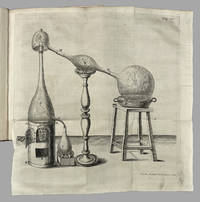
173685<p>EXTREMELY RARE ILLUSTRATED FIRST EDITION OF THE RENOWNED "PHARMACOPOEA TAURINENSIS"</p><p>MEDICAL/GASTRONOMICAL RECEIPT BOOKS PRINTED IN TORINO CONTAINING NUMEROUS RECIPES OF SPIRITS AND LIQUORS</p><p>THE FIRST APPEARANCE OF THE <em>VERMOUTH </em>RECIPE<br /><em><br />Pharmacopœa Taurinensis nunc primum edita jussu augustissimi regis. </em>Augustae Taurinorum : in Aedibus Academicis apud Joannem-Baptistam Chais typographum regium 1736.<br /><br />4to 238 x 180 mm contemporary stiff vellum title on leather label at spine pp. 8 246 16 Coat of arms of the House of Savoy at title page woodcut head-pieces and head-letters woodcut <em>cul-de-lampe<br /><br /></em>TWO LARGE ENGRAVED FOLDING PLATES 46X34 CM BY THE FRENCH ARTIST GEORGES TASNIERE ACTIVE IN TORINO AND WIEN DEPICTING THE DISTILLATORY APPARATUS NECESSARY FOR THE <em>SPIRITUS SULPHURIS</em> PLATE I AND <em>THE SPIRITUS VINI</em> PLATE II. THE PLATE II IS EXYTREMELY RARE BEING NOT PRESENT IN THE majority of the COPIES OFFERED ON THE MARKET IN THE LAST YEARS.<br /><br />The two plates were in fact meant to be used as project drawings to develop the instruments to perform distillation and so very often detached from the book.<br /><br />Officially presented in Turin by Antonio Battista Carpano in 1786 and based on the receipt of "<em>Vinum Absinthites</em>" Absinthe Wine described for the first time in the present book the <em>Vermouth</em> quickly become one of the best known liquor in the world and Vittorio Emanuele III di Savoia Victor Emmanuel III of Italy immediately appointed it as the "Official Aperitif" of the Court of Savoy.<br /><br />The <em>Pharmacopœa Taurinensis </em>is a complete and detailed illustrated spagyrical manual containing the most important and renowned receipts of the Savoy tradition and many spirits including the first receipt of the Vermouth. Many of the receipts originally meant to be used a medicine have also a great interest from a gastronomical point of view.<br /><br />The manual is formed by two parts; the first contains a list in alphabetical order of all the most important medicinal substances known at the time while the second composed by 21 chapters contains a rich and complete list of receipt regarding Essences Brews Decoctions Conserves Syrups Powders Liquors Oils Ointments Poultices<br /><br /></p><p>In the second half of the 18th century the town of Torino Piedmont Italy was already the main market in the production of flavored sweet wines to be used use as simple drugs. Pandering this market the <em>Pharmacopoea Taurinensis</em> gives a large list of recipes recommended for many diseases. It is also described for the first time the original recipe of vermouth that will have a great spread not only as medicinal elixir but also as a delicious drink.</p><p>Its diffusion was so great that the Duke Vittorio Amedeo III of Savoy declared the vermouth the "Court's Official Aperitive" preferring it to the "rosolio" the so far favorite liquor of Piedmont aristocracy.</p><p>Many local liqueurs makers claimed its making but as shows its presence in this book the proceeding was diffusely applied in Torino for many years before Benedetto Carpano in 1786 claimed its fabrication. Carpano developed his own recipe to face the increasing tax imposed by French and Spain on drugs so far used to produce sweet wines in Italy followed by all the other vermouth maker among them Martini e Cinzano.</p><p>The most important producers had their shop in the center of Torino where the bourgeoisie of the town went to celebrate the rite of the aperitive. From Torino the vogue of vermouth spread all over Europe as a typical Piedmont drink and contributed to the great industrialization process of Torino.</p><p>Provenance: I. Ownership signature <em>Rumianus Michael Antonius Chirurgus 1797</em> at title page and flyleaf. II. Paper <em>exlibris "Biblioteca di Pier Paolo Vaccarino"</em> pasted at front inside board</p> Joannem-Baptistam Chais hardcover
174740490DBGöttingen, Abraham Vandenhoeck, 1747?1752. 4°. Mit 76 gestochenen, gefalteten Tafeln. Pappbände der Zeit. + Wichtig: Für unsere Kunden in der EU erfolgt der Versand alle 14 Tage verzollt ab Deutschland / Postbank-Konto in Deutschland vorhanden +, 40490D 8 in 7 Bänden.
178030084ABLeipzig, Weidmann, 1780. (6), 296 (16) S. Mit 8 gef. Kupfertafeln. Pappband aus der Zeit. + Wichtig: Für unsere Kunden in der EU erfolgt der Versand alle 14 Tage verzollt ab Deutschland / Postbank-Konto in Deutschland vorhanden +, A|B [2 Warenabbildungen]
175730290ABLausanne, Marci-Michael Bousquet (Band 7: Sigismund d'Arnay), 1757-1760. 4°. Mit 8 gestochenen Titelvignetten und 34 (davon 20 gefaltete) Tafeln. Neuere Halblederbände mit roten, goldgeprägten Rückenschildern im Stile der Zeit. 7 Bände in 8 Bänden.
171850523BBLeipzig, bey Joh. Herbordt Klossen (II: Leipzig, bey Moritz George Weidmann)., 1718. 8°. 14 n.n. Bl., 674 S., 13 n.n. Bl. Register, 1 S. Druckfehler, 1 w. Bl.; 6 n.n. Bl., 440 S., 9 n.n. Bl. Register. Schlichter Interimspappband der Zeit mit handschriftlichem Rückentitel. [2 Warenabbildungen]
174630129BBGotha, verlegts Christian Medius, (1746)-1751. 8°. Mit 6 gestochenen Tafeln in Band 1. Pappbände der Zeit mit späteren, handschriftlichen Rückenschildern. 7 Bände (von 8).
175730290DBLausanne, Marci-Michael Bousquet (Band 7: Sigismund d'Arnay), 1757-1760. 4°. Mit 8 gestochenen Titelvignetten und 34 (davon 20 gefaltete) Tafeln. Neuere Halblederbände mit roten, goldgeprägten Rückenschildern im Stile der Zeit. + Wichtig: Für unsere Kunden in der EU erfolgt der Versand alle 14 Tage verzollt ab Deutschland / Postbank-Konto in Deutschland vorhanden +, 30290D 7 in 8 Bänden.
176331169ABWien, Johannes Thomas Trattner, 1763. 8°. 95 S. Halbpergament der Zeit mit handschriftlichem Rückentitel und Marmorpapierbezug. + Wichtig: Für unsere Kunden in der EU erfolgt der Versand alle 14 Tage verzollt ab Deutschland / Postbank-Konto in Deutschland vorhanden +, A|B|C|D [4 Warenabbildungen]
174630129DBGotha, verlegts Christian Medius, (1746)-1751. 8°. Mit 6 gestochenen Tafeln in Band 1. Pappbände der Zeit mit späteren, handschriftlichen Rückenschildern. + Wichtig: Für unsere Kunden in der EU erfolgt der Versand alle 14 Tage verzollt ab Deutschland / Postbank-Konto in Deutschland vorhanden +, 30129D 7 Bände (von 8).
176130077BBLeiden, Johann und Hermann Verbeek, 1761. Folio. 2 n.n. Bl., 295, 1 S. Mit 89 Kupfertafeln. Halblederband der Zeit mit goldgeprägtem Rückenschild.
175840192DBNürnberg, bey Johann Josef Fleischmann, 1758. Gr.-Folio. Titel, 41 S. Mit 39 gestochenen Tafeln. Etwas späterer Halblederband mit goldgeprägtem Rückenschild und wenig Rückenvergoldung. + Wichtig: Für unsere Kunden in der EU erfolgt der Versand alle 14 Tage verzollt ab Deutschland / Postbank-Konto in Deutschland vorhanden +, A|B|C [3 Warenabbildungen]
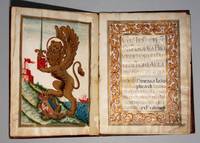
17175670<p>4to manuscript on vellum 23.5 x 17.1 cm 7 ff. 4 ff. vellum blanks including a full-page frontispiece illumination of Venetian Lion of St. Mark each text page with foliate borders in gold ink headings and initials in gold ink. Bound in contemporary Venetian morocco elaborately gold tooled gold block-printed foliate pastedowns. Edge wear and minor rubbing to spine and boards manuscript loose in binding oxidizing to edges of pastedowns. Marginal flaws to frontispiece illumination just touching border in places a few small wormholes elsewhere minor handsoiling.<br /></p><p>Finely illuminated early 18th-century Venetian manuscript issued by the city's Magistrato alla Sanità Health Department as a license to certify the physician Antonio Damugliano d. 1747 to practice medicine in the Venetian Republic using his propriety formula for topical salves <i>balsami</i> to treat "wounds and ulcers" f. 3v-3r. The manuscript ornately written out and decorated in gold and colored ink opens with a full-page image of the winged Lion of San Marco in the Venetian landscape which serves as an official seal of the document's authenticity and is inscribed by five <i>Provveditori</i> of the Magistrato and one notary who witnessed the certification.</p><p>This pharmaceutical license represents a rare material survival of how Venice's Magistrato alla Sanità regulated the practice of medicine in its territories even down to the level of controlling how individual practitioners could work with specific drugs. Damugliano presumably was required to keep the document on his person while plying his trade and to present it to the relevant authorities or even to his patients should his practice be called into question. The text of the document is written out twice – first in Italian and then in Latin – to suit the linguistic preferences of both the common Venetian citizen and the professional medical class.</p><p>Damugliano also known as Antimo Damulianos is noted in the document dated April 1717 as being a native of the Ionian island of Zante or Zakynthos at the time a Venetian colony and having recently returned from Moscow "where with good success and for a long time he practiced medicine with full official permission of many noteworthy people" f. 2v. Damugliano is said to have studied medicine in Europe likely in Italy specializing in contagious diseases and eventually practicing in Asia Minor Persia India China Egypt Constantinople and Trieste and to have been ordered by Emperor Charles VI 1685-1740 to treat the sick of a plague outbreak in Corinth see L. Zoes passim. Damugliano's name is also associated with a 1725 treatise entitled 'Medicina' which circulated in manuscript form in Venice and dealt with the use of salves pills and stones to treat hydrophobia see L. Zoes; we have been unable to locate a copy of this treatise. Damugliano is also recorded as having worked in Vienna where an April 1746 news magazine comments that the "very famous" Damugliano having traveled through numerous kingdoms has arrived to demonstrate the curative powers of "the wondrous Chinese stone called Bezoar" which is effective against fevers snake bites fatigue colic etc. <i>Nachtrag</i> p. 64. The bezoar stone an indigestible mass formed in the digestive tract of ruminants was lauded from the middle ages as a universal antidote to poison.</p><p> R. Palmer "Pharmacy in the Republic of Venice in the Sixteenth Century" in A. Wear et al. eds. <i>The Medical Renaissance of the Sixteenth Century</i> pp. 100-17; <i>Epeteris: Hetaireia Byzantinon Spoudon</i> vol. 43-44 1977 p. 417; H. Schmuck <i>Grieschischer Biographischer Index</i> vol. 1 p. 247; L. Zoes <i>Lexikon historikon kai laographikon Zakynthou</i> vol. 1; S. Carbone <i>Provveditori e sopraprovveditori alla Santità della Repubblica di Venezia</i>; P. Selmi "Il Magistrato all Sanità" in <i>Difesa della Sanità a Venezia Secoli XIII-XIX</i> pp. 28-50; <i>Nachtrag zu denen wöchentlich-kurtzgefaßter historischer Nachrichten Der neuern Europäischen Begebenheiten auf das Jahr 1746</i> p. 64.</p>
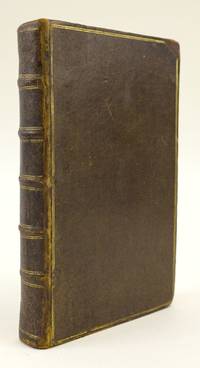
1742ST16000London: Printed for the author 1742. FIRST EDITION. 205 x 130 mm. 8 x 5". xxiv 285 1 pp. 3 leaves index. <br/> Contemporary sprinkled calf covers with double gilt-ruled borders raised bands flanked by gilt rules neatly rebacked preserving original backstrip one corner restored. Front flyleaf with ink inscription of Wm. Barber dated 1790. Weinberger "Introduction to the History of Dentistry" p. 330; Garrison-Morton 3672; Wellcome II 320; ESTC T63467. ◆Joints lightly rubbed corners a little bumped and worn but the binding solid and perfectly satisfactory; a handful of creased corners and a couple of trivial blemishes but the contents in very fine condition the paper clean and bright and obviously read very little.<br/> <br/> This is a fresh appealing copy of the first modern book on teething and the second book on dentistry in English. Weinberger says that "as far as English dental literature is concerned it began with Joseph Hurlock in 1742. Hurlock was a strong advocate of lancing the gums of infants to permit teeth to erupt more readily and thus prevent convulsions. His treatise was a plea for parents and nurses to allow him to carry out this procedure." The book documents symptoms of dentition difficulties and reports on cases in which our author lanced the gums of children whose health problems he attributed to teething trouble--not always with happy outcomes. The book does contain advice that was more beneficial. Weinberger notes "Hurlock apparently was a keen observer of dental conditions then found in children noticing that the havoc wrought by caries in the deciduous teeth was undoubtedly due to diet and recommended that such youngsters be sent to the country where fresh air and better food could be obtained." Little is known of the author who has no other works recorded in libraries or bibliographies. It has been suggested that he was related to the Joseph Hurlock 1715-93 who was a director of the East India Company. We are fortunate that Mr. Hurlock did not stint when it came to the quality of paper on which his treatise was printed; the text here has come down to us crisp and bright as a result. Printed for the author unknown