115 résultats
1833557691833. Contemporary morocco. Very good. Two parts octavo 24.2 by 14.3 cm. 280 unnumbered leaves. Manuscript on polished cream paper. Persian text recto and verso in black and red ink; triple-ruled inner text borders 15.4 by 7.9 cm in red and blue single-ruled outer border 21.7 by 11.3 cm in blue. The second part of the manuscript opens with an illuminated full-page double suite composition Arab. unwan in polychrome and gilt; marginal illumination appears on two other leaves in this section. Contemporary paneled tan morocco lightly rubbed at extremities elaborately tooled in blind. Some marginal annotations in black ink at several early leaves. Intermittent mild smudges mostly marginal; bottom corner of first leaf excised resulting in loss of several words. Very good.<br /> <br /> Compendium of medical tracts used by prominent physicians of the Muslim world written in superb Persian calligraphy by 'Ali Muhammad in A.H. 1249 = 1833. Much of the work deals with herbal remedies used by famous Persian physicians including Avicenna 980-1037. A treatise on anatomy is included along with commentaries penned between the two sets of borders which discuss various matters including diagnosis from urine; hygienic practices drawn from the treatises of famous physicians; prescriptions and recipes derived from the book Tuhfat al-mu'minin a work on materia medica by Muhammad Muʼmin Husayni d.1698 dedicated to the Safavid ShÄh SulaymÄn. Husayni was considered the greatest herbalist of the Mazandaran region of Persia. Four pages in the second part present various alphabets in black ink; comments and correspondences with the Arabic/Persian alphabet are noted in red ink. <br /> <br /> Provenance: Stamps of "Mohd. Halim Salimi Library Kandahar-Afghanistan" in blue ink at opening and closing leaves. In the late 1950s Mohammed Halim Salimi of Kandahar worked in an administrative capacity for the International Cooperation Administration a United States government agency and precursor of the U.S. Agency for International Development USAID. A smaller elliptical owner's stamp in red with text beneath at blank recto of the opening leaf. unknown
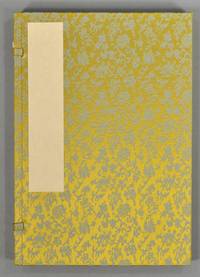
1869885781869. MEDICINE SUGITA Gempaku. RANGAKU KOTO HAJIME. Tokyo Tenshinro Meiji 2 1869. 22.5 x 15.1 cm. 2 vols. srting-bound Japanese-style fukuro-toji. Original covers and printed paper title labels. This memoir by the scientist behind the ground-breaking KAITAI SHINSHO was originally completed in Gempaku's old age in 1815. It was transmitted via manuscript until the fall of the ancien regime when Fukuzawa Yukichi and Gempaku's grandson arranged to have it published in a woodblock edition. The book was written in a very clear and simple style and reveals the great lengths of ingenuity the KAITAI SHINSHO author/translators went to to uncover the secrets and understand the esoteric Dutch vocabulary of Kulmas' anatomy that they translated therein. The RANGAKU KOTOHAJIME is often cited as perhaps the earliest Japanese text to explain techniques of cryptoanalysis from a practical and logically rigorous point of view. It is also a compelling story of scientific investigation in isolated traditional Japan. Finally despite its relatively late publication date the RANGAKU KOTOHAJIME is vanishingly rare. Our copy is in very good condition enclosed in a custom-fitted clasped chitsu case. unknown
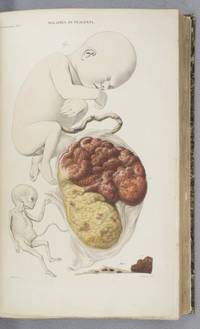
1829CJW1310Paris: J. B. Baillière 1829-42. FIRST EDITION IN BOOK FORM bound from the original parts. 486 x 337 mm. 19 1/8 x 13 1/4". Two volumes. <br/> Contemporary marbled boards backed with recent calf raised bands flanked by gilt fillets black morocco labels. WITH 231 LITHOGRAPHED PLATES two folding OF WHICH 167 ARE IN COLOR many heightened with gum arabic later tissue guards. Garrison & Morton 2286; "Heirs of Hippocrates" 863; Norman 538. ◆Corners and edges somewhat rubbed with some loss of paper as expected with large picture books text with variable foxing persistent but usually light never severe and principally confined to margins a handful of black & white plates with moderate spotting additional small defects internally otherwise quite a commendable copy of a book always found foxed browned and worse our volumes solidly restored now the spines unworn and the text and remarkable plates with no fatal condition problems.<br/> <br/> Garrison & Morton declares that "the fine illustrations of gross anatomy seen here make this one of the greatest works of its kind." The inaugural professor of pathological anatomy in Paris anatomist and pathologist Jean Cruveilhier 1791-1874 provided in the present work the first description of multiple sclerosis and an early identification of Cruveilhier's palsy. Hypertrophic pyloric stenosis and ulceration of the stomach due to hyperacidity were also detailed for the first time here. In "Doctrine of the Nerves" John A. Spillane called Cruveilhier "the prince of physician-pathologists" and this work a "treasure chest of neurology." "Heirs of Hippocrates" notes that "this atlas contains some of the finest illustrations of gross pathology ever made." The plates were done by anatomical illustrator Antoine Chazal 1793-1854 a French painter engraver art teacher at Muséum National d'Histoire Naturelle and great-uncle of Paul Gauguin. This work was originally issued in 40 parts at nine francs each over a period of 13 years. The parts were ultimately bound together into two volumes as here in a print run that based upon the subscriber's list was likely just more than 400 copies. While no stranger to auction rooms the book--a practical reference book heavily used by professionals--is all too often found with missing plates and/or parts and in condition that leaves much to be desired. J. B. Baillière unknown
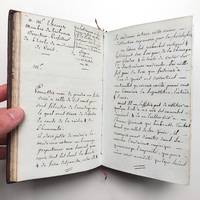
180319744<p><strong>A very interesting collection of around 80 copies of letters from the correspondence of Rouen physician Jean-Baptiste Vigné 1771-1842 a pioneer in the practice of vaccination in Rouen.</strong> He was head of the city's General Hospice and one of the first full members of the Académie de Rouen when it was re-established in 1803. He was also active in Paris as a corresponding member of the Académie de Médecine and the Société de Médecine Clinique.</p><p>This correspondence brings together the most important letters he sent between 24 Nivose An XI January 14 1803 and July 8 1806.<br />His correspondents were mainly doctors and members of learned societies in Paris and Rouen including leading medical figures of the period such as "shis ami" Jean-Etienne Esquirol 1772-1840 8 letters Michel-Augustin Thouret 1749-1810 6 letters François Chaussier 1746-1828 4 letters Philippe Pinel 1745-1826 2 letters J. J. le Roux b. 1749 1 letter and Henri-Marie Husson 1772-1853.</p><p><strong>Among the most interesting items are three letters relating the early beginnings of vaccinia in Rouen.</strong><br />One is addressed in his capacity as Corresponding Member of the Paris Academy of Medicine to Henri-Marie Husson 1772-1853 secretary of the central vaccinia committee in Paris dated 26 Pluviose an XI 1 page: "<em>Do not doubt Sir the pleasure I would have in communicating to you some observations favorable to vaccinia inoculation which I believe against the feeling of its detractors to be powerfully anti-smallpox</em>".<br />Two are addressed to Monsieur G. Robert pharmacist at the Hôtel Dieu in Rouen and secretary of the correspondence office of the central vaccinia committee of that city dated 8 brumaire an XIII 1 page and 3 pluviose an XIII 8 pp.<br />They concern the shipment of vaccine fluid taken from a 12-year-old child and give detailed observations on the vaccinations he carried out in Rouen reporting a few special cases such as the vaccination of a 9-month-old baby surrounded by sick people.<br />"<em>I have vaccinated only 26 people since Messidor Year XI three of whom were unsuccessfully. In twenty-two others I have seen all the symptoms of true vaccinia develop successively with a reddish superficial aureole forming around the injections as soon as they have been given and disappearing in a few moments.</em> "</p><p>Other letters concern the distribution of his own works or articles such as his analysis of Philippe Pinel's treatise on insanity his <em>Essai sur la petite vérole </em>his <em>Essai sur l'utilité de l'anatomie </em>1803 or <em>De la Médecine légale</em> 1805.</p><p>The volume also contains interesting observation letters and reports on a variety of subjects: care of wounds obstetrical observations peritonitis digestive tumors the case of a person with live salamanders coming out of his anus convulsions etc. There are 23 sheets of observations reported to the Paris Society of Clinical Medicine on Mr. Loger's illness.<br />Some letters are addressed directly to patients with instructions for their care and medical certificates and attestations.</p><p><strong>An important source on the activities of a particularly active corresponding member of several medical societies and a pioneer in the practice of vaccination.</strong></p>
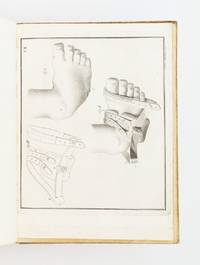
1803ST18718Pavia: Appresso Giuseppe Comini 1803. FIRST EDITION. 309 x 225 mm. 12 1/8 x 8 7/8". 42 pp. without the blank called for by Norman. <br/> Contemporary paper boards patterned to look like tree calf smooth spine. WITH FIVE ENGRAVED PLATES THREE OF THEM FOLDING BY FAUSTINO ANDERLONI. Norman 1900; Garrison-Morton 4308. See also: Heirs of Hippocrates p. 292; DSB XII pp. 136-39. ◆Two-inch dampstain to upper right corner of front cover also slightly affecting margins of first 10 leaves extremities a little worn but still a nearly fine copy--clean fresh and bright internally with excellent impressions of the plates in a sturdy contemporary binding.<br/> <br/> In excellent unsophisticated condition this is a rare copy of the first edition of what Garrison-Morton tells us is the "first accurate description of the pathological anatomy of congenital club-foot." In addition to correctly describing the anatomy of this common birth defect surgeon Antonio Scarpa also devised a brace for treating the malformation--detailed engravings of which are shown on the accompanying plates. A student of Morgagni Scarpa 1852-1932 quickly rose to prominence becoming a professor at the age of 20 and authoring several important works in the fields of otology cardiology ophthalmology and neuroanatomy among others. As DSB relates "his fame was so great that in 1805 he was personally complimented by Napoleon." According to Heirs of Hippocrates Scarpa was "a brilliant artist as well as a brilliant anatomist" who included his own anatomical drawings engraved by Faustino Anderloni in many of his published texts including the present work. The images here go beyond simply depictive to evoke an emotional response from the viewer who is invited to identify with the distress of the afflicted. Our first edition is a rare book: we could trace just two copies sold on RBH. Appresso Giuseppe Comini unknown
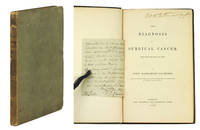
18551250181855. London: John Churchill 1855. <br /> <br /> Slim 8vo 77pp. 2 plates at the end then 28 pp. ads for Churchill's "Publications in Medicine Surgery and Science". Original green cloth hinges repaired at front and back cloth dull and backstrip with some wear.<br /> <br /> § First edition of the author's first book; presentation copy inscribed on the title-page by the author "With the Author's best complts" and a 4pp. mostly illegible ALs from the author to Dr. Long tipped in facing the title-page. A little known but apparently quite early and important study by this ophthalmic surgeon best known for his recognition of Laurence-Moon syndrome and his research on retinitis pigmentosa. The essay won the Liston prize for 1854. In the Journal of Ophthalmology for 1932 there is a long essay on Laurence who died at the age of 42 entitled "A Belated Tribute" by Arnold Sorsby pp. 727-740 with a bibliography of his writings. Laurence was a brilliant student and later ophthalmologist who founded the South London Ophthalmic Hospital now the Royal Eye Hospital. Among many other unrecognised achievements he was the first to describe macular degeneration. The tribute concludes: "the work that he started and did not see completed is today a living force. He has become an integral part of modern ophthalmology as founder of an important hospital as a pioneer in ophthalmic journalism and as one of the forerunners of that growing school of thought which correlates ocular defect with bodily structure." Not in Garrison-Morton. Armorial bookplate of Richard Long M.D. unknown
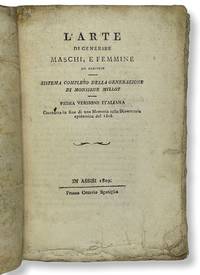
180939<p><strong>Very rare first Italian Edition</strong></p><p><strong>How to choose the gender of a newborn during procreation</strong></p><p><strong>Only 1 know existing copy of this issue recorded in WorldCat Italy</strong></p><p><strong>Untrimmed in its original printer paper binding</strong></p><p>Millot Jacques-André. <em>L'arte di generare maschi e femmine ad arbitrio : sistema completo della generazione / di monsieur Millot. Prima versione italiana corredata in fine di una Memoria sulla Dissenteria epidemica del 1808.</em>In Assisi: presso Ottavio Sgariglia 1809.</p><p>8° 205 x 140 mm contemporary printer paper binding small restorations paper pp. xiv 176 47 1.</p><p><strong>No copy on the market no copy at auction in last 40 years</strong></p><p>First Italian edition of this bizarre treatise dealing with the methods and techniques to choose the gender of the newborn during the procreation and on the formation of the Placenta.</p><p>The original work was translated by the Italian Giovanni Palmieri and dedicated to his friend Antonio Trevisani who was the inspirer of the translation. Upon learning that his friend's wife had given birth to yet another female Palmieri proposed to him the method devised by Jacques-André Millot surgeon-midwife of Marie-Antoinette and the Duchesses of Orleans and Bourbon with which they hypothesized techniques during the conception which would have guided in the choice of the genre of the unborn child and set about the translation with commentary of the work printed in its first absolute edition in Paris in 1800 with the title <em>L'Art de procreÌer les sexes aÌ€ volonteÌ ou SysteÌ€me complet de geÌneÌration par Jacques-AndreÌ Millot</em>.</p><p>The work however is not a mere translation. As stated by Palmieri in the introduction some parts of the original work have been summarized while an extended commentary and some revisions have been implemented.</p><p>In his treatise the author proposes natural methods to choose the gender of the unborn child avoiding the bloody ones suggested in the past such as the removal of a father's testicle before conception. The method in summary theorizes the specialization of the ovaries in the development of one gender rather than another proposing through precise positions during conception to fertilize one ovary or the other according to the desired gender.</p><p>In detail:</p><p>· In the first part of the text the historical theories on generation known at the time are retraced.</p><p>· The second part describes the Placenta its origin and formation the blood circulation in the foetus the phenomenon of superfetation the similarities and dissimilarities between new-borns and parents the ovaries and their functions the uterine tubes.</p><p>· Finally the third part is dedicated to the description of the methods proposed to pre-define the gender of the unborn child. In particular it discusses the way to choose the gender during procreation the experiences and proofs of the functioning of the method ending with the final conclusions.</p><p>The text then continues this is the missing part in the works recorded in WorldCat with the extensive notes and comments of the translator and with the final part dedicated to the<strong> <em>Memoria sulla Dissenteria epidemica del 1808.</em></strong></p><p>"<em>I do not believe I can render a greater service to humanity than to give it the mode of procreating the gender at will; this knowledge would also have its Moral goal: it is I believe the only means of increasing if it is possible the tenderness of the Fathers and Mothers and the attachment of the Children for them because the parents who will have only Children of their choice will see them with continual satisfaction</em> " Millon op. cit.</p><p>Census: University of Chicago Signature 2 xiv 160 pp. Cornell University Library New York Signature 2 xiv 160 pp. Pontificia Università Gregoriana Roma signature xiv 176 47 1.</p><p>World-Cat apparently records only three copies of this title. The two copies present in the United States are however characterized by a different reduced signature compared to the present copy and the one owned by the Gregorian library. The signature of the copies in the US is in fact <strong>pp. 2 xiv 160</strong> with respect to the signature <strong>pp. xiv 176 47 1</strong> of the present copy.</p><p>In fact they are missing the <em>Nota del Traduttore</em> translator's note pp. 161-176 and the first edition of the<strong> <em>Memoria sulla Dissenteria epidemica del 1808 </em>pp. 1-47 of the second part.</strong></p><p><strong>All the other libraries mentioned in WorldCat own an electronic copy of the book.</strong></p><p>Conditions: Small restoration at bindings. Internally an amazing copy with no defect untrimmed.</p> Ottavio Sgariglia
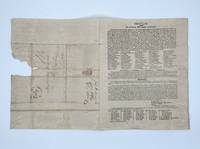
1819370363Baltimore 1819. 1p. letterpress circular letter. With a 2pp. autograph letter signed written to Anthony Kimmel on the verso and conjugate blanks ". the malignant fever is rather increasing on the point. There has been nearly one hundred new cases .". 4to. Usual folds. 1p. letterpress circular letter. With a 2pp. autograph letter signed written to Anthony Kimmel on the verso and conjugate blanks ". the malignant fever is rather increasing on the point. There has been nearly one hundred new cases .". 4to. The 1819 epidemic at Fell's Point Baltimore resulted in nearly 2300 deaths. The present handbill however signed in print by numerous businessmen and a committee of physicians downplays the rumor of danger to doing business in Baltimore as a whole. In part: ". We deem it proper further to inform you that the disease does not appear to be contagious and has not been communicated in any one instance to persons residing out of that atmosphere."<br /> <br /> Besides discussing the endemic the manuscript letter written on verso of the circular by J. Werdebaugh also touches on business matters and the 1819 Philadelphia Balloon Riot: "At Philadelphia they had a mob which tore & burnt down the beautiful spot the Pavilion Garden. It was a consequence of the non performance of the Balloon which was to have ascended from there. Baltimore is called mob town and Philadelphia mob ville. unknown
18263100861826. 37 ff. written on rectos only. 4to. Wrappers titled in manuscript. Covers worn and stained with some wear and chipping to the text. 37 ff. written on rectos only. 4to. Unpublished manuscript on the ancient Egyptian and Greek roots of medicine by the early American physician Charles Alfred Lee 1801-1872. Lee graduated from Williams College in 1822 and received his M.D. at Berkshire Medical College. He was connected with the Northern Dispensary of New York City chair of materia medica and general pathology at Geneva Medical College New York and taught at a series of eastern United States medical schools. Lee helped found the New York Journal of Medicine and the Collateral Sciences in 1843 and in 1850 he co-founded the Buffalo Medical School. His most famous work was the American edition of Dr. James Copeland's Dictionary of Practical Medicine 1848. He published several medical textbooks including the popular Human Physiology for the Use of Elementary Schools 1843. He also edited Bacchus: an Essay on the Nature Causes Effects and Cure of Intemperance 1840 by Ralph Grindrod.<br /> The present manuscript which appears to be unpublished is a survey of early Egyptian and Greek medicine and draws from sources quoted in the original Greek. unknown
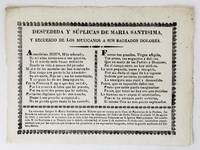
18336283Mexico City 1833. Near fine. Broadside 6.25 x 8.5 inches. Very minor soiling and wear. Cholera was a genuine scourge in 19th-century Mexico and the present work comes out of the epidemic that broke out in August of 1833. According to parish records it is estimated that a total of five percent of the population of Mexico City died as a result with the number of deaths causing overcrowding in both hospitals and cemeteries. The present document describes how the image of Our Lady of Sorrows was venerated in the Casa de los Ejercicios de la Profesa and carried in solemn procession to the church of the convent of the nuns of the Lord of Santa Teresa on Saturday August 17 1833 only eleven days after the first case of cholera was detected in Mexico City. After the conclusion of the novena held in the Metropolitan Church the image of the Most Holy Mary was returned to its temple on September 9 1833; through the supplications made by the faithful to the aforesaid images the great epidemic of cholera morbus was thereby calmed. An ephemeral piece not traced in OCLC. unknown
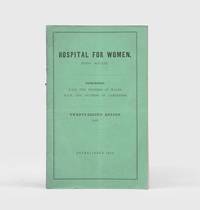
1865180002London: Judd and Glass 1865. First edition of this unrecorded report on Britain's first medical institution devoted to the care of women. It was founded in 1842 by Protheroe Smith a pioneering obstetrician and the first physician in London to administer chloroform in childbirth. The Soho Square "hospital embodied moral and social views about the 'special' nature of femininity" and was guided by Smith's 1810-1882 fervent evangelical beliefs Moscucci p. 75. It was distinguished by its closed-wards policy: "This was a pledge to debar medical students from the wards of the new hospital which was no doubt intended to secure public support for the project: ever since men-midwives had entered the lying-in chamber the suspicion that obstetricians violated women's modesty had proved one of the major obstacles to the advance of the male practitioners of midwifery" Moscucci p. 82. Women were also able to stay longer in Soho than at general hospitals allowing it to more effectively treat chronic and work-related conditions. Although the hospital was originally met with scepticism and concerns about morality in the ensuing decades its reputation improved to such an extent that it was able to secure royal patronage this report recording its present supporters as Alexandra Princess of Wales and Mary Adelaide Duchess of Cambridge. They were later joined by Queen Victoria herself who donated £500 in 1885. Small octavo. Original green printed wrappers. Central crease from folding worming to rear joint resulting in a little loss rear cover mottled and damp stained: a very good copy. Ornella Moscucci The Science of Woman: Gynaecology and Gender in England 1800-1929 1990 unknown
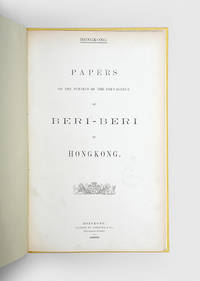
1889170565Hong Kong: Printed by Noronha & Co. Government Printers 1889. First edition of these materials on thiamine deficiency including contributions by Sir James Cantlie a pioneer in first aid treatment and a close associate of Sun Yat-Sen. A lengthy paper by Dr Patrick Manson the future founder of the London School of Hygiene and Tropical Medicine describes the symptoms and treatment of the condition for ten of his cases. WorldCat records two copies worldwide National Library of Australia and Manson's medical school. This copy was formally in the library of the Royal College of Surgeons of England and carries accession stamps on the front cover title page and first page. Quarto 313 x 200 mm pp. 23. Mid-century yellow cloth portion of original printed wrapper laid down on front cover cream endpapers. Light toning internally; a very good copy. hardcover
1881ZB375176Paris 1881-1957. Series II: volumes 10-13 17-22 25-64 66-74 77-79 81 82 89-98 101-106 108-123 130-131 133-139 141 octavos bound some bindings require repairs or replacement still good ex library PRICE IS FOR THE LOT:. - If you are reading this this item is actually physically in our stock and ready for shipment once ordered. We are not bookjackers. Buyer is responsible for any additional duties taxes or fees required by recipient's country. Photos available upon request. Paris unknown
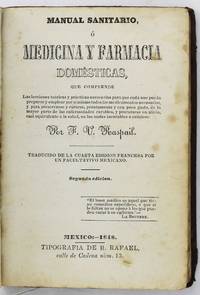
18484960Mexico City: Tipografia de R. Rafael 1848. Very good. 295pp. Contemporary Mexican calf spine gilt with leather label. Light wear to extremities heavier to corners; label a bit chipped. Light foxing and wear to text. Second edition after the first of the previous year. A popular manual for hygiene and the diagnosing and curing of diseases. Translated from the French and published in Mexico three subsequent years the present work provides advice on the means to stay well and prevent disease. Each tidbit of information is helpfully numbered 345 in all with the opening sections being devoted to health and hygiene with useful suggestions such as avoiding drafts and cold damp rooms; there follow several sections on various types of diseases with symptoms causes and recipes for curatives. The work covers everything from croup in children to heart palpitations to epileptic fits to the flux. The final half of the book is an alphabetical dictionary of afflictions followed by an index. The author was a French chemist and physician who published several works on domestic medicine including the original of this text in 1845. It is rare in all its Mexican editions. We locate copies of the first edition of 1847 at the University of Toronto and the Biblioteca Nacional de Mexico; one copy of the present edition located at the University Complutense de Madrid; and two copies of the third edition of 1849 found at the University of Texas and the Natural History Museum of Los Angeles County. Tipografia de R. Rafael unknown
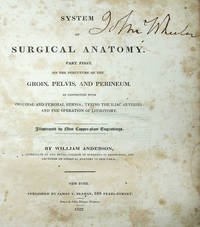
182254222New York: James V. Seaman 1822. First Edition. Quarto 28cm signed in twos. Original paper-covered boards with printed spine label; 19912pp; 9 leaves of plates bound in at rear. Early ink ownership signature to title page John Wheeler. A complete but worn copy. Covers are somewhat rubbed and worn with some flaking of paper at spine and portions of printed spine label rubbed away; text conspicuously foxed throughout; half-title lacking; front endpaper partially excised one plate partially detached at gutter. Text is uncut and despite the prominent foxing to text the plate leaves are mostly unblemished. Complete and Good. <br /> <br /> An infrequently encountered American surgical text. Anderson who trained at the Royal College of Surgeons in Edinburgh emigrated to America in 1820 and after delivering a series of anatomical lectures in New York under the patronage of Valentine Mott the current work was published to supplement these lectures became affiliated with the Vermont Academy of Medicine see Kelly American Medical Biographies. NY: 1920. This work is notable for the nine anatomical plates all engraved by A.B. Asher Brown Durand including four engraved from his original illustrations. These are quite early works by Durand who would achieve his first prominence as the engraver of John Trumbull's edition of the Declaration of Independence 1823 and later great renown as a landscape painter of the Hudson River School from about 1840 on. Not cited in any of the standard medical bibliographies and infrequent in commerce with only a single copy traced at auction in the past 50 years Swann 1979. James V. Seaman unknown
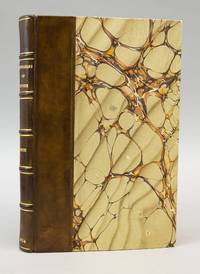
18118876Paris: Chez H. Nicolle 1811. Second edition. Half-Leather with marbled boards inside covers and endpapers. Very Good; light edgewear and scuffing to covers. Octavo pp. xlvi 478. Beautiful copy of a scarce and important book on conditions of the heart and major blood vessels. Corvisart is said to have been the first to describe heart symptoms comprehensively and accurately the first to differentiate clearly between heart and pulmonary ailments and the first to explain the mechanisms involved in heart failure. Corvisart 1755-1821 was personal physician to Napoleon and enjoyed a close and loyal relationship with him. This is a classic early work in the field of cardiology and this edition is scarce in the U.S. Chez H. Nicolle hardcover
1825SZEPEBKS007493ICarlsruhe: Chr. Fr. Muller 1825. First edition . Soft cover. Very Good/not applicable. Title continues: " . zur Geschichte der Lehre von der Beckenaxen". - Square 8vo. - x2126 pp. - Original plain grey wrappers armorial bookplate in red gold and black: "Recte faciendo / Neminem Timeas / van der Hoeven". - Slight darkening of one narrow edge of the plates and some pages else fine. - With 3 full-page plates a "Zusatz zu Seite 51 Note 1" Page 125 and a 2/3-page "Druckfehler"Page 126. - Garrison-Morton 6256. - First edition. - Naegele's classic morphological study of the pelvis clearly documenting that contrary to the commonly accepted view the axis of the pelvis is not affected by changes in the position of the body. - Shelf No.: P 333. <br/> <br/> Chr. Fr. Muller paperback
187147582Rome: Forzani et C. 1871. First Edition. Folio 33cm.; publisher's tan printed card wrappers; 18pp. Wrapper lightly soiled faint vertical creasing a few tiny chips to spine ele Very Good internally fresh and fine save the crease. Polemical attack on the state of the French university system written in March 1871 two months after the end of the disastrous for the French Franco-Prussian War. As Pasteur argues whereas in Germany universities proliferated across the country France "stymied by revolution was always occupied with the sterile search for a better form of government giving only distracted attention to her institutions of higher learning" p. 9 our translation. At the root of all this was the regime of Napoleon I who in the early years of the 19th century neglected the country's twenty-eight extant institutions of higher learning in favor of his Université de France a disastrously centralized state-run institution that he established in 1808. The University suffered greatly during the Restoration and with it the quality of education so that by 1868 only £8000 were being spent for "true academic purposes" across the country cf. W. Chandler Roberts et al "Journal of the Society for Arts Vol. 32 no. 1655 August 8 1884 p. 905 creating a lacuna of learned and innovative thinkers to match Germany's. Perhaps in order to combat this downward trend Pasteur later founded the Pasteur Institute in 1887 serving as its director until his death in 1895. <br /> <br /> This appears to be the only separate appearance of Pasteur's tract published abroad and distributed to various foreign leading scientific figures among these "Darwin's Bulldog" Thomas Henry Huxley who makes mention of this work in an address delivered in October of that same year. The essay appeared again in print in 1947 following an even more disastrous encounter with Germany in a collection titled "Pour l'Avenir de la Science Française." This publication quite scarce with four physical copies noted in OCLC as of February 2020. COPAC adds one copy at the LEC Library UK. Forzani et C. unknown
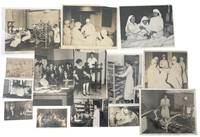
1900231121900. Women in Medicine Women's Employment Photo archive documenting women's participation in medicine nursing surgery laboratory science and public health from approximately 1900 through 1946 providing primary-source evidence of women working within institutional medicine during the decades in which their access to formal medical training and professional authority remained limited and uneven. The images document women in operating rooms clinical instruction environments laboratory settings and patient care contexts establishing record of how women functioned within medical institutions as practitioners trainees and technical specialists.<br /> <br /> Archive of fourteen silver gelatin photographs press prints and real photo postcards dating from c. 1900 to 1946 varying in size and format from 3.5" x 5" to 8" x10" with multiple examples retaining original verso captions typed press slips and annotations identifying subjects and contexts. The archive includes a estimated 1900 surgical preparation scene with women in operating attire working alongside male colleagues; a 1925 press photograph identifying "Kuniko" a Japanese woman working in the medical and chemical research field with the caption noting her public commitment to remain unmarried in order to pursue scientific work; a 1925 image of a women's medical board representing multiple organizations; a 1926 University of Cincinnati Medical College photograph documenting nurse Miss Mabel Miller participating in a nationally broadcast demonstration of human heartbeats; a 1931 image of Simmons College nursing students conducting a basal metabolism test with detailed clinical procedure noted in the caption; a 1932 press photograph of Spanish nursing students studying American medical methods; laboratory scenes from the 1920s showing women conducting chemical work; a 1935 clinical interior with a woman retrieving medical supplies; a real photo postcard depicting a surgical demonstration observed by suited male spectators with women among the surgical team; a Latvian postcard showing a nurse weighing schoolchildren in a public health context; and a 1946 anatomy class photograph documenting a predominantly female cohort performing cadaver dissection with student signatures preserved on the verso.<br /> <br /> The archive's geographic and chronological range corresponds to major developments in the history of women in medicine including the expansion of formal nursing education the gradual admission of women into medical training programs and the increasing specialization of laboratory and clinical work in the interwar and postwar periods.The University of Cincinnati broadcast photograph situates a named nurse within early intersections of clinical medicine and mass communication while the Simmons College image documents technical clinical training at a women's institution. The Kuniko press photograph documents a Japanese woman publicly identified as a professional scientific researcher underscoring the visibility of women in medical and laboratory fields across national contexts. The 1946 dissection photograph records a moment of postwar expansion in women's medical education preserving the identities of participants in a cohort entering a rapidly changing profession. Light silvering and minor edge wear to several prints; press photographs retain captions and stamps; postcards show age toning. Overall in good condition. A cohesive and internationally scoped documentary archive of women's medical training professionalization and clinical labor in the first half of the twentieth century. unknown
1871ZB375173Bordeaux 1871-1924. 1872 1884 1887-1892 1894-1895 1897 1900-1909 1913-1924 quartos bound in 28 parts some bindings require repairs or replacement textually darkened still good ex library. - If you are reading this this item is actually physically in our stock and ready for shipment once ordered. We are not bookjackers. Buyer is responsible for any additional duties taxes or fees required by recipient's country. Photos available upon request. Bordeaux unknown
1854159171854. Collection of medical texts 1757-1966 documenting the development of medical theory practice and institutional knowledge across Europe and the United States with particular emphasis on surgery therapeutics military medicine and cross cultural diagnostic systems. The group spans Enlightenment era surgical instruction nineteenth century American alternative medical movements and twentieth century advances in radiology and international medical coordination providing a longitudinal view of how medical knowledge circulated through print. Several volumes relate directly to international congresses of military medicine reflecting the formalization of global medical cooperation in the interwar period while others address reproductive health materia medica and comparative approaches to diagnosis across Asia and the West.<br /> <br /> Twelve books ranging in publication from 1757 to 1966 encompassing French British and American imprints and covering subjects including surgical theory medical history radiological technique pharmacology reproductive medicine and global healing traditions. The collection includes Enlightenment era surgical theses nineteenth century American medical reform literature and twentieth century institutional reports from international congresses of military medicine and pharmacy. Together the volumes demonstrate shifts in medical pedagogy from question and answer instructional formats to illustrated atlases and formal conference proceedings as well as the increasing role of state and international bodies in standardizing medical knowledge during the twentieth century.<br /> <br /> 1 Haller Albrecht von Le Baron de Haller. Collection de Theses Medico-Chirurgicales Sur les points les plus importans de la Chirurgie theorique & pratique. Paris: Chez Vincent 1757. Two volume French language work compiling surgical theses addressing theoretical and practical aspects of eighteenth century European surgery associated with early institutional medical training.<br /> 2 Barth M.; Roger Henri. Traite Pratique d'Auscultation ou Expose Methodique des Diverses Applications de ce Mode d'Examen. Paris: Labe 1854. Fourth edition treatise on auscultation and percussion as diagnostic techniques reflecting the growing importance of clinical examination methods in nineteenth century medicine; signed by both authors with a printed warning against unauthorized copies.<br /> 3 Gardner Augustus K. The Causes and Curative Treatment of Sterility. New York: De Witt & Davenport 1856. Illustrated American work addressing reproductive health and the physiology of generation contributing to nineteenth century medical discourse on fertility and sexual health.<br /> 4 Wilder Alexander. History of Medicine. New Sharon: New England Eclectic Publishing Co. 1901. Survey of medical history emphasizing alternative and eclectic schools of practice in the United States documenting dissenting traditions within American medicine.<br /> 5 Morris Henry. Essentials of Materia Medica Therapeutics and Prescription Writing. Philadelphia and London: W. B. Saunders Company 1906. Instructional text structured in question and answer format for medical students illustrating early twentieth century pedagogical approaches to pharmacology and treatment.<br /> 6 Bainbridge William Seaman; Ireland M. W. foreword. Report on Fourth International Congress of Military Medicine and Pharmacy. Menasha WI: George Banta Publishing Company 1927. Official report documenting international coordination of military medical practice in the interwar period.<br /> 7 Bainbridge William Seaman; Patterson Robert U. foreword. Report on Sixth International Congress of Military Medicine and Pharmacy. Menasha WI: George Banta Publishing Company 1931. Proceedings reflecting continued development of international standards in military medicine.<br /> 8 Bainbridge William Seaman; Rossiter P. S. foreword. Report on Seventh International Congress of Military Medicine and Pharmacy. Menasha WI: George Banta Publishing Company 1933. Documentation of expanding collaboration among national medical corps prior to World War II.<br /> 9 Bainbridge William Seaman; Reynolds Charles R. foreword. Eighth International Congress of Military Medicine and Pharmacy. Washington D.C.: Government Printing Office 1937. U.S. government publication recording international medical coordination during a period of rising global conflict.<br /> 10 Leonardo Richard A. American Surgeon Abroad. New York: Froben Press 1942. Signed narrative account of an American surgeon's overseas experience during World War II providing perspective on wartime medical service.<br /> 11 McNeill Clyde. Roentgen Technique: An Atlas of Roentgen Anatomy and Positioning. Springfield: Charles C. Thomas 1947. Illustrated atlas documenting radiological techniques and anatomical positioning reflecting postwar advances in diagnostic imaging.<br /> 12 Amber R. B.; Babey Brooke A. M. The Pulse in Occident and Orient. New York: Dunshaw Press 1966. Comparative study of pulse diagnosis across India China Iran and Western medicine illustrating mid twentieth century interest in integrating global medical traditions.<br /> <br /> The chronological breadth of this collection supports research into the transformation of medical knowledge from individualized theory and regional practice to increasingly standardized international systems shaped by scientific advancement and global conflict. The inclusion of military medical congress reports highlights the role of warfare in accelerating medical innovation and cooperation while works on reproductive health and cross cultural diagnostics demonstrate the persistence of diverse approaches within the field. Varied condition across volumes including former library markings occasional staining marginalia and wear to bindings with several volumes in very good condition; overall good. A cohesive research collection tracing the evolution of medical thought and institutional practice over two centuries. unknown
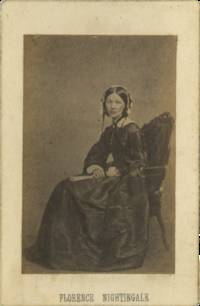
1870List36105N.p. 1870. Carte After the original photograph by William Edward Kilburn 1818–1891 taken circa 1854 with later CDV issue probably circa 1870s. Albumen print mounted on card; sitter identified in print beneath image. Standard carte-de-visite format approximately 2½ x 4 inches. Excellent contrast with light surface wear. Seated three-quarter portrait of Nightingale in dark silk dress with white collar hands folded over a paper posed beside an upholstered Victorian chair. The image derives from a sitting arranged in London with William Edward Kilburn one of Britain’s early professional photographers and a former daguerreotypist who gained fame by exhibiting at the Great Exhibition of 1851. By the early 1850s Kilburn had established a reputation for photographing members of the aristocracy and prominent public figures.<br /> <br /> The Nightingale sitting happened shortly before her departure for the Crimea in October 1854 at a moment when her name was just entering the public press. The portrait predates her full transformation into the national icon later known as the “Lady with the Lamp.†Unlike later more romanticized images Kilburn’s photograph presents a composed unsentimental likeness more consistent with standard portraiture practices than her later photographs. Following Nightingale’s wartime service at Scutari 1854–1856 and the subsequent surge of public acclaim Kilburn’s image became the primary photographic source from which engravings lithographs and later carte-de-visite reproductions were made.1<br /> <br /> 1 Denis Pellerin “Florence Nightingale: The Mystery Behind Her Iconic Photographs†The Classic November 15 2020 https://theclassicphotomag.com/florence-nightingale-the-mysteries-behind-her-iconic-photographs/ accessed February 27 2026. unknown
1826ST14206London: Burgess and Hill 1826. FIRST EDITION. 215 x 135 mm. 8 1/2 x 5 3/8". x 2 282 pp. 1 blank leaf lacking half title. <br/> Recent retrospective dark brown quarter calf over marbled boards raised bands gilt titling. Title page with ink library stamp of University College Hospital Medical School Library. The Founders of Child Neurology 1990 pp. 148-52. ◆Title a little foxed with a half-inch brown strip from older binding along gutter edge last two leaves with minor foxing otherwise a fine copy clean fresh and surprisingly bright in an unworn sympathetic binding.<br/> <br/> This is the first edition of the first monograph in English on the subject of convulsions in children by a man considered to be one of the founders of child neurology. One of 300 original Fellows of the Royal College of Surgeons and a renowned London practitioner specializing in midwifery and the diseases of women and children John North 1790-1873 was a forthright plain-spoken man whose obituary even noted that "he was occasionally too brusque to be pleasant." This candor was an asset in his writings. As "The Founders of Child Neurology" notes "Whereas most 18th- and early 19th-century medical authors were opaque verbose and interminable theorists North wrote simply and clearly avoided speculation admitted ignorance and actually dealt with practical matters such as distinguishing between types of convulsions and the extent of treatment required. Also perhaps in keeping with his character he did not hesitate to criticize other authors with whom he disagreed." One of his main targets was John Clarke who had declared that "every case of convulsion" resulted in "inevitable organic damage" to the brain. Consequently Clarke called for drastic treatment of every seizure whether caused by teething or serious illness often doing more harm than good with his purgatives clysters and bleeding. North saw convulsions as a disturbance in the brain but not as evidence of organic disease citing as evidence the lack of brain lesions found in autopsies of children who had died of convulsions. He distinguished epilepsy from other causes of seizures and was perhaps the first to note the association between rickets and convulsions. "Founders" concludes "his greatest gift to his contemporaries may have been his reiterated contention that most babies with convulsions need not be assaulted with calomel leeches and the lancet.". Burgess and Hill unknown
18122111902160201413Kyoto Book Forest Naniwa Book Forest 1812. Soft Cover. Fine. Number of books: 3 Kyoto Book Forest Naniwa Book Forest paperback
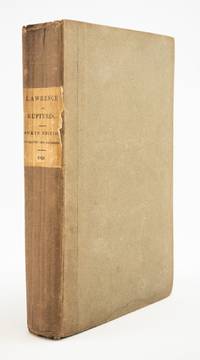
1824ST20601<p>London: Printed for Callow and Wilson 1824. Fourth Edition. 235 x 145 mm. 9 1/4 x 5 3/4". xvii 1 568 pp. <br />Publisher's gray paper boards flat spine with printed paper label leaves untrimmed. WITH TWO ENGRAVED PLATES one folding. Early ink ownership inscription of Jas. McKee on title page. Wellcome III p. 462; Garrison-Morton 3587 5th Edition; Heirs of Hippocrates 822 Second Edition. Spine and boards a bit darkened covers with a hint of soiling occasional light foxing a few closed tears not affecting text other trivial defects but AN EXTREMELY FINE COPY the insubstantial binding with nothing approaching a significant defect and the text remarkably bright clean and fresh.<br /><br />Still in its original boards and in lovely condition this extensive treatise on the causes and treatment of hernias was written by an English surgeon known as a radical precursor of Darwinian attitudes towards the nature and development of man. One of our author's earliest publications when it was first issued in 1807 as "A Treatise on Hernia" the present work won a prize at the Royal College of Surgeons. According to Heirs of Hippocrates William Lawrence 1783-1867 "contributed significantly to the understanding and management of ruptures" and his "Treatise" "remained for many years the standard work on the subject." Lawrence crossed swords with both the Church of England and the medical establishment with several lectures and publications that espoused his materialist views applauded France and the United States for their commitment to free scientific thought and even dared to question Old Testament narratives regarding the origins of man. DNB tells us that "Throughout the nineteenth century . . . he was often regarded as a martyr for the cause of science and of intellectual liberty. His lectures were even cited as precursors for such later works of scientific naturalism as Charles Darwin's 'Descent of Man' 1871 and Thomas Huxley's 'Man's Place in Nature' 1863." Various editions of the present work can be found on the market but it would be difficult to find one in better contemporary condition than ours.</p> Printed for Callow and Wilson