98 842 résultats
Folio (340 x 520 mm). (14), 125, (1 blank), 218, (2) pp. With hand-coloured engraved title-page and 30 double-page hand-coloured engraved plates, each celestial charts or model Universes. Also with 4 engraved and 2 woodcut in-text diagrams, illustrated woodcut initials, headpieces, and tailpieces. Contemporary full vellum ruled in floriated gilt, decorated with gilt arabesques, stamped in gilt on spine, all edges gilt. First edition, second issue of the only celestial atlas published in the Golden Age of Dutch cartography, and perhaps the most important 17th century celestial atlas to be produced. - Unlike later celestial atlases, the Cellarius charts demonstrated various ancient and contemporary cosmological ideas, rather than merely the names and positions of the stars. The purpose of the book was to assess contemporary attempts to discover the underlying harmony of the universe. As such, the charts represent the highest levels of 17th century astronomical thought, with lavishly engraved and hand-coloured plates showing the three great theories on the nature of the universe: the Ptolemaic, the Copernican, and the Brahean. This was an era when the debate between these models was at the forefront of cosmological science, on par with the debate between Einsteinian Relativism and Quantum Theory today. - Featured in four plates, the Ptolemaic model was the oldest, formulated by the Alexandrian astronomer and mathematician Ptolemy about 150 CE. Ptolemy's approach placed the Earth at the centre of the cosmos, but unlike other ancient models (for instance, Aristotle's) could explain the odd movement of the planets as observed from Earth: unlike the moon and Sun, most planets occasionally appear to travel in spirals in the night sky rather than tracking sedately East to West. This movement in rooted in the word planet itself, from the Greek "planetes" meaning "wandering one". Ptolemy was able finally to mathematically explain the wandering of the planets, though by way of a complex geometry of epicycles. - By the 16th century, this model was beginning to wear thin. In 1543 Nicholas Copernicus (1473-1543) made detailed observations which led him to publish "De Revolutionibus Orbium Coelestium" ("On the Revolutions of the Celestial Orbs"), which solved the worst geometrical complications of Ptolemy by placing the Sun at the centre of the universe and making orbits by and large circular. However, until Galileo, the Copernician theory lacked an underlying system of physics to explain this new movement. Tycho Brahe (1546-1601) attempted to forge a middle path between the classic Ptolemaic model and the neater mathematics of the Copernican, allowing that most planets would orbit the sun, but that the Sun orbited the Earth, which remained at the centre of the cosmos. As early as the 12th century it was not uncommon to posit that one or two planets might orbit the Sun, which in turn orbited the Earth. However, in the mediaeval period, debate was held off due largely to the lack of technological ability to observe the sky with precision. It was simply impossible to prove whether the Sun or the Earth stood at the centre, and thus similar (though always geocentric) models existed side by side without too much controversy. When Cellarius placed these three models together it was in a world where this had changed: one of these models would emerge to portray what was, to contemporaries, an inimitable truth both scientific and deeply religious. The only question was who would win the day. - In this volume, Cellarius has delved into this debate in striking baroque style, bringing to bear all the power of the Dutch Golden Age of cartography on the heavens rather than the Earth. The four engravings of the Ptolemaic system depict the central Earth encased, as was traditional, in the four elements, including a large ring of fire. Above this are the orbits of the seven planets: the Moon, Mercury, Venus, the Sun, Mars, Jupiter, and Saturn, bordered by the ecliptic, in which the fixed stars spin around the unmoving Earth once a day. Another Ptolemaic plate includes two smaller models as part of the marginal decoration, one of the Ptolemaic hypothesis, "in qua Terra totius Universi centrum", and one of the Brahean hypothesis, "in qua centrum Lunae et Firmamenti est Terra. reliquorum quinq. Planetarum Sol". In this way, Cellarius placed each model in direct dialogue with each other, not only in text but in image. Following the section on Ptolemy, Copernicus bursts onto the scene with a model dominated by a central sun, its rays stretching out to every corner of the universe. Around it are Mercury, Venus, and then Earth itself, around which orbits the Moon; next comes Mars and then Jupiter, now with four moons to itself, and finally Saturn. The four moons of Jupiter had only been discovered fifty years previously, near-simultaneously by Galileo and by Simon Marius; their presence remained innovative in Cellarius's time. The second illustrates in more detail the orbit of the Earth around the Sun and the rotation of Earth which must create night and day in the Copernican system. Finally, Brahe's compromise is introduced, mapped so beautifully that its inelegant fusion of theories appears somehow elegant in its own right. The Earth at the centre is orbited by the Moon, then by the Sun. Around the Sun, however, are Mercury and Venus in tight orbit, and then, more distantly, are Mars, Jupiter - again with its modern four moons - and Saturn. - Thus, in one volume, Cellarius has encapsulated the increasingly accurate celestial cartography, the increasingly uncertain laws of physics, and the endlessly fascinating 17th century multiverse in a moment on the cusp of the most momentous decision in the history of science. Strangely, Cellarius himself remains a somewhat mysterious figure, with little known other than that he was the rector of the Latin school of Hoorn and a gifted mathematician. In fact, it appears that "[t]he most elaborate and famous celestial atlas of the 17th century was issued by an author unknown to the history of astronomy" (Whitfield). This 1661 edition is a variant of the first edition of 1660, identical except for the change of date on the title. - Touch of exterior wear, a few plates with tape reinforcement where they have begun to separate from guards. Stunningly ornate, detailed, and well preserved. Koeman IV, Cel 2. Snyder, Oude Hemelkaarten p. 115f. Whitfield p. 101.
4to. 4 vols. (10), 20 pp. (10), 40 pp. (14), 33 pp. (12), 19 pp. With 2 watercoloured and 4 coloured engraved coats of arms, 1 coloured engraved dedication plate, 183 (instead of 186) plates of birds, 15 of which in watercolour and 168 on splendidly illuminated engraved plates, partly heightened in gold, silver and copper, with lavish watercolour borders. Contemporary glazed red morocco binding with double gilt engraved spine labels, splendid floral spine and cover gilding. Vols. 4-6 with coloured armorial supralibros to upper covers. Calico endpapers, all edges gilt. Unique copy of one of the rarest works of zoological book illustration, from the library of the banker, art collector, and patron Moritz von Fries (1777-1826), for whom the set was in all likelihood specially produced. Around 1800, Fries was considered without doubt the richest man in the Habsburg monarchy. The splendid engraved plates were elaborately illuminated, each with rich botanical and architectural decoration extending even beyond the engraved matter. In addition, the copy at hand was enhanced by 15 original watercolours (all in vols. 5 and 6), whereas the regular copies include merely prints. The only verifiable complete copies, in the Austrian National Library (ÖNB) and the Bavarian State Library (BSB), show less splendid decoration, with only three watercolours each in the respective volumes and no watercolour borders whatsoever. The Fideicommissum collection in the ÖNB holds 5 illuminated volumes of Spalowsky's work, with volume 5 containing the highest traceable number of watercolours among all copies available for comparison. As the final volume is lacking in the Fideicommissum collection, the eight watercolours and splendid framings of vol. 6 of Fries's copy are probably unique. - Since 1932, the only copies traceable at auction were those at Ketterer, 2017 (vols. 1-4) and Christie's, 2012 (vols. 1-3). The volumes sold in 2017, along with the ones at the ÖNB and BSB, belong to the normal edition without the watercolour embellishment and the artist's colouring, while the copy sold at Christie's would seem to have been at least comparable to Fries's in respect to its décor. However, neither the Christie's copy nor any of the others discussed above include any original watercolours, which are to be found in that of Fries's alone. - The splendid avian illustrations surrounded by landscape motifs and architectural decoration are labelled in red ink, identifying the animals' German and scientific names. The labelling is sometimes overpainted, suggesting that the decision to extend the watercolour décor was made at a later stage. The engravings were produced by five artists, among which were Benedikt Piringer and Sámuel Czetter. In vol. 5 of the Fideicommissum copy, Piringer signed one of the watercolours, proving that he provided templates for the engravers and contributed to the colouring. - Spalowsky's "Naturgeschichte der Vögel" was planned as part of a large natural history publication. In a subscription announcement from 1791 the surgeon and army physician advertised the plates showing species "previously not illustrated by any author" and promises the vivid, realistic colour "of the originals". A large proportion of the species depicted, including four falcons, originate from Asia, mostly from India and China, and are not to be found in Brisson's or Buffon's works. The present copy constitutes a special edition of the most expensive version of decoration, priced at 36 guilders - 15 times the cost of the plainest version. The eventual failure of this ambitious project was undoubtedly due not alone to the author's untimely death in 1797, although Spalowsky did succeed in wooing several prominent dedicatees for his elaborate publication. The "Naturgeschichte der Vögel" is dedicated to Alois I Joseph von Liechtenstein and Caroline von Manderscheid-Blankenheim (vol. 1), Beethoven's patron Franz Joseph Maximilian von Lobkowitz and Caroline Theresa von Schwarzenberg (vol. 4), Wenzel count Paar and Maria Antonia Princess Liechtenstein (vol. 5), as well as Anton Theodor von Colloredo-Waldsee-Mels, archbishop of Olmütz (vol. 6). - Provenance: 1) Maurice count Fries, with his library stamps, "EX BIBL(iotheca) MAVR(icii) COM(es) FRIES" to title-page (verso), now obscured by monogrammed red seals ("MF"); 2) Dorotheum sale, 12 Feb. 1932, lot 44, 75 ATS (description mounted to lower flyleaf of vol. 6); 3) Austrian private collection; 4) Dorotheum sale, 18 Dec. 2019, lot 222, not mentioning the Fries provenance or the 15 watercolours. - Marginal flaw to armorial supralibros of vol. 5. Lacks 3 plates (plate 2 in vol. 1, plates 6 and 39 in vol. 5). Index and plate 42 in vol. 4 have small flaws. Plate 31 in vol. 1, plate 43 in vol. 4, and plate 44, as well as one armorial engraving in vol. 5 slightly smudged. Nissen, IVB 888. Schlenker 345.1. Wurzbach XXXVI.56. Sitwell/Buchanan p. 143. Not in Nissen, ZBI. Not in Anker.
8vo. IX, (1), 502, 32 pp. With half title, folding lithographed diagram and publisher's adverts at end dated June 1859. Original green cloth covers bound in as pastedowns, cloth spine mounted on first free endpaper at the end. Modern blue morocco, gilt, marbled flyleaves. Stored in custom-made slipcase. First edition, first issue, of "the most important single work in science" (Dibner), and "a turning point, not only in the history of science, but in the history of ideas in general" (DSB). "No work of science has ever been so fully vindicated by subsequent investigation, or has so profoundly altered humanity's view of itself and how the living world works" (Wilson). - This first impression of the first edition can be distinguished from later impressions of the work through the presence of the misprint "speceies" on p. 20, which was corrected in the second impression. This copy handsomely rebound but still retaining the cloth binding of Freeman's variant b. Of the first edition of 1250 copies, fifty-eight were distributed for review and presentation, this being one of them: the slip of paper "with Mr Darwin's compliments", uncommonly in Darwin's own hand, tipped in at beginning. Small closed tear in the folded table, very light soiling and foxing at the beginning, but a good, clean and uncut copy. - Provenance: small ink stamp of Francis Darwin Swift (1864-1944), grandson of Charles Darwin's uncle Francis Sacheverel Darwin, showing a leaf-bearing stag and the name "F. Swift" in blackletter. PMM 344. Dibner Heralds (1980) 199. Eimas Heirs 1724. Freeman 373. Garrison/Morton (1991) 220. Grolier, Science 23b. Norman 593. Sparrow, Milestones 49. Waller 10786.
8vo. IX, (1), 502, 32 pp. With half title, folding lithographed diagram and publisher's adverts at end dated June 1859. 20th century blue half morocco binding with cloth covers, gilt rules, marbled flyleaves. Top edge gilt. Almost unobtainly rare revised issue of the first edition, or rather the intermediary stage to the first issue of the second edition, called by Darwin himself "only a reprint [with] a few important corrections". Published in January 1860, this is the only known copy to retain the year "1859" on the title-page, the original two quotations opposite (while the second edition is usually marked by having three), and the 32 pages of ads at the end, dated "June 1859" (usually lacking in the second edition). Alterations between the first and second editions are minor, though it is notable that Darwin corrected the misprint "speceies" on page 20 and shortened the "whale-bear" story on page 184. - Immediately recognized as revolutionary and controversial, the "Origin's" small first edition of only 1250 copies sold out on the first day, and by the late autumn of 1859 the publisher Murray was asking Darwin to begin revising at once for a new edition. This was to become the second edition (never so called on the title-page), of which a few copies were printed that retain the date "1859". Freeman knows of only two, at Yale and the University of Southern California, LA, both of which, however, already have three instead of two quotations opposite the title: "The existence of such copies has long been known to the trade, although, from their extreme rarity, few booksellers can ever have seen one" (p. 77). Freeman clarifies that while there is "only one issue of the first edition" of the "Origin of Species", "the text being identical in all copies" (p. 75), it was "customary, for many years, for anyone offering a copy of the first edition to describe it as 'first edition, first issue'", and he admits that "the book-sellers were, in a purist sense, right; the new printing was from standing type of the first edition, although with a considerable number of resettings" (p. 77). By this standard, the present specimen is clearly one of the second edition. Yet Freeman, from his evidence, considered "the presence of two quotations only, from Whewell and Bacon, on the verso of the half-title leaf", to be "diagnostic" of the first edition. Unknown to Darwin's bibliographer, the present revised version sits between the first edition and the first issue of the second, exhibiting characteristic features of both. Only a tiny number of copies of this proto-first issue of the second edition can have been produced: it appears a unique variant of what has always been considered the "rara avis" of Darwin bibliography. - Lower and right edges untrimmed, a very short tear in the diagram's first fold; an old repaired tear to the gutter of the following leaf and some very light foxing to the margin of the preceding one. Otherwise an impeccable copy, bound in the mid-20th century for the American petroleum geologist Dr. Edgar Wesley Owen (1896-1981) with a posthumous exlibris ticket loosely inserted. PMM 344. Dibner Heralds (1980) 199. Eimas Heirs 1724. Garrison/Morton (1991) 220. Grolier/Horblit, Science, 23b. Grolier, Medicine, 70B. Norman 593. Sparrow, Milestones 49. Waller 10786. Freeman p. 77 and cf. nos. 373 & 375.
Folio (208 x 310 mm). Latin ms. and illustrations on paper. 184 ff. with gilt-raised title-page and a total of 292 watercolour and gouache plant illustrations (1 double-page), captioned and numbered 1-290 by a contemporary hand (nos. 45 and 149 assigned twice). 19th century green half cloth over marbled boards. Stored in custom-made half morocco case. Unique, museum-quality manuscript herbal, previously unknown to research, compiled for the Memmingen pharmacist Wolfgang Schötz by an unidentified but obviously professionally trained artist. The nearly 300 watercolours and gouaches, all impressively accomplished, show the principal Central European medicinal, poisonous, spice and ornamental plants as they were to be found in the gardens, meadows and forests of the free imperial city of Memmingen: hollyhock, tarragon, snow pea, prunella, dandelion, spiked rampion (phyteuma spicatum), swallow-wort (asclepias vincetoxicum), echium, caper spurge (euphorbia lathyris), white bryony (wild hop, Bryonia alba), staghorn sumac (Rhus typhina), poppy (papaver rhoeas), banewort (atropa belladonna), foxglove (digitalis), hemlock (Conium maculatum), as well as splendid tulips, irises and martagon lilies, Jacob's ladder (polemonium), rose, chrysanthemum, gentian, daffodil, barberry, etc. The shapes of the leaves and blossoms, often also of the roots and bulbs are rendered with extreme precision; occasionally, the illustration is enlivened with beetles, caterpillars and other insects, drawn with similarly meticulous realism. The Latin and German captions are apparently by two different writers; some of the Latin annotations may be in Schötz's own hand. The quality of the draughtsmanship and colouring approaches that of the roughly contemporaneous studies by Nicolas Robert, whose documentation of the plants in the French royal gardens, commissioned by the court of Versailles, were famous even then and remain so to this day. - The pharmacist Wolfgang Schötz (Schütz) also served as judge in the municipal court of his native Memmingen. Correspondence in his hand with the German physician and alchemist Johann Joachim Becker (1635-82) has survived in the latter scholar's posthumous papers in Rostock. Schötz was considered "the largest and strongest man" in town; when he died in 1695, ten men were needed to bear his mortal remains to the graveyard (cf. J. F. Unold, Geschichte der Stadt Memmingen [1826], p. 292). - Title-page somewhat duststained and rubbed. Leaves numbered 1-183 in pencil in the later 19th century, probably during rebinding; a few leaves transposed. A few edge flaws (some with early repairs); edges somewhat fingerstained and dampstained throughout with a larger dampstain near the end, but illustrations preserved in brilliant original colour. A masterpiece of botanical illustration.
15655777<p><b><i>"FOR MANY YEARS THE MOST IMPORTANT WORK ON THE MEDICINAL PLANTS OF THE NEW WORLD"</i></b></p><p>8vo 13.4 x 9.1 cm 132 ff. with woodcut border to title page and woodcut initials. Bound in later stiff vellum title stamped on spine gift inscription on the front flyleaf to a certain 'Carmen Ballina' dated 1922 now covered in paper. Only minor wear and rubbing to binding. 'Tassa' price of 51 maravedis entered in manuscript on title page as issued early signature of a certain 'Henrique Correa' at fol. aiiir the occasional contemporary annotation in the text minor occasional dampstaining very minor occasional marginal worming.<br /></p><p>Very rare first edition 1565 – virtually unacquirable for the past half century or more – of the first printed work devoted to the botanical and medicinal discoveries made in the Americas a treatise which through its later expansions and numerous translations would remain "for many years the most important work on the medicinal plants of the New World" Garrison & Morton. The <i>Dos libros</i> was written by the renowned physician Nicolás Monardes 1493-1588 in Seville then the center of the Spanish printing industry and the only port from which ships were authorized to sail to and from the New World. Born in 1493 in the very year Columbus returned from his first voyage Monardes thus both occupied a front row seat for first decades of the 'Columbian Exchange' and was ideally positioned to disseminate his findings to a wider European indeed global audience.</p><p>Monardes shared much with his contemporary Garcia d'Orta 1501-68 the Portuguese physician stationed in India and famed for his <i>Coloquios dos simples e drogas e consas medicinais da India</i> Goa 1563: "Just as d'Orta gave the learned world of the West the first accurate accounts of various Asian medicinal and commercial plants so did Monardes with those of America … Monardes like Garcia d'Orta has a strong claim to be regarded as one of the fathers of the science of pharmacognosy. Both of them compiled what were virtually complete monographs on many important items of our actual <i>materia medica</i> which were then unknown or only inaccurately known to the Western World Boxer pp. 23-24. Even the diffusion of these two authors throughout the learned world of early modern Europe shared a common source in the Latin versions made of them by the Flemish physician and botanist Charles de L'Ecluse Carolus Clusius 1526-1609 who published them together for the first time at Antwerp by Plantin in 1574 and afterwards.</p><p>Monardes eagerly capitalized on his unique position in Seville to acquire botanical news specimens and seeds from the New World cultivating his own garden of American plants and distributing cuttings to correspondents throughout Spain and Europe. In 1553 he established a transatlantic business partnership with a colleague in Tierra Firme and over the next three decades Monardes' three sons and four daughters emigrated to Tierra Firme and New Spain thus providing him with a network which would prove invaluable in collecting information for the 1565 <i>Dos libros</i> and in expanding the treatise in its 1571 and 1574 editions published as <i>Segunda Parte</i> and <i>Primera y Segunda y Tercera Partes de la Historia Medicinal</i>. In the <i>Dos libros</i> Monardes describes more than two dozen botanical remedies sarsaparilla copal and other aromatic balsams guaiacum lignum vitae etc. their medicinal applications native nomenclature and where they were to be found Mexico City Jalisco Michoacán Cuba Santo Domingo San Juan Cartagena Honduras Peru Nicaragua. Fascinatingly he views this specialized information through the broader lens of early American exploration discussing the voyages of Columbus and Hernán Cortés Monardes' near contemporary the spread of New World diseases among the first conquistadors and assessing the value of America's medicinal riches against her wealth of gold and silver.</p><p>In his first printed work <i>Dialogo llamado pharmacodilosis o declaracion medicinal</i> Seville 1536 Monardes noted that he was skeptical of the therapeutic value of plants from the New World but "his change of heart between 1536 and 1565 about the value of American <i>materia medica</i> was a gradual process and was due to his own experience" Boxer p. 22. Monardes "took great care after about 1536 to examine those plants imported and/or transplanted into Spain – a self-imposed task facilitated by the unrivaled position of Seville as the sole <i>entrepôt</i> for Spanish trade with the New World … just as d'Orta cultivated Asian plants in his gardens and orchards at Goa and Bombay so Monardes had a botanical garden with native and exotic plants at Sevilla" Boxer 22.</p><p>In addition to Clusius' Latin translation of Monardes <i>De simplicibus medicamentis ex Occidentli India delatis</i> 1574 first Latin edition an English translation appeared in 1577 by John Frampton under the title <i>Joyful newes out of the newe found world. </i>Italian French and German translations followed with the work going through 19 editions during Monardes' lifetime and 14 after his death.</p><p>In the present 1565 first edition of the <i>Dos libros</i> Monardes challenged European travelers and residents in the Americas to "'<i>investigate and experiment with the many kinds of medicines that the Indians sell in their markets or Tianguez; it would be a thing of great utility and profit to see and know their properties and to experiment with their varied and great effects which the Indians make public and manifest through the great experiences they make of them among themselves'"</i> Monardes quoted from Bleichmar <i>Visual Voyages</i> p. 51. But tapping into native knowledge of medicinal matters apparently proved more difficult than Monardes had anticipated: In the 1571 <i>Segunda Parte</i> he notes that the increasing Amerindian hostility to the European presence in the Americas was provoking them to keep their medicinal/botanical practices secret to the point of providing misleading information to colonists seeking local remedies and consequently his 1565 <i>Dos Libros</i> had in fact become the primary source for Indian medicinal knowledge even among Europeans stationed and living in the Americas among the native populace see Bleichmar <i>Visual Voyages</i> p. 51.</p><p>Monardes' other published works include the 1539 <i>De secanda vena in pleuriti inter Grecos et Arabes concordia</i> and his 1540 <i>De rosa et partibus eius</i>. His treatise on the medicinal properties of the bezoar stone is appended to the present <i>Dos libros</i>.</p><p>OCLC locates U.S. examples of this 1565 <i>Dos Libros</i> of Monardes at the National Library of Medicine John Carter Brown Wisconsin Hunt Botanical SMU and NYPL.</p><p> Alden European Americana 565/45; Medina BHA 194; JCB vol. 1 no. 240; Palau 175485; Wellcome 4390; USTC 340089; Garrison & Morton 1817; ; Hunt 106 1569 ed.; Sabin 49936 the 2nd ed.; F. Guerra <i>Nicolás Bautista Monardes</i>; D. Bleichmar <i>Visual Voyages: Images of Latin American Nature from Columbus to Darwin</i>; J. Jiménez-Castellanos y Calvo-Rubio <i>Historia medicinal de las cosas</i>… Seville Padilla 1988; D. Bleichmar "Books Bodies and Fields: Sixteenth-Century Transatlantic Encounters with New World <i>Materia Medica</i>" in L. Schiebinger and C. Swan eds. <i>Colonial Botany: Science Commerce and Politics</i> pp. 83–99; J. M. López Piñero "Las 'Nuevas Medicinas' Americanas en la Obra 1565-1574 de Nicolás Monardes" <i>Asclepio</i> vol. 42 no. 1 1990 pp. 3-67; A. Barrera "Local Herbs Global Medicines: Commerce Knowledge and Commodities in Spanish America" in P. Smith and P. Findlen eds. <i>Merchants and Marvels: Commerce Science and Art in Early Modern Europe</i> pp. 163-81; J. D. Sauer "Changing Perception and Exploitation of New World Plants in Europe" in F. Chiappelli ed. <i>First Images of America</i> vol. 2 pp.-813-32; F. Egmond <i>The World of Carolus Clusius: Natural History in the Making 1550-1610</i>; A. Ubrizy and J. Heniger "Carolus Clusius and American Plants" <i>Taxon</i> vol. 32 no 3 1983 pp. 424-35; C. R. Boxer <i>Two Pioneers of Tropical Medicine: Garcia d'Orta and Nicolás Monardes</i> Wellcome Lecture Series No. 1 1963.</p> Sebastian Trugillo hardcover books
76 volumes, mostly offprints or articles removed from journals, bound in private wrappers or in the original printed wrappers. Mostly 8vo but including a few specimens in small folio. An ensemble of 82 works from the library of Sigmund Freud, comprising roughly half of the known corpus now in private hands. In his census, the medical historian Gerhard Fichtner established the number of works from Freud's former library now in private ownership at only 166 works, or some 4 percent of his former collection of 3725 titles, the vast majority of which (more than 3,400 books) are today preserved by the Freud Museum in London and the Health Sciences Library in New York. Regarding the privately owned works, "it is noteworthy that Freud (during both the Viennese and London time) bestowed upon Eva Rosenfeld, a friend of Anna Freud, 25 important early items from his library. Amongst the privately owned volumes are also some that surfaced in recent years in the second-hand market. They are predominantly offprints, whose dedications show they once belonged to Freud's library and, as a rule, carry the partially erased stamp of the Psychoanalytic Ambulatorium Vienna. They must have arrived long before Freud's emigration in this library, which was seized and destroyed by the Nazis. Did the erasure of the stamp help to save these items, or did it disguise unauthorized possession? They come from the estate of a German analyst" (Davies/Fichtner, pp. 17f.). Indeed, the nature of some of these erasures - rather constituting overpastings with near-contemporary typed transcriptions of those parts of the text obscured by the stamp (as in David Baumgart's article on Spinoza's image in German and Jewish thought) - would strongly suggest the former reason: such an overpasting would arguably have sufficed to conceal the items' provenance from a cursory examination in 1938, but would not at all be helpful to a collector wishing to obscure a third party's title. - The present ensemble includes articles by 40 different authors from a range of disciplines, including Hugo Bergmann, Eugen Bleuler, Carl Clemen, Josef Friedjung, Heinrich Gomperz, Gustav Hans Graber, Jakob Kläsi, Otto Pötzl, and Isidor Sadger. Two specimens preserve the author's inscription to Freud (by Pötzl); others contain autograph corrections by the author (Sadger). Eighteen items show traces of a removed stamp or inscription. Paper often brittle; some wrappers a little rubbed or chipped, but on the whole very well preserved. Acquired from a Belgian private collection. Detailed list available on request. Cf. Davies/Fichtner (eds.), Freud's Library. A Comprehensive Catalogue (Tübingen/London, 2006).
Paris, Simon de Colines, 1545. Folio. 17th century full mottled calf, neatly rebacked preserving the old spine. Title-page a bit dusty and strengthened at inner margin, on blank verso. A small closed tear to inner margin of 2nd leaf, no loss. Last leeaf with a repair to lower corner, no loss of text. Last three pages a bit dusty. A few repaired marginal tears, no loss. Light age yellowing and here and there some soiling and spotting (presumably due to medical use). All in all a good, well-margined copy. (24), 375, (1) pp. Printer's device to title-page, lovely woodcut initials, 62 full-page anatomical woodcuts, and ab. 100 sall medical illustrations to the text. With the 16t century autograph owner signature of Robert Westhawe to title-page and the manuscript ex libris of William Paschall (dated October 1646) to verso of last leaf. Wit Paschall's occasional marginalia.
Folio (46 x 30 cm). 2 vols. in 1. (18), 245, (2), 247-482, (10) pp. With 2 richly engraved allegorical frontispieces, an engraved plate with a full-page portrait of Emperor Leopold I, an engraved plate showing all knowledge of the universe organised as a tree, 2 engraved volvelles (with 4 rotating dials), 20 further engravings on integral leaves and a couple dozen woodcut figures in the text. Contemporary richly gold-tooled red goatskin morocco decorated a petit fers, gold-tooled turn-ins, board edges and raised bands, giving a total of more than 1500 impressions of about 14 stamps and 3 rolls, edges gilt over red and blue squiggles. Janssonius van Waesberge, who published Kircher's books in Amsterdam from 1664/65 to 1682, arranged to have copies of several luxuriously bound for Kircher to present to leading figures, and this is almost certainly one of them, presented to Giovanni Paolo Oliva, Superior General of the Jesuit Society. First and only edition of this work important for the theory of science. Its fundamental idea of connecting all branches of science in a common system is based upon the thoughts of Ramon Llull. "Represents the 17th century research for a universal language" (Merill) and is considered a "fascinating anticipation and precursor of computer science" for its treatment of the art of combinatorics. At the same time, it forms a manual of mnemotechnics and of a method of learning. - On 29 July 1661 Kircher contracted to have the Amsterdam bookseller Johannes Janssonius van Waesberge (1616-81) publish his books, including new editions of some previously published works as well as works not yet written. Kircher also had Van Waesberghe arrange for some copies of the books to be luxuriously bound for presentation to various luminaries. - No expense was spared to produce the present binding, and it bears the owner's inscription of Giovanni Paolo Oliva (1600-81), Superior General of the Jesuit Society, who granted the privileges for both volumes - an obvious candidate for a presentation copy. Moreover, the binding is nearly identical to that of the Morgan Library's copy of the same edition, using the same tools in a nearly identical arrangement: thus, a single binder made at least two virtually identical and extremely luxurious bindings for the same edition, a fact which strongly supports the notion that they were made as Kircher's presentation copies. - In a 1948 Sotheby’s catalogue, Anthony Hobson attributes the binding of the copy now at the Morgan to the most famous Dutch binder of all time, Albert(us) Magnus (1642-89). Miner merely notes this attribution and the Morgan still attributes it to Magnus, but Nixon, discussing other Kircher books bound by Magnus, writes "I am less certain that ... the Ars magna sciendi in the Landau-Finaly sale ... does come from the same workshop". Similarly, De la Fontaine Verwey calls the attribution to Magnus "doubtful", and Foot writes that the binding "is decorated ... with closely massed tools, which I have not found on any other Dutch binding of the period". High-quality Dutch bindings in richly gold-tooled morocco from the 1660s to the 1690s were once almost invariably attributed to Magnus, but Foot distinguishes about a dozen different Dutch workshops that finished bindings in this style, noting that some "show the same high level of craftsmanship and are decorated with tools very closely similar to those used by" Magnus. The fact that few of these groups of bindings have so far been linked to named bookbinders takes nothing away from the quality of the work. The present binding represents a workshop of the highest order that has so far been barely studied, and its large number of tools, with more than 1500 impressions of about 14 stamps and 3 rolls, gives a good overview of the workshop’s equipment. The paper is of royal format, probably indicating a large-paper copy, since many copies seem to be 37 to 40 cm tall. - With the contemporary owner’s inscription of Giovanni Paolo Oliva at the foot of the title-page and the armorial bookplate of the Bibliotheca Philosophica Hermetica in Amsterdam. Browned and foxed as common, a few leaves more severely, with the ink of both the letterpress text and the engravings sometimes leaving a browned offset or showing through on the reverse, but otherwise in good condition. The foot of the spine has a crack in the front hinge and a few wormholes and repaired tears in the backstrip (all within the lowest 4 cm); the head of the spine also shows a few wormholes but only minor damage. The turn-ins have browned the outer edges of the marbled pastedowns, and the free endleaves are more severely browned than the leaves of the book itself. The binding is otherwise in very good condition, with only minor scuff marks around the extremities and with nearly all of the tooling clear and well-preserved. De Backer/S. IV, 1066-1067 (no. 28). Breslauer cat. 107 [1984?], p. 188 (this copy). Caillet 5771. Dünnhaupt (Bibliogr. Handbuch), Kircher 23. Ferguson I, 467. Findlen, Athanasius Kircher, pp. 7, 35, 83-85 & passim. Fletcher, Athanasius Kircher (2011), pp. 415-417, 495, 557f. & 567 (no. 24). Honeyman 1827 (incompl.). Merrill, Athanasius Kircher 22 (2 copies, 1 lacking 1st frontispiece & 1 lacking portrait). Thorndike VII, 567. For the Morgan Library copy in a nearly identical binding: H. de la Fontaine Verwey, "The binder Albert Magnus ...", in: Quaerendo 1 (1971), pp. 158-178, at p. 163, note 3. Mirjam Foot, Henry Davis gift I (1978), p. 246. Dorothy Miner/Walters Art Gallery, History of bookbinding (1957) 434 (ill.). Howard Nixon, Broxbourne Library (1956), p. 154. Sotheby’s London, 13 July 1948 (Baron Horace de Landau coll.), lot 69. Sotheby’s London, 13 March 1956 (J. W. Hely-Hutchinson coll.), lot 391 (ill.). For Van Waesberge: Van Eeghen, De Amsterdamse boekhandel IV, pp. 257-163.
Folio (265 x 420 mm). (4), 3, (1) pp. With 59 etched plates (8 are double-page) by Daniel Mackenzie. Slightly later half calf, marbled sides, gold-tooled monogram AL on spine. First and only edition of one of the rarest books on Japanese flora. Kaempfer (1651-1716) was a professor from Lemgo, Germany, who joined the Dutch East India Company (VOC) as a physician in 1685. After periods in what are now India and Indonesia he travelled in 1690 to Japan to work as a doctor on Dejima (Deshima), the Dutch trading post or factory in Nagasaki. This was one of the rare places where Western and Japanese people were allowed to interact. During his three-year term of duty, Kaempfer was twice allowed to journey to Edo (now Tokyo) in the company of the head of the factory. Upon his return he went into medical practice in his native town, Lemgo. After his return to Europe he wrote a number of works in manuscript, but did publish them, leaving them in manuscript at his death. Sir Hans Sloane acquired these manuscripts, alsong with his drawings and herbarium, and arranged for their translation and publication, the first to appear in translation was The history of Japan in 1727. This English translation established Kaempfer's reputation as the 18th-century authority on Japan and deeply influenced Japan's image in Europe. - Kaempfer's botanical drawings used for the present publication were among the more than 4000 groups of manuscripts from Sloane's collection that formed the core of the Library of the British Museum when it was established in 1753 (Sloane MS 2914). The renowned botanist and companion of the 1768 Cook expedition Sir Joseph Banks (1743-1820) was responsible for the editing and publication of this work and dedicated it to the curators of the Library. In most cases no plates had previously been made from these drawings, so they remained unpublished. In the last years of his life Kaempfer himself had published only a small number of his drawings in his Amoenitatum exoticarum, printed in Lemgo in 1712. Thus the present publication introduces many Japanese plants for the first time to a large audience in the West. Kaempfer's herbarium is now in the Natural History Museum, South Kensington. - Royal Library duplicate stamp in the foot of title page. With some minor foxing, the last few plates stained only in the lower margin, not affecting the illustrations. Otherwise in very good condition. Great Flower Books, p. 62. Henrey 886. Nissen (BBI) 1019. Stafleu/Cowan 3484.
in-folio, ff. XXXVIII, (4), con segnat. a-e6, f-g4, (h4); legatura 500esca in pergamena floscia, titolo ms. al dorso. Impresa tipogr. in fine, testo su due colonne in car. semigotico, interamente rubricato in rosso e blu. Foglio a1: ''Lumen Apothecariorum''; f. a2: ''Incipit libellus intitulatus lumen apothecariorum:/ Editus a subtilissimo artium et medicine doctore do / mino magistro Quirico de Augustis de terdona. / Cogitanti...''; f. XXXVIII, g4 r., colophon: ''...Taurini impressum: per Nico / laum de benedictis hyspanum: et Jacobinum Suigum / Anno Salutis Mill.o uqadrigentessimo nonagessi / mo secundo: die quintadecima Februarij''. Dedica dell'autore al fratello Giovanni Francesco cui si dichiara riconoscente per averlo stimolato a non trascorrere nell'ozio la giovinezza. In fine un utile indice degli argomenti in ordine alfabetico. Editio princeps di questo trattato di farmacologia straordinariamente raro (3 soli esempl. in Italia: Milano, Torino e Venezia e nessun esempl. negli altri paesi europei ed in USA), contenente una quantità di formule dettagliate e di medicinali composti da un gran numero d'ingredienti (talvolta fino a trenta). L'opera, basata su fonti antiche e sugli scienziati arabi, quali Avicenna e Mesua, vuole aiutare i farmacisti nel chiarire oscure terminologie e nell'applicazione di droghe ed indica rimedi contro dolori di stomaco, di testa, agli occhi, ecc. e vari benefici per i disturbi dell'umore. L'applicazione di ingredienti esotici (quali oppio, rabarbaro, mandragora, cardamono, varie piante e pietre preziose) illustrano e documentano il commercio italiano delle droghe e la crescente conoscenza delle sostanze medicinali nel tardo medioevo. L'opera ebbe enorme successo, tanto da venir quasi, per così dire, consunta dall'uso dei farmacisti dell'epoca; fu ancora ristampata nel 1525 ed utilizzata nel corso di tutto il XVI secolo. Il piemontese Quirico degli Augusti, nato a Tortona intorno alla metà del XV sec., fu medico di Margherita, figlia di Carlo, duca del Borbonese, e moglie di Filippo ''senza terra'', allora conte di Bresse, poi duca di Savoia; verso la fine del secolo esercitò l'arte medica a Vercelli. Superbo cimelio dell'arte tipografica torinese. Esempl. puro e marginoso, con al verso dell'ultimo foglio una ricetta manoscritta in italiano d'inizio XVI secolo.. Come già detto, manca alle biblioteche pubbliche di tutti i paesi europei, tranne l'Italia. Non in Wellcome e Adams. IGI 1072. Klebs 122.1. Hain 2118. GW 3063. Cfr. Manzoni, Annali tipogr. torinesi, pp. 62-5. Malacarne, Opere de' medici e cerusici...negli Stati di Casa Savoia, p. 162..
4to. (3), 78 pp. With an engraved plate bound as a frontispiece. Contemporary marbled boards. Second edition of Leibniz's groundbreaking work on combinatorics. It was first published in 1666 as "Dissertatio de arte combinatoria", expanded from the author's thesis "Disputatio arithmetica de complexionibus", with which he earned the venia legendi. This unauthorized re-release, produced 24 years later, caused Leibniz to respond with corrections in the Acta Eruditorum of 1691. Both editions are extremely rare; NUC lists no more than two copies of the present one. - This is Leibniz's earliest work in combinatorics, the branch of mathematics concerned with the study of finite or countable discrete structures. It thus constitutes an early and important contribution to the scientific foundations of modern computer engineering. "In this treatise, Leibniz undertook that part of his grand plan that aimed at achieving a complete set of possible connections of terms, and the mathematical conception of this problem he named 'ars combinatoria' - a name that would stick" (cf. Cantor). This early work of Leibniz is all the more remarkable for the "very modest specialized knowledge that he then possessed [and which] is reflected in the 'Dissertatio de arte combinatoria'" (DSB). - Somewhat browned throughout as common due to paper. Trimmed rather closely, with some professional remarginings at the top edge near the end of the book and repairs to the gutter of the title page (loss of a few letters at the very left, some unobtrusively supplied). A single copy in auction records (1998: Reiss 65, lot 583: 65,000 DM). Apart from the frontispiece, VD 17 cites 33 numbered plates - in apparent error, for no known copy contains more than this single plate. VD 17, 12:194409W. Poggendorff I, 1413. DSB VIII, 153 & 160. Cantor III, 43-45. NDB XIV, 122. Cf. Ravier 6.
8vo. 134 pp., final blank leaf. Original printed wrappers with printed title enclosed in decorative border. First separate printing: exceptionally rare offprint of this important essay on the foundations of calculus and real analysis by the first inventor of non-Euclidean geometry. "As early as 1835, Lobachevsky showed in [this] memoir the necessity of distinguishing between continuity and differentiability" (Cajori). - Lobachevsky's works in other areas of mathematics were either directly relevant to his geometry (as his calculations on definite integrals and probable errors of observation) or results of his studies of foundations of mathematics (as his works on the theory of finites and the theory of trigonometric series). "The mathematicians of the 18th century did not touch the question of the relation between continuity and differentiability, presuming silently that every continuous function is eo ipso a function having a derivative. Ampère tried to prove this position, but his proof lacked cogency. The question about the relation between continuity and differentiability awoke general attention between 1870 and 1880, when Weierstrass gave an example of a function continuous within a certain interval and at the same time having no definite derivative within this interval (non-differentiable). Meanwhile, Lobachevski already in the thirties showed the necessity of distinguishing the 'changing gradually' (in our terminology: continuity) of a function and its 'unbrokenness' (now: differentiability). With especial precision did he formulate this difference in his Russian Memoir of 1835: 'A method for ascertaining the convergence, etc.'. A function changes gradually when its increment diminishes to zero together with the increment of the independent variable. A function is unbroken if the ratio of these two increments, as they diminish, goes over insensibly into a new function, which consequently will be a differential-coefficient. Integrals must always be so divided into intervals that the elements under each integral sign always change gradually and remain unbroken" (Halsted, p. 242). This work includes an extensive discussion of infinite series, including a new convergence criterion, now known as "Lobachevsky's test". Much space is also devoted in this memoir to definite integrals, prompted by the computation of areas and volumes in Lobachevskian geometry. One year later, Lobachevsky devoted a whole memoir to this subject. - Wrappers wrinkled; some damage to border on lower cover; spine and corners professionally restored with like paper. Chipped corners of title-page remargined; interior shows creasing with occasional light waterstains to margins. Exceptionally rare, as are all of Lobachevsky 's Kazan publications, even in Russian collections: OCLC lists the Harvard copy only. Cajori, History of Mathematics, S. 421. Halsted, "Biology and Mathematics", 12th Annual Report of the Ohio State Academy of Science (1903), S. 239-247. OCLC 84296869.
LCS-991L’édition originale d’un ouvrage fondamental dans l’histoire des mathématiques, l’un des textes fondateurs de la théorie des probabilités par « le Newton français ». Paris, Mme Ve Courcier, 1812 [-1820].In-4 de (3) ff., 464 pp., (1) f. d’errata, 34 pp., 50 pp., 36 pp. Des rousseurs. Relié en demi-maroquin aubergine à grain long, à coins, dos lisse orné de filets dorés. Coins et mors frottés. Reliure de l’époque fatiguée. 254 x 203 mm.
in folio (mm. 350X210), ff. 368 n.n., leg. coeva piena pergamena, titolo ms. al dorso (rifatto). Prima edizione impressa in Italia, e quinta in assoluto, di questa enciclopedia di storia naturale, stampata per la prima volta a Mainz nel 1491. Testo su due colonne, caratt. gotico, titolo entro elaborata bordura vegetale. Copiosamente Illustrato da circa 1000 magnifiche silografie nel testo (di circa mm 95x70 ognuna) raffiguranti piante, animali, figure umane e mostruose, per la maggior parte tratte dall'edizione del Pruss del 1509. Tre silogr. a piena pagina: al verso del tit. Consulto di medici, tratto dalla Chirurgia di Guglielmo da Piacenza del 1504; al f. A verso: Scheletro umano sormontato dalla scritta ''Homo natus de muliere brevi vivens tempore''; al f. aa verso: Consulto di medici, liberamente tratto dalla tavola del Ketham ''Fasciculo de medicina'' 1493. Importante e rara edizione di quest'opera, una sorta di ''musée à peu près compler de la superstition médiévale'' (Sander), ma particolarmente dettagliata nella sezione dedicata alla botanica: per ogni pianta vengono infatti fornite le proprietà medico-curative, le origini geografiche e i sinonimi. Ottimo esemplare, assai fresco.. Essling 1723. Nissen 2368. Sander 3470. Mortimer I, 238..
LCS-18343Un grand livre de science au XVIe siècle. A Paris, Chez Martin le Ieune, à l'enfeigne du Serpent, deuant le college de Cambray, 1580. In-8 de (8) ff., 361 pp., (23) pp. de table. Marge ext. du f. de titre restaurée sans atteinte au texte. Plein maroquin rouge janséniste, dos à nerfs, double filet or sur les coupes, tranches dorées. Reliure signée de Trautz-Bauzonnet. 156 x 106 mm.
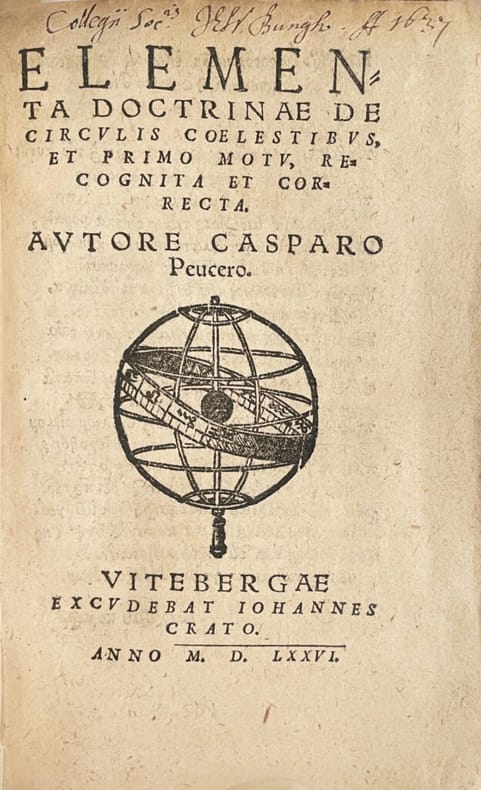
LCS-17871Précieuse et rarissime édition originale de « l’Epitome Astronomiae », l’œuvre majeure du maître de Johannes Kepler (1571-1630), l’astronome Michael Maestlin (1550-1631). Heidelberg, Jacobus Milius, 1582. (17) ff., (1) f.bl., 495 pp., (1) p. et 6 planches dépliantes. [Précédé de :] I - Peucer, Caspar. Elementa doctrinae de Circulis coelestibus et primo motu, recognita et correcta. Wittenb., Joh. Crato, 1576. (8) ff., 304 pp. (saut dans la pagination sans manque), 8 planches dépliantes. Soit deux ouvrages d’astronomie reliés en 1 volume in-8, plein vélin ivoire à recouvrement, traces de liens, dos lisse peint à l’époque avec auteur, titre et marques de bibliothèque calligraphiés à l’encre noire, tranches jaspées. Reliure de l’époque. 155 x 98 mm.
4to (200 x 264 mm). IX, (3), 187, (1) pp. With 13 folding engraved plans and maps, 3 folding tables. Publisher's original cloth with giltstamped spine title, bound by Edmonds & Remnants with their label to lower pastedown. Author's presentation copy of the third edition, inscribed on the day of publication to the influential London architect and journalist George Godwin (1813-88) on the title-page: "Geo. Godwin Esq. / in gratitude for the services he has / rendered to the cause of good / sanitary construction / Florence Nightingale / London, Dec. 14 1863". - When 'Notes on Hospitals' first appeared in 1859, in much briefer form than here, it was "immediately greeted by George Godwin as essential reading for architects, who were advised to 'obtain the volume and master it'" (Mark Bostridge, Florence Nightingale, p. 337f.). As editor of 'The Builder', Godwin expanded its scope to include sanitation, social issues, and other subjects. He wrote on slums and promoted the use of public baths, wash-houses, charitable housing trusts, and pavilion-styled hospitals. His architectural works, centred around Kensington and Chelsea, include The Boltons, Elm Park Gardens, and St. Luke's Kensington. The 1863 edition of "Notes on Hospitals" was "massively augmented and rewritten that it is effectively a new book" (McDonald). - Spine and joints professionally restored. Old paper label on spine. - Provenance: 1) George Godwin (presentation inscription); 2) front pastedown has bookplate of James O'Byrne (1835-97), the Liverpool-based architect whose library was dispersed at Christie's in 1987. Lynn McDonald, Florence Nightingale and Hospital Reform (2012), p. 79. Cf. Garrison/Morton 1611 (citing the 1859 first edition).
LCS-A70Notre exemplaire est somptueux, à l’état neuf, en superbe reliure de l’époque. Paris, Imprimerie Royale, 1834-35. 2 tomes en 1 volume in-4 de (4) ff., 15 pp. Introduction, [pp. 16-19]: Observations, Table, pp. 21-55: texte arabe en regard du texte français, pp. 57-61: préface, pp. 62-368 Première partie, (4) ff., pp. 369 à 630, Traité tome deuxième, 37 planches numérotées 1 à 38 (la planche n° 25 n'existe dans aucun exemplaire). Complet. Demi-chagrin rouge, dos à nerfs richement orné. Reliure de l’époque. 264 x 210 mm.
231 x 171 mm on backing cardboard (376 x 280 mm). The well-known portrait of Freud taken by the Austro-Hungarian photographer László Willinger: a very attractive print in excellent condition. Willinger, who has been barred from any professional activity in Germany in 1933, worked for some time in the Vienna atelier of his father Wilhelm before emigrating in 1939. The present portrait was created in 1935. - Provenance: collection of the granddaughter of the Austro-American psychoanalyst René Spitz; acquired from a Belgian private collection. - Backing cardboard a little stained in two places and traces of old mounting on verso, otherwise clean and crisp.
8vo. 136 pp. Yellow original cloth in modern half calf slipcase with giltstamped spine title. First edition of Freud's famous study known in English as "Civilization and Its Discontents", inscribed and signed by the author to his son Ernst, an architect, and Ernst's wife, the classical scholar Lucie (Lux), née Brasch (the parents of Lucian Freud): "Seinen lieben Kindern Ernst u Lux / vom Verf.". - Provenance: from the collection of the Austro-British photographer and cinematographer Wolfgang Suschitzky, whose family had known the Freuds in Vienna and who later, after his emigration to London, lived near the Freud Museum in Maresfield Gardens. Passed by descent to his son, the cinematographer Peter Suschitzky, whose works include the David Cronenberg film "A Dangerous Method" about the affair between C. G. Jung and Sabina Spielrein. Latterly in a Belgian private collection. - Occasional light duststaining the original cloth binding, interior in excellent condition. The elegant blue and black half calf slipcase is signed by the Franco-American bookbinder Paul Bélard. - Copies of Freud's works inscribed to his children are of the utmost rarity: the Freud Museum London owns just a single specimen, inscribed to his daughter Anna. Meyer-Palmedo/Fichtner 1930 a. Grinstein 10619.
8vo and 4to. 2 vols. and volume of plates. XLVIII, 654 pp. XXVIII, 757 pp. With 17 plates (12 in colour; with the extra plate after no. II). Contemporary half calf with giltstamped Saxon arms on covers. Edges marbled. First edition of Goethe's principal scientific work, the "Farbenlehre", including the quarto-sized "Erklärung der zur Goethe’s Farbenlehre gehörigen Tafeln". "Goethe's first publication on optics culminated in his 'Zur Farbenlehre', his longest and, in his own view, best work, today known principally as a fierce and unsuccessful attack on Newton's demonstration that white light is composite" (DSB V, 445). The plates are of various sizes, showing this to be the earliest impression of the 17-plate set, but do not have the manuscript corrections present in some copies (cf. Hagen, p. 170). - Bindings somewhat rubbed; occasional brownstaining due to paper. A fine, complete copy in its first binding, originally in the library of the Dukes of Saxe-Weimar-Eisenach: gilt Saxon arms on the marbled covers; armorial stamps to all titles. Most famously, Duke Karl August was Goethe's friend, lord, and benefactor. Hagen 347, 347 d. Goedeke IV 3, 583 (46). Kippenberg I, 386, 389. Hirzel A 288. Speck 2289/90. Schmid 55-58. Brieger 733. WG² 79.
Oblong folio (555 x 385 mm). Tinted lithographed title-page and 30 tinted lithographed plates (555 x 385 mm, one slightly smaller: 350 x 505 mm), all in fine contemporary hand colour. Loose in modern clamshell box. Extremely rare first edition of an impressive series of lithographed views showing the zinc mines, foundries and factories in Belgium and Germany owned by the "Société Anonyme de Mines et Fonderies de Zinc de la Vieille Montagne". The series includes views of Moresnet, Welkenraedt, Rabotraedt, Angleur, Saint Léonard (Liège), Valentin-Cocq and Bray, all beautifully rendered by the French landscape painter Adolphe Maugendre (1809-1895). The Vieille Montagne society was founded in 1837. Its history goes back to 1806, when Jean-Jacques Daniel Dony (1759-1819) was granted the sole mining rights to the calamine deposits of Vieille Montagne (or Altenberg), between Liège and Aachen. Dony had invented a new method for extracting zinc and casting it in ingots. In 1809 he established a rolling mill at Saint-Léonard, apparently the first plant for the industrial production of zinc. The series shows the complete process of producing zinc, from the zinc ore extraction to the stoking, pouring and refilling of the crucible, and finally the production of sheets of zinc in a rolling mill. It includes four detailed views of the Saint-Léonard plant (one, surprisingly, featuring a woman and two children). In the 20th century the Vieille Montagne society, together with a number of other mining and smelting companies, evolved into "Umicore", a global materials technology and recycling group still active today. A second edition was published in 1855 as Album des usines et etablissements de la société and is much less rare than the present first edition. - Some light marginal spotting, the title-page more severely, title-page with a tiny tear, otherwise in very good condition. An important visual record of the history of the zinc industry. WorldCat (only a catalogue entry, not listing any copies); no further copies in KVK. For Dony: Biographical Dictionary of the History of Technology, pp. 376-377; for Maugendre: Benezit VII, p. 273.
Edizione: Varie edizioni, da notare la Prima edizione del Rolandi . Pagine: 124+31+75+29+48+12+128+XIV+96+3 Tavole . Illustrazioni: Nel volume di Rolandi Tre tavole in rame disegnate ed incise dall'Autore, contenenti 10 Figure in totale. Nel volume di Fabrizi presente una tavola con tre incisioni raffiguranti il perforatore. . Formato: 8° . Rilegatura: Cartonato con dorso in pelle, piatti usurati, necessario un restauro della cartonatura. . Stato: Discreto . Caratteristiche: Bruniture presenti. Trattasi di una collazione (8 trattati) molto importante di medicina, fra le quali spicca per importanza e rarità l'opera del Rolando sul Cervello. Notevole anche il trattato di Fabrizi su una tecnica sperimentale di perforazione del timpano, con la descrizione dello strumento in tre immagini. Nel primo volume non sono presenti figure (mancano) e presente un tarlo di 2 mm per 40 pagine; nel quinto volume presente un forellino di tarlo nell'arco di tutte le 45 pagine; 5 Fabrizi, Medico chirurgo, la sua opera sulla perforazione del timpano, poi affinata, ebbe importanza ASSOLUTA. 6 Pacini fu professore a Lucca. 8 RARISSIMO.Molte bruniture. MANCA SOLO L'ULTMO FOGLIO DELL'INDICE, con la spiegazione delle ultime 4 figure. A Rolando si deve la scoperta delle ramificazioni cerebrali, diede il nome alla scissura sulla faccia esterna degli emisferi cerebrali (den. Scissura di Rolando). Torinese, fu medico di alta esperienza (divenne medico di corte Sabauda) ed attività scientifica. Fondò anche un Museo, che porta il suo nome ed è tutt'ora esistente a Torino. Il volume necessiterebbe di un restauro (l'esterno infatti non si presenta in buone condizioni) o di una divisione dei trattati ma abbiamo deciso di non effettuare questa operazione, lasciandola al futuro fortunato possessore. Presenti alle ultime due pagine bianche scritte a mano di conti. Foto disponibili a richiesta. . Note epoca: 1828, 1818, 1826, 1827, 1834, 1820
1984217199Berlin u. Heidelberg, Springer, 1868-1984. 8°, ab Bd. 361 in 4°. M. zahlr. Taf. u. Abb. In 400 versch. geb. Bibl.-Einbdn. (einige in Pp., u. brosch. meist in Hlwdbdn.). Einbde. teils etwas beschäd., beschabt u. fleckig. 5 Rücken fehlen. Teilw. m. Rsign. Fast durchg. mehrf. gest. Bibl.-Ex. Es fehlten: Taf. 3-5 in Bd. 41.