209 résultats
1967M9075Bethesda:: U. S. Department of Health Education and Welfare 1967. 1967. First edition. Thick 4to. xii 698 pp. Alphabetical list of items index. Full black and gilt stamped pictorial gray cloth. Very good. U. S. Department of Health, Education, and Welfare, 1967. hardcover books
197621944London: The Wellcome Institute for the History of Medecine 1976. First edition. 1 vols. Large 4to. Cloth. Fine. First edition. 1 vols. Large 4to. The Wellcome Institute for the History of Medecine unknown books
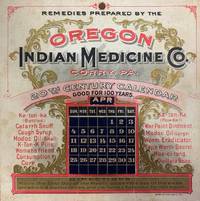
022677Corry PA: Oregon Indian Medicine Co. Trade Card. 9 x 9 inch cardstock with gold red black and blue inked design advertising Oregon Indian Medicines with two moveable tabs which allow for a perpetual calendar. Card is moderately soiled and lightly creased. Verso has pencil writing likely from previous owner. Fully operational and functional calendar. Printed by the Herald Lithography Company of Erie PA. Card advertises various quack medicines including Worm Eradicator Catarrh Snuff Woman's Friend and the always vital Tape Worm Secret. Ka-ton-Ka was a patent medicine of the Oregon Indian Medicine Company manufactured of course in Pennsylvania. Despite the claims of being a secret formula for healing from an Indian Tribe in Oregon Ka-ton-Ka was composed of sugar aloes baking soda and alcohol. The advertisements claimed it was a cure for all blood diseases stomach and liver difficulties plus cured Dyspepsia; Biliousness; Syphilis; Scrofula; Salt Rheum; Erysipelas; Catarrh; Liver Complaint; Rheumatism; Enlargement of the Liver; and Diseases of the Kidneys! A really nifty artifact of the patent medicine craze in a large moveable trade card. . Oregon Indian Medicine Co. unknown books
16210Two letters commending a female medical student Clara Cowles who is about to enter the field. The first is an autograph letter signed and dated 16 March 1893. 1 page handwritten on National Homeopathic Medical College of Chicago letterhead from the desk of W. M. W. Davison M. D. 9 x 5 ¾ in. Excellent condition with two horizontal fold lines. Davison writes in part: "Miss Cowles Kindly I wish to congratulate you for your most excellent paper." This letter also comes with a business card from W. M. W. Davison again dated March 16th 1893 which verifies that "Miss C S Cowles has passed the examination in Histology and Physiology and her standing is 90 in the former and 100 in the latter."<br/><br/>The second is a typed letter signed and dated January 24 1896. 1 page on The People's Health Journal letterhead from the desk of editors L. D. Rogers M.D. and Ida Wright Rogers M.D. two married doctors. 8.5 x 11 in. They write:<br/><br/>"Miss Clara CowlesEl Dorado Kas.<br/>Dear Miss Cowles:--<br/>Your favor of the 17th. together with your first examination papers came duly to hand. We have returned the papers. They were excellent. <br/>We thank you for the names of your two friends and will write to them. Let us hear from you often. <br/>Yours very sincerely Drs Rogers & Rogers"<br/><br/>Very good condition with two vertical fold creases and one horizontal one at center. Small tear at upper left crease. Comes with a joint business card for Drs. Rogers & Rogers and inscribed in pencil on verso is the address for Dr. E. S. Reed Dentist. Four more inscribed business cards from doctors are included. One of the cards is from Dr. E. S. Reed and has a neat inscription on verso in ink declaring that Miss C. S. Cowles "has a standing of 98 in Dental-Surgery for the session of 1892 & '93" signed by E.S. Reed Professor of Dental Surgery. Interesting 19th century correspondence related to a young woman's medical education and those who offered her professional support and encouragement. unknown books
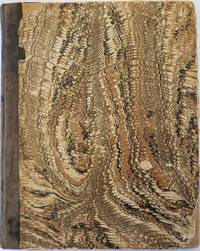
151271840s handwritten pharmaceutical notebook. Pennsylvania. Original marbled boards and cloth spine; Measures 4.5" x 8" inches. 79 handwritten pages in ink and pencil 1-69 hand-numbered; 150 pages total. The meticulous note-taker records copious medical recipes for various ailments and illnesses as well as the date source and doctor from whom the treatment method was acquired thus giving an amazingly precise and detailed record of contemporary medical knowledge and treatment protocol. Under "Uterine Hemorrhage" for example the writer notes first the ingredients then the administration then the source: "Rx Sulphate of Alum 3iij; sulphate of Magnesia 3xij; aromatic sulphuric Acid 3ij; water 3xig M. Dose 3j every four hours. If pain exists griss acetate of Morphia should be added to the whole.--Dr. Grettan of Killough Scot.- Bos. Med. Jour. May 1 1842." Entries are included for "Tic Douloureux" "Angina Pectoris" "Hysteria" "Opthalmic Diseases" "Sore Nipples" "Consumption" "Cancer" "Sea Sickness" "Gonorrhea" "Cholera" "Gout" "Antidotes for Poisons" and many more. Some of the entries go on for several pages with detailed notes about the application of various prescriptions. Also includes entries for "Writing Ink" "Hair Dye" "Ginger Beer" "Poor Man's Hand Soap" "A Very Brilliant Red Ink" and other such household amenities. In good condition. Boards showing through marbled covers at corners minor bumping to corners. Age-related toning and spotting to pages which are otherwise neat and without wrinkles or creases. Comes with 7 handwritten prescription slips. <br/><br/>18th century pharmacists were medical practitioners who treated patients directly. However the field of pharmacology was unregulated and otherwise-effective prescriptions were often corrupted by inaccurate dosages or ersatz ingredients. The founding of the Philadelphia College of Pharmacy PCP in the 1800s is recognized as a radical first step forward in the development of a system of pharmaceutical practice in the United States. On March 13 1821 68 pharmacists signed the Constitution of the first pharmaceutical association in the United States in the Carpenters' Hall the same room as where the founding fathers signed the Declaration of Independence. The symbolism of the Carpenters' Hall backdrop was clear: American pharmacy would be following in the footsteps of the founding fathers and their constitutional framework. The PCP constitution included a strict code of ethics that would expel anyone from the college who adulterated medications and provided for a committee of inspection to verify the purity safety and effectiveness of medicines and a committee of equity to arbitrate disputes between member pharmacists. In 1824 the PCP published "carefully determined formulas" for the fabrication of formerly "secret-formula" patent medicines imported from the UK an essential step toward self-sufficient pharmaceutical manufacturing in the U.S. WSU History of Pharmacy. unknown books
1989M09886London:: Wellcome Institute for the History of Medicine 1989. 1989. 4to. 56 pp. 12 figs. Pictorial wrappers. Fine. ISBN: 0854840702 Wellcome Institute for the History of Medicine, 1989. unknown books
M4936In:: The Lancet. . . Foreign & Colonial Edition Vol. CLXXX No. 4568 March 18 1911. 275 x 198 mm. 4to. Pages 758-759. Entire issue: ii 44 717-782 45-90 iii-iv pp. 7 figs. supplement to the Lancet entitled "New building of the Royal Society of Medicine" laid in. Original printed wrappers. Top corner of first leaf torn else fine. The Lancet. . ., Foreign & Colonial Edition, Vol. CLXXX, No. 4568, March 18, 1911. unknown books
1916M3546no place:: 1916. 1916. 8vo. 10 ads 4 pp. 9 figs. Self-wraps. Fine. 1916. paperback books
1935M4480Offprint from:: The Canadian Medical Assoc. Journal 1935. 1935. 8vo. 31 pp. Illus. Wrappers. Fine. Articles by Thomas B. Futcher Maude E. Abbott and W. W. Francis. The Canadian Medical Assoc. Journal, 1935. unknown books