98 839 résultats
Library sticker to spine, inside cover and FEP, stamp to inside cover and title page. Ex - Library
Soft cover in a very good condition. Contents sound and good, pages are crisp, text bright and tight throughout. Used
The Health Service Caring for the 1990's. stickers inside the cover. first two pages have riped out. FEP is creased
Paperback. Several superficial marks on covers. Leading corners, edges and spine ends are very slightly worn. Previous owner's name on FEP. Binding is tight, contents are clean and clear throughout. AM Used
2003SONG0309087031National Academies Press 2003-06-15. 1. hardcover. Used: Good. 6.24x1.15x9.40. Buy with confidence. Excellent Customer Service & Return policy. National Academies Press hardcover
Paperback. Minor rubbing / wear to cover edges and corners. Crease to lower right hand corner of front cover. Pages are clean and text is clear throughout. Used
Hardcover (no jacket) in very good condition. IARC Monographs on the Evaluation of the Carcinogenic Risk of Chemicals to Humans - Volume 25. Faint score and one or two tiny marks on the rear board. Stamps on the FEP. Pages are clean; all content is clear. CM Used
ria9780323776707_inpPaperback / softback. New. New Book; Fast Shipping from UK; Not signed; Not First Edition; N/A paperback
Library stickers on the spine, inside of the cover and FEP, Stamp on title page., Written by feminists and other researchers from the disciplines of psychology, sociology, anthropology, and management science, the 14 essays in this collection are about women's experience of paid work and women's ways of coping with employment stress. The opening essays highlight the social and cultural changes that have compelled women to develop new coping strategies. Several contributing authors examine specific workplace structures and describe women's experiences in different occupational contexts - whether hostile or hospitable. Shifting from a structural to an individual perspective, other contributors deal with psychosocial factors, such as gender differences, that have been found to moderate stress and enhance the coping process. They analyze individual experiences with work - related stressors, focusing on the mediating effects of cognitive appraisals. This work contains contributions by Nina Colwill, Bruce E. Compas, Esther R. Greenglass, Barbara Gutek, Catherine A. Heaney, Sharon E. Kahn, Ronald C. Kessler, Karen Korabik, Bonita C. Long, Judi Marshall, Diana L. Mawson, Lisa M. McDonald, Pamela G. Orosan, Hazel M. Rosin, Craig A. Smith, Anne Statham, Allison Tom, Elaine Wethington, and Lois M. Verbrugge. Government Reference Library
Library sticker to spine and FEP. Stamp to inside back cover and page block. 72 pages Ex - Library
Library sticker on spine and FEP. Stamp to FEP. Text is clean, tight and bright. Minor rubbing / wear to cover and page block corners. The abundance of data on women, health and medicine provided by researchers in various fields can be a source of confusion for those beginning to study the field. This book is to provide those who embark on such a project with a concise introduction to key arguments, problems and findings Government Library Reference
Library stickers and stamps to FEP, inside cover and page block. Ex - Library
Library sticker on spine and FEP. Stamp to FEP. Text is clean, tight and bright. Government Library Reference
Library sticker to spine and FEP. Stamp to catalogue and page. Text is clean, tight and bright. This study reviews existing literature to demonstrate the links between assertiveness and women's health and goes on to provide a rationale for assertiveness in women's health education and promotion Ex-Library
Paperback. Ex-library. Second edition. Oxford General Practice Series 12. Covers and early pages are stained and creased. Library stickers on creased spine and half title page. Stamps on marked page block and half title page. Text is clear. HCW Used
creases on the cover and on the corners, markings on the cover, stickers, stamps and library pocket on the inside of the cover and on the FEP, writing on thew page block, some pencil underlinngin the book easily removed. Ex - Library
Library sticker on spine and FEP. Stamp on title page. Recently there has been an upsurge of interest in research on women's health. Some of the issues to be addressed are clear, though the methods and problems involved may not be. Women's Health Matters , like its sister volume Women's Health Counts , is a valuable and practical guide to doing feminist research on women's health. For people starting to do research, the completed monograph and the methodology textbook can give only a partial understanding of what it is like to do research and what the problems and pleasures really are. What, for instance are the pitfalls of obtaining funding, finding researchable topics, and managing research projects? This collection, with contributions by pioneering researchers and practitioners such Ann Oakley and Sheila Kitzinger, provides accounts of research work ranging from getting the research idea, through obtaining the funding and doing the research, to the practical problems faced, and eventual publication. The contributors all underline the value of qualitative data and women's own experience in assessing and interpreting health issues. Intended for social scientists, nurses and medical students, Women's Health Matters will be of enormous help both to those beginning to research women's health and to experienced researchers. These lively accounts, with their emphasis on the practical aspects of research, provide an excellent antidote to textbooks and manuals. Government Library Reference
Hardcover. From the collection of John Hobcraft, with his name penned on front pastedown. Very light wear to jacket; a few minor marks on boards and one or two pages; the lightest of foxing on page block head. Text is clear throughout. TS Used
White dj, orange cloth quarto; xix, 689 pages : illustrations ; 23 cm Uncommon in cloth (hardcover). Contents: I. What is women's health? Social, biomedical, and feminist models of women's health / Pattern and puzzles : the distribution of health and illness among women in the United States / What we share and how we differ. What are the dynamics of differences? / The last sisters : health issues of women with disabilities / Creating women's health : health practices, working and living conditions, and medical care. Women, personal health behavior, and health promotion / The ergonomics of women's work / "Less than animals?" : the health of women workers in garment manufacture, agriculture, and electronics assembly / Access, cost, and quality of medical care : where are we heading? / A note from Louise : understanding women's health in Appalachia / Culture and complexities. Beauty myths and realities and their impact on women's health / Old woes, old ways, new dawn : Native American women's health issues / Asian/Pacific American women and cultural diversity : studies of the traumas of cancer and war / Issues in Latino women's health : myths and challenges / Intersections of race, class, and culture. African American women's health : the effects of disease and chronic life stressors / Women, power, and mental health / Who cares? : women as informal and formal caregivers / Older women : income, retirement, and health / Power and social control. Responses to stigma and marginality : the health of lesbians, imprisoned women, and women with HIV / "You can be safer, but--" : different women, many violences. Women's lived experiences of abuse / The battered women's movement ; Rape / A survivor speaks about the Victim Input Program / Anti-lesbian violence / Sexual harassment / The ongoing politics of contraception : Norplant and other emerging technologies / Challenges and choices for the twenty-first century. Research to improve women's health : an agenda for equity / Strengths and strongholds in women's health research / Conversing with diversity : implications for social research / Challenging purely biomedical definitions of women's health, Women's Health: Complexities and Differences draws attention to social, cultural, and behavioral elements crucial to a broader understanding of the issues. The contributors to this volume raise important questions about the directions currently being taken to improve women's health in the United States: Is women's health merely the absence of disease? What have been the consequences of promoting narrow biomedical models of health? What do the pervasive patterns and puzzles in the distribution of disease, illness, and death among different groups of women tell us about the sources of ill health? How well do national agendas address all women's health care priorities? What are the implications for social action? Particular attention is paid in this collection of essays to how race, class, gender, and culture shape and in turn are shaped by treatment options and health care for certain subpopulations among Native American, Latina, Asian American, and African American women. Discussions of reproductive health, mental health, violence, and the treatment of stigmatized women raise perplexing issues about choice, chance, and social change.

1998Q-1887299122Alternativemedicine.com Books 1998-01-01. Paperback. New. New. In shrink wrap. Looks like an interesting title! Alternativemedicine.com Books paperback
Light shelfwear else fine. ; In this book, Dean-Jones gives a close analysis of theories concerning women's bodies in such authors as the Hippocratics and Aristotle. She demonstrates the centrality of menstruation in classical theories of female physiology, pathology, and reproduction, and suggests that this had both negative and positive repercussions in attitudes towards women's bodies in that society. Many of the primary sources dealt with are not yet accessible in English, therefore, her book is important in assembling and presenting both original texts as well as her research on the texts. ; 312 pages
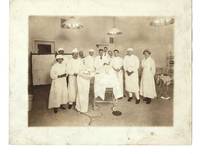
1900162081900. Women in Sciences. Original vintage photograph of operating room and surgery team. Photograph shows eleven figures dressed all in white standing around a patient in an early operating room. While most of the medical workers are men two women stand at the edges of the group and the woman standing on the left is shown wearing an operating apron and rubber gloves. 8 x 10 in. sepia photo. Photo is in good condition with light scuffing to photo surface two water marks in bottom left quadrant and some dirt and stains to the image border. Light crease in top left corner and small tear on lower right edge. Image remains crisp and clear. An important photograph that shows women's involvement in the medical field and the development of surgical technology throughout the 20th century. unknown
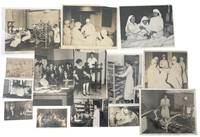
1900231121900. Women in Medicine Women's Employment Photo archive documenting women's participation in medicine nursing surgery laboratory science and public health from approximately 1900 through 1946 providing primary-source evidence of women working within institutional medicine during the decades in which their access to formal medical training and professional authority remained limited and uneven. The images document women in operating rooms clinical instruction environments laboratory settings and patient care contexts establishing record of how women functioned within medical institutions as practitioners trainees and technical specialists.<br /> <br /> Archive of fourteen silver gelatin photographs press prints and real photo postcards dating from c. 1900 to 1946 varying in size and format from 3.5" x 5" to 8" x10" with multiple examples retaining original verso captions typed press slips and annotations identifying subjects and contexts. The archive includes a estimated 1900 surgical preparation scene with women in operating attire working alongside male colleagues; a 1925 press photograph identifying "Kuniko" a Japanese woman working in the medical and chemical research field with the caption noting her public commitment to remain unmarried in order to pursue scientific work; a 1925 image of a women's medical board representing multiple organizations; a 1926 University of Cincinnati Medical College photograph documenting nurse Miss Mabel Miller participating in a nationally broadcast demonstration of human heartbeats; a 1931 image of Simmons College nursing students conducting a basal metabolism test with detailed clinical procedure noted in the caption; a 1932 press photograph of Spanish nursing students studying American medical methods; laboratory scenes from the 1920s showing women conducting chemical work; a 1935 clinical interior with a woman retrieving medical supplies; a real photo postcard depicting a surgical demonstration observed by suited male spectators with women among the surgical team; a Latvian postcard showing a nurse weighing schoolchildren in a public health context; and a 1946 anatomy class photograph documenting a predominantly female cohort performing cadaver dissection with student signatures preserved on the verso.<br /> <br /> The archive's geographic and chronological range corresponds to major developments in the history of women in medicine including the expansion of formal nursing education the gradual admission of women into medical training programs and the increasing specialization of laboratory and clinical work in the interwar and postwar periods.The University of Cincinnati broadcast photograph situates a named nurse within early intersections of clinical medicine and mass communication while the Simmons College image documents technical clinical training at a women's institution. The Kuniko press photograph documents a Japanese woman publicly identified as a professional scientific researcher underscoring the visibility of women in medical and laboratory fields across national contexts. The 1946 dissection photograph records a moment of postwar expansion in women's medical education preserving the identities of participants in a cohort entering a rapidly changing profession. Light silvering and minor edge wear to several prints; press photographs retain captions and stamps; postcards show age toning. Overall in good condition. A cohesive and internationally scoped documentary archive of women's medical training professionalization and clinical labor in the first half of the twentieth century. unknown
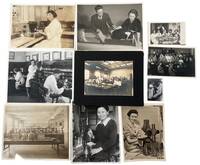
1910231281910. Women's History Women in scientific and medical laboratories photo archive documenting female participation in laboratory education microscopy chemical work dental training and technical employment across the first half of the twentieth century providing concrete visual evidence of how women entered scientific institutions in the years before full professional parity. The group brings together press and non-press photographs with identifiable news-service and reference-file markings that place several images within the public circulation of women's technical labor. Many of these photographs show women operating microscopes handling laboratory equipment conducting demonstrations and working within instructional and testing settings making the group especially effective as evidence of women's participation in scientific education industrial science and medical training.<br /> <br /> Photo archive of 10 silver gelatin photographs various sizes ranging from 2" x 3 to 7 x 10 inches United States and around the globe circa 1910-1946. The group includes a 1934 press photograph of Victoria Fischer in a laboratory identified on the verso as connected to Tokio Girl's Medical College in Japan shown standing at a bench with pipette flask and rack of test tubes; a 1946 photograph of Kinjian Laboratory showing a large coeducational classroom of students in white lab coats seated and standing around laboratory tables with test tubes and other equipment in hand; and a circa 1920s non-press photograph of four dental students all young women in lab coats seated around a table of instruments. Another non-press photograph circa 1930 identifies the senior female students of Mother Catherine High School and shows an all-female laboratory class with biological and ecological samples in the foreground bell jars between table and shelving and additional worktables beyond. A thick matted photograph with black border circa 1910 shows a skylit laboratory interior with approximately twenty-five men and four women gathered around long benches. Press photographs include a March 4 1941 Ottawa image of a woman operating a high-powered microscope in a gauge testing laboratory; a 1930s U.S. Testing Company Laboratories image from Hoboken New Jersey showing a woman in the fiber analysis section at a microscope bench; a 1933 press image of a woman and man conducting an experiment involving heated metal apparatus; and a 1924 Washington D.C. press photograph identifying Theresa Karger as chief of the chemical laboratory at Mount Alto U.S. Veterans Hospital described as one of the women in unusual employment. <br /> The archive aligns with a long period in which women entered scientific and medical work through segregated colleges women's schools wartime necessity industrial laboratories and specialized technical training often gaining access first in educational or auxiliary settings before achieving broader professional recognition. Its international scope is a particular strength: the photographs place women in laboratory systems from the the beginning of the century through World War II and the immediate postwar period showing how female students technicians and researchers across studied and contributed to science. Minor corner and edge wear and residue on versos from press filing stamps and caption mounts; overall good condition. A concise and materially grounded record of women's scientific labor and educational access as women's presence in STEM moved from exceptional visibility into institutional practice. unknown
Library stickers and stamps on the spine, inside of the cover and FEP, Stamp on the catalogue page. creasing down the spine. Women are the group that is most rapidly becoming infected with the human immunodeficiency virus, and it is estimated that women may ultimately account for half of all AIDS cases in the US, as they now do globally. Even so, most AIDS prevention research has been conducted in male populations Used