889 résultats
2019SKU0612047Vista Higher Learning 2019. hardcover. New. 10x8x2. New Textbook Ships with Tracking Vista Higher Learning hardcover
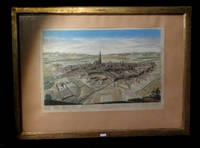
1770241361770. A Coutances et se vend ˆ Paris chez Esnauts & Rapilly s.d. circa 1770. Dimensions ˆ vue : 528 x 352 mm passe-partout cadre. Rare et importante vue perspective - en coloris du temps - figurant l'ensemble de la citÂŽ. LÂŽgendes et adresse en marge infÂŽrieure. PrÂŽsentÂŽe sous cadre baguette dorÂŽ. Marges lÂŽgÂrement oxydÂŽes. DiscrÂtes plissures au centre de l'ÂŽpreuve. Encrage de la partie lÂŽgendÂŽe parfois un peu faible. Du reste belle condition. Rare. b42961 unknown
85055301Amoy n.d. early ca 1900-1910 n.p. A large panoramic photo view 13 x 91 cm. printed on "Agfa Troopex" paper rolled with some fold/cracks otherwise a very good clear image in glossy black & white an actual photograph. R A R E ! . . . AN EARLY PANORAMIC VIEW OF AMOY XIAMEN . . A lovely and early black and white panoramic photograph of Amoy Xiamen island at the mouth of the Jiulong River. It has an excellent natural harbor. Fishing shipbuilding food processing and tanning were the major industries of the period. . Because of its key position across the Taiwan Straits from Taiwan this has always been a strategic island and area. Opposite Xiamen proper across the inner harbor is the island of Gulangxu the former foreign settlement and a fine residential section. Amoy was one of the earliest seats of European commerce in China with Portuguese arriving in the 16th century and the Dutch in the 17th century. Amoy was captured in 1841 by the British in the Opium War Opium Wars 1839-1842 and again in 1856-1860 two wars between China and Western countries. The first was between Great Britain and China. Early in the 19th century and became a treaty port opened to foreign trade by treaty. . "TREATY PORT" is a term usually confined to ports in those countries that formerly strongly objected to foreign trade or attempted altogether to exclude it. Thus it is used especially in reference to China and later in Japan. Amoy was long a Chinese port of emigration mainly to Southeast Asia. . Panoramic views are rare and required the use of a special camera apparatus. This early view shows Amoy when it only had a very few tall buildings and with many small homes and other structures including what appears to be a large chimney probably the early beginnings of the first electrical power plant in that area. A few small sampans are seen anchored otherwise it was an usually quiet day in one of China's most bustling coastal cities ! . CONDITION: Early panoramic photographs of Amoy are RARE and seldom found. Most panoramic views were rolled resulting in the typical folding bends and cracks. This copy is in remarkable good condition based on its age and rarity. . The work is in original rolled condition with the usual bends folds cracks please see photos posted to our website. . The back could be restored thus giving it a more stiff flat body by removing some of the old bends and folds bringing it back to is old solid glory. . Suitable for framing and museum or library display. . . unknown
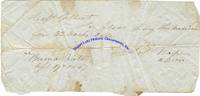
6331BATTLE OF BUENA VISTA. The Battle of Buena Vista fought over February 22 and 23 1847 saw the outmanned American Army under Zachary Taylor defeat the Mexicans under General Antonio Lpez de Santa Anna. The American forces were largely made up of volunteers rather than regular armyArchive. 15 pieces. 1847 mostly April. Buena Vista Mexico. An archive of fourteen receipts and manuscripts written in the wake of the Battle of Buena Vista; most are from April 1847 and a few state that the location of the receipts is Buena Vista. Some of these receipts are addressed to Charles C. Gilbert of Ohio and it is for volunteers from Indiana and Ohio. Some are in pencil and some are in pen. These documents show the American soldiers stuck in rural Mexico trying to find food for themselves and their beasts of burden. Mexican War dated manuscripts written from Mexico are scarce. A few sample documents include:aADS. 1pg. April 17th 1847. No place. An autograph document signed Lt. C.A. Shank AAQM 3 Reg Ina Vol addressing to pay for corn for mule feed.bADS. 1pg. April 17th 1847. Buena Vista. An autograph document signed Jos Napier AQM ordering pleas sic pay this Mexican for 33 Sacks.cADS. 1pg. April 17 1847. No place. An autograph document signed John Caldwell Act. A. Qr. M. 2d R. O.V. stating Return for 3 Horses and 40 Mules in the service of the 2r Regt. O.V. Ohio Volunteers for 2 days.dADS. 1pg. April 18 1847. No place. An autograph document signed Wm Erwin A A Q M ordering: Requisition for forage for fifty mules and seven horses in the service of the United States for two days commencing on the 17th and ending on the 18th April 1847.eADS. 1pg. April 17 1847. No place. An autograph document signed Thomas L. brent 1st Lieut & A.A. Qr Master noting Company B 4th Artillery Forage for two days 50 Bushels and 16 Quarts Corn116 Horses28 Mules. unknown
18363781Thomas Hookham 1836. 1836 4to. vi 155 p. Eighteen litho plates by Hullmandel on India paper mounted. First edition. Publisher's green cloth with spine ends and corners expertly restored. Original paper label present but chipped. Author's presentation inscription on front endpaper. Occasional faint spotting to the tissue guards. A very good copy of a scarce title. Thomas Hookham, hardcover
19092111902160200943Oyagi toku kichi 1909. Soft Cover. Fine. Volume: 1 Oyagi toku kichi paperback
17893750<p><b>Contemporary Image of the First Capitol of the United States</b></p><p>In September 1788 Congress selected New York City as the temporary site of the new government. "The citizens of New York desirous of testifying their attachment to the new national government and of making their city the place of permanent residence of the Federal Legislature have enlarged and repaired their city Hall and made it a convenient and elegant structure worthy of the respectable body for whose use it is designed." <i>Columbian Magazine</i> p. 473. <br /></p><p> The conversion of City Hall to the "Federal Edifice" or Federal Hall was directed by L'Enfant at a cost of $65000. The Executive offices the Senate and House chambers and the Supreme Court were all housed in this building. It was the nation's first Capitol under the Constitution. Although New York City's tenure as the new nation's capital was brief lasting only until 1790 Federal Hall was the site of several highly significant historic events. Washington's inauguration was held on the balcony of Federal Hall and he gave his inaugural address in the Senate chambers. Also the Hall was the meeting place of the first Congress; it was here that Congress adopted the Bill of Rights. <br /></p><p>There is no engraver noted on the image but several other engravings in <i>The</i><i>Columbian Magazine</i> from this time period have been ascribed to James Trenchard the <i>Magazine's</i> publisher. The image appeared a year before Amos Doolittle's famous and virtually unobtainable engraving which portrays Washington's inauguration on the balcony of Federal Hall. <br /></p><p><b>References:</b> Cresswell <i>The American Revolution in Drawings and Prints</i>: 554 illustrated p. 203. Lewis <i>Guide to Engravings in American Magazines 1741-1810</i>: p. 6. For the Doolittle engraving see Deak <i>Picturing America 1497-1899</i>: 181. <br /></p><b>Condition: </b> A strong clean image with original fold lines present. Lower half of left margin replaced with a portion of the inner and outer neat lines and a tiny portion of the image manually recreated. Otherwise very good. <p>ICN 3112. <br /></p><br /> From the August, 1789 issue of The Columbian Magazine.
17883741<p><strong>Harvard College -- "the earliest engraving of the College</strong><strong> which one may reasonably hope to obtain"</strong></p><p>This engraving entitled "View of the ancient Buildings belonging to Harvard College Cambridge New-England" appeared in the December 1788 issue of <em>The Columbian Magazine.</em> Bail notes that the view is based on the Burgis-Price print of 1743 which in turn was a slight modification of the Burgis view of 1726. The view taken from a point in front of the present Johnston Gate shows three College buildings in 1726 from left to right: the second Harvard College the first Stoughton Hall and the still-standing Massachusetts Hall. Although unsigned the engraving is undoubtedly the work of James Trenchard a co-owner of <em>The Columbian</em> <em>Magazine </em>and the engraver of nearly all the plates which appeared in it. <br /><br />Of the<em> Columbian</em> <em>Magazine</em> view Bail states: "In spite of the fact that the print is solely an adaptation it is important because of its early appearance and relative scarcity. This is the earliest engraving of the College which one may reasonably hope to obtain."</p><p>The engraving is accompanied by a disbound example of the December 1788 <em>Columbian Magazine</em> in which it appeared. It includes a 5-page "An Account of the ancient Colleges of Cambridge in New-England." Most of this is a republication of material from "a very scarce and valuable pamphlet" printed in London in 1642. In addition to a description of the College "The edifice is very fair and comely within and without." the rules and curriculum of the College are provided.</p><p>A very desirable engraving of Harvard with an example of the magazine in which it originally appeared.</p><p><strong>References:</strong> For the engraving: Bail <em>Views of Harvard</em>: 13; Plate XVII illustrated. Fielding <em>American Engravers upon Copper and Steel</em>: 1819. <br /><br /><strong>Condition: </strong>Image is age-toned with some generally light foxing. Darkening to margins outside of platemark where previously matted; remnant of strip of masking tape at upper margin on verso. The <em>Magazine</em> is complete and quite bright and clean although several pages are detached from the balance of the text.<br /><br />ICN 3431. <br /><br /><br /><br /></p> Printed for the Proprietors by W. Spotswood.
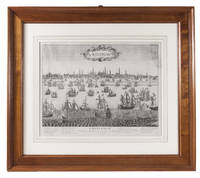
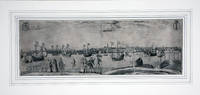
1660ABC_49405Amsterdam 1660. In a passe partout framed in a modern wooden frame. Engraving: ca. 38.5 x 50 cm; frame: 66.5 x 76 cm. Rare large engraved view of Amsterdam as seen from the inlet known as the IJ. The work is captioned in French and includes a numbered legend for the buildings in the background. According to d'Ailly it must have been engraved between 1660 and 1668 as it shows the Oost-Indisch Zeemagazijn a large warehouse built by the Dutch East India Company between 1660-1663 but not the Lutheran Church which was built in 1668. The present engraving is not signed but is very similar to a slightly later view of Amsterdam by French engraver Pierre-Alexandre Aveline 1656-1722. It bears the same caption and legend and has a nearly identical background but differs in the typography cartouche and the amount of ships in the foreground. The present state is exceptionally rare as we have not been able to trace any other copies of it in sales records and only three in literature.The engraving is slightly creased the upper right corner has been professionally repaired. Otherwise in very good condition.l D'Ailly E. A. Repertorium van de profielen der stad Amsterdam en van de plattegronden der schutterswijken 98 3 copies; cf. d'Ailly 101 and 102 Aveline view. unknown
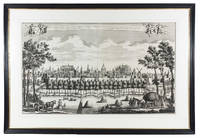
172891I90T01U79OAmsterdam 1728. Leonardus Schenk Framed 82.5 x 121 cm. Large engraved wall print on 2 sheets together 57.5 x 97 cm showing the Leiden city wall between the Koepoort and Zijlpoort with various windmills and prominent buildings in the background identified by name. The title appears in a banderole at the head with putti on either side holding the arms of Leiden and Holland. Leonardus Schenk's name appears as engraver and publisher at the right end of the banderole. Large view of the city of Leiden by the Amsterdam engraver and publisher Leonardus Schenk. The viewer observes the city from the south from between the city's Koe and Zijl gates. In the background several windmills and a few characteristic buildings are identified by name in the engraving including the university the library the Pieterskerk the Town Hall the Mare kerk the "Burcht" the fort and the Hooglandse kerk. On the quay outside the wall groups of people walk sporadically passed by small boats on the nearby city moat. In the foreground we see a typical Dutch landscape with grazing cattle farm workers a loaded hay cart and haystacks in the field. We know of several other wall prints by Schenk depicting local situations with almost photographic detail. Thanks to this detail important socio-historical aspects have been passed on to later generations giving these prints an important cultural meaning today. A few spots formerly folded otherwise in very good condition.l Overvoorde Catalogus van de prentverzameling der Gemeente Leiden 1906 no. 640; Waller Biogr. woordenb. Noord Ned. graveurs p. 287. unknown
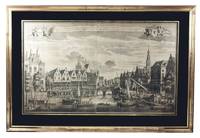
1728A2RGD4WT38YEAmsterdam: Leonardus Schenk 1728. In black passepartout and gilt frame 82 x 121 cm. Large engraved wall print on 2 sheets together 58 x 97 cm the sheets overlapping each other slightly showing the traditional business centre of the city of Leiden. The title both in Dutch and French is printed in a banderole at the head with putti on each side supporting the arms of Leiden and Holland. Leonardus Schenk's name appears as engraver and publisher at the right tip of the banderole. A large engraved wall print in two sheets showing the trading and commercial centre of the city of Leiden at the convergence of the Oude Rijn and Nieuwe Rijn canals. Unlike most other Dutch towns Leiden had no central market square so that the waterways formed the major access routes for merchandise. On the banks of the canals there is a lively market that converges on the bridge central in the print. Market traders and customers come and go. Women from the coastal fishing villages of Katwijk and Noortwijk display fresh fish for sale. Right in the print we see the monumental "Waag" the weigh-house built in 1658 following a plan by the Dutch architect and engraver Pieter Post. The splendid relief designed by Rombout Verhulst that crowns the entrance is reproduced with a sharp eye for detail. In front of the building commercial goods are hoisted up from carts and a number of ships for transport to the weigh-house. Several other ships had moored and now continue to their destination. A boat flying the Dutch flag brings in a prominent party while a herald standing precariously at the bow trumpets for right of way. We know of several other wall prints by Schenk depicting local situations with almost photographic detail. Thanks to this detail important socio-historical aspects have been passed on to later generations giving these prints an important cultural meaning today. With some faint foxing otherwise in very good condition.l Overvoorde Catalogus van de prentverzameling der Gemeente Leiden 1906 no. 964; Waller Biogr. woordenb. Noord Ned. graveurs p. 287. Leonardus Schenk, unknown
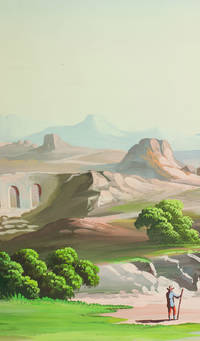
1910J68AIMO7W1D1Palestine 1910. Rolled up and kept in a cardboard tube. An enormous panoramic view drawn in coloured gouaches on a single continuous roll of unwatermarked wove paper 70 x 583 cm the drawing running to the edges of the paper. A panoramic view of what appears to be a fantasy Middle Eastern landscape with spectacular mountains in the background a body of water near each end and a wide variety of buildings and ruins some clearly classical Roman and others Middle Eastern. The combination of classical Roman architecture with dromedaries and other Middle Eastern features places it very likely in Palestine but we have not been able to identify specific buildings. The most distinctive ruin a round Roman temple with five columns on the viewer's side an entablature above them and a vertical base below them looks more like the Temple of the Vesta at Tivoli than like any known in the Middle East the columns are not rendered in sufficient detail to determine their order but they are almost certainly not Ionic and are probably Corinthian. There are also classical Roman aqueducts. The six shepherds with their flocks all wear broad-brimmed hats and have staffs and two are blowing long slightly curved horns. Several more figures with broad-brimmed hats and staffs might be pilgrims one together with what is presumably his wife. With a 33 cm tear into the left end a few insignificant and much smaller tears and with pin holes about 1 cm from the edges from mounting on a wall but otherwise in very good condition and with the colours fresh and bright. A spectacular panoramic view of the Middle East including many classical Roman ruins. unknown
1730E1Q9EQ01U79OAmsterdam: Reinier and Josua Ottens 1730. Mounted and framed. With title in banner at top centre arms of the city at top right city seal at top left and the primary locations with captions. Large engraved panorama on 4 sheets ca. 42 x 218 cm as assembled. Rare large engraved view of Amsterdam as seen from the inlet known as the IJ published by Reinier and Josua Ottens ca. 1730 with numerous ships on the IJ. It's the last state of the view by Jacob Savry published in 1647 and partly updated including the changes made by Visscher in his issue from 1653. Most obvious are the changes on the east part of the city with several new buildings including ''s Lands Zeemagazijn' now known as the Netherlands Maritime Museum.Washed and with one minor professional restoration near the title. Very good copy of a beautifully executed an detailed view of Amsterdam.l D'Ailly Profielen 186; De Vries Atlas van Amsterdam 14; cf. D'Ailly Profielen 55 & 74. Reinier and Josua Ottens, unknown
1599DB9FTP3RHVIKAntwerp 1599. Pieter Bast Framed. Large engraved panorama on 2 sheets ca. 27 x 76 cm as assembled. Rare first state of a 16th-century view of Amsterdam as seen from the inlet known as the IJ made by Pieter Bast a Dutch engraver from Antwerp best known for his city map of Amsterdam and this view. "In its amplitude and the sheer audacity of the presentation this engraving is indisputably one of Bast's most significant creations. It is as much a portrait of the harbour of Amsterdam as of the city itself and underscores the unique importance of maritime trade as the principle source of the city's wealth and power". With its distinctive orientation he not only initiated the series of representations of Amsterdam as seen from the IJ but also "established the standard for an entire genre of Dutch maritime painting" Keyes. In 1611 a second state edition was published by Claesz Jansz. Visscher who drastically altered the composition. In very good condition.l Hollstein Dutch & Flemish I p. 168 8; Keyes Pieter Bast 8 and p. 19. unknown