VUE D'OPTIQUEBiblio.com
178 résultats
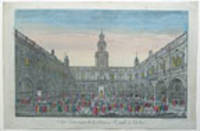
177015059Paris: Chez Daumont rue St. Martin 1770. Engraving with beautiful early colour. Printed on watermarked laid paper. In excellent condition with the exception of being trimmed within the platemark on the lower margin. Small tear on upper margin. Small puncture mark on left margin. Image size: 10 1/8 x 16 1/8 inches. This is a beautiful perspective view of the courtyard of the Royal Stock Exchange in London published by a Parisian printseller at the close of the eighteenth century.<br/> <br/> During the eighteenth century "vues d'optique" or "perspective views" became extremely popular in England and Europe. Like other optical prints they capitalized on a connoisseur market eager for the latest novelty. English publishers such as John Bowles and Robert Sayer had great success with these optical views which quickly developed into a collecting craze that swept through print shops on both sides of the Channel. "Vues d'optiques" were specifically designed to create the illusion of perspective when viewed with a zograscope or perspective glass. These viewing devices used a series of reflecting mirrors to enhance the illusion of depth in the print creating a veritable "view" for the onlooker. Typically these prints depicted city or landscape views and were horizontal in format. They had roughly the same dimensions and were sold with heavy opaque colouring so as to show the tints when viewed through the lens. In their heyday optical prints were a technical revolution; they could be seen in almost every fashionable drawing room and were enjoyed by the poorer classes in print shops or at traveling fairs. For a small fee the citizens of Europe and England could travel the world without leaving their village. The "vue d'optique" was the first medium to bring the visible appearance of the wider world to a large European public. Ironically the artists and engravers who created these prints rarely had first hand knowledge of the scenes depicted hence the views were often not as accurate as they were advertised to be. As a result of their constant handling optical prints such as these are rare especially in good condition. They are not only beautiful images but a fascinating glimpse into the history of printmaking.<br/> <br/> Clayton The English Print 1688-1802 140-141. Chez Daumont rue St. Martin unknown
177015059Paris: Chez Daumont rue St. Martin 1770. Engraving with beautiful early colour. Printed on watermarked laid paper. In excellent condition with the exception of being trimmed within the platemark on the lower margin. Small tear on upper margin. Small puncture mark on left margin. Image size: 10 1/8 x 16 1/8 inches. This is a beautiful perspective view of the courtyard of the Royal Stock Exchange in London published by a Parisian printseller at the close of the eighteenth century.<br/> <br/>During the eighteenth century "vues d'optique" or "perspective views" became extremely popular in England and Europe. Like other optical prints they capitalized on a connoisseur market eager for the latest novelty. English publishers such as John Bowles and Robert Sayer had great success with these optical views which quickly developed into a collecting craze that swept through print shops on both sides of the Channel. "Vues d'optiques" were specifically designed to create the illusion of perspective when viewed with a zograscope or perspective glass. These viewing devices used a series of reflecting mirrors to enhance the illusion of depth in the print creating a veritable "view" for the onlooker. Typically these prints depicted city or landscape views and were horizontal in format. They had roughly the same dimensions and were sold with heavy opaque colouring so as to show the tints when viewed through the lens. In their heyday optical prints were a technical revolution; they could be seen in almost every fashionable drawing room and were enjoyed by the poorer classes in print shops or at traveling fairs. For a small fee the citizens of Europe and England could travel the world without leaving their village. The "vue d'optique" was the first medium to bring the visible appearance of the wider world to a large European public. Ironically the artists and engravers who created these prints rarely had first hand knowledge of the scenes depicted hence the views were often not as accurate as they were advertised to be. As a result of their constant handling optical prints such as these are rare especially in good condition. They are not only beautiful images but a fascinating glimpse into the history of printmaking.<br/> <br/>Clayton The English Print 1688-1802 140-141. Chez Daumont rue St. Martin unknown books
175023693(vers 1750) Format 240 x 440 mm, avec marges 320 x 460 mm.
176027965Augsburg: L'Academic Imperiale des Arts 1760. Print. Otherwise very good condition. A view of Westminster over the water with the bridge and many vessels in the foreground. Fine original hand color. 11.5 x 15.75" some rusted pin holes in the margin where the print was hung. L'Academic Imperiale des Arts unknown
178010559Paris: Chez. Daumont rue St. Martin. Presentement chés Lachaussée rue S. Jacques 1780. Engraving with original colour. Printed on wove paper. This is a later copy of the earlier print of St. James' published by Daumont. In good condition with the exception of some scattered brown marks. Trimmed within the platemark. Image size: 9 1/4 x 14 1/2 inches. Vue d'Optique of St. James' Park in London<br/> <br/>During the eighteenth century "vues d'optique" or "perspective views" became extremely popular in England and Europe. Like other optical prints they capitalized on a connoisseur market eager for the latest novelty. English publishers such as John Bowles and Robert Sayer had great success with these optical views which quickly developed into a collecting craze that swept through print shops on both sides of the Channel. "Vues d'optiques" were specifically designed to create the illusion of perspective when viewed with a zograscope or perspective glass. These viewing devices used a series of reflecting mirrors to enhance the illusion of depth in the print creating a veritable "view" for the onlooker. Typically these prints depicted city or landscape views and were horizontal in format. They had roughly the same dimensions and were sold with heavy opaque colouring so as to show the tints when viewed through the lens. In their heyday optical prints were a technical revolution; they could be seen in almost every fashionable drawing room and were enjoyed by the poorer classes in print shops or at traveling fairs. For a small fee the citizens of Europe and England could travel the world without leaving their village. The "vue d'optique" was the first medium to bring the visible appearance of the wider world to a large European public. Ironically the artists and engravers who created these prints rarely had first hand knowledge of the scenes depicted hence the views were often not as accurate as they were advertised to be. As a result of their constant handling optical prints such as these are rare especially in good condition. They are not only beautiful images but a fascinating glimpse into the history of printmaking.<br/> <br/>Clayton The English Print 1688-1802 140-141. Chez. Daumont rue St. Martin. Presentement chés Lachaussée rue S. Jacques unknown books
178010559Paris: Chez. Daumont rue St. Martin. Presentement chés Lachaussée rue S. Jacques 1780. Engraving with original colour. Printed on wove paper. This is a later copy of the earlier print of St. James' published by Daumont. In good condition with the exception of some scattered brown marks. Trimmed within the platemark. Image size: 9 1/4 x 14 1/2 inches. Vue d'Optique of St. James' Park in London<br/> <br/> During the eighteenth century "vues d'optique" or "perspective views" became extremely popular in England and Europe. Like other optical prints they capitalized on a connoisseur market eager for the latest novelty. English publishers such as John Bowles and Robert Sayer had great success with these optical views which quickly developed into a collecting craze that swept through print shops on both sides of the Channel. "Vues d'optiques" were specifically designed to create the illusion of perspective when viewed with a zograscope or perspective glass. These viewing devices used a series of reflecting mirrors to enhance the illusion of depth in the print creating a veritable "view" for the onlooker. Typically these prints depicted city or landscape views and were horizontal in format. They had roughly the same dimensions and were sold with heavy opaque colouring so as to show the tints when viewed through the lens. In their heyday optical prints were a technical revolution; they could be seen in almost every fashionable drawing room and were enjoyed by the poorer classes in print shops or at traveling fairs. For a small fee the citizens of Europe and England could travel the world without leaving their village. The "vue d'optique" was the first medium to bring the visible appearance of the wider world to a large European public. Ironically the artists and engravers who created these prints rarely had first hand knowledge of the scenes depicted hence the views were often not as accurate as they were advertised to be. As a result of their constant handling optical prints such as these are rare especially in good condition. They are not only beautiful images but a fascinating glimpse into the history of printmaking.<br/> <br/> Clayton The English Print 1688-1802 140-141. Chez. Daumont rue St. Martin. Presentement chés Lachaussée rue S. Jacques unknown
175023701(vers 1750) Format 260 x 400 mm, avec marges 340 x 480 mm.
175023700(vers 1750) Format 260 x 400 mm, avec marges 340 x 480 mm.
175024097(vers 1750) Format 260 x 400 mm, avec marges 340 x 480 mm. Petites taches dans l'angle supérieur droit.
175023699(vers 1750) Format 260 x 400 mm, avec marges 340 x 480 mm.
176246405503A Paris chez Basset rue St. Jacques, [vers 1762] ; 30 x 42 cm. sur une feuille de 32 x 47 cm., Belle eau-forte aquarellé montrant l’incendie de la Foire Saint-Germain. Des chiffres gravés sur l’épreuve renvoient à des légendes imprimées sous l’image : Porte Guisarde, Porte de la rue du Four, Porte du Concièrge, lieu où on sert les pompes, charettes qui voiturent l’eau... On trouve généralement cette estampe à l’adresse de Chéreau fils. Cachet dans une marge.
1755215Vue d'optique « La bourse de Petersbourg ». Vue de la bourse & du port de Petersbourg en Russie. Sur papier, N°4. Gravure rehaussée en couleurs à l'aquarelle, 1755. La feuille mesure 33 x 39 cm, le dessin mesure 24,5 x 39 cm et pèse 0,100 kg (c). Très Bon état général.
175023694(vers 1750) Format 240 x 440 mm, avec marges 320 x 460 mm.
175023695(vers 1750) Format 240 x 440 mm, avec marges 320 x 460 mm.
178014868A Paris / A Rouen, chez Mondhard / chez Lucas, s.d. [circa 1780]. Dimensions (à vue) : 452 x 233 mm.
1776009Vue d'optique, Estampe « Le cap de bonne esperance » Chez Chereau 1776, Sous verre, l'Encadrement mesure 31 x 44 cm, le dessin mesure 27 x 42 cm et pèse 1 kg (c). Très Bon état général.
1790048Vue d'optique « Vue perspective du château Rle. de Marly » Marly N°39, Sur papier, encadré, Gravure rehaussée en couleurs à l'aquarelle XVIIIe. l'Encadrement mesure 35 x 45 cm, le dessin mesure 29 x 38,5 cm et pèse 1,300 kg (c). Très Bon état général.
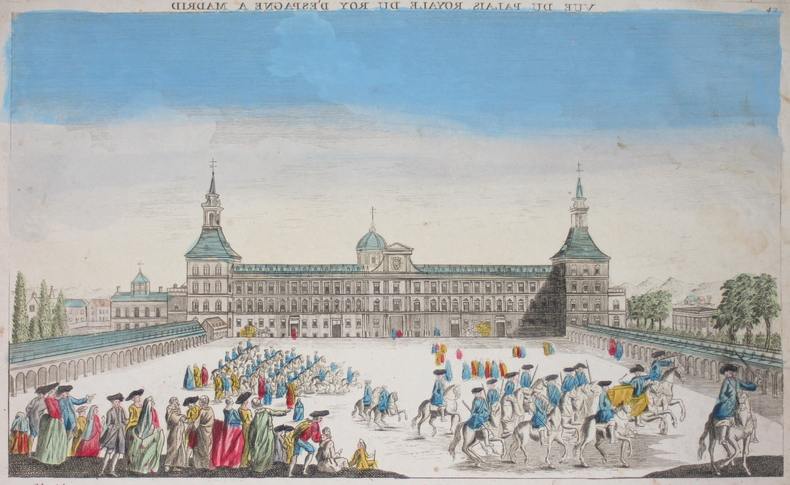
1760049Vue d'optique « Vue du palais royal du Roy d'Espagne a Madrid », Vue du palais royal de sa majesté catholique le Roy d'Espagne a Madrid, Sur papier, Chez Basset, N°42, Gravure rehaussée en couleurs à l'aquarelle, env. 1760, Anglais/Français, La Feuille mesure 41 x 33 cm, le dessin mesure 41 x 25,5 cm et pèse 0,100 kg (c). Très Bon état général, quelques cacas de mouche.
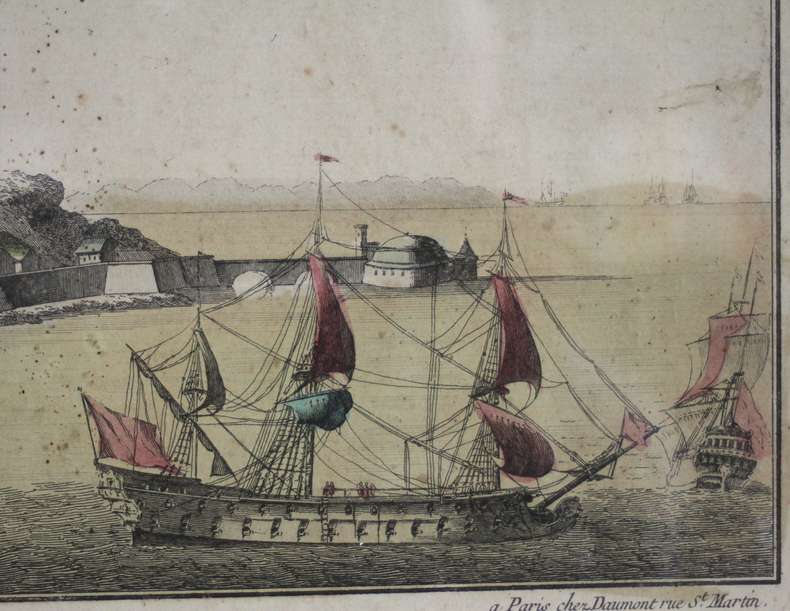
1770052Vue d'optique Estampe « Vue du detroit et de la ville de Gibraltar petite ville d'Espagne dans l'Andalousie, appartenant aux anglais depuis 1704 » 1770, Chez Daumont, Sous verre, l'Encadrement mesure 29 x 40 cm, le dessin mesure 29 x 40 cm et pèse 1,000 kg (c). Bon état général, plusieurs petites taches.
1740219Vue d'optique « Le jardin du comte d'Althann » Vue des treillages du jardin de SE le général Comte d'Althann en face. Sur papier, Chez Daumont. Gravure rehaussée en couleurs à l'aquarelle, env. 1740. La feuille mesure 39,5 x 32,5 cm, le dessin mesure 39,5 x 22,5 cm et pèse 0,100 kg (c). Très Bon état général, rousseurs claires.
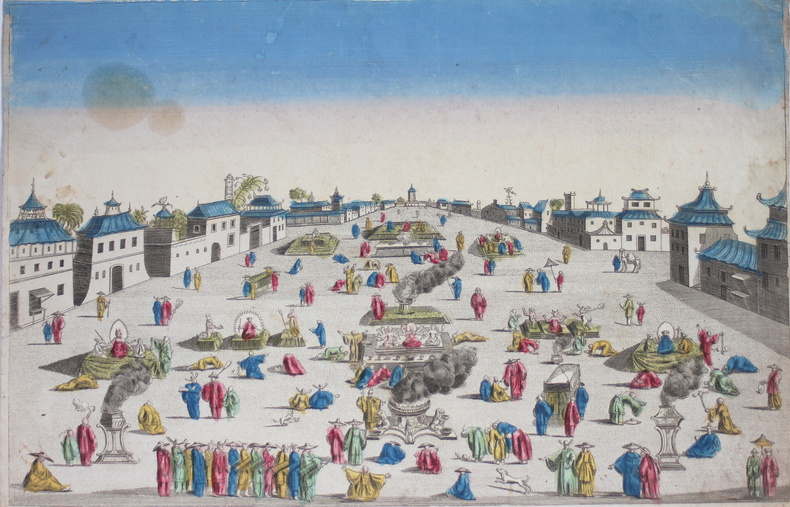
1752213Vue d'optique « Cérémonie de la grande Festé que les chinois célèbre le 24 de la lune d'Aoust dans la principale de Pékin » Sur papier, Chez Mondhare. Gravure rehaussée en couleurs à l'aquarelle, env. 1752. La feuille mesure 42,5 x 33 cm, le dessin mesure 42,5 x 29 cm et pèse 0,300 kg (c). Très Bon état général, une grande tache claire, une mouillure claire.
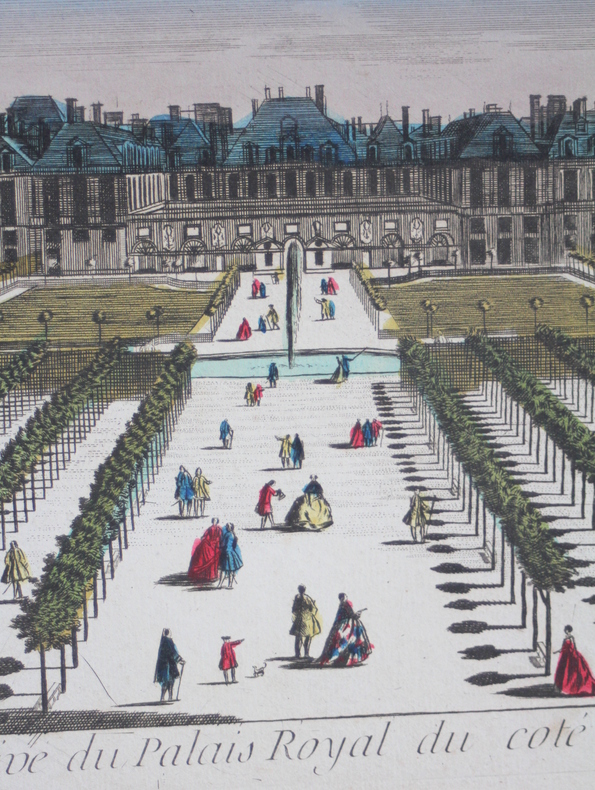
1760051Vue d'optique Vue perspective du Palais Royal du coté du Jardin. Sur papier, Chez Mondhare. Gravure rehaussée en couleurs à l'aquarelle, 1760. La feuille mesure 32,5 x 43 cm, le dessin mesure 26,5 x 43 cm et pèse 1,300 kg (c). Très Bon état général, un trou « de punaise ».
1760218Vue d'optique « L'Arsenal de Venise ». Vue du grand Arsenal à Venise, qui a deux portes, l'une pour recevoir les ouvriers, l'autre pour faire entrer les vaisseaux. Sur papier, Chez Basset, N°58. Gravure rehaussée en couleurs à l'aquarelle, env. 1760. La feuille mesure 41 x 33 cm, le dessin mesure 39 x 29 cm et pèse 0,100 kg (c). Très Bon état général, bords émoussés.
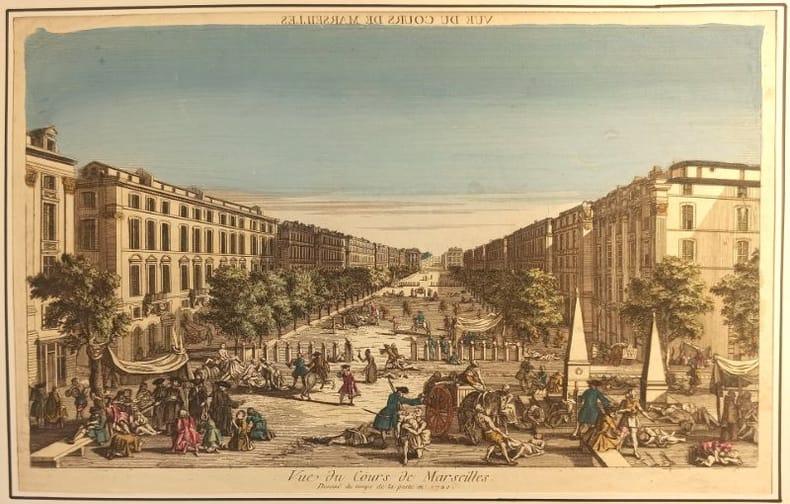
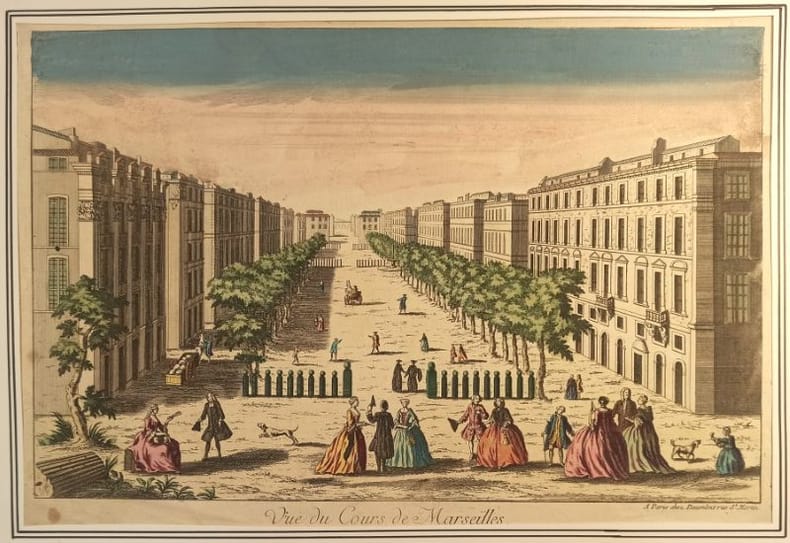
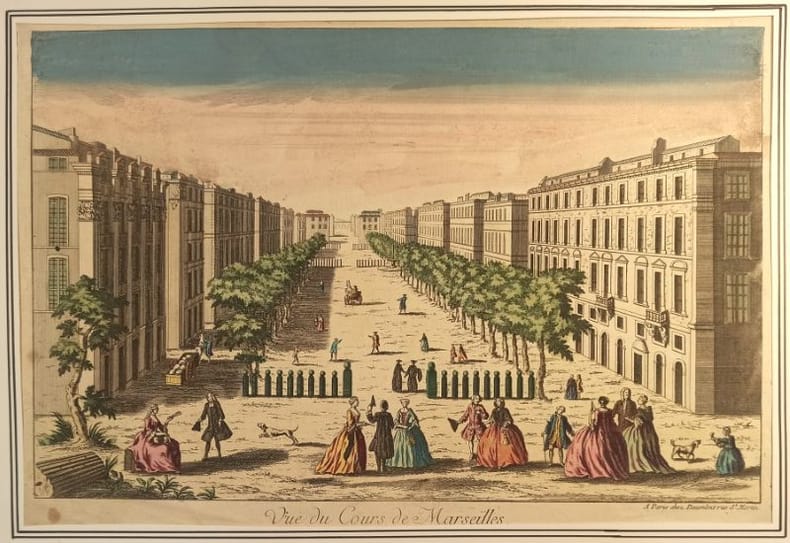
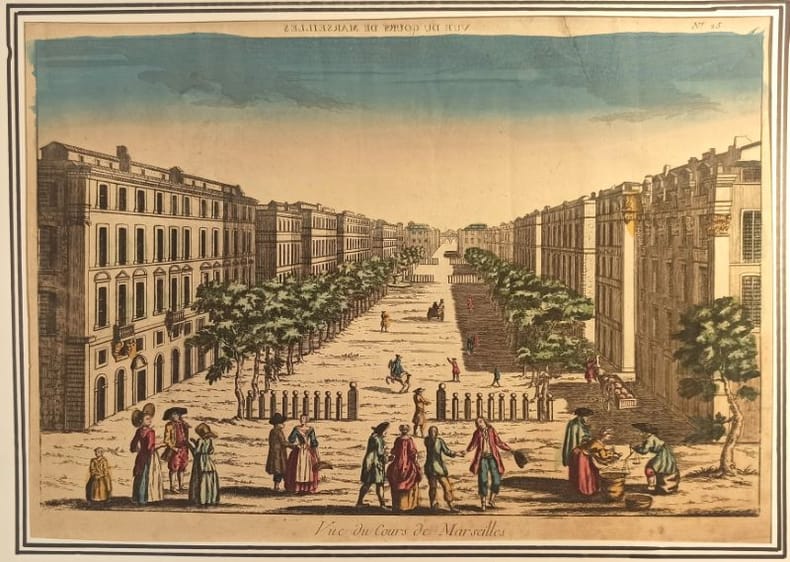
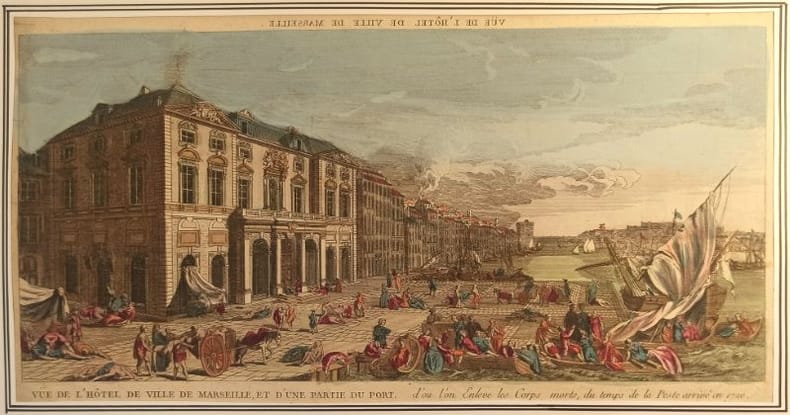
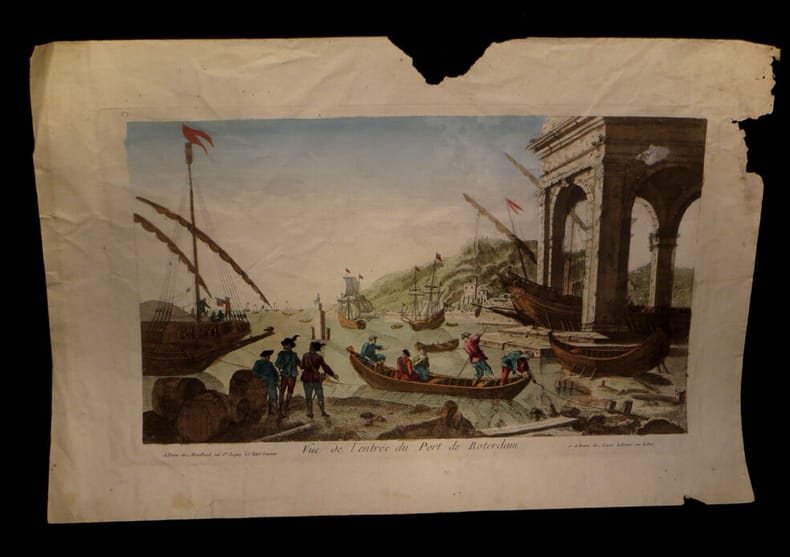
1740boz_003899Vue d'optique, Gravure rehaussée, Vue d'Optique Représentant Les Boulvards de Paris pris du grand Caffé prés le Reservoir de la Ville Vue d'optique du Pont Royal et du Pont Neuf à Paris, avec légende. « Vue d'Optique Représentant Les Boulvards de Paris pris du grand Caffé prés le Reservoir de la Ville » « Prospectus Majoris deambulatorii vulgo dicti Boulvard a Majori loco Caffé prope urbis publicum aquarum receptaculum Parisiis » Gravure rehaussée à l'aquarelle à la main d'époque. Marges conservées. Chez Daumont, à Paris, Rue St Martin. Dimensions de la feuille : 42,6 x 30,8 cm Dimensions à la cuve : 40,4 x 30,1 cm État : Rousseurs, et restaurations. Apparues vers 1740, ces estampes étaient spécifiquement conçues pour être visionnées à travers un appareil appelé "zograscope" ou une lanterne magique. La perspective : Le dessin accentue volontairement les lignes de fuite pour créer une illusion de profondeur saisissante. L'inversion : Le titre en haut de la gravure est souvent imprimé à l'envers (en miroir) pour apparaître correctement une fois reflété dans le miroir de l'appareil d'optique. L'usage : Véritable ancêtre de la 3D, elles permettaient aux curieux de l'époque de "voyager" immobile à travers l'Europe et le monde.
176027730PARIS 1760 une vue d'optique en couleurs, GRAVÉE A L'EAU-FORTE ET AQUARELLE SUR PAPIER DE FORMAT: 49 x 34,5 cm., 1760 PARIS sans nom d'Editeur,