Kiehl, Wilhelm Friedrich PeterAntiquariat.de

440 résultats
1865109897Berlin, Nicolai 1865. * XVI, 588 S. 20,5 x 13,5 cm. Schwarzer Pappband der Zeit (leicht berieben und bestoßen) mit rotem Rückenschild.
188559550ABBasel, Benno Schwabe, 1885. gr.-8°. 18 S., Pp., Rücken beschädigt, vord. Deckel lose, kl. Ab.-u. Einrisse d. Kanten, gebräunt/braunrandig u. etwas fleckig, Knickspuren, innen minim. Bleistift-Anstreichungen.
18343616Wien, Mayer und Compagnie, 1834. zahlr., tls. gefaltete Tabellen, II, X, 366 S., Interimseinband mit 2 hs. Rückenschildchen in alter Tinte u. späterer hs. Beschriftung in großer Schrift auf Papierschild am vo. Deckel. Zustand -2, vor allem am Schnitt stockfleckig.
qu.8°. 79 S. Original Halbleinwand mit mont. Deckel- und Rückentitel, dabei Original Halbleinwand-Deckel mit Styroporrahmen, darin lose eine braunfarbene Gedenkmedaille Kochs (Gips-Nachguss der Koch-Medaille, die dem Forscher am 11. Februar 1908 auf einem Kommers der Berliner Ärzteschaft überreicht wurde). Beides in sehr gutem Zustand (I/II). Nr. 33 von 300 numerierten Exemplaren. Mit einem mont. Front.-Porträt, zahlr. Abb. im Text und auf Tafeln nach Zeichnungen und sw Photographien, einer Biographie, Anekdoten zu R. Koch sowie einem Kapitel über die erfolgreiche Tbk-Behandlung in der DDR. Die Robert-Koch-Medaille trägt auf der Rückseite die Inschrift: "Aus der Welt im Kleinen / schufst Du Deine Größe/ und erobertest den Erdkreis, / der dankerfüllt Dir den / unverwelklichen Kranz / der Unsterblichkeit reicht."
Very Good Turkish, Ottoman (1500-1928) Original registry book in its original grey art nouveau cloth. All edges marbled. 'The English manufactory of book and register' written on end-papers. 'Zugologion' written in Greek letters on front cover. Slightly faded. A fine copy. Demy 8vo. (22 x 15 cm). In Ottoman script. 52 p. is written of which apprx. 200 p., but it's finished and complete; one folding hand-drawn color map, and 3 tables. [MANUSCRIPT] [Ottoman Prokopi sanitary report] Konya Sihhiye Müfettisligi'nin 16 Tesrinievvel 1327 tarihli mezkûr müfettislige takdim olunan rapordur ki 327 senesi Ürgüp'te zuhur eden koleraya dairdir.; Vilâyetin topografya-yi sihhiye ve harita-yi sihhiyesi. The report on the cholera occurring in Ürgüp in 1910, which was presented to the Inspectorate of Konya Sihhiye on October 16, 1910. Besides cholera, it contains information about diseases such as measles. 1329 (Hegira) written at the end of first 10-paged report. The second part contains title: Mecelle-i Memâlik-i Osmaniye'ye ait minvallere cevabât yazilarak Üsküp Kaymakamligi'na takdim olunan 'Müslüman Sihhiye' raporu [= Muslim health report submitted to the Ürgüp (Prokopi) District Governor]. This and following next chapters include general health and sanity registers on epidemics like 'frengi' (syphilis, pox), all kinds of 'humma' (pyrexia) and several others (almost more 15 titles) and give information about how often diseases are encountered in the region of Prokopi and Cappadocia. One folded map which is hand-drawn includes color markers as 'Ürgüp Bölgesi saglik haritasi' [= Prokopi region sanity and epidemic map]. Also it shows demographic and historical info about region. There are 3 statistical tables contain demographic, historical, religious info such 'Muslim' and 'Non-Muslim'. Maps and tables are perfectly drawn. Another chapter is 'Usul-i sihhiye', has all epidemics and their historical and demographic contexts, their cures etc. Book was written in a very nice hand-writing. Used black, blue, and red inks. Report was not published before such as that. Roumi: 1327 = Gregorian: 1910. The Ottoman land represented a bridge between Asia and Europe, which was destroyed by epidemic diseases that emerged in different periods. In the 19th century, the main source of epidemic was the cholera morbus that emerged in India in the lower Bengal delta between the Ganges and Brahmaputra rivers. At the beginning of the 19th century, the disease became a global threat. Cholera epidemic appeared for the first time in the Ottoman territory in 1822, and continued to emerge into intermediate outbreaks. Due to its geographical location, the cholera epidemic was easily spread to the Ottoman territory and caused great losses in the 19th century, when it became a global threat. At the beginning of the 20th century, still cholera was a serious problem. Prokopi is a settlement in Central Asia Minor, built on a plateau at an altitude of 1,200 m above sea level. It lies near the confluence of four tributary rivers of the Alys River (Kizilirmak), which flows to the north of Ürgüp, within about 10 km from the settlement. It has been claimed that the word Ürgüp is the Turkish version of the Greek name Prokopi. The latter is supposed to refer to St. Prokopios, although there is no evidence suggesting the existence of a namesake church. Levidis supported that the ancient name of the settlement was Osiana, which the traveller Texier (Charles) adopted as well. Ürgüp was inhabited by Muslims, Turkish-speaking Greek-Orthodox and some Armenians. Several conflicting opinions have been stated about the population. Farasopoulos talks about 15,000 Muslims and 5,000 Christians. According to an inventory carried out by the state in 1919, Ürgüp was inhabited by 12,500 Muslims, 6,000 Christian-Orthodox and 15-20 Armenian families.
14244De l'imprimerie de Mellinet-Malassis Nantes, 1832, plaquette in-12 brochée, couverture imprimée, 55pp. Bulletin des séances / Coup d'il sur la médecine Physiologique par M. Esmein fils / Circulaire sur le Choléra Morbus adressée par M. de la Boutraye, consul de France à Dantzick, à l'intendance sanitaire de Nantes. Brochure en partie non coupée, très bon état.
23 cm, brossura editoriale, titolo incorniciato alla copertina; pp. 29, una firma all'antiporta
1831160273Hamburg, gedr. auf Kosten des Verfassers bei F. H. Nestler und Melle, 1831. 15 S. 8°, OHeft.
In 8, pp. 33 + (1b) + (1) + (1b). Br. rifatta. Nozioni per la cura del colera. Terminati gli studi di medicina a Napoli, Lanza fu designato professore nella clinica medica dell?ospedale degli incurabili e nel 1815 direttore di clinica medica nell?ospedale della pace. Deputato al Parlamento del Regno delle Due Sicilie. Dopo le insurrezioni anti borboniche del 1848, Ferdinando II di Borbone sciolse il parlamento, perseguitandone i membri liberali e dando la caccia a rivoluzionari veri e presunti. La repressione reazionaria del sovrano si abbatte' anche sul Lanza, che fu costretto ad abbandonare la citta' campana per evitare la sua cattura. Nel 1849 si stabili' a Genova dove continuo' ad esercitare la sua professione di medico. Ritornato a Napoli, mori' nel 1860.
185144412Hamburg, Johann August Meißner, 1851. Titel, 667, CXXVIII S., 4 Bll. Pp. d. Zt. mit RSch.
183782477Hamburg, Johann August Meißner, 1837. 5 Bll., 450, LXIV S. 18,5 cm. HLdr. d. Zt.
183782478Hamburg, Johann August Meißner, 1837. 7 Bll., 450, LXIV S. 18,5 cm. Ln. d. Zt.
183281987Hamburg, Johann August Meißner, 1832. Titel, 13 Bll., 734 S., 1 w. Bl., XLIV S. 18,5 cm. HLdr. d. Zt. mit RSch. u. RVergold.
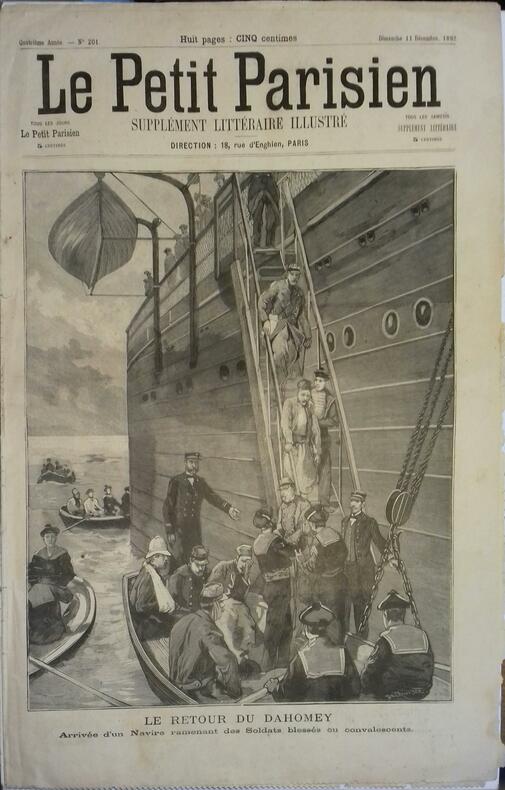
189281576Couverture souple. 8 pages. 31 x 45 cm. Gravures en couleurs. Défraîchi. Réparé. Rousseurs.
189261060Couverture souple. Numéro complet, gravures en noir et blanc. 8 pages. 30 x 45 cm. Légèrement défraîchi.
124482aafFrankfurt a.M., Meidinger Sohn, 1856, in-4°, VIII + 93 S., stockfleckig, Stempel: ‘N. Gutmann Buchhandlung Bern’, hs. ‘Dr. Herzberg 1856’ auf Umschlag Original-Broschüre, Rücken etwas beschädigt.
18867Paris, Albin Michel, 1932. 14 x 23, 296 pp., broché, bon état.
Innsbruck, dalla Tip. di Feliciano Rauch, 1831, in-16, br. edit. con cornice tipografica, pp. 52.
22 cm, brossura originale, p. 59. Volume con forellini di aghi da parte a parte fatti all'epoca per disinfezione
7951Caen, Société d'Impression de Basse-Normandie, s.d. Une plaquette in-8 couverture bleue, 57 pages, illustrations en n&b. Dos faible, bon état.
183131541ABBerlin, Haude und Spener'sche Buchhandlung (S.J. Joseephy), 1831. 8° (19x12), XXVI, 218 S., mit einer mehrfach gefalteten grenzkolorierten Karte, Pbd d.Zt. mit goldgepäg RSchild, dreiseitiger Rotschnitt, 2., unveränderte Aufl. bestossen, obKapital etwas eingrissen, Rückenetikett, STempel auf Innenspiegel und verso Titel, kaum gelesen, fest und sauber,
18311316411Berlin, Haude u. Spener, 1831. 2 Bl., 144 S. OBroschur (Umschlag leicht fleckig u. m. Stempel, Besitzvermerk u. Stempel recto/verso Titel, schwach stockfleckig, unbeschnitten, ohne die 13 römisch paginierten Seiten am Anfang).
2 opere rilegate insieme in un volume in-8° (cm. 18,9x11,9), mezza pelle coeva, piatti in carta decorata. Mancanze della pelle presso le cuffie, bel titolo chiaramente impresso tra fregi al dorso. 1) LICHTENTHAL, pp. XV, 271. Censito in 3 bibl. ital. Lichtenthal, austriaco (Pressburg 1778 - Milano 1853), medico e compositore musicale amico di Mozart e di Paganini, a Milano dal 1810, scrisse anche sulla musicoterapia. Qui riporta i medici inglesi Annesley e Jameson, ma anche metodi maomettani; e fonti ufficiali della RUSSIA (cure, fenomeni, statistiche ecc.) sulle epidemie dalla "coléra asiatica" del 1829 e 1830. 2) BROUSSAIS, pp. 96. Censito in 7 bibl. ital. (Saint-Malo 1772 - Vitry-sur-Seine 1838) fisiologo, e pensava che lo stomaco fosse "la sede delle emozioni", in collegamento con le patologie del cervello, e curava la maggior parte delle malattie come collegate alla gastroenterite. Fu influenzato dalla teoria della frenologia di Franz Joseph Gall. Nel 1832 scoppiò un'epidemia di colera che minò profondamente le sue teorie fisiologiche dato che la sua terapia a base di sanguisughe si dimostrò del tutto inutile: infatti uno dei suoi più famosi pazienti, Casimir Pierre Périer, primo ministro francese, morì sotto le sue cure. Questo insuccesso della sua teoria gli fece perdere notevolmente popolarità che riuscì a riacquisire grazie alla sua abilità retorica e alle lezioni di frenologia che tenne presso l'università di Parigi. (wiki)
Mm 125x195 Brossura cucita di pp. 439, in buono stato. SPEDIZIONE IN 24 ORE DALLA CONFERMA DELL'ORDINE.
4°, br. mod. (conservata la bross. orig. ant.), pp. 144, 1 tav. topografica a doppia pag.