440 résultats
1923012850Paris Edition du Sagittaire, chez Simon Kra 1923 In-12 Broché Edition originale Dédicacé par l'auteur
In-8 p (mm. 212 x 128), cartonato muto coevo. Il volume raccoglie i seguenti 9 opuscoli (di diverso formato e di editori diversi): - Guyton-Morveau “Metodo per purgare le arie infette...” (1817), pp. 55, con 2 tavole a colori fuori testo. - “Storia della malattia che trasse a morte l’avvocato sig. Luigi Rainoldi..” (1826), pp. 43. - Bodei A. “Preparativi per la soluzione di gravissimi problemi intorno all’epidemia dominante” (1817), pp. 110. - “Lettera d’un medico di città ad un parroco di campagna sulla febbre petecchiale e sui preservativi contro di essa” (s.d.), pp. 18. - “Istruzioni e regolamenti di privata sanitaria quarantina da osservarsi in caso di contagio per tenere lontano dalle proprie abitazioni il cholera-morbus e qualunque alta malattia contagiosa” (1831), pp. 24. - “De Cholerae modo epidimice in quibusdam Europae regionibus furentis symptomatibus diagnosticis...”, Ticini Regii, ex Tip. Fusi (1832), pp. 28. - Calderini C.A, “Precetti salutari per essere preservati dal cholera morbus” (1835), pp. 36. - Ferrario O. “Saggio analitico della così detta acqua purgativa della fonte vicina a Settala Distretto X, Provincia di Milano” (1826), pp.13. - “Avviso al popolo intorno al cholera-morbus” (1835), pp. 13.<br> Con qualche fiorit. ma certam. un buon esemplare.
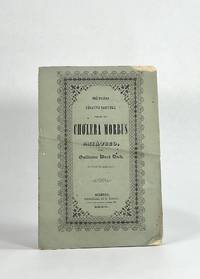
185010296Mexico: R. Rafael 1850. Original Wrappers. near Very Good binding. Octavo. 16 pp. Stitched in original wrappers. Horizontal crease through the center of the pamphlet from accidental folding; light edgewear including folded leaf corners; rear wrapper soiled; wormholes through the entire pamphlet that touch the occasional letter not impacting comprehension. <br /> <br /> Uncommon pamphlet in which the author a self-professed retired physician identifies how to diagnose cholera which had reemerged as a serious problem during and after the Mexican-American War. We've not been able to find other references to work by Duck. Fairly uncommon. While this is not an ideal copy given the condition it is fairly good. Sutro p. 858. R. Rafael unknown
174520421Lugduni Batavorum, apud Gerardum Potvliet, 1745. In-4 de [24]-324-[45]; [2]-de 73 à 258-[2] pages, vélin souple du temps, attache (il en manque une).
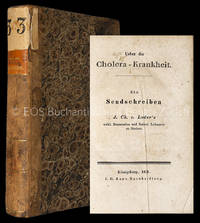
18312684BBKönigsberg, J.H. Bon's Buchhandlung, 1831. 8°. 60 S., 48 S. (Zusätze). Halblederband aus der Zeit.
18312684BB1831. Königsberg J.H. Bon's Buchhandlung 1831. 8°. 60 S. 48 S. Zusätze. Halblederband aus der Zeit. Beigebunden: Schnurrer Friedrich: Die Cholera morbus ihre Verbreitung ihre Zufälle die versuchten Heilmethoden . Stuttgart und Tübingen Gotta'schen Buchhandlung 1831. X 2 79 S. Mit 1 gef. Karte. Beigebunden: Hegetschweiler Joh.: Ueber den Charakter die Cur und die Verhütung der ostindischen Brechruhr Cholera mit besonderer Berücksichtigung der Verhältnisse der Schweiz. Zürich Orell Füssli 1831. 52 S. Beigebunden: Köchlin J. R.: Ueber die Cholera oder den Brechdurchfall und die dagegen gerichteten Schutz- und Hülfsmittel. Zürich Schulthess 1831. 74 S. Beigebunden: Bastler Anton Dominik: Die Cholera in Wien. Wien Strauss 1832. 1 Bl. 134 S. - Sammlung div. Beiträge über die Cholera in einem Buch gebunden. - Mit Bibliotheksnummern. Der Einband berieben. unknown
MED654M1834, Imprimerie Royale, Paris. In-4, reliure d'attente, plats cartonnés, 205pp suivies de tableaux statistiques et de cartes concernant chaque arrondissement et chaque commune rural. Exemplaire bien complet de toutes ses planches (51 cartes). Intérieur bon. Carte 49 brunie, sûrement une planche provenant d'un autre exemplaire puis montée sur onglet (trace de découpe sur ce qui devait être la planche 49 initiale). Cachet humide ex-libris sur page de titre. Charmant exemplaire de ce rare et éminent ouvrage.
1987000928Paris Blaizot 1987
18312684BBKönigsberg, J.H. Bon's Buchhandlung, 1831. 8°. 60 S., 48 S. (Zusätze). Halblederband aus der Zeit. + Wichtig: Für unsere Kunden in der EU erfolgt der Versand alle 14 Tage verzollt ab Deutschland / Postbank-Konto in Deutschland vorhanden +, A|B [2 Warenabbildungen]
183222939Montreal. A la Librairie de E.R. Fabre & Cie. Juin 1832 1832. Hardcover. 24mo 13cm 16p. in the original plain boards fine n12 A book of prayers in response to a cholera epidemic outbreak in Lower Canada in 1832 which was brought by immigrants from Britain. At the time it was not understood how the disease spread nor how to treat it. Six thousand people were believed to have died. Montreal. A la Librairie de E.R. Fabre, & Cie. Juin 1832 hardcover
1814019557Büreau Für Literatur Und Kunst, Halberstadt 1814. Erstausgabe Interim-Broschur Sehr gut
Very Good Turkish, Ottoman (1500-1928) Original registry book in its original grey art nouveau cloth. All edges marbled. 'The English manufactory of book and register' written on end-papers. 'Zugologion' written in Greek letters on front cover. Slightly faded. A fine copy. Demy 8vo. (22 x 15 cm). In Ottoman script. 52 p. is written of which apprx. 200 p., but it's finished and complete; one folding hand-drawn color map, and 3 tables. [MANUSCRIPT] [Ottoman Prokopi sanitary report] Konya Sihhiye Müfettisligi'nin 16 Tesrinievvel 1327 tarihli mezkûr müfettislige takdim olunan rapordur ki 327 senesi Ürgüp'te zuhur eden koleraya dairdir.; Vilâyetin topografya-yi sihhiye ve harita-yi sihhiyesi. The report on the cholera occurring in Ürgüp in 1910, which was presented to the Inspectorate of Konya Sihhiye on October 16, 1910. Besides cholera, it contains information about diseases such as measles. 1329 (Hegira) written at the end of first 10-paged report. The second part contains title: Mecelle-i Memâlik-i Osmaniye'ye ait minvallere cevabât yazilarak Üsküp Kaymakamligi'na takdim olunan 'Müslüman Sihhiye' raporu [= Muslim health report submitted to the Ürgüp (Prokopi) District Governor]. This and following next chapters include general health and sanity registers on epidemics like 'frengi' (syphilis, pox), all kinds of 'humma' (pyrexia) and several others (almost more 15 titles) and give information about how often diseases are encountered in the region of Prokopi and Cappadocia. One folded map which is hand-drawn includes color markers as 'Ürgüp Bölgesi saglik haritasi' [= Prokopi region sanity and epidemic map]. Also it shows demographic and historical info about region. There are 3 statistical tables contain demographic, historical, religious info such 'Muslim' and 'Non-Muslim'. Maps and tables are perfectly drawn. Another chapter is 'Usul-i sihhiye', has all epidemics and their historical and demographic contexts, their cures etc. Book was written in a very nice hand-writing. Used black, blue, and red inks. Report was not published before such as that. Roumi: 1327 = Gregorian: 1910. The Ottoman land represented a bridge between Asia and Europe, which was destroyed by epidemic diseases that emerged in different periods. In the 19th century, the main source of epidemic was the cholera morbus that emerged in India in the lower Bengal delta between the Ganges and Brahmaputra rivers. At the beginning of the 19th century, the disease became a global threat. Cholera epidemic appeared for the first time in the Ottoman territory in 1822, and continued to emerge into intermediate outbreaks. Due to its geographical location, the cholera epidemic was easily spread to the Ottoman territory and caused great losses in the 19th century, when it became a global threat. At the beginning of the 20th century, still cholera was a serious problem. Prokopi is a settlement in Central Asia Minor, built on a plateau at an altitude of 1,200 m above sea level. It lies near the confluence of four tributary rivers of the Alys River (Kizilirmak), which flows to the north of Ürgüp, within about 10 km from the settlement. It has been claimed that the word Ürgüp is the Turkish version of the Greek name Prokopi. The latter is supposed to refer to St. Prokopios, although there is no evidence suggesting the existence of a namesake church. Levidis supported that the ancient name of the settlement was Osiana, which the traveller Texier (Charles) adopted as well. Ürgüp was inhabited by Muslims, Turkish-speaking Greek-Orthodox and some Armenians. Several conflicting opinions have been stated about the population. Farasopoulos talks about 15,000 Muslims and 5,000 Christians. According to an inventory carried out by the state in 1919, Ürgüp was inhabited by 12,500 Muslims, 6,000 Christian-Orthodox and 15-20 Armenian families.
189340<p><strong>Very rare Second enhanced edition </strong></p><p><strong>No copy of any edition of this title recorded in WorldCat</strong></p><p><strong>Uncut</strong></p><p>Oliveti Torquato. <em>Della morte apparente nei cholerosi del modo di farli risorgere e della sola cura giovevole nel cholera asiatico / Torquato Oliveti</em>. Savignano : Tipografia dei Filopatridi 1893</p><p>8° 185 x 120 mm original paper binding with title page printed on front board pp. 116.</p><p>Very rare second edition of Torquato Olivetti treatise on Asian cholera and the phenomenon of apparent death in the sufferers of cholera</p><p>The treatise published in First Edition in Naples in 1886 organised as a practical manual to be used by doctors during an epidemic of cholera deals with the causes and symptoms of the disease the most effective cures and deals with the phenomenon of the apparent death of some sick people on how to recognise this symptom and how to raise the apparent dead.</p><p>Olivetti a doctor and lawyer from Emilia formed his experience on cholera during the terrible plague epidemic that broke out in Naples in 1884.</p><p>In the summer of 1884 a devastating cholera epidemic was recorded in Naples. The difficult housing situation in the popular neighbourhoods and poor sanitation conditions favoured the rapid proliferation of the disease. In the space of a few weeks the death toll exceeded 7000. To prevent the recurrence of other similar tragedies the mayor Nicola Amore with the support of King Umberto I and Prime Minister Depretis started the "gutting" of the ancient city with a massive recovery plan.</p><p>CONDITION: Amazing copy with no defects; uncut.</p> Tipografia dei Filopatridi paperback
1 épreuve gélatino argentique [120 x 172 mm] contrecollée sur carton fort de l'époque , , in-8, 1 épreuve gélatino argentique [120 x 172 mm] contrecollée sur carton fort de l'époque, , Portrait de Louis Pasteur sur son lit mortuaire. Étant donné son cadrage et sa proximité, ce portrait mortuaire a sans doute été effectué par un proche de Pasteur; il ne s'agit pas d'une prise de vue officielle. Louis Pasteur, né le 27 décembre 1822, meurt le 28 septembre 1895 à 16h40 à Villeneuve-l'Étang, dans l'annexe dite « de Garches » de l'Institut Pasteur, où il s'installait souvent l'été. Sa chambre y est toujours conservée. Des funérailles nationales lui sont réservées le 5 octobre suivant, au cours desquelles son corps, préalablement embaumé, est déposé dans la crypte de Notre-Dame de Paris. En 1896, à la demande de son épouse, son corps fut placé dans la crypte de l'Institut où il repose au milieu de ses disciples. Un masque mortuaire est visible dans la crypte. Un négatif sur plaque de verre montrant la chambre mortuaire prise en 1926 est conservé au Département Estampes et photographie à la BnF (8/5/26, la chambre mortuaire de Pasteur à Garches : photographie de presse / Agence Rol.) Un cliché mortuaire montrant Pasteur sur son lit de mort en présence de ses petits enfants a été publié en 1956 par sa petite-fille Camille: Pasteur Vallery-Radot, Images de la vie et de l'oeuvre, p. 158 (document photographique provenant de la collection Pasteur Vallery-Radot). Le carton sur lequel est contrecollé le portrait de Pasteur porte un fin liseret rouge d'encadrement, le bord supérieur du tirage est accidenté. Documents annexes joints : 1 tirage argentique contrecollé sur carton [165 x 110 mm] légendé : Portrait de Pasteur avec sa petite-fille Camille Vallery-Radot par Léon Bonnat (1886) / 4 tirages argentiques [170 x 220 mm] de portraits réalisés aux pastels par le jeune Louis Pasteur entre 1835 et 1842 : portrait de sa mère, de Claudine Benoiste Parpandet dite soeur Constance, portrait d'une jeune fille et portrait de son père / 1 gravure du XIXe siècle : portrait âgé de Louis Pasteur par Roussel
1854241271854 Format 58 x 94 cm sous vitre et cadre doré ancien. (Petite restauration dans le ciel).