104 résultats
1801197311801. Paris Brosson Gabon et Cie. 1801 8° CXII 244 pp. pp.245 - 636 XXXVIII 414 pp. pp.415 - 828 4 HLdrBde. d.Zt. 2 farb. Rsch. In der theoretischen Medizin begegnet uns an der Schwelle des 19. Jahrhunderts der geniale Pariser Anatom Yavier Bichat jedem Stomatologen durch den seinen Namen tragenden Fettpfropf in der Wange wohlbekannt. Sein Wirken strahlte weit über sein Spezialfach hinaus; in einem kurzen Leben lenkte er die Heilkunde von der Spekulation die weitgehend das 18. Jahrhundert beherrscht hatte wieder zur Beobachtung. Den Sitz des Lebens und auch der Krankheit sah er im Gewebe 1801 so wie ihn Morgagni vierzig Jahre zuvor in die Organe und nach ihm Virchow 1858 in die Zelle verlegt hat. - Da Bichat das Mikroskop vernachlässigte blieb ihm das Wurzelelement unbekannt und das Dentin ist für ihn eine knöchernde Substanz mit Fasern die im allgemeinen die Richtung der Wurzeln haben. Vom Zahnwechsel hat er die klare Vorstellung daß die Scheidewand und die Wurzel des Milchzahnes durch die Einsaugung der phosphorsauern Kalkerde schwinden. Diese Nährsubstanz substance nutritive eignen sich dann die zweiten Zähne an. Hoffmann-Axthelm S-438. Heirs of Hippocrates No.756; Garrison-Morton 403; Cushing B 371; Osler 1301; Waller 1027; Wellcome II p.164. unknown
1801203921801. Paris Brosson Gabon et Cie. 1801 8° CXII 244 pp. pp.245 - 636 XXXVIII 414 pp. pp.415 - 828 4 HLdrBde. d.Zt. 2 farb. Rsch. BEGRÜNDER DER GEWEBELEHRE "In der Histologie und Physiologie Marie Francois Xavier Bichats 1771-1802 zeichnen sich für die Hepatologie einige wichtige neue Gesichtspunkte ab." 1.Das Leberparenchym wird als das morphologisch und funktionell spezifische Lebergewebe erkannt. Nach anderthalb Jahrhunderten iatromechanischer Physiologie die in der Leber eine hydraulische Maschine mit Blut- und Gallenröhren sah wird die vitale Bedeutung der spezifischen Lebersubstanz erneut hervorgehoben. Diese Anschauung führte dann zur Theorie der spezifisch belebten organischen Drüsensubstanz von Johannes Müller. 2.Bichat vermutete daß die Leber außer der Gallensekretion wichtige aber noch völlig unbekannte Funktionen zu erfüllen habe. Diese noch rätselhaften Aufgaben der Leber verküpfte Bichat mit dem Pfortadersystem. Die Leber ist Einzugsgebiet des venösen Blutes das aus den Verdauungsorganen herauskommt. Sie muß in irgendeiner Weise mit den Prozessen der Ernährung und Verdauung gekoppelt sein. 3.Bichat forderte eine strenge experimentelle Klinik und eine vorsichtige Interpretation der vivissektorischen Befunde." Mani II S.213-218 unknown
1801208531801. Paris Brosson Gabon et Cie. 1801 8° CXII 244 pp. pp.245 - 636 XXXVIII 414 pp. pp.415 - 828 4 HLdrBde. d.Zt. 2 farb. Rsch. ERSTE AUSGABE dieses Klassikers der Medizin in einem außergewöhnlich gutem Exemplar. unknown
1801183291801. Paris Brosson Gabon et Cie. 1801 8° CXII 244 pp. pp.245 - 636 XXXVIII 414 pp. pp.415 - 828 4 HLdrBde. d.Zt. 2 farb. Rsch. One of Medicine's most important books G/M. Marie Francois Xavier Bichat 1771-1802 "has introduced a new system into the science of anatomy and it is in this fact that his chief greatness lies." "In his writings Bichat shows himself about all a medical man; the functions of the body are invariably described in close relation to its morbid changes and to the manner in which the should be treated. Pathological anatomy engages his interest quite as much as normal anatomy and postmortem examinations formed a considerable part of his practical work. He studied the various parts of the body in both its healthy and its diseased state employing a number of different methods for the purpose; besides dissection he mentions drying cooking and maceration as well as treatment with acids alkalis and alcohol. On the other hand he did not use a microscope for he thought that this only gives to fallacies and delusions. And yet it is as the founder of a science of microscopy that he won his highest fame." "Bichat's conception of life has always been regarded as vitalistic. Indeed his theoretical fundamental view is unquestionably reminiscent of Stahl; life says he is »the sum of the functions that resist death«. It is a far cry however between Bichat's so called vitalism and Stahl's; the latter's theory of the soul as the ultimate end and conservator of the body Bichat strongly denies. Stahl he declares had realized the incompatibility between physical laws and animal functions but because the soul was everything to him in explaining the functions of life he failed to discover the laws of life. With equal emphasis however Bichat rejects Boerhaave's theory that life should be regarded as a purely mechanical process. »The true essence of life is unknown it can only be studied through the phenomena it manifests«." "The primary lesson he learnt from Stahl however is the importance that different structural conditions have for the functions of the organism; in fact the theory of structure represents Bichat's greatest contribution to the development of biology; it forms one of the corner-stones on which our conception of life and its manifestions rests." According to Bichat's classification the body is built up of tissues which may be grouped in systems - for example the bone system the cartilage system the muscle system. An organ is composed of several systems e.g. the stomach the lungs the brain; several organs form an apparatus e.g. the respiratory apparatus the digestive apparatus. The knowledge of the tissue systems forms what Bichat calls "general anatomy." "The tissues Bichat declares are the true conservators of the life of the body. He distinguishes between twentyone different kinds if tissues - namely 1 celluar closley corresponding to what is now called retiform connective tissue; 2 the nervous tissue of animal life; 3 the nervous tissue of organic life; 4 arterial; 5 venous; 6 the tissue of exhalation; 7 absorbent; 8 bone-tissue; 9 medullary tissue in the bones; 10cartilaginous; 11 fibrous; 12 fibrocartilaginous; 13 animal musculature; 14 organic musculature; 15 mucuous tissue; 16 serous; 17 synovial; 18 glandular; 19 dermoid; 29 epidermoid dermis and epidermis 21 capillary tissue. These tissues however are by no means alike everywhere; rather they invariably posess the power to adapt themselves to the organs in which they are incorporated. The tissues are the true conservators of life; not each invidual organ as Bordeau asserted but each individual tissue has invidual life. Therefore diseases in so far they attack individual organs are localized in their tissues; in abdominal catarrh it is the mucuous membrane that is affected and not the muscles in the abdominal wall; in inflammation of the brain it is in most cases the cerebral membrane that is the seat of the disease. »If we would study a bodily function we must consider the organs which perform that function from a general point of view but if we would become acquainted with the vital qualities of the organ we must disintegrate it« - that is into the tissues of which it is formed." "According to Bichat sensibility is the characteristic quality of the nervous system; the muscular system displays a quality that he calls contractility; this has different characteristics in different organs and should not be confused with the tensibility that the tissues possess independently of life." ."Bichat made serious attempts to ascertain the nature of these vital phenomena by experimenting with living organs under various conditions. Thus he tried to analyse especially muscular contractility and distinguishes several categories thereof." "Of sensibility he distinguishes two categories - namely »organic« which consists in the power of receiving an impression and »animal« which not only receives the impression but conveys it further to a common centre and is that a higher category of the previous one." "The contrasted ideas organic and animal frequently referred to above play an important part in Bichat's explanation of life. »Organic« are vegetable life and the unconscious life of animals; »animal« are the functions in animals that are controlled by the will of the invidual and are consequently the more developed the higher the life is. Even in modern times one sometimes differentiates between animal organs among which are included especially the nervous system and the motive organs and the vegetative among which are included the digestive circulatory respiratory and excretal organs." "At all events if only for the new system that he introduced into anatomical science Bichat must be counted as one of the greatest pioneers of that science that have ever lived." "Bichat's greatness then lies in his having so convincingly proved the quality of the tissues as fundamental constitutents of the body and its functions. He thereby placed the study of the phenomena of life on a definite basis." Even the terms »s e n s i b i l i t y« and the term »c o n t r a c t i l i t y« which were invented by him have been incorporated in modern terminology." Nordenskiöld Hist. of Biology p.344-351. Heirs of Hippocrates No.756; Garrison-Morton 403; Cushing B 371; Osler 1301; Waller 1027; Wellcome II p.164. unknown
1801183281801/03. Paris Brosson & Gabon 1801/03 8° XXXII 464 VI 624 VI 661 XXIV 496 VIII 472 pp. 5 HLdrBde. d.Zt. Heirs of Hippocrates No.757:"Bichat died of tuberculosis at the age of thirty-one having finished the first three volumes of this his last great work. Francois Régis Buisson 1786-1805 compiled the fourth volume and Philibert-Joseph Roux 1780-1854 the fifth." Garrison & Morton 404; Osler 1302; Waller 031; Wellcome II p.164. unknown
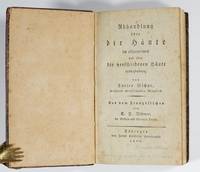
1802270151802. Aus dem Französischen von C.F. Dörner. - Tübingen Jakob Friedrich Heerbrandt 1802 8° XXIV 400 pp. 2 Blätter Druckfehler und 4 Seiten Verlagsanzeigen Pappband der Zeit; feines Expl. Erste deutsche Ausgabe dieses bahnbrechenden medizinischen Werkes "Traité des membranes" herausgegeben im gleichen Jahr wie seine "Antomie générale". "Das unsterbliche Verdienst Bichat's besteht in der Begründung der Gewebelehre auf welcher der Hauptsache nach der Umschwung der Heilkunde unserer Tage beruht. . Bichat stellte sich die Aufgabe die lebendingen Vorgänge als den unmittelbaren Ausdruck ihres Baues nachzuweisen." Hirsch Marie Francois Xavier Bichat 1771-1802 teilte in dieser Schrift von den Membranen die Häute in muköse Schleimhaut des Verdauungs- und des Uro-Genital-Kanals seriöse und fibröse mit ihren Unterarten: sero-muköse und fibro-muköse Häute. Mit Meisterhand schildert er namentlich die 'bis jetzt unbeachtet gebliebenen 'Synovial-Häute und deren normales und pathologisches Verhalten' "Bichat conceived the idea of science of anatomy and pathology based upon an accurate classification of the various tissues of the body their distribution in the various organs and parts and their particular susceptiblities to disease. He is regarded as the founder of modern hsitology and tissue pathology." Garrison & Morton No.537 1st. French Ed. 1800 unknown
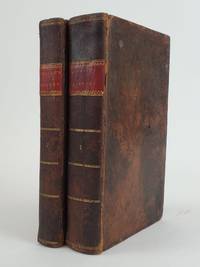
180135956Paris: Gabon; Brosson 1801. Bichat Marie Francois Xavier 1771-1802. Traite d'anatomie descriptive. 5 vols. 8vo. Paris: Gabon et Cie.; Brosson 1801-3. 201 x 126 mm. Calf c. 1803 gilt spines rubbed some hinges cracking head of Vol. V spine chipped. Occasional foxing & soiling stains in inner margins of first and last few leaves in most vols. corner of one leaf in Vol. IV torn with loss of a few letters but a very good crisp copy. 19th cent. engraved bookplate of Dr. Macreight probably Chambers Macreight botanist and physician 1799-1856. </p> <p>First Edition. Garrison-Morton 404; 1315. Bichat was the founder of pathological anatomy creating a theory of disease based on tissues rather than organs. "Bichat's five-volume Anatomie descriptive 1801-3 and his work on general anatomy applied to physiology and medicine 1802 opened out an entirely new field for anatomists that of a detailed description of the parts and tissues of the body in health and disease. . . . Bichat was a forerunner of Henle and the histologists dividing the tissues into 21 non-microscopic varieties which he treated as indivisible parts like the elements in chemistry each tissue having its own particular kind of sensibility and contractibility" Garrison Hist. Med. pp. 444-45. The Anatomie descriptive was Bichat's last exposition of his pathological system; he died in 1802 at the age of 31 having completed only the first three volumes. The remaining volumes were completed by Francois Buisson and Philibert-Joseph Roux. Vol. III includes the section "Nerfs de la vie organique" in which Bichat introduced the terms "animal" and "vegetative" system. Maulitz Morbid Appearances pp. 9-35. Waller 1031. Gabon; Brosson unknown books
180146400824Paris, Brosson, Gabon, an X (1801) ; 2 tomes en 4 volumes in-8, basane porphyre, dos ornés à l'or, tranches jaspées (reliure de l'époque) - CXII pp. (2 tableaux dépliants), 244 pp. - 2 ff. pp 245 à 636 - XXXVIII, 414 pp. - 2 ff., pp. 415 à 828. EDITION ORIGINALE de cet ouvrage fondamental. "" L'œuvre capitale de Bichat, une pierre angulaire du savoir médical moderne "" En français dans le texte n°204 - Garrison - Morton 403 - Wellcome II, 164 - Le Fanu. "" Notable Medical books "" pages 157 - Waller 1027. Exemplaire en pleines reliures de l'époque, sans rousseurs ni mouillures Fentes dues à un travail de ver sur une charnière du tome 2"
18141357326Philadelphia: Thomas Dobson 1814. First Thus. Hardcover. Octavos Two Volumes. In Good condition. Bound in full contemporary leather. Boards have several surface marks and some bookworm damage to covers wear and rubbing to spine edges and corners slight crack to leather along spine of Vol. I. Text blocks show age toning to edges and some foxing to pages throughout. Eight plates including two folding plates present and intact in Vol. I. Four folding plates present and intact in Vol. II. Ex-library with usual markings including bookplates to front pastedown institutional stamps to several pages and call number written in pencil. MF Consignment.<br /> <br /> <br> <br> CONTENTS: Vol. I. xiii 512 pages -- Vol. II. vi 308 pages. 1357326. Special Collections. Thomas Dobson hardcover
182218963Boston: Richardson and Lord 1822. FIRST EDITION IN ENGLISH. Contemporary mottled calf rebacked and recased. A fine set. First English edition of this text that “revolutionized descriptive anatomy and that … marks the beginning of modern histology†G-M. Relying on verbal descriptions rather than illustrations Bichat addresses individual tissues within the organs while his contemporaries typically wrote on whole organs alone. He worked mostly without microscope technology but was able to isolate 21 different types of tissues.<br /> <br /> Bichat 1771-1802 was French pathologist and anatomist. He is remembered for bridging the gap between organ pathology and cell pathology.<br /> <br /> Garrison-Morton 403. Richardson and Lord unknown
182596942Paris, J.-B. Baillière, 1825, in-8, portrait, [2]-XVI-335 pp, 1 pl. dépl. et 1 pl. additionnelle, Demi-veau bleu nuit, dos lisse orné de fers rocaille, Édition originale, peu courante, de cette publication posthume du célèbre biologiste et physiologiste Xavier Bichat (1771-1802). Elle est ornée d'un portrait de profil de "l'immortel auteur de l'Anatomie générale" en lithographie, copié d'après un dessin fait quelques heures après sa mort. La planche dépliante est un fac-similé des leçons de Bichat rédigées par Béclard. Ce dernier cour, qui peut être considéré comme un résumé des travaux de Bichat en pathologie, présente ses observation sur les propriétés vitales des tissus et leurs maladies. Bichat est l'un des pères de l'histologie et il est le fondateur de ce que Claude Bernard appellera la physiologie anatomique; au lieu d'étudier les organes par région, il les étudiait par rapport à leur fonction, qu'il démontrait par des expériences sur animaux vivants. Avec la Révolution française, il put également accéder à des cadavres fraîchement guillotinés. Exemplaire enrichi d'un double portrait de Desault et Bichat dessiné par Julien Boilly et gravé par Amédée Geille : le maître et son élève (Bichat publia les écrits chirurgicaux de Desault après sa mort). Monogramme "MM" doré en pied du dos. Au contreplat : étiquette du Citoyen Jouanneau, docteur médecin, et ex-libris morbide du docteur François Moutier. Rousseurs et petits frottement aux mors et aux coiffes; sinon, bon exemplaire. Wellcome II, p. 164. Couverture rigide
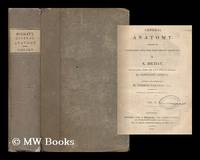
18247541Printed For The Translator By Shackell & Arrowsmith London 1824. First English Edition. Hardback. Edge worn and dulled grey boards professionally rebacked with paper labels to the spines. Bookplate of the Charing Cross Hospital Medical School to the front paste down.; 0 pages; Description: 2 v. ; 22 cm. Translation of: Anatomie generale. Revised and Corrected from the last French edition by George Calvert. Pages uncut; an unread copy and particularly well preserved internally. Complete sets are uncommon. All books fully on approval. Subjects: Human anatomy. Physiology. Printed For The Translator By Shackell & Arrowsmith, London hardcover
1825631171825. A Pairs Chez J.-B. Baillière Libraire 1825 8 XIV 335 pp. Frontispice Portrait von Bichat gealt Faksimile Tafel des Manuscripts Halbledereinband mit eigebundener orig. Broschur; teilweise fleckig. Erste Ausgabe! Posthum erschienenes Werk von Marie-Francois Xavier Bichats letzten Anatomie Kurs. Die von dem französischen Anatomie-Professor Pierre-Augustin Béclard 1785-1825 verfaßte Vorlesungsmitschrift fand sich im Nachlaß und wurde von seiner Hand als Bichats letzter Kurs bezeichnet. Der französischen Medizin-Verleger Baillière erwarb mit großem finanziellen Aufwand das Manuskript und gab es heraus als 'als Dokument des letzten geistigen Kraftaufwandes eines berühmten Mannes vor seinem Tode zugleich eine interessante Zugabe zu seinen früheren Werken abgeben dürfte." "Der nur 31 Jahre alt gewordene Francois Xavier Bichat wird zum Begründer der Gewebelehre und der Histopathologie freilich ohne sich noch in seinem kurzen Leben des Mikroskops bedienen zu können. . Im Winter 1801/1892seinem letzten Lebensjahr soll er allein mehr als 600 Autopsien durchgeführt haben. Dabei leidet er bereits an einer Tuberkulose . wahrscheinlich an einer tuberkulösen Meningitis. . Bichat erweitert die anatomische Beobachtung von den Organen auf die Gewebe und unterscheidet dabei 21 Typen. Diese Gewebe setzen in unterschiedlicher Weise den Organismus zusammen. Sie können einzeln für sich krankhafte Veränderungen unterliegen. Nach Bichat gibt es daher nicht einfach eine Herzentzündung sondern es ist zwischen Peri- Myo- und Endokarditis zu unterscheiden. Wie viel später Virchow betrachtet er die Gewebe auch als den Ausgangspunkt der Geschwülste. Beim Magenkrebs sieht Bichat die "Schleimmebran" also die Schleimhaut als primäre Lokalisation an die serösen Haut wird erst gegen Ende der Krankheit angegriffen. Für das Bindegewebe prägt Bichat den Begriff Zellgewebe tissu céllulaire". Es füllt die Zwischenräume zwischen den Organen aus und ist der Ort der entzündlichen Prozesse. Ganz zweifellos wäre Bichat grundlegender Entdeckungen zur Zellularpathologie geglückt wäre ihm ein längeres Leben und der Gebrauch des Mikroskops vergönnt gewesen sein. "Bichat hat den anatomischen Gedanken in der Pathologie einen Schritt weiter in die Tiefe getragen vom Organ zum Gewebe." Sigerist Er wird damit zum Begründer der Histologie und Histopathologie auch wenn der Begriff "Histologie" erst 1819 von dem Bonner Anatomen Carl Mayer geprägt werden wird. ." Dhom pp.8-10 First Edition! The great French anatomist's Xavier Bichat's 1771-1802 last lecture on pathological anatomy based on student notes of Pierre August Beclard who also wrote the supplement to Bichat's Anatomie generale one of medicine 's most important books. These lectures published first in French 1825 are "particularly valuable as a record of Bichat's organization of the subject". Long p.80 unknown
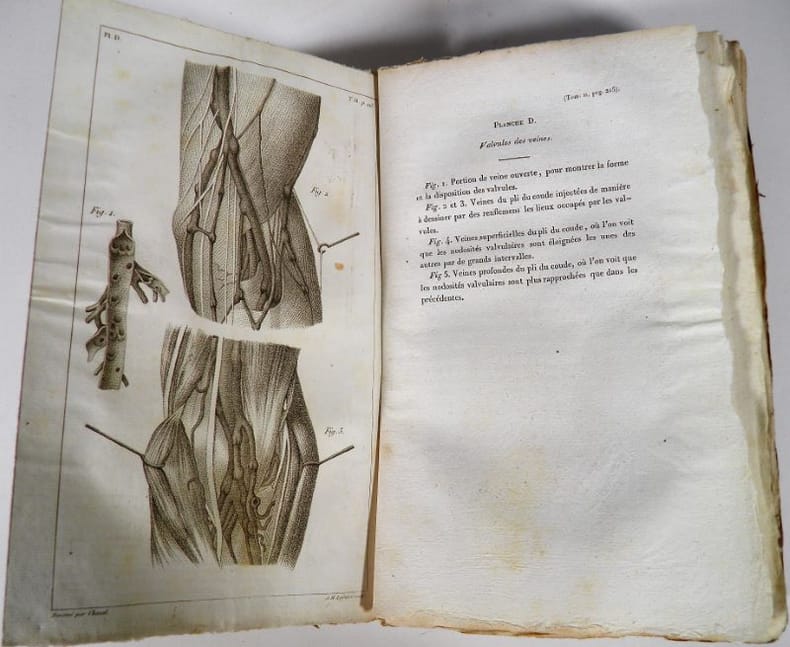
18302238Paris, Montpellier, J.S. Chaudé, libraire-éditeur ; chez Sévalle, 1830. 4 volumes, COMPLET. In-8. 14 x 21,5 cm. Brochés sous couverture parme imprimée en noir. Non rognés. Tome 4 non coupé. xxxij, civ, 342 pp., 3 pl., 1 ff. ; 527 pp., 3 pl ; 556 pp., 2 pl. ; 564 pp. ; 1 pl. T.1 : xxxij (préface de cette nouvelle édition, préface de l’auteur, Précis historique sur Bichat par Matthieu François Régis Buisson), civ (considérations générales), 342 pp., 1 portrait gravé de Bichat, 1 tableau (double feuillet dépliant) de la physiologie, 2 planches gravées.T.2 : 527 pp., 3 planches gravées.T.3 : 556 pp., 2 planches gravées. T.4 : 564 pp., 1 planche gravée. Ouvrage bien complet du portrait de Bichat, d’un tableau dépliant en 2 feuillets et de 8 planches gravées, par ailleurs truffé de deux coupures de journaux (portraits de Desault et de Broussais par Lebédeff). Edition considérablement enrichie de l’œuvre maîtresse du médecin et anatomo-pathologiste Marie François Xavier Bichat (1771-1802), initialement publiée en 1801. Ces quatre volumes bénéficient en effet des commentaires de Blandin, chirurgien, professeur agrégé d’anatomie et de chirurgie, qui s’ajoutent aux notes de Béclard (parues en « supplément » quelques années après la première édition), ainsi que de 8 planches dessinées par Chazal et gravées en taille-douce par Lefèvre et Marchand, l’édition originale n’en comportant pas.
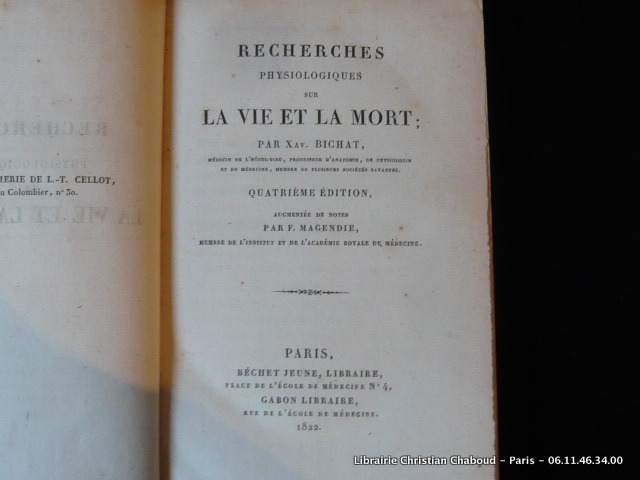
182268262Paris, Béchet, Gabon, 1822, in-8, Plein veau glacé. Reliure de Purgold., 538 pages. Elégant volume dans une fine reliure de Purgold ( le prince des relieurs de son temps ) présentant des frottements aux mors, coins et coupes.
18023228A PARIS. CHEZ MME VEUVE RICHARD, LIBRAIRE ET CHEZ LE C. MEQUIGNON, L’AINE, LIBRAIRE. AN XI - 1802. IN-8 (13,5 X 20,5 X 3 CENTIMETRES ENVIRON) DE XXXII + 302 PAGES, DANS UNE FINE RELIURE D’EPOQUE PLEIN VEAU HAVANE, DOS LISSE ORNE D'UN JOLI DECOR DE FLEURONS DORES, TITRE DORE SUR ETIQUETTE MAROQUIN ROUGE, PLATS ENCADRES D’UNE CHAINETTE DOREE, FILET DORE SUR COUPES, TOUTES TRANCHES DOREES. TRES BEL EXEMPLAIRE.
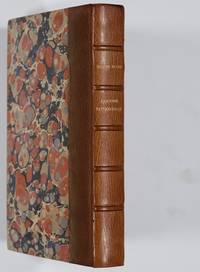
180596797Paris, Brosson, Gabon et Compagnie, 1805, in-8, XX-347 pp, Demi-basane brune, dos lisse orné de filets entrecroisés, pièce de titre rouge, tranches citron, Troisième édition après l'originale de 1800 et la seconde de 1802. Les Recherches physiologiques sur la vie et la mort ont établi la célébrité du biologiste et physiologiste français François-Xavier Bichat (1771-1802), avec son Anatomie générale. L'ouvrage est divisé en deux parties, l'une théorique, contenant un grand nombre d'idées neuves sur les différentes fonctions de la vie organique ; l'autre expérimentale, exposant le passage de la vie à la mort et l'influence qu'exercent les uns sur les autres les principaux organes du corps humain. Bichat a organisé une vision générale de la physiologie humaine totalement nouvelle et révolutionnaire. Il est le fondateur de ce que que Claude Bernard appellera la physiologie anatomique ; au lieu d'étudier les organes par région, il les étudiait par rapport à leur fonction, qu'il démontrait par des expériences sur animaux vivants. Avec la Révolution française, il put également accéder à des cadavres fraîchement guillotinés qui lui permirent d'aller plus loin dans ses recherches et de démontrer, notamment, que l'excitation cardiaque par l'électricité ne se produit que lorsque le coeur est stimulé par un contact direct. Bon exemplaire. Légers frottements. Wellcome II, p. 164 ; Garrison and Morton, 597. Couverture rigide
1829221478Paris: Gabon; - Bechet Jeune Librairies 1829. Fifth Edition . Hardcover. Good. Hardcover; 8vo 528 pages. Fifth edition. Scarce french physiological work. Quarter bound with black pebbled cloth and marbled boards. Gilt lettering on spine. Fairly worn edges and corners. White pages clean save for some light foxing in places. G/-- <br/> <br/> Gabon; - Bechet Jeune, Librairies hardcover
18054259bdParis: Chez Brosson et Gabon Ann. XIII-1805. Octavo full polished calf hardcover leather calf labels blind-stamped decorations to spine xx 347 pp. Bichat the French anatomist and pathologist is best known as the Father of Histology. For his research in this particular work he obtained permission to examine recently guillontined bodies in order to perform his experiments and propose his theories of the relationships of the brain heart and lungs in violent or sudden death. Third edition of Garrison & Morton 5th 597. Very Good bearing the bookplate of David Gibson M.D. Chez Brosson et Gabon, Ann. XIII-1805. hardcover books
18081357334Paris: Chez Brosson Gabon et Cie 1808. Hardcover. Octavo iv 449 pp. Fair; bound in contemporary red paper with leather spine with front board fully separated and back cover hinge compromised some wear to edges and corners; binding else tight; text block age-toned; foxing and age-toning to pages throughout; previous owner bookplate to front pastedown "Henry Barton Jacobs;" MF consignment. 1357334. Special Collections. Chez Brosson, Gabon et Cie hardcover
181288091812 basane racinée, étiquette vieux rose.( Manque de cuir à un des vol.) 4 vol. in-8, CXIIpp. y compris 2 tableaux repliés, 244pp.; (2ff.), pp. 245 à 636 ; XXXVIII-414pp. et (2ff.), pp. 415 à 828pp., P. Brosson Gabon 1812,
1823R160214224J.A. Brosson et Chaudé/Gabon et Cie. 1823. In-8. Relié demi-cuir. Etat d'usage, Coins frottés, Dos abîmé, Quelques rousseurs. 32+464+6+624+6+461+8+472 pages - auteur, titre, tomaison et ornements dorés sur le dos - tranches et plats jaspé - tranches et plats frottés - mouillure à l'intérieur de quelques ouvrages - *dos absent sur les tomes 3+5. . . . Classification Dewey : 611-Anatomie humaine
182756240Boston: Published by Richardson and Lord. J.H.A. Frost Printer 1827. 1 vols. 8vo. Full contemporary sheep worn cover slightly sprung foxed front free-endpaper missing else a very good tight copy. 1 vols. 8vo. One of Bichat's most influential works wherein he examines what happens in violent accidental and sudden death. Published by Richardson and Lord. J.H.A. Frost, Printer unknown books
180949380Philadelphia: Smith & Maxwell 1809. First American from the Second Paris Edition. Hardcover. Very good. 300p octavo Very foxed throughout old stain on the lower right corner on the first 10 pages reboumd in modern blue boards. <br/><br/> Smith & Maxwell hardcover
182756240Boston: Published by Richardson and Lord. J.H.A. Frost Printer 1827. pp. viii 9-334. 1 vols. 8vo. Full contemporary sheep worn cover slightly sprung foxed front free-endpaper missing else a very good tight copy. Signed Baj. L. Swan 1`836. pp. viii 9-334. 1 vols. 8vo. One of Bichat's most influential works wherein he examines what happens in violent accidental and sudden death. See Garrison-Morton 597: "When Volta questioned the validity of experiments claiming to show responsiveness of an ex vivo heart devoid of blood flow and nervous connections Bichat obtained permission to experiment on the freshly killed bodies of those guillotined during the French Revolution. His trials on both laboratory animals and human cadavers led him to conclude that cardiac excitation by electricity would occur only when the organ was simulated by direct contact. Published by Richardson and Lord. J.H.A. Frost, Printer unknown