Bichat, XavierBiblio.com
66 résultats
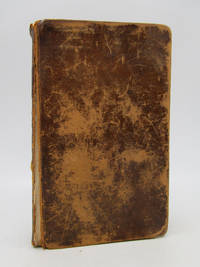
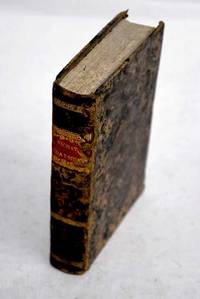
1813h43065Boston: Cummings & Hilliard 1813. First American Printing. Hardcover. Very good. First English language edition. 8vo 9 x 5.25 inches early or original full calf very good light toning to text light wear to front inner hinge previous owner's name and information on flyleaf Dr. William Chambers Broadalbin NY 1798-1874 studied medicine in Boston. xix 21 -259 pp errata. "Bichat conceived the idea of a science of anatomy and pathology based upon an accurate classification of the various organs and parts and their particular susceptibilities to disease. He is regarded as the founder of modern histology and tissue pathology." Garrison & Morton. Cummings & Hilliard hardcover
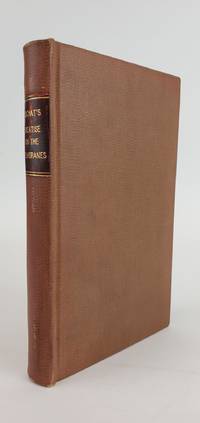
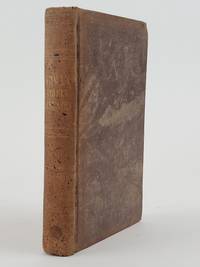
18131355411Boston: Cummings and Hilliard 1813. First Thus. Hardcover. Octavo xix 21-253 154 255-259. Good; text complete despite pagination error; rebound in modern brown cloth boards with very light wear to spine edges and corners; binding tight; previous owner's stamps in ink on several pages as well as fore edge and top and bottom edges; other previous owner's name in ink on title page "Th. Henderson" text block else clean with a few areas of discoloration; extensive foxing and age-toning throughout. MF consignment. 1355411. Special Collections. Cummings and Hilliard hardcover
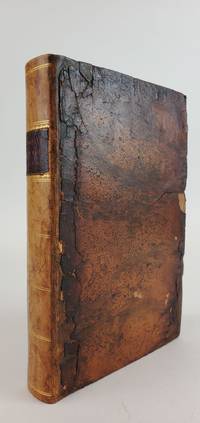
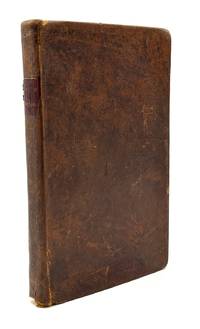
18111355441Philadelphia: Kimber & Conrad 1811. Second Edition. Hardcover. Octavo xiii 15-398 pp. Good; bound in contemporary leather with spine rebound in modern leather with boards showing extensive chipping and wear to front edges and corners; binding tight; text block discolored; foxing and age-toning throughout; ex-library copy with usual markings including a bookplate to front pastedown institutional stamps to several pages and call number written in pencil. MF consignment. 1355441. Special Collections. Kimber & Conrad hardcover
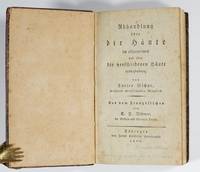
1802270151802. Aus dem Französischen von C.F. Dörner. - Tübingen Jakob Friedrich Heerbrandt 1802 8° XXIV 400 pp. 2 Blätter Druckfehler und 4 Seiten Verlagsanzeigen Pappband der Zeit; feines Expl. Erste deutsche Ausgabe dieses bahnbrechenden medizinischen Werkes "Traité des membranes" herausgegeben im gleichen Jahr wie seine "Antomie générale". "Das unsterbliche Verdienst Bichat's besteht in der Begründung der Gewebelehre auf welcher der Hauptsache nach der Umschwung der Heilkunde unserer Tage beruht. . Bichat stellte sich die Aufgabe die lebendingen Vorgänge als den unmittelbaren Ausdruck ihres Baues nachzuweisen." Hirsch Marie Francois Xavier Bichat 1771-1802 teilte in dieser Schrift von den Membranen die Häute in muköse Schleimhaut des Verdauungs- und des Uro-Genital-Kanals seriöse und fibröse mit ihren Unterarten: sero-muköse und fibro-muköse Häute. Mit Meisterhand schildert er namentlich die 'bis jetzt unbeachtet gebliebenen 'Synovial-Häute und deren normales und pathologisches Verhalten' "Bichat conceived the idea of science of anatomy and pathology based upon an accurate classification of the various tissues of the body their distribution in the various organs and parts and their particular susceptiblities to disease. He is regarded as the founder of modern hsitology and tissue pathology." Garrison & Morton No.537 1st. French Ed. 1800 unknown
18291358768Philadelphia: Carey Lea & Carey 1829. Hardcover. Octavo 2 v-viii 9-326 pp. Poor; bound in contemporary leather with surface scratches to covers and wear to spine edges and corners; front board fully separated binding else tight; text block age-toned; age-toning and extensive foxing to pages throughout; ex-library copy with usual markings including a bookplate to front pastedown institutional stamps to several pages and call number written in pencil; MF consignment. 1358768. Special Collections. Carey, Lea & Carey hardcover
18291405150005Carey Lea & Carey 1829. Hardcover. Good. Full contemporary leather binding. Hardcover. Solid binding and cover. Some rubbing/scuffing to leather. Toning. Marginal dampstain to last few pages. Ships daily. Carey, Lea & Carey hardcover
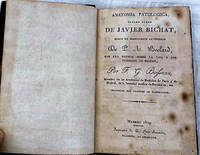
182971249Madrid: León Amarita 1829. León Amarita unknown
190088297Paris : G. Steinheil 1900-1901. 230x138mm. 604Êpages reliure demi-basane. Auteur titre et filets dors au dos. 1490 G. Steinheil unknown
1801018631Paris: Chez Brosson Gabon et Cie 1801. 1ª Edição . Meia Inglesa / Half Leather. Bom / Good / Bon. In-8º 205x135. 1 Vol. de CXII-244 2 desdobráveis. Apenas o primeiro volume dos quatro que compõem a obra completa. <br/> <br/> Chez Brosson, Gabon et Cie hardcover
1801203921801. Paris Brosson Gabon et Cie. 1801 8° CXII 244 pp. pp.245 - 636 XXXVIII 414 pp. pp.415 - 828 4 HLdrBde. d.Zt. 2 farb. Rsch. BEGRÜNDER DER GEWEBELEHRE "In der Histologie und Physiologie Marie Francois Xavier Bichats 1771-1802 zeichnen sich für die Hepatologie einige wichtige neue Gesichtspunkte ab." 1.Das Leberparenchym wird als das morphologisch und funktionell spezifische Lebergewebe erkannt. Nach anderthalb Jahrhunderten iatromechanischer Physiologie die in der Leber eine hydraulische Maschine mit Blut- und Gallenröhren sah wird die vitale Bedeutung der spezifischen Lebersubstanz erneut hervorgehoben. Diese Anschauung führte dann zur Theorie der spezifisch belebten organischen Drüsensubstanz von Johannes Müller. 2.Bichat vermutete daß die Leber außer der Gallensekretion wichtige aber noch völlig unbekannte Funktionen zu erfüllen habe. Diese noch rätselhaften Aufgaben der Leber verküpfte Bichat mit dem Pfortadersystem. Die Leber ist Einzugsgebiet des venösen Blutes das aus den Verdauungsorganen herauskommt. Sie muß in irgendeiner Weise mit den Prozessen der Ernährung und Verdauung gekoppelt sein. 3.Bichat forderte eine strenge experimentelle Klinik und eine vorsichtige Interpretation der vivissektorischen Befunde." Mani II S.213-218 unknown
1801197311801. Paris Brosson Gabon et Cie. 1801 8° CXII 244 pp. pp.245 - 636 XXXVIII 414 pp. pp.415 - 828 4 HLdrBde. d.Zt. 2 farb. Rsch. In der theoretischen Medizin begegnet uns an der Schwelle des 19. Jahrhunderts der geniale Pariser Anatom Yavier Bichat jedem Stomatologen durch den seinen Namen tragenden Fettpfropf in der Wange wohlbekannt. Sein Wirken strahlte weit über sein Spezialfach hinaus; in einem kurzen Leben lenkte er die Heilkunde von der Spekulation die weitgehend das 18. Jahrhundert beherrscht hatte wieder zur Beobachtung. Den Sitz des Lebens und auch der Krankheit sah er im Gewebe 1801 so wie ihn Morgagni vierzig Jahre zuvor in die Organe und nach ihm Virchow 1858 in die Zelle verlegt hat. - Da Bichat das Mikroskop vernachlässigte blieb ihm das Wurzelelement unbekannt und das Dentin ist für ihn eine knöchernde Substanz mit Fasern die im allgemeinen die Richtung der Wurzeln haben. Vom Zahnwechsel hat er die klare Vorstellung daß die Scheidewand und die Wurzel des Milchzahnes durch die Einsaugung der phosphorsauern Kalkerde schwinden. Diese Nährsubstanz substance nutritive eignen sich dann die zweiten Zähne an. Hoffmann-Axthelm S-438. Heirs of Hippocrates No.756; Garrison-Morton 403; Cushing B 371; Osler 1301; Waller 1027; Wellcome II p.164. unknown
1801208531801. Paris Brosson Gabon et Cie. 1801 8° CXII 244 pp. pp.245 - 636 XXXVIII 414 pp. pp.415 - 828 4 HLdrBde. d.Zt. 2 farb. Rsch. ERSTE AUSGABE dieses Klassikers der Medizin in einem außergewöhnlich gutem Exemplar. unknown
1801183291801. Paris Brosson Gabon et Cie. 1801 8° CXII 244 pp. pp.245 - 636 XXXVIII 414 pp. pp.415 - 828 4 HLdrBde. d.Zt. 2 farb. Rsch. One of Medicine's most important books G/M. Marie Francois Xavier Bichat 1771-1802 "has introduced a new system into the science of anatomy and it is in this fact that his chief greatness lies." "In his writings Bichat shows himself about all a medical man; the functions of the body are invariably described in close relation to its morbid changes and to the manner in which the should be treated. Pathological anatomy engages his interest quite as much as normal anatomy and postmortem examinations formed a considerable part of his practical work. He studied the various parts of the body in both its healthy and its diseased state employing a number of different methods for the purpose; besides dissection he mentions drying cooking and maceration as well as treatment with acids alkalis and alcohol. On the other hand he did not use a microscope for he thought that this only gives to fallacies and delusions. And yet it is as the founder of a science of microscopy that he won his highest fame." "Bichat's conception of life has always been regarded as vitalistic. Indeed his theoretical fundamental view is unquestionably reminiscent of Stahl; life says he is »the sum of the functions that resist death«. It is a far cry however between Bichat's so called vitalism and Stahl's; the latter's theory of the soul as the ultimate end and conservator of the body Bichat strongly denies. Stahl he declares had realized the incompatibility between physical laws and animal functions but because the soul was everything to him in explaining the functions of life he failed to discover the laws of life. With equal emphasis however Bichat rejects Boerhaave's theory that life should be regarded as a purely mechanical process. »The true essence of life is unknown it can only be studied through the phenomena it manifests«." "The primary lesson he learnt from Stahl however is the importance that different structural conditions have for the functions of the organism; in fact the theory of structure represents Bichat's greatest contribution to the development of biology; it forms one of the corner-stones on which our conception of life and its manifestions rests." According to Bichat's classification the body is built up of tissues which may be grouped in systems - for example the bone system the cartilage system the muscle system. An organ is composed of several systems e.g. the stomach the lungs the brain; several organs form an apparatus e.g. the respiratory apparatus the digestive apparatus. The knowledge of the tissue systems forms what Bichat calls "general anatomy." "The tissues Bichat declares are the true conservators of the life of the body. He distinguishes between twentyone different kinds if tissues - namely 1 celluar closley corresponding to what is now called retiform connective tissue; 2 the nervous tissue of animal life; 3 the nervous tissue of organic life; 4 arterial; 5 venous; 6 the tissue of exhalation; 7 absorbent; 8 bone-tissue; 9 medullary tissue in the bones; 10cartilaginous; 11 fibrous; 12 fibrocartilaginous; 13 animal musculature; 14 organic musculature; 15 mucuous tissue; 16 serous; 17 synovial; 18 glandular; 19 dermoid; 29 epidermoid dermis and epidermis 21 capillary tissue. These tissues however are by no means alike everywhere; rather they invariably posess the power to adapt themselves to the organs in which they are incorporated. The tissues are the true conservators of life; not each invidual organ as Bordeau asserted but each individual tissue has invidual life. Therefore diseases in so far they attack individual organs are localized in their tissues; in abdominal catarrh it is the mucuous membrane that is affected and not the muscles in the abdominal wall; in inflammation of the brain it is in most cases the cerebral membrane that is the seat of the disease. »If we would study a bodily function we must consider the organs which perform that function from a general point of view but if we would become acquainted with the vital qualities of the organ we must disintegrate it« - that is into the tissues of which it is formed." "According to Bichat sensibility is the characteristic quality of the nervous system; the muscular system displays a quality that he calls contractility; this has different characteristics in different organs and should not be confused with the tensibility that the tissues possess independently of life." ."Bichat made serious attempts to ascertain the nature of these vital phenomena by experimenting with living organs under various conditions. Thus he tried to analyse especially muscular contractility and distinguishes several categories thereof." "Of sensibility he distinguishes two categories - namely »organic« which consists in the power of receiving an impression and »animal« which not only receives the impression but conveys it further to a common centre and is that a higher category of the previous one." "The contrasted ideas organic and animal frequently referred to above play an important part in Bichat's explanation of life. »Organic« are vegetable life and the unconscious life of animals; »animal« are the functions in animals that are controlled by the will of the invidual and are consequently the more developed the higher the life is. Even in modern times one sometimes differentiates between animal organs among which are included especially the nervous system and the motive organs and the vegetative among which are included the digestive circulatory respiratory and excretal organs." "At all events if only for the new system that he introduced into anatomical science Bichat must be counted as one of the greatest pioneers of that science that have ever lived." "Bichat's greatness then lies in his having so convincingly proved the quality of the tissues as fundamental constitutents of the body and its functions. He thereby placed the study of the phenomena of life on a definite basis." Even the terms »s e n s i b i l i t y« and the term »c o n t r a c t i l i t y« which were invented by him have been incorporated in modern terminology." Nordenskiöld Hist. of Biology p.344-351. Heirs of Hippocrates No.756; Garrison-Morton 403; Cushing B 371; Osler 1301; Waller 1027; Wellcome II p.164. unknown
1801mon0003512292Chez Brosson Gabon et Cie 1801. Hardcover. Good. . Vol. I and II ONLY. General shelf/age wear. Minor foxing here and there throughout overall clean. Bindings tight. A really nice set overall especially for its age. Chez Brosson, Gabon et Cie hardcover
1825631171825. A Pairs Chez J.-B. Baillière Libraire 1825 8 XIV 335 pp. Frontispice Portrait von Bichat gealt Faksimile Tafel des Manuscripts Halbledereinband mit eigebundener orig. Broschur; teilweise fleckig. Erste Ausgabe! Posthum erschienenes Werk von Marie-Francois Xavier Bichats letzten Anatomie Kurs. Die von dem französischen Anatomie-Professor Pierre-Augustin Béclard 1785-1825 verfaßte Vorlesungsmitschrift fand sich im Nachlaß und wurde von seiner Hand als Bichats letzter Kurs bezeichnet. Der französischen Medizin-Verleger Baillière erwarb mit großem finanziellen Aufwand das Manuskript und gab es heraus als 'als Dokument des letzten geistigen Kraftaufwandes eines berühmten Mannes vor seinem Tode zugleich eine interessante Zugabe zu seinen früheren Werken abgeben dürfte." "Der nur 31 Jahre alt gewordene Francois Xavier Bichat wird zum Begründer der Gewebelehre und der Histopathologie freilich ohne sich noch in seinem kurzen Leben des Mikroskops bedienen zu können. . Im Winter 1801/1892seinem letzten Lebensjahr soll er allein mehr als 600 Autopsien durchgeführt haben. Dabei leidet er bereits an einer Tuberkulose . wahrscheinlich an einer tuberkulösen Meningitis. . Bichat erweitert die anatomische Beobachtung von den Organen auf die Gewebe und unterscheidet dabei 21 Typen. Diese Gewebe setzen in unterschiedlicher Weise den Organismus zusammen. Sie können einzeln für sich krankhafte Veränderungen unterliegen. Nach Bichat gibt es daher nicht einfach eine Herzentzündung sondern es ist zwischen Peri- Myo- und Endokarditis zu unterscheiden. Wie viel später Virchow betrachtet er die Gewebe auch als den Ausgangspunkt der Geschwülste. Beim Magenkrebs sieht Bichat die "Schleimmebran" also die Schleimhaut als primäre Lokalisation an die serösen Haut wird erst gegen Ende der Krankheit angegriffen. Für das Bindegewebe prägt Bichat den Begriff Zellgewebe tissu céllulaire". Es füllt die Zwischenräume zwischen den Organen aus und ist der Ort der entzündlichen Prozesse. Ganz zweifellos wäre Bichat grundlegender Entdeckungen zur Zellularpathologie geglückt wäre ihm ein längeres Leben und der Gebrauch des Mikroskops vergönnt gewesen sein. "Bichat hat den anatomischen Gedanken in der Pathologie einen Schritt weiter in die Tiefe getragen vom Organ zum Gewebe." Sigerist Er wird damit zum Begründer der Histologie und Histopathologie auch wenn der Begriff "Histologie" erst 1819 von dem Bonner Anatomen Carl Mayer geprägt werden wird. ." Dhom pp.8-10 First Edition! The great French anatomist's Xavier Bichat's 1771-1802 last lecture on pathological anatomy based on student notes of Pierre August Beclard who also wrote the supplement to Bichat's Anatomie generale one of medicine 's most important books. These lectures published first in French 1825 are "particularly valuable as a record of Bichat's organization of the subject". Long p.80 unknown
184741262London: Fisher Son & Co 1847. Margin: 277x213 mm. Very faint foxing around the edges. Facsimile signature. Fisher, Son & Co unknown
182218963Boston: Richardson and Lord 1822. FIRST EDITION IN ENGLISH. Contemporary mottled calf rebacked and recased. A fine set. First English edition of this text that “revolutionized descriptive anatomy and that … marks the beginning of modern histology†G-M. Relying on verbal descriptions rather than illustrations Bichat addresses individual tissues within the organs while his contemporaries typically wrote on whole organs alone. He worked mostly without microscope technology but was able to isolate 21 different types of tissues.<br /> <br /> Bichat 1771-1802 was French pathologist and anatomist. He is remembered for bridging the gap between organ pathology and cell pathology.<br /> <br /> Garrison-Morton 403. Richardson and Lord unknown
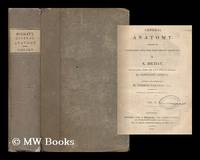
1824e2982London: S Highley. Worn condition. Boards worn and detached. Spines missing. Some foxing. Content in overall good condition. Ex Royal College of Surgeons Ireland Library. 1824. Revised Edition. Brown hardback half-leather cover. 220mm x 140mm 9" x 6". ci 742pp; xxxii 960pp. Heavy item - shipping supplement may apply for overseas. . S Highley hardcover
18247541Printed For The Translator By Shackell & Arrowsmith London 1824. First English Edition. Hardback. Edge worn and dulled grey boards professionally rebacked with paper labels to the spines. Bookplate of the Charing Cross Hospital Medical School to the front paste down.; 0 pages; Description: 2 v. ; 22 cm. Translation of: Anatomie generale. Revised and Corrected from the last French edition by George Calvert. Pages uncut; an unread copy and particularly well preserved internally. Complete sets are uncommon. All books fully on approval. Subjects: Human anatomy. Physiology. Printed For The Translator By Shackell & Arrowsmith, London hardcover
1822063874Boston: Richardson and Lord 1822. First Edition. Hardcover. Very Good -/No Jacket as Issued. Full brown leather binding with a burgundy slip and gilt lettering on the spine. 454pp. Front cover almost detached. Covers and spine rubbed. Front free endpaper is almost detached. Crease to middle of spine as well as chipping to top and bottom. Previous owners' names written and stamped on first few pages up to the title page. Some text blocks near the middle loosening and starting to detach still holding. Text contains marks underlining doodles and notes scattered throughout in pencil. VG- considering that it was published almost 200 years ago. Full refund if not satisfied. "Marie Francois Xavier Bichat 14 November 1771 – 22 July 1802 was a French anatomist and pathologist known as the father of modern histology. Although he worked without a microscope Bichat distinguished 21 types of elementary tissues from which the organs of the human body are composed. He was also 'the first to propose that tissue is a central element in human anatomy and he considered organs as collections of often disparate tissues rather than as entities in themselves.' Although Bichat was 'hardly known outside the French medical world' at the time of his early death forty years later 'his system of histology and pathological anatomy had taken both the French and English medical worlds by storm.' The Bichatian tissue theory was 'largely instrumental in the rise to prominence of hospital doctors" as opposed to empiric therapy as 'diseases were now defined in terms of specific lesions in various tissues and this lent itself to a classification and a list of diagnoses.'" Wikipedia Richardson and Lord hardcover
18073632727Madrid.: s.n. 1807. Hardcover. Cubierta deslucida. Good. 15 cm. 1 v. Encuadernación en tapa dura artesanal en plena piel con tejuelo. Traducidas al castellano de la segunda edicion francesa por Tomás García Suelto. Imprenta de la Administracion del Real Arbitrio. Fisiología. Imprenta de la Administración del Real Arbitrio de Beneficencia Madrid. imp . Cubierta deslucida. [s.n.]. hardcover
1807mon0003566128Madrid: Tomas Garcia Suelto 1807. Hardcover. Acceptable. . full leather cover shows moderate wear soiling rubbing. some minor soiling on the edges and endpapers. pages are mostly clean. Madrid: Tomas Garcia Suelto hardcover
1813006229Paris: Mequignon L'aine Pere Libraire De La Faculte De Medecine Rue De l'Ecole De Medecine. Garrison-Morton 5580. Vols. I & II. Green and red leather labels on spine. Spines dry but not flaking. Vol. I tiny tear in one of the labels; frontis. and two folding plates xvi 444 pp.; xii 592 pp. Exceptionally clean bright copy. Bookplate endpprs.Troisieme Edition Revue Corrigee et Augmentee. Vol. II 8 plates primarily folding very scattered brown spotting 4 pages tiny piece removed at base. Extra shipping costs may be required. . Good Plus. Hardcover. 1813. Mequignon L'aine, Pere, Libraire De La Faculte De Medecine, Rue De l'Ecole De Medecine hardcover
18011358728Paris: Chez Mequignon 1801. New Edition. Hardcover. Octavo v-xii 592 pp with plates. Good; bound in contemporary leather with gilt title to spine with surface marks and scratches to covers slight crack to front hinge and wear to spine edges and corners; binding tight; text block age-toned with some liquid staining; some foxing to pages throughout; 8 folding plates present and intact; MF consignment. 1358728. Special Collections. Chez Mequignon hardcover