Bichat, XavierBiblio.com
357 résultats
0483418358.Gpaperback. Good. Access codes and supplements are not guaranteed with used items. May be an ex-library book. paperback
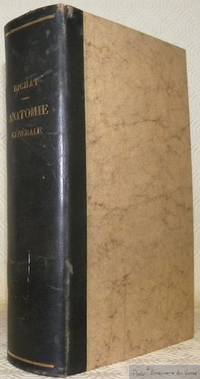
190088297Paris : G. Steinheil 1900-1901. 230x138mm. 604Êpages reliure demi-basane. Auteur titre et filets dors au dos. 1490 G. Steinheil unknown
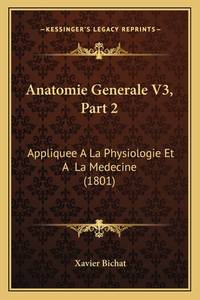
1801018631Paris: Chez Brosson Gabon et Cie 1801. 1ª Edição . Meia Inglesa / Half Leather. Bom / Good / Bon. In-8º 205x135. 1 Vol. de CXII-244 2 desdobráveis. Apenas o primeiro volume dos quatro que compõem a obra completa. <br/> <br/> Chez Brosson, Gabon et Cie hardcover
1801203921801. Paris Brosson Gabon et Cie. 1801 8° CXII 244 pp. pp.245 - 636 XXXVIII 414 pp. pp.415 - 828 4 HLdrBde. d.Zt. 2 farb. Rsch. BEGRÜNDER DER GEWEBELEHRE "In der Histologie und Physiologie Marie Francois Xavier Bichats 1771-1802 zeichnen sich für die Hepatologie einige wichtige neue Gesichtspunkte ab." 1.Das Leberparenchym wird als das morphologisch und funktionell spezifische Lebergewebe erkannt. Nach anderthalb Jahrhunderten iatromechanischer Physiologie die in der Leber eine hydraulische Maschine mit Blut- und Gallenröhren sah wird die vitale Bedeutung der spezifischen Lebersubstanz erneut hervorgehoben. Diese Anschauung führte dann zur Theorie der spezifisch belebten organischen Drüsensubstanz von Johannes Müller. 2.Bichat vermutete daß die Leber außer der Gallensekretion wichtige aber noch völlig unbekannte Funktionen zu erfüllen habe. Diese noch rätselhaften Aufgaben der Leber verküpfte Bichat mit dem Pfortadersystem. Die Leber ist Einzugsgebiet des venösen Blutes das aus den Verdauungsorganen herauskommt. Sie muß in irgendeiner Weise mit den Prozessen der Ernährung und Verdauung gekoppelt sein. 3.Bichat forderte eine strenge experimentelle Klinik und eine vorsichtige Interpretation der vivissektorischen Befunde." Mani II S.213-218 unknown
1801197311801. Paris Brosson Gabon et Cie. 1801 8° CXII 244 pp. pp.245 - 636 XXXVIII 414 pp. pp.415 - 828 4 HLdrBde. d.Zt. 2 farb. Rsch. In der theoretischen Medizin begegnet uns an der Schwelle des 19. Jahrhunderts der geniale Pariser Anatom Yavier Bichat jedem Stomatologen durch den seinen Namen tragenden Fettpfropf in der Wange wohlbekannt. Sein Wirken strahlte weit über sein Spezialfach hinaus; in einem kurzen Leben lenkte er die Heilkunde von der Spekulation die weitgehend das 18. Jahrhundert beherrscht hatte wieder zur Beobachtung. Den Sitz des Lebens und auch der Krankheit sah er im Gewebe 1801 so wie ihn Morgagni vierzig Jahre zuvor in die Organe und nach ihm Virchow 1858 in die Zelle verlegt hat. - Da Bichat das Mikroskop vernachlässigte blieb ihm das Wurzelelement unbekannt und das Dentin ist für ihn eine knöchernde Substanz mit Fasern die im allgemeinen die Richtung der Wurzeln haben. Vom Zahnwechsel hat er die klare Vorstellung daß die Scheidewand und die Wurzel des Milchzahnes durch die Einsaugung der phosphorsauern Kalkerde schwinden. Diese Nährsubstanz substance nutritive eignen sich dann die zweiten Zähne an. Hoffmann-Axthelm S-438. Heirs of Hippocrates No.756; Garrison-Morton 403; Cushing B 371; Osler 1301; Waller 1027; Wellcome II p.164. unknown
1801208531801. Paris Brosson Gabon et Cie. 1801 8° CXII 244 pp. pp.245 - 636 XXXVIII 414 pp. pp.415 - 828 4 HLdrBde. d.Zt. 2 farb. Rsch. ERSTE AUSGABE dieses Klassikers der Medizin in einem außergewöhnlich gutem Exemplar. unknown
1801183291801. Paris Brosson Gabon et Cie. 1801 8° CXII 244 pp. pp.245 - 636 XXXVIII 414 pp. pp.415 - 828 4 HLdrBde. d.Zt. 2 farb. Rsch. One of Medicine's most important books G/M. Marie Francois Xavier Bichat 1771-1802 "has introduced a new system into the science of anatomy and it is in this fact that his chief greatness lies." "In his writings Bichat shows himself about all a medical man; the functions of the body are invariably described in close relation to its morbid changes and to the manner in which the should be treated. Pathological anatomy engages his interest quite as much as normal anatomy and postmortem examinations formed a considerable part of his practical work. He studied the various parts of the body in both its healthy and its diseased state employing a number of different methods for the purpose; besides dissection he mentions drying cooking and maceration as well as treatment with acids alkalis and alcohol. On the other hand he did not use a microscope for he thought that this only gives to fallacies and delusions. And yet it is as the founder of a science of microscopy that he won his highest fame." "Bichat's conception of life has always been regarded as vitalistic. Indeed his theoretical fundamental view is unquestionably reminiscent of Stahl; life says he is »the sum of the functions that resist death«. It is a far cry however between Bichat's so called vitalism and Stahl's; the latter's theory of the soul as the ultimate end and conservator of the body Bichat strongly denies. Stahl he declares had realized the incompatibility between physical laws and animal functions but because the soul was everything to him in explaining the functions of life he failed to discover the laws of life. With equal emphasis however Bichat rejects Boerhaave's theory that life should be regarded as a purely mechanical process. »The true essence of life is unknown it can only be studied through the phenomena it manifests«." "The primary lesson he learnt from Stahl however is the importance that different structural conditions have for the functions of the organism; in fact the theory of structure represents Bichat's greatest contribution to the development of biology; it forms one of the corner-stones on which our conception of life and its manifestions rests." According to Bichat's classification the body is built up of tissues which may be grouped in systems - for example the bone system the cartilage system the muscle system. An organ is composed of several systems e.g. the stomach the lungs the brain; several organs form an apparatus e.g. the respiratory apparatus the digestive apparatus. The knowledge of the tissue systems forms what Bichat calls "general anatomy." "The tissues Bichat declares are the true conservators of the life of the body. He distinguishes between twentyone different kinds if tissues - namely 1 celluar closley corresponding to what is now called retiform connective tissue; 2 the nervous tissue of animal life; 3 the nervous tissue of organic life; 4 arterial; 5 venous; 6 the tissue of exhalation; 7 absorbent; 8 bone-tissue; 9 medullary tissue in the bones; 10cartilaginous; 11 fibrous; 12 fibrocartilaginous; 13 animal musculature; 14 organic musculature; 15 mucuous tissue; 16 serous; 17 synovial; 18 glandular; 19 dermoid; 29 epidermoid dermis and epidermis 21 capillary tissue. These tissues however are by no means alike everywhere; rather they invariably posess the power to adapt themselves to the organs in which they are incorporated. The tissues are the true conservators of life; not each invidual organ as Bordeau asserted but each individual tissue has invidual life. Therefore diseases in so far they attack individual organs are localized in their tissues; in abdominal catarrh it is the mucuous membrane that is affected and not the muscles in the abdominal wall; in inflammation of the brain it is in most cases the cerebral membrane that is the seat of the disease. »If we would study a bodily function we must consider the organs which perform that function from a general point of view but if we would become acquainted with the vital qualities of the organ we must disintegrate it« - that is into the tissues of which it is formed." "According to Bichat sensibility is the characteristic quality of the nervous system; the muscular system displays a quality that he calls contractility; this has different characteristics in different organs and should not be confused with the tensibility that the tissues possess independently of life." ."Bichat made serious attempts to ascertain the nature of these vital phenomena by experimenting with living organs under various conditions. Thus he tried to analyse especially muscular contractility and distinguishes several categories thereof." "Of sensibility he distinguishes two categories - namely »organic« which consists in the power of receiving an impression and »animal« which not only receives the impression but conveys it further to a common centre and is that a higher category of the previous one." "The contrasted ideas organic and animal frequently referred to above play an important part in Bichat's explanation of life. »Organic« are vegetable life and the unconscious life of animals; »animal« are the functions in animals that are controlled by the will of the invidual and are consequently the more developed the higher the life is. Even in modern times one sometimes differentiates between animal organs among which are included especially the nervous system and the motive organs and the vegetative among which are included the digestive circulatory respiratory and excretal organs." "At all events if only for the new system that he introduced into anatomical science Bichat must be counted as one of the greatest pioneers of that science that have ever lived." "Bichat's greatness then lies in his having so convincingly proved the quality of the tissues as fundamental constitutents of the body and its functions. He thereby placed the study of the phenomena of life on a definite basis." Even the terms »s e n s i b i l i t y« and the term »c o n t r a c t i l i t y« which were invented by him have been incorporated in modern terminology." Nordenskiöld Hist. of Biology p.344-351. Heirs of Hippocrates No.756; Garrison-Morton 403; Cushing B 371; Osler 1301; Waller 1027; Wellcome II p.164. unknown
116078566X.Gpaperback. Good. Access codes and supplements are not guaranteed with used items. May be an ex-library book. paperback
1160785678.Gpaperback. Good. Access codes and supplements are not guaranteed with used items. May be an ex-library book. paperback
1168122198.Gpaperback. Good. Access codes and supplements are not guaranteed with used items. May be an ex-library book. paperback
1168133742.Gpaperback. Good. Access codes and supplements are not guaranteed with used items. May be an ex-library book. paperback
0428616577.Ghardcover. Good. Access codes and supplements are not guaranteed with used items. May be an ex-library book. hardcover
1801mon0003512292Chez Brosson Gabon et Cie 1801. Hardcover. Good. . Vol. I and II ONLY. General shelf/age wear. Minor foxing here and there throughout overall clean. Bindings tight. A really nice set overall especially for its age. Chez Brosson, Gabon et Cie hardcover
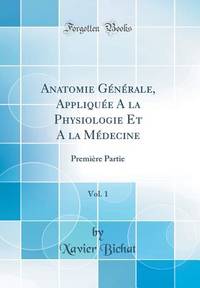
A9781168133748New. unknown
0484411128.Ghardcover. Good. Access codes and supplements are not guaranteed with used items. May be an ex-library book. hardcover
0259236691.Gpaperback. Good. Access codes and supplements are not guaranteed with used items. May be an ex-library book. paperback
0259788589.Gpaperback. Good. Access codes and supplements are not guaranteed with used items. May be an ex-library book. paperback
0259449954.Gpaperback. Good. Access codes and supplements are not guaranteed with used items. May be an ex-library book. paperback
026687116X.Gpaperback. Good. Access codes and supplements are not guaranteed with used items. May be an ex-library book. paperback
028236305X.Gpaperback. Good. Access codes and supplements are not guaranteed with used items. May be an ex-library book. paperback
0282327819.Gpaperback. Good. Access codes and supplements are not guaranteed with used items. May be an ex-library book. paperback
0282034390.Gpaperback. Good. Access codes and supplements are not guaranteed with used items. May be an ex-library book. paperback
0364101474.Ghardcover. Good. Access codes and supplements are not guaranteed with used items. May be an ex-library book. hardcover
0483216453.Ghardcover. Good. Access codes and supplements are not guaranteed with used items. May be an ex-library book. hardcover
0666206503.Ghardcover. Good. Access codes and supplements are not guaranteed with used items. May be an ex-library book. hardcover