FOLLIN E., DUPLAY SIMONMareMagnum

4 520 résultats
G. Masson. 1874-1888. In-8 Carré. Relié demi-cuir. Etat d'usage. Couv. légèrement passée. Dos à nerfs. Quelques rousseurs. 7 tomes d'env. 800-1000 pages chacun. Illustrés de très nombreuses gravures en noir et blanc dans le texte. Auteur, titre et tomaison dorés sur les dos. Tranches de tête dorées. Dos et bords des plats frottés. Tome I: Inflammations, Tumeurs, Plaies, Maladies virulentes (Syphilis). Tome II: Maladies des tissus. Tome III: Maladie des tissus, Maladies des régions. Tome IV: Maladies des régions. Tome V: Maladies du cou, de la poitrine et de l'abdomen. Tome VI: Maladies de l'abdomen, Maladies du bassin, Maladies de l'anus et du rectum, Maladies des organes urinaires. Tome VII: Maladies des organes urinaires (suite), Maladies des organes génitaux, Maladies des membres.
1888RO40158838G. Masson. 1874-1888. In-8. Relié demi-cuir. Etat d'usage, Couv. légèrement passée, Dos à nerfs, Quelques rousseurs. 7 tomes d'env. 800-1000 pages chacun. Illustrés de très nombreuses gravures en noir et blanc dans le texte. Auteur, titre et tomaison dorés sur les dos. Tranches de tête dorées. Dos et bords des plats frottés.. . . . Classification Dewey : 616.9-Autres maladies
1842R260154895LIBRAIRIE DE CROCHARD ET Cie / LIBRAIRIE DE FORTIN, MASSON ET Cie. 1837-1842. In-8. Broché. Etat d'usage, Coins frottés, Dos satisfaisant, Quelques rousseurs. 439 + 471 + 519 pages. Dos de cuir marron, titres et filets dorés, papier marron et beige sur les plats. 3 planches dépliantes en noir et blanc dans le tome 1 et 5 pl. dans le tome 2. Epidermures. Coiffes frottées. Tampons de bibliothèque.. . . . Classification Dewey : 616.6-Maladies génito-urinaires
1881R240094655CAMILLE COULET / ADRIEN DELAHYE ET E.LECROSNIER. 1881. In-8. Reliure bradel. Bon état, Couv. convenable, Dos satisfaisant, Quelques rousseurs. VIII + 1096 pages - avec 35 figures dans le texte, et 10 planches dont 6 en chromolithographie et photoglyptie - plats et contre plats jaspés - titre + auteur + filets dorés sur le dos - quelques orusseurs sans conséquence sur la lecture - 7 photos disponibles.. . . . Classification Dewey : 616.8-Maladies du système nerveux
Masson et Cie. 1914. In-4 Carré. Relié. Bon état. Couv. convenable. Dos satisfaisant. Quelques rousseurs. 195 pages pour le tome I et 194 pages pour le tome II. Illustrés de très nombreuses gravures en noir et blanc dans le texte et de dessins en couleur sur planches hors texte. Avec 56 planches hors texte en noir et en couleurs.
1914RO40104648Masson et Cie. 1914. In-4. Relié. Bon état, Couv. convenable, Dos satisfaisant, Quelques rousseurs. 195 pages pour le tome I et 194 pages pour le tome II. Illustrés de très nombreuses gravures en noir et blanc dans le texte et de dessins en couleur sur planches hors texte.. . . . Classification Dewey : 616.6-Maladies génito-urinaires
1909RO20005302Masson. 1901 à 1909. In-4. Relié demi-cuir. Bon état, Couv. convenable, Dos à nerfs, Intérieur frais. 14 Volumes reliés. De nombreuses illustrations dans et hors textes parfois couleurs.Titre et filet doré.. . . . Classification Dewey : 616.6-Maladies génito-urinaires
1938RO80063923MASSON & Cie. 1938. In-4. Cartonnage d'éditeurs. Très bon état, Couv. convenable, Dos satisfaisant, Intérieur frais. 192 pages. Nombreuses planches illustrées en noir et blanc.. . . . Classification Dewey : 616.7-Maladies de l'appareil locomoteur
2017002004South Africa: Ampath Trust 2017 An excellent clean and tightly bound book. 445 pages including index. Size: 7" X 9" Ampath Trust paperback
1727EXE-680Wien, Hehinger, 1727. In-4°, reliure de plein parchemin de l'époque.
50943Paris.17676.In-4 reliure d'époque.420 p.Reliure usagée.Etat moyen
7138traduits nouvellement en françois suivant la vérité du texte grec, avec un mélange de paragraphes d’éclaircissement es lieux plus obscurs et la clef de cette doctrine par le moyen de la circulation du sang & d’autres nouvelles découvertes de ce siècle en anatomie et chymie. Ouvre nécessaire aux médecins, chirurgiens & apoticaires,& utile à plusieurs autres sortes de personnes,curieuses et sçavantes comme l’avis au lecteur le montre amplement.In 12 plein cuir fauve raciné à nerfs, titre et caissons dorés, tire, XXXIV, 316 pages, tranches jaspées.A Lyon chez Pierre Compagnon & Robert Taillandier 1684.Une pâle mouillure en partie inférieure,sans gravité,pratiquement à tout le volume.Complet du sommaire des sentimens de L. Meyssonnier, extraits des œuvres sur les comètes de 1664 à 1665 dont les effets dureront dix neuf ans,& le moyen de remédier aux maladies qui en peuvent provenir.
185814840New York State Medical Society. G. 1858. Hardcover. Blue cloth boards with gilt writing. Binding is very good marks on a few places only. Pages start with page 231 and continue to page 306. An essay on compound human monsters comprising of the history literature classification description embryology of double and triple formation including the so-called Parasitic Monsters Foetus in Foetu and Supernumerary Formation of Parts of Organs in Man. Illustrated with drawings starting with Figure 1 numbering to 120. Includes figures of humans and animals History of the Science of Teratology Diploteratology. Pictures of cojoined twins . New York State Medical Society hardcover
16623Medicine Manuscript medical notebook on diseases vaccination and treatment. Pennsylvania. The first dated entry is "Sept. 23 1918". Quarto. Cloth boards 304 lined pages with 202 filled with medical handwritten notes."A. Schumacher" ownership signature on inside cover. This large notebook includes 202 pages of handwritten entries from a medical student largely on the treatment and prognosis of virulent infectious agents that are both very contagious and very virulent. World War I was a key transition point in scientific medicine and the treatment of disease. Medical officers incorporated Louis Pasteur's discoveries into their understanding of microorganisms as the cause of infectious diseases which were therefore susceptible to rational control and treatment measures even in the pre-antibiotic era. In 1918 Smallpox wasstill one of the deadliest diseases-- about 30% of cases ended in death-- and the smallpox entry in particular is extremely detailed; going over "Etiology."The infection is usually transmitted by direct contact or it may be transmitted by a 3rd person . unless protected by vaccination every one is susceptible to the contagion the colored race is especially pre-disposed . A protozone is supposed to be the cause of the disease . the Cytorrliyetes Variollae Protozone." "Symptoms" "Pathology" "Varieties" "Prognosis" "Complications" "Diagnosis" and more of smallpox in all its known forms in 1918 including notes on vaccination and quarantine protocols : "Discreet" "Confluent" "Purpuric" and "Vauloid". During the 20th century it is estimated that smallpox was responsible for 300-500 million deaths "in confluent cases its very grave . in purpuric rash the prognosis is hopeless" <br/><br/>While the entire manuscript is notable for its clarity and detail. First the manuscript goes over "Discreet" smallpox "An acute contagious disease characterized by sudden onset. An eruption passing successively through the stages of macule papule vesicle pustule and crust. The high fever exhibiting a distinct remission on 3rd of 4th day . The development of the rash from one form of lesion to another is due to a peculiar degeneration of the epithelial cell. The lesion is known as a Pox . These are found all over the body- frequently in the mouth asophiagus Larynx and nose . onset manifested by a chill vomiting high fever headache and intense lumbar pains . the temperature rises suddenly to 103-104 degree for 3 days or until the eruption appears then it falls several degrees. Remission is accompanied by a marked or marshall improvement in the symptoms until the rash becomes pustule then the fever returns. This second remission is marked by fluctuations ever few hours until the beginning of desquamation . the true rash appears on the 3r and 4th day first in the forehead and wristsm spreads rapidly over he entire body and begins in small red macules which are quickly transfmormed into small hard papules. At the end of 2 days these papules become clean vesicles centrally depressed . in the course of 2 or 3 weeks the crusts or scales separate forming permanent pits or "pock" marks" then smallpox's "confluent form" "The papules are abundant . the second fever is high of long duration lesions develop in the air passages . fetted discharge from nose throat produce hoarseness cough delirium stupor often result. If the patient does recover it is often after a tedious convalescence. There is great facial disfigurement usually defected hearing" its "Perpuric forms" "In sorry cases the disease is ushered in with high fever . bleeding from mucus membranes . death ensues before a true rash appears. In such cases the disease proceeds like the ordinary form up to the pustular stage then the pustules become perfused with blood . this form is also usually fatal." and finally its "Vauloid form" . The student then goes over a complete prognosis "depends on the virulence of the epidemic . in all the vaccinated the mortality ranges between 20 & 60%." and treatment "Complete isolation preferably a special hospital . disinfection of everything that came in contact with the Patient Vaccination of everyone that was around the patient . use hot water bags or ice bags . if no relief give Opium Chlorals or Bromides.". As well as the smallpox account the medical notebook includes sections on other virulent diseases such as Scarlet Fever "Recovery is the rule in uncomplicated cases. Complications may make the prognosis grave . Patient should be quarantined for at least 4 weeks from onset of disease. The sick room should be well ventilated and moderately darkened. Child should be in bed at least 2 weeks."; German Measles Rubella "An acute contagious disease resembling both scarlet fever and measles . The disease is highly contagious . it maybe transmitted by contact . it is epidemic and one attack confers immunity."; and many others. Endpapers record parcel shipping information for Roaring Spring Pennsylvania September 1914. Handwriting clear and dark. Single page loose. Binding overall tight though some cracking at front hinge. In good condition. A unique manuscript documenting a crucial time in the development of disease treatment and prevention. unknown books
17633309Couverture rigide Chez Desaint et Saillant 1763 Paris 16x10 cm
Third edition, corrected, xiv, [2], 384pp., spotted throughout (particularly the first 40 pages) recent quarter calf, marbled paper boards, spine gilt. John Clark (bap. 1744-1805) was a Scot who studied in Edinburgh with John Gregory, and graduated MD from St. Andrews. He then served as surgeon on the Talbot of the Honourable East India Company from 1768-1772. This work is "an account of his experiences on board the East Indiaman Talbot. It brought him 100 guineas from the company and a reputation in nautical medicine. Making early use of numerical and comparative methods, his work included meteorological and epidemiological data as well as therapeutic trials in scurvy and 'fevers'. Comparing the death rate of the Talbot's crew with that of seven other crews simultaneously stationed at Bengal, he argued that the below-average mortality of his men was connected with the success of his method of treating 'fevers' early and liberally with Peruvian bark (quinine)."?(ODNB).
176919821769 2 volumes (two books), reliure plein veau havane marbré in-octavo (binding full calfskin in-octavo), dos 5 nerfs - roulettes sur les nerfs - manque de dorure (spine with 5 raised bands with fillets - miss gilding) - entre-nerfs à fleuron au centre avec des petits fers isolés en remplissage et des feuillages exécutés aux filets courbes aux angles dans un encadrement à double filet (between the raised bands double gilt lines - floweret with hollowed out blocking stamp - with foliages executed in the curved lines in angles - with small blocking stamp in filling) - tomaison (volume numbering) - pièce de titre avec double filet or sur fond grenat (label of title with double gilt lines) - petit manque de cuir sur le compartiment de la pièce de titre (small leather lack on the compartment of the label of title), coiffes défraîchies (head and tail of the spine lightly faded), une forte et petite épidermure jusqu'au carton sur le premier plat du deuxième volume (a strong and small scratch to the paperboard on the front cover of the second book), coins écornés (corners dog-eared), filet sur la tranche des plats - manque de dorure (gilt line on the cuts - blurred gilding), tranches peignées (painting edges), illustrations : orné bandeaux et culs-de-lampe (illustrations : illuminated of headpieces and headpieces), XVI (Table des articles et introduction) + 688 et VII (Table des articles) - 678 pages, 1769 à Paris Chez Vincent Imprimeur-Libraire de Monseigneur le Comte de Provence,
168480191684 1 volume comprenant 2 tomes reliés ensemble (1 volume composed of 2 books linked together), reliure plein veau brun marbré in-octavo (binding full calfskin in-octavo), dos 5 nerfs (spine with 5 raised bands) - entre-nerfs à fleuron au fer évidé et rinceaux aux angles (between the raised bands floweret with hollowed out blocking stamp with foliages carried out with the curved line with the angles) - titre frappé or (gilt title), coiffe supérieure défraîchie (head of the spine faded), coins écornés (corners dog-eared), roulettes sur les coupes - manque de dorure (fillets on the cuts - blurred gilding), tranches jaspées (marbled edges), texte à manchette (marginal note), sans illustration (no illustration), cicatrices de mouillures marginales (scars of waterstains), annotations manuscrites anciennes à l'encre sur les pages de garde au début et à la fin de l'ouvrage (old handwritten annotations with ink on the endpapers at the beginning of the book and at rear), 110 et 55 pages avec Approbation & Permission, 1684 Imprimées à Rouen et se trouvent à Paris Chez lAuteur rue Simon le Franc proche le Signe de la Croix,
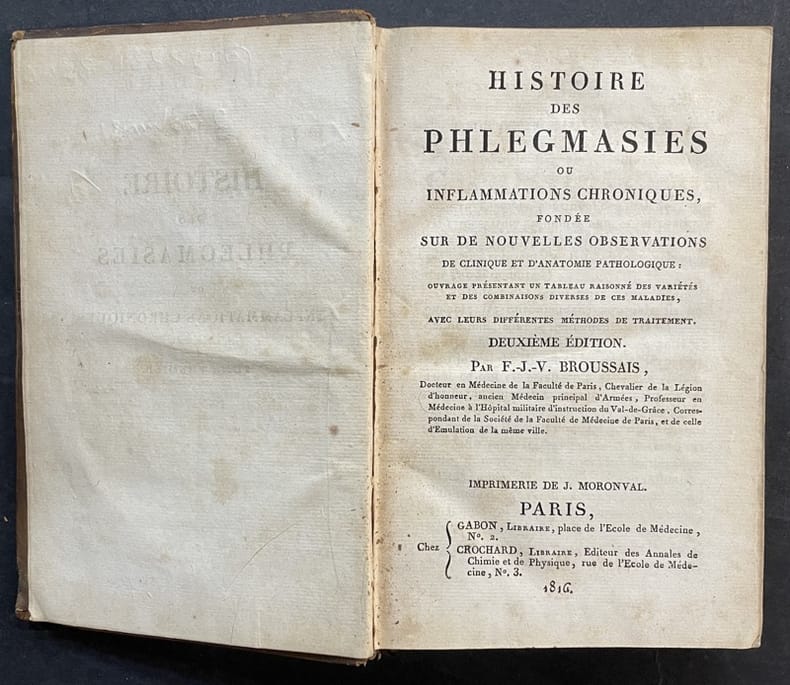
1816128831Paris, Chez Gabon, Crochard, impr. Imprimerie de J. Moronval 1816 Complet en 2 volumes. In-8 20,5 x 12,5 cm. Reliures de l’époque basane fauve marbrée, dos lisses ornés de roulettes dorés, XX-648-584 pp., tables des articles contenus dans ces volumes.
2991Paris, chez Béchet Jeune, 1838 - in-8, 595 pp. - 1/2 rel. d'ép., 5 grav. coul. et 1 planche dépliante coul. ( manque au dos)
5646Véritables secrets d’EMERY qui regardent la nature et l’art augmenté de beaucoup d’autres secrets forts curieux,très utiles & tirés de ce qu’il y a de meilleurs auteurs en le genre. Deux tomes en deux volumes in 12 plein cuir fauve raciné à nerfs, pièce de titre chagrin rouge, fers,roulette,filets et tomaison dorés,roulette dorée sur coupes.Tome 1: titre,VI préface,12 pages de table des matières. Tome 2 titre,II préface,414 pages,22 pages de table des matières et d’approbation.Tranches marbrées. A Paris chez Pierre Ribou 1713,très bon état.Rare
[4]-654 pp demi-maroquin bleu nuit moderne, à la bradel, titre et auteur dorés 1879, 1879, in-8, [4]-654 pp, demi-maroquin bleu nuit moderne, à la bradel, titre et auteur dorés, Édition originale. Alfred Fournier (1832-1914) fut, à l'hôpital du Midi, l'élève du grand spécialiste des affections vénériennes, le Dr Ricord, dont il suivit l'enseignement non officiel. Agréé médecin des hôpitaux, il fut chargé d'un cours sur les maladies vénériennes, à Lourcine, puis à Saint-Louis. Fournier admit l'origine syphilitique du tabès et il établit le rapport entre la syphilis et la paralysie générale. Semelaigne II, p. 186 et suiv
1939014524Lyon Albums du Crocodile, septième année, numéro I, janvier-février 1939 In-8 agrafé, couverture illustrée
186919935Paris, Germer et Baillière, 1869 ; in 12, demi chagrin vert foncé, dos à nerf, titre doré ; XXIV, 206, [2] pp. EAS à un confrère.