2 197 résultats
Covers creased; library sticker on front cover and inside cover; library stamp on page 3 and page 15. 15 pages. No foxing. Ex-Library
1911033164Chicago: The Open Court Publishing Co 1911. 1st Edition 1st Printing. Hardcover. Near Fine/No Jacket. 413 Pp. Red Cloth Gilt. First English Language Printing With 1911 Date On Title Page. Near Fine With Just A Trace Of Rubbing At Corners And On Spine Gilt Brilliant Cloth And Contents Immaculate. A Classic Of Semi-Science First Published In Italy In 1906 This Being The First Edition In English. Per Wikipedia: Eugenio Vittorio Rignano 1870 In Livorno - 1930 Was A Jewish Italian Philosopher. He Was Born In Livorno To Giacomo Rignano And Fortunata Tedesco Into A Jewish Family. Rignano Edited The Journal Rivista Di Scienza Later Known As Scientia It. His Book The Psychology Of Reasoning 1923 Influenced The Social Anthropologist Edward Evans-Pritchard. His Book Man Not A Machine 1926 Was Replied To By Joseph Needham's Man A Machine 1927. Rignano Took Interest In Biology And Wrote A Book That Argued For The Inheritance Of Acquired Characteristics. He Advanced A Moderated Lamarckian Hypothesis Of Inheritance Known As "Centro-Epigenesis". His Views Were Controversial And Not Accepted By Most In The Scientific Community. His Book The Nature Of Life 1930 Was Described In A Review As Presenting A "Militant At Times Almost An Evangelical Exposition And Defense Of An Energetic Vitalism." However Historian Peter J. Bowler Has Written That Rignano Rejected Both Materialism And Vitalism And Adopted A Similar Position To What Was Known As Emergent Evolution. Li Dazhao One Of The Founders Of The China Communist Party Was An Avid Reader Of Rignano's Works And Chinese Communist Emphasis On Absolute Control Of All Conduct May Be Influenced By The Belief That It Will Result In Changed Behavior Forever In Future Generations Their Stated Goal. . Rignano's Views On Acquired Characteristics And Organic Memory Are Discussed In Detail By Historian Laura Otis And Psychologist Daniel Schacter. The Finding That The Immune System Does Indeed Acquire Inheritable Characteristics Puts Much Of The Lamarckian Debate Into A New And Politically Distressing Light. <br/> <br/> The Open Court Publishing Co hardcover

Ruth Moore Uomo tempo e fossili. , Garzanti 1954, L'evoluzione dell'umanità. 70 disegni di Sue Richert e 62 illustrazioni fuori testo. Brossura editoriale con tagli e mancanze, interno ingiallito ma completamente fruibile. Buono (Good) . <br> <br> <br> 400<br>
LIBRO IN ECCELLENTE STATO.
210 pages including index. A comprehensive survey of many areas of reproductive biology and genetics. Clean, bright and unmarked with very light wear. Dust jacket price-clipped. Excellent copy. Book
18820159981882 - 1898: Various Publishers 1882. 1st Edition . Hardcover. Very Good. The Author's Personal Copies No Duplicates Of His Nineteenth Century Works On Paleontology And Related Areas Of Biology 127 Of His Published Writings Including Original Offprints Extracts Title Pages Manuscripts And Notes In German Or English With A Few Clippings And Photographs Laid In Loosely. Three Volumes Dark Brown Pebbled Cloth Over Brown Patterned Boards. Bindings Worn And Frayed Material Should Be Professionally Rebound With Archival Materials. His Obituary In The American Naturalist Sept 1898 Pp 717-718 Refers To A Total Output Of 143 Papers Being Reported By His Brother Which Possibly Includes Reprints And Translations As He Wrote In Both German And English And This Collection Appears Complete. Baur Was Last A Professor At The University Of Chicago 1892 -1898. Baur Wrote Extensively On Various Paleontological Topics. He Also Built On The Late Nineteenth Century Theory Of Evolution And Wrote Extensively On His Idea That Changes In Morphology Might Be Brought Out By A Change In Environment Including Nutrition Etc. Such That These Changed Characteristics Would Persist In Successive Generations So Long As The Changed Conditions Persisted For Which There Is Now Some Evidence For At Least Three Generations. He Cited Extensively To Personal Observations And Reports From Others. His Work Differs From Weizmann Etc. In That He Maintained That Changes In Environment Could Bring Out Changes In Morphology Without Changes In The Genetic Material Such Changes Persisting In Successive Generations When The Environmental Changes Also Persisted. In One Such 1891 Paper He Concludes With A Citation To Darwin's Letter To Wagner: "In My Opinion The Greatest Error Which I Have Committed Has Been Not Allowing Sufficient Weight To The Direct Action Of The Environment - I.E. Food Climate Etc. -Independently Of Natural Selection." Although Now Dismissed Some Because Of His Neo-Lamarckian Ideas His Departures From Rigorous Scientific Evidence In Genetics Is Perhaps Less Serious Than The Acceptance And Promotion Of The Ideas Of "Phlogiston" By Important Earlier Chemists And Of "Ether" By His Contemporaries Among Important Physicists; And The Emphasis Of The Neo-Lamarckians On Environmental Nutritional And Physiological Factors Is More In Keeping With Modern Understanding Of Individual Development Than The Emphasis Upon Purely Genetic Evolution Which Treats Only Classes Of Individuals By Arbitrary Groupings Into Classes Of Individuals . Complete Collections Of Original Manuscripts And Scientific Offprints From This Period Are Increasingly Uncommon In The Market. All Material In Excellent Condition Bound Into Three Volumes Bindings Very Worn. <br/> <br/> Various Publishers hardcover
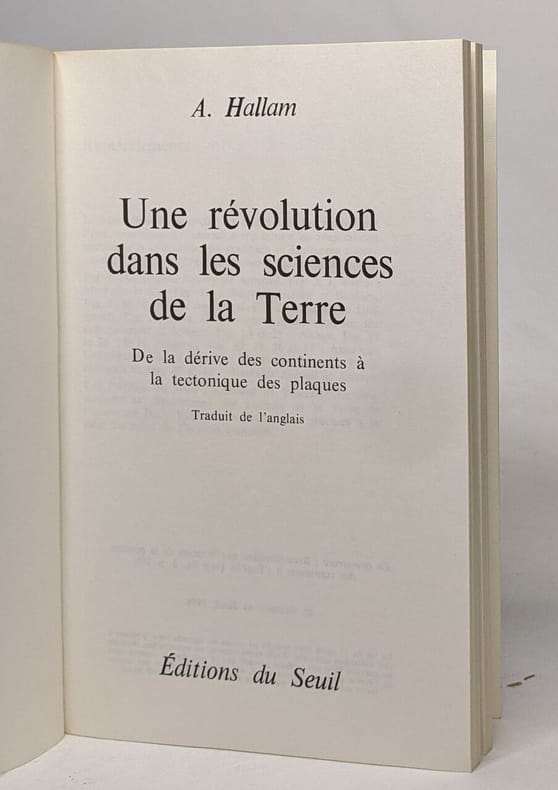
100119812Editions du Seuil in12. Sans date. Broché.
Hardcover without jacket; printed boards. Minor pencil mutations to margins Ex-Library
1966042311Englewood Cliffs: Prentice-Hall 1966. 1st Edition 3rd Printing. Hardcover. Fine/Very Good Jacket. Photographs And Drawings. 175 Pp. Black Cloth Gilt. Third Printing. Elementary But Surprisingly Wide Ranging Yet Detailed Over View Of Evolutionary Processes Causes And Effects. Fine In Very Good Dust Jacket. <br/> <br/> Prentice-Hall hardcover
br. Dal 1968 al 1981 Edoardo Boncinelli ha dedicato tutte le sue energie ad allevare drosofile, quei "moscerini della frutta" che sono l'incubo di ogni cucina ma che hanno fra gli scienziati molti estimatori. La biologia era allora in un momento di lenta e inesorabile trasformazione. La ricerca mirava a comprendere i meccanismi che regolano l'espressione dei geni, che sarebbero stati scoperti uno dopo l'altro in un'esaltante epopea scientifica. Boncinelli questa avventura l'ha vissuta da protagonista e sul filo dei ricordi la ripercorre nei suoi snodi cruciali, a cominciare dalla scoperta dei geni architetto dell'uomo, frutto di un'intuizione fortuita avuta chiacchierando con un collega. È il primo passo di un viaggio che lo porterà a indagare le dinamiche dello sviluppo del cervello e ad addentrarsi nel complesso e affascinante universo delle neuroscienze. È la vita di uno scienziato animato fin da bambino da una inesauribile sete di conoscenza, quella che si dispiega nelle pagine di questo libro, intessuta di faticose e inebrianti giornate in laboratorio ma anche di affetti e amicizie saldissime. Una vita assaporata sullo sfondo delle città più amate - Firenze, Napoli, Trieste - ma anche di un mondo girato freneticamente per condividere le proprie conquiste con la comunità scientifica. La ricerca attiva ha con gli anni lasciato il posto al pensiero e alla riflessione, ma questo "ribelle esorbitantemente disciplinato" non ha rinunciato a dare il suo contributo.
AAVV Un mare di risorse, introduzione alla conservazione ed alla gestione delle risorse ittiche. , Senza editore 2000, Libro usato in buone condizioni, Pagine ingiallite lievemente con segni d'umidità . Tagli regolari impolverati, Copertina flessibile cartonata con se Buono (Good) . <br> <br> <br> 395<br>
(Roma, 1910) stralcio con copertina posticcia muta, pp. 387/391 con una illustrazione. - !! ATTENZIONE !!: Con il termine estratto (o stralcio) intendiamo riferirci ad un fascicolo contenente un articolo di rivista, sia che esso sia stato stampato a parte utilizzando la stessa composizione sia che provenga direttamente da una rivista. Le pagine sono indicate come "da/a", ad esempio: 229/231 significa che il testo è composto da tre pagine. Quando la rivista di provenienza non viene indicata é perchè ci è sconosciuta. - !! ATTENTION !!: : NOT A BOOK : “estratto” or “stralcio” means simply a few pages, original nonetheless, printed in a magazine. Pages are indicated as in "from” “to", for example: 229/231 means the text comprises three pages (229, 230 and 231). If the magazine that contained the pages is not mentioned, it is because it is unknown to us.
13157Guy Authier, 1973.Format 16x24 cm, broche, couverture illustree rempliee, 510 pages.Bon etat.
Modena, Soc. Nat. e Matem., 1928, 8vo estratto con copertina originale, pp. 16. - !! ATTENZIONE !!: Con il termine estratto (o stralcio) intendiamo riferirci ad un fascicolo contenente un articolo di rivista, sia che esso sia stato stampato a parte utilizzando la stessa composizione sia che provenga direttamente da una rivista. Le pagine sono indicate come "da/a", ad esempio: 229/231 significa che il testo è composto da tre pagine. Quando la rivista di provenienza non viene indicata é perchè ci è sconosciuta. - !! ATTENTION !!: : NOT A BOOK : “estratto” or “stralcio” means simply a few pages, original nonetheless, printed in a magazine. Pages are indicated as in "from” “to", for example: 229/231 means the text comprises three pages (229, 230 and 231). If the magazine that contained the pages is not mentioned, it is because it is unknown to us.
br. I gemelli identici non sono affatto identici e i nostri geni non determinano affatto il nostro destino. Questo è il messaggio centrale di questo libro, scritto con mano sicura e ricco di storie vere, tratte dal più grande studio sui gemelli che sia mai stato fatto e che Tim Spector conduce in Gran Bretagna da oltre vent'anni. Se siete a disagio ogni volta che leggete sul giornale che è stato trovato "il gene dell'alcolismo" (o del cancro, o della felicità, o dell'omosessualità ecc.) e se vi sembra riduttivo pensare a voi stessi come ad automi guidati ineluttabilmente dal DNA, con una condanna scritta nelle cellule da cui è impossibile sfuggire, allora questo libro vi offrirà una via di fuga inaspettata. La nuova disciplina si chiama "epigenetica" e sta rivoluzionando quello che sappiamo sui geni e sull'eredità biologica, aprendo campi di ricerca che erano considerati tabù solo pochi anni fa. Lo studio dei gemelli ha infatti convinto Tim Spector che la cosa più interessante sono le differenze, non le somiglianze, e che queste differenze sono il risultato di un dialogo continuo tra ambiente e DNA, in parte ereditabile. Ciò che fino a poco tempo fa la biologia considerava anatema, oggi non lo è più: i nostri comportamenti e le nostre esperienze modificano il nostro patrimonio genetico e sono in parte ereditati dai nostri figli e dai nostri nipoti.
188829801ABJena, Gustav Fischer, 1888. 8°. XVIII, 258 S. Mit 3 gef. Tafeln. Halbleinenband der Zeit mit mont. vord. Orig.-Umschlag. + Wichtig: Für unsere Kunden in der EU erfolgt der Versand alle 14 Tage verzollt ab Deutschland / Postbank-Konto in Deutschland vorhanden +
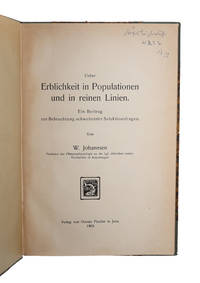
190344335Jena Gustav Fischer 1903. Lex8vo. Fine contemp. hcloth. spine gilt and with gilt lettering. 668 pp. textfigs. Internally clean and fine. <br/><br/><em>First edition of a groundbreaking work in genetics in which Johannsen introduces the concept of "pure line". Johannsen's work is dedicated to Francis Galton "the creator of the exact science of heredity". Johannsen was the first to attribute to mutation the origin of the small differences in the continous kind of variability characteristic of normal heredity."Yet Johannsen had shown that Galton's "law of regression" was wrong when applied as Galton had done - to impure or mixed populations. He proved that selection was ineffective - that is regression to parental averages was complete - only in the offspring derived by self-fertilization from a single parent as in peas beans and other "selfers." The offspings and descendants from such a plant Johannsen referred to as a "pure line". His theory was that offspring of a pure line were genetically identical and that fluctuating variability among such offspring was due to effects of change and enviromental factors. These effects were not heritable and hence were not subject to the action of selection either natural or artificial."DSB VII p. 114.Garrison & Morton No. 242. </em> hardcover
18922947DBJena, Gustav Fischer, 1892. 8°. X, 158 S. Mit 3 gef. Tafeln. Orig.-Broschur. + Wichtig: Für unsere Kunden in der EU erfolgt der Versand alle 14 Tage verzollt ab Deutschland / Postbank-Konto in Deutschland vorhanden +
190344335Jena, Gustav Fischer, 1903. Lex8vo. Fine contemp. hcloth., spine gilt and with gilt lettering. (6),68 pp., textfigs. Internally clean and fine.
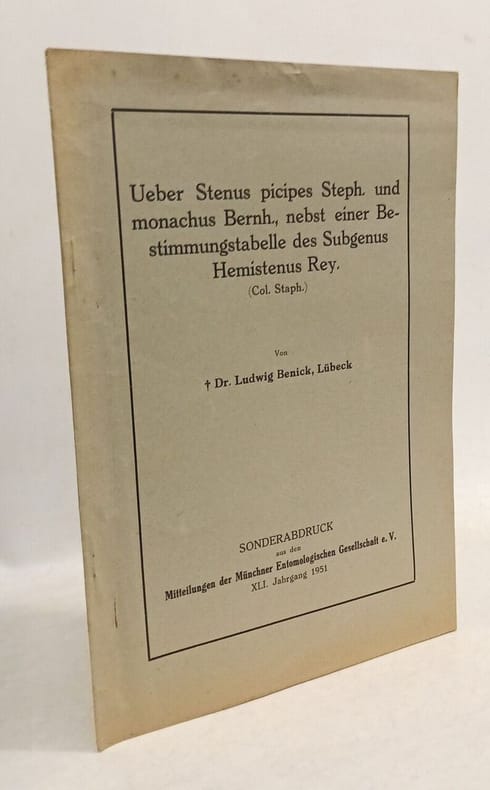
1951100142677Sonderabdruck 1951 in8. 1951. Broché.
188829801ABJena, Gustav Fischer, 1888. 8°. XVIII, 258 S. Mit 3 gef. Tafeln. Halbleinenband der Zeit mit mont. vord. Orig.-Umschlag.
18922947DBJena, Gustav Fischer, 1892. 8°. X, 158 S. Mit 3 gef. Tafeln. Orig.-Broschur.
Angelo Lombardi Uccelli da gabbia da cortile da voliera.. , Sansoni 1974, Collana: Enciclopedie pratiche illustrate Sansoni. La copertina è integra ma opacizzata. Tagli bruniti come le pagini ai bordi. Buono (Good) . <br> <br> <br> 168<br>
Ex - Library, Usual Stamps Ex - Library
br. Da sempre l'uomo cerca di liberarsi dalla natura e da sempre l'uomo vive contro di essa, con esiti incerti se non coincidenti con l'autodistruzione. La posta in gioco si è alzata e ora la volontà è tutta tesa a creare un essere frutto della ricerca unificata di genetica, robotica, informatica e nanotecnologie. Per riferirci a ciò che verrà pare più appropriato il termine "grinantropo", ossia la conservazione di qualcosa di umano - forse la sola forma - ma programmato e implementato per come si possono immaginare i più sofisticati robot. Il problema, in realtà, forse non risiede tanto nei potenziati e nella biologia genetica, quanto negli interessi economico-finanziari che ruotano attorno a questo tipo di ricerche. Qui nasce il problema, e diventa chiaro che l'approccio per capire il futuro che verrà comporta il prezzo che siamo disposti a pagare per diventare potenziati. Il "grinantropo" è, per l'uomo, una sfida tutta nuova e insidiosa. Una sfida non più, o meglio, non solo, umana: l'uomo non è più al centro degli scenari biotecnologici.