71 résultats
1901500051663Churchill 1901. 1st Edition . Hardcover. Good. half leather <br/> <br/> Churchill hardcover
0265139937.Gpaperback. Good. Access codes and supplements are not guaranteed with used items. May be an ex-library book. paperback
0260198757.Ghardcover. Good. Access codes and supplements are not guaranteed with used items. May be an ex-library book. hardcover
79,[1]pp., recent marbled wrappers, printed paper label on upper cover. Consists of a list of members of the Committee of Visitors, report of the visiting justices (F. H. Dickinson, chairman... [et al.]), report of the superintendent (Robert Boyd), obituary and statistical statements and financial statements (George William Gunn). Copac listing the Wellcome library copy only.
A clean, unmarked book with a tight binding. 96 pages. 9"w x 10 1/2"h.
25467Nice, A.D.I.A., 1945. 25 x 33, 89 pp., 8 planches couleurs en trichromie phototypie sur B.K.F. de Rives, reproductions en N/B et texte sur vélin de Renage à la forme, broché sous étui, non coupé, couverture rempliée, très bon état.
188439173No place Philadelphia: No publisher/printer no date 1884. 8vo 24.4 cm 9.5". 1 f. printed on both sides. <br><br>Includes the need to raise $400000 vote of thanks to Miss Chevaillier election of officers and wording of a circular to be sent to members and others for the fund raising effort. Age-toning along top and fore-edge; fore-edge crumpled with with tattering. A good copy. No publisher/printer unknown books
097674418X.Gpaperback. Good. Access codes and supplements are not guaranteed with used items. May be an ex-library book. paperback
First edition, 4to (276 x 220 mm), large paper copy, xx, [21]-227, [1, errata]pp., engraved frontispiece of the North front vie of the Retreat, quite heavily offset onto title as usual, small oval oil stain to lower blank margin of title and prelims, loss to top corner of P1 removing one letter from margin header, 2 engraved ground plans, nineteenth-century half calf, marbled boards, leather spine label, slightly rubbed. In 1791 a Quaker woman, Hannah Miles, died in suspicious circumstances in the York Asylum (later Bootham Park Hospital). William Tuke was appalled, and when his daughter Ann asked why there could not be an establishment for such persons within the Quaker Society he was immediately taken with the idea. His wife hated the whole idea and the Society of Friends and initially disapproved of the whole scheme, but despite all obstacles the basic principle of The Retreat was formerly laid down. It was to be 1796 before The Retreat first opened its doors to patients and the first three arrived in May of that year. At the time of The Retreat's foundation many patients in other institutions were chained or manacled to starve them to reduce their strength. Many madhouses were filled with stench and patients were cruelly beaten to fit in with the common philosophy that the rule of fear was the only way to control patients. Tuke's philosophy was vastly different and, in 1813 his grandson Samuel published this book. It was to have a profound effect on the conceptions of how to deal with the mentally ill, and was instrumental in bringing about reforms at York Asylum. With intense interest aroused the House of Commons set up a Select Committee to report on 'Madhouses' in 1815 as a direct result. Tuke gave evidence to a second report and his 'mild method' of looking after the mentally ill eventually won support and gave rise to new legislation. The Retreat was to evolve new and far reaching methods of humane treatment of the mentally ill and leave a lasting impression on the theory and practice of other establishments both nationally and internationally. Garrison-Morton, 4925.1; Hunter & Macalpine, pp. 684-90; Norman, 2109.
15383Thèse de doctorat. Paris. Doin. 1888. Grand in-8 (25x17). 144 pages. Broché.
First edition, 2 vols., 8vo (210 x 130 mm), xviii, 678; [4], 864pp., with half-titles, BUT WITHOUT THE ATLAS VOLUME OF 27 PLATES, several neat library stamps, later library buckram, joints cracked, upper cover of vol. I detached. The first modern textbook of psychiatry. Provenance: Formerly in the library of the Birmingham Medical Institute. Hook & Norman, Haskell F. Norman Library I, 728; Hunter & Macalpine, pp. 731-38; Garrison-Morton, 4798.
34365New York: n.p. Letter. Very good. Letter/document. Approx. 7" x 8" single sheet of paper. 1 page content. Letter addressed 91 9th Street and dated December 4th 1862. Document reads "This Certifies that George Montgomery West has for some near past been afflicted with a species of Insanity. That last spring he was for two months in the Bloomingdale Lunatic Asylum. He is liable at any time to paroxysms a sudden attack or violent expression of a particular emotion or activity of this infirmity. Signed R G Raphael MD. Professor of Surgery N.Y. Med College. n.p. unknown
19783Paralysie générale - Démence sénile - Démence précoce. Lyon. Legendre. 1912. Grand in-8 (25x16). 353 pages. Broché (partiellement décousu).
ND-MNWQ-0UYMNew. unknown
1880888Boston: Tolman & White Printers 1880. 8vo 9.5" 23.5 cm. 2 ff. printed on recto and verso. <br/><br/>Perhaps the first printing of the association's constitution. <br/><br/>Ex-American Antiquarian Society Copy with its embossed stamp. Top edge tattered with loss of blank paper age-toned some dog-earing. [Tolman & White Printers?] unknown books
8vo., First Edition, with plates; navy cloth, gilt back, a very good, bright, clean copy in unclipped dustwrapper. Lively and facsinating social history of Bethlem Royal Hospital, and the treatment of the insane. The building in Lambeth is now the home of the Imperial War Museum.
19536314Neuchatel/ Paris, Delachaux/ Niestlé, 1953 ; in-8, broché ; 212 pp. , (4) pp.
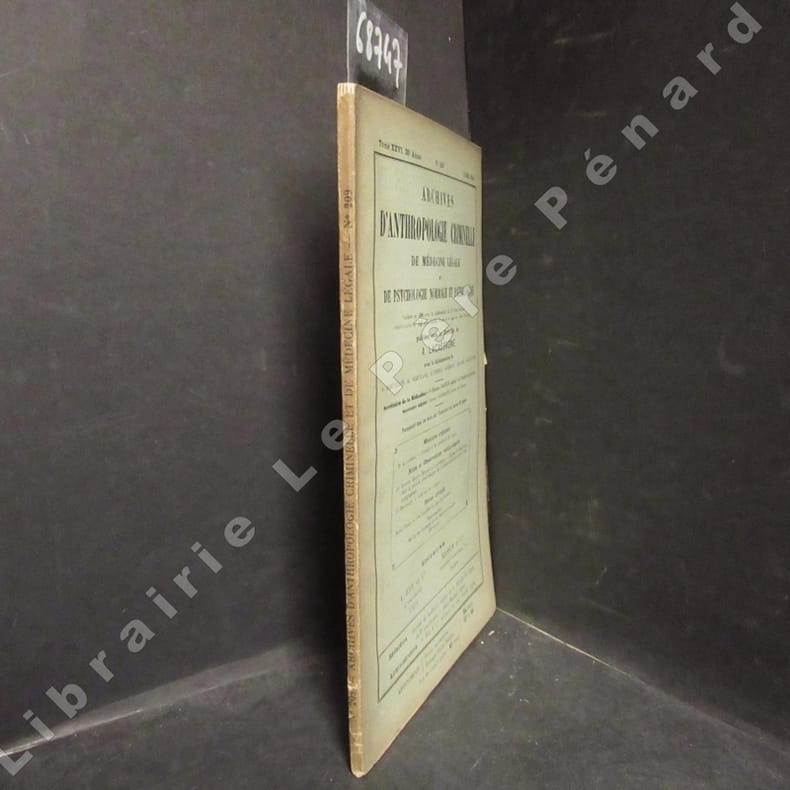
68747Tome XXVI - 26ème année - N° 211 - 15 juillet 1911 - Fondées en 1886 avec la collaboration du Dr. Albert Bournet, transformées en 1893 avec Gabriel Tarde et en 1904 avec Paul Dubuisson - Editeurs A. Rey et Cie / Masson et Cie - Grand in-8 broché - 80 pages
x, 381 pages. Index. "It has been suggested to me that the experience gained through the many years in which I was chiefly concerned with the ascertainment of mental disorder and defect, in accused persons coming before the courts, should afford some help to others similarly engaged. This book is the result." - Preface. Author was a medical doctor, medical inspector of H.M. Prisons, England and Wales; Inspector of Retreats under the Inebriates Acts, Lecturer on Criminology and Forensic Psychiatry, Maudsley Hospital, and Senior Medical Officer, H.M. Prison, Brixton, etc. Most of the sixteen chapters are devoted to the various modes of insanity. Average wear to dark olive green boards. Gilt lettering upon spine. Prior owner's inkstamp upon free endpapers and title page. Ten Point Scale affixed inside back board. Back hinge open. Front hinge started. A worthy copy of this fascinating vintage text. Book
First edition, 8vo (220 x 130 mm), ix, [1], 320pp., some intermittent light foxing, 1 folding table, fait stamp to title page, later maroon cloth, rubbed, spine lettered in gilt. An investigation of the curability of insanity based on the statistics of a countrywide survey of mental institutions. "Burrows claimed to have cured eighty-one percent of all the mental patients in his private asylum, with the rate rising to ninety-one percent for cases of less than a year's duration?questionable figures that were nevertheless accepted uncritically by his book's many readers. The cult of curability was an extreme reaction to the earlier belief that insanity was beyond help; during the period of its greatest influence, it inspired a marked increase in the construction of state mental hospitals."?Hook & Norman. Provenance: Formerly in the library of the Birmingham Medical Institute. Hook & Norman, Haskell F. Norman Library I, 379; Hunter & Macalpine, p. 778; Wellcome II, p. 277.
First English edition, 8vo (210 x 130 mm), lv, [1], 288pp., with the half-title, faint unobtrusive stamp to title page, 2 engraved plates, one folding table, some light browning and spotting, some minor water-staining more so to the last ten leaves, later maroon cloth, lower hinge torn. The French physician Philippe Pinel (1745-1826), who founded the French School of Psychiarry at Hospice de la Salp?triere, has been described as 'the father of modern psychiatry'. "Pinel was among the first to treat insane humanely; he dispensed with chains and placed his patients under the care of specially selected physicians. Garrison considered the above book one of the foremost medical classics, giving as it did a great impetus to humanitarian treatment of the insane."?Garrison-Morton. The first edition of his Traite medico-philosophique sur l'alienation mentale; ou la manie appeared in 1801. Provenance: Formerly in the library of the Birmingham Medical Institute. Hook & Norman, Haskell F. Norman Library II, 1704; Hunter & Macalpine, pp. 602-610; Garrison-Morton, 4922; Wellcome IV, p. 388.