8 621 résultats
201308480, Editions de l érable , 1969 ; in-8, 242 pp., cartonnage de l'éditeur.
201015961Paris, Edition correa, 1935 ; in-8, 366 pp., plein marocain .
1991_202000751S. l. (Paris), Éditions Gallimard, 1991 ; in-8 (141 x 226 mm), 720 pp., broché. Nouvelle édition entièrement revue et complétée par Alain Rivière et Pierre de Gaulmyn. Préface et notes par Pierre de Gaulmyn.
200904359Paris, Librairie plon, 1926 ; in-12, 264 pp., broché.
201007197Paris, Nouvel angle editions, 2007 ; in-8, 327-110 pp., broché, couverture illustr. Très bon état.
201007196Argenteuil, Nouvel angle editions, 2008 ; in-8, 400 pp., broché, couverture illustr. Comme neuf.
1926D3782Paris, Plon, 1926 ; in-8, 264 pp., broché. Exemplaire numéroté grandes marges. Édition originale. Très bon état.
1989_202303969Paris, Librarie Arthème Fayard, 1989 ; in-8 (155 x 235 mm), 384 pp., broché, couverture illustrée.
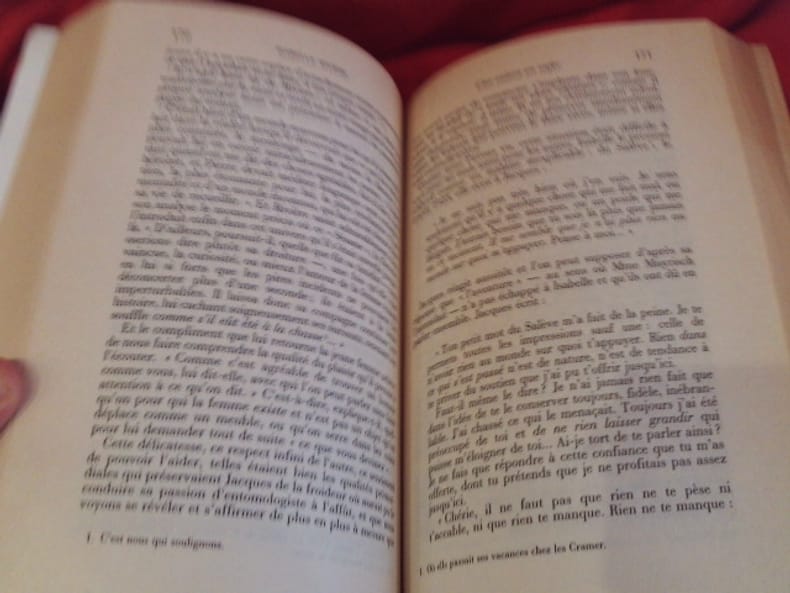
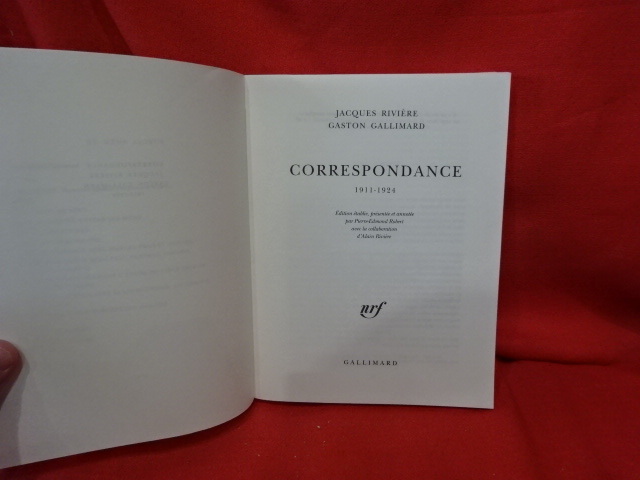
1994202005028Paris, Éditions Gallimard, 1994 ; in-8 carré, 263 pp., broché. Édition établie, présentée et annotée par Pierre-Édmond Robert, avec la collaboration d'Alain Rivière.
1710252472London: John Morphew 1710. Second edition of vol. I first edition of vol. II. Frontispiece in vol. I. ii vi 246; xvi 380 pp. 1 vols. 8vo. Contemporary panelled calf vol. I rebacked preserving most of original black morocco label corners repaired hinges strengthened. Bookseller's ticket on rear pastedown. Vol. II with later spine label binding rubbed. Second edition of vol. I first edition of vol. II. Frontispiece in vol. I. ii vi 246; xvi 380 pp. 1 vols. 8vo. This famous attack scandalized virtually every member of the Whig Party and led to Mrs. Manley's arrest. A friend and collaborator of Swift's she succeeded him as editor of The Examiner and exercised some influence on Defoe. ESTC N47961; ESTC T106837 John Morphew unknown
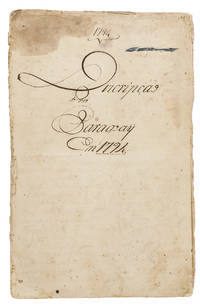
1794ABC_47826Paraguay and/or Brazil 1794. 34 x 22 cm. Stitched through 2 single holes only one remains intact. Written in brown ink in a very legible late 18th-century cursive. 1 1 blank 12 2 blank pp. A contemporary unpublished and unrecorded Portuguese manuscript describing the Paraguay River and the lands rivers and territories adjoining including the location of former Jesuit Missions. It is written within the context of the Portuguese-Spanish dispute over the frontier between Portuguese Brazil and the Spanish colonies and focuses in particular on the upper reaches of the river which at that time still remained relatively unknown. The Portuguese under the governorship of Luis de Albuquerque 1739-97 had recently in 1778 established the towns of Albuquerque today Corumbá Laredo Villa María today Cáceres Casalvasco and Salinas. These new establishments and their locations on the Paraguay River are mentioned here. The terms of the 1777 Treaty of San Ildefonso between Portugal and Spain directed that a Portuguese-Spanish delegation be sent to the Paraguay River region to determine a definitive border between the territories. The Spanish delegation arrived in 1781 under the command of the military officer and naturalist Félix Manuel de Azara 1746-1821 and waited in Asunción in Paraguay for the Portuguese. The latter in the end never arrived but the Spanish delegation remained in the region until the 1790s Azara until 1801 exploring and measuring the region as well as handling the ongoing disagreements with the Portuguese over the demarcation. This Portuguese description of the River Paraguay is undoubtedly connected to these ventures though whether it is a contemporary translation into Portuguese of a Spanish survey or a survey of the river carried out by the Portuguese themselves is uncertain. It is however the only known copy of an unpublished description of the River Paraguay and it describes in detail the little-known upper regions of the Paraguay River.With a crossed-out annotation on the title-page the title-page and the last blank leaf are somewhat water stained. The paper is otherwise uniformly toned and showing some occasional foxing the edges of the leaves are somewhat frayed slightly affecting the text at the head of each page. Overall in good condition. unknown
1955LFA-126746419Un ouvrage de 324 pages, format 130 x 195 mm, broché, publié en 1955, Librairie Plon, bon état
4365Sans lieu, 1990. Tapuscrit in-4.
188760494Salem OR: n.p. 1887. 8vo. 6 2 pp. Self-printed softcovers & title minor shelfwear dustsoiling still a VG bright copy from the library of Caroline Augusta Gray Kamm 1840-1932 noted socialite and philanthropist in Portland built home for poor women & girls with the YWCA and was daughter of PNW pioneer William H. Gray 1810-1889 who traveled to the Lapwai Mission in Lewiston ID in 1836 where he was the Nez Perce secular agent and she subsequently later married Jacob Kamm 1823-1912 pioneering Oregon steamship builder industrialist entrepreneur and co-owner/operator of the Ilwaco Railway & Navigation Co. First edition of this scarce speech delivered by J.H.D. Gray 1839-1902 who was the first Euro-American “White†male child born west of the Rocky Mountains after his pioneer father William Henry Gray 1810-1889 came West with Dr. Marcus Whitman in 1836. This speech was one of the earliest proposals to construct a “large iron gastron†dam immediately above the Dalles filled with heavy timbers to back up enough water so that the treacherous Celilo Falls could be deepened and enable continuous navigation on the Columbia River. Largely due to financing political will and the Herculean engineering obstacles this dream would not reach fruition until March 10 1957 when the floodgates of The Dalles Dam were opened 70 years later. J.H.D. Gray first began working for his brother-in-law Jacob Kamm’s Oregon Steam & Navigation Co. in 1858 and ran sternwheelers from Celilo Falls to Lewiston ID to the Owyhee Crossing and onto the Snake River. After losing his hand he began operating the sternwheeler U.S. Grant between Astoria and Ilwaco and in 1886 was elected to the Oregon State Senate. No copies in Worldcat. n.p.], paperback
193662194New York: Reynal & Hitchcock 1936. 8vo. 67 1 pp. Colour frontisp. 3 colour plates numerous woodcut engravings. Gray-blue publisher’s cloth silverlettering on spine minor shelfwear dustsoiling w/ d.j. cover art by Edward A. Wilson minor chipping head of spine scuffing from removed label on front cover dustsoiling & darkening still VG/VG- copy inscribed w/ sailboat illustration by the author on ffep. to Esther Campbell. First edition inscribed with small pen illustration by the author. This semi-autobiographical novella served as the prequel basis for Binns’ acclaimed Lightship 1934 surrounding the experiences of two young couples near Astoria OR dreaming of restoring an abandoned wooden cutter to sail to the South Seas young love and the vicissitudes of sea life. Reynal & Hitchcock, hardcover
190963358New York: G.P. Putnam’s Sons 1909. Tall thick 8vo. xx 409 1 pp. plus 8 pp. publ. ads. Title in red & blk. Photogravure frntsp. 79 plates 2 large folding colour maps. Blue ribbed publisher’s cloth gilt lettering photo illust. mounted front cover t.e.g. rubbing to corners minor edgewear slightly shaken faint ex-lib markings on spine still VG- copy from the libraries of Dr. John C. Brougher 1901-1983 founder of Vancouver Clinic and famed obstetrician & gynecologist believed to have delivered over 10000 children in SW Washington during his years of practice and Clark County Historical Society Collections recently deaccessioned bookplates on front pastedown. First edition of Lyman’s classic work on the Columbia River and its inhabitants and an early title in the American Waterways series. The author has included extensive sections on the Northwest Coast Native Americans early fur traders the impact of the missionaries Oregon trail and westward movement pioneers and more. G.P. Putnam’s Sons, hardcover
191063830New York: G.P. Putnam’s Sons 1910. Tall thick 8vo. xvi 308 pp. plus 8 pp. publisher’s ads. Photo frontisp. photo plates maps 1 folding. Blue ribbed publisher’s cloth photo illust. mounted front cover decorative gilt lettering front cover & spine t.e.g. minor shelfwear slight bumping to foot of spine couple corners still VG bright copy. First edition of this installment in the American Waterways Series describing the great Mississippi River the area’s role in the opening of the American West including the Lewis & Clark Expedition acquisition of the Louisiana Purchase and impact of the Civil War. G.P. Putnam’s Sons, hardcover
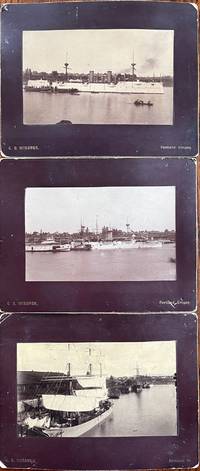
189260143Portland OR: C.E. Wiester E.J. Partridge Corner of 3rd & Columbia 1892. Three mounted albumen photographs sized 6.75 x 4.25 in. mounted on dark maroon-coloured studio board w/ photographer’s imprint at lower right corner minor edgewear rubbing slight dustsoiling still nice images w/ good contrast. Three striking images of a bustling Port of Portland Oregon on the Willamette River depicting United States Navy warships sternwheelers barges 3-masted barks and others. The first depicts a Newark-Class Protected Cruiser most likely the USS Baltimore C-3 which was launched and commissioned in 1888 and joined the Pacific Squadron where she served until cruising the West Coast of the United States until October 1892 when she returned to the Atlantic to take part in the Naval maneuvers for the 1893 Columbian Exposition. The second shows the stern of a Yorktown-class gunboat possibly the USS Yorktown PG-1 who sailed with the USS Baltimore in Chile and later took part in sealing patrols from 1892-1898 off of Alaskan waters with the Royal Navy. Wiester 1858-1941 not to be confused with contemporary George M. Weister 1862-1922 who also began his photographic career with the Partridge Photo Company of Portland OR around 1890 and by 1892 had taken over the operation with his own imprint while Weister had launched the Weister Company selling photographs photographic supplies cameras and lantern slides. Charles Wiester worked only for a short time as a photographer as by 1900 he was working as a railroad agent and moved subsequently to Spokane WA by 1910. C.E. Wiester, E.J. Partridge, Corner of 3rd & Columbia, unknown
201702662Paris, Ladvocat libraire, 1829 ; in-8, cartonnage de l'éditeur. Xx + 304pp.+ 24 planches dépliantes hors-texte (lettres autographes en fac-simile), Edition originale, 20cm., reliure cart. (dos en cuir avec titre et décorarions dorées).
27118P., Hachette, 1867, in 8° relié demi-chagrin rouge, dos à faux nerfs et à caissons, fer doré du "Lycée Impérial Louis Le Grand" frappé au centre du plat supérieur, 268pp. ; qq. rousseurs ; menus frottis.
4772Editions de Minuit. Avril 1945. In-8° broché. 136 pages. Bandeau conservé. Bon état.
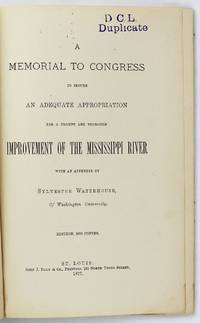
18775827St. Louis 1877. Good. 239pp. Original limp cloth covers gilt. Light fading and wear. Library ink stamp on title page. Minor wear to contents. Memorial submitted to Congress by the members of the River Improvement Convention held in St. Paul advocating for an allocation of government funds to improve the flow and path of the Mississippi River to better accommodate trade along the water route. unknown
1882JC111661882. Hardcover. Very Good. Mottled black cloth backed in ornately gilt-ruled black calf; oblong 184 x 132 mm; contains 25 pencil drawings most of them titled and dated. It includes Fort Snelling; Minnehaha Falls; Oak Drive in White Bear Lake; a boat on White Bear Lake; St. Anthony's Falls in Minneapolis; Lake Minnetonka; Wabasha St. Bridge; an Old Brewery in St. Paul; Shanty-ville; Shelter Island New York; Goat Island; plus 3 portraits a bonfire scene and other views of the upper Mississippi River Niagara Falls and St. Paul Minnesota. Boards detached and spine perished; a few leaves loose and laid-in. Skilled work most of it on one side of the leaf therefore removable and suitable for display. <br/><br/>Harley DeWitt Nichols 1859-1939 was born in Barton Wisconsin. He began his education in art as early as 11 years of age. His first job putting his talent and training to use came in the form of an apprenticeship with the Milwaukee firm Marr & Richards where he stayed for 3 years drawing and engraving on wood. The subsequent years included many moves from Milwaukee to Chicago and later to New York where he studied at ASL and was encouraged by Professor Packard to pursue a career as an illustrator at a European school. Nichols left for Munich in October 1885 to attend the Royal Academy where he studied under Heckel became a member of the American Club and socialized with Carl von Marr the clubs president. He went to London for a little while and worked as an illustrator. By 1893 hed returned to New York working mostly in advertising and illustrating for Harpers Weekly and Century magazines. He helped organize the New York Water Color Club. Nichols didnt curb his parapatetic lifestyle until he moved to Laguna Beach California in 1894. The art community in Los Angeles was in its infancy but he got a teaching job at the Echo Mountain summer school and he was inspired by the scenery of Yosemite Monterey San Juan Capistrano and other locations in southern California. He stayed in Laguna Beach until his death in 1939. hardcover
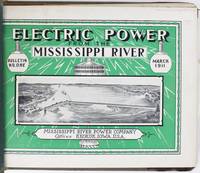
19135027Keokuk Ia: Mississippi River Power Company 1913. Very good. Ten volumes complete. Profusely illustrated. Oblong folio. Each issue measuring 9 x 12 inches in original pictorial wrappers two holes punched along spines and bound together in a later gray cloth Tatum-style Y binder with leather corners. Minor edge wear and staining to boards. Light edge wear to contents. A couple of panoramic photographs detached but present. A complete run of bulletins tracking the progress of construction on the Keokuk Dam & Power Plant which was then the longest monolithic concrete dam in the world and a pioneering effort in large-scale low-head hydroelectric power. Still in operation today the dame served as a prototype for many future power plants harnessing the power of the Mississippi River between Keokuk Iowa and Hamilton Illinois generating clean low cost and reliable energy enough to power 75000 homes. The present bulletins are chock full of facts figures photographs renderings and progress reports intended to familiarize the public with the project by illustrating the methods employed in its construction from beginning to completion. The bulletins are about equal parts text and photographs providing an easy-to-follow format for learning about the Keokuk project. Some of the issues also have folding maps or larger-format photographs which provide further visual accompaniment to the explanatory text.<br /> <br /> Known as a "run-of-river" plant the Keokuk Dam uses the natural energy of falling water to generate electricity. The power of this part of the river was identified by none other than Robert E. Lee in 1836 when he was serving as a surveyor for the U.S. War Department. Lee called attention to the turbulent waters but found no way to control it. In 1899 a group of leaders from Keokuk and Hamilton teamed up raised the backing funds received governmental approval for the dam and hired Hugh L. Cooper to oversee the project. Cooper had previously engineered construction of a hydroelectric plant at Niagara Falls. Interestingly an observation tower was also built on both sides of the river to allow the public to watch the progress of the Keokuk project then the largest privately-funded construction effort in the world. In addition to the dam a powerhouse and a new lock and dry system to accommodate river traffic were also built. The final bulletin includes comments from the chief engineer who noted that in the first bulletin it was stated that the project would be completed by July 1 1913. He remarks: "It is naturally a source of great satisfaction to all concerned with construction to see this prediction fulfilled."<br /> <br /> An informative and substantial production relating to a major construction project on the Mississippi River in the early-20th century. OCLC records a smattering of institutional holdings but complete runs appear to be rather rare. Mississippi River Power Company unknown
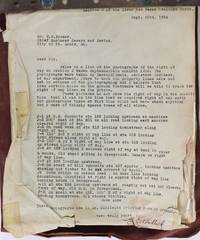
19313720St. Louis 1931. Good. Cover letter plus 109 photographs all 8 x 10 inches including about thirty duplicate prints. Contemporary brad-bound wrappers typed title label on front cover. Moderate soiling and significant edge wear and tearing to wrappers. Varying levels of marginal chipping to cover letter first two photographs and top right edge of several later photographs with some mostly marginal staining. An informative collection of photographs featuring the right of way on Section J of the River des Peres Drainage Works project in St. Louis from the Fall of 1926 to August 1933. According to the cover letter to the earliest group of photographs from the District Engineer E.E. Ashlock the first group of photographs were taken between September 14th and 16th 1926 by the assistant engineer of his department Harrold I. Smutz. Ashlock also includes a detailed listing with descriptions of the contents of some of the photographs keyed from "J-1" to "J-11." Following Ashlock's cover letter are over a hundred photographs detailing the River des Peres project with additional typed annotations for the later group of photographs. The project pictured here was undertaken after a series of significant floods in St. Louis. The River des Peres at the confluence of the Mississippi River was effectively channelized and its contents redirected underground through a series of large pipes. The river functions today as a critical part of the city's sanitary and storm water system a role it took on after the project pictured here.<br /> <br /> The photographs depict a wide range of perspectives of the River des Peres showing views of upstream equipment pictures taken from an "old road looking east across the cleared right of way" from a "road west.looking downstream along right of way" "on crest of hill.looking upstream showing cut timber to be covered by spoil" and so forth. The photographs are often annotated on the verso sometimes in pen and sometimes on small sheets with typed captions. A typical caption reads: "300 feet west of Sta. 201 on old road looking east. Men are standing on West R. of W. line. The line shown is the west of R. of W. line. East R. of W. line is approximately along line of Telegraph poles."<br /> <br /> The first twenty-two photographs were taken in September 1926. The next thirteen images were produced in 1927-28. The remainder of the images were produced from 1931 to 1933. About thirty of the images are present in duplicate but one or both of the images are usually produced at different exposures or sometimes one of the images is annotated or has additional information captioned on the front or back. In several cases on both the unique images and some of the duplicates an engineer has drawn the right of way lines on the surface of the images and added additional explanatory text especially in the earlier images.<br /> <br /> An important group of photographs showing the state of a major St. Louis public works project in the midst of the Roaring Twenties and one of the largest and most significant public works projects of its time. unknown