8 545 résultats
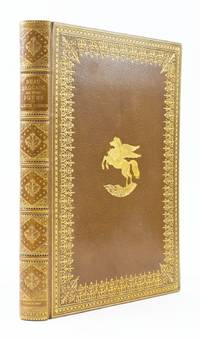
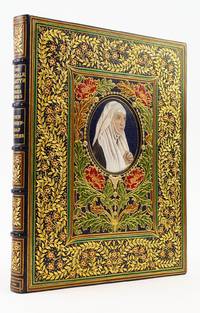
1914ST18714London 1914. 265 x 207 mm. 10 1/2 x 8 1/4". 41 3 blank pp. 1 leaf colophon. <br/> RESPLENDENT IN DARK BLUE MOROCCO RICHLY GILT AND ONLAID BY RIVIERE & SON stamp-signed on front doublure covers with wide frame of swirling gilt vines bearing red morocco blossoms and blue and green berries bordered by strips of green and tan morocco central panel of upper cover with recessed oval containing a portrait of a young nun sculpted in leather with painted details this encircled by an onlaid ivory morocco rosary and surrounded by an exuberant spray of red morocco poppies with green and tan leaves central panel of lower cover with an arch-backed black morocco cat beneath the arch of a gray morocco horseshoe at center a black and red witch's hat above the horseshoe and the whole on a very densely stippled gilt ground incised with calligraphic curls and set with nine silver stars around the cat this centerpiece surrounded by curling gilt vines bearing red morocco and gilt posies raised bands spine compartments framed with tan morocco and containing a gilt and onlaid floral sprig TAN MOROCCO DOUBLURES bordered by a strip of purple morocco this with onlaid green morocco frame adorned with gilt latticework densely stippled gilt cornerpieces set with purple morocco passionflowers all accented with inlaid circles of purple navy and green in varying sizes leather hinges apricot watered silk endleaves all edges gilt. In the original silk- and velvet-lined green morocco box. Numerous two- to three-line initials in red blue or burnished gold three three-line illuminated initials 11 five- to six-line initials in shades of purple blue and green with highlights of pink and burnished gold two of these with extensions running the length of the text and two incorporated into full borders four very large initials 12 lines or more in colors and gold five full borders that on title page incorporating a small oval miniature of Whittier and TWO FULL-PAGE MINIATURES one of a young nun at prayer the other of two lovers walking in a forest. Calligraphed colophon SIGNED by Sangorski stating: "This manuscript . . . was designed written out and illuminated by Alberto Sangorski for Messrs. R. Rivière & Son Bookbinders & Booksellers to his Majesty King George V. London. This manuscript will not be duplicated. This manuscript was executed by me." From the collection of Phoebe A. D. Boyle her sale at Anderson Galleries 19-20 November 1923 lot 368. Front flyleaf with engraved bookplate of comic book pioneer M. C. Gaines 1894-1947; typed description from "Kolb Collection" Louis Kolb laid in. Ratcliffe "Albert Sangorski Bibliography" SJR 245. Vellum a bit wavy as is typical but A BEAUTIFUL COPY the leaves creamy and bright being painted with rich colors and glittering gold and IN A FLAWLESS BINDING.<br/> <br/> This is an outstanding example of the artistry of Alberto Sangorski and that of the binders gilders and finishers of Riviere & Son the volume being executed at the zenith of their creative powers and formerly owned by the most important collector of Sangorski's manuscripts. Sangorski has written out and illuminated three poems by American author John Greenleaf Whittier: "The Female Martyr" inspired by an 18-year-old nun from the Sisters of Charity who died nursing cholera victims; "The Witch's Daughter" set in Puritan New England; and "Memories" a lover's touching reminiscences of youthful romance. In addition to elaborate initials and borders in his preferred palette of blues purples and greens brightened with burnished gold Sangorski has created two full-page paintings one of the beautiful young nun at prayer the other of youthful sweethearts strolling arm-in-arm through a wood. <br /> <br /> Alberto Sangorski 1862-1932 started his professional life as secretary to a goldsmith's firm became attracted to the book arts at the age of 43 and began doing illuminated manuscripts that were then bound by his brother Francis' firm Sangorski & Sutcliffe. Sometime around 1910 Alberto and Francis had a falling out and the artist went to work for Riviere the chief competitor to his brother's firm. Like the manuscript here our binding by Riviere is the work of many months with hundreds of individual inlays onlays and applications of gilt. Robert Riviere began as a bookseller and binder in Bath in 1829 then set up shop as a binder in London in 1840; in 1881 he took his grandson Percival Calkin into partnership at which time the firm became known as Riviere & Son and the bindery continued to do business until 1939. New York collector Phoebe A. D. Boyle was the widow of a canvas manufacturer who had made a fortune providing tents to the U.S. Army in the Civil War. George Sutcliffe described this important client as "rivalling the Medici in her patronage of the production of beautiful books." Stephen Ratcliffe deems the Boyle collection as "unrivalled" for its jewelled bindings and modern illuminated manuscripts; 33 of Alberto Sangorski's creations appeared in her sale at Anderson Galleries in 1923 and during World War I she was one of the only customers for extravagant productions like the present item. Any book from the Boyle collection which was put together with the greatest taste and discrimination is recognized as desirable beyond its intrinsic literary merit. unknown
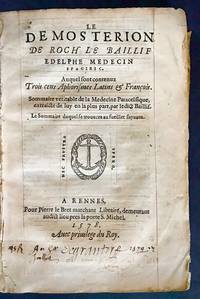
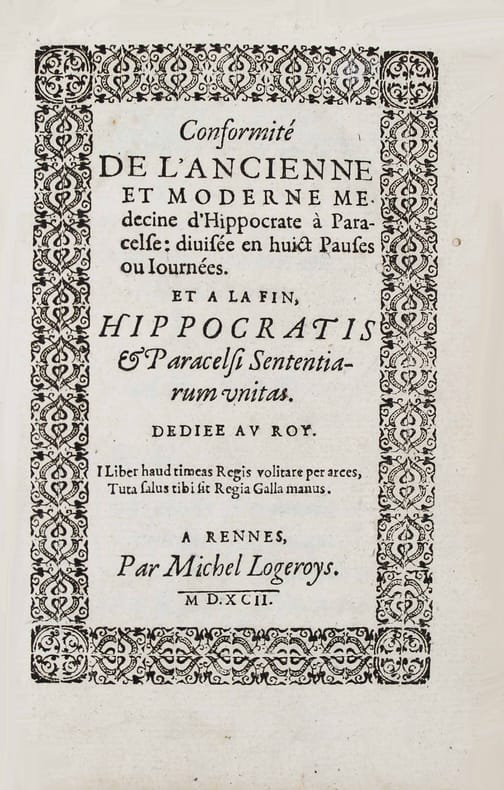
157810732Rennes: J. du Clos for P. Le Bret 1578. Contemporary vellum soiled and stained later manuscript spine title evidence of four pigskin ties slightly overlapping edges ruled in red. <p>      Only Antiquarian Edition. Half in French and half in Latin the Demosterion presents an introduction to Paracelsian medicine a distillation of its principles into three hundred bilingual aphorisms a work on divination a dictionary of terms a chiromantic essay and a balneological and mineralogical description of Brittany. Together the texts address alchemy geomancy astrology ethics dietetics physiology pathology and cures for ulcers leprosy edema plague gout and paralysis.<br />       Schematic the first plate outlines ailments and their cures according to Paracelsian principles. The second plate has a large woodcut with the Moon phases of a sidereal month noting enterprises and therapies favored on each day along with astrological influences.<br />       In good condition ink spots on the plates; two contemporary title inscriptions one dated 1579 19th-century manuscript shelf labels.<br /> ¶Trevor-Roper “The sieur de la Rivière Paracelsian physician to Henri IV†in Science Medicine and Society in the Renaissance: Essays to Honor W. Pagel ed. Debus II: 227-50; Baudry Contribution à l’étude du paracelsisme en France au XVIe siècle 1560-1580…Le Demosterion de Roch Le Baillif passim & 2172; Sudhoff Bibliographia paracelsica 181a n.; Duveen Bibliotheca alchemica 343-4 “very rareâ€; Brunet III: 897 “rare et curieuxâ€.</p> [J. du Clos] for P. Le Bret unknown
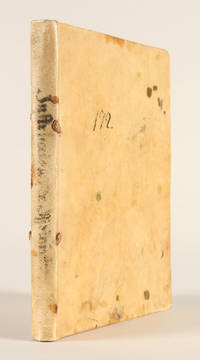
157810732Rennes: J. du Clos for P. Le Bret 1578. Contemporary vellum soiled and stained later manuscript spine title evidence of four pigskin ties slightly overlapping edges ruled in red. Only Antiquarian Edition: "The Demosterion provides the most extensive documentation of early French Paracelsianism" Baudry tr. Half in French and half in Latin its six parts present an introduction to Paracelsian doctrine a distillation of its principles into three hundred bilingual aphorisms a work on divination a dictionary of Paracelsian terms a chiromantic essay and a balneological and mineralogical description of Brittany. Together the texts address alchemy geomancy astrology ethics dietetics physiology pathology and cures for ulcers leprosy edema plague gout and paralysis.    Schematic the first plate outlines which remedy cures which ailment according to Paracelsian principles. The second plate has a large woodcut with the phases of the Moon passing through a sidereal month noting enterprises and therapies favored on each day along with astrological influences.    Complete and in good condition ink spots on the plates two contemporary title inscriptions one dated 1579 19th-century manuscript shelf labels.¶Trevor-Roper "The sieur de la Rivière Paracelsian physician to Henri IV" in Science Medicine and Society in the Renaissance: Essays to Honor W. Pagel ed. Debus 1972 II: 227-50; Baudry Contribution à l'étude du paracelsisme en France au XVIe siècle 1560-1580.Le Demosterion de Roch Le Baillif passim & 2172; Sudhoff Bibliographia paracelsica 181a n.; Duveen Bibliotheca alchemica 343-4 "very rare"; Brunet III: 897 "rare et curieux". [J. du Clos] for P. Le Bret unknown books
05208Oxford: The Clarendon Press 1925. The True Art of Memory is the Art of Attention" Samuel Johnson<br /> A Superb Cosway Binding with a Remarkable Portrait by Miss C.B. Currie of Dr. Samuel Johnson<br /> <br /> COSWAY BINDING. RIVIÈRE & SON binders. MISS C.B. CURRIE miniaturist. A Bibliography of Samuel Johnson by William Prideaux Courtney and David Nichol Smith. A Reissue of the Edition of 1915 Illustrated with Facsimiles. Oxford at the Clarendon Press 1925. <br /> <br /> Limited to 350 copies. Octavo 8 3/4 x 5 1/2 inches; 223 x 140 mm. i-viii 1-186 pp. Thirty-seven facsimile plates.<br /> <br /> Limitation statement at front "This is No. 926 of the Cosway Bindings invented by J. H. Stonehouse with Miniatures on Ivory by Miss Currie. Signed in black ink 'J.H. Stonehouse' Inventor. 'C.B. Currie' Artist."<br /> <br /> Bound by Rivière & Son in full dark green crushed levant morocco. Covers with gilt double-rule border the front cover set with superb and very large rectangular portrait miniature set under beveled glass measuring 4 7/8 x 3 7/8 inches; 123 x 98 mm. of a mature Dr. Samuel Johnson after Sir Joshua Reynolds by Miss C.B. Currie within an elaborate gilt foliate frame. Rear cover with gilt double-rule border and large decorative gilt foliate corner pieces. Spine with five raised bands elaborately tooled and lettered in gilt in compartments. Double gilt-ruled board edges decorative gilt turn-ins green moiré silk liners and endleaves top edge gilt others uncut. Stamp-signed by the binders on front turn-in: "Bound by Rivière & Son London." Stamped-signed by the artist on rear liner: Miniatures by C.B. Currie." Additionally signed on the upper and lower board edges: "Cosway Binding" and "Invented by J.H. Stonehouse."<br /> <br /> A wonderful and absolutely fine example of a real Cosway binding with a superb and large portrait miniature of Dr. Samuel Johnson. Housed in a felt-lined green cloth clamshell case spine with leather label lettered in gilt. <br /> <br /> Cosway Bindings: In the first decade of the twentieth century the London bookselling firm of Henry Sotheran & Co. introduced a type of binding that was decorative had historic associations and catered to the level of quality expected by connoisseurs at the time. Between 1902 and 1903 John Harrison Stonehouse 1864-1937 managing director of Sotheran's created what came to be referred to as "Cosway bindings." These were named after the celebrated eighteenth-century English portrait miniaturist Richard Cosway 1742-1821. Cosway bindings are distinguished by their attractive finely painted miniatures that are protected by glass and inset into the covers or doublures inside covers of elegantly tooled books. Stonehouse's success with the bindings was due in part to his employment of skilled miniaturist Miss C. B. Currie. It has been estimated that Miss Currie painted several thousand miniatures recognized for their delicate rendering and precision for over nine hundred bindings before her death circa 1940. For many of the more lavish Cosway bindings Currie painted multiple portraits. Occasionally landscapes and other subjects adorn the covers or doublures. To enhance Currie's miniatures Stonehouse arranged for the London firm of Rivière & Son to produce a variety of high-quality single-volume bindings. One of the best large-scale binderies active in the first quarter of the twentieth century Rivière & Son integrated the miniatures into bindings for both previously published editions and new works. Stonehouse marketed Sotheran's finished Cosway-bound volumes primarily to booksellers in the United States or to American agents. Before Sotheran's 1911 catalogue in which they identified the miniature artist as Miss Currie the miniatures are attributable only by their recognizable style. By 1913 many of the bindings were distinguished by a limitation statement on a colophon leaf where a publisher's emblem or trademark is placed which provides the number of the Cosway binding with facsimile signatures of Stonehouse and Miss Currie. The customary gilt-stamped signature on the turn-in is generally lettered: "Bound by Rivière & Son from Designs by J. H. Stonehouse" and "Miniatures by C. B. Currie." <br /> <br /> "Miss C.B. Currie" December 12 1849 - April 2 1940 was the miniaturist artist of all the genuine Cosway bindings. Born in Cornwall England Caroline Billin Curry was also one of the most prominent fore-edge artists in the twentieth-century. A master of the art of miniature painting she excelled as a copyist working for Henry Sotheran Booksellers London. She became famous for her miniature paintings applied to two art forms. First mounted on Rivière bindings and named by her employer as "Cosway" bindings. Later she expanded her work into the art of painting on the fanned edge of a book - called a fore-edge painting. Oxford: The Clarendon Press, 1925 unknown
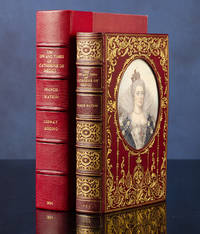
05209London: Hutchinson & Co 1934. Happiness is the one Thing we Queens can never have." Catherine de' Medici<br /> A Superb Cosway Binding with a Fine Portrait by Miss C.B. Currie of Catherine de' Medici<br /> <br /> COSWAY BINDING. RIVIÈRE & SON binders. MISS C.B. CURRIE miniaturist. WATSON Francis. The Life and Times of Catherine de' Medici. With 16 Illustrations. London: Hutchinson & Co 1934. <br /> <br /> First edition. Octavo 8 7/8 x 5 3/4 inches; 226 x 146 mm. 1-287 1 blank pp. Photogravure frontispiece with original tissue guard and fifteen photogravure plates.<br /> <br /> Limitation statement at front "This is No. 912 of the Cosway Bindings invented by J. H. Stonehouse with Miniatures on Ivory by Miss Currie. Signed in blue & black ink 'J.H. Stonehouse' Inventor. 'C.B. Currie' Artist."<br /> <br /> Bound by Rivière & Son in full maroon crushed levant morocco. Covers with gilt double-rule border the front cover set with superb large oval portrait miniature set under glass measuring 4 3/4 x 3 3/4 inches; 121 x 95 mm. of Catherine de' Medici by Miss C.B. Currie within an elaborate gilt scroll design. Rear cover with double-rule borders and broken gilt fillet border with gilt rococo corner ornaments. Spine with five raised bands elaborately tooled and lettered in gilt in compartments. Double gilt-ruled board edges decorative gilt turn-ins light blue moiré silk liners and endleaves All edges gilt. Stamp-signed by the binders on front turn-in: "Bound by Rivière & Son." Stamped-signed by the artist on rear liner: Miniatures by C.B. Currie." Additionally signed on the upper and lower board edges: "Cosway Binding" and "Invented by J.H. Stonehouse." Housed in a felt-lined quarter red morocco over red cloth boards clamshell case by Zaehnsdorf spine with five raised bands lettered in gilt in compartments. A very fine example of a real Cosway Binding from the library of Paul Edward Chevalier with his circular red leather bookplate on front blank. <br /> <br /> This book appeared in the Chevalier Collection of English Twentieth-Century Bookbindings. Christie's New York Friday November 9th 1990 lot #72.<br /> <br /> Cosway Bindings: In the first decade of the twentieth century the London bookselling firm of Henry Sotheran & Co. introduced a type of binding that was decorative had historic associations and catered to the level of quality expected by connoisseurs at the time. Between 1902 and 1903 John Harrison Stonehouse 1864-1937 managing director of Sotheran's created what came to be referred to as "Cosway bindings." These were named after the celebrated eighteenth-century English portrait miniaturist Richard Cosway 1742-1821. Cosway bindings are distinguished by their attractive finely painted miniatures that are protected by glass and inset into the covers or doublures inside covers of elegantly tooled books. Stonehouse's success with the bindings was due in part to his employment of skilled miniaturist Miss C. B. Currie. It has been estimated that Miss Currie painted several thousand miniatures recognized for their delicate rendering and precision for over nine hundred bindings before her death circa 1940. For many of the more lavish Cosway bindings Currie painted multiple portraits. Occasionally landscapes and other subjects adorn the covers or doublures. To enhance Currie's miniatures Stonehouse arranged for the London firm of Rivière & Son to produce a variety of high-quality single-volume bindings. One of the best large-scale binderies active in the first quarter of the twentieth century Rivière & Son integrated the miniatures into bindings for both previously published editions and new works. Stonehouse marketed Sotheran's finished Cosway-bound volumes primarily to booksellers in the United States or to American agents. Before Sotheran's 1911 catalogue in which they identified the miniature artist as Miss Currie the miniatures are attributable only by their recognizable style. By 1913 many of the bindings were distinguished by a limitation statement on a colophon leaf where a publisher's emblem or trademark is placed which provides the number of the Cosway binding with facsimile signatures of Stonehouse and Miss Currie. The customary gilt-stamped signature on the turn-in is generally lettered: "Bound by Rivière & Son from Designs by J. H. Stonehouse" and "Miniatures by C. B. Currie." <br /> <br /> "Miss C.B. Currie" December 12 1849 - April 2 1940 was the miniaturist artist of all the genuine Cosway bindings. Born in Cornwall England Caroline Billin Curry was also one of the most prominent fore-edge artists in the twentieth-century. A master of the art of miniature painting she excelled as a copyist working for Henry Sotheran Booksellers London. She became famous for her miniature paintings applied to two art forms. First mounted on Rivière bindings and named by her employer as "Cosway" bindings. Later she expanded her work into the art of painting on the fanned edge of a book - called a fore-edge painting. <br /> <br /> Catherine de' Medici 1519-1589 was an Italian noblewoman. She also was queen consort of France from 1547 until 1559 by marriage to King Henry II and mother of kings Francis II Charles IX and Henry III. The years during which her sons reigned have been called "the age of Catherine de' Medici" as she had extensive if at times varying influence in the political life of France. London: Hutchinson & Co, [1934] unknown
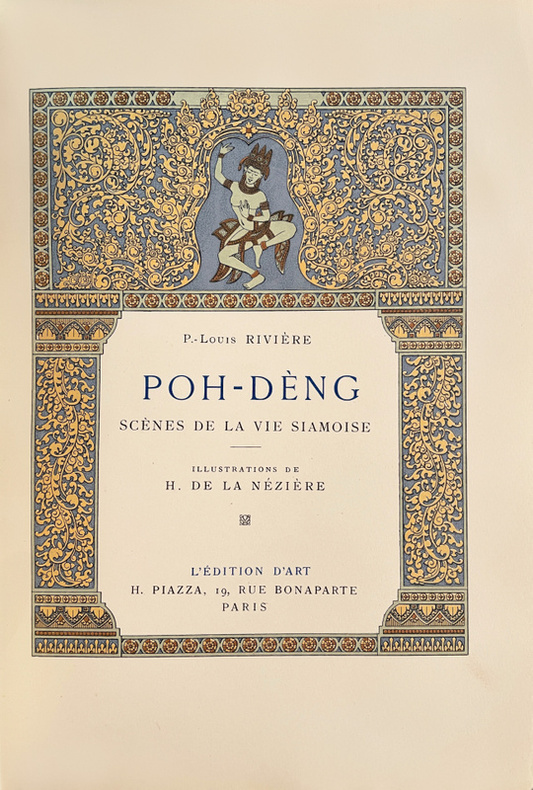
LCS-17951Le présent exemplaire fait partie des 288 exemplaires imprimés sur papier vélin à la cuve des manufactures Blanchet et Kléber et porte le n°83. Paris, L’édition d’art, H. Piazza, s.d. [1913]. In-4 de (2) ff.bl., 179 pp., (3) ff. Couverture supérieure, pp. 51-52, p. 107 et pp. 35-36 répétées deux fois à la fin. Conservé dans une reliure très raffinée spécialement exécutée pour cet ouvrage, veau ivoire en box mosaïqué décoré sur chaque plat d'une grande composition figurative dans les tons rouge, rose, orange et vert, figurant une scène avec un dragon, dos lisse, non rogné, tranche supérieure dorée, couverture et dos conservés. Reliure signée Georges Baudin. 229 x 159 mm.
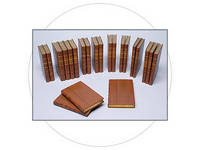
00231London: various publishers 1748. A Fine Collection of Smollett First Editions <br/><br/>SMOLLETT Tobias. The Adventures of Roderick Random. In Two Volumes. London: Printed for J. Osborn 1748. Together with: The Adventures of Gil Blas of Santillane. A New Translation by the Author of Roderick Random. Adorned with Thirty-Three Cuts Neatly Engraved. In Four Volumes. London: Printed for J. Osborn 1750. And: The Adventures of Peregrine Pickle. In which are included Memoirs of a Lady of Quality. In Four Volumes. London: Printed for the Author: And Sold by D. Wilson 1751. And: The Adventures of Ferdinand Count Fathom. By the Author of Roderick Random. In Two Volumes. London: Printed for W. Johnston 1753. And: The Adventures of Sir Launcelot Greaves. By the Author of Roderick Random. In Two Volumes. London: Printed for J. Coote 1762. And: The History and Adventures of an Atom. In Two Volumes. London: Printed for J. Almon 1769. And: The Expedition of Humphry Clinker. By the Author of Roderick Random. In Three Volumes. London: Printed for W. Johnston and B. Collins 1671 i.e. 1771. And: The Adventures of Telemachus the Son of Ulysses. Translated from the French of Messire François Salignac de la Mothe-Fenelon Archbishop of Cambray. By T. Smollet M.D. London: Printed for S. Crowder T. Longman G. Robinson R. Baldwin and E. Johnston 1776. And: Plays and Poems Written by T. Smollet M.D. With Memoirs of the Life and Writings of the Author. London: Printed for T. Evans and R. Baldwin 1777.<br/><br/>All first editions first edition in book form of The Adventures of Sir Launcelot Greaves. Together nine works in twenty-two twelvemo volumes.<br/><br/>Uniformly bound in early twentieth-century polished calf by Rivière & Son stamp-signed on the verso of the front free endpaper. Covers ruled in blind spines ruled in blind with five raised bands and two olive green morocco gilt lettering labels all edges gilt marbled endpapers. Date in gilt at foot of spine. A superb collection.<br/><br/>Tobias Smollett 1721-1771 "English satirical novelist best known for his picaresque novels. Smollett apprenticed as a surgeon and throughout his life he combined the roles of medical man and writer.In 1748 Smollett published his novel Roderick Random a graphic account of British naval life at the time and he also translated from the French the great picaresque romance Gil Blas. Peregrine Pickle was published in 1751 and The Adventures of Ferdinand Count Fathom.appeared in 1753.He translated Don Quixote from the Spanish 1755 and in 1756 he became editor of The Critical Review a Tory and church paper at the same time writing his four-volume Complete History of England 1757-58.In 1759 he was convicted for libel on Admiral Sir Charles Knowles in The Critical Review fined and sentenced to three months' imprisonment in the King's Bench Prison. He drew on his experiences there for his two-volume novel The Adventures of Sir Launcelot Greaves 1762.His finest work Humphry Clinker 1771 recounts the adventures of a family traveling through Britain" Merriam-Webster's Encyclopedia of Literature.<br/><br/>Rothschild 1905 1910 1912 1919 note 1923 and 1925. Tinker 1924 1927 1932 and 1933. London: [various publishers], 1748 unknown books
18450002564Good. 1845. On offer is a sensational remarkable group of 1845 manuscript depositions detailing the mutinous activity and desertions during a voyage of the whaling Bark Alto between 1844 - 1845. The eyewitness testimonies are comprised of 37 pages or so of handwritten fair copies; five 5 complete and one 1 incomplete deposition all by various crew members the five complete copies each personally attested and signed at the conclusion by George William Gordon American Consul at Rio de Janeiro May 20 1845. Blunt facts display the ferocity of emotions and simmering violence provide snippets like 'Palmer said to deponent that . . . he would put one of those dirk knives into him' abound throughout the testimonies. The depositions paint a picture of unbridled upset on the ship: lawlessless violence suspicions of poisoning desertion and a final critical comment from nature itself: a calamitous lightning strike makes for a final exclamation point to the awful whaling voyage. The vessel at the center of the events described herein the Alto was built in Tiverton Rhode Island we note that research indicates the Alto was in fact the only such vessel ever built at Tiverton in 1826 and was lost near the Falkland Islands in 1870. The National Maritime Digital Library date the events related in the documents occurred during the Alto's fourth voyage under the direction of Captain Nehemiah West whose deposition is included and which lasted from September 1844 to April 1847. A successful voyage commercially as the records further note that the Alto collected 339 barrels of sperm oil 304 barrels of baleen oil and 2700 lbs. of whale bone. As a group the depositions--from the Captain First Second and Third Mates and two boat helmsmen paint a vivid often harrowing picture of a voyage fraught with tension and danger. Researchers and historians will note that at least two of the depositions document an ominous shipboard discussion of the earlier well-documented mutiny aboard the vessel Globe out of Nantucket which took place in 1827. While the general outline of the events remains consistent throughout each of the deponents provides a unique personal perspective on what transpired often with the addition of unexpected or surprising details omitted by the others. Virtually all of the crew involved are identified by name multiple times throughout the documents two however are repeatedly described only as "Portuguese". In broad overview complaints from crew members that the vessel is leaky and unseaworthy leads to refusal to perform duties; the captain administers punishment including placing crew members in irons and striking them with a piece of "rattling" ratline; a small group of crew desert with one of the boats but are caught and jailed at St. Jago Cape Verde and shipped back to the U.S. on the U.S. Sloop of War Decatur; after a few months of relative calm unrest breaks out again this time with threats of violence to fellow crew members with clubs and "dirk knives"; in the most dramatic event eleven crew members desert with the remaining two boats taking with them a large store of the whaling equipment. The Alto its crew and equipment drastically reduced suffers the final indignity of a lightning strike "breaking and splitting" the mainmast but is able to hobble into Rio de Janeiro where these eyewitness accounts were given to the American Consul and preserved in the present documents. Here is a snippet from the deposition of helmsman William Williams approx. 8 pages on two pairs of conjugate leaves: "William Williams . . . deposed as follows. . . . That he was born in the County of Essex in England is 29 years of age and a naturalized citizen of the United States was naturalized at Boston Mass. in July 1842. That he shipped on board the Barque 'Alto'--Nehemiah West Master at New Bedford in August 1844 as Boat steerer to proceed on a Whaling Voyage. That the Vessel sailed on the 3rd September following. That 14 or 15 days after the Vessel went out to sea all the foremost hands refused duty--alleging that the Vessel was leaky. On their refusing duty Captain West interrogated each of them separately and three of them returned to duty and eleven still refused and were sent below where they were kept about 48 hours. While the eleven men were below as aforesaid they experienced two very heavy squalls but none of said men offered to return to duty--but on the other hand made sport of them that were at work. After they had been below deck 24 hours the Master went forward and requested four of the men to come on deck. They refused to come unless all were allowed to some on deck at a time--and after a good many threats on the part of the men the Master told them that if the men he had called did not come on deck that he would have the forecastle smoked to force them out. Soon after four came on deck as the Master had directed and still refusing to go to duty on being called upon the deck and refusing duty were put in Irons and the others one being called upon deck and refusing duty were seized in the rigging there being no Irons to put upon them. That at New Bedford before sailing one of the men named Spencer who had shipped deserted and another man named Charles Shane came on board in his place--but Shane's name was not put on the Papers. That when the men were called up as aforesaid said Shane took the ground that his name was not upon the Shipping Paper and therefore he would not go to duty and obey the Master--upon which the Master gave him four blows with a piece of Rattling i.e. part of the ratline. George Ritter also who was supposed to be the instigator in the men's refusing duty and who was insolent to the Master also receive three strokes with the Rattling. Another man the steward named James Wilson also got three blows with the Rattling for insolence to the Captain. He said that he never was flogged on board of a Blubber Hunter although he had been on board of a Man of War. No others were flogged or punished in any way and they all returned to duty." Scattered light soiling a bit of staining and handling wear creases; some tears tiny holes and small chips mostly confined to edges; no substantial losses; otherwise very good to fine overall the writing dark and distinct. Overall G.; Manuscript; 4to - over 9¾" - 12" tall; KEYWORDS: HISTORY OF WHALING SHIP MUTINY BARK ALTO NEW BEDFORD MASSACHUSETTS WHALERS MUTINEERS DESERTERS BARQUE MARINE NAUTICAL NAVAL GEORGE WILLIAM GORDON AMERICAN CONSUL AT RIO DE JANEIRO CAPTAIN NEHEMIAH WEST TIVERTON RHODE ISLAND MUTINY ABOARD THE VESSEL GLOBE NANTUCKET AMERICANAHANDWRITTEN MANUSCRIPT DOCUMENT LETTER AUTOGRAPH WRITER HAND WRITTEN DOCUMENTS SIGNED LETTERS MANUSCRIPTS HISTORICAL HOLOGRAPH WRITERS AUTOGRAPHS PERSONAL MEMOIR MEMORIAL AMERICANA ANTIQUITÉ CONTRAT VÉLIN DOCUMENT MANUSCRIT PAPIER ANTIKE BRIEF PERGAMENT DOKUMENT MANUSKRIPT PAPIER OGGETTO D'ANTIQUARIATO ATTO VELINA DOCUMENTO MANOSCRITTO CARTA ANTIGÜEDAD HECHO VITELA DOCUMENTO MANUSCRITO PAPEL . unknown
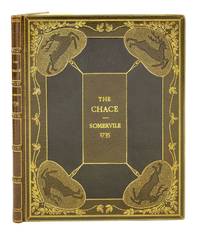
1735ST15797London: Printed for G. Hawkins and sold by T. Cooper 1735. FIRST EDITION. ONE OF 750 COPIES. 263 x 207 mm. 10 1/4 x 8 1/8". 6 p.l. 106 pp. 1 leaf errata. <br/> SUPERB OLIVE GREEN CRUSHED MOROCCO BY RIVIERE & SON stamp-signed on front turn-in cover with lettered central panel surrounded by four onlaid sections of darker green morocco outer frame of leafy vines emanating from the tips of the fan-palm-shaped cornerpieces each of these compartments with a blind-stamped leaping stag on a stippled gold ground raised bands spine with gilt-ruled compartments gilt titling gilt-ruled turn-ins all edges gilt. In a somewhat worn fleece-lined burgundy buckram chemise and marbled paper slipcase. Engraved allegorical frontispiece featuring Diana and Apollo by Scotin after Gravelot. Front pastedown with morocco ex-libris of Alfred Barmore Maclay. Foxon S-562; Hayward 158; Rothschild 1932; Schwerdt II 166. ◆Leather on spine uniformly sunned to olive brown as expected with green morocco text perhaps lightly washed and pressed in keeping with bibliophilic fashion at the time of binding occasional faint marginal smudges otherwise fine internally and in a very lustrous binding with no signs of wear.<br/> <br/> This is the first edition of the most popular work by Somerville 1675-1742 a mock-heroic poem about hunting in an apt and very striking binding by a renowned English workshop. Divided into four books of Miltonic blank verse "The Chace" is considered to be one of the finest didactic poems of the first half of the 18th century. The text covers hounds and their kennels along with the hunting of hare fox and otter and there are digressions that bring in methods of the chase in exotic localities. Most of the hunts described are accompanied by dogs and set in England past or present but the poet occasionally strays far afield to describe lion stalking or the hunting habits of Genghis Khan. According to Schwerdt the book was "highly approved of by the first literary characters of his day." The extraordinarily handsome binding by Riviere incorporates the hunting motif with four stags appearing to chase one another around the covers. Riviere is one of the foremost names in English binding partly because the firm did consistently fine work and partly because it was so long in business. Robert Riviere began as a bookseller and binder in Bath in 1829 then set up shop as a binder in London in 1840; in 1881 he took his grandson Percival Calkin into partnership at which time the firm became known as Riviere & Son and the bindery continued to do business until 1939. Our volume comes from the library of Alfred Barmore Mackay 1871-1944 who after a very brief career at his family's bank devoted himself to collecting books art and antiques engaging in equestrian sports and designing a sumptuous garden at his Florida estate now a state park. Printed for G. Hawkins, and sold by T. Cooper unknown
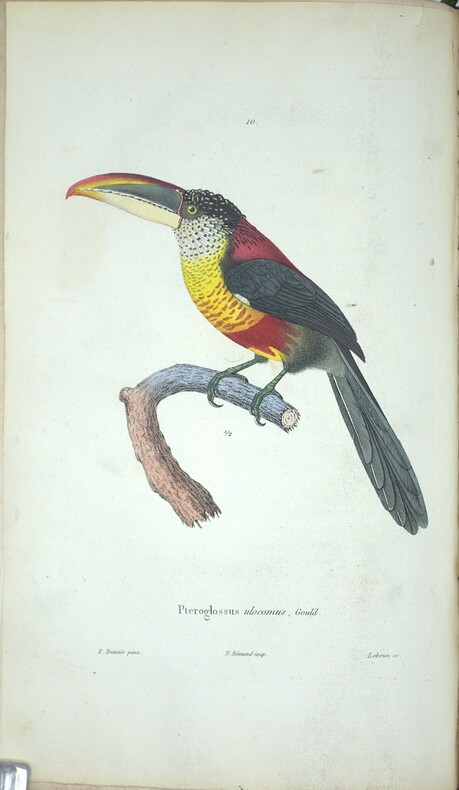
1833PHO-2302Paris, Imprimerie Royale, Arthus Bertrand, au dépôt général de la marine, 1833-1839. 5 vol. in-8 (25,5x16,5cm) demi-chevrette rouge, dos à nerfs orné (reliure de l'époque), supplément lépidoptères broché de I. [2] ff.-xli-558-[1] pp. ; II. [2] ff.-481-[1] pp., grande carte dépliante (piqûres, coupures aux pliures sans manque) ; III. [2] ff.-510-[1] pp. ; IV. [2] ff.- 480 pp. ; V. [2] ff., 195-200 pp., Supplément Lépidoptères 30pp., 70 planches dont 61 soigneusement aquarellées. Rousseurs touchant principalement le texte et très peu les planches, mouillures claires par endroits au texte, feuillets volants pour le supplément. Sans les deux grands atlas historique et hydrographique, mais bien complet du très rare 5e volume d'histoire naturelle, paru ultérieurement qui manque presque toujours et complet des planches. Ce rarissime cinquième et dernier volume de texte, qui comporte 2 parties, renferme le rapport fait à l'Académie des sciences le 4 février 1833 sur les collections d'histoire naturelle recueillies pendant le voyage de la corvette La Favorite…, les Recherches sur les marsupiaux par Fortuné Eydoux et Laurent, la 2e partie Zoologie par Fortuné Eydoux et Paul Gervais, le supplément sur les Lépidoptères nouveaux par Feisthamel.
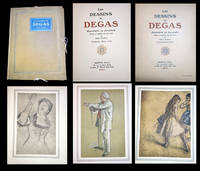
1922N - 2026 - 26<p>A rare copy of the complete portfolio Les Dessins de Degas 1922–1923. Published by P. Demotte the set includes the first series 1922 and second series 1923 accompanied by a foreword by Henri Rivière. This portfolio comprises the full series of 100 plates together with the original title pages and table of contents. The prints are presented as loose sheets collected into four separate folders and housed within the original linen-covered portfolio with ties. This copy is number 72 from a limited edition of 250 copies. <br />The plates are heliogravure reproductions of Edgar Degas's drawings selected from multiple original works. Together they form a curated anthology of Degas's charcoal drawings pencil studies pastels and compositional sketches assembled by Demotte to illustrate the breadth of Degas's draftsmanship and his evolving working process.<br />Condition minor scuffing and warping to the folder covers light toning in very good condition.</p> P. Demotte
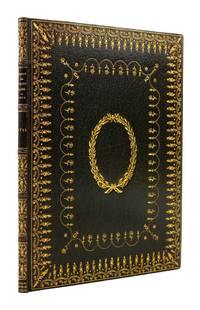
1711ST20182London: W. Lewis 1711. FIRST EDITION First Issue. 280 x 152 mm. 8 1/8 x 6". 1 p.l. 43 1 pp. <br/> VERY PRETTY DARK GREEN CRUSHED MOROCCO ELABORATELY GILT IN PERIOD STYLE BY RIVIERE & SON stamp-signed on front turn-in covers with double frames formed of floral sprigs drawer handles and other small tools the frames enclosing an elegant central wreath; raised bands spine panels densely gilt with stippling floral tools radiating from small central flower gilt lettering turn-ins densely gilt with scrolling foliate tools all edges gilt. With an attractive woodcut headpiece and tailpiece; one foliated woodcut initial. Front pastedown with the bookplate of Winston Henry Hagen and book label of William A. Strutz. Griffith 2; Rothschild 1564; Foxon P806; Day "History of English Literature 1600-1837" pp. 73-4. Sheets uniformly a little toned because carefully washed the usual offsetting on facing flyleaves from turn-ins but a very pleasing copy--the text without signs of use and the exceptionally pretty binding lustrous and virtually unworn.<br/> <br/> This first printing of Alexander Pope’s first independent publication called by Day "one of the most quoted poems in English" offers a sumptuous binding in the style of the period retains its scarce original half-title and boasts an impressive provenance. Pope 1688-1744 composed "An Essay on Criticism" early in his career possibly when he was just 18. In this poem which introduced several expressions now common in the lexicon including "to err is human; to forgive divine" and "fools rush in where angels fear to tread" Pope provides his philosophy on what makes good criticism and by extension good poetry. Of it Day writes: "no one can claim originality for the content of 'Essay on Criticism' but all must admit the incomparable mastery of verse and language." This copy retains the half-title which is often missing primarily because it was often used as part of the volume's wrappers. Our copy does lack the final leaf of ads as almost always with copies of this edition. The strikingly attractive binding done in an elaborately gilt style reminiscent of a Roger Payne design is the work of Riviere one of the foremost names among English binderies. Our copy has belonged to two notable collectors. According to Dickinson Hagen 1859-1918 was a collector whose library especially strong in English literature "reflected a highly developed intelligent connoisseurship." Beverly Chew wrote in the foreword to the catalogue for the Hagen sale at Anderson Galleries 13 May 1918 that the library which featured high spots bought at the Lefferts and Poor sales "was one of the best ever submitted to the public at auction." William A. Strutz 1934-2024 was a North Dakota attorney and passionate bibliophile who assembled a library of over 15000 rare and important literary works. Our first printing of "Essay on Criticism" is not easy to find in the attractive condition seen here. W. Lewis unknown
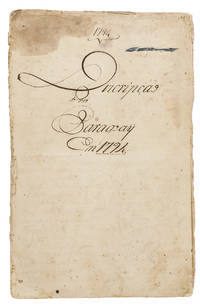
1794ABC_47826Paraguay and/or Brazil 1794. 34 x 22 cm. Stitched through 2 single holes only one remains intact. Written in brown ink in a very legible late 18th-century cursive. 1 1 blank 12 2 blank pp. A contemporary unpublished and unrecorded Portuguese manuscript describing the Paraguay River and the lands rivers and territories adjoining including the location of former Jesuit Missions. It is written within the context of the Portuguese-Spanish dispute over the frontier between Portuguese Brazil and the Spanish colonies and focuses in particular on the upper reaches of the river which at that time still remained relatively unknown. The Portuguese under the governorship of Luis de Albuquerque 1739-97 had recently in 1778 established the towns of Albuquerque today Corumbá Laredo Villa María today Cáceres Casalvasco and Salinas. These new establishments and their locations on the Paraguay River are mentioned here. The terms of the 1777 Treaty of San Ildefonso between Portugal and Spain directed that a Portuguese-Spanish delegation be sent to the Paraguay River region to determine a definitive border between the territories. The Spanish delegation arrived in 1781 under the command of the military officer and naturalist Félix Manuel de Azara 1746-1821 and waited in Asunción in Paraguay for the Portuguese. The latter in the end never arrived but the Spanish delegation remained in the region until the 1790s Azara until 1801 exploring and measuring the region as well as handling the ongoing disagreements with the Portuguese over the demarcation. This Portuguese description of the River Paraguay is undoubtedly connected to these ventures though whether it is a contemporary translation into Portuguese of a Spanish survey or a survey of the river carried out by the Portuguese themselves is uncertain. It is however the only known copy of an unpublished description of the River Paraguay and it describes in detail the little-known upper regions of the Paraguay River.With a crossed-out annotation on the title-page the title-page and the last blank leaf are somewhat water stained. The paper is otherwise uniformly toned and showing some occasional foxing the edges of the leaves are somewhat frayed slightly affecting the text at the head of each page. Overall in good condition. unknown
18726405London: John Camden Hotten and George Routledge and Sons 1872. First editions. Two octavo volumes 7 1/4 x 5 1/4 inches; 184 x 133 mm. & 7 x 5 3/8 inches; 179 x 137 mm. ix 2 14-222 4 adv.; viii 1 14-224 4. adv. pp. Black and white frontispieces with original tissue guards black and white text illustrations throughout. Bound c. 1920 by Rivière & Son for the Gardenside Bookshop Boston in full emerald crushed levant morocco with a gilt decorated broad inlaid border of maroon morocco enclosing an elaborate gilt frame surrounding a maroon morocco border and decorated sunken central panel within which are figures from the text pictorially depicted with multi-colored padded morocco onlays. The Bab Ballads with the onlaid figures of Babette and Jacot page 67 and More Bab Ballads with the onlaid figures of Sir Berkely and William Lee page 122. Lower boards with gilt ruled maroon morocco border surrounding an elaborate gilt border with decorative gilt corner pieces. Spines with five raised bands decoratively tooled and lettered in gilt in compartments gilt ruled board edges elaborate gilt turn-ins cream watered silk liners and end-leaves all edges gilt. Original gilt decorated green cloth covers bound in at end of each volume. Outer front joint of volume 2 with subtle repairs. Housed together in the original felt-lined green cloth slipcase. A fine set.<br /> <br /> This publication evidences how a writer's work is never done. First published as a humorous column in Fun magazine in 1876 Gilbert collected fifty of his favorite poems for the book Fifty "Bab" Ballads:Much Sound and Little Sense it contained one poem collected for the first time titled "Etiquette" and excluded 25 previously published poems. As Gilbert explained: "The period during which they were written extended over some three or four years; many however were composed hastily and under the discomforting necessity of having to turn out a quantity of lively verse by a certain day in every week. As it seemed to me and to others that the volumes were disfigured by the presence of these hastily written impostors I thought it better to withdraw from both volumes such Ballads as seemed to show evidence of carelessness or undue haste and to publish the remainder in the compact form under which they are now presented to the reader" Gilbert. However "Gilbert's readers were not happy with the loss and in 1882 Gilbert published all of the poems that had appeared in either The "Bab" Ballads or More "Bab" Ballads once again excluding "Etiquette." Some twentieth-century editions of More "Bab" Ballads include "Etiquette" Ellis. The poems range from satire to absurdist texts and will surely entertain all who read them.<br /> <br /> "The Riviere Bindery was one of the most notable and prolific shops in London's West End from about 1840 through 1939" Princeton. Bath-based Bayntun Bindery acquired the firm in 1939 transforming into the "Bayntun-Riviere bindery" which is still in existence and family owned. John Camden Hotten [and] George Routledge and Sons unknown
19266406London: John Lane The Bodley Head Ltd 1926. Fine. A very fine and unique copy. Specially bound with two superb original watercolor paintings on both of the calf doublures by Helen R. Haywood. Octavo 7 1/8 x 4 1/2 in; 181 x 113 mm. lxxxix 4 454 14 as Anglers' Calendar pp. Black and white illustrations throughout some full-page. Initials and vignettes. Inserted limitation leaf "With Water/Colour Drawings/on/Calf Doublures/by/signed Helen R. Haywood." Bound by Rivière & Son c. 1926 stamp-signed in gilt on front turn-in. Full forest green crushed morocco covers with gilt double-rule border spine with five raised bands decoratively tooled and lettered in gilt in compartments. Double gilt-ruled board edges decorative gilt ruled turn-ins enclosing calf doublures with full angling-themed original watercolor paintings. Green moire silk free endpapers all edges gilt. Housed in a felt-lined green cloth clamshell case spine with leather label lettered in gilt. <br /> <br /> Izaak Walton's The Compleate Angeler 1653 is perhaps the quintessential pastoral work on fishing. Structured as a dialogue between a fisherman huntsman and fowler the book is a celebration of the natural world and the thrills of fishing as a pastime. The two exquisite original watercolors on calf elegantly reproduce at the front "Come now bait your hook again and lay it into the water for it rains again" Compleat Angler Fourth Day and at the rear "Marry God requite you sir and we'll eat it cheerfully" Compleat Angler Third Day. Helen Riviere Haywood 1908-1995 was an English painter children's book illustrator and writer best known for her foredge paintings. She came from a book-binding family: Haywood was the granddaughter Robert Riviere founder of the great bindery which executed this lovely binding and her uncle who also worked for the firm introduced her to foredge and double foredge painting. Between the 1930s-1970s she completed multiple commissions for Inman's Books a New York City based antiquarian book dealer. From her intertest in science anthropology and naturalism Haywood developed a keen attention to the world's natural elements; this talent for observation and specificity found its way into her artwork.<br /> <br /> Provenance: Purchased by David Brass Rare Books from John & Judith Head May 2012; sold to Randal Moscovitz December 2012. Fine. John Lane The Bodley Head Ltd unknown
1739WRCAM52099Manila 1739. 3611 leaves. Small quarto. Slightly later limp vellum spine title in manuscript edges sprinkled red remnants of two ties at fore-edge. Boards with some ink and dampstaining corners bumped. Small unobtrusive stamp on titlepage verso. Contemporary manuscript inscriptions on front and rear endpapers. Light tanning else internally clean. Very good. An exceedingly rare work printed at the University of St. Thomas in Manila the first university in Asia providing instructions to the Order of Dominicans in the Philippines for the completion of their various religious duties. A second work on the privileges allowed to various members of the order and those accorded to natives is also included with continuous foliation. Del Rio was a Dominican who had arrived in the Philippines in 1713. He worked primarily in the town of Pangasinan eventually became the Procurator General of the provincial order and is known to be the author of one other work an account of a small Philippine mission also from 1739. The Dominicans first arrived in the Philippines in 1587 and used Manila as the base of their operations in Asia and the Pacific. Not in the National Library of Spain OCLC locates only one copy of the present work at the Boston Public Library. MEDINA MANILA 207. LeCLERC 2939. PALAU 268230. OCLC 317736434. hardcover books
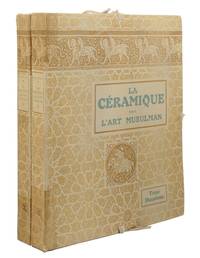
1923140945683Paris: Emile Lévy 1923. First edition. First edition. Complete in two imperial folio volumes immense illustrated boards with cloth ties containing loose sheets. Copy #49 of 200 total. Text in French. Ex-art museum library copies with tiny call numbers written on spines card pocket on paste down tape stains to cloth and tape on inside of boards; despite this Very Good overall a few ties have perished typical age-toning to contents but generally bright.All 100 plates and their textual pages present. Numbers written on plates in light pencil. A deluxe monograph about Muslim ceramics with large color plates.<br /> <p>Please note: these volumes are exceptionally heavy and large and will require substantial additional cost if shipping outside of the USA. Emile Lévy unknown
19642091202133213239Ganku Shoten Hosekisha Kobunsha 1964. Soft Cover. Fine. Number of books: 203 Ganku Shoten, Hosekisha, Kobunsha paperback
1892ST17864eLondon: Kegan Paul Trench Trübner & Co 1892. No. 10 OF 450 LARGE PAPER COPIES 250 for England and 200 for America SIGNED by the author on the limitations page. 253 x 178 mm. 10 x 7". xiii 3 83 9 pp. <br/> ELEGANT CONTEMPORARY TAN MOROCCO GILT BY RIVIERE & SON stamp-signed on front pastedown "Bound by Riviere & Son for L. Samuel Montagu 1893" covers with gilt rule and bead-and-star roll border intricate dentelle frame Pegasus ornament at center raised bands spine compartments with central fleuron enclosed by a lozenge of star tools curling cornerpieces gilt lettering densely gilt turn-ins marbled endpapers top edge gilt other edges untrimmed. Original ivory cloth binding bound in. With 50 illustrations by Hugh Thomson 25 of these plates printed on Japanese vellum. Signed on title page by the artist. AN IMMACULATE COPY.<br/> <br/> This collection of 18th century-style ballads by a poet of the Aesthete School comes in a refined binding that captures the elegance of that time. Described by Day as a "genteel bureaucrat" who specialized in "the graceful insouciance of 'vers de société' rather than the 'flowers of evil'" favored by others of his cohort Henry Austin Dobson 1840-1921 wrote light witty verse that reflected his fascination with the 18th century. Day notes that "he could write heroic couplets with much of Pope's conversational ability" and "could reproduce the elaborate French stanzas" of triolet ballade and rondeau with a finesse matched by few Englishmen. Dobson's extensive knowledge of the 18th century was so respected that DNB says "any publisher intending to reissue an eighteenth-century work went to Dobson for an introduction." Our binder Riviere is one of the foremost names in English binding partly because the firm did consistently fine work and partly because it was so long in business. Robert Riviere began as a bookseller and binder in Bath in 1829 then set up shop as a binder in London in 1840; in 1881 he took his grandson Percival Calkin into partnership at which time the firm became known as Riviere & Son and the bindery continued to do business until 1939. This binding was done for L. Samuel Montagu perhaps Louis Samuel Montagu 1869-1927 son of financier Liberal MP and philanthropist Samuel Montagu 1st Baron Swaythling. While the delicate filigree tooling is very characteristic of Riviere's finishing the Pegasus centerpiece is not a regular Riviere tool and was perhaps particular to this client. In any case the brilliant gilt and intricate finishing make for a memorable piece of work. Kegan, Paul, Trench, Trübner, & Co unknown
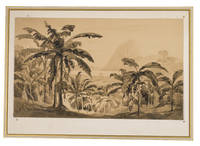
1837ABC_47967Rio de Janeiro 1837. Ad 1: 19 x 32 cm. Passe-partout: 365 x 47 cm. Sepia ink on paper. Ad 2: 245 x 34 cm. Passe-partout: 37 x 44 cm. Sepia ink on paper with blue and sepia ink washes. Two ink drawings on paper depicting the same view of Guanabara bay with a banana plantation and the Pao de Açucar near Rio de Janeiro in Brazil. This scene has also been included in Flora Brasiliensis as plate LV in volume 1.1. Plate LV is lithographed after a drawing by Belgian artist and botanist Benjamin Mary 1792-1846 made in 1837. The largest drawing of the two present here ad 1 is believed to be this drawing by Mary.Flora Brasiliensis is a 15-volume work on Brazilian plants edited by botanist Carl Friedrich Philipp von Martius and others. It was published between 1840 and 1906 and systematically categorised the known plants in the region. The numerous plates were designed by many different artists including Benjamin Mary. He lived in Rio de Janeiro from 1832-1837 so his Brazilian drawings were based on his own observations. Although the present drawing is unsigned it can be attributed to Mary due to stylistic similarities with his other works its exact likeness to the litho in Flora Brasiliensis and its provenance both drawings are from the collection of the Von Martius family.The second drawing depicts the same scene but is clearly made by a different artist. It is signed "A. L." in the lower left corner. This work has been attributed to Carl August Lebschée 1800-1877 a German artist who also made drawings for the Flora Brasiliensis. However this is uncertain because he typically monogrammed his work with C. L.Both drawings in very good condition.l Cf. for the Flora Brasiliensis: Borba de Moraes 525 f; Nissen BBI 2248; Stafleu & Cowan 5538. ABE CAT Art History unknown
19286418London: Robt. Riviere & Son 1928. Special edition. Octavo 8 x 5 3/8 inches; 204 x 137 mm. ii blank iii-viii 75 1 imprint pp. With twelve illustrations by Gilbert James hand-colored and heightened with gold and printed with blue initials for each stanza. Caslon Old Face type on Studio hand-made paper some light marginal foxing to plates otherwise fine. Bound ca. 1928 by Rivière & Son stamp-signed on front turn-in in full blue crushed levant morocco. Front cover with a central oval panel with an onlaid brown-spotted serpent twining around a large gilt chalice. This central panel is surrounded by a floral border of inlaid green flowers on orange stems with bunches of grapes in purple. Inside a double-ruled gilt border on each cover is stanza number fifty-eight "Oh Thou who Man of baser Earth didst make And who with Eden didst devise the Snake: For all the Sin wherewith the Face of Man Is blacken'd Man's Forgiveness give - and take." Rear cover with a similar oval panel also surrounded by a floral border of inlaid green flowers on orange stems with bunches of grapes in purple and with a single onlaid green flower and a central inlaid bunch of purple grapes. Spine with five raised bands decoratively bordered in gilt with inlaid purple morocco bunches of grapes in five of the panels and gilt lettered in the other double gilt ruled board edges elaborate gilt turn-ins featuring a vine motif marbled paper doublures and endleaves all edges gilt. Upper joint expertly and almost invisibly repaired otherwise a near fine example of a late twenties Rivière 'Inlaid' binding. Engraved bookplate of Willsherr Lodge the home of Samuel Clay Williams 1884-1949 lawyer and tobacco magnate on front pastedown. <br /> <br /> "The Riviere Bindery was one of the most notable and prolific shops in London's West End from about 1840 through 1939" Princeton. Bath-based Bayntun Bindery acquired the firm in 1939 transforming into the "Bayntun-Riviere bindery" which is still in existence and family owned. A similar binding but without the quotations on the borders of both covers was sold in the Chevalier sale at Christie's New York Friday November 9th 1990 lot 63; it had been previously sold to Paul Chevalier by David Brass and then later to another private collector. Loosely inserted in the Chevalier copy was a pencilled note identified by a second description as being in the hand of George Napier an Edinburgh collector who commissioned a number of bindings. Napier explains his purchase of the book from Rivière in 1932 and that he commissioned the special border now decorating the book. He adds that "George" at Rivière's explained that the chalice and serpent motif was designed by Alberto Sangorski brother of George Sangorski the binder and concludes with the mention of the "Great Omar" which sank with the Titanic.<br /> <br /> Fitzgerald attributed the original work to the famed astronomer and mathematician Omar Khayyum and this collection of quatrains rapidly became a favored text of the Pre-Raphaelites. "Like the Odyssey or the Vita Nuova it was once the most widely known and quoted work of Victorian poetry in the world" and its place in Western culture at the time was secured by Fitzgerald's "epigrammatic sophisticated often mordant verses that display Fitzgerald's adroitness in handling this stanza form" Warner. Yet with rise of Modernism the Rubaiyat fell out of style for a time its lush and romantic orientalism considered out of step with the concerns of those who were living through a devastating World War. But the beautiful surviving copies in exceptional vellum silk and leather alongside recently released critical editions have helped draw attention back to the Rubaiyat's beauty and its role in inspiring so many monumental pieces of Victorian art and literature. Here illustrations by Gilbert James 1865-1941 illustrate the dramatic and sensorial prose. Robt. Riviere & Son unknown
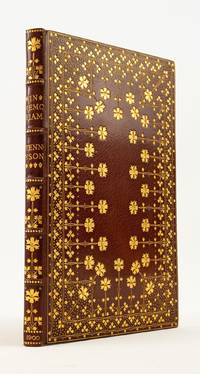
1900ST20797New York; London: Printed at the Bankside Press for M. F. Mansfield 1900. No. 83 OF 100 COPIES reserved for Great Britain from a total edition of 500. 244 x 155 mm. 9 1/2 x 6 1/8". CXXXI pp. 1 leaf colophon. <br/> LOVELY HONEY BROWN MOROCCO ELABORATELY GILT BY RIVIERE & SONS stamp-signed on front turn-in covers framed by delicate gilt chains the outer edge punctuated with tiny heart and dot tools the space between the gilt rules filled with many gilt dots and with 86 trefoils the central panel with 28 irises extending from the edge of the frame on alternating two and three chain link stems corner pieces with an oblique iris stem on a background of gilt dots accented by trefoils and small leaves raised bands spine panels with an iris rising from a cluster of small leaves gilt lettering gilt-ruled turn-ins with trio of irises on a stippled ground at corners top edge gilt other edges untrimmed. In the original felt-lined leather chemise with gilt lettering on spine and in a marbled paper slipcase bottom panel carefully reinforced with cellotape. With decorative initials from designs by Blanch McManus printed in orange. A FINE COPY--internally clean fresh and bright and THE BINDING SPARKLING AND UNWORN.<br/> <br/> This is a famous poet's most famous poem offered in elegantly vigorous binding from a pre-eminent English workshop. First published in 1850 the elegy "In Memoriam" is a tribute to Tennyson's college friend Arthur Henry Hallam 1811-33 son of the famous historian Henry Hallam 1777-1859. Tennyson 1809-92 had been publishing verses for seven years before Hallam's death but after the loss of his friend nothing from his pen appeared for nearly a decade. During that period he was working on the present poem the product of protracted meditation. Written in rhyming quatrains the poem moves from grief and doubt to certainty that the universe is purposeful. It was a sensational bestseller striking a deep note of resonance with Victorian readers. The queen herself told the poet "Next to the Bible 'In Memoriam' is my comfort." The design of our binding is especially intricate and the tooling is impeccable resulting in a notable aesthetic achievement. Riviere is one of the foremost names in the field partly because the firm did consistently fine work and partly because it was so long in business. Robert Riviere began as a bookseller and binder in Bath in 1829 then set up shop as a binder in London in 1840; in 1881 he took his grandson Percival Calkin into partnership at which time the firm became known as Riviere & Son and the bindery continued to do business until 1939. The condition of our volume is impressive; the original chemise has kept the binding safe from the fading of sunlight so that it looks virtually as it did when it left the bindery. [Printed at the Bankside Press for] M. F. Mansfield unknown
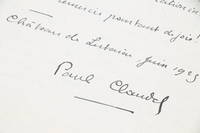
192587317Château de Lutaines Cellettes 1925. Fine. And how much this emotion is heightened when the author of this book is our friend when we have conversed familiarly with him and when he is close to us by what has been attributed to him as transient and temporal and close to God by what in him henceforth as eternal has begun! Château de Lutaines Cellettes juin 1925 21 x 27 cm 17 pages sur 5 doubles feuillets Original autograph signed and dated manuscript by Paul Claudel for his preface to Jacques Rivière's 'A la trace de Dieu'. Seventeen and a half pages in black ink on five double leaves. A few words crossed out and rewritten. Horizontal fold some foxing to the first page pencil notes by a bibliographer on the last blank page. The preface dated June 1925 first appeared in Le Correspondant on September 25 1925 then with Rivière's Carnets published the same year by his wife under the title 'A la trace de Dieu' Gallimard pp. 9-24. Complete manuscript of Paul Claudel's moving preface to the notebooks kept by Jacques Rivière during his captivity in WW1. The writer pays homage to a book which would have become a treatise on Christian Apologetics - had its author not met an untimely death at the age of 39. As early as 1907 Claudel had played an important role in his conversion and religious journey. He kept up a correspondence with the young critic now director of Gallimard's prestigious Nrf until his sudden death in 1924. In the manuscript he introduces Rivière's writings from his three years in the Knigsbrück and Hülseberg prison camps after his capture during the Battle of Eton in August 1914. In the form of notes he intended for prisoner reunions it contains a profound reflection on the search for God and the means to encounter Him. Although fo or Jacques Rivière ""God remains a fact"": after a long theological quest and many reversals he had reached the pinnacle of his faith during the war years. The deaths of his friends and writers Alain-Fournier and Péguy piety of his wife Isabelle and feeling of being supported by God during those difficult days all contributed to giving him a living faith which the poet-playwright Claudel celebrates in these beautiful pages. Rivière recognized the presence of a personal God in his life and believed in the value of prayer and self-discipline to which Claudel had urged him from their earliest exchanges. These Carnets are the ultimate proof of Claudel's influence: ""Rivière's end was completely illuminated by the doctrine revealed to him by the great Christian poet"" Paul Beaulieu. Claudel devotes magnificent passages to Rivière's communion on Christmas Day 1913 which publicly marked his return to Catholicism: ""All I can say is that Jacques Rivière's life seems to me to be one of those that cannot be explained solely by itself but by the good or bad teaching it contains because it is the type in which a host of others are realized and informed that it has the value of a parable. It is the best illustration of that Providence whose hand he never ceased to feel upon him that humble gentle Providence always present and always unexpected infinitely patient ingenious and artistic of which he spoke so well. It was this Providence that led this good soul through the pilgrimage of Intelligence from the confusion of adolescence to that Christmas day in 1913 when in an act of deference to the most extravagant theories from Darwin to Freud which presented themselves to them with the character of the latest fashion in which the noble deliberation of judgment had more share than the exigency of feeling he came to kneel at the feet of the holy priest of Clichy"". The preface doubling as a eulogy reflects the dialogue between father and spiritual son. Despite their disagreements Claudel admired Rivière's thinking and his objective vision of the Catholic Church in relation to secular society - without seeing it as the guardian of social conservatism like far-right writers like Maurras or Barrès: ""Among J unknown
190662652St. Louis MO: Holt St. Louis Streets Dept. 1906. Forty-four of 46 original linen-backed panoramic silver gelatin photographs comprised of 116 approx. 8 x 10 in. images divided into 2-4 panel panoramic photographs w/ captions neatly written w/in negatives at lower fore-edge annotations in red & black ink occasional pencil notes sectional numbers on versos edgewear & rubbing some lifting to fore-edges of some of the images creasing soot soiling to versos minor over-exposure to some images still a VG archive. This historic archive of panoramic photographs meticulously document the now largely disappeared and built-over River des Peres in a Ruscha-like manner and if pasted end-to-end would span nearly 100 feet. Capturing the River des Peres Valley which still meandered at the beginning of the 20th-Century along the Western boundaries of St. Louis MO and reveal a fast-growing Western city industrializing and appropriating the marshy lowlands farms and rural areas into factories breweries and railroad routes. Eleven of the images wind through Forest Park where much of the river had been channeled in 1904 through wooden sewers and culverts in order to cut down on the stench and prepare the park for the 1904 St. Louis World’s Fair. Holt 1866-1925 was renowned for his excessive photographic documentation leading groups of city engineers armed with large format cameras shooting on glass plate negatives recording the sprawling activities of the burgeoning St. Louis community in the Progressive Era. As evidenced by this meticulously shot archive of panoramic images Holt and his team document from the Mouth of River des Peres looking North with railroad bridge in right foreground and steamers in the river alongside the banks. The images continue along the River des Peres capturing the brewery next to the Railroad and between Broadway & Alabama Ave.; the sprawling unidentified factory on Webster; and also demarcating where the City Limits Stones were set and what numbers. A four-panel panoramic photo denotes the Saints Peter & Paul Cemetery on Gravois Avenue followed by others indicating different distances from Gravois Road bridges and houses along the road a road grading and roadbuilding team West of Gravois and then recording the rural lowland areas Southwest of Gravois and then towards Echelberger Street. About halfway through the series the images begin capturing more industrial and suburban development including the St. Louis & San Francisco Railroad Line Frisco RR telephone poles along Fyler Ave. Frisco RR stone station on Fyler with nearby culvert; the Hirsch Rolling Mill Co. complex with railcars labeled and carrying steel and railroad bridge in the distance. The photos show the River des Peres winding around revealing the Clifton Heights in the background; between Knox and Sulpher Ave. with Fire Engine House in the right foreground and many different railroad company cars including those for the Cotton Belt Line the Chicago Peoria & St. Louis RR the Missouri Kansas & Texas RR; and many for the Frisco RR. Several photos shot by Holt and his team May 10 1906 capture the sprawling Laclede Fire Brick Manufacturing Co. complex the Frisco RR Arch Bridge and even a Birds-Eye view. Other photos approaching Forest Park also depict the Police Headquarters Stables the Forest Park Highlands and once in the Park a group of boys playing baseball in the lower foreground. The final three-panel panoramic photo was taken looking West with Delmar Blvd. on the right and the Frisco RR trestle in the middle foreground Delmar Garden in the background and center field filled with the trestle stretching over the River des Peres. Unsurprisingly this cataloguer could find no similar partial or extant collection of images and the original negatives appear to have probably been dumped by St. Louis City Hall housecleaning around 1950 when they offloaded the thousands of photos shot by the Holt for the Street Department. The historically invaluable images were all sold at an auction comprising three 13 foot high stacks of negatives nearly all of them on glass. Purchased originally by Swekosky the collection was lent to Dick Lemen of Moline IL who cleaned printed and enlarged the photos purchased them and later donated the remnants of what he preserved to the St. Louis Mercantile Library. These photographs capture a Western waterway almost entirely displaced with nearly all of its original route completely rebuilt as it was engineered to operate as the backbone of the St. Louis sewer system and almost completely underground with just a few sections near the mouth with a channel and paved bans. In 1904 the Forest Park section was covered in a “large wooden box†to prevent visitors to the World’s Fair from breathing the unhealthy stench and after a 1915 flood backed up sewers killed 11 people in flooding and destroyed over 1000 homes chief engineer Horner was ordered to prepare a plan to completely control and build over the River des Peres. It still carries storm water and sewage in separate pipes and now that the channel has almost no direct source from the Mississippi River and all of the lowland meadows wetlands and areas that existed at the beginning of the 20th Century have been entirely paved over there largely remains no water to supply the river itself. Some of the River at the site of the former Carondelet Coke Plant has been largely remediated and a short piece connected to the Mississippi Greenway near River City Casino. See: Kelly Moffitt Salvaged Photographs from the St. Louis Street Department circa 1900-1930 Catalogued in New Book St. Louis on the Air St. Louis Public Radio Aug. 2 2017; Enter Dick Lemen Dr. William G. Swekosky The collection Grows Unwieldy Lafayette Square Archives 2020; Michael Allen The Harnessed Channel: How the River Des Peres Became a Sewer Preservation Research Office Nov. 27 2010; Chris Naffziger Reconnecting with the Roots of River des Peres in St. Louis Terrain Magazine 2022. Holt, [St. Louis Streets Dept.], unknown