Aguado, E and Burt, JE J EBiblio.com
11 020 résultats
20108665081Prentice Hall 2010. This is an ex-library book and may have the usual library/used-book markings inside.This book has soft covers. Clean from markings. In good all round condition. Please note the Image in this listing is a stock photo and may not match the covers of the actual item1300grams ISBN:9780321674371 Prentice Hall paperback
20159627116Routledge 2015. This is an ex-library book and may have the usual library/used-book markings inside.This book has soft covers. In good all round condition. Please note the Image in this listing is a stock photo and may not match the covers of the actual item750grams ISBN:9780415734493 Routledge paperback
19949047763Chapman & Hall 1994. This is an ex-library book and may have the usual library/used-book markings inside.This book has hardback covers. In good all round condition. No dust jacket. Please note the Image in this listing is a stock photo and may not match the covers of the actual item550grams ISBN:9780412554803 Chapman & Hall hardcover
20139946422Esri Press 2013. This is an ex-library book and may have the usual library/used-book markings inside.This book has soft covers. Clean from markings. In good all round condition. Please note the Image in this listing is a stock photo and may not match the covers of the actual item1300grams ISBN:9781589483460 Esri Press paperback
20139946423Esri Press 2013. This is an ex-library book and may have the usual library/used-book markings inside.This book has soft covers. Clean from markings. In good all round condition. Please note the Image in this listing is a stock photo and may not match the covers of the actual item1300grams ISBN:9781589483460 Esri Press paperback
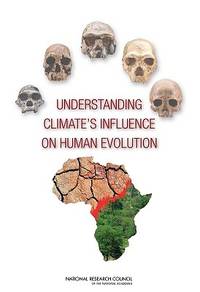
A9780309148382Paperback / softback. New. The hominin fossil record documents a history of critical evolutionary events that have ultimately shaped and defined what it means to be human including the origins of bipedalism; the emergence of our genus Homo; the first use of stone tools; increases in brain size; and the emergence of Homo sapiens tools and culture. The Earth's geological record suggests that some evolutionary events were coincident with substantial changes in African and Eurasian climate raising the possibility that critical junctures in human evolution and behavioral development may have been affected by the environmental characteristics of the areas where hominins evolved. Understanding Climate's Change on Human Evolution explores the opportunities of using scientific research to improve our understanding of how climate may have helped shape our species. Improved climate records for specific regions will be required before it is possible to evaluate how critical resources for hominins especially water and vegetation would have been distributed on the landscape during key intervals of hominin history. Existing records contain substantial temporal gaps. The book's initiatives are presented in two major research themes: first determining the impacts of climate change and climate variability on human evolution and dispersal; and second integrating climate modeling environmental records and biotic responses. Understanding Climate's Change on Human Evolution suggests a new scientific program for international climate and human evolution studies that involve an exploration initiative to locate new fossil sites and to broaden the geographic and temporal sampling of the fossil and archeological record; a comprehensive and integrative scientific drilling program in lakes lake bed outcrops and ocean basins surrounding the regions where hominins evolved and a major investment in climate modeling experiments for key time intervals and regions that are critical to understanding human evolution. paperback
0309148383.Gpaperback. Good. Access codes and supplements are not guaranteed with used items. May be an ex-library book. paperback
19944943437Wm. C. Brown 1994. This is an ex-library book and may have the usual library/used-book markings inside.This book has soft covers. In fair condition suitable as a study copy. Please note the Image in this listing is a stock photo and may not match the covers of the actual item1000grams ISBN:9780697204561 Wm. C. Brown paperback
19714312231MIT Press 1971. This is an ex-library book and may have the usual library/used-book markings inside.This book has soft covers. In poor condition suitable as a reading copy. Please note the Image in this listing is a stock photo and may not match the covers of the actual item950grams ISBN:9780262570244 MIT Press paperback
20149482287Wh Freeman 2014. This is an ex-library book and may have the usual library/used-book markings inside.This book has soft covers. Clean from markings. In fair condition suitable as a study copy. Please note the Image in this listing is a stock photo and may not match the covers of the actual item1450grams ISBN:9781464138744 Wh Freeman paperback
20149482288Wh Freeman 2014. This is an ex-library book and may have the usual library/used-book markings inside.This book has soft covers. Clean from markings. In fair condition suitable as a study copy. Please note the Image in this listing is a stock photo and may not match the covers of the actual item1450grams ISBN:9781464138744 Wh Freeman paperback
20145970652W.H.Freeman & Co Ltd 2014. This is an ex-library book and may have the usual library/used-book markings inside.This book has soft covers. In good all round condition. Please note the Image in this listing is a stock photo and may not match the covers of the actual item1500grams ISBN:9781464138744 W.H.Freeman & Co Ltd paperback
20145970651W.H.Freeman & Co Ltd 2014. This is an ex-library book and may have the usual library/used-book markings inside.This book has soft covers. In good all round condition. Please note the Image in this listing is a stock photo and may not match the covers of the actual item1500grams ISBN:9781464138744 W.H.Freeman & Co Ltd paperback
I11E-02042National Academies Press. Used - Very Good. Very Good condition. A copy that may have a few cosmetic defects. May also contain light spine creasing or a few markings such as an owner’s name short gifter’s inscription or light stamp. National Academies Press unknown
201080999Washington DC: The National Academies Press 2010. Presumed First Edition First printing. Taped spine. Very good. xii 97 1 pages. Illustrations. Footnotes. References. Limited Distribution/Official Use Only. It is understood that this limitation no longer applies due to the passage of time and the dissemination of comparable information into the public domain. It is also noted that an abbreviated version was issued by the National Research Council in 2011. The U.S. Department of Energy's costs for securing its facilities that house nuclear weapons and material have increased from $550 million in 2002 to around $930 million in 2010. This is a congressionally requested report from the National Research Council that examines whether risk-based approaches including probabilistic risk assessment could be used to improve methods for determining security requirements at these facilities. A nuclear weapon or a significant quantity of special nuclear material SNM would be of great value to a terrorist or other adversary. It might have particular value if acquired from a U.S. facility--in addition to acquiring a highly destructive tool the adversary would demonstrate an inability of the United States to protect its nuclear assets. The United States expends considerable resources toward maintaining effective security at facilities that house its nuclear assets. However particularly in a budget-constrained environment it is essential that these assets are also secured efficiently meaning at reasonable cost and imposing minimal burdens on the primary missions of the organizations that operate U.S. nuclear facilities. It is in this context that the U.S. Congress directed the National Nuclear Security Administration NNSA--a semi-autonomous agency in the U.S. Department of Energy DOE responsible for securing nuclear weapons and significant quantities of SNM--asked the National Academies for advice on augmenting its security approach particularly on the applicability of quantitative and other risk-based approaches for securing its facilities. In carrying out its charge the committee has focused on what actions NNSA could take to make its security approach more effective and efficient. The committee concluded that the solution to balancing cost security and operations at facilities in the nuclear weapons complex is not to assess security risks more quantitatively or more precisely. This is primarily because there is no comprehensive analytical basis for defining the attack strategies that a malicious creative and deliberate adversary might employ or the probabilities associated with them. However using structured thinking processes and techniques to characterize security risk could improve NNSA's understanding of security vulnerabilities and guide more effective resource allocation. The National Academies Press unknown
201073685Washington DC: The National Academies Press 2010. Presumed First Edition First printing. Marked "Official Use Only" and "Limited Distribution". Wraps. Very good. xii 94 pages. Illustrations. Boxed text. Footnotes. References. Acronyms. Dissenting statement by W. Earl Boebert. Roger Hagengruber was a Committee member. Stiff card cover in cloth spine. Ink notation on front. An abbreviated version of about 30 pages was published in 2011. The mission of the National Academies of Sciences Engineering and Medicine is to improve government decision making and public policy increase public understanding and promote the acquisition and dissemination of knowledge in matters involving science engineering technology and health. Our reports and other scientific activities inform policies and actions that can improve the lives of people in the U.S. and around the world. Our major programs conduct studies facilitate workshops and undertake other activities: Behavioral and Social Sciences and Education; Earth and Life Studies; Engineering and Physical Sciences; Health and Medicine; Policy and Global Affairs; Transportation Research Board; and the Gulf Research Program. The Council's rules and regulations govern this work. It is understood that the distribution limitation has expired with the passage of time and publication of the abbreviated version. A nuclear weapon or a significant quantity of special nuclear material SNM would be of great value to a terrorist or other adversary. It might have particular value if acquired from a U.S. facility-in addition to acquiring a highly destructive tool the adversary would demonstrate an inability of the United States to protect its nuclear assets. The United States expends considerable resources toward maintaining effective security at facilities that house its nuclear assets. However particularly in a budget-constrained environment it is essential that these assets are also secured efficiently meaning at reasonable cost and imposing minimal burdens on the primary missions of the organizations that operate U.S. nuclear facilities. It is in this context that the U.S. Congress directed the National Nuclear Security Administration NNSA-a semi-autonomous agency in the U.S. Department of Energy DOE responsible for securing nuclear weapons and significant quantities of SNM-to ask the National Academies for advice on augmenting its security approach particularly on the applicability of quantitative and other risk-based approaches for securing its facilities. In carrying out its charge the committee has focused on what actions NNSA could take to make its security approach more effective and efficient. The committee concluded that the solution to balancing cost security and operations at facilities in the nuclear weapons complex is not to assess security risks more quantitatively or more precisely. This is primarily because there is no comprehensive analytical basis for defining the attack strategies that a malicious creative and deliberate adversary might employ or the probabilities associated with them. However using structured thinking processes and techniques to characterize security risk could improve NNSA's understanding of security vulnerabilities and guide more effective resource allocation. Over the course of the study the committee identified three key shortcomings in NNSA's current security approach: 1 the interactions and dependencies among security countermeasures; 2 the interactions between DOE/NNSA and other organizations responsible in part for preparing for or responding to an attack on NNSA facilities; and 3 the adequacy of attack scenarios used to design update and test the security systems to consider all possible attack scenarios. As a first step in addressing these shortcomings the committee recommends that NNSA adopt what the committee termed a "total systems approach" to characterize the interactions and dependencies of security countermeasures at its facilities. Such an approach is commonly used as an initial step in assessing the risks associated with a complex technological system. However performing such an analysis is not sufficient for implementing highly effective security. Coordination communication and joint exercises that include all relevant security organizations are also necessary. In addition it is essential to understand the adversary. This involves understanding adversary objectives goals and in particular how adversaries view the security system. The committee's approach could help DOE to better understand a range of potentially unexpected vulnerabilities and attack scenarios. The National Academies Press paperback
400 pages. Index. Black and white illustrations. "Settles the question once and for all that building and living underground is a viable alternative to conventional home building. The 33 chapters cover all aspects of building and living in an underground home. Also includes glossary and 13 appendices. Title page price-clipped. Unmarked. Average wear. Binding intact. A sound copy. Book
8vo., First US Edition, with 9 plates on 8, and a full-page map and full-page plan in the text; cloth, gilt back, a very good, clean copy in price-clipped dustwrapper, the latter very lightly chafed at extremities. Published simultaneously with the UK edition. This is the first dedicated publication of Lashly's complete diary. Lashly was awarded the Albert Medal for rescuing 'Teddy' Evans; the harrowing story of their return is vividly portrayed in Cherry-Garrard's 'The Worst Journey in the World'. Uncommon in this condition. Spence 686 (recording the far scarcer UK edition).
8vo., Third Impression, with 9 plates on 8, and a full-page map and full-page plan in the text; blue cloth, gilt back, a near fine copy in unclipped dustwrapper, the latter lightly sunned at backstrip. Published four months after the first edition. This is the first dedicated publication of Lashly's complete diary. Lashly was awarded the Albert Medal for rescuing 'Teddy' Evans; the harrowing story of their return is vividly portrayed in Cherry-Garrard's 'The Worst Journey in the World'. The UK edition is considerably scarcer than its American (Taplinger) counterpart, especially in the dustwrapper. Spence 686.
ill., ril. Nel gennaio del 1863 il fiorentino Orazio Silvestri giunse a Catania per occupare la cattedra di Chimica Generale di quella Università. L'Etna lo incantò subito e quando nel 1865 esplose la grande eruzione, che formò i Monti Sartorius, avvenne il fortunato incontro con il vulcanologo francese Ferdinand Fouqué. Il ritrovamento di rilevanti epistolari ha permesso una ricostruzione accurata dell'attività di questo valoroso scienziato sia nella vita familiare che nel contesto universitario pisano e catanese. Ma Orazio Silvestri, votatosi alla Vulcanologia, ci ha lasciato soprattutto delle avvincenti e accurate descrizioni delle eruzioni alle quali assistette in condizioni spesso rischiose. Le ascensioni al vulcano, i congressi, gli incontri con i più eminenti scienziati, le diatribe scientifiche, la calamità del colera: è il mondo della seconda metà del XIX secolo a rivivere in queste pagine corredate da immagini spesso inedite, fino all'ultima eruzione studiata da Silvestri quella che nel nel 1888 provocò l'esplosione di Vulcano nelle isole Eolie, conclusasi nel 1890, l'anno stesso della sua prematura morte.
Modena, Tip. Pontificia ed Arcivescovile, 1881, in-16, legatura di poco successiva in mezza tela con angoli, pp. XVI, 296. Asportato il margine superiore del frontespizio. Manca l'occhietto.
ill., br. Negli anni Cinquanta del secolo scorso, all'inizio della "grande accelerazione" (nell'uso dei combustibili fossili e nella crescita economica e demografica), nell'alta Val d'Astico si tentò di costruire una diga ma i lavori furono improvvisamente abbandonati. Poi fu la volta di un ardito progetto di attraversamento autostradale in galleria dello sbarramento montuoso fra Trentino e Vicentino. In anni recenti, il piano è stato rilanciato con un diverso tracciato e l'autore è stato chiamato ad analizzarlo, mettendo in luce una criticità trascurata, cioè un rilevante pericolo geologico. Il progetto definitivo ha forse in qualche modo rimediato alla carenza iniziale, senza tuttavia modificare le scelte operate in assenza di adeguate conoscenze. L'analisi del caso serve a inquadrare l'evoluzione fisica del territorio nel contesto più ampio delle attività che hanno fatto dell'uomo il principale agente geologico di modificazione del pianeta, tanto da posticipare l'inizio di una nuova fase glaciale e da rendere necessaria l'istituzione di una nuova epoca, definita Antropocene. Completano il volume alcune schede sui principali siti di interesse geologico della valle.
In-4 (30.40), cartonato editoriale, sovracoperta editoriale illustrata, pp. 429, (1), con illustrazioni in bianco e nero ed a colori nel testo. Esemplare di 1500 copie stampate. In ottimo stato (nice copy).
Collana: Romanzi e Racconti, febbraio 1990. Con dedica autografa dell'autore. Rilegato con copertina rigida e sovraccoperta. Prima edizione. Spedizioni tracciabili con raccomandata entro 24 ore dall'ordine. First edition. Hardback cover with dust jacket in fine conditions, no price clipped, no inscriptions or markings inside. Worldwide delivery.
Buenos Aires, José Ballesta, Editor, s.a. (hacia 1930). 4to.mayor; 142 pp., con 45 reproducciones fotográficas en trece láminas aparte. Cubiertas originales.