Compagnie des chemins de fer de l'EstLivre Rare Book
649 résultats
188931427Compagnie des chemins de fer de l'Est (Sous la Direction de M. Barabant), 1889. Fort volume in-4 relié (31 x 23 cm), reliure pleine percaline rouille, titre en noir sur le 1er plat et le dos.- Notices par le Service d'Exploitation (46 pages de texte) + 10 planches dépliantes - Notices par le service de la voie (52 pages de texte) + 29 planches dépliantes dont cartes en couleurs - Notices par le Service de la construction (32 pages de texte) + 4 planches, dont deux superbes gravures à double-page du Viaduc de la Vingeanne, et Viaduc du Vair - Notices par le service du matériel et de la traction (135 pages de texte) + 34 planches dépliantes (pas de n° I, XIII, mais XXIII et XXIII bis) Rousseurs sur la page de faux- titre seulement, le reste frais (bord des planches parfois un peu recourbé), reliure solide et en très bon état. Très bon état d'ensemble pour cette rare publication- Complet et RARE.
18965434Entworfen und gezeichnet. Mit 10 lithogr. Tafeln. Berlin, M. Spielmeyer, [1896]. Folio (48,5 x 33,5 cm). 1 Blatt Titel. Lose in Orig.-Halbleinwandmappe.
1802701091802. Wien : Hraschanzky 1802 8° 192 pp. Titelvignette polierter Kalbsledereinband mit Rvg. Erste Ausgabe! "Mit gegenwärtiger Abhandlung werden dem Publikum die Berichte vorgelegt welche über die gemachten Versuche mit der Impfung von Kuhpocken der Nied. Oesterreichischen Regierung übergeben worden sind. . Da aber nun alle diese Versuche ohne einige Ausnahme die Behauptung bestättigen daß die Impfung der Kuhpocken ein leicht anwendbares und sicheres Schutzmittel gegen die Blattern sey so ist es nun Pflicht die wohltätige Erfindung allgemein bekannt zu machen ." Ferro Pascal Joseph Ferro ab 1805 Pasqual Joseph Ritter von Ferro 5. Juni 1753 in Bonn - 21. August 1809 in Wien war ein deutscher Arzt Sanitätsreferent der niederösterreichischen Landesverwaltung und Hochschullehrer in Wien der das moderne Sanitäts- und Rettungsdienstwesen sowie die Kuhpockenimpfung in Österreich eingeführt hat. Pascal Joseph wurde 1753 in Bonn als Sohn des Offiziers Johann Lazarus Ferro aus Treviso und der Anna Catharina Komerscheid geboren. Mit 14 Jahren begann er zunächst eine Ausbildung als Wundarzt damals ein Handwerksberuf und ging dann zum Militär. Von 1771 bis 1775 war er Feldscher eines pfälzischen Kavallerieregiments. Ferro wollte jedoch Arzt werden und studierte Medizin in Heidelberg Straßburg und Wien. Er blieb in Wien und war zunächst Assistenzarzt am Parzmayerschen Spital ehe er 1785 in den sanitären Verwaltungsdienst eintrat mit dem Titel Sanitätsmagister von Wien. Im Jahr 1793 wurde er zum Sanitätsreferent der niederösterreichischen Landesregierung im Rang eines Regierungsrates ernannt. In dieser Position sorgte er für die Einrichtung eines Rettungswesens und regelte das Bestattungswesen. 1780 begann Ferro als Mediziner mit Kaltwasserbehandlungen Hydrotherapie und Sauerstofftherapie zudem konstruierte er ein Badefloß als schwimmende Badeanstalt auf der Donau. -cf. wiki unknown
1867RO80104493MARESQ AINE, DUNOD. 2ème édition. 1867. In-8. Relié. Etat d'usage, Couv. légèrement passée, Mors fendus, Quelques rousseurs. XXIII + 520 + 528 pages. Etiquette de code sur la coiffe en-tête et tampons de bibliothèque sur la page de titre et dans quelques marges. Mors fendu sur le 1er volume.. . . . Classification Dewey : 625-Chemins de fer, routes, autoroutes
188722569ABKöln 1887. Jeweils ca 51 x 68.5 cm, zwei Bögen ca 102 x 68.5 cm.
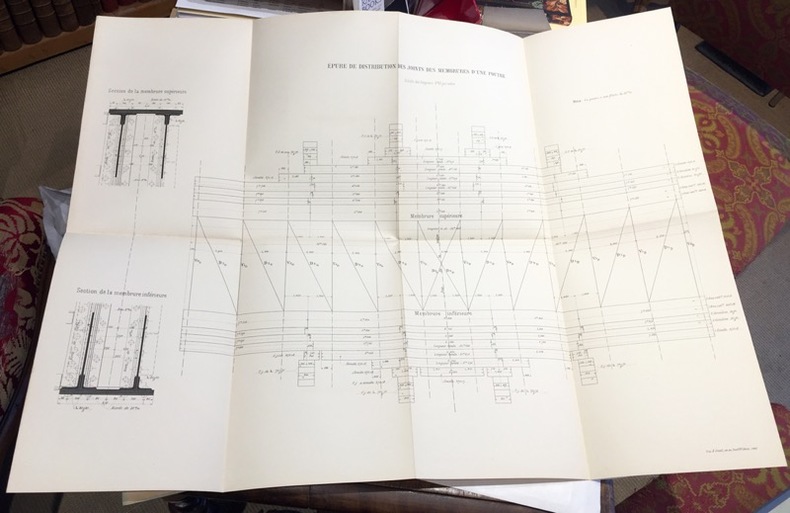
1891108701891 ; dossier petit in-folio (22 x 32 cm) ; composé d’une chemise cartonnée bleu-clair imprimée, dos toile et rubans de fermeture ; 8 grandes planches dépliantes lithographiées.I- Epure et distribution des joints des membrures d’une poutre ; II- Ensemble du tablier. Elvation et plan ; III- Demi-élévation extérieure d’une poutre au 1/10e et détails ; IV- Coupe transversale et assemblages ; V- Garde-grèves ; VI- Platelage ; VII- Détails des appuis des poutres ; VIII- Détails des garde-corps.
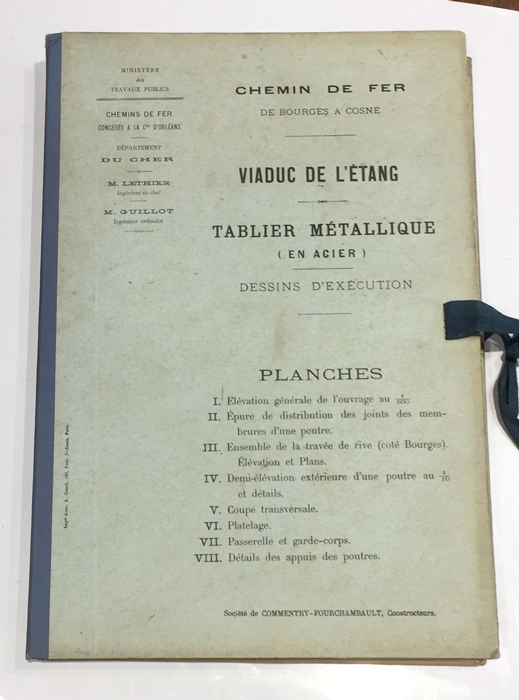
1891108791891 ; dossier petit in-folio (22 x 32 cm), composé d’une chemise cartonnée bleu-clair imprimée, dos de toile bleue et rubans de fermeture ; 8 grandes planches dépliantes lithographiées.I- Elévation générale de l’ouvrage au 1/500e (216 m entre les culées). II- Epure de distribution des joints des membrures d’une poutre. III- Ensemble de la travée de rive (côté Bourges), élévation et plans. IV- Demi-élévation extérieure d’une poutre au 1/10e et détails. V- Coupe transversale. VI- Platelage. VII- Passerelle et garde-corps. VIII- Détails des appuis des poutres.
18692168A series of papers on the manufacture and properties of iron and steel; with reports on iron and steel in the Paris Exhibition 1867; reviews of the state and progress of the manufacture during the years 1867 & 1868; and descriptions of many of the principal iron and steel works in Great Britain and on the continent. (Reprinted from 'Engineering', Revised and Enlarged by the Author.) Mit Holzstich-Frontispiz, 64 (17 gefalt.) Holzstich-Tafeln u. zahlr. Holzstichen im Text. London, W. Mackenzie, 1869. Folio (36,5 x 26,5 cm). XII, 270 S. Orig.-Halblederband.
184669331846 feuillet broché in-octavo, 56 pages, 1846 à Paris Imprimerie Royale,
18915398(300) Tafeln mit Motiven zu Geländern, Füllungen, Kreuzen, Wandarmen und Leuchtern... Zum Gebrauch für Schlosser und Bautechniker sowie für gewerbliche Schulen. 3 Mappen (alles Erschienene). Mit zus. 300 Tafeln in blau-grünem Druck. Karlsruhe, A. Bielefeld's Hofbuchhandlung, Liebermann & Cie., 1888-1891. Kl.-4to. (26,4 x 19,6 cm). Je 2 Bl. u. Tafeln lose in Orig.-Halbleinwandmappen mit Schließbändern.
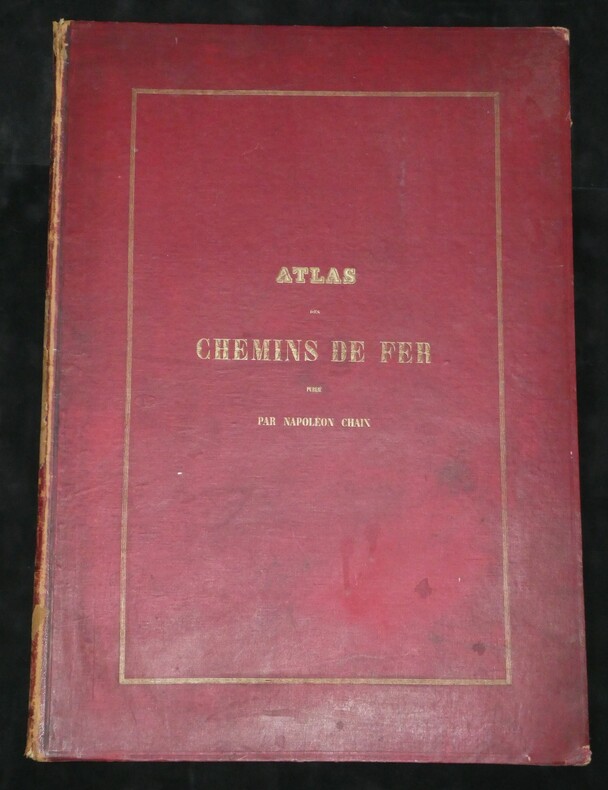
1859boz_001469Atlas des chemins de fer publié par Napoléon Chaix - 1859 Atlas des chemins de fer publié par Napoléon Chaix. Imprimerie et Librairie Centrales des Chemins de Fer de Napoléon Chaix et Cie, 1859. Reliure d'époque de percaline rouge, ornée d'un encadrement doré, et du titre en lettres dorées. Complet de ses 17 cartes gravées en couleurs dont la France, l'Europe, la Grande-Bretagne, et les États-unis. - Dimensions : 49,5 x 68,5 cm - État : Reliure usagée. La carte des environs de Paris et celle du Nord ont été restaurées, sinon, intérieur frais, bel état de conservation des cartes. - Poids : 4,515 kg
189525973Paris Imprimerie Nationale 1895 GRAND In-8 Cachets de Bibliothèque 316 pp et XXVI planches , certaines déchirées sans manque
1856WRCAM27974Nueva-York: Imprenta de Hallet 1856. 40pp. in Spanish. Original printed wrappers. Rear wrapper detached front wrapper separated four inches down from head of spine. Slight wear to extremities. Very good. The prospectus for an American mining and land company on the Pacific coast of Mexico. Imprenta de Hallet unknown books
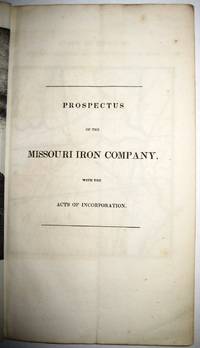
183730091St. Louis 1837. 36pp folding plate frontis full-page map. Institutional rubberstamps at base of title page verso. Original printed wrappers light rubberstamp discard stamp on front wrapper. Otherwise Very Good. <br /> <br /> "Missouri Imprints Inventory No. 197 cites only one copy. This tract is probably the first description of Iron mines west of the Mississippi. The Iron Mountains were located in St. Francis and Madison Counties. A proposal is made to make iron rails for a railroad from the mountains to the Mississippi" Decker. <br /> AII MO 197 1. 37 Decker 214. Not in Eberstadt Soliday Graff. OCLC indicates a number of institutional copies. unknown
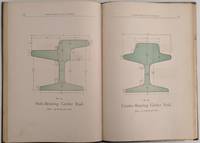
1890502San Francsico California: Pacific Rolling Mill Company 1890. 8vo. 250 x 170 mm. 10 x 7 inches. 100 pp. plus 4 leaves of ruled paper 2 with measurements in manuscript. Illustrated throughout with simple drawings of parts many stenciled with green wash; one plate folding. Bound in limp cloth covered boards title in gilt on front cover; a cloth binding shows some wear to gilt title two pencil drawings on front endpaper; other a very good sound copy. Straight forward price list of iron bar steel rail rolled and forged metal axles nuts bolts washers and dozens of other metal products. There is no introduction about the history of the firm just images of parts prices and a few lines of text describing specifications for some of the more complicated manufacture items. What distinguishes this rare trade catalogue is the design sense of many of the images and the application of stenciled color to highlight the object. The printed form of the parts are in outline and as one pages through the catalogue the images take on an abstract quality. Metal parts become contoured shapes with form being determined only by the light green wash applied to the physical part of the design. Although unintentional I am sure this late 19th century publication replete with many of the characteristics of period book design exhibits a very modernist feel one that is most unusual in publications of this nature. Although called the 7th edition this is only one of three issues of the PRMC's product guide and price list that is known. Organized in 1867 PRMC grew continuously and by 1892 was producing more than 40 thousand tons of iron and steel. "This giant enterprise is so closely identified with the manufacturing interests of the Pacific Coast that there is scarcely a manufacturing firm or corporation on the Coast that does not depend upon its output. The mills are located at Potrero Point in South San Francisco and cover an immense area" Master Hands. Romaine Guide to American Trade Catalogues p. 200 this edition and one from 1886 both known in only one copy each at California Historical Society. OCLC cites an edition from 1885 in one copy at San Francisco Public Library and this edition 1890 also in only one copy at California H. S. See: Master Hands in the Affairs of the Pacific Coast Historical Biographical and Descriptive. A Resumé of the Builders of Our Material Progress. San Francisco: Western Historical Publishing Company 1892 pp. 260. Pacific Rolling Mill Company unknown
1890502San Francsico California: Pacific Rolling Mill Company 1890. 8vo. 250 x 170 mm. 10 x 7 inches. 100 pp. plus 4 leaves of ruled paper 2 with measurements in manuscript. Illustrated throughout with simple drawings of parts many stenciled with green wash; one plate folding. Bound in limp cloth covered boards title in gilt on front cover; a cloth binding shows some wear to gilt title two pencil drawings on front endpaper; other a very good sound copy. Straight forward price list of iron bar steel rail rolled and forged metal axles nuts bolts washers and dozens of other metal products. There is no introduction about the history of the firm just images of parts prices and a few lines of text describing specifications for some of the more complicated manufacture items. What distinguishes this rare trade catalogue is the design sense of many of the images and the application of stenciled color to highlight the object. The printed form of the parts are in outline and as one pages through the catalogue the images take on an abstract quality. Metal parts become contoured shapes with form being determined only by the light green wash applied to the physical part of the design. Although unintentional I am sure this late 19th century publication replete with many of the characteristics of period book design exhibits a very modernist feel one that is most unusual in publications of this nature. Although called the 7th edition this is only one of three issues of the PRMC's product guide and price list that is known. Organized in 1867 PRMC grew continuously and by 1892 was producing more than 40 thousand tons of iron and steel. "This giant enterprise is so closely identified with the manufacturing interests of the Pacific Coast that there is scarcely a manufacturing firm or corporation on the Coast that does not depend upon its output. The mills are located at Potrero Point in South San Francisco and cover an immense area" Master Hands. Romaine Guide to American Trade Catalogues p. 200 this edition and one from 1886 both known in only one copy each at California Historical Society. OCLC cites an edition from 1885 in one copy at San Francisco Public Library and this edition 1890 also in only one copy at California H. S. See: Master Hands in the Affairs of the Pacific Coast Historical Biographical and Descriptive. A Resumé of the Builders of Our Material Progress. San Francisco: Western Historical Publishing Company 1892 pp. 260. Pacific Rolling Mill Company unknown books
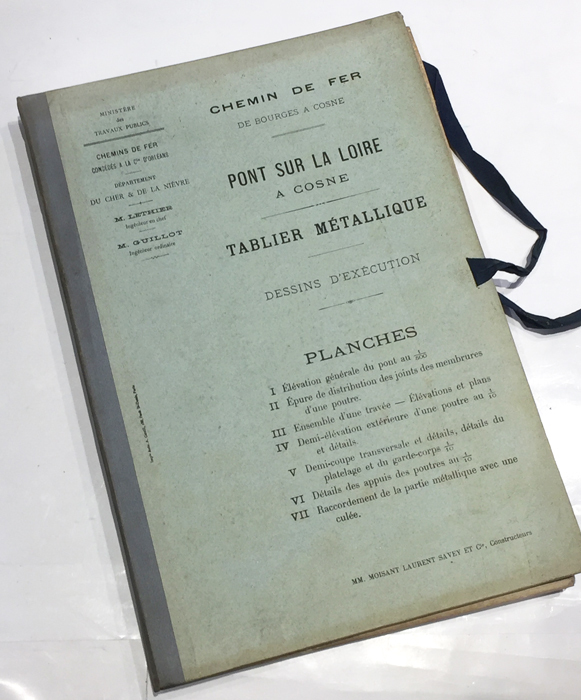
1890108691890 ; petit in-folio (22 x 32 cm) ; dossier composé d’une chemise cartonnée bleu-clair, dos toile et rubans de fermeture ; 7 grandes planches dépliantes lithographiées.I- Elévation du pont au 1/500e ; II- Epure de distribution des joints de membrures d’une poutre ; III- Ensemble d’une travée. Elévations et plans ; IV- Demi-élévation extérieure d’une poutre au 1/10e et détails ; V- Demi-coupe transversale et détails, détails du platelage et du guide-corps 1/10e ; VI- Détails des appuis des poutres au 1/10e ; VII- Raccordement de la partie métallique avec une culée.
188318901883 Edition Knight and Leonard, Chicago, 1883. In-quarto, reliure éditeur (cloth binding) illustrations en couleurs insérées de C. E. Sickels sur première et quatrième de couverture. 288 pages, plus d'une centaine d'illustrations, la plupart en couleurs. "Subscription Edition". 70 illustrations originales de Thomas Moran
18633623Illustrated by numerous plates and diagrams. Second edition. Mit 16 gefalt. lithogr. Tafeln. Glasgow, Printed for and sold by the author, 1863. 8vo. (22,6 x 13,7 cm). 2 Bll., 226 S. (S. 101-104 übersprungen), 2 Bll. "Opinions of the press". Grüner Orig.-Leinwandband mit Goldprägung.
18674359Krupp à Essen (Prusse). Cast-Steel Works. Gussstahl-Fabrik. Aciérie. 1867. Panoramafotografie des Fabrikgeländes. Albumin, auf Karton gewalzt. Dort bezeichnet u. mit lithographiertem Rahmen. 5,0 x 29,1 cm.
18653839Travaux Artistiques, plomb, zinc, cuivre, tôle. Album 1865. Mit lithogr. Titel u. 45 (6 doppelblattgr.) lithogr. Tafeln nach A[ntoni] Sanguineti. Paris, Imp. Becquet, 1865. 4to. (30,5 x 23,5 cm). Halbleinwandband d. Zt. mit Deckeltitel.
18994327Gegründet 1866. (9. Auflage). Mit Titelillustration (Fabrikgebäude in der Reissigerstr. 51/53) sowie zahlreichen Abb. auf 289 Tafeln. Dresden, Selbstverlag, [1899]. Groß-4to. (32,9 x 25,2 cm). 3 Bl. Farbig illustrierter Orig.-Halbleinwandband.
18295673Aus dem Schwedischen übersetzt von J. W. Pfaff. Mit 11 gefalt. gest. Tafeln von C. A. Broling. Nürnberg, J. L. Schrag, 1829. 4to. (23,7 x 20,3 cm). XVIII S., 1 Bl., 268 S., 2 Bl. (Verbesserungen, Anzeigen). Marmorierter Halblederband d. Zt. mit Rückenvergoldung. [2 Warenabbildungen]
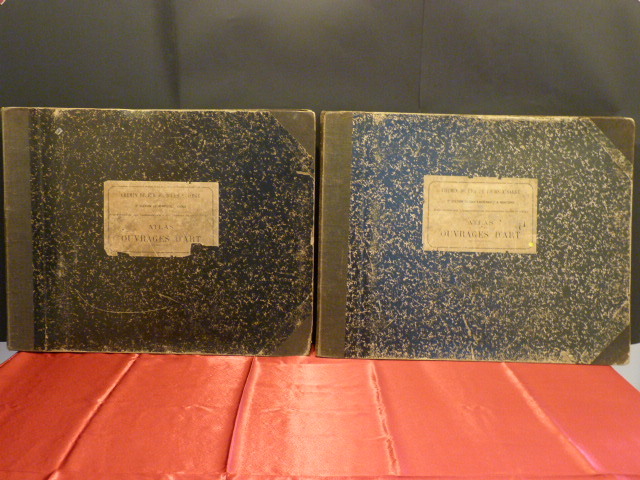
18951872S.l.[Tours], S.n. [Juliot], 1895. 2 volumes. In-Folio à l'Italienne, 59 x 47 cm. Reliures de l’époque en demi-toile noire à coins, dos lisses et muets, plats de papier marbré, étiquettes indicatives au centre des premiers plats. 2, 69 pl ; 2, 124 pl. Intéressants recueils de dessins d’exécution (plans, coupes, élévations) des ouvrages d’art présents sur ces deux tronçons de la voie ferrée qui relie Tours à Sargé : ponceaux, ponts voûtés ou métalliques, passages, viaducs, galeries, … Pour chacun, figurent des renseignements sur la construction de l’ouvrage et son prix de revient. Ce travail a été supervisé par deux Ingénieurs en chef, MM. Prompt et Faure, ainsi que par deux Ingénieurs ordinaires, MM. Mazoyer et Leroux, chargés, comme leurs supérieurs, des études et de la construction. Ouvrages bien complets de respectivement 69 planches (2e section) et 124 planches (3e section), dont la plupart doubles et plusieurs dépliantes.(l'atlas de la 1ère section, de Vouvray à Châteaurenault, est absent). Les deux lignes de chemin de fer ont été ouvertes à la circulation des trains en 1893, à partir du 2 janvier pour la section Sargé-Montoire-sur-le-Loir, et à compter du 15 octobre pour la section Montoire-Châteaurenault. Cette dernière reste en activité jusqu’en 1957, alors que l’autre est fermée dès 1942. Le déclassement puis la dépose des voies interviendront dans les années 1970. Rares documents liés au patrimoine ferroviaire et architectural de la vallée de la Braye, dans la région Centre, concernant une ligne de chemin de fer qui n’existe plus aujourd’hui.
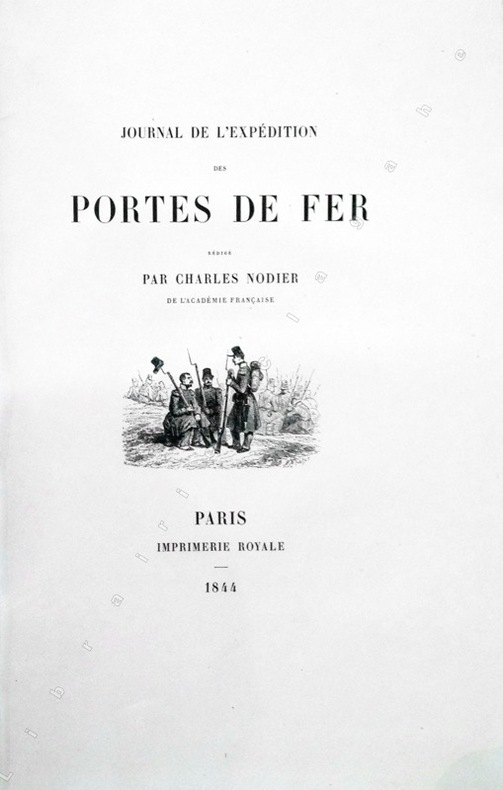
184413368Paris, Imprimerie Royale, 1844 ; grand in-8 ; cartonnage à la bradel de l'éditeur ; [4], XVI, 329 pp., [1] f. blanc, 40 planches hors-textes tirées sur chine contrecollées, protégées par des serpentes légendées et une carte dépliante en fin d'ouvrage et 200 vignettes gravées sur bois dans le texte.