Merian, Maria SibyllaAntiquariat.de

20 751 résultats
17147500CBAmsterdam, Valk, 1714-1717. Kl.-4°. 1 Bl., (6) S. 8?30; (2) Bl., 30 S.; (4) S. 5?24. Mit Portrait, 3 Frontisp. (davon 2 kol.) und 150 kol. Kupferfafeln. Lederband der Zeit. + Wichtig: Für unsere Kunden in der EU erfolgt der Versand alle 14 Tage verzollt ab Deutschland / Postbank-Konto in Deutschland vorhanden +, 7500CB|7500CB_2|7500CB_3|7500CB_4 [4 Warenabbildungen]
(Edinburgh, 1839-41). Elephant-folio. In the two original half-calf-folders with green leather-spines and pattern-stamped cloth boards " gilt title and author to front boards. Remains of the original green cloth-ties. Some wear to spines, especially at capitals. 12 magnificent hand-coloured plates with one leaf of text for each, the first, 8th and 11th text-leaves with an engraved illustration measuring 22x13,5 cm. (depicting ""Stake Nets of the Solway Firth"", ""Poke Nets of the Solway Firth"", and ""Young States of S. Truttafrom Mr. Shaw's Ponds"" - the last beautifully hand-coloured)" all leaves laid in loose, as originally published, and all plates with the original tissue-guards. Plates and text-leaves measuring ab. 64,5 x 49 cm
183940374(Edinburgh, 1839-41). Elephant-folio. In the two original half-calf-folders with green leather-spines and pattern-stamped cloth boards" gilt title and author to front boards. Remains of the original green cloth-ties. Some wear to spines, especially at capitals. 12 magnificent hand-coloured plates with one leaf of text for each, the first, 8th and 11th text-leaves with an engraved illustration measuring 22x13,5 cm. (depicting ""Stake Nets of the Solway Firth"", ""Poke Nets of the Solway Firth"", and ""Young States of S. Truttafrom Mr. Shaw's Ponds"" - the last beautifully hand-coloured)" all leaves laid in loose, as originally published, and all plates with the original tissue-guards. Plates and text-leaves measuring ab. 64,5 x 49 cm
In-folio (mm. 380x264), 3 volumi, mz. pelle coeva con ang., decorazione e tit. oro al dorso. L’opera è così composta: - Volume 1°, in due parti: "Mammiferi", 10 cc.nn. (frontespizio, Indice, Prefazione, Introduzione), 24 tavole + 65 cc.nn. di descrizione delle 44 specie illustrate <br><br> "Uccelli", 10 cc.nn. (Introduzione), 24 tavole + 57 cc.nn. di descrizione delle 35 specie illustrate. - Volume 2°: "Amfibi", 5 cc.nn. (frontespizio, Indice, Introduzione), 54 tavole + 130 cc.nn. di descrizione delle 60 specie illustrate. - Volume 3°: "Pesci", 12 cc.nn. (frontespizio, Indice, Introduzione), 78 tavole + 263 (su 266) cc.nn. di descrizione delle 181 specie illustrate. "Mancano 3 carte" al testo della specie "Torpedo narce". Complessivamente l’opera è illustrata da 180 splendide litografie, di preciso disegno e finissima coloritura a mano. La tavole, incise da Battistelli, Rosa, Santarella e Wieller, sono tratte per lo più da disegni di Carlo Ruspi e Pietro Quattrocchi e forniscono una panoramica, fino a quel momento la più completa, dei vertebrati italiani. In questo grandioso progetto di riesame delle numerose descrizioni della fauna regionale italiana già esistenti, si trovano elencate circa un migliaio delle quindicimila specie di vertebrati presenti in Italia, essendo state scelte quelle più rappresentative della classe, o meno note alla letteratura zoologica ufficiale, o affatto sconosciute. "Edizione originale" di questa celebrata e rara opera. Cfr. Ceresoli, p. 101 - Zimmer, p. 66 - Nissen DIV,118. Nel ns. esemplare il 3° vol. con alone al margine infer. bianco del testo che fortunatamente intacca in modo insignificante alcune tavv. Complessivamente solo le pagine di testo portano qualche lieve fioritura, mentre le tavole sono fresche e molto ben conservate. "Carlo Luciano Bonaparte (Principe di Canino e Musignano), nato a Parigi nel 1803, in seguito alla caduta di Napoleone I di cui era nipote, dopo un breve soggiorno in America fissò a Roma la sua residenza e si dedicò agli studi scientifici. E' considerato un ornitologo di fama mondiale. Mori' a Parigi nel 1857". .
174659912ABNürnberg, J.J. Fleischmann, 1746-1761. 20,8x18 cm. Mit 3 kolor. gestoch. Frontispiz, 1 gestoch. Frontispiz (Portrait) und 400 gestoch. handkolor. num. Tafeln auf 331 Bl. cplt. Dekorative HLdr.-Bde. der Zeit mit roten Rückenschildern und reicher Rückenvergoldung; Nomenklatur in Papierumschlag der Zeit. Zus. 6 Bände.
1984217199Berlin u. Heidelberg, Springer, 1868-1984. 8°, ab Bd. 361 in 4°. M. zahlr. Taf. u. Abb. In 400 versch. geb. Bibl.-Einbdn. (einige in Pp., u. brosch. meist in Hlwdbdn.). Einbde. teils etwas beschäd., beschabt u. fleckig. 5 Rücken fehlen. Teilw. m. Rsign. Fast durchg. mehrf. gest. Bibl.-Ex. Es fehlten: Taf. 3-5 in Bd. 41.
22910Paris ; F. G. Levrault, Amsterdam ; Legras Imbert et Comp., 1838 [1820-1839]. Cinq volumes grand in-4 (37 x 28 cms) illustrés de 600 planches en couleurs dont 4 doubles. De petites rousseurs à certains cahiers de texte. Les planches sont en très bel état de fraîcheur (pl. 398 légèrement brunie, petit manque de papier en marge d'un feuillet de texte en regard de la pl. 417, petite tâche pl. 570 sans atteinte à la gravure, légère mouillure angulaire au texte du Tableau méthodique se trouvant en fin d'ouvrage ). Demi-veau glacé à coins rouge framboise, dos à nerfs joliment orné de filets dorés et fers à froid. Reliure signée de F. Saulnier, qui a exercé rue de Condé à Paris de 1923 à 1955. (2 coins légèrement choqués).
178854125Havniae (København), N. Möller (et Filii) og N. Christensen, 1788-1806. Folio. Bound in two contemporary half calf bindings (vol. 1-4) with single gilt lines to spines. Gilt leather-title-label. Small tear to upper part of one hinge of vol. I. Marbled paper over boards. Spines with light signs of wear. Four engraved title-vignettes. (2),VI,52 (4),56 (4),71,(1)" (6),46 pp. + 160 engraved plates (complete). Both plates and text have been printed on thick, heavy paper and are in excellent condition. Vol. II, however has a bit of marginal brownspotting to the first text-leaves. A few plates with minor, vague, marginal brownspotting. Apart from the 160 plates in b/w as issued, there is an unusual ""appendix volume"" that contains the first 120 plates (I-CXX) of the work, corresponding to the plates of vols. I-III, in beautiful ORIGINAL HAND-COLOURING. Furthermore, the binding has belonged to our famous zoologist OTTO FABRICIUS (internationally renowned for his ""Fauna Groenlandica"" (1780) ). At the foot of every plate, Fabricius has added species- and figure-determination in his own hand, outside of the print. That these denominations are in Fabricius' hand is evident from a handwritten note on the front free end-paper: ""The designations here written are added by the zoologist professor Otto Fabricius, at whose auction this work is bought by H.B. Melcior."" (""De her anførte skrevne benævnelser ere tilföiede af Zoologen professor Otto Fabricius, paa hvis Auktion dette værk er kiöbt af H.B. Melcior.""). Melchior was a teacher at Herlufsholm and founded the natural history collections of the school. On the front free end-paper there is a stamp from the library of the school (Herlufsholms Bibliotek). This collection is bound in a contemporary full mottled calf binding with richly gilt spine. Small holes to boards. Binding with some wear. The plates are fine and fresh.
Havniae (København), N. Möller (et Filii) og N. Christensen, 1788-1806. Folio. Bound in two contemporary half calf bindings (vol. 1-4) with single gilt lines to spines. Gilt leather-title-label. Small tear to upper part of one hinge of vol. I. Marbled paper over boards. Spines with light signs of wear. Four engraved title-vignettes. (2),VI,52 (4),56 (4),71,(1) " (6),46 pp. + 160 engraved plates (complete). Both plates and text have been printed on thick, heavy paper and are in excellent condition. Vol. II, however has a bit of marginal brownspotting to the first text-leaves. A few plates with minor, vague, marginal brownspotting. Apart from the 160 plates in b/w as issued, there is an unusual ""appendix volume"" that contains the first 120 plates (I-CXX) of the work, corresponding to the plates of vols. I-III, in beautiful ORIGINAL HAND-COLOURING. Furthermore, the binding has belonged to our famous zoologist OTTO FABRICIUS (internationally renowned for his ""Fauna Groenlandica"" (1780) ). At the foot of every plate, Fabricius has added species- and figure-determination in his own hand, outside of the print. That these denominations are in Fabricius' hand is evident from a handwritten note on the front free end-paper: ""The designations here written are added by the zoologist professor Otto Fabricius, at whose auction this work is bought by H.B. Melcior."" (""De her anførte skrevne benævnelser ere tilföiede af Zoologen professor Otto Fabricius, paa hvis Auktion dette værk er kiöbt af H.B. Melcior.""). Melchior was a teacher at Herlufsholm and founded the natural history collections of the school. On the front free end-paper there is a stamp from the library of the school (Herlufsholms Bibliotek). This collection is bound in a contemporary full mottled calf binding with richly gilt spine. Small holes to boards. Binding with some wear. The plates are fine and fresh.
In-4 p., 9 volumi (di cui 1 di Supplemento), mz. pelle coeva con ang., dorso a cordoni con filetti e tit. oro, tagli sup. dorati. L'opera, in 8 volumi, pubblicati nel 1871-1881, è cosi' composta: - Vol. 1°: pp. XIII (list of subscribers), III-XLVI,102 (prefatory matter and indices) /// Vol. 2°: pp. (2),VIII,644, con 95 tavv. /// Vol. III: pp. (2),VIII,620, con 86 tavv. /// Vol. 4°: pp. (2),VIII,636, con 92 tavv. di cui 1 (la 262) in b.n. /// Vol. 5°: pp. (2),VIII,668, con 90 tavv. /// Vol. 6°: pp. (2),VIII,708, con 92 tavv. /// Vol. 7°: pp. (2),VIII,660, con 89 tavv. di cui 1 (la 485) in b.n. /// Vol. 8°: pp. (2),VIII,666, con 90 tavv. (la 599 è bis). - Il "Supplement", vol. 9°, pubblicato nel 1895-96, pp. (2),XXV,441, con 89 tavv. Importante e ricercata opera di ornitologia, magnificamente illustrata da complessive 723 tavole litografate di cui: 721 con pregevole coloritura a mano e 2 in b.n. Le bibliografie citano 722 tavv. "Ediz. originale", rara. Cfr. Zimmer,I, p. 177/179: "A very thorough manual of the subject, beautifully illustrated by J.G. Keulemans, Joseph Wolf, E. Neale and others.. Vol. IX was intended to treat only of species not included in the original work, but offers occasional corrections to the original letterpress, also" - Nissen,DIV,267 - The British Museum (Natural History),I, p. 479. Cfr. anche Benezit,VII, p. 774 che dell'artista olandese precisa: "Johannes Gerardus Keulemans (1842-1912), peintre animalier, graveur, illustrateur. Passionné d'histoire naturelle, ornithologue, il représente, selon un graphisme très précis, toutes les sortes d'oiseaux qu'il connait". Benezit,XIV, p. 687, dell'illustratore tedesco Joseph Wolf (1820-1899) così precisa: "Il peignit un grand nombre de tableaux d'oiseaux, s'amusant à les représenter dans les mutations de l'éclairage". Solo nel 9° volume 4 cc. con alone al margine super. bianco, altrimenti bellissimo esemplare.
1784200771Gedruckt bey der Kayserl. Academie der Wissenschaften, St.Petersburg 1770, 1774 und 1784 (Band 4)). 4 Blatt, 182 Seiten mit 40 teils gefalteten Kupfertafeln auf 39 Tafelblättern (davon 1 Karte) - VIII, 260 Seiten mit 46 teils gefalteten Kupfertafeln auf 37 Tafelblättern, davon 5 Karten - 1 Blatt, 508 Seiten mit 57 teils gefaltte Kupertafeln auf 51 Tafelblättern - 1 Blatt, XXVI, 218 Seiten ohne Tafeln 4°, modernes Halbleder mit Rückentitel, breitrandig gebundenes Exemplar, wenige Tafeln mit nur geringfügigen Beschädigungen, insgesamt außergewöhnlich gutes Exemplar mit sauberen Tafeln,
17583547Nürnberg, Fleischmann, 1758. Erste und einzige Ausgabe. - Nissen, ZBI 3464; Graesse VI, 146. - Der Einband etwas berieben und fleckig. Das vordere obere Gelenk mit kleiner Läsur, die untere Ecke des hinteren Deckels restauriert. - Der vordere fliegende Vorsatz unten beschnitten. Die fliegenden Vorsätze mit alten handschriftlichen Eintragungen. Die letzten 10 Bl. unten im Rand mit Wellung und die letzten 4 Bl. unten angeschmutzt. - Bedeutendes Werk über Frösche und Kröten, über ihre Anatomie, Fortpflanzung, ihren Lebensraum und ihr Verhalten. Verfasst wurde es von dem deutschen Naturkundler und Künstler August Johann Rösel von Rosenhof (1705-1759), der auch schon ein wichtiges Werk zur Insektenkunde veröffentlicht hatte ("Insecten-Belustigung", Erstveröffentlichung 1740). Die Abbildungen wurden nach Rösels eigenen Entwürfen und Vorlagen von verschiedenen Nürnberger Kupferstechern (Heumann, Tyroff, Joninger) gestochen. Das Werk erschien ursprünglich in mehreren Lieferungen in den Jahren 1753-1758. Der Text zweispaltig in Deutsch/Latein. Die gestochenen Tafeln parallel angeordnet in doppelter Ausführung: die linke Tafel jeweils altkoloriert und unbeschriftet, die rechte Tafel unkoloriert und mit Numerierung und Buchstabenbezeichnungen. - Besonders aufgrund seiner schönen und detailgenauen Abbildungen gilt Rösels "Historie der Frösche" als eines der schönsten naturkundlichen Bücher des 18. Jahrhunderts.
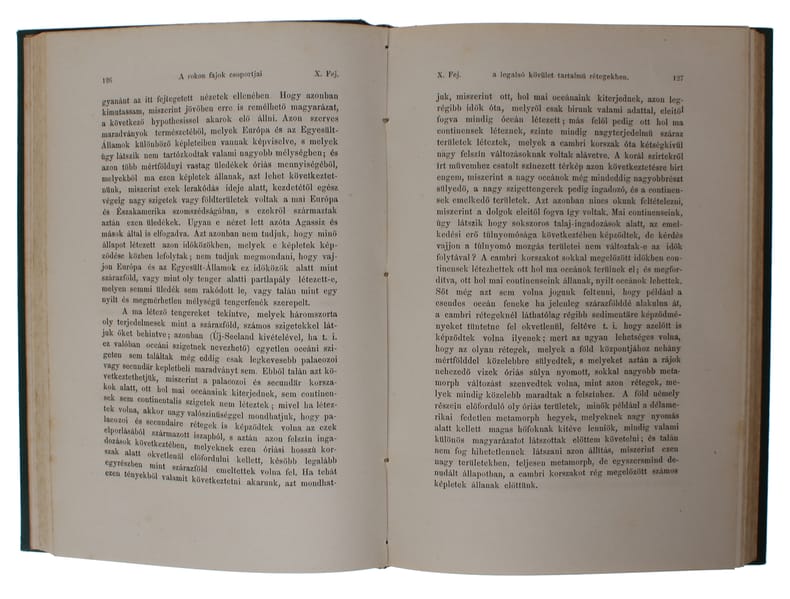
187460158Budapest, Kiadja a Természettudományi Társulat [Academy of Sciences], 1873 & 1874. 8vo. In two contemporary embossed full cloth bindings with gilt letter- and numbering to spine. Bindings with light wear, primarily affecting hindges. Previous owner's stamp to half title and title page in both volumes. Light occassional brownspotting, primarily affecting first and last leaves. An overall nice copy. XVI, (2), 303, (1)"" VII, (1), 361, (1) pp. + 1 leaf of Advertisement + 2 plates (A frontiespiece of Darwin and one listing the evolution of the different generations).
Budapest, Kiadja a Természettudományi Társulat [Academy of Sciences], 1873 & 1874. 8vo. In two contemporary embossed full cloth bindings with gilt letter- and numbering to spine. Bindings with light wear, primarily affecting hindges. Previous owner's stamp to half title and title page in both volumes. Light occassional brownspotting, primarily affecting first and last leaves. An overall nice copy. XVI, (2), 303, (1)" " VII, (1), 361, (1) pp. + 1 leaf of Advertisement + 2 plates (A frontiespiece of Darwin and one listing the evolution of the different generations).
In folio max. (mm. 520x370), legatura alle armi in p. pelle bazana coeva (restaurata; rifatto in pelle mod. il dorso a cordoni con filetti e tit. oro su tassello), cornice e stemma dorati ai piatti. Rarissima "edizione originale" di questa mitica opera, fra le più ricercate di tutta la storia della letteratura equestre, di cui offriamo soltanto la parte iconografica così composta: - antiporta incisa, a doppia pagina + 42 tavole, pure a doppia pagina, incise in rame e numerate. Magnifiche sono le illustrazioni, per numero e qualità: disegnate da Abraham van Diepenbeke di Anversa ed incise in rame da vari illustri artisti di questa città, le tavole sono impostate come vere e proprie composizioni pittoriche e, similmente a quelle del Pluvinel, fanno riferimento alla storia. Vi figurano: parecchi ritratti dell'A. nella sua apoteosi (su un carro trionfale trascinato da centauri e circondato da cavalli inginocchiati; in volo a cavallo circondato da cavalli seduti, ecc,), personaggi della sua famiglia, il Re Carlo II d'Inghilterra, come pure castelli, dimore, parchi, ecc., sullo sfondo. Per lo più le tavole rappresentano "des chevaux, des airs de manège, des haras, des chasses, des mors et des épérons, etc. Malgré les incorrections de dessin dans la représentation des chevaux - comme toujours à cette époque - ces planches ont une véritable valeur artistique.. Dans certains exemplaires, un ‘I’ est ajouté à la date qui devient ainsi 1658”. Così Mennessier,II, p. 247. Cfr. anche Brunet,I,1700: “Edition originale, publiée sous les yeux de l’auteur, pendant son exil, dont il passa une grande partie à Anvers. Elle est très recherchée par rapport aux 42 belles estampes (non compris le frontisp. gravé) dont elle contient les premières épreuves: les exemplaires s’en trouvent fort difficilement, parce qu’une partie de l’édition a été brulée dans les magasin du libraire” - Wells,1396 - Lewine, p. 383 - Graesse,I,93 - Nissen,848 - Benezit,IV, p. 568: "Abraham Van Diepenbeeck (1596-1675) entra dans l'atelier de Pierre Paul Rubens, le grand maitre de l'Ecole flamande, dont il devint l'élève et l'ami. Son habileté et la finesse de ses travaux le placèrent parmi ses meilleurs élèves.. Il travailla pour William Cavendish, lord de New Castle, pour lequel il fit plusieurs portraits ainsi que des paysages..". Bell’esemplare, ben conservato. .
177655812AB1. Theil: Leipzig, Johann Carl Müller, ab Bd. 2: Nürnberg, Gabriel Nikolaus Raspe, 1776-1783. 25,6x22 und Bd. 6 + 7: 24,7x20 cm. Mit 238 (12 kolorierten) Kupfertafeln cplt. Band 1-5: HLn.-Bde. der Zeit mit goldgepr. Rückentiteln und etwas Rückenvergoldung (Rücken verblasst); Band 6-7: HLdr.-Bde. der Zeit, alt überklebt mit Papier und hs. Rückentiteln (Papier stellenweise abgesplittert). 7 Bde.
2 tomi, su quattro, in un volume in-folio (480x350 mm), 100 tavole (su 200 complessive) e 2 frontespizi figurati con vari animali, incisi e dipinti a mano con vivi colori, legatura coeva in mezza pelle e ang., carta decorata ai piatti (difetti alle cerniere e alle cuffie). Le cento straordinarie tavole raffigurano animali quadrupedi singoli o a due-tre nel loro habitat naturale, incise a piena pagina e dipinte vivacemente da mano del tempo, stupende. Prima e unica edizione, molto rara, della più bella e pregiata opera di zoologia che vide la luce in Europa nel Settecento, alla quale si può solo affiancare l'ornitologia del Manetti. L'arte veneziana di quel secolo è evidente nelle magnifiche incisioni acquerellate degli artisti Alessandri e Scattaglia attivi sul ponte di Rialto, eseguite nell'arco di cinque anni e pubblicate a fascicoli mensili. Ogni composizione è ricca di decorazioni attorno alla figura del quadrupede, alberi e fiori, tane... Esemplare in buono stato di conservazione, stampato su carta pesante, a grandi margini.. NISSEN, Zoologia, I, 79. THIEMEBECKER I, 254. MORAZZONI, Libri veneziani del "700, p. 208..
...nouvelle edition, accompagnée de notes et dans laquelle les supplémens sont insérés dans le premier texte, à la place qui leur convient. L'on y a ajouté l'histoire naturelle des quadrupèdes et des oiseaux découverts depuis la mort de Buffon, celle des reptiles, des poissons, des insectes et des vers; enfin, l'histoire des plantes, dont se grand naturaliste n'a pas eu le tems de s'occuper. Ouvrage formant un cours complet d'Histoire naturelle redigé par C.S. Sonnini. 127 volumi (12,5x20 cm) in bella legatura coeva in piena pelle marmorizzata, cornice dorata ai piatti, dorso liscio ornato e dorato con doppio tassello di titolo e tomagione. --Un volume con rilegatura rifatta a imitazione, alcune cuffie mancanti o altri segni d'uso e del tempo ai margini e agli angoli. Risguardie marmorizzate, testimoni. Set completo di questa famosa edizione, con 1113 tavole quasi tutte colorate a mano e carte geografiche, più circa 30 schemi di classificazione e tabelle. Qualche brunitura a macchia o fioriture, ma bell'insieme di questa monumentale riedizione e aggiornamento dell'opera di Buffon. L'opera è così divisa: Théorie de la terre, 3 tomes; Epoques de la Nature, 1 tome; Histoire des Minéraux, 12 tomes; Des Animaux, 1 tome; De l'Homme, 4 tomes; Quadrupèdes, 13 tomes; des Singes, 2 tomes;; des Oiseaux, 28 tomes; Crustacés et Insectes, 14 tomes; Mollusques, 6 tomes; Reptiles, 8 tomes; Plantes, 18 tomes; Poissons, 14 tomes; Tables analytiques, 3 tomes. Non tutte le tavole sono numerate, e a volte non sono in sequenza, ma corrispondono al testo.Oltre al testo “classico” di Buffon sono assai importanti le integrazioni sulla base delle nuove scoperte scientifiche. Rettili e anfibi sono opera del Dudin, con 100 tavole; i molluschi sono di Denis de Monfort, con 72 tavole; uccelli e pesci sono sviluppati dal Sonnini; gli insetti da Latrelle... In sostanza, i migliori studiosi degli anni a cavallo tra 7 e 8cento furono partecipi dell'opera, rara da trovare così completa e in belle condizioni esterne.
The »Herbarius Latinus«, a most important plant incunabula, with striking Italian woodcuts. – Content: The »Herbarius Latinus« is an anonymous compilation from antiquity as well as Arabic and medieval sources. Present edition is the 2nd Italian one, at the same time the 1st of about a dozen Venetian editions of this most important Renaissance plant book. Present edition was also the first to erroneously ascribe the text to 13th ct. Spanish born physician Arnaldus de Villa Nova, whose name appears run-on with Avicenna's at the head of the preface, the printer having misunderstood the significance of the names printed beneath a woodcut that supposedly represented these two scholars and that was used as head-piece to the preface in the Vicenza 1491 edition. While the woodcut was omitted from this edition, the names were retained, and the misattribution was perpetuated throughout later editions. – Illustration: The woodcuts were printed from the woodblocks of the 1st Italian edition executed in 1491 by Leon Achates in Vicenza. They seem much more ambitious and naturalistic than those in the earlier German editions (the book was first published in Mainz in 1484), „… being finer in execution and the lines are more delicate…“ (Klebs). "A delightful example, almost Japanese in style, shows an iris at the edge of a stream, from which a graceful bird is drinking. In another picture the fern called 'capillus veneris', which is perhaps intended for the maidenhair, is represented hanging from rocks over water" (Arber, pp. 192f.)." As regards content this Italian edition also differs, as it includes plants used as medicine and sold in pharmacies and by spice merchants. – With beautifully calligraphed, partly contemporary annotations and marginalia throughout made with differently coloured ink in various languages (e.g. Hungarian), due to later cutting in parts lost.. – Condition: Cover bumped and worn, top and bottom part with faults due to worming, some parts with worm holes, moderately stained and finger-soiled throughout, leafs i2 to i4 loose, some pages with minor faults at margins or traces of old restoration, overall despite 14 leafs missing a substantial copy of this precious incunabula, gorgeously printed with wide margins. – Rarity: ISTC quotes 75 copies worldwide in institutional holdings, of which 17 imperfect like preceded. – Reference (in alphabetical order): Ahumada 7; Hain 1807*; BMC XVth, V, 524; BSB-Ink. H-104; Choulant: Graph. Inkunabeln 10; Early Herbals 11; Essling II, 1190; Goff H-69; Harvard/Walsh 2540; IGI 5677; Klebs 506. 11; Liechtenstein-Hauslab 20; Nissen BBI 2308; Pechellet 1315; Poynter 289; Proctor 5415; Pritzel 10757; Sander 612; Schullian/Sommer 237; Sajo/Soltesz 1639; Welcome 3101; Agnes Arber: Herbals, their Origin and Evolution. Cambridge et al.: Cambridge University Press, 1938.
in-folio, pp. (6, compr. tit. inc., ma privo di un f. bianco), pp. 732 (dopo p. 480 sono inseriti 2 ff. di cui sotto), (28); legatura coeva p. perg. rigida, dorso a nervi con tit. ms., altro tit. calligr. sul taglio infer. Frontespizio inciso entro splendida bordua allegorica con figure e stemma di Francesco Vitelli, arcivescovo di Tessalonica, cui l'opera è dedicata da da parte di Marco Ant. Bernia. Pur essendo una fedele ristampa della precedente edizione del Tebaldini, in questa del 1661 l'editore ha aggiunto 2 ff. tra le pp. 480 e 481 (particolarità non riscontrata nelle bibliografie): il primo (pp. cccclxxxj-cccclxxxij) col testo del ''Libri tertij de Piscibus Auctariolum de inviso antea Pisce Monstroso'' ed il secondo con la raffigurazione silografica del medesimo pesce serpentiforme pescato nelle vicinanze di Napoli. Edizione di notevole pregio (la prima era stata impressa da Giov. Batt. Bellagamba nel 1612-13), curata da Ioannes Cornelius Uterverius, corredata di 400 splendide figure in silografia di pesci e cetacei, anche a piena pagina. Opera di grande interesse pure per gli ampi capitoli sulla natura e sulla pesca della balena. "Ce qui est précieux, ce sont ses figures; elles se composent de toutes celles de Gesner, de Rondelet et de Belon et d'un très grand nombre de dessins nouveaux. Placé plus favorablement que Rondelet et Gesner pour recevoir les productions du midi de l'Europe, (Aldrovandi) en recueillit plusieurs qui avaient échappé à ces deux grands naturalistes. Il en reçut aussi des Indes. L'Amérique d'ailleurs et l'intérieur de l'Afrique lui fournirent différentes éspèces qui n'étaient pas encore arrivées en Europe" (Hoefer I, 745). E' uno tra i più preziosi dei 13 volumi di storia naturale redatta dall'Aldrovandi, che costituisce la più significativa raccolta del sapere naturalistico del Rinascimento, ed il più notevole tentativo di descrizione e classificazione zoologica, botanica e mineralogica che sia mai stato fatto dopo Aristotele e prima dei tempi moderni. Figura straordinariamente eclettica, l'Aldrovandi (Bologna 1522-1605) fu appassionato collezionista di materiale naturalistico raro e prezioso: si vantava "di non avere mai descritto cosa alcuna senza averla toccata colle proprie mani e senza averne fatto l'anatomia". Bell'esempl. genuino e marginoso.. Ediz. non in BMC, XVII sec. né Cat. Vinciana. Nissen n. 70. Ceresoli p. 41..
in-4 (mm 235x170), pp. VIII, 347, (1b). Perfetto cartonato rustico originale con titolo manoscritto nella parte superiore del dorso. Silografia di due cani sul foglio di titolo, al recto del secondo foglio figura di Diana con cani, al verso altra figura di cane seduto. Il testo è illustrato da 26 belle incisioni in silografia raffiguranti esemplari delle razze canine al tempo conosciute. Alcuni capitoli del raro trattato corncernono la caccia: ''De cane leporario, et veloce - De vestigatione canum in venatu - De cane venatico - De cane acquatico, et aucupe - Miscella de canum natura, et venatione - De venatione cum canum''. Prima ed unica edizione di una delle prime monografie di cinofilia Cirino (1618-1664), assai rara anche essendo impressa a Palermo, e riccamente illustrata. Solo 4 esemplari completi censiti in biblioteche italiane. Il Cirino pubblicò a Palermo nel medesimo anno un trattato "De venatione et natura animalium". Magnifico esemplare a fogli chiusi, freschissimo con nitidissime incisioni; abile restauro al margine superiore di alcuni fogli del primo quaderno, stemma di antica collezione privata al titolo.. B:Museum XVII sec., 238. Souhart 103. Ceresoli 158. Schwedt, I, 112. Manca a Michel-Michel. ''L'opera è affascinante ed unica nel suo genere e si occupa oltre che dei cani e del loro addestramento alla caccia, anche di animali selvatici. Le illustrazioni sono divertenti e curiosissime, di un'ingenuità e di un sapore particolare... Opera che Ceresoli dichiara rarissima''(Moncada, Bibl.Siciliana).
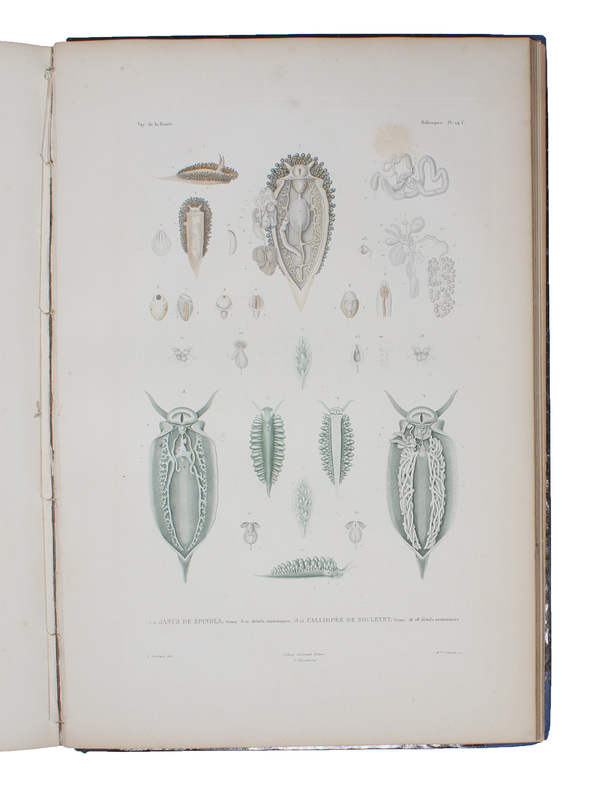
184156775Paris, Arthus Bertrand, (1841-42). Folio. (50 x 34 cm.). Contemp. hcloth. Marbled covers. Spine with gilt lettering. Light wear along edges. Corners renewed. Printed title-page (thick paper), 8 pp. of ""Table Explicative des Planches"" (of which 2 leaves are remargined) and 101 (of 102) fine engraved plates. 96 are in excellent original handcolouring and 5 are uncoloured. The lacking plate is: Carinairorïde Placenta (femelle), in the section of mollusques. Textleaves with some faint brownspots. Plates clean and fine, a few very faint marginal brownspots.
Paris, Arthus Bertrand, (1841-42). Folio. (50 x 34 cm.). Contemp. hcloth. Marbled covers. Spine with gilt lettering. Light wear along edges. Corners renewed. Printed title-page (thick paper), 8 pp. of ""Table Explicative des Planches"" (of which 2 leaves are remargined) and 101 (of 102) fine engraved plates. 96 are in excellent original handcolouring and 5 are uncoloured. The lacking plate is: Carinairorïde Placenta (femelle), in the section of mollusques. Textleaves with some faint brownspots. Plates clean and fine, a few very faint marginal brownspots.
168628142Oxford, Sheldonian, 1686. Folio. Recent full calf with 6 raised bands, ruled and blind-stamped in antique style, morocco label. (8),343,30,(1),(11) pp. Engraved allegorical frontispiece dated 1685, 188 copper engraved plates. Slight browning and small stain at the top. Three plates with a minor tear.
Oxford, Sheldonian, 1686. Folio. Recent full calf with 6 raised bands, ruled and blind-stamped in antique style, morocco label. (8),343,30,(1),(11) pp. Engraved allegorical frontispiece dated 1685, 188 copper engraved plates. Slight browning and small stain at the top. Three plates with a minor tear.