1 389 résultats
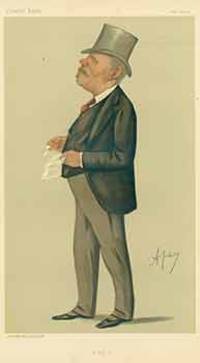
18-3252London: Vanity Fair 1871. Original colour lithograph. 13.5 x 8.5 inches accompanied by 1 sheet of letterpress description. Very Good. Trimmed at bottom of page with some loss of text. Published in Vanity Fair 25 March 1871.Richard Dowse PC 1824 – 14 March 1890 was an Irish politician barrister and judge reputed to be the wittiest orator of his time. He was born in Dungannon County Tyrone eldest son of William Dowse and Maria Donaldson. He was educated at the Royal School Dungannon and the University of Dublin entered Lincoln's Inn in 1849 and was called to the Irish Bar in 1852. After practicing for some years on the North-West Circuit he became Queen's Counsel in 1863 and Third Serjeant in 1867. London: Vanity Fair, 1871. unknown
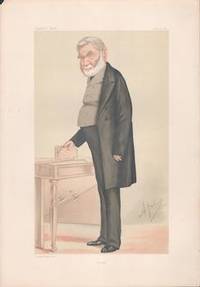
18-1315London: Vanity Fair 1887. Original colour lithograph. 40 x 27 cm 15.75 x 10.6 inches. Very Good. Some wear to top edge and toning in margins not affecting image. Dated 22 Oct 1887. Vincent Brooks Day & Son Lith. Scarce.Sir Thomas Sutherland GCMG Chinese: 蘇石蘭 16 August 1834 – 1 January 1922 was a British banker and politician initially elected to represent the Liberal Party and then as a Liberal Unionist. He founded The Hongkong and Shanghai Banking Corporation which was the founder member of HSBC Group and directed the P&O Company. Sutherland got his start clerking in the London office of the Peninsular and Oriental Steam Navigation Company P&O. Soon after P&O promoted Sutherland to superintendent assigning him to British Hong Kong to manage the firm's Asian operation. In 1863 he became the first chairman of the Hong Kong and Whampoa Dock. In order to help finance the burgeoning trade between China and Europe and explore the potential for China--United States trade Sutherland established The Hongkong and Shanghai Banking Corporation in 1865 and became its first vice-chairman. He was appointed member of the Legislative Council of Hong Kong from 1865 to 1866. In 1872 he was appointed Managing Director of P & O. In November 1884 Sutherland was elected at a by-election as the Member of Parliament MP for Greenock. A Liberal he was re-elected in 1885 but when the Liberals split over Irish Home Rule he joined the breakaway Liberal Unionist Party. He was re-elected as a Liberal Unionist in 1886 but lost the seat at the 1892 general election. However he was reinstated when his opponent was unseated on petition and held the seat until he stood down at the 1900 general election. In 1880 Sutherland married Alice Macnaught. She was the daughter of Rev. John Macnaught of Holy Trinity Church Conduit Street London England. Sutherland and his wife had two sons and a daughter Helen Sutherland 1881–1965 known as an art patron; one of the sons Eric Macnaught Sutherland died in the Second Boer War the other son died during World War I. In 1920 Sutherland's wife Alice died. In 1922 Sutherland died in London England. Sutherland Street in Sheung Wan Hong Kong was named after him. London: Vanity Fair, 1887. unknown
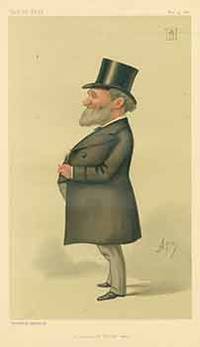
18-1340London: Vanity Fair 1885. Original colour lithograph. 40 x 27 cm 15.75 x 10.6 inches. Very Good. Minor foxing and wrinkling in margins not affecting image. Dated 2 May 1885. Vincent Brooks Day & Son Lith. Scarce. London: Vanity Fair, 1885. unknown
18-1336London: Vanity Fair 1885. Original colour lithograph. 40 x 27 cm 15.75 x 10.6 inches. Very Good. Some toning and wrinkling in margin not affecting image. Dated 3 Oct 1885. Vincent Brooks Day & Son Lith. Scarce.Sir William Henry Houldsworth 1st Baronet 20 August 1834 in Ardwick Manchester – 18 April 1917 in Kilmarnock was a mill-owner in Reddish Lancashire. He was Conservative MP for Manchester North West from 1883 to 1906 and sometime chairman of the Fine Cotton Spinners' Association. He was made a baronet in 1887. London: Vanity Fair, 1885. unknown
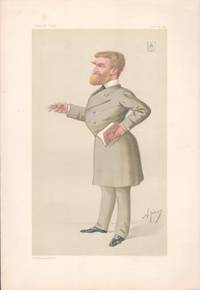
18-1346London: Vanity Fair 1885. Original colour lithograph. 40 x 27 cm 15.75 x 10.6 inches. Good. Foxing and wrinkling in margins and one-inch tear in top edge not affecting image. Dated 31 Jan 1885. Vincent Brooks Day & Son Lith. Scarce.Wilfrid Scawen Blunt 17 August 1840 – 10 September 1922 sometimes spelled "Wilfred" was an English poet and writer. He and his wife Lady Anne Blunt travelled in the Middle East and were instrumental in preserving the Arabian horse bloodlines through their farm the Crabbet Arabian Stud. He was best known for his poetry which was published in a collected edition in 1914 but also wrote a number of political essays and polemics. Blunt is also known for his views against imperialism viewed as relatively enlightened for his time. London: Vanity Fair, 1885. unknown
18-3246London: Vanity Fair 1871. Original colour lithograph. 13.5 x 8.5 inches accompanied by 1 sheet of letterpress description. Very Good. Published in Vanity Fair 4 Feb 1871.Konstantinos Mousouros Greek: Κωνσταντίνος ΜουσοÏÏος Turkish: Kostaki Musurus PaÅŸa; 1807–1891 also known as Kostaki Musurus Pasha was an Ottoman Greek diplomatic official of the Ottoman Empire who served as ambassador to Greece Austria Great Britain Belgium and the Netherlands. London: Vanity Fair, 1871. unknown
18-1306London: Vanity Fair 1874. Original colour lithograph. 40 x 27 cm 15.75 x 10.6 inches. Good. Some toning and foxing and a vertical crease down the center. Letterpress clipping with biography of subject pasted on verso. Dated 15 Aug 1874. Vincent Brooks Day & Son Lith. Scarce.Sir Arthur Helps KCB Hon DCL 10 July 1813 – 7 March 1875 was an English writer and dean of the Privy Council. He was a Cambridge Apostle. The youngest son of London merchant Thomas Helps Arthur Helps was born in Streatham in South London. He was educated at Eton and at Trinity College Cambridge coming out thirty-first wrangler in the mathematical tripos in 1835. He was recognized by the ablest of his contemporaries there as a man of superior gifts and likely to make his mark in later life. As a member of the "Conversazione Society" better known as the Cambridge Apostles a society established in 1820 for the purposes of discussion on social and literary questions by a few young men attracted to each other by a common taste for literature and speculation he was associated with Charles Buller Frederick Maurice Richard Chenevix Trench Monckton Milnes Arthur Hallam and Alfred Tennyson. London: Vanity Fair, 1874. unknown
71-1040London: Vanity Fair 1874. Chromolithograph. 30.7 x 18.5 cm. image. 39.8 x 25.8 cm. sheet. Dated 17 January 1874. Vincent Brooks Day & Son Lithographers. Very Good. Light toning along sheet edges missing upper left and right sheet corners.Sir Antonio Genesio Maria Panizzi better known as Anthony Panizzi was a naturalised British citizen of Italian birth and an Italian patriot. He was a librarian becoming the Principal Librarian of the British Museum from 1856 to 1866. London: Vanity Fair, 1874. unknown
18-1343London: Vanity Fair 1885. Original colour lithograph. 40 x 27 cm 15.75 x 10.6 inches. Good. Foxing along top edge minor loss on top left corner and half inch tear in bottom edge not affecting image. Dated 27 Jun 1885. Vincent Brooks Day & Son Lith. Scarce.Sir Frederick George Milner 7th Baronet GCVO PC 7 November 1849 – 8 June 1931 was a British Conservative Party politician who sat in the House of Commons from 1883 to 1885 from 1890 to 1906. Educated at Eton and Christ Church Oxford he was elected as one of the two Members of Parliament MPs for York at a by-election in 1883 but was defeated at the 1885 general election. London: Vanity Fair, 1885. unknown
18-3287London: Vanity Fair 1871. Original colour lithograph. 13.5 x 8.5 inches accompanied by 1 sheet of letterpress description. Very Good. Trimmed at bottom of page with some loss of text. Published in Vanity Fair 29 April 1871.Sir Francis Grant PRA 18 January 1803 – 5 October 1878 was a Scottish portrait painter who painted Queen Victoria and many distinguished British aristocratic and political figures. He served as President of the Royal Academy. London: Vanity Fair, 1871. unknown
18-3292London: Vanity Fair 1871. Original colour lithograph. 13.5 x 8.5 inches accompanied by 1 sheet of letterpress description. Very Good. Trimmed at bottom of page with some loss of text. Published in Vanity Fair 1 July 1871.Sir John George Shaw-Lefevre KCB 24 January 1797 – 20 August 1879 was a British barrister Whig politician and civil servant.Shaw-Lefevre was the son of Charles Shaw-Lefevre by his wife Helen daughter of John Lefevre. Charles Shaw-Lefevre 1st Viscount Eversley was his elder brother. He was educated at Trinity College Cambridge where he was Senior Wrangler in 1818 and was called to the Bar Inner Temple. He was elected a Fellow of the Royal Society in 1820. He was returned to Parliament for Petersfield in December 1832 but was unseated on petition in March 1833. He served under Lord Grey as Under-Secretary of State for War and the Colonies in 1834. The latter year Shaw-Lefevre was appointed a Poor Law Commissioner after the passing of the Poor Law Amendment Act which he remained until 1841. Between 1856 and 1875 he served as Clerk of the Parliaments. He also helped found the University of London and served as its Vice-Chancellor for many years. He was made a KCB in 1857 for his public services.Shaw-Lefevre married Rachel Emily daughter of Ichabod Wright in 1824. They had one surviving son George who became a prominent politician and was ennobled as Baron Eversley and five daughters. One daughter Madeleine Shaw-Lefevre was the first Principal of Somerville Hall; another daughter Rachel married Arthur Hamilton-Gordon son of the Prime Minister the 4th Earl of Aberdeen.Shaw-Lefevre died in August 1879 aged 82. His wife lived for six more years before dying in February 1885.The Lefevre Peninsula in South Australia was named by Governor John Hindmarsh on 3 June 1837 after Shaw-Lefevre who was one of South Australia's Colonisation Commissioners. London: Vanity Fair, 1871. unknown
18-1301London: Vanity Fair 1875. Original colour lithograph. 40 x 27 cm 15.75 x 10.6 inches. Good. Some toning foxing and stains and a vertical fold down the center. Letterpress clipping with biography of subject pasted on verso. Dated 24 Apr 1875. Vincent Brooks Day & Son Lith. Scarce.Sir George Samuel Jenkinson 11th Baronet 27 September 1817 – 19 January 1892 was a British Conservative politician. Jenkinson was the son of the Right Reverend John Jenkinson Bishop of St David's and Frances Augusta daughter of Augustus Pechell. Prime Minister Robert Jenkinson 2nd Earl of Liverpool was his first cousin once removed. In 1855 he succeeded his uncle as eleventh Baronet. He died in Eastwood House Falfield on 19 January 1892 and was buried in a vault in St George's Church Falfield. London: Vanity Fair, 1875. unknown
18-1304London: Vanity Fair 1874. Original colour lithograph. 40 x 27 cm 15.75 x 10.6 inches. Good. Some toning foxing and creases and a vertical fold down the center. Letterpress clipping with biography of subject pasted on verso. Dated 5 Sep 1874. Vincent Brooks Day & Son Lith. Scarce.Sir Henry Drummond Charles Wolff GCB GCMG PC 1830 – 11 October 1908 known as Henry Drummond Wolff or H. Drummond Wolff was an English diplomat and Conservative Party politician who started as a clerk in the Foreign Office. Wolff was the son of Georgiana Mary née Walpole and Joseph Wolff. His father was a missionary who had been born Jewish and his mother a descendant of Prime Minister Robert Walpole. Wolff was educated at Rugby School. London: Vanity Fair, 1874. unknown
18-1310London: Vanity Fair 1875. Original colour lithograph. 40 x 27 cm 15.75 x 10.6 inches. Good. Some toning foxing and stains and a half inch tear at bottom edge. Letterpress clipping with biography of subject pasted on verso. Dated 1 Aug 1875. Vincent Brooks Day & Son Lith. Scarce.Sir Henry Thompson 1st Baronet FRCS 6 August 1820 – 18 April 1904 was a British surgeon and polymath. Thompson was born at Framlingham Suffolk. His father wished him to enter business but he was eventually by 1848 able to enroll in the Medical School of University College London. He obtained his medical degree in 1851 with the highest honours in anatomy and surgery. In 1853 he was appointed assistant surgeon at University College Hospital becoming full surgeon in 1863 professor of clinical surgery in 1866 and consulting surgeon in 1874. In 1884 he became professor of surgery and pathology in the Royal College of Surgeons. Specializing in surgery of the genito-urinary tract and in particular in that of the bladder he studied in Paris under Jean Civiale who in the first quarter of the 19th century had developed a procedure to crush a stone within the human bladder and who had invented an instrument for this minimally invasive surgery. After his return from Paris Thompson soon acquired a reputation. In 1863 when King Leopold I of Belgium was suffering from kidney stones Thompson was called to Brussels to consult in the case and after some difficulties was allowed to perform the operation of lithotripsy. It was successful and in recognition of his skill Thompson was appointed surgeon-extraordinary to the King an appointment which was continued by Léopold II. Nearly ten years later Thompson carried out a similar operation on the former Emperor Napoléon III; however the Emperor died four days after not from the surgical procedure as was proved by the post-mortem examination but from uremia. In 1874 Thompson helped in founding the Cremation Society of Great Britain of which he was the first president; he also did much toward the removal of the legal restrictions on cremation. He denounced the prevailing methods of death certification in Great Britain; and in 1892 a select committee was appointed to inquire into the matter; its report published the following year was generally in line with his thinking. Woking Crematorium finally became the first of its kind in the UK. Thompson's last public duty for the society in 1903 was to open Birmingham Crematorium the country's ninth. He died in April 1904; his body was cremated at Golders Green Crematorium the first in London which he had opened in 1902 London: Vanity Fair, 1875. unknown
18-1309London: Vanity Fair 1874. Original colour lithograph. 40 x 27 cm 15.75 x 10.6 inches. Good. Some toning and foxing and a vertical crease down the center. Letterpress clipping with biography of subject pasted on verso. Dated 26 Sept 1874. Vincent Brooks Day & Son Lith. Scarce.Sir James Hudson GCB 1810 – 20 September 1885 was a British diplomat. He is noted for his time as British ambassador to Turin between 1852 and 1863 as an italophile and strong supporter of Italian unification and a collector of Italian art. London: Vanity Fair, 1874. unknown
71-1034London: Vanity Fair 1880. Chromolithograph. 31 x 18.5 cm. image. 40 x 26.5 cm. sheet. Dated 16 October 1880. Vincent Brooks Day & Son Lithographers. Very Good. Light toning along sheet edges.Sir John George Tollemache Sinclair 3rd Baronet was a Scottish landowner and Liberal politician who sat in the House of Commons from 1869 to 1885. London: Vanity Fair, 1880. unknown
18-1322London: Vanity Fair 1887. Original colour lithograph. 40 x 27 cm 15.75 x 10.6 inches. Very Good. Minor toning in margins and wear on edges not affecting image. Dated 14 May 1887. Vincent Brooks Day & Son Lith. Scarce.Sir James Porter Corry 1st Baronet 8 September 1826 – 28 November 1891 was an Irish politician. He served as a Conservative Member of Parliament MP from 1874 to 1885 and an Irish Unionist Alliance MP from 1886 until his death. Sir James was the son of Robert Corry of Turnagardy Newtownards Co. Down a quarry owner and Belfast timber merchant. Educated at the Royal Belfast Academic Institution he entered the family timber firm which was at that time occupied with building the growing industrial port of Belfast. He was first elected to Parliament for the Irish constituency of Belfast in the 1874 general election. The constituency was abolished for the 1885 general election. On 15 September 1885 he was created a baronet of Dunraven Antrim. On 1 February 1886 he became the MP for Mid Armagh in a by-election following the death of John McKane. In July 1886 he joined the Irish Unionist Alliance and stood for subsequent elections for this party. He died in office in 1891 at his home Dunraven on Belfast's Malone Road and was succeeded in the baronetcy by his son William. London: Vanity Fair, 1887. unknown
18-1319London: Vanity Fair 1887. Original colour lithograph. 40 x 27 cm 15.75 x 10.6 inches. Very Good. Toning in margins and wear on top edge not affecting image. Dated 23 Apr 1887. Vincent Brooks Day & Son Lith. Scarce.Sir Julian Goldsmid 3rd Baronet 8 October 1838 – 7 January 1896 was a British lawyer businessman and Liberal later Liberal Unionist politician who sat in the House of Commons between 1866 and 1896. Goldsmid was the son of Frederick Goldsmid and his wife Caroline Samuel. His father was a banker and Member of Parliament for Honiton. Goldsmid was educated privately until he entered University College London. In 1864 he became a fellow of University College and was also called to the bar. After a brief period on the Oxford circuit he gave up practicing law when he was elected to parliament. London: Vanity Fair, 1887. unknown
18-3288London: Vanity Fair 1871. Original colour lithograph. 13.5 x 8.5 inches accompanied by 1 sheet of letterpress description. Very Good. Trimmed at bottom of page with some loss of text. Published in Vanity Fair 6 May 1871.Thomas Erskine May 1st Baron Farnborough KCB PC 8 February 1815 – 17 May 1886 was a British constitutional theorist. This derived from his career at the House of Commons. London: Vanity Fair, 1871. unknown
18-3211London: Vanity Fair 1870. Original colour lithograph. 13.5 x 8.5 inches accompanied by 1 sheet of description. Good. Loss in bottom margin not affecting image else fine. Published in Vanity Fair 22 Oct 1870.Thomas Carlyle 4 December 1795 – 5 February 1881 was a Scottish philosopher satirical writer essayist translator historian mathematician and teacher. Considered one of the most important social commentators of his time he presented many lectures during his lifetime with certain acclaim in the Victorian era. One of those conferences resulted in his famous work On Heroes Hero-Worship and The Heroic in History where he explains that the key role in history lies in the actions of the "Great Man" claiming that "the history of the world is but the biography of great men".A respected historian his 1837 book The French Revolution: A History was the inspiration for Charles Dickens' 1859 novel A Tale of Two Cities and remains popular today. Carlyle's 1836 Sartor Resartus is a notable philosophical novel.A great polemicist Carlyle coined the term "the dismal science" for economics. He also wrote articles for the Edinburgh Encyclopædia and his Occasional Discourse on the Negro Question 1849 remains controversial. Once a Christian Carlyle lost his faith while attending the University of Edinburgh later adopting a form of deism.In mathematics he is known for the Carlyle circle a method used in quadratic equations and for developing ruler-and-compass constructions of regular polygons. London: Vanity Fair, 1870. unknown
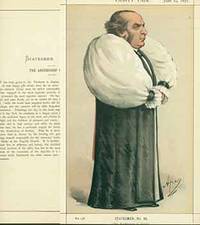
18-3259London: Vanity Fair 1871. Original colour lithograph. 13.5 x 8.5 inches accompanied by 1 sheet of letterpress description. Very Good. Trimmed at bottom of page with some loss of text. Published in Vanity Fair 24 June 1871.William Thomson FRS FRGS 11 February 1819 – 25 December 1890 was an English church leader Archbishop of York from 1862 until his death. He was born the eldest son of John Thomson of Kelswick House near Whitehaven Cumberland and educated at Shrewsbury School and at The Queen's College Oxford of which he became a scholar. He took his B.A. degree in 1840 and was soon afterwards made fellow of his college. He was ordained in 1842 and worked as a curate at Cuddesdon. In 1847 he was made tutor of his college and in 1853 he delivered the Bampton lectures his subject being The Atoning Work of Christ viewed in Relation to some Ancient Theories. These thoughtful and learned lectures established his reputation and did much to clear the ground for subsequent discussions on the subject. London: Vanity Fair, 1871. unknown
18-3249London: Vanity Fair 1871. Original colour lithograph. 13.5 x 8.5 inches accompanied by 1 sheet of letterpress description. Very Good. Trimmed at bottom of page with some loss of text. Published in Vanity Fair 4 March 1871.Carlo Cadorna 8 December 1809 Pallanza – 2 December 1891 Rome was an Italian politician and the elder brother of General Raffaele Cadorna.He graduated in law in 1830 at the University of Turin. In 1840 he was elected to the Chamber of Deputies in the constituency of Pallanza. He was the Minister of Education during the government headed by Vincenzo Gioberti.He was rapporteur of the law of secularisation of 29 May 1855 and spoke to a principle of separation of church and state and that the Church would be responsible only spiritual power on "thoughts aspirations beliefs" while the assets of the Church must be under the jurisdiction of the state.In 1857 Cadorna was elected President of the Chamber of Deputies of the Kingdom of Sardinia and in 1858 became a senator and appointed Minister of Education in the government led by Camillo Benso Count of Cavour 1858-1859.In 1864 he was the prefect of Turin and in 1868 Minister of the Interior of the Legislature I of Italy.He was the ambassador to the United Kingdom from 1869 to 1875. London: Vanity Fair, 1871. unknown
18-3241London: Vanity Fair 1870. Original colour lithograph. 13.5 x 8.5 inches accompanied by 1 sheet of description. Very Good. Published in Vanity Fair 9 July 1870.George Granville William Sutherland-Leveson-Gower 3rd Duke of Sutherland KG FRS 19 December 1828 – 22 September 1892 styled Viscount Trentham until 1833 Earl Gower in 1833 and Marquess of Stafford between 1833 and 1861 was a British politician from the Leveson-Gower family. London: Vanity Fair, 1870. unknown
18-1295London: Vanity Fair 1875. Original colour lithograph. 40 x 27 cm 15.75 x 10.6 inches. Good. Some toning foxing and stains and a vertical fold down the center. Two half-inch tears at bottom edge. Letterpress clipping with biography of subject pasted on verso. Dated 29 May 1875. Vincent Brooks Day & Son Lith. Scarce.Richard Plantagenet Campbell Temple-Nugent-Brydges-Chandos-Grenville 3rd Duke of Buckingham and Chandos GCSI PC DL 10 September 1823 – 26 March 1889 styled Earl Temple until 1839 and Marquess of Chandos from 1839 to 1861 was a British soldier politician and administrator of the 19th century. He was a close friend and subordinate of Benjamin Disraeli and served as the Secretary of State for the Colonies from 1867 to 1868 and Governor of Madras from 1875 to 1880. Buckingham was the only son of Richard Temple-Grenville 2nd Duke of Buckingham and Chandos and was educated at Eton and Christ Church Oxford. He joined the British Army eventually rising to become a colonel. Buckingham entered politics as Lord Chandos in 1846 when he was elected unopposed from Buckinghamshire as a candidate of the Conservative Party. Buckingham served as Member of Parliament from 1846 to 1857 when he resigned. He contested a re-election in 1859 but lost. Buckingham served in various political offices during his tenure. In March 1867 he was appointed Secretary of State for the Colonies and served until December 1868. He also served as Governor of Madras from 1875 to 1880. As Governor he handled the relief measures for the victims of the Great Famine of 1876-78. Buckingham also served as Lord of the Treasury Keeper of the Privy Seal of the Prince of Wales Deputy Warden of the Stannaries Deputy Lieutenant of Buckinghamshire Chairman of the London and North-Western Railway member of the Imperial Privy Council Lord President of the Council and chairman of the committees in the House of Lords. He died on 26 March 1889 at the age of 65. London: Vanity Fair, 1875. unknown
18-3239London: Vanity Fair 1870. Original colour lithograph. 13.5 x 8.5 inches accompanied by 1 sheet of description. Very Good. Published in Vanity Fair 18 June 1870.William Ward 1st Earl of Dudley 27 March 1817 – 7 May 1885 known as The Lord Ward from 1835 to 1860 was a British landowner and benefactor.Ward was born on 27 March 1817 at Edwardstone Boxford Suffolk England the son of William Ward 10th Baron Ward who had succeeded in the barony of Ward on the death of his second cousin Foreign Secretary John Ward 1st Earl of Dudley in 1833 the earldom becoming extinct. His mother was Amelia daughter of William Cooch Pillans. He was educated at Eton and Christ Church Oxford and Trinity College Oxford. He played first-class cricket for Oxford University Cricket Club between 1838 and 1842. His inheritance included Himley Hall and the ruins of Dudley Castle. In 1837 his trustees puchased the Witley Court estate in Worcestershire from Thomas Foley 4th Baron Foley. London: Vanity Fair, 1870. unknown