Talbot, William Henry FoxBiblio.com
15 988 résultats
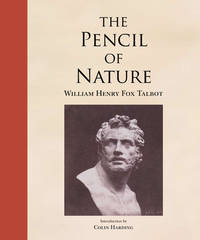
201190001KWS Publishers. New. 2011. Hardcover. 0981773664 . FREE UPGRADE to Courier/Priority Shipping Upon Request - IN STOCK AND IMMEDIATELY AVAILABLE FOR SHIPMENT - Flawless copy brand new pristine never opened -- 168 pp. -- with a bonus offer-- . KWS Publishers hardcover
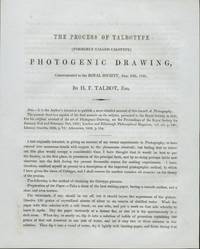
184148243London.: Printed by J. L. Cox and Sons. 1841. Loose as issued later morocco-backed portfolio. 4to. 229 x 182 mm. Leaf with drop-head title and note above opening text printed text recto and verso on following leaves folded as issued. The rare first edition of the first announcement of William Henry Fox Talbot's calotype method - the negative / positive photographic process - the most important innovation in the history of photography.Although Talbot had announced his researches and progress in the field of what was to become photography in his 1839 lecture to the Royal Society 'Some Account of the Art of Photogenic Drawing . &c.' that lecture although ground-breaking dealt largely with the achievement of an image on treated paper and only alluded briefly to the possibility of a more versatile development. It was not until his 1841 lecture to the same body the title as per the present publication is 'The Process of Calotype Photogenic Drawing . &c.' that the details of his refinements and most particularly his successes with the negative / positive process were delineated. Those successes and Talbot's development of the resultant negative / positive process for photographic reproduction and duplication remained the predominant methodology in the field for more than 150 years; all subsequent refinements whether in the chemicals used differing methods for image capture printing and so on were merely variations on Talbot's original scheme. Talbot had patented his method in secret he was awarded 'Her Majesty's Royal Letters Patent No. 8842' in February 1841 prior to his lecture to the Royal Society concerned by Arago's announcement of Daguerre's discoveries the efforts of Hippolyte Bayard and the priority of his own work.'In 1841 William Henry Fox Talbot announced an improvement of his photogenic drawing process which he named 'calotype' from the Greek meaning 'beautiful picture'. Previously he had allowed his sensitized paper to remain exposed to light until an image became visible. He now made a remarkable discovery: a much shorter exposure so changed the characteristics of the silver salts that they could be reduced to silver by chemical after-treatment. This principle of the 'development of the latent image' is basic to most subsequent photographic processes . To make a calotype negative Talbot bathed a sheet of paper in two solutions one of silver nitrate the other of potassium iodide . After exposure the paper was bathed again in this solution a mixture of gallic acid and silver nitrate which acted as a physical developer and gradually brought out the image . He printed them the resultant negative with his original silver chloride paper.' Beaumont Newhall. 'Privately printed for the author for distribution to friends and editors.' Gernsheim.'Between 1835 and 1839 Talbot and Henneman continued their experiments motivated by a desire . for reproducing images from nature. Following Arago’s announcement to the Académie des Sciences 7 January 1839 of the existence of Daguerre’s photographic process Talbot became concerned over the priority of his work; he frantically sought to improve his process prior to the disclosure of Daguerre’s . In 1840 Talbot would develop a latent image on paper and he called this new process the calotype. He patented and then disclosed the process in a paper presented to the Royal Society in June of 1841 . '. DSB.Talbot's document is scarce: COPAC locates no copies in the UK and the catalogue for the British Library reports no example; OCLC lists two copies in Germany at Marburg and Stuttgart's Staatsgalerie and four in the US at Syracuse Columbia Harvard and Princeton.The document was reprinted with an altered title 'The Process of Talbotype formerly called Calotype Photogenic Drawing . &c. in 1846.Gernsheim 655; see Beaumont Newhall's 'The Calotype: The Pencil of Nature' in 'The History of Photography' New York 1997 pg. 43. Printed by J. L. Cox and Sons. unknown
184649London: Printed by J. and H. Cox Brothers 74 and 75 Great Queen Street Lincoln’s-Inn Fields 1846. First edition under this title. Privately printed reprint of Talbot’s memoir that was published with variant title and imprint Process of Calotype Photogenic Drawing … London: J. L. Cox & Sons 1841. The printers J. & H. Cox were active from 1844–1846. Housed in blue cloth folder. In fine condition. First edition under this title. Privately printed reprint of Talbot’s memoir that was published with variant title and imprint Process of Calotype Photogenic Drawing … London: J. L. Cox & Sons 1841. The printers J. & H. Cox were active from 1844–1846. Housed in blue cloth folder. 4 p. In this paper Talbot 1800–1877 photographer inventor announced his invention of the photographic process the first permanent negative process on paper that he called Calotype and later – first in print in the title of this paper – Talbotype. His process was the forerunner of most photographic processes of the 19th and 20th century. It also had the advantage of fastness compared to other photogenic drawing processes of the time. <br /> An extremely rare and early paper on photography as Talbot printed privately in limited number for presentation to his friends and editors. Printed by J. and H. Cox, Brothers, 74 and 75, Great Queen Street, Lincoln’s-Inn Fields unknown
184152094London: Printed by J. & H. Cox Brothers 74 & 75 Great Queen Street Lincoln's-Inn Fields 1841. First edition. 4to. 4 pp. Aside from a few faint pinpoint spots of foxing this is a fine as new copy. Housed in a custom made cloth chemise and slipcase titled in gilt along the spine. Shortly after the presentation of his paper before the Royal Society on 31 January 1839 Talbot at his own expense printed the text as a pamphlet of 14 pages; "Some Account of the Art of Photogenic Drawing."became the world's first separate publication on photography. Through this process an ordinary piece of writing paper was immersed in a sensitizing solution dried placed in a camera and exposed in daylight to a subject for upwards of an hour or longer. Upon examination a tonally reversed rendering of the subject was visible. It was then soaked in a solution of salt and washed and dried then the process was essentially repeated exposing the first print to the new sensitized sheet reversing the tones to produce an image with the tonality as in nature. Through a series of further experiments over the next months Talbot discovered that a "latent" image always existed and that through chemical development it could be brought to life. This allowed for speeding the exposure in the camera to be cut to a mere 30 seconds and the enriched chemical solutions would produce a sharper and tonally richer image. This process he first called the Calotype from the Greek kalos - beautiful. <br /> <br /> On June 10 1841 Talbot presented the Calotype process at a meeting of the Royal Society and at his own expense he published a four page description of his process. Unlike his earlier publication on Photogenic Drawing here he states in detail the full process. <br /> Upon the urging of John Herschel and David Brewster he began to call his process the Talbotype rather than Calotype. His intention was to license this process and likely this printed description was printed to distributed to potential licensees. <br /> <br /> Aside from changing the name from Calotype to Talbotype in the title of this publication and the slight alteration in the printer's imprint the text of the two issue are identical - the word Calotype remains in the body of the text This is the foundation stone of the negative-positive process that has been in use since it was first published.<br /> <br /> This printing is much rarer than the Calotype variant with WorldCat locating only Harvard University - Houghton Library and Cornell University. Gernsheim Incunabula No. 655 listing only the Calotype variant. Roosens and Salu No. 10285 listing only the Calotype variant. Weaver HENRY FOX TALBOT SELECTED TEXTS AND BIBLIOGRAPHY No. 87 listing only the Calotype variant. Printed by J. & H. Cox, Brothers, 74 & 75, Great Queen Street, Lincoln's-Inn Fields unknown
1341698238.Ghardcover. Good. Access codes and supplements are not guaranteed with used items. May be an ex-library book. hardcover
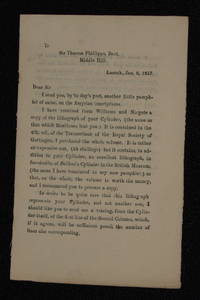
1866MH205Cheltenham : Middle Hill Press 1866 Book. Very Good. Disbound. 4 pages. Final page blank. Disbound torn along the inner margin. Transcribes a letter from Fox Talbot about Babylonian cylinders and the inscription on one owned by Sir Thomas. Holzenberg 544. [ Middle Hill Press ] unknown
2010DADAX1164441655Kessinger Publishing 2010-09-10. hardcover. New. 6.00x1.25x9.00. Buy with confidence. Excellent Customer Service & Return policy. Kessinger Publishing hardcover
1164441655.Ghardcover. Good. Access codes and supplements are not guaranteed with used items. May be an ex-library book. hardcover
0548796459.Gpaperback. Good. Access codes and supplements are not guaranteed with used items. May be an ex-library book. paperback
1164107046.Gpaperback. Good. Access codes and supplements are not guaranteed with used items. May be an ex-library book. paperback
1436596459.Ghardcover. Good. Access codes and supplements are not guaranteed with used items. May be an ex-library book. hardcover
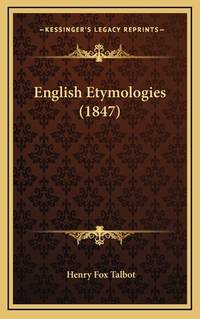
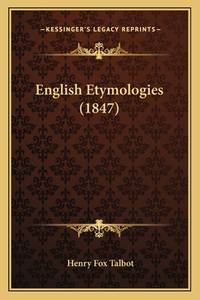
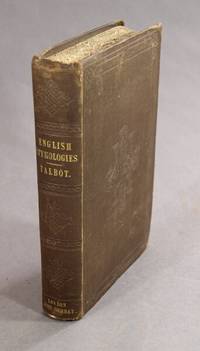
184744318London: John Murray 1847. First and only edition and one of only 500 copies printed; 8vo pp. viii 492 16-p. publisher's catalogue dated January 1847; original brown blindstamped cloth gilt lettering on spine; bottom of spine a little cracked prelims lightly foxed; a very good sound copy. A little-known work by the photography pioneer. "Talbot not only invented the negative/positive process that was the forerunner of modern photographic materials but he also produced the first books to be illustrated with photographs" Witkin & London p. 249. In this work on English etymology in which he chastens Dr. Johnson who "had no taste for etymology" Talbot details the etymologies of approximately 900 English words and proper names. Not a common book in the trade. Kennedy 8291; Vancil p. 233. John Murray unknown
1983017527Gruppo Editoriale Electa 1983. Good copy in slipcase. Slipcase has fraying edges and small tears at spine some markings and shelf wear. First inside pages are creased. . First Edition. Boxed. Good/Good. Elephant Folio - over 15" - 23" tall. Gruppo Editoriale Electa Hardcover
1994438Budapest 1994. Hardcover. Near Fine. Facsimile Edition of the 1844 edition. London Longman Brown Green & Longmans. Decorative cover. 24 tissue guarded & captioned photographs ca 30pp of tet in Hungarian. Ltd. ed. numbered. Slipcase. <br/><br/>This publication celebrates the 150th Anniversary of the first publication which contained the first photos from negatives. Includes the booklet laid in that was published with this edition with the English translation. 2 pieces. hardcover
1166016374.Gpaperback. Good. Access codes and supplements are not guaranteed with used items. May be an ex-library book. paperback
3732625699.Ghardcover. Good. Access codes and supplements are not guaranteed with used items. May be an ex-library book. hardcover
184753117London: John Murray 1847. First edition. 8vo. vii 492 pp. with 16 pp. of advertisements dated July 1846. Publisher's cloth decorated in blind and titled in gilt on the spine. Tips slightly curled and rubbed; a clean tear at the rear joint and at the spine crown have been expertly repaired and are barely noticeable. Original owner's neat signature on the front pastedown. Polymath William Henry Fox Talbot inventor of the negative/positive photographic process the photogravure printing process which afforded reproduction of images from life to ink on paper translator of Assyrian cuneiforms and etymologist of the English language here states "in giving the opinion of previous inquirers I have frequently quoted Johnson and also Thompson's Etymons of English Words. But it is evident that Johnson had no taste for etymology so that the assistance to be derived from him is usually rather meagre."<br /> <br /> Limited to 500 copies. John Murray unknown
185149876Paris Bachelier 1851. 4to. No wrappers. In: "Comptes Rendus Hebdomadaires des Séances de L'Academie des Sciences" Tome 33 No 22. Pp. 589- 632 entire issue offered. Talbot's paper: pp. 623-627. <br/><br/><em>First printing of the paper in which Talbot describes how he worked out the method of instant photography. He patented it in 1852 and 1858. "The beginning of high speed photography might be considered to be William Henry Fox Talbot's experiment in 1851. He attached a page of the London Times newspaper to a wheel which was rotated in front of his wet plate camera in a darkened room. As the wheel rotated Talbot exposed a few square inches of the newspaper page for about 1/2000th of a second using spark illumination from Leyden jars. This experiment resulted in a readable image." </em> unknown
1998BN95585Hogyf Editio. 1998. 1998. Hardcover. The Pencil of Nature by H.Fox Talbot. Der Zeichenstift der Natur. Faksimile der Ausgabe Longman Brown Green and Longmans. London. 1844. <br/><br/>The Pencil of Nature by H.Fox Talbot. Der Zeichenstift der Natur. Faksimile der Ausgabe Longman Brown Green and Longmans. London. 1844. Hogyf Editio. hardcover
20091-0307267504Everymans Library 2009. Hardcover. New. everyman's library ed. edition. 888 pages. 8.25x5.25x1.75 inches. Everymans Library hardcover
2090502113715390Not Available N.A. Soft Cover. Fine. The book is in fine condition. Not Available paperback
19922090502113717497Not Available 1992. Soft Cover. Fine. The book is in fine condition. Not Available paperback
0483231495.Ghardcover. Good. Access codes and supplements are not guaranteed with used items. May be an ex-library book. hardcover
0484418440.Ghardcover. Good. Access codes and supplements are not guaranteed with used items. May be an ex-library book. hardcover
1331859964.Gpaperback. Good. Access codes and supplements are not guaranteed with used items. May be an ex-library book. paperback