RENARD, LouisBiblio.com
21 262 résultats
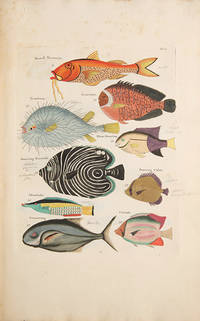
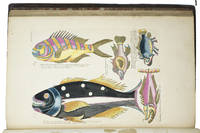
1754ABC_46313Amsterdam: Reinier & Josua Ottens 1754. Contemporary calf richly-gold tooled spine and bords green morocco spine label with title in gold decorated edges marbled endpapers. Preserved in a professionally made black cloth box with a black morocco spine label with the author title and imprint in gold. Folio. Title-page in red and black a divisional-title for each volume and 100 engraved plates numbered 1-43 & I-LVII no. LVII folding vividly hand-coloured as published showing 460 fishes and other marine animals. 2 volumes bound as 1. Renard's famous but rare work noted for the spectacular imagery of colourful but also bizarre tropical fishes crabs and lobsters from the Indo-Pacific being the first colour-plated fish book here in its rare second edition. The book contains 100 plates with 460 originally and extraordinary hand-coloured copper engravings divided over two volumes with their own half-title 'Histoire naturelle des plus rare curiositez de la mer des Indes' of 415 fishes 41 crustaceans two stick insects a dugong and even a mermaid all living in the Indian Ocean between the East Indies. Sometimes the descriptions specifically refer to fishes of some islands in the East Indies as Ambon the Moluccas or Buton but they also contain references to the "fishes of the Antilles Brazil" Sabin and Mauritius. The illustrations in the first volume seems to be quite realistic in contrast to those in the second volume which are sometimes quite surreal which is even more emphasized by the short anecdotical and highly entertaining descriptions.The Amsterdam publisher and bookseller Louis Renard compiled this collection of ichtyological illustrations by copying the sets of drawings which were brought to Amsterdam by Frederik Julius Coyett the son of the governor and ambassador of Ambon and Banda Balthasar Coyett. The drawings in the first part were copied after the collection of Balthasar Coyett. The illustrations in the second part were copied by Samuel Fallours a soldier in the service of the Dutch East India Company who started drawing marine life in the East Indies for the governors after those in the collection of Andriaen van der Stel governor of the Moluccas.The book shows marine life in the East Indies and the Indo-Pacific when Europe knew very little on this subject there. Because of the brilliant colours fantastic shapes and the described habits of its subjects the work however was often dismissed in its own time as fantasy. Nevertheless Renard's Poissons ecrevisses et crabes is nowadays still one of the rarest and most magnificent ichtyological works being the first colour-plated fish book and a highly interesting scientific effort to represent the Indo-Pacific maritime life mixed with flights of fantasy.Spine and joints professionally restored preliminaries a little foxed some minor browning especially in volume 1 but overall in good condition with brightly coloured plates. One of 35 known copies of a rare ichthyological work.l Landwehr Coloured plates 159; Nissen ZBI 3361; Nissen Schone Fischbucher 103; Sabin 69600; cf. Grace Costantino Renard's book of fantastical fish 2016 on https://blog.biodiversitylibrary.org; Julie Gardham Louis Renard: Poissons ecrevisses et crabes 2002 on www.gla.ac.uk; Theodore W. Pietsch Fishes crayfishes and crabs . 1995 pp. 22-26. Reinier & Josua Ottens, hardcover
118288Amsterdam Reinier & Josué Ottens 1754. . Second edition; 2 volumes bound in 1 folio 41.5 x 26.5 cm; 100 hand-coloured engraved plates of which 1 is folding title printed in red and black engraved dedication leaf divisional title printed 19th century bookplate of Dr. Henry Petit later pencilled notes identifying species short closed tear to plate 22 not affecting the image some spotting primarily to the front matter and index but plates overall clean; later paste-paper boards in red blue and yellow marbled paper backstrip in tree-calf pattern manuscript title to spine some wear hinges and spine professionally conserved a very good copy housed in a custom marbled slipcase with chemise.<br /> The first colour plate book on ichthyology among the rarest and most beautiful of all works of this type. One of only approximately 35 remaining copies of the second edition.<br /><br />The first edition of Poissons Ecrevisses et Crabes was produced by Amsterdam publisher Louis Renard in 1718 or 1719. This edition and the two that followed it 'each contain 100 color plates bearing a total of 460 brilliantly colored copper engravings representing 415 fishes 42 crustaceans two stick-insects a dugong and a mermaid. With one exception all of the illustrations represent tropical species of the East Indies said to have been drawn from nature on the island of Ambon in the South Moluccas by an artist named Samuel Fallours in the employ of the Dutch East India Company. The original drawings were obtained by Renard from various individuals who brought them to Holland in 1708 and 1715'. A recent survey by biologist and historian of science Theodore Pietsch determined that of the one hundred copies printed only sixteen are still know to exist Pietsch 'Louis Renard and his Poissons' in Ichthyology in Context 2023.<br /><br />The second edition is 'only slight more accessible' than the first'. 'It seems that the publishing firm of Ottens took the 30 or 36 unbound copies purchased from Renard's estate had the plates colored replaced the old undated title page of Renard and added a "Preface" provided by Vosmaer and the 'Declaration sur cet Ouvrage' of Renard. These then together with some 70 additional copies newly printed from the original coppers save for the new title page and "Preface" constitute the second edition' of which around 35 copies still exist Pietsch.<br /><br />While the illustrations have been criticised in the past for their 'dazzling' colour and embellishments they are in fact based on real specimens and were considered a valuable source of information by naturalists including Georges Cuvier who in 1828 described them as 'still indispensable'. 'Indeed fully 91% of the 460 organisms depicted in the book have been identified at least to the taxonomic level of family' Pietsch.<br /> Amsterdam, Reinier & Josué Ottens, 1754. hardcover
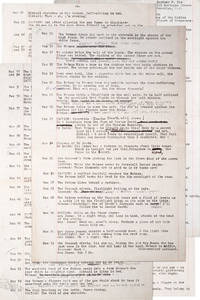
19392DC Comics 1939. none. Very good. Original hand corrected typescript. The complete story from Detective Comics no. 30 here titled "The Batman and the Diamonds of Death" the title was changed when it was published to "The Return of Dr. Death". 6 pages on 5 leaves 8" X 13" 1500 typed words plus 196 words of handwritten ink and pencil changes additions deletions and corrections including a rewrite of the final scene on the last page accompanied by a pencil drawing of a gliding Batman. Very good condition no mending tape or repair. This is Dark Knight incunabulum and as rare as a one ended stick. No other Batman manuscripts from this vintage or even from near this vintage is known. In fact any and all DC superhero manuscripts before 1945 except this one are impossible. Ex-Bob Kane. Ex-Mario Sacripante part of a dispersal of Kane's abandoned papers that included some page proofs and sketches but only this one manuscript. And by the way the printed Detective Comics no. 30 with our story in it sold for $19120 at auction in 2012. And the world record at auction for any issue of Detective Comics May 1939 graded 7 is $1500000 HA 2020 and for any Batman comic Spring 1940 graded 9.4 is $2220000 HA 2021 4 times the price of the most expensive imaginable hardbound 20th century 1st edition so something big and real is going on here. And both those prices are for a single comic of which dozens are known making our unique manuscript seem not to be very expensive and the chances of finding something even vaguely like it are the same as the chances of sitting in a chair with your mouth open and having a nicely roasted duck fly into it. Batman is the model for all modern superheroes without superpowers. Fueled by his superior intellect and powered by his fabulous toys he first showed up in Detective Comics no. 27 in a story written by Bill Finger and illustrated by Bob Kane. Finger also wrote the second story. When DC noticed its popularity they called in Gardner Fox who took over and wrote the next 4 including this one. Finger and Fox collaborated on the 7th story Detective Comics Nov. 1939 then Fox wrote the 8th one alone. Then with the exposition settled he turned it back to Finger and moved on to a long and influential career at DC co-creating Flash The Sandman Hawkman and the first superhero team-up with The Justice Society of America forerunner of The Justice League and it was Fox who conceived the Multiverse and introduced it to DC in 1961. First of all don't doubt it for a minute comic books are books. And this is the only early manuscript from the 2nd most valuable run in all of 20th century books Superman is the most valuable his debut in Action comics no. 1 selling for $3200000 2014 the world record for any 20th century book. Our manuscript will be looked back on in 10 years with regret captured in the thought "Why didn't I buy that" The answer is because there were no comps comparables or price points and only the most experienced enlightened and self-reliant collectors can calculate value without comps. From a more general perspective collector insight changes. Collector taste changes. The clues that point direction are only obvious in reflection. Some more stubborn booksellers continue holding to their view of what is in demand from a generation ago while other more cunning booksellers strategize to direct the insight and taste that drives demand towards obscurities that they can buy for cheap so as to extract large profit margins but the best collectors are immune to both the illusion of market rigidity and the deceit of bookseller manipulation because the savviest among them know that the market isn't static and watch carefully as the deck is shuffled and then focus on the center of the new radar. Whichever is the cause all but the nimblest booksellers get ambushed and in the confusion and isolation ensuing from their own folly they blame their disorientation on the collapse of enthusiasm for book collecting Book Code. DC Comics unknown books
200985454Charlottesville: Virginia Arts of the Book Center Press 2009. Limited Edition number 4/50 on last page. Hardcover. Very good. Jeff Pike. Format approximately 4 inches by 6.75 inches. Unpaginated 28 pages. No dust jacket present may not have been issued. Signed by both the author and illustrator on the title page. Very rare early published compendium by emerging poetic force and award-winning illustrator. Contents include: After the Party On Plenitude Metropolitan the Consolations of Philosophy After Love Charlie Chaplin and Nineteenth Symphony. Handsome and well made example of a finely produced specialty volume. This volume was printed on the letterpress and handbound at Virginia Arts of the Book Center Charlottesville in the summer of 2009. The text was set in Cambria and printed from polymer plates made by Boxcar Press of Syracuse NY. The paper used was Hahnemuhle photo rag 100% cotton smooth. Ryan Fox is a graduate of the University of Missouri and received his MFA from the University of Virginia. The poems in this volume first appears in New Orleans Review Columbia Caketrain and New Ohio Review. Jeff Pike is a Professor of Communication Design program of the College & Graduate School of art Sam Fox School of Design & Visual Arts Washington University in St. Lois. He worked in Charlottesville while on sabbatical. Ryan Fox attended St. Louis University High School where he was an editor of Sisyphus and a frequent contributor to the magazine and also features editor of the Prep News. Fox was a 2016 winner of the Discovery Poetry Context. He earned an MFA from the University of Virginia where he was poetry editor of Meridian and a JD from Fordham University School of Law where he was Editor-in-Chief of the Fordham Intellectual Property Media & Entertainment Law Journal. His poems have appeared in The New Yorker Boston Review and others. A member of the New York State bar. Jeff Pike earned a BFA degree from the Kansas City Art Institute and an MFA in Visual Communication from Syracuse University. Pike joined the faculty of the School of Art at Washington University in 1983. He has directed the Illustration program and in 1993 he was appointed Associate Dean responsible for the undergraduate programs. Pike was appointed Dean of the School of Art in 1999 a position he held through July 2008. Pike's professional work has appeared in numerous print and broadcast venues. He has worked for major advertising agencies and clients. His work has been recognized in Print Art Direction Creativity and Adweek magazines. He also has won Addy's and Flair awards for his creative work in advertising. In 2010 Pike published a boxed letterpress book of illustrations and works of fiction by two authors based upon the letters of Heloise and Abelard titled From Letters to Fictions: Heloise & Abelard. Most recently Pike's work has been accepted into the 53rd Annual New York Society of Illustrators exhibition. Pike has lectured at a number of schools and universities. He has twice been a resident at the Cité International des Arts Paris. He has led abroad programs in Belgium France and Italy. As dean he has traveled throughout Asia. Pike has been a board member for several art organizations most recently the National Association of Schools of Art and Design NASAD. Virginia Arts of the Book Center Press hardcover
184148243London.: Printed by J. L. Cox and Sons. 1841. Loose as issued later morocco-backed portfolio. 4to. 229 x 182 mm. Leaf with drop-head title and note above opening text printed text recto and verso on following leaves folded as issued. The rare first edition of the first announcement of William Henry Fox Talbot's calotype method - the negative / positive photographic process - the most important innovation in the history of photography.Although Talbot had announced his researches and progress in the field of what was to become photography in his 1839 lecture to the Royal Society 'Some Account of the Art of Photogenic Drawing . &c.' that lecture although ground-breaking dealt largely with the achievement of an image on treated paper and only alluded briefly to the possibility of a more versatile development. It was not until his 1841 lecture to the same body the title as per the present publication is 'The Process of Calotype Photogenic Drawing . &c.' that the details of his refinements and most particularly his successes with the negative / positive process were delineated. Those successes and Talbot's development of the resultant negative / positive process for photographic reproduction and duplication remained the predominant methodology in the field for more than 150 years; all subsequent refinements whether in the chemicals used differing methods for image capture printing and so on were merely variations on Talbot's original scheme. Talbot had patented his method in secret he was awarded 'Her Majesty's Royal Letters Patent No. 8842' in February 1841 prior to his lecture to the Royal Society concerned by Arago's announcement of Daguerre's discoveries the efforts of Hippolyte Bayard and the priority of his own work.'In 1841 William Henry Fox Talbot announced an improvement of his photogenic drawing process which he named 'calotype' from the Greek meaning 'beautiful picture'. Previously he had allowed his sensitized paper to remain exposed to light until an image became visible. He now made a remarkable discovery: a much shorter exposure so changed the characteristics of the silver salts that they could be reduced to silver by chemical after-treatment. This principle of the 'development of the latent image' is basic to most subsequent photographic processes . To make a calotype negative Talbot bathed a sheet of paper in two solutions one of silver nitrate the other of potassium iodide . After exposure the paper was bathed again in this solution a mixture of gallic acid and silver nitrate which acted as a physical developer and gradually brought out the image . He printed them the resultant negative with his original silver chloride paper.' Beaumont Newhall. 'Privately printed for the author for distribution to friends and editors.' Gernsheim.'Between 1835 and 1839 Talbot and Henneman continued their experiments motivated by a desire . for reproducing images from nature. Following Arago’s announcement to the Académie des Sciences 7 January 1839 of the existence of Daguerre’s photographic process Talbot became concerned over the priority of his work; he frantically sought to improve his process prior to the disclosure of Daguerre’s . In 1840 Talbot would develop a latent image on paper and he called this new process the calotype. He patented and then disclosed the process in a paper presented to the Royal Society in June of 1841 . '. DSB.Talbot's document is scarce: COPAC locates no copies in the UK and the catalogue for the British Library reports no example; OCLC lists two copies in Germany at Marburg and Stuttgart's Staatsgalerie and four in the US at Syracuse Columbia Harvard and Princeton.The document was reprinted with an altered title 'The Process of Talbotype formerly called Calotype Photogenic Drawing . &c. in 1846.Gernsheim 655; see Beaumont Newhall's 'The Calotype: The Pencil of Nature' in 'The History of Photography' New York 1997 pg. 43. Printed by J. L. Cox and Sons. unknown
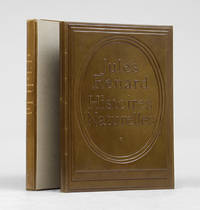
189997129Paris: Floury 1899. Toulouse-Lautrec's masterpiece of the illustrated book First edition number 84 of 100 copies only one of the most celebrated and sought-after of all livres d'artiste some of Lautrec's finest illustrations and the prototype of nearly all modern bestiairies Garvey. Lautrec and Jules Renard met first in 1894. The artist asked to illustrate some of the charming and witty portraits of animals and his first sketches were made at the Jardin d'Acclimatation and Jardin des Plantes in 1896. The last two illustrations printed were executed by Lautrec while he was a patient at the Neuilly clinic of Dr Sémalaigne. Renard's Histoire naturelles "contains some of Toulouse Lautrec's most refined draftsmanship and with Yvette Guilbert it is considered one of the masterpieces of the illustrated book. It was Lautrec who requested the pleasure of illustrating Renard's bestiary and Renard agreed hoping for descriptions that 'would please the animals themselves'. The two creative personalities clashed. Lautrec resented the book's limitation to mundane animals while Renard although paid homage to by a cover design of a fox objected to a number of Lautrec's drawings. Today we are amazed that it took Floury twenty years to sell out the edition of 100 copies" Donson/Gripp. Small folio 310 x 220 mm. With an original transfer lithograph to front wrapper on Japan paper and 22 throughout the text on vélin paper by Toulouse-Lautrec. Finely bound in 1973 by Pierre Lucien Martin 1913-1985 in olive green modelled calf titles to covers in raised lettering. Housed in a matching quarter calf chemise and slipcase. Foot of spine lightly rubbed with one small nick contents fresh; slipcase slightly sunned and rubbed. A finely bound copy. Adhémar 333-355; The Artist and the Book 304; Delteil 297-319; Donson/Gripp Great Lithographs by Toulouse-Lautrec nos. 78/79; Garvey 304 "Now one of the greatest rarities of the 19th century. Not only does it contain some of Lautrec's finest illustration but it is the prototype of nearly all modern bestiaries"; Rauch 17; Wittrock Toulouse-Lautrec I 202-224. unknown
184649London: Printed by J. and H. Cox Brothers 74 and 75 Great Queen Street Lincoln’s-Inn Fields 1846. First edition under this title. Privately printed reprint of Talbot’s memoir that was published with variant title and imprint Process of Calotype Photogenic Drawing … London: J. L. Cox & Sons 1841. The printers J. & H. Cox were active from 1844–1846. Housed in blue cloth folder. In fine condition. First edition under this title. Privately printed reprint of Talbot’s memoir that was published with variant title and imprint Process of Calotype Photogenic Drawing … London: J. L. Cox & Sons 1841. The printers J. & H. Cox were active from 1844–1846. Housed in blue cloth folder. 4 p. In this paper Talbot 1800–1877 photographer inventor announced his invention of the photographic process the first permanent negative process on paper that he called Calotype and later – first in print in the title of this paper – Talbotype. His process was the forerunner of most photographic processes of the 19th and 20th century. It also had the advantage of fastness compared to other photogenic drawing processes of the time. <br /> An extremely rare and early paper on photography as Talbot printed privately in limited number for presentation to his friends and editors. Printed by J. and H. Cox, Brothers, 74 and 75, Great Queen Street, Lincoln’s-Inn Fields unknown
1562376729Frankfurt am Main: David Zöpfel 1562. Woodcut title vignette 43 woodcut illustrations some repeated. Title page in red and black. 8 300 leaves. Small 4to 7-3/4 x 5-7/8 inches. Late nineteenth century brown crushed morocco gilt by Frances Bedford marbled endpapers gilt edges. Provenance: William Title inscription dated 1856 on front free endpaper; C. S. Ascherson bookplate and inscription to; Edward Ascherson bookplate. Woodcut title vignette 43 woodcut illustrations some repeated. Title page in red and black. 8 300 leaves. Small 4to 7-3/4 x 5-7/8 inches. The first of two Frankfurt printings by David Zöpfel that year using the same woodcuts. The text is descended from the Low German version Reynke de Vos first printed at Lübeck in 1498. <br /> <br /> Among the most widely adapted of the beast fables the tales of Reynard the Fox originated in the 12th and 13th centuries with early versions in French Dutch Latin and German being notable. One of the most important secular literary traditions of the Middle Ages Reynard the Fox is at its essence biting satire and parody. The character of Reynard an anthropomorphic fox and trickster has since become almost an archetype in the literatures of many languages. "The supreme 'anti-hero' of medieval fiction" Cambridge Guide to Children's Books in English.<br /> <br /> This copy from the renowned library of the eminent British architect and book collector Sir William Tite 1798-1873 whose sale at Sotheby's in May-June 1874 took sixteen days certainly one of the greatest collections of the time. [David Zöpfel] unknown
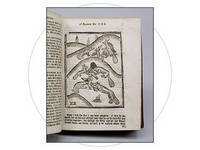
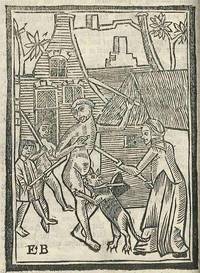
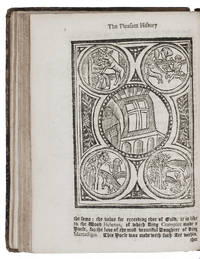
00654London: Printed by T. Ilive for Edward Brewster 1701. Early English Edition of the Reynard Fables<br/><br/>REYNARD THE FOX. The Most Delectable History of Reynard the Fox. Newly Corrected and Purged from all grossness in Phrase and Matter. Augmented and Enlarged with sundry Excellent Morals and Expositions upon every several Chapter. To which may now be added a Second Part of the said History: As also the Shifts of Reynardine the Son of Reynard the Fox Together with his Life and Death &c. London: Printed by T. Ilive for Edward Brewster 1701.<br/><br/>Bound together with:<br/><br/>REYNARD THE FOX. The Most Pleasant and Delightful History of Reynard the Fox. The Second Part. Containing Much Matter of Pleasure and Content. Written For the Delight of young Men Pleasure of the Aged and Profit of all. To which is added many Excellent Morals. London: Printed by A.M. and R.R. for Edward Brewster 1681.<br/><br/>And:<br/><br/>REYNARD THE FOX. The Shifts of Reynardine The Son of Reynard the Fox Or a Pleasant History of His Life and Death. Full of Variety &c. And may fitly be applied to the Late Times. Now Published for the Reformation of Mens Manners. London: Printed by T.J. for Edward Brewster and Thomas Passenger 1684.<br/><br/>Three parts in one small quarto volume 7 5/16 x 5 9/16 inches; 186 x 141 mm. 156 2 table of contents 2 publisher's advertisements; 111 1 publisher's advertisements; 8 160 pp. Mostly black letter with titles and side notes in roman letter. Sixty-two woodcuts in the first part printed from thirty-nine blocks and fifteen woodcuts in the second part five repeated all repeats from the first part. Most cuts signed "E.B." Edward Brewster. Woodcut on C1 recto Part I printed upside down.<br/><br/>Contemporary sprinkled sheep. Covers ruled and decoratively tooled in blind spine decoratively tooled in gilt in compartments with two red morocco gilt lettering labels. Minor restoration to covers. Some browning occasional light dampstaining and soiling. Part I with tiny puncture marks in the lower blank margin through gathering I just touching one letter in the imprint on the title-page six small holes in I3 and one tiny hole in I4 causing loss of a couple of letters. Part III with paper flaw in the upper blank corner of A3 and A4 tiny tear 1/4 inch in the lower blank margin of F4 and paper flaw in the lower blank corner of I2 none affecting text. Armorial bookplate of Gloucester on front free endpaper. Bookplate of Hugh Cecil Lowther 5th Earl of Lonsdale 1857-1944 on front pastedown his sale 12 July 1937 lot 445. An excellent copy. Housed in a quarter morocco clamshell box.<br/><br/>Reynard the Fox "hero of several medieval European cycles of versified animal tales that satirize contemporary human society. Though Reynard is sly amoral cowardly and self-seeking he is still a sympathetic hero whose cunning is a necessity for survival. He symbolizes the triumph of craft over brute strength usually personified by Isengrim the greedy and dull-witted wolf. Some of cyclic stories collected around him such as those telling of the wolf or bear fishing with his tail through a hole in the ice are found throughout the world; others like that of the sick lion cured by the wolf's skin are derived from Greco-Roman sources. The cycle arose in the area between Flanders and Germany in the 10th and 11th centuries when clerks began to forge Latin beast epics out of popular tales. The main literary tradition of Reynard the Fox descends from the extant French ‘branches' of the Roman de Renart about 30 in number nearly 40000 lines of verse. The facetious portrayal of rustic life the camel as a papal legate speaking broken French the animals riding on horses and recounting elaborate dreams all suggest the atmosphere of 13th-century France" Merriam-Webster's Encyclopedia of Literature.<br/><br/>"Caxton's immediate successors as printers of the Historye of Reynart the Foxe Wynkyn de Worde and Richard Pynson both published illustrated editions using the same woodcuts. Although neither a de Worde nor a Pynson edition survives intact there are fragments and there is circumstantial evidence to show that a Wynkyn de Worde edition of about 1495 or earlier was illustrated by a series of 43 woodcuts.apparently newly made for that edition.The earliest nearly complete fully illustrated History of Reynard the Fox to come down to us probably dates from the period 1560-1586. It survives in a unique copy.sometimes described as the ‘Anonymous' edition because it lacks the first few and the last few pages were we would expect to find the name of the printer and the place of publication. It contains 39 of the 43 Wynkyn de Worde cuts. To judge by their worn state.they had been much used since they were first made. This Anonymous edition also contains a series of 19 smaller artistically inferior pictures.They too are quite worn and may date from soon after the earliest illustrated editions.I have ascribed this Anonymous edition to the period 1560-1586. It is therefore just possible that it is either the lost William Powell edition of 1560-1561 or the lost Edward Allde edition of 1586 for both of these are mentioned in the Stationer's Register but neither survives" Kenneth Varty Reynard Renart Reinaert and Other Foxes in Medieval England: The Iconographic Evidence Amsterdam: 1999 pp. 98-99.<br/><br/>"From William Caxton's first edition 1481 to Thomas Gaultier's only edition 1550 the story is divided into 43 chapters. This may explain why the Wynkyn de Worde picture cycle contained 43 vertical cuts though in fact some chapters were not illustrated and some were illustrated with more than one picture. In the period before the appearance of the Anonymous edition we know.of only three illustrated editions: the one by Wynkyn de Worde sometime before or in 1495 and the other by him c. 1515; and the one by Richard Pynson somewhere between 1501 and 155. In the Anonymous edition between 1560 and 1585 the story is divided into 58 chapters. This may account for the frequent repetition of the vertical cuts as space-fillers and even for the introduction and occasional repetition of the smaller horizontal cuts. For most of the seventeenth century the story now short-titled The Most Delectable History of Reynard the Fox is divided into 25 chapters but this does not result in any noticeable reduction in the number of cuts used of either the vertical or the horizontal kind nor in the introduction of new illustrative material. In short the same cuts go on in much the same order apart from space-filler repetitions illustrating the same episodes. The first seventeenth-century edition to continue this picture cycle tradition is Edward Allde's 1620 followed by Elizabeth Allde's 1629. It continues in the two editions published in 1640 by Richard Oulton one for John Slater and the other for John Wright; also in the editions published by Jane Bell in 1650 1654 and 1656; and in the first edition published by Edward Brewster in 1662. By this date the Wynkyn de Worde blocks had become so worn and damaged that it is not surprising to discover a totally new set closely modelled on them and on the sixteenth-century horizontals and that this set should appear in an edition made for the publisher who last owned the de Worde blocks; that is in Edward Brewster's second edition in 1671 of The most Delectable History of Reynard the Fox.The forty different cuts which illustrate this edition all prominently display his initials EB. He published further illustrated editions in 1676 1681 1694 and 1701. In 1671 Brewster gave a new lease of life to the old picture cycle and in 1672 he grafted new life onto the old story with A Continuation Or Second Part Of The Most Pleasant and Delightful History of Reynard the Fox.In due course this new story about Reynard was to attract new illustrations but in this volume Brewster makes do with a sprinkling of fifteen cuts from his new cycle bearing the initials EB and he uses them again in his 1676 edition of the old story now called Part One and in his 1681 edition of both Part One and Part Two.In 1684 Brewster marketed a further sequel to this Continuation. Since Reynard was dead the chief role in this new story is given to one of his sons the one called Reynardine. It is entitled The Shifts of Renardine The Son of Reynard the Fox.Edward Brewster was not the only late seventeenth-century publisher of the Beast Epic to feel the need to renew it. His contemporary John Shurley sometimes spelled Shirley also felt that need and in 1681 he published his Most Delightful History of Reynard the Fox in Heroic Verse.Unlike other earlier renovations of the story it was never reprinted perhaps because the verse form was unpopular and because the illustrations were poor and few" Varty pp. 254-257.<br/><br/>Brunet IV cols. 1228-1229. Lowndes p. 2076. Varty Appendix Three: "A Short-Title List of All Extant Illustrated Histories of Reynard the Fox from Wynkyn de Worde c. 1495 to A. Soulby c. 1800 which are kept in United Kingdom libraries based on H. Menke Bibliotheca Reinardiana" 24 18 and 21. Wing S3512 Part II and S3436 Part III. London: Printed by T. Ilive, for Edward Brewster, 1701 unknown books
195417365ZAUBERKREIS 1954. 1. softcover. Weisse Hölle Maloftege! ZAUBERKREIS paperback
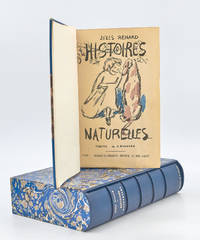
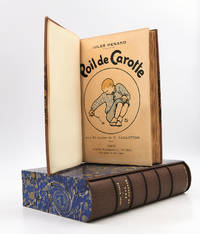
190487526Paris: Flammarion 1904. Fine. Flammarion Paris s.d. 1904 11.50 x 19 cm relié sous chemise et étui New edition and first printing of the superb illustrations by Pierre Bonnard one of 20 numbered copies on japon the only deluxe paper issue. Half blue percaline bradel binding with corners smooth spine adorned with a central gilt fleuron and double gilt fillet at the foot chocolate brown shagreen title label with minor scuffing french curl on Turkish patterned paper boards covers and spine preserved contemporary binding signed Carayon. Spine slightly browned corners slightly dulled. Our copy is housed under a half morocco chemise with five raised bands ill. de P. Bonnard stamped in gilt at foot of spine boards of tiger patterned paper and a slipcase bordered with blue Morocco with boards of tiger patterned paper signed T. Boichot. Illustrated with 68 drawings by Pierre Bonnard the second cover is also illustrated with a drawing by Félix Vallotton for the edition of Poil de Carotte published by the same publisher two years earlier. A rare and pleasant copy in a contemporary binding by Carayon. Flammarion hardcover
1684WRCLIT66732London: Printed by T.J. for Edward Brewster . and Thomas Passenger . 1684. Three parts bound in one volume. 80 leaves A-U4; 56 leaves A-O4; and 8160pp. Quarto. Modern blind paneled calf raised bands gilt label. First two parts illustrated with spirited woodcuts. Occasional foxing and mild spotting marginal smudges to first title usual tanning lower forecorners of E2-3 in first part torn away and replaced with a few letters and a few words in the sidenote in ms a few upper margins dust-soiled last three gatherings in third part supplied from another copy and trimmed slightly shorter at lower margin; a good sound copy neatly bound. First edition of the third part. An omnibus gathering of these three separately printed editions each with independent register and with the title of the first part taking into account the presence of the latter two. The terminal advert leaf to the first part is present. Wing attributes the text of the first part to John Shirley and that for the third is occasionally attributed to the publisher Edward Brewster. The first part is illustrated with 62 woodcut illustrations signed 'E.B.' of which 23 are repeats; the second part includes 15 woodcuts all of which appear as well in the first part. The first part was first printed in this form in 1667 and the second in 1672; the first part was reprinted again in 1701. Among the most widely adapted of the beast fables the tales of Reynard the Fox originated in the 12th and 13th centuries with early versions in French Dutch Latin and German being notable. Caxton printed a translation based on a Flemish text in 1481. The character of Reynard an anthropomorphic fox and trickster has since become almost an archetype in the literatures of several languages. ESTC R24532 & R218371 & R40614. WING S3513 & M2912 & S3436. BRUNET IV:1228. LOWNDES VII:2076. Printed by T.J. for Edward Brewster ... and Thomas Passenger ... hardcover books
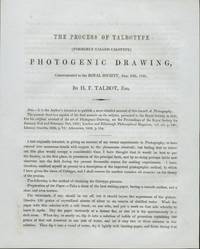
184152094London: Printed by J. & H. Cox Brothers 74 & 75 Great Queen Street Lincoln's-Inn Fields 1841. First edition. 4to. 4 pp. Aside from a few faint pinpoint spots of foxing this is a fine as new copy. Housed in a custom made cloth chemise and slipcase titled in gilt along the spine. Shortly after the presentation of his paper before the Royal Society on 31 January 1839 Talbot at his own expense printed the text as a pamphlet of 14 pages; "Some Account of the Art of Photogenic Drawing."became the world's first separate publication on photography. Through this process an ordinary piece of writing paper was immersed in a sensitizing solution dried placed in a camera and exposed in daylight to a subject for upwards of an hour or longer. Upon examination a tonally reversed rendering of the subject was visible. It was then soaked in a solution of salt and washed and dried then the process was essentially repeated exposing the first print to the new sensitized sheet reversing the tones to produce an image with the tonality as in nature. Through a series of further experiments over the next months Talbot discovered that a "latent" image always existed and that through chemical development it could be brought to life. This allowed for speeding the exposure in the camera to be cut to a mere 30 seconds and the enriched chemical solutions would produce a sharper and tonally richer image. This process he first called the Calotype from the Greek kalos - beautiful. <br/><br/>On June 10 1841 Talbot presented the Calotype process at a meeting of the Royal Society and at his own expense he published a four page description of his process. Unlike his earlier publication on Photogenic Drawing here he states in detail the full process. <br/>Upon the urging of John Herschel and David Brewster he began to call his process the Talbotype rather than Calotype. His intention was to license this process and likely this printed description was printed to distributed to potential licensees. <br/><br/>Aside from changing the name from Calotype to Talbotype in the title of this publication and the slight alteration in the printer's imprint the text of the two issue are identical - the word Calotype remains in the body of the text This is the foundation stone of the negative-positive process that has been in use since it was first published.<br/><br/>This printing is much rarer than the Calotype variant with WorldCat locating only Harvard University - Houghton Library and Cornell University. Gernsheim Incunabula No. 655 listing only the Calotype variant. Roosens and Salu No. 10285 listing only the Calotype variant. Weaver HENRY FOX TALBOT SELECTED TEXTS AND BIBLIOGRAPHY No. 87 listing only the Calotype variant. <br/><br/> Printed by J. & H. Cox, Brothers, 74 & 75, Great Queen Street, Lincoln's-Inn Fields hardcover books
184152094London: Printed by J. & H. Cox Brothers 74 & 75 Great Queen Street Lincoln's-Inn Fields 1841. First edition. 4to. 4 pp. Aside from a few faint pinpoint spots of foxing this is a fine as new copy. Housed in a custom made cloth chemise and slipcase titled in gilt along the spine. Shortly after the presentation of his paper before the Royal Society on 31 January 1839 Talbot at his own expense printed the text as a pamphlet of 14 pages; "Some Account of the Art of Photogenic Drawing."became the world's first separate publication on photography. Through this process an ordinary piece of writing paper was immersed in a sensitizing solution dried placed in a camera and exposed in daylight to a subject for upwards of an hour or longer. Upon examination a tonally reversed rendering of the subject was visible. It was then soaked in a solution of salt and washed and dried then the process was essentially repeated exposing the first print to the new sensitized sheet reversing the tones to produce an image with the tonality as in nature. Through a series of further experiments over the next months Talbot discovered that a "latent" image always existed and that through chemical development it could be brought to life. This allowed for speeding the exposure in the camera to be cut to a mere 30 seconds and the enriched chemical solutions would produce a sharper and tonally richer image. This process he first called the Calotype from the Greek kalos - beautiful. <br /> <br /> On June 10 1841 Talbot presented the Calotype process at a meeting of the Royal Society and at his own expense he published a four page description of his process. Unlike his earlier publication on Photogenic Drawing here he states in detail the full process. <br /> Upon the urging of John Herschel and David Brewster he began to call his process the Talbotype rather than Calotype. His intention was to license this process and likely this printed description was printed to distributed to potential licensees. <br /> <br /> Aside from changing the name from Calotype to Talbotype in the title of this publication and the slight alteration in the printer's imprint the text of the two issue are identical - the word Calotype remains in the body of the text This is the foundation stone of the negative-positive process that has been in use since it was first published.<br /> <br /> This printing is much rarer than the Calotype variant with WorldCat locating only Harvard University - Houghton Library and Cornell University. Gernsheim Incunabula No. 655 listing only the Calotype variant. Roosens and Salu No. 10285 listing only the Calotype variant. Weaver HENRY FOX TALBOT SELECTED TEXTS AND BIBLIOGRAPHY No. 87 listing only the Calotype variant. Printed by J. & H. Cox, Brothers, 74 & 75, Great Queen Street, Lincoln's-Inn Fields unknown
17016399London: T. Ilive 1701. Early English editions. Bound together with:<br /> <br /> The Most Pleasant and Delightful History of Reynard the Fox. The Second Part. Containing Much Matter of Pleasure and Content. Written For the Delight of young Men Pleasure of the Aged and Profit of all. To which is added many Excellent Morals. London: Printed by A.M. and R.R. for Edward Brewster 1681.<br /> <br /> And:<br /> <br /> The Shifts of Reynardine The Son of Reynard the Fox Or a Pleasant History of His Life and Death. Full of Variety &c. And may fitly be applied to the Late Times. Now Published for the Reformation of Mens Manners. London: Printed by T.J. for Edward Brewster and Thomas Passenger 1684.<br /> <br /> Three parts in one small quarto volume 7 5/16 x 5 9/16 inches; 186 x 141 mm. 156 2 table of contents 2 publisher's advertisements; 111 1 publisher's advertisements; 8 160 pp. Mostly black letter with titles and side notes in roman letter. Sixty-two woodcuts in the first part printed from thirty-nine blocks and fifteen woodcuts in the second part five repeated all repeats from the first part. Most cuts signed "E.B." Edward Brewster. Woodcut on C1 recto Part I printed upside down. Some browning occasional light damp staining and soiling. Part I with tiny puncture marks in the lower blank margin through gathering I just touching one letter in the imprint on the title-page six small holes in I3 and one tiny hole in I4 causing loss of a couple of letters. Part III with paper flaw in the upper blank corner of A3 and A4 tiny tear 1/4 inch in the lower blank margin of F4 and paper flaw in the lower blank corner of I2 none affecting text. Contemporary sprinkled sheep. Covers ruled and decoratively tooled in blind spine decoratively tooled in gilt in compartments with two red morocco gilt lettering labels. Some expert restoration to joints and corners. Armorial bookplate of Gloucester on front free endpaper. Bookplate of Hugh Cecil Lowther 5th Earl of Lonsdale 1857-1944 on front pastedown his sale 12 July 1937 lot 445. An excellent copy. Housed in a felt-lined quarter brown morocco clamshell case spine with five raised bands decoratively tooled and lettered in gilt in compartments.<br /> <br /> Reynard the Fox "hero of several medieval European cycles of versified animal tales that satirize contemporary human society. Though Reynard is sly amoral cowardly and self-seeking he is still a sympathetic hero whose cunning is a necessity for survival. He symbolizes the triumph of craft over brute strength usually personified by Isengrim the greedy and dull-witted wolf. . The main literary tradition of Reynard the Fox descends from the extant French 'branches' of the Roman de Renart about 30 in number nearly 40000 lines of verse. The facetious portrayal of rustic life the camel as a papal legate speaking broken French the animals riding on horses and recounting elaborate dreams all suggest the atmosphere of 13th-century France" Merriam-Webster's Encyclopedia of Literature. There is some variation in chapter number within the early editions: From "Caxton's first edition 1481 to Thomas Gaultier's only edition 1550 the story is divided into 43 chapters" while the anonymous edition 1560-1585 has 58 chapters Varty. By the 17th century when the text is titled The Most Delectable History of Reynard the Fox it appears with only 25 chapters and maintains its image cycle. Early 17th century editions also maintained this "picture cycle" through Edward Brewster's 1662 edition but at this point the Wynkyn de Worde blocks were extremely worn and new set was created Varty. Forty images were used for his second edition 1671 and all contain his initials EB. "He published further illustrated editions in 1676 1681 1694 and 1701. in 1672 he grafted new life onto the old story with A Continuation Or Second Part of the Most Pleasant and Delightful History of Reynard the Fox" Varty for which he eventually created an additional 15 illustrations. In 1684 he would produce an additional sequel following the adventures of Reynard's son Reynardine. <br /> <br /> Brunet IV cols. 1228-1229. Lowndes p. 2076. Varty Appendix Three: "A Short-Title List of All Extant Illustrated Histories of Reynard the Fox from Wynkyn de Worde c. 1495 to A. Soulby c. 1800 which are kept in United Kingdom libraries based on H. Menke Bibliotheca Reinardiana" 24 18 and 21. Wing S3512 Part II and S3436 Part III. T. Ilive unknown
190487526Flammarion | Paris s.d. [1904] | 11.50 x 19 cm | relié sous chemise et étui
190287525Paris: Flammarion 1902. Fine. Flammarion Paris s. d. 1902 11.50 x 19 cm relié sous chemise et étui Second edition with some parts in first edition with 5 added tales Félix Vallotton's illustrations in first issue one of 20 numbered copies on japon only deluxe issue. Bradel binding brown 3/4 cloth smooth spine with floral motif stamped in gilt at center twice ruled in gilt at foot slightly chafed morocco title-label marbled paper boards original covers and spine preserved contemporary binding signed Carayon. Small clear stains to the top edge of first board one corner slightly rubbed a spot of foxing at foot of the first few pages. Illustrated with 50 drawings by Félix Vallotton. Rare and handsome copy housed in a contemporary binding by Carayon. Renard and Vallotton the foreign nabi had met in the offices of La Revue Blanche a famous avant-garde journal which frequently featured Vallotton's woodcuts and published numerous contributions by Jules Renard. The writer invited Vallotton to illustrate this ""other first edition of Poil de Carotte which includes 5 previously unpublished stories: My dear Vallotton Would it amuse you to illustrate - in complete freedom - Poil de Carotte for Flammarion Renard wrote him in a letter dated June 21 1902. Vallotton was chosen ahead of Toulouse-Lautrec and Alexandre Steinlen two other great artists of the time who had shown an interest in the project. Renard's affinity with Vallotton's style is easy to understand as Vallotton's raw simplicity perfectly matches Poil de Carotte's incisive depiction of a loveless childhood: A few words a few lines are enough for these two artists. They both ruthlessly cut away the superfluous Léon Guichard L'Interprétation graphique cinématographique et musicale des uvres de Jules Renard. Flammarion hardcover
190287525Flammarion | Paris s. d. [1902] | 11.50 x 19 cm | relié sous chemise et étui
WALTER-FILM000325No binding. Very Good. Fine Art Print Vintage original 41 x 27 103 x 68 cm. one sheet poster USA. Gene Tierney Clifton Webb Dana Andrews Judith Anderson Vincent Price dir: Otto Preminger; Twentieth Century Fox. One of the rarest and most desirable of all posters for this classic film noir one of the finest and best remembered of the genre. Perhaps the most romantic and one of the most haunting of all noir posters. Story of a beautiful girl in a painting who is believed to have been murdered the police investigator who falls in love with her image and her jealous Svengali. Lovely portrait of the iconic Tierney. On linen there has been touch-up to the fold lines and touch-up to one tiny tear near the right edge middle fold near Vincent Price shoulder. Immaculate colors a really clean copy ABOUT FINE. unknown books
170122642London 1701. 4to. Thomas Ilive for Edward Brewster Late-18th-century sprinkled calf sewn on 5 cords 3 attached to the boards and 2 cut short gold double fillets blind-tooled board edges red morocco spine label in 2nd of 6 compartments red sprinkled edges. With woodcut of King Lion's court on the title page 61 woodcuts in text of part 1 including 23 repeats all signed Edward Brewster and all half-page 7.5 x 10.5 cm to nearly full-page 13 x 9.5 cm and 15 woodcuts in part 2 all repeated from part 1. Further with a large woodcut decorated initial in part 3 and decorations built up from cast fleurons in parts 1 and 2. Set in textura types with incidental roman and italic including Moxon's 1669 Canon roman on the title-page of part 3. 3 parts in 1 volume. 160; 112; 4 160 pp. One of the rare sets of all 3 parts of the English Reynard the Fox the third part here in its first edition. The Reynard stories were already established as a coherent collection in the 12th century and were first printed in 1479 in a Dutch prose edition. They became especially well known when translated into English and adapted for Caxton's 1481 edition in 43 chapters. The publisher Edward Alde in London began work on an extensive revision of Caxton's text with many new additions but he published only the first part probably in 1620 the first edition of the present part 1 containing 25 chapters some corresponding with chapters in Caxton's edition and some not. Although the second part would have to wait 52 years the first part quickly became the standard English version of the Reynard the Fox stories with 8 editions from 1620 to 1671. Its language was modernized giving both a view of the stories as they were known through most of two centuries and insights into English values and culture of the time. In 1684 Brewster added the present first edition of part 3 giving the adventures of Reynard's son Reynardine.With 20th-century woodcut bookplate. The woodcut on C1 of part 1 is printed upside down. In good condition with parts 2 and 3 slightly browned. One front endleaf is detached the spine slightly damaged at the head and the front hinge cracked.l Ebert II 18879; ESTC T60836 R218371 R40614; Kirmse 15; Menke V B c note on pp. 221-222 nos. 35 29 30; Wing S3512 S3436 parts 1-2; not in Prien. hardcover
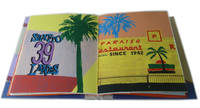
9647Achill Island Ireland: Rex Fox Press 2014. One of only 69 signed and numbered copies. 24 screen printed pages. 25 x 33 cms. In a superb large enginerred binding by the great British bookbinder Peter Jones of brown tan and green morocco backed wooden and perspex boards with palm tree and signs design in various coloured pape applied to perspex sections. All housed in a superb wooden orange felt lined box perspex windows with original upper wrapper screen print on the upper cover. Original screen printed back wrappers in a pocket at the back. The binding statement declares: Through my choice of materials design and structure I sought to capture the essence of the scenes depicted within the book. The treatment of the spine and adjacent shapes are palm trees with the shapes at the fore-edges being stylised representations of signage viewed from street level. The structure of the binding was devised to cope with the particular demands of a thick single section text block printed on heavy paper. The original covers of the edition binding have been incorporated into the box as the top of the lid.â€<br>Peter Jones worked in London as a furniture restorer and leather liner before training in bookbinding at Brighton Polytechnic. He now works as a bookbinder and as a carpenter and his books have a remarkably engineered quality with a great understanding of how to use different material in his work. He has taught bookbinding extensively including at the Universities of Brighton and Roehampton and is a Fellow and Past President of Designer Bookbinders. His work is exhibited internationally and held in numerous collections. Peter mainly works from his studio bindery in Wannock East Sussex. Rex Fox Press hardcover
43728Lausanne, André & Pierre Gonin, 1984. In-4° à l'italienne, 52p. en feuilles, sous couverture imprimée rempliée, chemise et étui.
197522502Paris chez l'Artiste 1975 In-8 oblong, maroquin beige entirement recouvert sur les plats d'un dcor gomtrique de filets pousss or et l'oeser noir voquant une superposition de feuilles, dos sans nerfs portant les noms de l'auteur et de l'artiste ainsi que le titre de l'ouvrage pousss l'oeser noir; doublures et gardes de papier beige fonc, tte dore, non rogn, couverture imprime. Chemise, tui (Michel Richard, 1976).Edition originale de ces pomes qui accompagnent 7 aquatintes originales hors texte de Michel Richard. Tirage limit 40 exemplaires numrots sur papier d'Arches, signs par l'auteur et l'artiste. Un des 5 exemplaires hors commerce, comportant toutes les aquatintes signes par l'artiste et un trs grand dessin original excut l'encre et sign par Michel Richard. Exemplaire reli par l'artiste ds la sortie du livre.
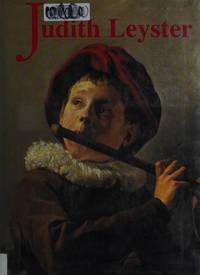
198987140Davaco Publishers. New. 1989. Hardcover. 9070288621 . FREE UPGRADE to Courier/Priority Shipping Upon Request - IN STOCK AND IMMEDIATELY AVAILABLE FOR SHIPMENT - FLAWLESS COPY BRAND NEW PRISTINE NEVER OPENED -- - Corresponds to ISBN: 9070288621. Text in English. 300 pages; 176 illustrations. Leijster Catalogue Raisonne Catalog Raisonné Complete Works Life and Work Raisonnee -- with a bonus offer . Davaco Publishers hardcover
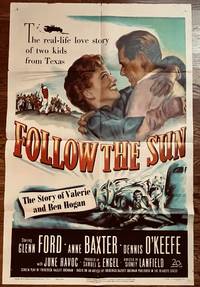
1951665Los Angeles: Twentieth Century Fox Film Corp 1951. 38 x 24 1/2 inches. Very good condition. Movie poster of the Ben Hogan Story called Follow the Sun. Very rare. See pics. Twentieth Century Fox Film Corp unknown