M.de la GuérinièreLivre Rare Book
28 résultats
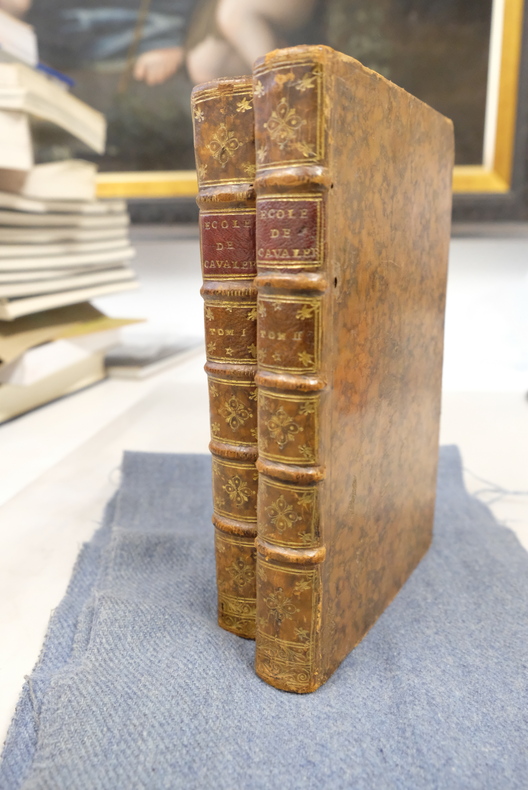
1736CHE2987MReliés, 319 et 298 pages, paru en 1736 à Paris, chez Jacques Guérin, libraire-imprimeur, 19,5x13,5cm. Très bon état général, très bien conservés, reliures légèrement usées, certaines pages légèrement brunies ou présentant des rousseurs.
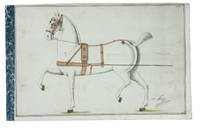
1800F6DFHL01U79OVienna 1800. Oblong small folio 23.5 x 37 cm and 25.5 x 39.5 cm. Volume 1 stab-sewn volume 2 with the leaves mounted on stubs and sewn through the folds each with blue shell-marbled paper wrapped around the spine. In an early 19th-century half tanned sheepskin box in the form of a book Stormont marbled sides metal hook-clasps. With 67 pen-and-ink watercolour and gouache drawings of horses plus stubs of 5 more numbered 1-54 and 75-87 including 1 folding most highlighted with silver and gold all signed each within a black ruled border most trimmed and mounted on blank leaves ca. 1805. With 2 etchings added at the end of volume 1 executed by Friedrich Leopold Bürde and dated 1812. 2 volumes. Unique harness maker's colour-drawn sample book with each drawing depicting a horse in elaborate carriage horse tack. The drawings were executed by Michael Fölsch himself one of the foremost Viennese makers and sellers of luxury tack in the early 19th century to show prospective clients possible designs for their carriage horses. Each drawing is signed by Fölsch as artist. His talent for draughtsmanship and colouring was hitherto unknown and is remarkable for a leather craftsman who probably never received training as a painter. The variety and complexity of the designs and the use of gold and silver is impressive suggesting that such bespoke equipment was intended for the wealthy elite.From the equestrian library of the Imperial stable master Franz Wenzel Schleichart von Wiesenthal ca. 1730-post 1800 with his engraved armorial bookplate upside down on the back of the box. He was a leading figure in a great dynasty of stable masters and horse breakers. Thereafter in the collection of Franz Josef II Fürst von und zu Liechtenstein 1906-1989.With only stubs for 5 of what would have been 72 leaves. A few leaves had torn or nearly torn before they were mounted ca. 1805 but most are in very good condition and the mounting has preserved and protected those that had been damaged. The drawings were clearly made for daily use and show occasional dirt small stains spots or other minor blemishes. ABE CAT Art History hardcover
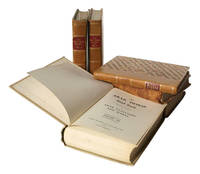
1788H47D4T46464Q1788. Amassed over the last fifty years and covering four centuries of relevant material the present collection spans all aspects of the history and development of the breeding of Arabian horses. It comprises within itself many books from the Le Vivier collection: fine press books of racing and thoroughbred literature produced by Eugene Connett's famous Derrydale press as well as numerous important items from the library of Duke Maximilian in Bavaria 1808-88 himself a great enthusiast of Arabic horses. Including items of exceptional rarity such as the rare beautifully illustrated first German edition of Friedrich von Eisenberg's famous riding school 1747 which lauds Arabian horses as "the finest produced by the Orient". Also we here find the early Arabian Horse Registry of America Stud Books and many items also bear presentation inscriptions from the authors Carl Raswan Gladys Brown Edwards etc. The common practice in such a specialized field most of the publications here were issued for a very limited circulation in runs of 1000 or fewer individually-numbered copies. As a reference library for breeding the collection is unparalleled: almost any Arabian horse's forefathers will be found amongst the exhaustive stud books and breeding serials from the 18th to the 20th century from Australia Poland Spain Russia the USA etc. often with accompanying photographs. Perhaps the most famous reference work is the Raswan Index of which only 380 copies were printed and many destroyed by a flood. Raswan became an expert on the Arabian breed through his lengthy trips to the desert where he lived with the Bedouins and learned their language and customs. Several scarce early 20th century works also testify to the Western fascination with the Bedouin and desert roots of the Arabian horse: Homer Davenport's My Quest of the Arabian Horse 1909 and Raswan's The Black Tents of Arabia: My Life Amongst the Bedouins 1935. Alongside modern surveys of the key centres of horse-breeding in the Arab world the early Western classics are also found here in their scarce first editions. French and German authors are also well-represented including the text and first French translation of the Hilyat al-fursân wa-shi'âr ash-shuj'ân an abridgement of Ibn Hudhail's horse treatise prepared around 1400. Finally the owner's collection of notable catalogues and magazines paints a fascinating composite picture of the evolution and heyday of Arabian horse-breeding in the Arab world Poland America and the United Kingdom. Also contained in this magnificent collection are the classic reference works on Arabian and Anglo-Arabian racehorses and their breeding. These standard works and encompassing sets of specialised thoroughbred literature include not only the indispensable guides to horse pedigrees the Racing Calendar General Stud Book Spanish American and Australian Stud Books Bloodstock Breeders' Review and Prior's Register of Thoroughbred Stallions in near-complete runs stretching back as far as the 18th century but also British and international horseracing history and several volumes of exquisite coloured plates. The size and comprehensiveness of the present collection cannot be overstated; it is safe to say that it represents the largest private collection of its kind which has come up for sale in recent decades. Many of the items found here can be located in just a handful of public institutions worldwide. Such items come into the market so rarely and have recently like the Raswan Index and the AHRA Stud Books commanded prices of five figures that it would be impossible to build a comparable collection item-by-item; the volumes here represent a lifetime of serious dedication to the task. Yet the value of such a collection lies not simply in its impressive number of important publications but in the vast amount of practical knowledge contained within. As the introduction to one manual expresses it "The horses shown and described form the foundation ancestry of a major number of breeding programs being propagated today. They appear in every area of endeavour. Yet pictures and facts are not easy to obtain. A knowledge of what has been and is what proved successful and what endured is pertinent to the maintenance of type and quality in the Arabian. Whatever your chosen bloodline this is a worthy study."Illustrated catalogue available upon request. unknown