Edwards, GeorgeBiblio.com

219 résultats
17437015London:: The College of Physicians 1743-51. First edition. Fine . Pl 207 Double-headed Snake & The Black Butterflies. Original hand-colored copperplate engraving. Quarto 9 x 12 inches. Includes text. George Edwards London 1694-1773 was a Fellow of the Royal Society and Fellow of the Society of Antiquaries in London who rejected his early formal training and potential career in business to pursue his passion in natural history. His dedication and talent as a draftsman and naturalist was evident thus gaining the attention of Sir Hans Sloane President of the College of Physicians and the Royal Society. Sir Hans offered Edwards the post of Librarian of the Royal College of Physicians in London and enlisted him to draw the natural curiosities of Sloane's private museum. This connection became the inspiration for Edward's masterful achievements; A Natural History of Uncommon Birds Published between 1743 and 1751 and the subsequent work; Gleanings of Natural History which was produced between 1758 and 1764. These two works illustrated and documented many previously unrecorded specimens of birds reptiles and insects held in England's private collections up to the mid eighteenth century. A monumental achievement Edwards documented- in English and French- painted engraved and hand-colored every one of the fine compositions in this Pre-Linnaean natural history opus. Although not a field naturalist Edwards placed many of his birds and animals in landscaped settings which was unusual for the time. In other compositions birds are elegantly perched on stylized branches in a classic Georgian format more decorative than realistic charming nonetheless. A gracious and humble man Edwards established firm and respected alliances with naturalist pioneers Carl Linnaeus 1707-78 Mark Catesby 1683-1749 from whom he learned the art of engraving and subsequently aided Catesby in the revision of his publication; The Natural History of Carolina Florida and the Bahama Islands London c.1754 as well as William Bartram from whom he acquired several species of Pennsylvanian birds included in his volumes. As Edwards' work predates the completion of the Linnaean classification system Linnaeus was to borrow the English names of many of Edwards species for his renowned work on classification and nomenclature. Ref: Buchanan Jackson Fine Bird Books. Matted in Rag Board The College of Physicians, unknown
17437013London:: The College of Physicians 1743-51. First edition. Fine . A fine original hand-colored copperplate engraving. Quarto 9 x 12 inches. Includes text. George Edwards London 1694-1773 was a Fellow of the Royal Society and Fellow of the Society of Antiquaries in London who rejected his early formal training and potential career in business to pursue his passion in natural history. His dedication and talent as a draftsman and naturalist was evident thus gaining the attention of Sir Hans Sloane President of the College of Physicians and the Royal Society. Sir Hans offered Edwards the post of Librarian of the Royal College of Physicians in London and enlisted him to draw the natural curiosities of Sloane's private museum. This connection became the inspiration for Edward's masterful achievements; A Natural History of Uncommon Birds Published between 1743 and 1751 and the subsequent work; Gleanings of Natural History which was produced between 1758 and 1764. These two works illustrated and documented many previously unrecorded specimens of birds reptiles and insects held in England's private collections up to the mid eighteenth century. A monumental achievement Edwards documented- in English and French- painted engraved and hand-colored every one of the fine compositions in this Pre-Linnaean natural history opus. Although not a field naturalist Edwards placed many of his birds and animals in landscaped settings which was unusual for the time. In other compositions birds are elegantly perched on stylized branches in a classic Georgian format more decorative than realistic charming nonetheless. A gracious and humble man Edwards established firm and respected alliances with naturalist pioneers Carl Linnaeus 1707-78 Mark Catesby 1683-1749 from whom he learned the art of engraving and subsequently aided Catesby in the revision of his publication; The Natural History of Carolina Florida and the Bahama Islands London c.1754 as well as William Bartram from whom he acquired several species of Pennsylvanian birds included in his volumes. As Edwards' work predates the completion of the Linnaean classification system Linnaeus was to borrow the English names of many of Edwards species for his renowned work on classification and nomenclature. Ref: Buchanan Jackson Fine Bird Books. Matted in Rag Board The College of Physicians, unknown
17437014London:: The College of Physicians 1743-51. later printing. Fine . Pl 208 The Mango-fish & The Great Brown Locust. Original hand-colored copperplate engraving. Quarto 9 x 12 inches. Includes text. This print is from a later edition printed on J Whatman Turkey Mills paper watermarked 1836. George Edwards London 1694-1773 was a Fellow of the Royal Society and Fellow of the Society of Antiquaries in London who rejected his early formal training and potential career in business to pursue his passion in natural history. His dedication and talent as a draftsman and naturalist was evident thus gaining the attention of Sir Hans Sloane President of the College of Physicians and the Royal Society. Sir Hans offered Edwards the post of Librarian of the Royal College of Physicians in London and enlisted him to draw the natural curiosities of Sloane's private museum. This connection became the inspiration for Edward's masterful achievements; A Natural History of Uncommon Birds Published between 1743 and 1751 and the subsequent work; Gleanings of Natural History which was produced between 1758 and 1764. These two works illustrated and documented many previously unrecorded specimens of birds reptiles and insects held in England's private collections up to the mid eighteenth century. A monumental achievement Edwards documented- in English and French- painted engraved and hand-colored every one of the fine compositions in this Pre-Linnaean natural history opus. Although not a field naturalist Edwards placed many of his birds and animals in landscaped settings which was unusual for the time. In other compositions birds are elegantly perched on stylized branches in a classic Georgian format more decorative than realistic charming nonetheless. A gracious and humble man Edwards established firm and respected alliances with naturalist pioneers Carl Linnaeus 1707-78 Mark Catesby 1683-1749 from whom he learned the art of engraving and subsequently aided Catesby in the revision of his publication; The Natural History of Carolina Florida and the Bahama Islands London c.1754 as well as William Bartram from whom he acquired several species of Pennsylvanian birds included in his volumes. As Edwards' work predates the completion of the Linnaean classification system Linnaeus was to borrow the English names of many of Edwards species for his renowned work on classification and nomenclature. Ref: Buchanan Jackson Fine Bird Books. Matted in Rag Board The College of Physicians, unknown
17587020London:: The Royal College of Physicians 1758-1764. First edition. Fine. Pl 282 The Spur Fish & The Indian Gattorugina. Original hand-colored copperplate engraving. Quarto 9 x 12 inches. Includes text. George Edwards London 1694-1773 was a Fellow of the Royal Society and Fellow of the Society of Antiquaries in London who rejected his early formal training and potential career in business to pursue his passion in natural history. His dedication and talent as a draftsman and naturalist was evident thus gaining the attention of Sir Hans Sloane President of the College of Physicians and the Royal Society. Sir Hans offered Edwards the post of Librarian of the Royal College of Physicians in London and enlisted him to draw the natural curiosities of Sloane's private museum. This connection became the inspiration for Edward's masterful achievements; A Natural History of Uncommon Birds Published between 1743 and 1751 and the subsequent work; Gleanings of Natural History which was produced between 1758 and 1764. These two works illustrated and documented many previously unrecorded specimens of birds reptiles and insects held in England's private collections up to the mid eighteenth century. A monumental achievement Edwards documented- in English and French- painted engraved and hand-colored every one of the fine compositions in this Pre-Linnaean natural history opus. Although not a field naturalist Edwards placed many of his birds and animals in landscaped settings which was unusual for the time. In other compositions birds are elegantly perched on stylized branches in a classic Georgian format more decorative than realistic charming nonetheless. A gracious and humble man Edwards established firm and respected alliances with naturalist pioneers Carl Linnaeus 1707-78 Mark Catesby 1683-1749 from whom he learned the art of engraving and subsequently aided Catesby in the revision of his publication; The Natural History of Carolina Florida and the Bahama Islands London c.1754 as well as William Bartram from whom he acquired several species of Pennsylvanian birds included in his volumes. As Edwards' work predates the completion of the Linnaean classification system Linnaeus was to borrow the English names of many of Edwards species for his renowned work on classification and nomenclature. Ref: Buchanan Jackson Fine Bird Books. Matted in Rag Board The Royal College of Physicians, unknown
17587018London:: The Royal College of Physicians 1758-1764. First edition. Fine . Pl 283 Sea Bat & The Pyed Acarauana. Original hand-colored copperplate engraving. Quarto 9 x 12 inches. Includes text. George Edwards London 1694-1773 was a Fellow of the Royal Society and Fellow of the Society of Antiquaries in London who rejected his early formal training and potential career in business to pursue his passion in natural history. His dedication and talent as a draftsman and naturalist was evident thus gaining the attention of Sir Hans Sloane President of the College of Physicians and the Royal Society. Sir Hans offered Edwards the post of Librarian of the Royal College of Physicians in London and enlisted him to draw the natural curiosities of Sloane's private museum. This connection became the inspiration for Edward's masterful achievements; A Natural History of Uncommon Birds Published between 1743 and 1751 and the subsequent work; Gleanings of Natural History which was produced between 1758 and 1764. These two works illustrated and documented many previously unrecorded specimens of birds reptiles and insects held in England's private collections up to the mid eighteenth century. A monumental achievement Edwards documented- in English and French- painted engraved and hand-colored every one of the fine compositions in this Pre-Linnaean natural history opus. Although not a field naturalist Edwards placed many of his birds and animals in landscaped settings which was unusual for the time. In other compositions birds are elegantly perched on stylized branches in a classic Georgian format more decorative than realistic charming nonetheless. A gracious and humble man Edwards established firm and respected alliances with naturalist pioneers Carl Linnaeus 1707-78 Mark Catesby 1683-1749 from whom he learned the art of engraving and subsequently aided Catesby in the revision of his publication; The Natural History of Carolina Florida and the Bahama Islands London c.1754 as well as William Bartram from whom he acquired several species of Pennsylvanian birds included in his volumes. As Edwards' work predates the completion of the Linnaean classification system Linnaeus was to borrow the English names of many of Edwards species for his renowned work on classification and nomenclature. Ref: Buchanan Jackson Fine Bird Books. Matted in Rag Board The Royal College of Physicians, unknown
17587019London:: The Royal College of Physicians 1758-1764. First edition. Fine . Pl 288 The Prickled Dog or Hound-fish with an insect called the Walking-stick. Original hand-colored copperplate engraving. Quarto 9 x 12 inches. Includes text. George Edwards London 1694-1773 was a Fellow of the Royal Society and Fellow of the Society of Antiquaries in London who rejected his early formal training and potential career in business to pursue his passion in natural history. His dedication and talent as a draftsman and naturalist was evident thus gaining the attention of Sir Hans Sloane President of the College of Physicians and the Royal Society. Sir Hans offered Edwards the post of Librarian of the Royal College of Physicians in London and enlisted him to draw the natural curiosities of Sloane's private museum. This connection became the inspiration for Edward's masterful achievements; A Natural History of Uncommon Birds Published between 1743 and 1751 and the subsequent work; Gleanings of Natural History which was produced between 1758 and 1764. These two works illustrated and documented many previously unrecorded specimens of birds reptiles and insects held in England's private collections up to the mid eighteenth century. A monumental achievement Edwards documented- in English and French- painted engraved and hand-colored every one of the fine compositions in this Pre-Linnaean natural history opus. Although not a field naturalist Edwards placed many of his birds and animals in landscaped settings which was unusual for the time. In other compositions birds are elegantly perched on stylized branches in a classic Georgian format more decorative than realistic charming nonetheless. A gracious and humble man Edwards established firm and respected alliances with naturalist pioneers Carl Linnaeus 1707-78 Mark Catesby 1683-1749 from whom he learned the art of engraving and subsequently aided Catesby in the revision of his publication; The Natural History of Carolina Florida and the Bahama Islands London c.1754 as well as William Bartram from whom he acquired several species of Pennsylvanian birds included in his volumes. As Edwards' work predates the completion of the Linnaean classification system Linnaeus was to borrow the English names of many of Edwards species for his renowned work on classification and nomenclature. Ref: Buchanan Jackson Fine Bird Books. Matted in Rag Board The Royal College of Physicians, unknown
17437008London:: The College of Physicians 1743-51. First edition. Fine . Pl. 121 The American Nightingale & the Green Sparrow or Green Ruby-throated Hummingbird. Original hand-colored copperplate engraving. Quarto 11.5 x 9 inches. Includes text. George Edwards London 1694-1773 was a Fellow of the Royal Society and Fellow of the Society of Antiquaries in London who rejected his early formal training and potential career in business to pursue his passion in natural history. His dedication and talent as a draftsman and naturalist was evident thus gaining the attention of Sir Hans Sloane President of the College of Physicians and the Royal Society. Sir Hans offered Edwards the post of Librarian of the Royal College of Physicians in London and enlisted him to draw the natural curiosities of Sloane's private museum. This connection became the inspiration for Edward's masterful achievements; A Natural History of Uncommon Birds Published between 1743 and 1751 and the subsequent work; Gleanings of Natural History which was produced between 1758 and 1764. These two works illustrated and documented many previously unrecorded specimens of birds reptiles and insects held in England's private collections up to the mid eighteenth century. A monumental achievement Edwards documented- in English and French- painted engraved and hand-colored every one of the fine compositions in this Pre-Linnaean natural history opus. Although not a field naturalist Edwards placed many of his birds and animals in landscaped settings which was unusual for the time. In other compositions birds are elegantly perched on stylized branches in a classic Georgian format more decorative than realistic charming nonetheless. A gracious and humble man Edwards established firm and respected alliances with naturalist pioneers Carl Linnaeus 1707-78 Mark Catesby 1683-1749 from whom he learned the art of engraving and subsequently aided Catesby in the revision of his publication; The Natural History of Carolina Florida and the Bahama Islands London c.1754 as well as William Bartram from whom he acquired several species of Pennsylvanian birds included in his volumes. As Edwards' work predates the completion of the Linnaean classification system Linnaeus was to borrow the English names of many of Edwards species for his renowned work on classification and nomenclature. Ref: Buchanan Jackson Fine Bird Books. Matted in Rag Board The College of Physicians, unknown
1758699London:: The Royal College of Physicians 1758-1764. First edition. Fine. A fine original hand-colored copperplate engraving. Quarto 9 x 12 inches. George Edwards London 1694-1773 was a Fellow of the Royal Society and Fellow of the Society of Antiquaries in London who rejected his early formal training and potential career in business to pursue his passion in natural history. His dedication and talent as a draftsman and naturalist was evident thus gaining the attention of Sir Hans Sloane President of the College of Physicians and the Royal Society. Sir Hans offered Edwards the post of Librarian of the Royal College of Physicians in London and enlisted him to draw the natural curiosities of Sloane's private museum. This connection became the inspiration for Edward's masterful achievements; A Natural History of Uncommon Birds Published between 1743 and 1751 and the subsequent work; Gleanings of Natural History which was produced between 1758 and 1764. These two works illustrated and documented many previously unrecorded specimens of birds reptiles and insects held in England's private collections up to the mid eighteenth century. A monumental achievement Edwards documented- in English and French- painted engraved and hand-colored every one of the fine compositions in this Pre-Linnaean natural history opus. Although not a field naturalist Edwards placed many of his birds and animals in landscaped settings which was unusual for the time. In other compositions birds are elegantly perched on stylized branches in a classic Georgian format more decorative than realistic charming nonetheless. A gracious and humble man Edwards established firm and respected alliances with naturalist pioneers Carl Linnaeus 1707-78 Mark Catesby 1683-1749 from whom he learned the art of engraving and subsequently aided Catesby in the revision of his publication; The Natural History of Carolina Florida and the Bahama Islands London c.1754 as well as William Bartram from whom he acquired several species of Pennsylvanian birds included in his volumes. As Edwards' work predates the completion of the Linnaean classification system Linnaeus was to borrow the English names of many of Edwards species for his renowned work on classification and nomenclature. Ref: Buchanan Jackson Fine Bird Books. Matted in Rag Board The Royal College of Physicians, unknown
17437011London:: The College of Physicians 1743-51. First edition. Fine . Pl. 71 The Brown and Spotted Heathcock. Original hand-colored copperplate engraving. Quarto 11.5 x 9 inches. Includes text. George Edwards London 1694-1773 was a Fellow of the Royal Society and Fellow of the Society of Antiquaries in London who rejected his early formal training and potential career in business to pursue his passion in natural history. His dedication and talent as a draftsman and naturalist was evident thus gaining the attention of Sir Hans Sloane President of the College of Physicians and the Royal Society. Sir Hans offered Edwards the post of Librarian of the Royal College of Physicians in London and enlisted him to draw the natural curiosities of Sloane's private museum. This connection became the inspiration for Edward's masterful achievements; A Natural History of Uncommon Birds Published between 1743 and 1751 and the subsequent work; Gleanings of Natural History which was produced between 1758 and 1764. These two works illustrated and documented many previously unrecorded specimens of birds reptiles and insects held in England's private collections up to the mid eighteenth century. A monumental achievement Edwards documented- in English and French- painted engraved and hand-colored every one of the fine compositions in this Pre-Linnaean natural history opus. Although not a field naturalist Edwards placed many of his birds and animals in landscaped settings which was unusual for the time. In other compositions birds are elegantly perched on stylized branches in a classic Georgian format more decorative than realistic charming nonetheless. A gracious and humble man Edwards established firm and respected alliances with naturalist pioneers Carl Linnaeus 1707-78 Mark Catesby 1683-1749 from whom he learned the art of engraving and subsequently aided Catesby in the revision of his publication; The Natural History of Carolina Florida and the Bahama Islands London c.1754 as well as William Bartram from whom he acquired several species of Pennsylvanian birds included in his volumes. As Edwards' work predates the completion of the Linnaean classification system Linnaeus was to borrow the English names of many of Edwards species for his renowned work on classification and nomenclature. Ref: Buchanan Jackson Fine Bird Books. Matted in Rag Board The College of Physicians, unknown
17437012London:: The College of Physicians 1743-51. First edition. Fine . Pl. 73 The Bustard Cock. Original hand-colored copperplate engraving. Quarto 11.5 x 9 inches. Includes text. George Edwards London 1694-1773 was a Fellow of the Royal Society and Fellow of the Society of Antiquaries in London who rejected his early formal training and potential career in business to pursue his passion in natural history. His dedication and talent as a draftsman and naturalist was evident thus gaining the attention of Sir Hans Sloane President of the College of Physicians and the Royal Society. Sir Hans offered Edwards the post of Librarian of the Royal College of Physicians in London and enlisted him to draw the natural curiosities of Sloane's private museum. This connection became the inspiration for Edward's masterful achievements; A Natural History of Uncommon Birds Published between 1743 and 1751 and the subsequent work; Gleanings of Natural History which was produced between 1758 and 1764. These two works illustrated and documented many previously unrecorded specimens of birds reptiles and insects held in England's private collections up to the mid eighteenth century. A monumental achievement Edwards documented- in English and French- painted engraved and hand-colored every one of the fine compositions in this Pre-Linnaean natural history opus. Although not a field naturalist Edwards placed many of his birds and animals in landscaped settings which was unusual for the time. In other compositions birds are elegantly perched on stylized branches in a classic Georgian format more decorative than realistic charming nonetheless. A gracious and humble man Edwards established firm and respected alliances with naturalist pioneers Carl Linnaeus 1707-78 Mark Catesby 1683-1749 from whom he learned the art of engraving and subsequently aided Catesby in the revision of his publication; The Natural History of Carolina Florida and the Bahama Islands London c.1754 as well as William Bartram from whom he acquired several species of Pennsylvanian birds included in his volumes. As Edwards' work predates the completion of the Linnaean classification system Linnaeus was to borrow the English names of many of Edwards species for his renowned work on classification and nomenclature. Ref: Buchanan Jackson Fine Bird Books. Matted in Rag Board The College of Physicians, unknown
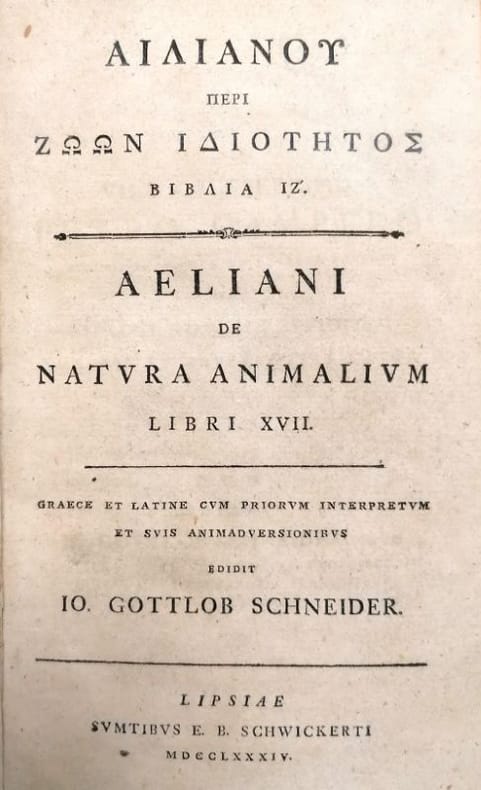
1784115887Lipsiae E. B. Schwickert 1784 1 vol. relié 2 parties reliées en 1 fort vol. in-8, demi-basane fauve à coins, dos à nerfs orné de filets dorés, pièce de titre rouge, tranches rouges (reliure postérieure), X + 585 + (21) + 228 + (44) pp, 2 index. Edition du texte grec avec index et notes en latin par Johann Gottlob Schneider (1750-1822). Compilation d'anecdotes sur les caractéristiques et les moeurs de plus de 300 animaux, dont un certain nombre inconnus ou fantaisistes, rédigées par Claude Elien dit Elien le Sophiste (175-235), historien et zoologiste romain de langue grecque. Reliure modeste mais solide du début du XIXe siècle.
1784115887Lipsiae E. B. Schwickert 1784 1 vol. relié 2 parties reliées en 1 fort vol. in-8, demi-basane fauve à coins, dos à nerfs orné de filets dorés, pièce de titre rouge, tranches rouges (reliure postérieure), X + 585 + (21) + 228 + (44) pp, 2 index. Edition du texte grec avec index et notes en latin par Johann Gottlob Schneider (1750-1822). Compilation d'anecdotes sur les caractéristiques et les moeurs de plus de 300 animaux, dont un certain nombre inconnus ou fantaisistes, rédigées par Claude Elien dit Elien le Sophiste (175-235), historien et zoologiste romain de langue grecque. Reliure modeste mais solide du début du XIXe siècle.
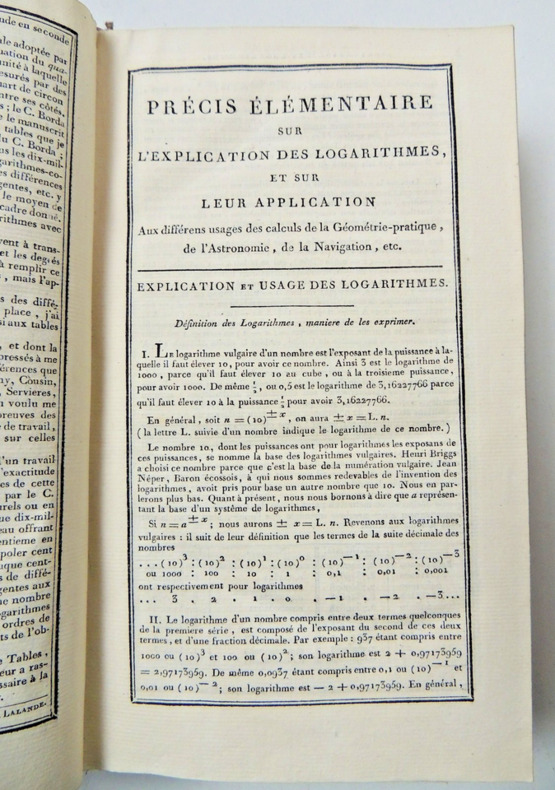
1795CZC-13171Précédées d'un discours préliminaire sur l'explication, l'usage et la sommation des logarithmes, et sur leur application à l'astronomie, à la navigation, à la géométrie-pratique, et aux calculs d'intérêts. Suivies de nouvelles tables plus approchées, et de plusieurs autres utiles à la recherche des longitudes en mer, etc. Édition stéréotype, gravée, fondue et imprimée par Firmin Didot avec 2 planches dépliées hors texte. volume relié fort in 8, 140x140, relié pleine basane époque, bon état intérieur, 1118pp. A Paris, chez Firmin Didot, 1795
1795CZC-13171Précédées d'un discours préliminaire sur l'explication, l'usage et la sommation des logarithmes, et sur leur application à l'astronomie, à la navigation, à la géométrie-pratique, et aux calculs d'intérêts. Suivies de nouvelles tables plus approchées, et de plusieurs autres utiles à la recherche des longitudes en mer, etc. Édition stéréotype, gravée, fondue et imprimée par Firmin Didot avec 2 planches dépliées hors texte. volume relié fort in 8, 140x140, relié pleine basane époque, bon état intérieur, 1118pp. A Paris, chez Firmin Didot, 1795
1787114712Rouen, chez J. Racine, Libraire 1787 Fort in-4 26 x 20 cm. Reliure de l’époque veau havane marbré, dos à nerfs encadrés de fers dorés, manque pièce de titre, XXXII-638 pp., manque la planche XII des XIX planches repliées sur le traité de la construction du cheval..., complet des 20 planches de plantes médicinales, table des matières. Coiffe de dos avec accroc, coins légèrement émoussés et frottés, deuxième plat restauré amateur, intérieur frais exempt de rousseurs.
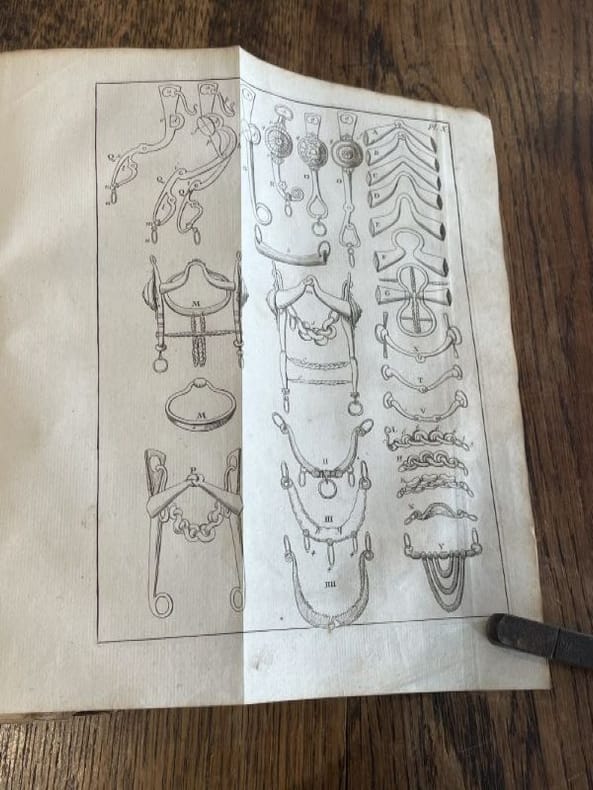
174119563Divisé en six Traités. 1° De sa Construction. 2° Du Haras. 3° De l'Ecuyer et du Harnois. 4° Du Chirurgien et des Opérations. 5° Du Maréchal ferrant. 6° De l'Apoticaire, ou des Remèdes. Avec un Dictionnaire des Termes de Cavalerie. Le tout enrichi de quarante-neuf Figures en Taille-douce. Par M. Fr. A. De Garsault, ci-devant Capitaine en Survivance du Haras du Roi.Édition originale. A Paris, Chez Louis-Estienne Ganeau - 1741 - 18 feuillets (Préface et Tables), 512 pages suivies de 20 planches (hors-texte, botanique) et cxxvij pages (dictionnaire et table des matières). 29 planches dépliantes dans le texte (pagination aléatoire), numérotées de I à XXVIII avec 2 planches numérotées X, bandeaux et lettrines. Complet des 49 planches totales. (Le portrait frontispice n'existe pas dans l'édition originale). Ex-libris manuscrit Huard sur une page de garde.Reliure plein veau moucheté de l'époque. Dos à nerfs orné et doré avec pièce de titre. Tranches jaspées rouges. Roulette dorée sur les coupes. Petit accident à la coiffe supérieur. Une petite déchirure sans manque page 7. Pas de rousseur. Très bon état pour ce bel exemplaire. Format in-8°(26x20).François-Alexandre Pierre de Garsault dit François-Alexandre de Garsault est un hippiatre, zoologiste, botaniste et dessinateur français. Il a décrit pour l'Académie royale des sciences plusieurs ouvrages des arts et métiers.
174688370Paris François Mathey 1746 1 vol. relié in-4, plein veau tabac, dos à nerfs, pièce de titre de veau havane, caissons ornés de fleurons, roulette à froid en encadrement sur les plats, tranches rouges, (38)-641 pp., portrait gravé en frontispice, 49 planches gravées, bandeaux et lettrines, index. Deuxième édition de ce célèbre traité d'hippologie dédié au comte de Maurepas. Le traité se décompose en 6 parties (construction du cheval, haras, écuyer et harnais, maladies, chirurgie, maréchal ferrant) et comprend 29 belles planches gravées dépliantes (numérotation dans le désordre). La 7e partie constitue un traité de pharmacie à usage vétérinaire illustré de 20 planches de botanique. Reliure de l'époque un peu frottée, petite mouillure marginale aux premiers feuillets. Sinon exemplaire en bonne condition, planches en très bel état.
174688370Paris François Mathey 1746 1 vol. relié in-4, plein veau tabac, dos à nerfs, pièce de titre de veau havane, caissons ornés de fleurons, roulette à froid en encadrement sur les plats, tranches rouges, (38)-641 pp., portrait gravé en frontispice, 49 planches gravées, bandeaux et lettrines, index. Deuxième édition de ce célèbre traité d'hippologie dédié au comte de Maurepas. Le traité se décompose en 6 parties (construction du cheval, haras, écuyer et harnais, maladies, chirurgie, maréchal ferrant) et comprend 29 belles planches gravées dépliantes (numérotation dans le désordre). La 7e partie constitue un traité de pharmacie à usage vétérinaire illustré de 20 planches de botanique. Reliure de l'époque un peu frottée, petite mouillure marginale aux premiers feuillets. Sinon exemplaire en bonne condition, planches en très bel état.
17985cb7in8 plein veau, 710-16+14 planches nb. Dos à motifs fleuris et frises dorés, pièce de titre - frises et cadres dorés sur les plats - Gardes marbrées bleues, tranches marbrées.
17881241840Berlin, J. A. Kunze, 1788. Titel, 133 S. Kart. d. Zeit (Einbd etwas fleckig u. beschabt, Kapitale abgestoßen, Signatur auf Vorder- u. Innendeckel, gering gebräunt u. vereinzelt leicht braunfleckig, Papier gering wellig, mehrfach gestempelt).
17449470Genève, Herit. Cramer et Frères Philibert, 1744 ; in-4 ; plein veau fauve marbré, dos à nerfs décoré et doré, pièce de titre havane, tranches rouges (reliure de l'époque) ; XXII pp., (1) f. bl., 348 pp., 1 planche dépliante ; les 2 dernières pages sont un catalogue de livres du libraire.
1765110423Paris chez Claude Prudhomme 1765 1 vol. relié in-12, plein veau havane, dos à nerfs orné de fleurons et encadrements dorés, pièce de titre, tranches rouges, (20) + 356 + (14) pp. (bordure des plats un peu brunie), 1 planche gravée (exemples de cages) et 2 planches de musique notée. Nouvelle édition revue, corrigée et augmentée par l'auteur. Très bonne condition.
1765110423Paris chez Claude Prudhomme 1765 1 vol. relié in-12, plein veau havane, dos à nerfs orné de fleurons et encadrements dorés, pièce de titre, tranches rouges, (20) + 356 + (14) pp. (bordure des plats un peu brunie), 1 planche gravée (exemples de cages) et 2 planches de musique notée. Nouvelle édition revue, corrigée et augmentée par l'auteur. Très bonne condition.
175166730Paris, Huart et Moreau, Desaint et Saillant, Durand, Delormel, Pissot 1751 In-folio, veau marbré moderne à l'imitation, dos à nerfs orné, double filet doré avec fleurons en écoinçons, 8- 318- 10 pp. Frontispice, vignette de titre, 3 belles vignettes d'entête, 24 planches hors-texte, la plupart d'après Parrocel. Ex-libris Château de Montrevost. Exemplaire lavé mais très bon état.
1797cv2740A Paris, chez Plassan, Imprimeur-Libraire, rue du Cimetière André-des-Arcs, n°10 Relié 1797 "In-12 (10,5 x 17,5 cm.), relié plein veau, caissons et fleurons dorés au dos, pièce de titre et de tomaison au dos, filet doré à la coupe, gardes et tranches marbrées couleurs, ccvj + 288 pages, 9 planches, daté de ""l'an VI de la République"", signet ; coins et bords frottés, mors marqués, légères rousseurs, quelques traces aux plats, bon état. Livraison a domicile (La Poste) ou en Mondial Relay sur simple demande."