1 056 résultats
18351241771Berlin, Duncker u. Humblot, 1835. 4, 132 S. Ppbd d. Zeit (Einbd beschabt, mehrfach gestempelt, Titel im Steg u. 1 Textblatt im Falz hinterlegt, leicht gebräunt u. stellenweise etwas fleckig).
186410095041864. 4to. 4 Bl., 28 S., 8 Chromolithographien. Lwdbd d. Zeit (braunfl.).
189715893Nature Study Publishing Co. 1897. Hardcover. Fair ex-library blue boards darkened rubbing edge bumps page edges toned front end page missing. The sixty full page color illustrations are very good or better. Issues are bound with the original covers. ; Color plates. . Nature Study Publishing Co. hardcover
1812DEMO016656ILondon: J. Carpenter J. Booker 1812. New edition. Hardcover. Near Fine. 69 woodcuts. 16mo modern speckled calf extra gilt by Bayntun a.e.g. some closed splits in the leather on the covers. <br/><br/>Classic and handsome treatment of Gay's first collection and his posthumous collection of fables. "Printed at The Chiswick Press by Mr. Whittingham whose taste and skill in fine typography have conspired to enter his name pre-eminent in the literary annals of the country. . the typographical connoisseur sees much to delight his eye and to gratify his mind. He perceives the most careful display and arrangement of type; the most pleasing tone of ink on every page; and the woodcuts brought out in all their brightness clearness and richness of colour -"The Gentleman's Magazine." The first fable in part 2 "The Dog and the Fox" is dedicated to a lawyer. "I know you Lawyers can with ease / Twist words and meanings as you please;". 69 woodcuts. J. Carpenter, J. Booker hardcover
18093176London:: George Shaw and E. Nodder 1809. First edition. Fine condition with original bright hand-coloring. . A Fine and rare original hand-colored copperplate engraving by Frederick Polydore Nodder and/or his son Richard Polydore Nodder from The Naturalist's Miscellany. Octavo 6 x 9.5 inches 15.24 x 24.13 cm. Includes the original text in both English and Latin by George Shaw MD FRS. The Naturalist's Miscellany distinguished by the refined hand-colored copperplate engravings and astute naturalists' observations was aptly named as a diverse naturalists' compendium of the birds mammals reptiles insects fish and crustacean identified by seventeenth and eighteenth century naturalists spanning the globe particularly around the South Seas. Many of nature's most fascinating and unusual creatures were discovered during this period several of which were introduced through The Naturalist's Miscellany. Doctor George Shaw 1751-1813 Fellow of the Royal Society cofounder of the Linnaean Society as well as Zoologist of the British Museum contributed the text. Publication of the Naturalist's Miscellany ceased with his death in 1813. Upon the death of the artist FP Nodder 1770-1800 his wife Elizabeth and their son Richard Polydore Nodder 1793-1820 contributed artistically and editorially to the publication. Indeed a family affair both Frederick Polydore Nodder and his son Richard produced every one of the plates. A gifted and distinguished naturalist Frederick P. Nodder was the preferred Botanical Painter to Her Majesty Queen Charlotte. His early skills as botanical and animal draughtsman and engraver were honed from his association with Sir Joseph Banks who employed Nodder to complete and engrave the drawings from the sketchbooks of the late Sydney Parkinson. Parkinson accompanied Banks as botanical draughtsman aboard Captain James Cook's The Endeavor in 1771. Parkinson died on the return of this South Seas Voyage. These engravings along with the natural history collections of the British Museum were the basis for the mastery of the Naturalist's Miscellany. Frederick's son Richard P. Nodder a gifted animal painter in his own right was distinguished as botanic painter to King George III. At the time of its creation The Naturalist's Miscellany was highly coveted as a definitive natural history offering and as was the custom the work was issued in installments between 1790 and 1813. Each volume was dedicated by permission and dutifully inscribed to the most devoted patrons and contributors of the natural historical pursuits of eighteenth and early nineteenth century Britain: Queen Charlotte Sir Joseph Banks Thomas Pennant Esq. The Universities of Oxford and Cambridge The Trustees of the British Museum to name a few. Andrews1986 Blunt 151Coats 25 Sitwell FBB 142 Wood 482. Copyright: Lowry-James Rare Prints & Books 1/09. George Shaw and E. Nodder, unknown
18093163London:: George Shaw and E. Nodder 1809. First edition. Fine condition with original bright hand-coloring. . A Fine and rare original hand-colored copperplate engraving by Frederick Polydore Nodder and/or his son Richard Polydore Nodder from The Naturalist's Miscellany. Octavo 6 x 9.5 inches 15.24 x 24.13 cm. Includes the original text in both English and Latin by George Shaw MD FRS. The Naturalist's Miscellany distinguished by the refined hand-colored copperplate engravings and astute naturalists' observations was aptly named as a diverse naturalists' compendium of the birds mammals reptiles insects fish and crustacean identified by seventeenth and eighteenth century naturalists spanning the globe particularly around the South Seas. Many of nature's most fascinating and unusual creatures were discovered during this period several of which were introduced through The Naturalist's Miscellany. Doctor George Shaw 1751-1813 Fellow of the Royal Society cofounder of the Linnaean Society as well as Zoologist of the British Museum contributed the text. Publication of the Naturalist's Miscellany ceased with his death in 1813. Upon the death of the artist FP Nodder 1770-1800 his wife Elizabeth and their son Richard Polydore Nodder 1793-1820 contributed artistically and editorially to the publication. Indeed a family affair both Frederick Polydore Nodder and his son Richard produced every one of the plates. A gifted and distinguished naturalist Frederick P. Nodder was the preferred Botanical Painter to Her Majesty Queen Charlotte. His early skills as botanical and animal draughtsman and engraver were honed from his association with Sir Joseph Banks who employed Nodder to complete and engrave the drawings from the sketchbooks of the late Sydney Parkinson. Parkinson accompanied Banks as botanical draughtsman aboard Captain James Cook's The Endeavor in 1771. Parkinson died on the return of this South Seas Voyage. These engravings along with the natural history collections of the British Museum were the basis for the mastery of the Naturalist's Miscellany. Frederick's son Richard P. Nodder a gifted animal painter in his own right was distinguished as botanic painter to King George III. At the time of its creation The Naturalist's Miscellany was highly coveted as a definitive natural history offering and as was the custom the work was issued in installments between 1790 and 1813. Each volume was dedicated by permission and dutifully inscribed to the most devoted patrons and contributors of the natural historical pursuits of eighteenth and early nineteenth century Britain: Queen Charlotte Sir Joseph Banks Thomas Pennant Esq. The Universities of Oxford and Cambridge The Trustees of the British Museum to name a few. Andrews1986 Blunt 151Coats 25 Sitwell FBB 142 Wood 482. Copyright: Lowry-James Rare Prints & Books 1/09. Matted in Rag Board George Shaw and E. Nodder, unknown
18093164London:: George Shaw and E. Nodder 1809. First edition. Fine condition with original bright hand-coloring. . A Fine and rare original hand-colored copperplate engraving by Frederick Polydore Nodder and/or his son Richard Polydore Nodder from The Naturalist's Miscellany. Octavo 6 x 9.5 inches 15.24 x 24.13 cm. Includes the original text in both English and Latin by George Shaw MD FRS. The Naturalist's Miscellany distinguished by the refined hand-colored copperplate engravings and astute naturalists' observations was aptly named as a diverse naturalists' compendium of the birds mammals reptiles insects fish and crustacean identified by seventeenth and eighteenth century naturalists spanning the globe particularly around the South Seas. Many of nature's most fascinating and unusual creatures were discovered during this period several of which were introduced through The Naturalist's Miscellany. Doctor George Shaw 1751-1813 Fellow of the Royal Society cofounder of the Linnaean Society as well as Zoologist of the British Museum contributed the text. Publication of the Naturalist's Miscellany ceased with his death in 1813. Upon the death of the artist FP Nodder 1770-1800 his wife Elizabeth and their son Richard Polydore Nodder 1793-1820 contributed artistically and editorially to the publication. Indeed a family affair both Frederick Polydore Nodder and his son Richard produced every one of the plates. A gifted and distinguished naturalist Frederick P. Nodder was the preferred Botanical Painter to Her Majesty Queen Charlotte. His early skills as botanical and animal draughtsman and engraver were honed from his association with Sir Joseph Banks who employed Nodder to complete and engrave the drawings from the sketchbooks of the late Sydney Parkinson. Parkinson accompanied Banks as botanical draughtsman aboard Captain James Cook's The Endeavor in 1771. Parkinson died on the return of this South Seas Voyage. These engravings along with the natural history collections of the British Museum were the basis for the mastery of the Naturalist's Miscellany. Frederick's son Richard P. Nodder a gifted animal painter in his own right was distinguished as botanic painter to King George III. At the time of its creation The Naturalist's Miscellany was highly coveted as a definitive natural history offering and as was the custom the work was issued in installments between 1790 and 1813. Each volume was dedicated by permission and dutifully inscribed to the most devoted patrons and contributors of the natural historical pursuits of eighteenth and early nineteenth century Britain: Queen Charlotte Sir Joseph Banks Thomas Pennant Esq. The Universities of Oxford and Cambridge The Trustees of the British Museum to name a few. Andrews1986 Blunt 151Coats 25 Sitwell FBB 142 Wood 482. Copyright: Lowry-James Rare Prints & Books 1/09. Matted in Rag Board George Shaw and E. Nodder, unknown
18093178London:: George Shaw and E. Nodder 1809. First edition. Fine condition with original bright hand-coloring. . A Fine and rare original hand-colored copperplate engraving by Frederick Polydore Nodder and/or his son Richard Polydore Nodder from The Naturalist's Miscellany. Octavo 6 x 9.5 inches 15.24 x 24.13 cm. Includes the original text in both English and Latin by George Shaw MD FRS. The Naturalist's Miscellany distinguished by the refined hand-colored copperplate engravings and astute naturalists' observations was aptly named as a diverse naturalists' compendium of the birds mammals reptiles insects fish and crustacean identified by seventeenth and eighteenth century naturalists spanning the globe particularly around the South Seas. Many of nature's most fascinating and unusual creatures were discovered during this period several of which were introduced through The Naturalist's Miscellany. Doctor George Shaw 1751-1813 Fellow of the Royal Society cofounder of the Linnaean Society as well as Zoologist of the British Museum contributed the text. Publication of the Naturalist's Miscellany ceased with his death in 1813. Upon the death of the artist FP Nodder 1770-1800 his wife Elizabeth and their son Richard Polydore Nodder 1793-1820 contributed artistically and editorially to the publication. Indeed a family affair both Frederick Polydore Nodder and his son Richard produced every one of the plates. A gifted and distinguished naturalist Frederick P. Nodder was the preferred Botanical Painter to Her Majesty Queen Charlotte. His early skills as botanical and animal draughtsman and engraver were honed from his association with Sir Joseph Banks who employed Nodder to complete and engrave the drawings from the sketchbooks of the late Sydney Parkinson. Parkinson accompanied Banks as botanical draughtsman aboard Captain James Cook's The Endeavor in 1771. Parkinson died on the return of this South Seas Voyage. These engravings along with the natural history collections of the British Museum were the basis for the mastery of the Naturalist's Miscellany. Frederick's son Richard P. Nodder a gifted animal painter in his own right was distinguished as botanic painter to King George III. At the time of its creation The Naturalist's Miscellany was highly coveted as a definitive natural history offering and as was the custom the work was issued in installments between 1790 and 1813. Each volume was dedicated by permission and dutifully inscribed to the most devoted patrons and contributors of the natural historical pursuits of eighteenth and early nineteenth century Britain: Queen Charlotte Sir Joseph Banks Thomas Pennant Esq. The Universities of Oxford and Cambridge The Trustees of the British Museum to name a few. Andrews1986 Blunt 151Coats 25 Sitwell FBB 142 Wood 482. Copyright: Lowry-James Rare Prints & Books 1/09. George Shaw and E. Nodder, unknown
18093179London:: George Shaw and E. Nodder 1809. First edition. Fine condition with original bright hand-coloring. . A Fine and rare original hand-colored copperplate engraving by Frederick Polydore Nodder and/or his son Richard Polydore Nodder from The Naturalist's Miscellany. Octavo 6 x 9.5 inches 15.24 x 24.13 cm. Includes the original text in both English and Latin by George Shaw MD FRS. The Naturalist's Miscellany distinguished by the refined hand-colored copperplate engravings and astute naturalists' observations was aptly named as a diverse naturalists' compendium of the birds mammals reptiles insects fish and crustacean identified by seventeenth and eighteenth century naturalists spanning the globe particularly around the South Seas. Many of nature's most fascinating and unusual creatures were discovered during this period several of which were introduced through The Naturalist's Miscellany. Doctor George Shaw 1751-1813 Fellow of the Royal Society cofounder of the Linnaean Society as well as Zoologist of the British Museum contributed the text. Publication of the Naturalist's Miscellany ceased with his death in 1813. Upon the death of the artist FP Nodder 1770-1800 his wife Elizabeth and their son Richard Polydore Nodder 1793-1820 contributed artistically and editorially to the publication. Indeed a family affair both Frederick Polydore Nodder and his son Richard produced every one of the plates. A gifted and distinguished naturalist Frederick P. Nodder was the preferred Botanical Painter to Her Majesty Queen Charlotte. His early skills as botanical and animal draughtsman and engraver were honed from his association with Sir Joseph Banks who employed Nodder to complete and engrave the drawings from the sketchbooks of the late Sydney Parkinson. Parkinson accompanied Banks as botanical draughtsman aboard Captain James Cook's The Endeavor in 1771. Parkinson died on the return of this South Seas Voyage. These engravings along with the natural history collections of the British Museum were the basis for the mastery of the Naturalist's Miscellany. Frederick's son Richard P. Nodder a gifted animal painter in his own right was distinguished as botanic painter to King George III. At the time of its creation The Naturalist's Miscellany was highly coveted as a definitive natural history offering and as was the custom the work was issued in installments between 1790 and 1813. Each volume was dedicated by permission and dutifully inscribed to the most devoted patrons and contributors of the natural historical pursuits of eighteenth and early nineteenth century Britain: Queen Charlotte Sir Joseph Banks Thomas Pennant Esq. The Universities of Oxford and Cambridge The Trustees of the British Museum to name a few. Andrews1986 Blunt 151Coats 25 Sitwell FBB 142 Wood 482. Copyright: Lowry-James Rare Prints & Books 1/09. George Shaw and E. Nodder, unknown
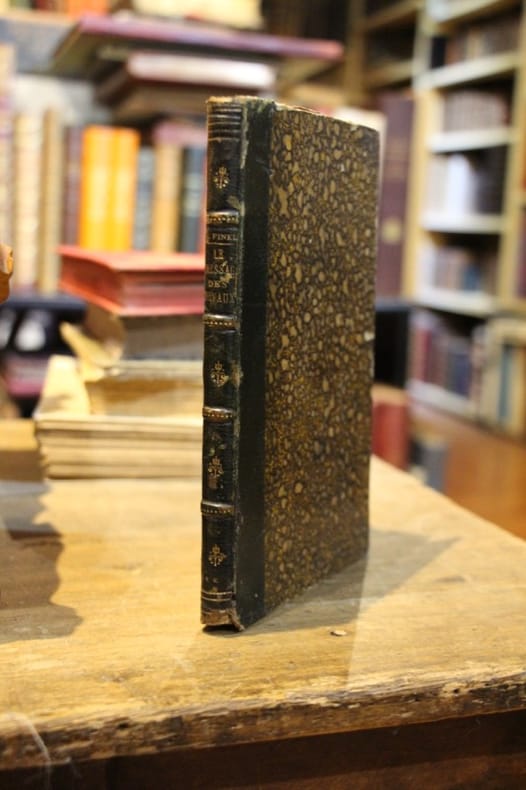
188166885Librairie Militaire de J. Dumaine, éditeur, coll. « Publication de la Réunion des Officiers » 1881 In-12, demi-basane noire, dos à nerfs ornés de roulettes et de petits fers dorés, 86 pp. Mouillures marginales et angulaires, coiffe de pied usée. En l’état.
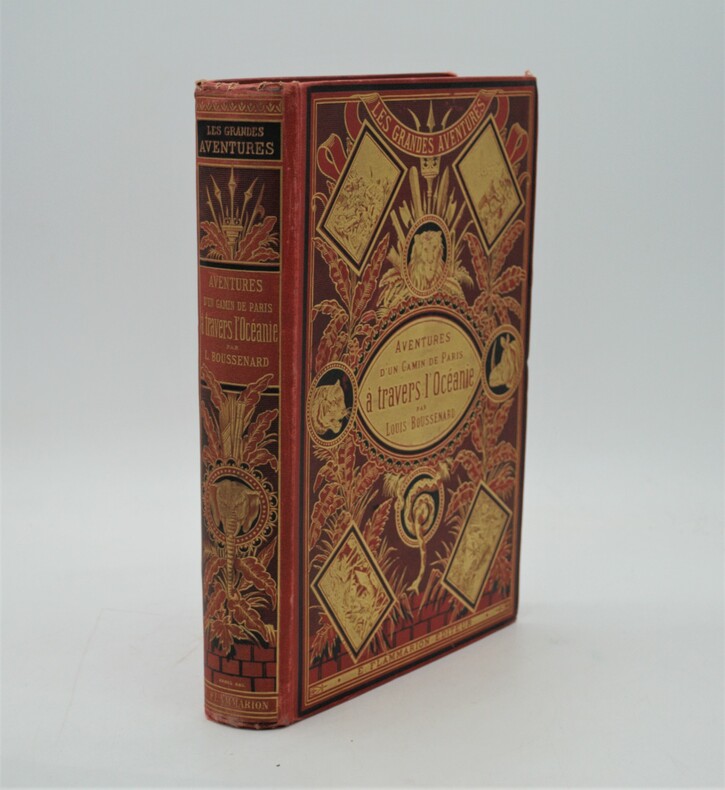
1880PHO-1062Paris, Marpon et Flammarion, sans date (circa 1880). grand in-8, 603 pages. Reliure éditeur pleine percaline rouge au décor richement orné avec plantes et animaux sauvage , dos lisse orné avec auteur , titre, etc. (Engel), tranches dorées , coins légèrement usés ,quelques rousseurs , bel exemplaire.P2-4E
18271241789Berlin, A. Rücker, 1827. 20, 252 S. Späterer Kart. m. eingebundenem OUmschl. (Umschl. m. Signaturen u. leichten Klebespuren, mehrfach gestempelt, etwas gebräunt u. braunfleckig, unbeschnitten).
18203282London: W. Bulmer & Co 1820. First Edition . Full-Leather. Very Good. 4to - over 9¾" - 12" tall. Brown leather boards. 3ii-xxi22-465p12-27p46illusdepcolor. All 15 called for plates present with three fold out color plates. Three folded Synoptical Tables present at rear page 386 Interior very good. Dep and fep pulling Both leather boards off but present . Leather off on one panel. <br/> <br/> W. Bulmer & Co hardcover
1867FAU12C175Paris, E. Dentu, 1867, 1 volume, in-8, sous demi reliure d'époque, VII-394 p. Préface et post-face par Alexandre Dumas. Nombreuses gravures in-texte.
1831147414Wien. Gedruckt bey A. Strauß 's sel. Witwe. 1831. VIII, 360 Seiten. Neuerer, roter Halbleinwand-Einband in guter Erhaltung. (Papier teils etwas fleckig. Wenige Bll. fachmännisch a. d. Rändern repariert). 22x14 cm
189627819Wien Gerlach & Schenk 1896 une planche chromolithographiée par ANTON SEDER, format : 44 centimètres de large par 56 centimètres de haut, titrée : "N°3 - POISSONS", tirée de : "Das Thier in der decorativen Kunst. (Les animaux dans les arts décoratifs), par Seder Anton, léger manque de papier en marge sur moins d'un cm2, 1896 Wien, Gerlach & Schenk Editeurs",
189627822Wien Gerlach & Schenk 1896 une planche chromolithographiée par ANTON SEDER, format : 44 centimètres de large par 56 centimètres de haut, titrée : "N°3 - POISSONS", tirée de : "Das Thier in der decorativen Kunst. (Les animaux dans les arts décoratifs), par Seder Anton, léger manque de papier en marge sur moins d'un cm2, 1896 Wien, Gerlach & Schenk Editeurs",
18283079FBKaschau, Verlag Otto Wigand, 1828. 8°. 19 x 12 cm. VI, 334 Seiten. Pappband der Zeit mit zwei verschiedenen Marmorpapierbezügen und goldgeprägtem Rückenschild. [3 Warenabbildungen]
1880CZC-7598Tome II. L'Homme - Les quadrupèdes Histoire naturelle de l'homme - de l'enfance - Histoire naturelle des animaux ( domestiques - sauvages et carnassiers ) 29 planches couleurs. fort vol relié in4, 28x18, superbe reliure demi cuir, très bel état intérieur, 995pp. Paris, Garnier Frères, vers 1880
184665008CBLeipzig, Druck und Verlag von B. G. Teubner, 1846. 4°. 26,5 x 18,5 cm. Frontispiz, Titelblatt, (2) 464 Seiten. Neuer Halblederband mit goldgeprägtem Rückentitel und marmoriertem Bezugspapier. [2 Warenabbildungen]
1891023337Edinburgh: David Douglas 1891. Illustrated a double-page coloured map large octavo pp xxiv 314 top edge gilt the fore-edge lightly untrimmed very clean internally a decorated title page a 16-page publisher's catalogue at the rear original green cloth slightly faded a small private shelf number on the spine the spine frayed at the base lacking a small piece at the top a small split to the top of the upper spine. From the library of the naturalist and conservationist Richard Fitter with his stamp on the half-title. First Edition. Cloth. Good. David Douglas Hardcover
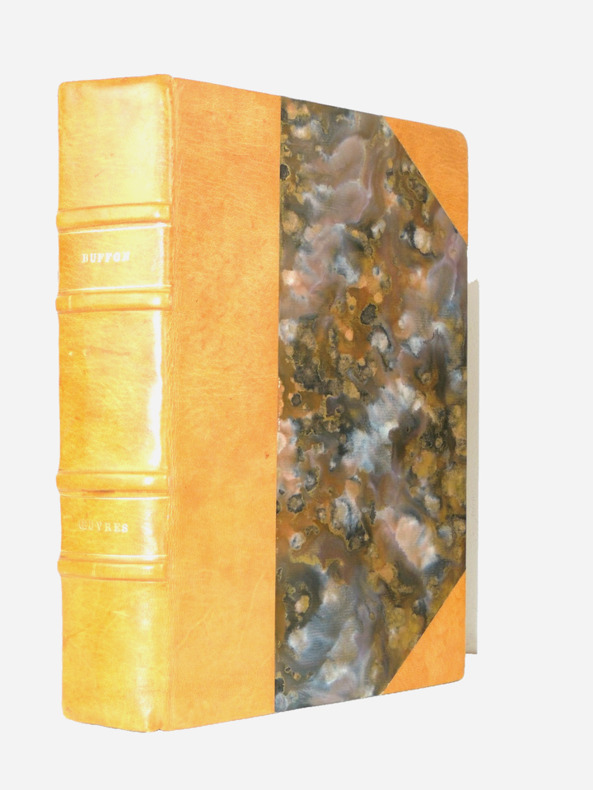
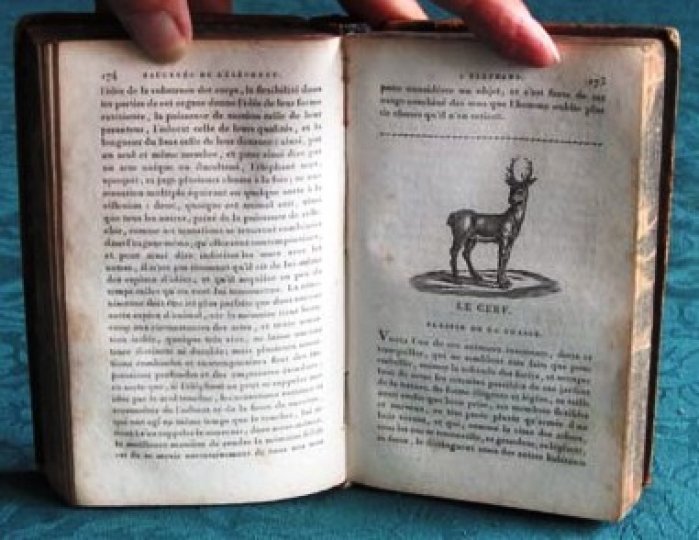
182617898Ou Recueil de ce que ses écrits ont de plus parfait sous le rapport du Style et de l'Eloquence.Discours de réception à l'académie française - de la nature - nature sauvage - nature dégénérée - sur l'air, la terre, la mer - des volcans - comparaison du printemps et de l'hiver - reproduction de la nature - nature des végétaux - l'homme - les sens - l'oeil - le visage - influence du climat - aliments de l'homme - l'enfance - état de l'homme dans les différents ages de la vie - de la vieillesse et de la mort - sur la mort - sur l'age d'or - l'homme en société - les peines et les plaisirs - la mémoire - les rêves - l'imagination - la pitié - modes - le progrès des langues - description de l'Arabie - moeurs des arabes - comparaison de l'homme et de l'animal - comparaison des animaux et des végétaux - différence entre l'animal et le minéral - qualités des animaux - perfectionnement des races - le chien - le chat - le cheval - l'âne - la brebis - la chèvre - le boeuf - le buffle - les animaux sauvages - l'éléphant - le cerf - le chevreuil - le renne - le lama - le blaireau - l'écureuil - le rat - la souris - le hérisson - le castor - les animaux carnassiers - le lion - le tigre - la panthère - l'hyène - le loup - le lynx - l'ours - le renard - le mococo - le mongous - l'hippopotame - l'unau - la chauve-souris - les oiseaux - l'aigle - le vautour - les pies-grièches - les oiseaux de proies - le paon - le pigeon - le moineau - le serin - la fauvette - l'oiseau-mouche - le colibri - le perroquet - les pics - les oiseaux aquatiques - la cigogne - le kamichi - le héron - le cygne - l'oie - les abeilles.A Paris, chez Jules Renouard - 1826 - VII et 332 pages. Illustré de vignettes.Reliure plein veau moucheté de l'époque. Dos lisse à faux nerfs orné et doré avec pièce de titre verte. Roulette dorée encadrant les plats. Tranches marbrées. Roulette sur les coupes. Accidents aux coiffes. Coins émoussés. Très rares rousseurs. Bon état. Format in-16°(14x9).
186116761Contenant des renseignements complets sur les particularités qui distinguent chacune d'elles. Éducation et Dressage, soins à donner dans toutes les maladies. Par H. Robinson. Orné de 5 planches (dont le frontispice) et de gravures intercalées dans le texte.Deuxième édition. Bruxelles, Ve. Parent & Fils. Paris, Auguste Goin. Leipzig, Ch. Mucquardt - 1861 - 270 pages. Catalogue éditeurs (relié in fine) 2 pages. Cachet répété de la Bibliothèque de Georges Renard.Reliure pleine percaline marron clair. Dos aux titre, auteur, date en pied et fleuron central dorés. Rares rousseurs. Petits frottements sans gravité. Très bon état. Bon exemplaire. Format in-8°(23x15).
18274809BB3. Auflage. München, Joseph A. Finsterlin, 1827. 8°. VIII, 172 S. Halblederband der Zeit mit Rückenschild und Rückenvergoldung (berieben und bestossen).