Waters, RJ R JBiblio.com

205 résultats
18561476811856-1937. Collection of approximately 393 photographic prints of ships in the San Francisco Harbor taken at the turn of the twentieth century. Photographs of full rigged sailing ships clipper ships whaling barks tramp steamers steam trawlers and a torpedo boat are in the collection many stamped Waters Company or R.J. Waters & Co. San Francisco. Ships from all around the world are represented including Scotland the United Kingdom Australia Germany Sweden and the United States. Many show San Francisco docks skyline and headlands as the setting one depicting Alcatraz in the background. In very good condition. The photographs measure approximately 8 inches by 10 inches. Collected in four large folios. R.J. Waters a lesser-known figure in the realm of early photography made notable contributions to documenting maritime life and industrial advancements in the late nineteenth century. His collection of photographs captured the transition from sail to steam power showcasing ships harbors and coastal communities with remarkable detail. These images not only served as a visual record of the maritime industry during a transformative era but also highlighted the socio-economic impact of technological progress on seafaring communities. Waters' work bridged art and historical documentation providing valuable insights into the aesthetics of industrial photography and the role of visual media in preserving maritime heritage. Today his photographs are regarded as important artifacts for studying the intersection of maritime history technology and visual culture. unknown
185641598London: J & C. Brown & Co. 1856. 1856. First edition. First edition of this Queen’s Quorum title #2 preceded only by Poe’s Tales in the history of the detective short story. A rare book to find in the original yellowback format; original covers laid down lacking the spine former owner's small name stamp on front pastedown sheet and a small inked number on the front fly leaf else a very good copy with interior clean. "Waters" is identified as a detective in the Metropolitan police and many of his cases are reported in this book which is quite readable. This book is a result of the publicity and public relations of the new Metropolitan Police which had been established in the 1820s. An interesting and early historical book in the early days of crime and mystery fiction. Also an early Haycraft/Queen Cornerstone mystery title and a rare book. Housed in a cloth clamshell case with titles stamped in red on the spine and front cover of the book reproduced on the front of the case. J & C. Brown & Co., [1856]. hardcover
1890List2833Shasta County and Siskiyou County 1890. Fifteen photographs approximately 4 ½ x 7 ½ inches. Each mounted on heavy cardboard backing approximately 5 ½ x 8 ½ inches which is mounted on heavy cardboard of approximately 8 x 10 ½ inches. Unknown if photographs are stamped verso due to mounting. Some with recent captions on the largest mount; some captions likely incorrect see description. Fine contrast overall fine condition. Raper James Waters 1856–1937 was a professional photographer from Sacramento California. He was first active as a photographer in Gold Hill Nevada in the 1880s. Following this he returned to California and had studios in Berkeley and San Francisco between the late 1880s and mid-1920s. Offered here is a collection of fifteen of Waters’ photographs from around Mount Shasta likely from the late 1880s or 1890s.<br /> <br /> The photographs are mainly from places in Siskiyou County where Mount Shasta is located including shots of the towns of Sisson now Mount Shasta and Dunsmuir Sisson and Dunsmuir are on the Siskiyou Trail an ancient Native American footpath running from the San Francisco area to Portland Oregon. The Central Pacific Railroad Company completed a train line along the Siskiyou Trail in 1887; one shot from an unknown location shows railroad tracks rounding a curve among felled trees. Just outside of Dunsmuir is the Shasta Springs resort mislabeled here as Shasta Bottling Works famous for its springwater – the fountains of water in the photograph are from pressurized pipes coming from the springs.<br /> <br /> Other captioned photographs show Castle Crags hikers summiting Mount Shasta Mossbrae Falls and Castle Lake mislabeled as Crystal Lake. Photographs also show campers with their tent small houses a canoe on a lake and snowy winter scenes. Overall a striking set of photographs. unknown
188014974Shanghai 1880. 880 by 960mm. 34.75 by 37.75 inches. Lithographed map dissected and laid down on linen in 24 sections with contemporary hand-colour in full; preserved in original publisher's green cloth slipcase. Compiled by Thomas Waters 1842-1898 "expressly for Sportsmen" slipcase label. Waters was an Irish civil engineer and architect who carved out a successful early career in Japan designing the Imperial Mint in Osaka and the headquarters for the Imperial Japanese Army. He worked briefly in Shanghai in the 1880s before going out to Colorado to join his brothers in silver and gold mining. This map also appeared in cyanotype probably originally drawn up as part of Waters' bid for the commission to construct a new waterworks in Shanghai. Waters was a strong contender in the competition as he had experience in the field: he was partially responsible for the construction of Japan's first sewer system. Rare: OCLC locates only two institutional examples those in the BnF and University of Chicago. hardcover
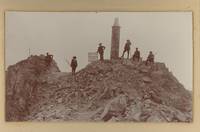
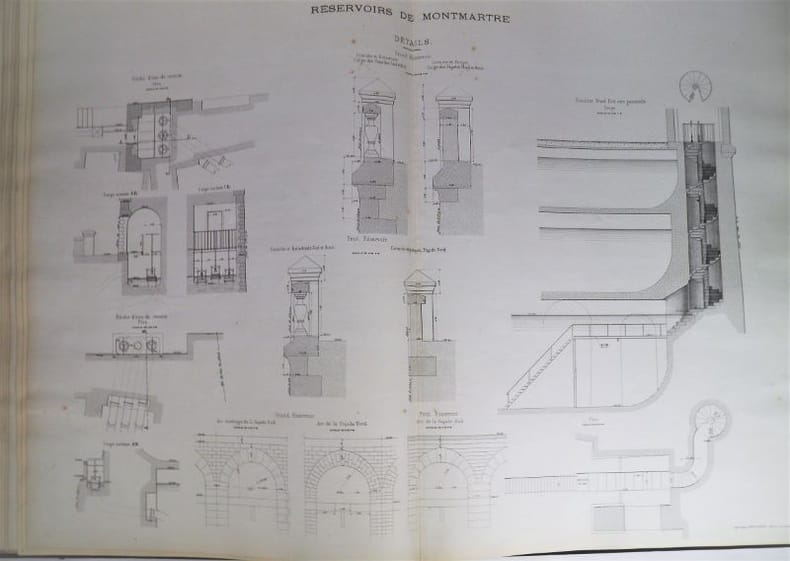
18892356Paris, Imprimerie Autog. Aost & Gentil, sans date [1889]. In-Plano – 49 x 65 cm. Reliure de l’époque en demi-chagrin bleu marine à coins, triples filets à froid en encadrement des plats de toile, titre, dates et blason parisien dorés sur le premier plat. Exemplaire entièrement monté sur onglets. 1 f. bl. ; 2 planches doubles + 4 planches (6 photographies originales), 1 p. (titre), 3 p. (texte autographié imprimé), 19 planches doubles (plans, coupes, façades et détails). ALPHAND ; HUET ; BECHMANN ; DIET ; JOURNET ; DUTOIT ; VILLE DE PARIS (auteurs). Entrepreneurs : LAZIES (maçonnerie). MATHELIN et GARNIER (Fontainerie). Rare et important ouvrage illustré de 6 photographies originales, dont 2 sur double page, et de 19 planches doubles, techniques et architecturales, témoignant de l’ampleur des travaux effectués à Montmartre à la fin du XIXe siècle, afin d’améliorer l’alimentation en eau d’un quartier en pleine croissance démographique. En effet, les sources naturelles présentes sur les flancs de la butte qui alimentèrent longtemps de nombreuses fontaines ne suffisaient plus : il fallait donc aller capter de l’eau de rivières (ce que permet dès 1834 une machine hydraulique édifiée à Saint-Ouen), la monter au sommet – au moyen d’une pompe à vapeur -, et enfin la stocker, d’où la construction en 1835 d’un château d’eau qui fonctionnera jusqu’en 1927. A partir de 1887, sous la houlette d’Adolphe Alphand, Directeur des Travaux de la Ville de Paris, sont entrepris deux chantiers de grande envergure. Le premier est la construction de deux réservoirs (un « grand » et un « petit »), dotés d’une capacité totale de 11 000 m3, dont la conception est confiée aux ingénieurs Bechmann et Journet et les plans sont dressés par l’architecte Diet (photographies 4 et 5). L’ouvrage occupe l’emplacement de l’ancien pressoir à raisins de l’abbaye des Dames de Montmartre, rue Azaïs, sur une colline sableuse à environ 128 m d’altitude. La nature du sol complexifie énormément les travaux, d'autant que l'usage du béton pour les fondations, d'un coût prohibitif, est exclu. Les deux concepteurs ont donc misé sur la pression de l'eau contenue dans les réservoirs pour stabiliser le banc de sable présent à cet endroit. Néanmoins, une partie de ce sable (avec les gravats) fut évacuée par des wagonnets tirés par une locomotive à vapeur (photographie 3), tandis que l'on imaginait d'ingénieux systèmes pour garantir l'étanchéité de l'édifice. Le sous-sol, les murs et le sol sont donc réalisés en meulière, les voûtes de la couverture en briquettes, et les piliers intérieurs en maçonnerie de brique de Bourgogne. Autre contrainte : la proximité du Sacré-Cœur (édifié à partir de 1886), qui requiert une harmonisation du style décoratif du bâtiment avec l’architecture néo-byzantine de la basilique (photographie 6), et là intervient le calcaire blanc des carrières de Souppes-sur-Loing et Château-Landon. Le second chantier de cette même année 1887 est celui de la nouvelle usine de relevage (ou élévatoire) Saint-Pierre, qui alimente à la fois le château d’eau et le réservoir. Ce dernier, définitivement opérationnel en 1889, pourvu de respectivement deux et trois étages, distribue l’eau dans les quartiers bas de Montmartre encore de nos jours. Les deux premières photographies, sur doubles pages, prises en 1886 et 1889, attestent de la transformation du paysage de la butte lorsque les réservoirs sont achevés.