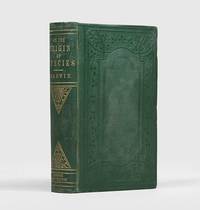
DARWIN CharlesABAA

271 résultats
186268006First Edition in Original Cloth of Darwin's Work on Orchids With Pre-Publication Advertisements DARWIN Charles. On the Various Contrivances by Which British and Foreign Orchids. Are Fertilised by Insects and on the Good Effects of Intercrossing. With Illustrations. London: John Murray 1862. First edition. Octavo 7 3/4 x 5 inches; 195 x 125 mm. vi 365 1 colophon 32 publisher's advertisements pp. With 33 woodcuts in the text and one woodcut folding plate. With publisher's 32 page advertisements dated December 1861. These advertisements being dated before publication indicate that this is a very early copy. Original full maroon cloth. Covers stamped and ruled in blind. Front board with gilt central device of an orchid. Spine stamped and lettered in gilt. Brown coated endpapers. Spine with some sunning. Some very minor foxing mainly to preliminaries. Small old bookseller's label on front free endpaper. Overall a near fine copy. "Darwin was adept at flanking movements in order to get around his critics. He would take seemingly intractable subjectsólike orchids flowersóand make them test cases for 'natural selection.' Hence the book that appeared after the Origin was to everyoneÃs surprise The Various Contrivances by which British and Foreign Orchids are Fertilised by Insects 1862. He showed that the orchidÃs beauty was not a piece of floral whimsy 'designed' by God to please humans but honed by selection to attract insect cross-pollinators. The petals guided the bees to the nectaries and pollen sacs were deposited exactly where they could be removed by a stigma of another flower." Brittanica Freeman Darwin. Hunt. McGill/Wood. Nissen BBI. Nissen ZBI. Darwin Collection 779. HBS 68006. $5500 John Murray hardcover books
189720038New York: D. Appleton and Company 1897. Octavo 15 volumes bound in three quarters red morocco over marbled boards. Top edge gilt gilt titles and tooling to the spine. Engraved plates numerous other illustrations throughout maps and charts. In excellent condition. Charles Darwin has been widely recognized since his own time as one of the most influential writers in the history of Western thought. His books were widely read by specialists and the general public and his influence had been extended by almost continuous public debate over the past 150 years. His most well known works are The Origin of Species The Descent of Man and Voyage of the Beagle. D. Appleton and Company hardcover books
186542842London: Longman Green Longman Roberts & Green 1865. <p>Darwin Charles 1809-84. On the movements and habits of climbing plants. In Journal of the Linnean Society 9 nos. 33 & 34 1865: 1-118. Text wood-engravings. Whole number. 128pp. 224 x 144 mm. uncut and unopened. Original blue-green printed wrappers a bit chipped at extremities very minor spotting. Very good copy. Preserved in a cloth folding box.</p> <p>First Edition journal issue of Darwin's book-length paper on climbing plants containing the essence of his discoveries in this field. The book-form second edition published ten years later by which his work on this subject is generally known is actually a revision and enlargement of the above. Darwin found that climbing was the result of the bending in a revolving plane of the apex of a plant's stem while it grows. He later studied the mechanism of bending and showed that it was due to a substance that comes down from the apex when acted upon by light. This research laid the foundation of the science of growth hormones in plants.</p> <p>The first printing of Darwin's monograph appeared in three forms all from the same setting of type: the double number of the Linnean Society Journal as above which was issued to the Fellows; a commercial offprint for sale to the public; and an offprint for the author. It made its first appearance between hard covers in 1875. Dictionary of Scientific Biography. Freeman 833. Norman 596.</p> . Longman, Green, Longman, Roberts & Green unknown books
1871140939389London: John Murray 1871. First Edition. Very Good. 2 Volumes. First edition both volumes first issue with "transmitted" the first word on page 297 in Volume I and with the errata on the verso of the title page of Volume II. Bound without ads in contemporary calf decorated in gilt with all edges marbled; the postscript page is present though bound at the end of Volume II. Light rubbing to joints and edges. Small scuff to front cover of Volume I and thin scuff to the front cover of Volume II. Small bookplate to front pastedowns in both volumes endpaper foxed. A lovely set in which the word "evolution" appears for the first time in Darwin's work. John Murray unknown books
3609Folding lithographed diagram. 8vo orig. pale green cloth head & foot of spine with slightest chipping occasional unimportant foxing covers stamped in blind spine lettered in gilt. New York: D. Appleton 1860. First American edition "second issue" with three quotations on verso of half-title. A very good and bright copy preserved in a slip-case. ❧ Freeman 378. For the first edition see Horblit 23b; Dibner Heralds of Science 199; and Printing & the Mind of Man 344b. hardcover books
18712173London: John Murray 1871. First edition. Original cloth. Very Good. FIRST EDITION FIRST ISSUE one of only 2500 copies in original cloth of Darwin's seminal work on the evolution of man. "This is really two works. The first demolished the theory that the universe was created for Man while in the second Darwin presented a mass of evidence in support of his earlier hypothesis regarding sexual selection. In the Origin Darwin had avoided discussing the place occupied by homo sapiens in the scheme of natural selection stating only that `light will be thrown on the origin of man and his history.' Twelve years later he made good his promise with The Descent of Man in which he compared man's physical and psychological characteristics to similar traits in apes and other animals showing how even man's mind and moral sense could have developed through evolutionary processes. In discussing man's ancestry Darwin did not claim that man was directly descended from apes as we know them today but stated simply that the extent ancestors of homo sapiens would have to be classified among the primates; however this statement as misinterpreted by the popular press caused a furor second only to that raised by the Origin" Norman 599. "The word `evolution' occurs for the first time in any of Darwin's works on page 2 of the first volume of the first edition" Freeman p.129.<br /> <br /> London: John Murray 1871. Octavo original green cloth; custom box. Two volumes. First issue with second volume with errata on verso of title and Postscript leaf tipped in after Contents. With 16-page publishers' catalog at end of each volume dated January 1871 first issue. Nearly invisible expert repair to upper hinge of volume 1; small blindstamp on front free endpapers; foxing to last few leaves of ads in both volumes as often; small hole likely paper flaw and line of soiling to volume 2 title page. A very good copy in original cloth. John Murray unknown books
1871101316London: John Murray 1871. First edition first issue with errata on verso of vol. II title-leaf. viii 423 1; viii ii 475 1 pp. 8vo. Publisher's green cloth. Light wear to covers expertly recased. Bookplate. First edition first issue with errata on verso of vol. II title-leaf. viii 423 1; viii ii 475 1 pp. 8vo. Darwin's Descent of Man created an uproar second only to his Origin of the Species; however "contrary to popular error prevalent now as well as then Darwin never said that man was descended from apes let alone monkeys; what he claimed was that man's ancestors if alive today would have to be classified among the Primates" De Beer Charles Darwin pp. 210-1. ODNB further clarifies "The Descent understood by Darwin as a sequel to the Origin was written with a maturity and depth of learning that marked Darwin's status as an élite gentleman of science" Freeman 937 John Murray unknown books
18712382London: John Murray 1871. First Edition. Very Good to Near Fine. Original green publisher's cloth binding stamped in blind with spines lettered in gilt. Black coated endpapers. With errata on the verso of the title page to Volume 2 the inserted leaf in Volume 2 explaining "a serious and unfortunate error" affecting the text of pages 297-299 in Volume 1 and pages 167 and 237 in Volume 2. No text corrected. Two small octavo volumes partially unopened measuring 191 x 126 mm. Collates viii 423 1 printer's imprint; viii 475 1 printer's imprint: complete with half titles present and the 16 page publisher's advertisements dated January 1871 at the rear of each volume. Includes 76 wood engraved illustrations.<br/><br/>Volume one Very Good with a closed tear to the cloth at the front joint inner hinges repaired and page 15 reinserted possibly supplied. Volume two generally in excellent condition free of repair or restoration Near Fine. Both volumes with bright spine gilt and only a bit of wear to the spine ends and corners. Housed in a cloth slipcase.<br/><br/>"The sole object of this work is to consider firstly whether men like every other species is descended from some pre-existing form; secondly the manner of his development and thirdly the value of differences between the so called races of man." This critically important scientific work applies the theory of evolution to human development detailing how humans over time have deployed sexual selection to shape the species. Disrupting Judeo-Christian narratives that traditionally placed man at the center of nature The Descent of Man posits that humans are largely like other animals from the time of their embryonic formation and through their evolution. Among Darwin's notable contributions were his assertion of women's dominant role in shaping the species through mate choice and discussions of how the developments of human sympathy and medicine have altered the effectiveness of natural selection. Very Good to Near Fine. John Murray unknown books
18711409510John Murray Albemarle Street London 1871. 1st Edition. Hardcover. Very Good. First edition 1st issue. London: John Murray 1871 1871. 2 volumes octavo. Original green cloth titles to spines gilt sides with panels blocked in blind blue coated end papers. The covers are in very good condition. Gilt nice and bright. There is scuffing to the covers and the corners are a bit bumped. The bindings are very tight and square. Internally both volumes are very good. Gutters of vol.1 have been repaired. Previous owners' name and initial on front free end paper and half-title page of vol. 1 on front free end paper of vol.2. Some foxing to first and last few leaves of each volume but the text pages are clean and bright throughout. The original adverts are complete and dated January 1871. Some scuffing to front paste-down of vol.2. Cloth very lightly rubbed. Engravings throughout. First edition first issue with the errata on the verso of the title leaf of vol. II. Here the word "evolution" appears for the first time in any of Darwin's works preceding its appearance in the sixth edition of The Origin of Species the following year. Darwin had hoped that one of his supporters might tackle the thorny question of human evolution but was forced to face the logic of his own theory himself. Darwin deviated from his ostensible subject of mankind to describe sexual selection in the animal kingdom enabling him to answer those who saw peacock tails as an expression of divine aesthetics. Darwin also set out a definite family tree for humans tracing their affinity with the Old World monkeys and laid out his views on the evolutionary origins of morality and religion. "The Descent understood by Darwin as a sequel to the Origin was written with a maturity and depth of learning that marked Darwin's status as an "élite gentleman of science" ODNB. Housed in a custom-made collectors slipcase. Quite uncommon in the true first issue. John Murray, Albemarle Street, London hardcover books
186096973London: John Murray 1860. Rare second edition second issue in Freeman's binding variant "a" of Darwin's magnum opus. Freeman 376; Norman 594. Octavo original publisher's green cloth. In excellent condition with the spine gilt bright contemporary owner's signature to the title marginalia on pages 72 and 132. A nice example. Darwin "revolutionized our methods of thinking and our outlook on the natural order of things. The recognition that constant change is the order of the universe had been finally established and a vast step forward in the uniformity of nature had been taken" PMM 344. "Without question a watershed work in the history of modern life sciences Darwin's Origin elaborated a proposition that species slowly evolve from common ancestors through the mechanism of natural selection. As he himself expected Darwin's theory became and continues to be in some circles the object of intense controversy" American Philosophical Society. "The five years of Darwin's voyage on the Beagle were the most important event in Darwin's intellectual life and in the history of biological science. Darwin sailed with no formal training. He returned a hard-headed man of science. The experiences of his five years in the Beagle how he dealt with them and what they led to built up into a process of epoch-making importance in the history of thought" PMM. Darwin wrote in his diary that all 1250 copies of the first edition published on November 24 were sold on the first day; however more accurately nearly all of the edition had been sold to the trade immediately with the exception of personal copies set aside for Darwin and review copies. John Murray hardcover books
1865WRCAM54258St. Petersburg 1865. viii5401; 3viii466pp. plus frontispiece. 12mo. Half titles. Modern half calf and marbled boards spines gilt with raised bands. Light dampstaining at top edge of a few leaves light tanning and foxing throughout. Very good. The very rare first edition in Russian of Darwin's classic scientific journal and travel account of his experiences and observations aboard the H.M.S. Beagle. "His first published book is undoubtedly the most often read and stands second only to ON THE ORIGIN OF SPECIES as the most often printed. It is an important travel book in its own right and its relation to the background of his evolutionary ideas has often been stressed" - Freeman. Despite recording over 250 editions of Darwin's JOURNAL and eighteen in Russian Freeman misses this initial printing translated into Russian by Elizaveta Bekatova and edited by her husband Andrei Beketov. OCLC records only one copy at the University of Toronto. FREEMAN pp.31; 52-53 ref. hardcover books
1861304713London John Murray 1861. 1861. Third edition with additions and corrections seventh thousand. 8vo. Half title page folding diagram at p. 123. 2 pages of advertisements at end. Original green cloth stamped in gilt and blind; brown coated endpapers. Binder's ticket of Edmonds & Remnants on back pastedown. A fresh bright tight copy of a book that is usually found in worn condition. No foxing. Small booksellers label on verso front free endpaper. Neat signatures of two previous owners on the half title page. Freeman 381. "The most important biological book ever written" Freeman p. 73. 3rd Edition. Hardcover. Very Good/No Jacket. London, John Murray, 1861. hardcover books
18711308103John Murray UK 1871. 1st Edition. Hardcover. Near Fine/No Jacket. London: John Murray 1871 1871. 2 volumes octavo. Original green cloth titles to spines gilt sides with panels blocked in blind blue coated endpapers. The covers are in good condition and very secure - both spines have been professionally rebacked. Gilt nice and bright. There is a scuffing to the covers and the corners are a bit bumped but with very little loss - a quite presentable set. The bindings are very tight and square having been repaired strengthened and re-cased. Internally both volumes are very good indeed. The endpapers have been expertly reinforced with matching period paper - something that could well be missed without careful scrutiny. Previous owner name and notes in light pencil to the verso of the half-title which could be easily erased. Some foxing to first and last few leaves of each volume but the text pages are clean and bright throughout with very little foxing that I can see and no previous ink marks. The original adverts are complete and dated January 1871. Cloth very lightly rubbed a lovely set. Engravings throughout. First edition first issue with the errata on the verso of the title leaf of vol. II. Here the word "evolution" appears for the first time in any of Darwin's works preceding its appearance in the sixth edition of The Origin of Species the following year. Darwin had hoped that one of his supporters might tackle the thorny question of human evolution but was forced to face the logic of his own theory himself. Darwin deviated from his ostensible subject of mankind to describe sexual selection in the animal kingdom enabling him to answer those who saw peacock tails as an expression of divine aesthetics. Darwin also set out a definite family tree for humans tracing their affinity with the Old World monkeys and laid out his views on the evolutionary origins of morality and religion. "The Descent understood by Darwin as a sequel to the Origin was written with a maturity and depth of learning that marked Darwin's status as an élite gentleman of science" ODNB. Housed in a custom-made collectors slipcase. Along with Darwins Origin of Species one of the most important books in all of science and thus in all of human knowledge. Quite uncommon in the true first issue. John Murray, UK hardcover books
187112819First Edition First Issue. Extremely scarce. With "transmitted" the first word on p.297 in the first volume; in the second volume printer's note on verso of half-title errata on verso of title and the postscript leaf after p.viii. January ads in both volumes.<br />The First Edition contains two parts: The Descent of Man itself and Selection in Relation to Sex.<br />"The word 'evolution' in Volume 1 .2 occurs for the very first time in any of Darwin's worlds." Freeman 128-9.<br />Often misunderstood Darwin never said that man was descended from apes let alone monkeys; that statement of his -- what he claimed and that highly important and still controversial statement today was that man's ancestors if alive today would have to be classified among the primates.<br />One of the most significant books ever written SIGMUND FREUD Freeman 937; GarrisonMorton 170; Printing and the Mind of Man 169; Rieber 12.<br />SCARCE AND HIGHLY COLLECTIBLE<br />Both volumes endpapers highly foxed otherwise in surprisingly decent condition gilt titles clean and in volume two surprisingly bright.<br /><br /><br /><br /><br /><br /><br /><br /><br /><br /><br /><br /> John Murray hardcover books
18391226633 vols. London: Henry Colburn 1839. 3 vols. in 4 vol. 2 having a separate appendix 8vo xxviii iv 1-559 556-597 pp. with 17 engraved plates and 3 folding maps; xiv 2 1-694 2 pp. with 25 engraved plates and 2 folding maps; viii 352 pp. with 6 engraved plates and 2 folding maps; iii-xiv 629 1 609-615 pp. with 2 folding maps. In total 9 folding maps all now bound in and 48 plates and charts. A very good copy with minimal wear and a few repaired tears to the folding maps rebound sympathetically and well in half speckled calf and marbled boards backstrips elaborately gilt with morocco labels and raised bands in two slipcases. § First edition first issue of the account of the most famous voyage in the history biological science. Volume III is the first issue of Darwin's Journal his first published book containing the observations and fieldwork that would form the basis for On The Origin of Species. "The five years of the voyage were the most important event in Darwin's intellectual life and in the history of biological science. Darwin sailed with no formal scientific training. He returned a hard-headed man of science knowing the importance of evidence almost convinced that species had not always been as they were since the creation but had undergone change. DSB III 566. Darwin's Journal "is one of the most interesting records of natural history exploration ever written and is one of the most important for it was on this voyage that Darwin prepared for his lifework ultimately leading to On The Origin of Species" Hill 104-5. Vol.1 contains Captain King's account of the first voyage which surveyed the coasts of Patagonia and Tierra del Fuego; Vol 2. with the appendix contains Captain Fitzroy's account of the second voyage of the Beagle which visited Brazil Argentina Tierra del Fuego Chile Peru the Galapagos Islands Tahiti New Zealand Australia among other islands and countries. A beautiful copy of these incomparably important books. Freeman 10. Hill 104-105. Norman 584. Henry Colburn hardcover books
1839317725London: Henry Colburn 1839. First edition. xxviii 4 597; xiv 2 694 1; xiv 615; viii 352 pp. including half titles in three primary volumes plus forty-six plates including two frontispieces one plan and nine folding maps and charts. 4 vols. 8vo. Bound in period half dark green morocco and marbled boards spines gilt t.e.g. Repaired tear on half-title of vol. I maps backed with japanese tissue. Bound without publisher's ads at end of appendix volume which are often lacking. Fine. First edition. xxviii 4 597; xiv 2 694 1; xiv 615; viii 352 pp. including half titles in three primary volumes plus forty-six plates including two frontispieces one plan and nine folding maps and charts. 4 vols. 8vo. Darwin's First Book. The account of the Beagle's two voyages edited by Robert Fitzroy who served as commander of both voyages. Volume three of this work represents the first edition of Darwin's account of the voyage which provided the basis for his work on the origin of species found here in its second issue entitled JOURNAL OF RESEARCHES INTO THE GEOLOGY AND NATURAL HISTORY OF THE VARIOUS COUNTRIES VISITED BY H.M.S. BEAGLE. "The third volume contains Darwin's account of the voyage now famous as the genesis of his theory of evolutionary biology. The demand for Darwin's JOURNAL immediately exceeded that for the companion volumes of the NARRATIVE. Colburn therefore brought out a separate edition of it in the same year" - Hill. Freeman notes that Darwin's "first published book is undoubtedly the most often read and stands second only to ON THE ORIGIN OF SPECIES as the most often printed. It is an important travel book in its own right and its relation to the background of his evolutionary ideas has often been stressed." The first volume contains Captain King's account of the first coastal surveys of Patagonia and Terra del Fuego produced on the first expedition between 1826 and 1830. The other volumes comprise the account of the second voyage of the Beagle. Between 1831 and 1836 the ship visited Brazil Argentina Terra del Fuego Chile Peru the Galapagos Islands Tahiti New Zealand and Australia. The appendix to the second volume bound here as the fourth volume of this set includes a meteorological journal official instructions correspondence and notes. Four of the six plates in the appendix volume consist of sixteen separate illustrations of various cloud formations. A fine attractive set of a landmark of scientific exploration one of the most important Pacific voyages and Darwin's first substantial book publication. Hill 607; Freeman 10 pp. 31-39; Borba de Moraes p. 247; Sabin 37826 Henry Colburn unknown books
1839125508London: Henry Colburn 1839. First edition of the account of the most famous voyage in the history of biological science and modern thought volume III being the first issue of Darwin's Journal his first published book containing the observations and fieldwork that form the basis for On the Origin of Species. Octavo four volumes including Vol. II of the Appendix bound in three quarter morocco over marbled boards with morocco spine labels lettered in gilt half-titles present 7 engraved folding maps and charts 48 plates and charts and 6 in-text illustrations. From the library of the British Royal Navy's Office of the Admiralty this copy was borrowed by Captain Richard Charles Mayne and used on board the HMS Nassau during his survey expedition to the Straits of Magellan 1866-1869. With an annotated typed note laid in signed by Lieutenant Commander Andrew David of the Admiralty's Hydrographic Department which reads: The voyages of Adventure and Beagle was apparently used by Captain Richard Maybe of H.M.S. Nassau for his surveys of Magellan Strait which commenced in 1866. The corrections given in the Errata et Corrigenda were inserted in 1866. Some of the amendments to positions given in the appendix to volume II agree with those given in the Hydrographic archives from Nassau's observations and they both seem to be in the same handwriting. "ACF David" A.C.F. David Lieutenant Commander Hydrographic Department 28th July 1974 Other marginalia eg Vol II page 594 by G.H. Richards later Hydrographer. David has also added a later annotation to the note: "The pencil notation on page 325 of the Appendix to Vol 2 stating that Morrice Pocket Chronometer 6144 was also on the Nassau confirms my supposition below ACF David 25th August 1989." Upon learning of Mayne's planned for a survey expedition to the Straits of Magellan Darwin requested the Lords of the Admiralty to ask Capt. Mayne to collect several boatloads of fossil bones of extinct species of quadrupeds. Admiral Sir Bartholomew James Sulivan had previously discovered an astonishingly rich accumulation of fossil bones not far from the Straits which were found to have belonged to a more ancient period than the fossils collected by Darwin on HMS Beagle and therefore of great interest to science. In near fine condition. With the British Royal Navy's Office of the Admiralty Library stamp the Hydrographer's Office stamp and ACF David's bookplate to each volume. In very good condition. An exceptional example of this landmark work with noted provenance. "The five years of the voyage were the most important event in Darwin's intellectual life and in the history of biological science. Darwin sailed with no formal scientific training. He returned a hard-headed man of science knowing the importance of evidence almost convinced that species had not always been as they were since the creation but had undergone change. The experiences of his five years in the Beagle how he dealt with them and what they led to built up into a process of epoch-making importance in the history of thought" DSB. In his own words: 'The voyage of the Beagle has been by far the most important event in my life and has determined my whole career' Charles Darwin Life and Letters I p.61. Darwin's Journal "his first published book is undoubtedly the most often read and stands second only to On the Origin of Species as the most often printed" Freeman 31. It is "one of the most interesting records of natural history exploration ever written and is one of the most important for it was on this voyage that Darwin prepared for his lifework ultimately leading to The Origin of Species" Hill I:104-05. Volume I contains Captain King's account of the first expedition which surveyed the coasts of Patagonia and Tierra del Fuego; Volume II with its appendix volume is Captain Fitzroy's account of the second voyage of the Beagle. Complete with 44 plates four inserted charts and maps and eight folding maps. Folding charts and maps originally issued loose have been bound into their respective volumes at the rear. Bound with half titles. Bound without publisher's advertisements at rear of Appendix volume lacking the map of the Keeling Islands frontispiece and 4 plates to vol. I trimmed and mounted. Freeman 10. Norman 584. Hill I:104-05. Sabin 37826. Henry Colburn hardcover books
18801104188vo. London: John Murray 1880. 8vo x 592 32 ads dated May 1878 pp. Illustrated with 196 in-text woodcuts. Original green blind-stamped cloth backstrip titled in gilt brown coated endpapers hinges cracked a little wear to crown and foot of backstrip text block edges but not pages stained an unsophisticated copy. § First edition first issue inscribed in Charles Darwin’s hand “Elizabeth Darwin From her Fatherâ€. Presentation copies from Darwin in his own hand are exceptionally rare most presentation copies were inscribed “from the author†by the publisher; a copy inscribed to a family member by Darwin himself is extraordinarily so. Elizabeth Darwin known as Bessy was Charles and Emma Darwin’s youngest daughter who lived at home until the death of her mother and died in 1926. Very little is known about her. “Despite her constant presence in the house only very occasionally does her name appear in any of the mountain of family letters†Bowlby Charles Darwin: A New Life 408. After her mother’s death Elizabeth moved to a small house in Cambridge where she lived to be 78. The book is an extension of Darwin’s work on movement in climbing plants to show that the same mechanisms hold true for flowering plants in general. Darwin was assisted by his son Francis who had become an accomplished botanist. The book was well reviewed and immediately sold 1500 copies. Freeman 1325. John Murray hardcover books
18593310London: John Murray 1859. First edition. Very Good . Octavo. Original green diagonal-wave-grain cloth binder's ticket of Edmonds & Remnant to rear pastedown spine lettered and decorated in gilt covers ornamentally blocked in blind pale brown coated endpapers. Folding diagram lithographed by W. West. 32-page publisher's catalogue at rear dated June 1859. Engraved bookplate of Thomas Cope Huyton to front pastedown; later ownership inscriptions of George Taylor and Alexander Glass Darien CT the latter dated 4-15-62 to half-title a few small pencil marks in margins. Cloth lightly marked on front cover spine ends and inner hinges neatly restored a little light spotting to early leaves chiefly marginal overall a very good copy. House in a green cloth bookform slipcase and chemise. <br/><br/>First edition of "the most influential scientific book of the 19th century" Horblit and "certainly the most important biological book every written" Freeman. Only 1250 copies were printed. With the provenance of Thomas Cope 1827-1884 a prosperous manufacturer of cigars and tobacco products in Liverpool in the mid-19th century. He was the first person in England to hire women to make cigars and was speaker of the Liverpool Parliamentary debating society. <br/><br/>Dibner 199. Freeman 373 binding variant b advertisements variant 2 no priority. Garrison-Morton 220. Horblit 23b. Norman 593. PMM 344b. Very Good . John Murray unknown books
367831 pp. 8vo bound in attractive green morocco-backed cloth over boards. Cambridge: "Printed for Distribution among the Members of the Cambridge Philosophical Society" 1 December 1835. First edition of Darwin's first separately printed work and of the greatest rarity. This unauthorized pamphlet contains extracts from ten letters written to John Stevens Henslow 1796-1861 by Darwin during his five-year voyage on the Beagle. Henslow had been Darwin's botany professor at Cambridge and their friendship "was one of the most influential circumstances in his Darwin's early life."-ODNB. It was Henslow who obtained for him the post of naturalist on the Beagle. Darwin's letters were published without his knowledge; Henslow had read some of them before the Cambridge Philosophical Society and was responsible for printing this small pamphlet of extracts. The present work did introduce Darwin's name and some important observations to a small but influential group of scientists and when he arrived back in England in the autumn of 1836 he carried with him something of a reputation as a geologist. Fine copy preserved in a green morocco-backed box. From the library of Robert Crewe-Milnes 1st Marquess of Crewe 1858-1945 British statesman and author note on pastedown stating that the book was purchased by Maggs Bros. from the Crewe library. Accompanied by the 1960 privately printed facsimile. ❧ Freeman 1. hardcover books
1859116380London: John Murray 1859. First edition of "certainly the most important biological book ever written" Freeman one of 1250 copies. Octavo bound in original cloth half-title one folding lithographed diagram without advertisements. In fine condition with a touch of shelfwear. Housed in a custom clamshell box. An exceptional example of this landmark work one of the nicest extant. Darwin "revolutionized our methods of thinking and our outlook on the natural order of things. The recognition that constant change is the order of the universe had been finally established and a vast step forward in the uniformity of nature had been taken" PMM 344. "Without question a watershed work in the history of modern life sciences Darwin's Origin elaborated a proposition that species slowly evolve from common ancestors through the mechanism of natural selection. As he himself expected Darwin's theory became and continues to be in some circles the object of intense controversy" American Philosophical Society. "The five years of Darwin's voyage on the Beagle were the most important event in Darwin's intellectual life and in the history of biological science. Darwin sailed with no formal training. He returned a hard-headed man of science. The experiences of his five years in the Beagle how he dealt with them and what they led to built up into a process of epoch-making importance in the history of thought" PMM. John Murray hardcover books