DARWIN, CHARLESBiblio.com
1 160 résultats
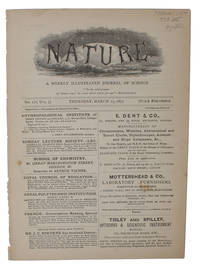
187360131London 1873. Small folio. Extracted with traces from the sewn cords in the original printed wrappers. In "Nature" No. 176 Vol. 7 March 13. Entire issue offered. Issue split in two otherwise fine and clean. Housed in a portfolio with white paper title-label to front board. Darwin's notice: P. 360. Entire issue: Pp. 1 lxxxvi-xcii 357-376. <br/><br/><em>First appearance of Darwin' comment on Aldred Wallace's suggestion that animals find their way home by recognising the odour of the places which they have passed. In the comment Darwin describes the following anecdote: "Many years ago I was on a mail-coach and as soon as we came to a public-house the coachman pulled up for the fraction of a second. He did so when we came to a second public-house and I then asked him the reason. He pointed to the off-hand wheeler and said that she had been long completely blind and she would stop at every place on the road at which she had before stopped. He had found by experience that less time was wasted by pulling up his team than by trying to drive her past the place for she was contented with a momentary stop. After this I watched her and it was evident that she knew exactly before the coachman began to pull up the other horses every public-house on the road for she had at some time stopped at all. I think there can be little doubt that this mare recognised all these houses by her sense of smell." From the present paper. Freeman 1759 </em> unknown
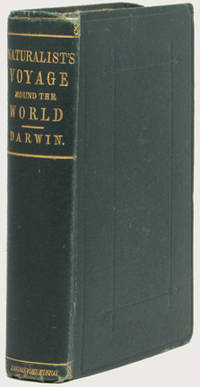
187634481London: John Murray 1876. Very Early Printing the eleventh thousand in the publisher's original dark-green cloth typical for Darwin's books. With a number of illustrations. 8vo publisher's original dark-green cloth with gilt lettering to the spine. vii 519 1 pp. A handsome and well preserved copy some light evidence of age bur quite fresh with bright gilt and some minor general mellowing from age. AN IMPORTANT WORK IN THE DARWIN OEUVRE. One of the early printings which used the title "A Naturalist's Voyage" on the title page. One of Darwin’s earliest works. Even without publication of his works on evolution he would have had a considerable reputation as the author of The Voyage of the Beagle. While ‘The Origin of Species’ dominates perceptions of his work this is an important travel book in its own right and its relation to the background of his evolutionary ideas has often been stressed.Freeman.<br> “Of the great exploratory voyages ‘a most important place is taken by the voyage of the ‘Beagle’ in 1831-1834. Darwin’s name is so associated with the evolutionary idea through which he profoundly influenced scientific philosophical political religious and ethical thought that certain of his other claims are often forgotten. To appreciate his distinction it is necessary to recall that had he never written on evolution he would still stand in the front rank among naturalists and would have to be included in any history of science. Thus even during the voyage in the ‘Beagle’ he reached conclusions that modified and extended the fundamental working principles of geology and geophysics.†- Singer.<br> During the voyage Darwin suffered severely from seasickness. In a letter to his sister Caroline he wrote “ I continue to suffer so much from sea-sickness that nothing not even geology itself can make up for the misery .†Bowlby p.164 John Murray hardcover
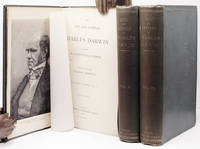
188734482London: John Murray 1887. 3 volumes. An early printing published in the year of the first edition. With seven illustrations including three portraits. Tall 8vo publisher's original pale grey-green cloth gilt lettered on the spines. x 395 1; iii 393 1; iv 418 1 pp. A clean and pleasing set with light evidence of age or use. AN IMPORTANT WORK. This is the first and basic life of Darwin. It contains the first version of Darwin's autobiography which was edited to avoid giving offense to his widow the full text was not published in English until 1958. The letters were selected with a more personal rather than scientific bias with particular emphasis on the period during which Darwin was writing and preparing for publication his ORIGIN OF SPECIES. There is particular emphasis on the period during which Darwin was writing and preparing for publication of his ORIGIN OF SPECIES. John Murray hardcover
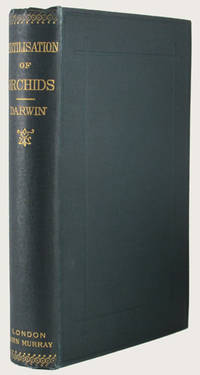
189933340London: John Murray 1899. Second edition revised sixth impression. With numerous illustrations. 8vo original green cloth lettered in gilt on spine and blocked in blind on the covers. xvi 300 Index 32 ads. pp. A very fine copy bright and clean and beautifully preserved. EARLY PRINTING IN VERY FINE CONDITION. One of Darwin's most important but often overlooked works. The LIFE AND LETTERS of Darwin III p. 274 quotes Asa Gray as saying that "if the Orchid-book with a few trifling omissions had appeared before the 'Origin' the author would have been canonised rather than anathematised by the natural theologians" and noted that a review in the 'Literary Churchman' found only one fault "that Mr. Darwin's expression of admiration at the contrivances in orchids is too indirect a way of saying 'O Lord how manifold are Thy works.'"<br> The book was concerned with working out in detail the relationships between sexual structures of orchids and the insects which fertilize them their evolution being attributed to natural selection and therefore was the first of the volumes of "supporting evidence" for his ORIGIN OF SPECIES. Although it was praised highly by botanists it did not sell well only about 6000 copies by the turn of the century. John Murray hardcover
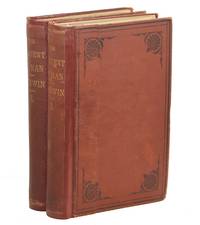
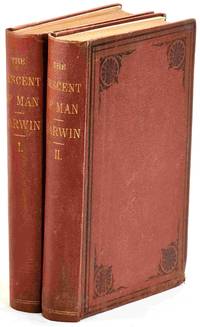
1871000010496New York: D. Appleton and Company 1871. First American edition. Hardcover. Good. 2 vol. 8vo. 3 iv-vi 1 2-409 1 2 pages of publisher's advertisements 2; 3 iv-v 4 2-436 6 pages of publisher's advertisements 2 pp. Orange-red cloth with black decorations on the boards and gold lettering on the spines. Yellow coated endpapers and pastedowns. With several in-text illustrations. Freeman 129-131. Oxford DNB Adrian Desmond James Moore and Janet Browne "Darwin Charles Robert 1809–1882". With the postscript in volume two both versos of our title pages are blank. Both title pages dated 1871. These volumes contain the first appearance of the word evolution and a verbal description of humanity's ancient ancestors which was no doubt distrubing to Victorian sensibilities. Darwin painted human ancestors as hairy tree dwellers. The majority of the book however focuses on sexual selection among other animal species. The first print run was very popular selling 5000 copies right away. A landmark work in biological science a paradigm shift in the way the animal kingdom's history was understood. Both volumes have been rebacked within the past 40 years with strips of the original spine cloth laid down later endpapers placed before and after the originals in each volume. A few leaves reattached and realigned to the gutters with archival tape. D. Appleton and Company hardcover
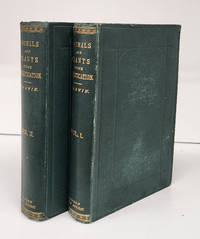
1882BB2290London: John Murray 1882. Original Cloth. Fine. Second Edition Revised Fifth Thousand two volumes complete in fine original bindings featuring first occurrence of the phrase "survival of the fittest." Crown 8vo 188 x 118: xiv4731; x4951pp with 43 woodcut illustrations. Publisher's green cloth covers paneled in blind arches style spine stamped in gilt chocolate coated end papers top edge rough-trimmed. A superb set with bright bindings uncracked hinges and virtually spotless pages. Very mild rubbing to corner tips dusty top edges else very fine. Freeman 883. Intended originally as the first two chapters of a monumental work that Darwin envisioned but never published on the origin of species not the Origin of 1859 which Darwin viewed as only an abstract of a more substantial project. This second edition substantially revised and enlarged from the first edition of 1868 is the final text in which Darwin proposed the concept of pangenesis his provisional hypothetical mechanism for heredity which was proven obsolete by the 1900 rediscovery of Mendel's theory of the particulate nature of inheritance and in which he detailed and discussed at length artificial selection. N. B. With few exceptions always identified we only stock books in exceptional condition carefully preserved in archival removable mylar sleeves. All orders are packaged with care and posted promptly. Satisfaction guaranteed. Fine Editions Ltd is a member of the Independent Online Booksellers Association and we subscribe to its codes of ethics. John Murray unknown
188354398London: Kegan Paul Trench Trubner. Very Good with no dust jacket. 1883. First Edition. Hardcover. Original gilt-titled brown cloth black eps. Points lightly bumped spine and top upper board sunned. Mild scattered foxing. Foldout frontis chart erratum slip by page 15. Solid copy. ; Large 8vo 9" - 10" tall; 41132ads pages . Kegan Paul, Trench, Trubner hardcover
1874Pa804London: John Murray 1874. 2nd edition revised and Augmented . Hardback. Vg. 8vo. Half-title xvi 688 pp. Errata slip bound in page one with five corrections listed. No inscriptions or marks. Original green cloth with gilt titles. Blind rules to the borders. A very good NEAR FINE copy with a tight and clean text block and a fine binding. The brown end-papers have split so the text block is now loose.The 2nd edition revised and Augmented with illustratons. Tenth thousand with a preface by Darwin from Down in Bechenham Kent dated September 1874. Printed by William Clowes and Sons Stamford Street and Charing Cross. PLEASE EMAIL FOR PHOTOS. <br/> <br/> John Murray hardcover
18712602020032D. Appleton and Company 1871. First Edition. Hardcover. Very Good. FIRST AMERICAN EDITION FIRST ISSUE. Includes the first appearance of the word "evolution" in any of Darwin's works. 2 volume set. Bound in publisher's russet cloth. Hardcover. Good binding and cover. Clean unmarked pages. 4 vi 409 3. Slight bubble on front cover of v.1 but near fine besides. 'The word 'evolution' occurs for the first time in any of Darwin's works on page 2 of the first volume of the first edition that is to say before its appearance in the sixth edition of The origin of species in the following year.' Freeman 941. "In the Origin Darwin had avoided discussing the place occupied by Homo sapiens in the scheme of natural selection stating only that 'life will be thrown on the origin of man and his history.' Twelve years later he made good his promise with The Descent of Man in which he compared man's physical and psychological characteristics to similar traits in apes and other animals showing how even man's mind and moral sense could have developed through evolutionary processes. In discussing man's ancestry Darwin did not claim that man was directly descended from apes as we know them today but stated simply that the extent ancestors of Homo sapiens would have to be classified among the primates; however this statement as misinterpreted by the popular press caused a furor second only to that raised by the Origin" Norman 599. D. Appleton and Company hardcover
1875000908John Murray 1875. Hardcover. Good. Second edition revised. John Murray 1875. First John Murray edition. This was originally published ten years earlier in the Journal of the Proceedings of the Linnean Society of London. Dark green covers are generally clean with some wear to the spine ends and corners with a few small areas of bubbling and a couple of tiny marks. Top edge a little darkened front free endpaper is detached front hinge cracked and a little loose feeling but the rest of the page block is securely bound. The next page is the half title page unsure whether there is supposed to be a blank page before that. Half title has a previous owners name. Pages a little age toned there are some pages with slightly creased corners from having been read plus a few pages with a spot or small mark. The rear free endpaper is starting to come loose and the rear board also has a slightly loose feel. The pages are slightly indented to the bottom inside corner at the spine possibly has been dropped at some point. Good condition. viii 208 pages 32 pages of publishers works at the back dated January 1875. <br/> <br/> John Murray hardcover
1871100165New York: D. Appleton. 1871. 1st US Ed. second issue 2 Volumes complete original cloth boards decorated in black gilt spine titles. b&w illus pp vi 409; v 436 plus publisher's ads including ads for On the Origin of Species. Professionally recased in original boards. Very good condition. Ground-breaking considerations on the origins of man covering evolutionary development races of man and the role of sexual selection in species differentiation. First use of the word 'evolution' by Darwin page 2 last line of Vol. I preceeding its appearance in the 6th ed of 'Origin of Species'. Freeman 942. 1st US Edition. Cloth Boards. D. Appleton hardcover
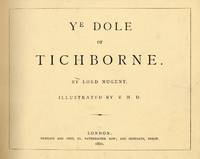
18712200159<p><i>Oblong 8vo pp. 4 with nine anastatic plates by 'V H D'arwin the first folding and with poetic verses facing two leaves of introduction in the original publisher's bind stamped green cloth upper board lettered in gilt inner joints lightly cracked else a very good sound copy.</i></p><p>Published to capitalise on the infamous Tichborne case then beginning to run its course through the courts.</p><p>The poem recounts the history of the Tichborne dole of bread a charity festival active until the 1790's and held at the village of Tichborne in Hampshire during the Feast of the Annunciation. The tale concerns a curse by twelfth century Lady Mabella Tichborne on her descendants. This predicted that should the dole stop the family would produce only daughters and die out which indeed did happen with the male issue cut down by early death and shipwreck all of which paved the way to the interminable Tichborne claimant cause.</p><p>The illustrations are very clearly in the style of Richard Doyle's <i>The Manners and Customs of Ye Englyshe</i> which first appeared in <i>Punch</i> in 1849 they capture many of the more absurd parts of the tale in a mock medieval manuscript technique replete with a border of a dragon.</p><p>The illustrator Violetta Harriot Darwin 1826-1880 was a half cousin to the famous Charles both sharing Erasmus Darwin as a grandfather. Although Charles descended through Erasmus' first wife Polly and Violetta through his second wife Elizabeth the cousins despite being near contemporaries appear to have had very little contact. A number of Violetta's anastactic topographical views were published in the 1860's and her illustrated version of Southey's <i>Bishop Hatto: a legend of the Mouse-Tower on the Rhine</i> in 1861 but these are both in a quite different style.</p><p>The author of the poems Lord Nugent unlike many of the Grenville clan supported the cause of anti-slavery parliamentary reform religious liberty penal reform and the amelioration of the condition of the rural poor. He also inherited an aptitude for literary and scholarly pursuits as well as their tendency to corpulence and financial ineptitude. He was not a great poet however some of his smaller works found a willing space in the 'Annuals'. Under the less antiquated title 'The Dole of Tichborne' the poem first appeared first in the 1830 volume of <i>The Gem</i>.</p><p>OCLC records only a second edition at the National library of Wales only.</p> Bemrose and Sons
1845A63207London: John Murray 1845. viii 519 1 14 text figs. . HB. Small 8vo 178x124mm rebound in antique-style half calf spine with raised bands gilt rules blind stamped floral motifs to compartments leather title piece marbled boards. Occasional light foxing/spotting. Vg. Second edition corrected with additions. Taken from Darwin's journals while on the H.M.S. Beagle these notes form a background for ideas he would later develop in <i>On the Origin of Species</i> while also serving as an excellent travel narrative of the voyage around South America New Zealand and Australia as well as the famous survey of the Galapagos Islands.Freeman 14. John Murray hardcover
18738223London: John Murray 1873. 8vo pp. xxi i 458 folding diagram. Ads at rear discarded. Original green cloth boards blocked with a simple frame in blind spine lettered in gilt. A little spotting a few marginal pencil marks and minor dampmarks. Sometime neatly rebacked preserving most of original cloth. Ink ownership insciption to title-page dated 26/5/75 in Calcutta later ownership stamp to contents page. John Murray hardcover
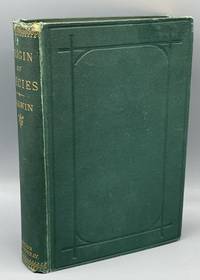
188928730<p>This 1889 printing of Darwin's The Origin of Species was issued by John Murray in London. It is the sixth edition and includes the final updates made during Darwin's lifetime. The book is bound in the original green cloth with blind-stamped borders and gilt titling on the spine. The condition is Very Good. The cover shows mild wear at the edges and corners. The text block is complete clean and shows minimal age toning. No pages are torn or missing. The binding remains secure. Handwritten provenance of C. H. Hocken on title page otherwise free of markings. This edition was the first edition to feature the title "The Origin of Species" and includes the full historical sketch and core chapters like Natural Selection Instinct Hybridism and Geographical Distribution. It contains no illustrations. It is listed in Freeman as number 426. Questions and photo requests welcome</p> John Murray hardcover
18764345Half polished calf; marbled boards & endpapers; five raised bands; ruled black morocco label to spine. Three line errata slip facing p.viii. Wear to head of spine & corners see images otherwise a nice clean copy without previous owners' names or other markings. viii 482 John Murray hardcover
187520274New York: D. Appleton and Company 1875. First US edition. Hardcover. Near fine. 8vo. x462pp. followed by 8pp of publisher's ads. Original brick-colored cloth blocked in gilt on the spine and in black on the covers. Pale yellow coated endpapers. Illustrated. Index.<br/> <br/>Some wear to the hinges and boards else a near fine bright copy superior in condition to most. <br/> <br/>Freeman 1220. The American edition was printed form stereos of the first English edition. D. Appleton and Company hardcover books
188969842New York: D. Appleton and Company 1889. Hardcover. Good. Third edition with an appendix by Prof. T.G. Bonney D.Sc. F.R.S. F.G.S. 344 p. with three folding plates and the publisher's ads. Octavo. Original brown cloth binding with decorative gilt and black stamping. An ex-library copy with minimal markings: a bookplate to the front pastedown and a small numeric label to the spine. Minor creases to the folding plates. The top edge is a trifle dust stained with some mild foxing to the fore-edge. There is also a small bit of rubbing to the corners and tips. From the library of the esteemed American paleontologist Stephen Jay Gould 1941-2002. In his essay "Worm for a Century" from the collection Hen's Teeth and Horse's Teeth: Further Reflections in Natural History 1983 Gould argued that this Darwin's first book on a specific subject is essential to understanding his theoretical approach: "This book is about coral but it is also about historical reasoning. Vegetable mold formed fast enough to measure its rate directly; we capture the past by summing effects of small and observable present causes. But what if rates are too slow or scales too large to render history by direct observation of present processes For such cases we must develop a different method. Since large-scale processes begin at different times and proceed at diverse rates the varied stages of different examples should exist simultaneously in the present. To establish history in such cases we must construct a theory that will explain a series of present phenomena as stages of a single historical process. The method is quite general. Darwin used it to explain the formation of coral reefs. We invoke it today to infer the history of stars. D. Appleton and Company hardcover books
18311501511London Colburn and Bentley 1831. 1st Edition. Hardcover. Near Fine. A collection of reports of military and scientific expeditions in 1830 including a fascinating and important section on the expedition of the Beagle which included Charles Darwin. Author unknown but possibly Darwin himself. In any case includes information about the expedition that is reported nowhere else. London Colburn and Bentley hardcover books
187520274New York: D. Appleton and Company 1875. First US edition. Hardcover. Near fine. 8vo. x462pp. followed by 8pp of publisher's ads. Original brick-colored cloth blocked in gilt on the spine and in black on the covers. Pale yellow coated endpapers. Illustrated. Index.<br /> <p><br /> Some wear to the hinges and boards else a near fine bright copy superior in condition to most. <br /> <p><br /> Freeman 1220. The American edition was printed form stereos of the first English edition.<br /> <p>. D. Appleton and Company hardcover
188412288London: John Murray 1884. Octavo 7.75 x 5.25" green cloth with gilt spine lettering xxi 1 458 pp. Sixth Edition with editions and corrections to 1872 Twenty-Sixth Thousand. An early edition of this classic. An attractive copy with wear to corners mild fraying to spine tips slight discoloration to covers bit of rubbing and soiling to endpapers rear endpaper lacking owner inscription to front endpaper. John Murray hardcover
187140592New York: D. Appleton and Co. 1871. Fifth Edition with Additions and Corrections. Octavo original brown blind stamped pebbled cloth. Very Good with light edge wear including lightly bumped spine ends and a short abrasion on the side of the spine. D. Appleton and Co. hardcover
188969842New York: D. Appleton and Company 1889. Hardcover. Good. Third edition with an appendix by Prof. T.G. Bonney D.Sc. F.R.S. F.G.S. 344 p. with three folding plates and the publisher's ads. Octavo. Original brown cloth binding with decorative gilt and black stamping. An ex-library copy with minimal markings: a bookplate to the front pastedown and a small numeric label to the spine. Minor creases to the folding plates. The top edge is a trifle dust stained with some mild foxing to the fore-edge. There is also a small bit of rubbing to the corners and tips. From the library of the esteemed American paleontologist Stephen Jay Gould 1941-2002. In his essay "Worm for a Century" from the collection Hen's Teeth and Horse's Teeth: Further Reflections in Natural History 1983 Gould argued that this Darwin's first book on a specific subject is essential to understanding his theoretical approach: "This book is about coral but it is also about historical reasoning. Vegetable mold formed fast enough to measure its rate directly; we capture the past by summing effects of small and observable present causes. But what if rates are too slow or scales too large to render history by direct observation of present processes For such cases we must develop a different method. Since large-scale processes begin at different times and proceed at diverse rates the varied stages of different examples should exist simultaneously in the present. To establish history in such cases we must construct a theory that will explain a series of present phenomena as stages of a single historical process. The method is quite general. Darwin used it to explain the formation of coral reefs. We invoke it today to infer the history of stars. D. Appleton and Company hardcover
18311501511London Colburn and Bentley 1831. 1st Edition. Hardcover. Near Fine. A collection of reports of military and scientific expeditions in 1830 including a fascinating and important section on a pre-Darwin expedition of the Beagle which later included Charles Darwin. Author unknown. Includes information about a Beagle expedition that is reported nowhere else. London Colburn and Bentley hardcover
1868157199London: John Murray Titles state 1868. First Edition second issue. Hardcover. Good. 2 vols.: viii 411 32; viii 486 2 p. 23 cm. 43 b&w illustrations in vol. I. Original publisher's green cloth with blank impressing on boards gilt on spine. Corners worn some dents to edges softening to spine ends stains and rubbing to cloth. Vol. II has scuff on lower spine. Bookplates on front pastedowns. Endpapers at front have stuck together in vol. II and were formerly stuck in vol. I; the latter has scuffs at front. Light stains to vol. I bottom edge. <br/><br/>32 p. publisher's catalogue at rear of vol. I dated February 1871. 2 p. publisher's list at rear of vol. II dated February 1868. One line Erratum to vol. I and no errata to vol. II. Incudes the first appearance of the phrase "survival of the fittest" in any of Darwin's works on p. 6 of vol. I where he gives credit for the phrase to Herbert Spencer. A large part of the book contains discussion of artificial selection and pangenesis the mechanism he suggested to explain heredity. John Murray hardcover