Charles DarwinBiblio.com
1 008 résultats
1889153561London: John Murray 1889. First Edition; Early Printing. Hardcover. Near Fine in green cloth. Neat owner name. John Murray hardcover
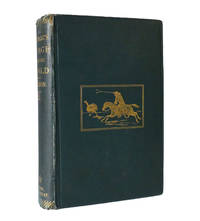
188960London: John Murray 1889. Hardcover. Fair. Original green board in plastic protective covers. Gilt on spine and illusltration on front cover. Spine weak but holding - front portrait of Darwin almost detached and foxing to protective tissue paper Otherwise a nice well kept copy of this early edition. John Murray hardcover
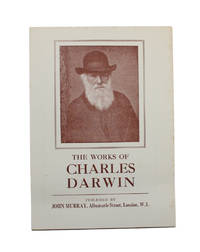
1900031933UK: John Murray 1900. Paper. Near Fine. 24mo - over 5" - 5¾" tall. C1900 A Lovely Rare Four Sided Flyer Printed by John Murray for their Works of Charles Darwin Series that was published in the early 1900s. In near fine condition. Ref 19388 <br/> <br/> John Murray unknown
1889feb02702<p>1889. First Norwegian Edition of Autobiography in 3 Volumes by Charles Darwin Son - Francis Darwin.<br /><br />liv og breve med et kapitel selvbiografi</p><p>Used book For more details and availability please contact me</p> Bibliothek for de tusen hjem hardcover
1888feb02667<p>1888. First French Edition of Autobiography in 2 Volumesby charles Darwin son Fancis Darwin.<br /><br />La vie et la correspondance de Charles Darwin avec un chapitre autobiographique</p><p>Used book For more details and availability please contact me</p> C. Reinwald hardcover
1891feb73967<p>1891: First Polish Edition of Autobiography by Charles Darwin<br /><br />Autobiografia i wybór listów. Wydane przez Syna<br /><br />Used. For more details please contact me</p> Wydawnictwo Przeglądu Tygodniowego hardcover
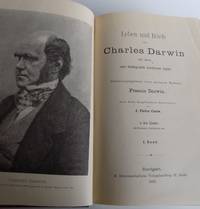
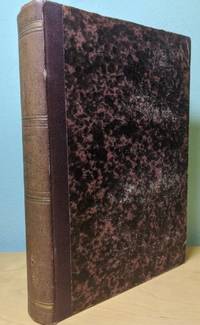
1887feb58494<p>1887:First German Edition of Autobiography in 3 Volumes bounded into one by Charles Darwin <br /><br />Used. For more details please contact me</p> E. Schweizerbartsche Verlagshandlung hardcover
18842502190011Theodor Thomas Leipzig 1884. Hardcover. Very Good. 6x1x9. Bound in publisher's cloth. Paper spine label. Hardcover. Gothic German text. Good binding and cover. Shelf wear. A couple markings on preliminary pages else unmarked. viii 442 1 p. ; 17 cm. <br> From the library Dr. Owen Hannaway. Hannaway was director of the Center for the History and Philosophy of Science at Johns Hopkins University. He authored numerous books and served as an editor of academic magazines in the history of science. Partial list of publications: Chemists and the Word: The Didactic Origins of Chemistry 1975; Observation Experiment and Hypothesis in Modern Physical Science 1985; The Evolution of Technology 1989; Science and the Practice of Medicine in the Nineteenth Century 1994; and The Foundations of Modern Science in the Middle Ages: Their Religious Institutional and Intellectual Contexts 1996. Theodor Thomas, Leipzig hardcover
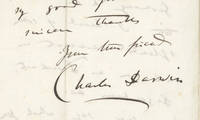
18643456104/11/1864. <blockquote><p>Darwin's work had profound implications for the relationship between science and religion and here he opposed anyone who would seek to profess religious over scientific faith</p><p> </p><p>Scientists Darwin felt should work in the spirit of seeking ""truth"" with no preconceived notions</p><p> </p><p>The adoption of the Theory of Evolution by scientists is ""the real cream of the enjoyment to me; indeed it is to me worth far more than any medal.""</p><p> </p><p>Significantly he hopes to continue his work in science</p><p> </p><p>One of the most important Darwin letters we have carried</p></blockquote><p><img class=""alignnone wp-image-34774 size-post-window"" src=""https://cdn.raabcollection.com/wp-content/uploads/20251016172859/Darwin-2-1-1600x1200.jpg"" alt="""" width=""1600"" height=""1200"" /></p><p>Charles Darwin's ""On the Origin of Species"" was one of the most important books of all time. When it was published in 1859 there was skepticism within as well as without the scientific community about the central premise that species changed through time by a process Darwin labeled natural selection. The idea that human beings evolved from other previous species struck at the heart of the generally accepted belief that humans were different from other animals and that species were fixed or immutable. Everyone had learned the story of creation from the Bible and Darwin's ideas presented a challenge to those who looked at the question through a literal religious perspective. But Darwin hoped that scientists as well as others would be able to accommodate adopt an essentially new view and accept evolution. Yet at the same time he realized that many who had grown up in the previous scientific school would have a hard time doing so. It seemed that perhaps a new generation of scientists might have to rise before his work was generally accepted.</p><p>The Copley Medal the highest award of the Royal Society is given for “sustained outstanding achievements in any field of scienceâ€. In 1864 Darwin was nominated to receive the medal and was awarded it ""For his important researches in geology zoology and botanical physiologyâ€. Previous winners included scientists like Benjamin Franklin William Herschel Alessandro Volta Humphry Davy and Michael Faraday.</p><p>Hugh Falconer was a paleontologist and botanist who was an admirer of Darwin though not a convert to his theory of evolution. He seconded the nomination of Darwin for the medal and Darwin wrote to thank him for doing so. In his letter Darwin made some points of great importance: 1. That more and more scientists were becoming converts to his theory of evolution; 2. That he hopes to continue his work in science despite advancing age; 3. That scientists should work in the spirit of seeking truth with no preconceived notions and 4. That the support of scientists he respected like Falconer meant more than the medal to him.</p><p>Falconer was outraged by a petition that was circulating within Britain’s learned societies that attempted to limit the bounds of scientific enquiry. The petition claimed that scientific research was being “‘perverted by some…into occasion for casting doubt upon the Truth and Authenticity of the Holy Scriptures†and was specifically aimed against evolutionary theory and investigations into the antiquity of man. Falconer made clear to Darwin that he aimed to ""protest against the profession of religious against scientific faithâ€.</p><p><img class=""alignnone wp-image-34775 size-post-window"" src=""https://cdn.raabcollection.com/wp-content/uploads/20251016172938/Darwin-4-1-1600x680.jpg"" alt="""" width=""1600"" height=""680"" /></p><p><strong>Autograph letter signed</strong> four pages with the addressed envelope Down House headed stationery Kent November 4 1864 to Hugh Falconer making all the important points cited above. <em>“What a good kind friend you are. I know well that this medal must have cost you a great deal of trouble. It is a very great honor to me but I declare that the knowledge that you & a few other friends here so much interested themselves in the subject is the real cream of the enjoyment to me; indeed it is to me worth far more than any medal. So accept my true and cordial thanks. I hope that I may yet have strength to do a little more work in natural science; shaky and old though I be.â€</em></p><p><em>“I have chuckled and triumphed over your postscript about poor M. Brullé and his young pupils. About a week ago I had a nearly similar account from Germany and at the same time I heard of some splendid converts in such men as Rudolf Leuckart Carl Gegenbaur &c. You may say what you like about yourself but I look at a man who treats Natural History in the spirit with which you do exactly as good for what I believe to be the truth as a convert. Farewell my good friend with sincere thanks your true friend Charles Darwin.â€</em></p><p>In mentioning M. Brullé Darwin alludes to an amusing story told by Falconer to him in a previous letter relaying the complaint of the entomologist Gaspard Auguste Brullé that he heard of nothing but Darwin from his students.</p><p>Darwin need not have worried about his future productivity in this 1864 letter. Afterwards he wrote several more books which include “The Variation of Animals and Plants Under Domestication†1868 which explored the principles of heredity and how variations occur in domesticated species; his famous “The Descent of Man†1871 applying the theory of natural selection to human evolution and discussing sexual selection; “The Expression of the Emotions in Man and Animals†1872 examining the evolutionary origins of emotions and facial expression; and “The Formation of Vegetable Mould through the action of worms"" 1881.</p><p>Falconer replied to Darwin’s letter on November 7 and the spirit with which he treated Natural History and the reason for his support for Darwin were evidenced in that reply. Falconer explained that he believed the award of the Copley medal to Darwin was doubly important: “1. As regards due appreciation of yourself. 2d. As a determined protest against the profession of religious against scientific faithâ€.</p><p>Falconer was right to be concerned about the reaction of the religious community and its sympathizers to the theory of evolution. Darwin’s ideas provoked a harsh response from religious leaders and their allies of which this petition was one example. As examples of the criticism of evolution England’s highest-ranking Catholic official Henry Cardinal Manning denounced Darwin’s views as “a brutal philosophy – to wit there is no God and the ape is our Adam.†And Samuel Wilberforce the Anglican Archbishop of Oxford and one of the most highly respected religious leaders in 19th-century England also condemned natural selection in a now-famous speech on what he deemed the theory’s deficiencies.</p><p>This is one of the most important Darwin letters we have carried dealing as it does with support for his theory of evolution his hopes for future work in science and the role of science in seeking truth.</p><p><img class=""alignnone wp-image-25018 size-post-window"" src=""https://cdn.raabcollection.com/wp-content/uploads/20231204144051/Folder-site-11-1600x1327.jpg"" alt="""" width=""1600"" height=""1327"" /></p> unknown
1870266381870. <blockquote><p>Our first Darwin signed photograph in all these years</p></blockquote><p>Charles Darwin English naturalist whose scientific theory of evolution by natural selection became the foundation of modern biology and evolutionary studies. Darwin's explanation for the great unfolding of life through time - evolution by natural selection - transformed our understanding of the living world and focused attention on the cumulative inherited change in a population of organisms through time leading to the appearance of new forms: the process by which new species or populations of living things develop from preexisting forms through successive generations. Darwin revolutionized the understanding of the development of living things as Einstein revolutionized our understanding of the physical universe.</p><p>An attractive<strong> Carte de Visite signed</strong> <em>""Ch. Darwinâ€</em> circa late 1870s very good condition though with a few small adhesive tape marks. The photograph was taken by Elliott & Fry 56 Baker Street London and has their front and back stamps. For a century after its founding in 1863 the firm’s core business was taking and publishing photographs of the Victorian public and social artistic scientific and political luminaries. Among the notables known to have sat for a photograph by Elliott & Fry were Prime Minister William Gladstone Alfred Lord Tennyson W.S. Gilbert Rudyard Kipling Oliver Wendell Holmes Sr. Florence Nightingale and Charles Darwin.</p><p>In all our years in the field we have seen just a handful of Darwin signed photographs and have never ourselves had one. This is indeed a rarity. But the provenance is just as fascinating as finding a signed Darwin photograph with provenance is perhaps unique.</p><p>William Bateson was a British biologist who founded and named the science of genetics and whose experiments provided evidence basic to the modern understanding of heredity. He was a dedicated evolutionist and his early works on the mechanisms of biological evolution were strongly influenced by Charles Darwin though he believed that Darwin’s theory of evolution required a firmer base in heredity. Bateson also became the foremost champion of Gregor Mendel’s work on genetics. Darwin died in 1882 when Bateson was at college and though Bateson may have written Darwin such letter is unknown. Bateson and his wife did however correspond with Darwin’s family in later years as “Darwin Online†indicates.</p><p>This CDV comes with an <strong>autograph letter signed</strong> from Darwin’s granddaughter Margaret Keynes dated January 23 1929 addressed to Sir George Buckston Browne proposing an alternative date for her and her husband Dr. Geoffrey Keynes to come for lunch expressing gladness that Browne wanted <em>""the Bateson letter and the other things""</em> and acknowledging that he attended the same school as Dr. Keynes. Browne had bought Darwin's old home so lunch there would have been a homecoming of sorts for Margaret. Finding the CDV and letter together we would conjecture that this CDV was the property - one of <em>“the other thingsâ€</em> - of Margaret that she mentioned in the letter that she was glad Browne wanted and had descended in the family to her along with the Bateson letter. Thus this CDV was apparently property of the Darwin family the most important provenance imaginable.</p><p><img class=""alignnone wp-image-25018 size-post-window"" src=""https://cdn.raabcollection.com/wp-content/uploads/20231204144051/Folder-site-11-1600x1327.jpg"" alt="""" width=""1600"" height=""1327"" /></p> unknown
1877feb02642<p>1877. First German Edition of Cross and Self Fertilisation by Charles Darwin<br />Die Wirkungen der Kreuz- und Selbst-Befruchtung im Pflanzenreich<br /><br /></p><p>Used book For more details and availability please contact me</p> E. Schweizerbartsche Verlagshandlung hardcover
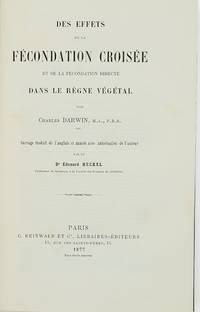
1877feb58554<p>1877: First French Edition of Cross and Self Fertilisation by Charles Darwin<br /><br />Des effets de la fécondation croisée et de la fécondation directe dans le règne végétal<br /><br />Used. For more details please contact me</p> C. Reinwald hardcover
189083500New York: D. Appleton and Co 1890. Hardcover. Good/no jacket. D. Appleton and Company New York 1884. Hardcover. Condition: Very Good. First edition. 351 p. Selected and Arranged by Nathan Sheppard. "By means of a systematic selection of passages from the various writings of Charles Darwin the reader of this volume is enabled to grasp readily the scope of Darwin's argument as to the origin and evolution of species." Published less than two years after Darwin's death in 1882. 12mo. Original red cloth binding with gilt titles and decorative black stamping. Soiling and rubbing to cloth mostly on cover and tail of spine. Mild wear and bumps to edges. D. Appleton and Co hardcover
1871025954Appleton 1871. 1st Edition 1st Printing. Hardcover. Good. First US edition first impression February 1871 or earlier; 2 volume set with first ownership dated Richard Blip Jr. Feb 1871 in pencil to front free endpaper and just his name in vol. II same spot. 16 entry errata of Vol. I to verso of contents leaf in vol. II 2pp ads to rear of vol. I 12pp to rear of vol. II; publisher's rust cloth ruled with decorations in black spine lettered in gilt. Some spine end wear dampstaining last pages & cover bottom of vol. II small chip lower edge FC vol. I app. 3/16" x 3/4" upper spine splits both FC's. The first US edition first impression of Darwin's second work. A true sequel to Origin of a Species the Descent of Man picked up where the earlier work had left off discussing for the first time the place occupied by Homo sapiens in the Darwinian scheme of natural selection. Quite scarce in this or indeed any state. <br/> <br/> Appleton hardcover
1896138071New York: D. Appleton & Company 1896. Authorized Edition; revised. Fine Binding. Very Good in boards. D. Appleton & Company unknown
189033642London: John Murray 1890. Second edition revised and augmented. Twenty-ninth thousand. With illustrations. Preface to second edition September 1874. Table of the principal additions and corrections to the present edition.693 pages including index. Green cloth faded to navy blue on spine. Spine ends worn and a tear halfway down. Corners rubbed. Top edge dustmarked. Light foxing restricted to endpapers and prelims. Both gutters slightly weak. Previous owner`s name and date written neatly in black ink on flyleaf. Second Edition. Cloth. Very Good. Octavo. John Murray Hardcover
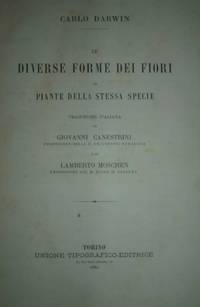
1884feb118287<p>1884: First Italian Edition of Different Forms of Flowers by Charles Darwin</p><p>Le diverse forme dei fiori in piante della stessa specie<br />Used. For more details please contact me</p> Torino hardcover
1877feb118092<p>1877: First German Edition of Different Forms of Flowers by Charles Darwin<br /><br />Die Bewegungen und Lebensweise der kletternden Pflanzen<br /><br />Used. For more details please contact me</p> E. Schweizerbartsche Verlagshandlung hardcover
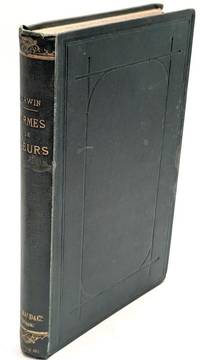
1878feb118457<p>1878: First French Edition of Different Forms of Flowers by Charles Darwin<br />Des différentes formes de fleurs dans les plantes de la même espèce<br />Used. For more details please contact me</p> C. Reinwald hardcover
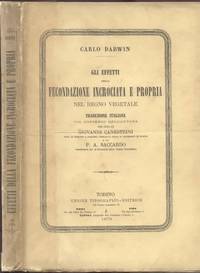
1878feb02664<p>1878. First Italian Edition of Cross and Self Fertilisation by Charles Darwin<br /><br />GLI EFFETTI DELLA FECONDAZIONE INCROCIATA E PROPRIA NEL REGNO VEGETALE</p><p>Used book For more details and availability please contact me</p> Torino
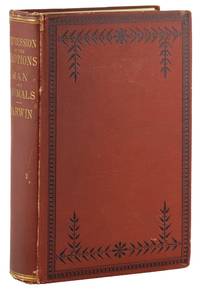
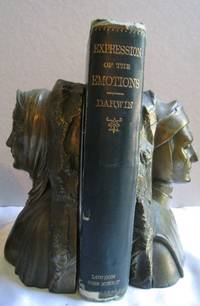
188645683New York: D. Appleton and Company 1886. Very Good. New York: D. Appleton and Company 1886. Later Printing. Octavo 20 cm; 1vi374pp2ads; illus. with seven 7 plates collated complete. Boards in publisher's maroon cloth with black decoration and gilt stamping to spine. Dark top stain. Board margins and corners rubbed and bumped with shelfwear and minor scratching to spine. Binding slightly cocked but firm. Top stain faded and dust-soiled. Interior clean with brief pencil and minor exposed binding at some signatures. Signature beginning with page 259 detached at all threads except the bottom so sits slightly proud. Overall a Very Good copy. <br /> <br /> While working on Descent of Man Darwin became interested in emotional expression across species. In animals he believed expressions were a part of their purposeful action and not connected to emotion. Humans however were very emotional. He examines reactions and expressions in human subjects to different stimuli like "low spirits" of grief and anxiety and "high spirits" like love. Though for Darwin the most intriguing and peculiar reaction to emotion was blushing. So much so that he dedicates an entire chapter to it and comes to the conclusion "It appears that the mental powers of infants are not as yet sufficiently developed to allow of their blushing. Hence also it is that idiots rarely blush. D. Appleton and Company unknown
187212London: John Murray. Albemarle St. 1872. First edition first state. Hardcover. Fair. Octavo. vi 374pp 4 ads. Bound in green cloth. 7 heliotype plates complete showing photographs of human emotion 3 of which are fold out. Plates are in nice condition without tearing or foxing. Additional in-text illustrations. Joints are cracked stain on front cover chips out of bottom of spine. Lacking half-title. First edition first state Freeman F1142. A worn copy which would benefit from a rebinding. John Murray. Albemarle St. hardcover
1883feb02671<p>1883. First Italian Edition of Fertilisation of Orchids by Charles Dariwn.<br /><br />I diversi apparecchi col mezzo dei quali le orchidee vengono fecondate dagli insetti</p><p>Used book For more details and availability please contact me</p> Torino hardcover
1862feb02637<p>1862. First German Edition of Fertilisation of Orchids by Charles Darwin.<br /><br />Über die Einrichtungen zur Befruchtung Britischer und ausländischer Orhideen durch Insekten</p><p>Used book For more details and availability please contact me</p> E. Sclnveizerbart'sche Verlagshandlung hardcover
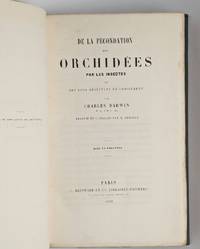
1870feb02700<p>1891. First French Edition of Fertilisation of Orchids by Charles Darwin.<br /><br />De la fécondation des orchidées par les insectes et des bons résultats du croisement</p><p>Used book For more details and availability please contact me</p> C. Reinwald hardcover