1 008 résultats
1888317676London: John Murray 1888. 7th thousand. Very Good. octavo. orig. cloth ix 395 393 iv 418pp. frontis.3 index Signs of use with bumps & rubbing to boards at edges o/w a nice tight clean set of an increasingly uncommon work John Murray hardcover
1878572London: Macmillan 1878. 1st Edition. FIRST EDITION OF GEORGE DARWIN'S FISSION THEORY OF THE FORMATION OF THE MOON. The history of modern lunar origin theory dates to this paper. A reprint of this paper was published in the 1879 Philosophical Transactions; that paper is sometimes misidentified as a first edition but it is not. This paper the one appearing in 1878 in Nature is the true first. <br /> <br /> "Before Kuiper revived the double planet thesis George Darwin son of the famous British naturalist had in 1878 advanced an attractive alternative. Drawing on the pronounced tidal effects exerted between the earth and moon Darwin speculated that the moon's mass had been ejected from a fluid and rapidly spinning protoearth when centrifugal force and solar tides acting on matter in the earth's equatorial plane exceeded the force of gravity. In time the moon moved out to its present orbit and attained its coincident period of rotation and revolution as a result of tidal interactions between the two bodies. <br /> <br /> Darwin proposed that these tidal effects on the spherical shape of the earth have changed as the moon has moved farther away in its orbit. Darwin's proposed idea for the creation of the moon came to be known as the "fission theory" of lunar formation. This theory basically stated that the moon broke away from the earth due to its rapid rotation. From this he also calculated that it would have taken at least 56 million years for the moon to reach its current distance from the earth" Giedd Tidal Friction. <br /> <br /> Darwin argues "that tides raised by the Moon imply an Earth much closer to the Moon far in the past. Modeling Earth and Moon as a viscous liquid rather than a system dominated by oceans and basins Darwin calculated that the two bodies merged about 50 million years ago with the system rotating every five hours" Crottis The New Moon 159. CONDITION & DETAILS: London: Macmillan. 4to. 11 x 8.25 inches; 275 x 206mm. Ex-libris bearing only minimal markings - a few stamps on the title page and none whatsoever on the spine. Full volume. Handsomely and professionally rebound in half leather. 5 raised bands at the spine gilt-ruled. One red morocco label; one black morocco label; both gilt-lettered. Tightly and very solidly bound. Clean and bright throughout. Very good condition. Macmillan hardcover
189745786Stockholm Beijer 1897 Leipzig B. G. Teubner 1899. Acta Mathematica 4to. As extracted from "Acta Mathematica 21. Band. No backstrip. Fine and clean. Pp. 99-242 4 plates. Mathematische Annalen 8vo. Original printed wrappers no backstrip. In "Mathematische Annalen. Herausgegeben von A. Clebsch und C. Neumann. 51. Band. 4. Heft." Entire issue offered. A fine and clean copy. Darwin: Pp. 523-583. Entire issue: Pp. 481-607 4 plates. <br/><br/><em>First printing of Darwin's famous paper including the abridgement published two years later which contained the first systematic search for periodic orbits and work on the three body problem. "The paper which had taken him three years to complete contained the numerical calculations of periodic solutions of the restricted three body problem together with a discussion of their stability. It provided not only extensive details of the numerical results but also a full description of the mathematical methods used to obtain them." Barrow-Green Poincaré and the three body problem P. 194. Darwin was introduced to the three body problem through the works of Poincare. Following his accession to the Plumian chair Darwin delved even more deeply into the problems of the origin and evolution of the solar system making numerous investigations of the figures of equilibrium of rotating masses of fluid and later making extensive studies of periodic orbits in the restricted problem of three bodies carried out with special reference to cases obtaining for the particular values of the mass ratio of the two finite bodies of 1:10 and 1:1048 the latter approximating the mass ratio of Jupiter to that of the sun. DSB </em> unknown
1898008549Boston: Houghton Mifflin. Slight mildew fading along part of top edge of both covers bookplate Very Good Minus. George Howard Darwin was the son of Charles Darwin. . Very Good. Hardcover. First American Edition. 1898. Houghton Mifflin hardcover
1898622237Boston: Houghton Mifflin and Co. 1898. First edition hard cover with a loose plastic jacket no dust jacket both in very good condition. Green cloth boards have gilt title and author to front board gilt book details to spine. Gilt pageblock head present. General shelf and handling wear including light creasing and wear to board edges spine head and foot with tanning to pageblock this leading into pastedowns and page edges. The lower half of page 331 is damaged at the leading edge caused by the careless cutting of the leaves upon first use; page 330 has the narrow strip still attached to its own leading edge. Otherwise content is unmarked pages tightly bound. CN. First Edition. Hardcover. Very Good/No Dust Jacket. Houghton Mifflin and Co. Hardcover
189242591London Harrison and Sons 1892. 4to. No wrappers as extracted from "Philosophical Transactions" 1891 Vol. 182 - Series A. Pp. 159-229. Clean and fine. <br/><br/><em>First appearance of a classic paper on the mathematics of tidal phenomena. </em> unknown
188844508London Harrison and Sons 1888. 4to. No wrappers as extracted from "Philosophical Transactions" 1887 - Vol. 178 - Series A. Pp. 378-428 and 2 plates. <br/><br/><em>First printing of one of Darwin's major papers on the Nebular Hypoyhesis and the evolution of celestial systems.Following his accession to the Plumian chair Darwin delved even more deeply into the problems of the origin and evolution of the solar system making numerous investigations of the figures of equilibrium of rotating masses of fluid and later making extensive studies of periodic orbits in the restricted problem of three bodies carried out with special reference to cases obtaining for the particular values of the mass ratio of the two finite bodies of 1:10 and 1:1048 the latter approximating the mass ratio of Jupiter to that of the sun. DSB."Darwin's most significant contribution to the history of science lies in his pioneering work in the application of detailled dynamical analysis to cosmological and geological problems. That many of his conclusions are now out of date should in no way diminish the historical interest in his experiments nor the importent service thet he rendered cosmogony by the example he gave of putting various hypotheses to the test of actual calculations. Darwin's method remains a milestone in the development of cosmogony and subsequent investigators have favored it over the merely qualitative arguments prevalent until that time."DSB. </em> unknown
187842424London Taylor and Francis 1878. 4to. No wrappers as extracted from "Philosophical Transactions" 1877 Vol. 167 - Part I. Pp. 271-312. 3 leaves with minor brownspots to upper margin otherwise fine and clean. <br/><br/><em>First appearance of an importent paper by the "Father of Geophysics". "Darwin's paper "On the Influence." the paper offered .marked the beginning of his investigations of essentially geophysical problems.This work was directly inspired by Lord kelvin whose great interest in the young Darwin may be said to have been the chief influence in his decision to make science his career"Darwin's most significant contribution to the history of science lies in his pioneering work in the application of detailled dynamical analysis to cosmological and geological problems. That many of his conclusions are now out of date should in no way diminish the historical interest in his experiments nor the importent service thet he rendered cosmogony by the example he gave of putting various hypotheses to the test of actual calculations. Darwin's method remains a milestone in the development of cosmogony and subsequent investigators have favored it over the merely qualitative arguments prevalent until that time."DSB. </em> unknown
189042956London Harrison and Sons 1890. 4to. No wrappers as extracted from "Philosophical Transactions" Vol. 180 - A. Pp. 1-69. 2 textillustr. Clean and fine. <br/><br/><em>First printing."Darwin's most significant contribution to the history of science lies in his pioneering work in the application of detailled dynamical analysis to cosmological and geological problems. That many of his conclusions are now out of date should in no way diminish the historical interest in his experiments nor the importent service thet he rendered cosmogony by the example he gave of putting various hypotheses to the test of actual calculations. Darwin's method remains a milestone in the development of cosmogony and subsequent investigators have favored it over the merely qualitative arguments prevalent until that time."DSB. </em> unknown
188042425London Harrison and Sons 1880. 4to. No wrappers as extracted from "Philosophical Transactions" 1879 Vol. 170 - Part II. Pp. 447-538 and. 1 plate. Clean and fine. <br/><br/><em>First appearance of an importent paper announcing Darwin's so-called "Resonance Theory" of the origin of the moon according to which the moon might have originated from the fission of a parent earth as the result of an instability produced by resonant solar tides."Darwin's most significant contribution to the history of science lies in his pioneering work in the application of detailled dynamical analysis to cosmological and geological problems. That many of his conclusions are now out of date should in no way diminish the historical interest in his experiments nor the importent service thet he rendered cosmogony by the example he gave of putting various hypotheses to the test of actual calculations. Darwin's method remains a milestone in the development of cosmogony and subsequent investigators have favored it over the merely qualitative arguments prevalent until that time."DSB. </em> unknown
188042401London Harrison and Sons 1880. 4to. No wrappers as extracted from "Philosophical Transactions" Vol. 171 - Part II. Pp. 713-891. A few textilustr. Clean and fine. <br/><br/><em>First printing of a main work by the "Father of Geophysics" in which he set up the hypothesis that the results from his earlier investigations on the relations between the tidal frictions on the earth and the motion of the moon away from the earth could be used to explain the formation of satellites of the other planets and their movements in relation to the sun. In DSB it is called "a monumental paper"."Darwin's most significant contribution to the history of science lies in his pioneering work in the application of detailled dynamical analysis to cosmological and geological problems. That many of his conclusions are now out of date should in no way diminish the historical interest in his experiments nor the importent service thet he rendered cosmogony by the example he gave of putting various hypotheses to the test of actual calculations. Darwin's method remains a milestone in the development of cosmogony and subsequent investigators have favored it over the merely qualitative arguments prevalent until that time."DSB. </em> unknown
188144054London Harrison and Sons 1881. 4to. No wrappers as extracted from "Philosophical Transactions" 1881 Vol. 172 - Part II. Pp. 491-535 a. 3 plates. <br/><br/><em>First appearance of a classic paper on "cosmological" tidal friction and effects."Following his accession to the Plumian chair Darwin delved even more deeply into the problems of the origin and evolution of the solar system making numerous investigations of the figures of equilibrium of rotating masses of fluid and later making extensive studies of periodic orbits in the restricted problem of three bodies carried out with special reference to cases obtaining for the particular values of mass ratio of the twofinite bodies of 1:10 and 1:1048 the later approximating the mass ration of Jupiter to that of the sun."DSB III p. 583."Darwin's most significant contribution to the history of science lies in his pioneering work in the application of detailled dynamical analysis to cosmological and geological problems. That many of his conclusions are now out of date should in no way diminish the historical interest in his experiments nor the importent service thet he rendered cosmogony by the example he gave of putting various hypotheses to the test of actual calculations. Darwin's method remains a milestone in the development of cosmogony and subsequent investigators have favored it over the merely qualitative arguments prevalent until that time."DSB III p. 583. </em> unknown
188042402London Harrison and Sons 1880. 4to. No wrappers as extracted from "Philosophical Transactions" 1879 Vol. 171 - Part II. Pp. 539-593. <br/><br/><em>First printing of a main paper by the "Father of Geophysics" in which he shows that the effect of the tides was to force a retreat of the moon from the earth - thus going backward in time in the history of the earth he concludes that the earth had been in contact with the moon and this represents the time at which the whirling earth threw off a portion of its outer crust by centrifugal action loosing angular motion in that way."Darwin's most significant contribution to the history of science lies in his pioneering work in the application of detailled dynamical analysis to cosmological and geological problems. That many of his conclusions are now out of date should in no way diminish the historical interest in his experiments nor the importent service thet he rendered cosmogony by the example he gave of putting various hypotheses to the test of actual calculations. Darwin's method remains a milestone in the development of cosmogony and subsequent investigators have favored it over the merely qualitative arguments prevalent until that time."DSB. </em> unknown
189153494Warszawa Wydawnictwo Przegladu Tygodniowego 1891. 4to. In contemporary half calf with gilt lettering to spine and four raised bands. Spine with wear and top right corner 3 x 5 cm of title-page lacking not affecting text. Internally fine and clean. 4 446 2 pp. <br/><br/><em>Rare first edition of the first Polish translation of Darwin's autobiography.Freeman 1529 </em> hardcover
187555758Lwów Ksiegarnia Polska 1875-1876. 8vo. In contemporary half cloth with gilt lettering to spine. Previous owner's stamp and another owner's sginature to title-page. Light wear to extremities otherwise a fine and clean set. 262 2; 313 3 pp. <br/><br/><em>Rare first Polish edition of the second and third parts of the Descent of Man but published separate from the first part as one work hence the title 'Sexual Selection' a translation authorised by Darwin in response to Malowski's request to make the translation Letter 8910 14 May 1873. Whereas "Origin of Species" established Darwinism as a turning point in nineteenth-century biology "The Descent of Man" helped built a bridge between biology the social sciences and the humanities and made Darwinism a broad system of research designs theoretical principles and philosophical outlook.The numeration of parts is from Chapter I to Chapter VI vol. I and from Chapter VII to Chapter XIV vol. II. It is generally based on the first English edition 1871 but at the end of vol. II the Polish publisher has added the short note on the brains of man and apes of T. H. Huxley which was originally published in the second English edition 1874. "It was translated into Danish Dutch French German Italian Polish Russian and Swedish in Darwin's lifetime and into ten further languages since." Freeman.Maslowski 1847-1928 studied medicine and natural sciences in Paris before returning to Poland where he took part in the January Uprising: he remained active in politics primarily as a journalist. At first an ardent Darwinian he later became a fierce opponent.Not in FreemanDarwin Online: F1101b.1 F1101b.2.OCLC locates four copies worldwide Cornell Univ. Huntington Libr. Yale Univ. Libr. National Library of Poland </em> hardcover
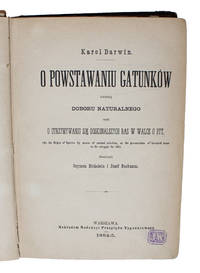
188456005Warszawa Przegladu Tygodniowego 1884. Large8vo. In contemporary half calf. Spine with wear lacking the upper 1 cm. Small stamp to title-page. Hindges weak and back board detached from bookblock. Verso of title-page and first leaf on content. 437 1 XVI Including the plate pp. <br/><br/><em>First edition of the first full Polish translation of Darwin's "Origin of Species". An attempt to publish a Polish translation was made as early as 1873. This was however never completed and only half of the work was published Freeman 739 thus making the present copy the very first full Polish translation. As seen in several other countries especially in Japan the majority of Polish intellectuals adopted a Social Darwinism perspective at a very early stage rather than appreciating the English naturalist's caution in applying his ideas to human society."Before the first translations of Darwin's appeared . many Polish intellectuals such as positivist writer Eliza Orzeszkowa 1841-1910 complained about the increasing confusion over the essence of the English naturalist's ideas which had all too often been mixed up with all sorts of ideological debates. However when Darwin's books were actually available in Polish translations the novelty of his concepts gradually wore off making room for more serious attempts to come to terms with evolutionary theory." Glick The Reception of Charles Darwin in Europe. "It appears that the struggle for or against Darwinism in partitioned Poland prefigured a pattern that is relevant for Polish thinking up to the present day: the conflict of striving for progress with the help of powerful allies abroad and of virulently rejecting all foreign advice for fear of losing one's cultural identity." Ibid.Translation was begun by Szymon Dickstein who in the processe of the translation committed suicide. It was completed by Józef Nusbaum who also translated 'The Variation of Animals and Plants under Domestication' in 1888.Freeman 740 </em> unknown
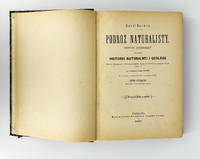
188753495Warszawa 1887. 4to. In contemporary half calf with gilt lettering to spine and four raised bands. Spine with wear and top right corner 3 x 5 cm of title-page lacking not affecting text. Internally fine and clean. 4 II 412 XVIII pp. <br/><br/><em>Extremely rare first Polish translation of Darwin’s Journal of Researches: "His first published book is undoubtedly the most often read and stands second only to ‘On the origin of Species’ as the most often printed. It is an important travel book in its own right and its relation to the background of his evolutionary ideas has often been stressed."Freeman p. 31.Freeman 223 </em> hardcover
1887009557Warsaw: Wydawnictwo Przeglądu Tygodniowego 1887 8vo 24 cm 4 II 412 XVIII pp. Contemporary cloth-backed marbled boards binding rubbed with a small loss to the marbled paper at the tail of the front board endpapers somewhat stained a number written in blue pencil on the front free endpaper light toning throughout the text. The first Polish edition of Charles Darwin's celebrated travel narrative originally published in English as "Journal of Researches into the Geology and Natural History of the Various Countries Visited by H.M.S. Beagle" and later known as "The Voyage of the Beagle". This work presents Darwin's observations and scientific reflections made during the historic 1831-1836 voyage of the Beagle documenting his studies in geology zoology botany and ethnography across South America the Galápagos Islands and other regions--research that proved foundational for the later development of his theory of evolution by natural selection. Translated into Polish by Józef Nusbaum from the 1884 English edition this publication represents an important milestone in the reception of Darwinian thought in Poland and remains a key text in the history of nineteenth-century science and exploration. Wydawnictwo Przeglądu Tygodniowego hardcover
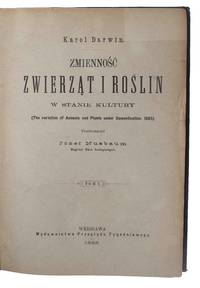
188853153Warszawa Wydawnictwo Przegladu Tygodnio 1888-1889. Large8vo. In two uniform contemporary half calf bindings with four raised bands and gilt lettering to spine. Top right corner app. 3 x 5 cm of both title pages cut off; volume 1 not affecting text volume 2 missing the n in 'Darwin'. Light wear to extremities otherwise a fine set. 2 X 11-357 III; 2 379 IV VIII V pp. <br/><br/><em>Rare first Polish translation of Darwin's extensive work 'The Variation of Animals and Plants under Domestication'. It is the longest work and being so detailed was never a very successful one selling only about five thousand copies in his life time and eight before the end of the century" R.B. Freeman. Freeman 922. </em> hardcover
1881S4145London:: Harrison and Sons 1881. 1881. 303 x 231 mm. 4to. Pages 491-535; 537-545 pp. 4 tables 3 lithographic plates; 2 figs. 2 tables. Dis-bound. George Howard Darwin was the fifth child of Charles Robert Darwin and Emma Wedgwood. George Darwin graduated from Trinity College Cambridge in 1868. In 1883 Darwin was elected Plumian professor of astronomy and experimental philosophy at Cambridge. Darwin delved deeply into the problems of the origin and evolution of the solar system making numerous investigations of the figures of equilibrium for rotating masses of fluid. A further application of Darwin's theory of tidal friction to the motion of the planets round the sun opened up the wider question of the genesis of the solar system. DNB 1912-1921 pp. 144-147; DSB III pp. 582-584. Harrison and Sons, 1881. unknown
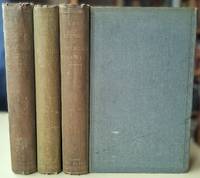
1888023178London: John Murray 1888. Seventh thousand revised. Large octavo three volumes pp x 395; ii 393; iv 418 a slight mark to one fore-edge very slight signs of use otherwise clean and tight internally. Original blue cloth rubbed and a little worn the spines age-toned the spine-heads a little frayed the second volume slightly marked on the rear cover. With three portait frontispieces. Freeman 1457. A heavy set - extra postage will be required. Cloth. Good. John Murray Hardcover
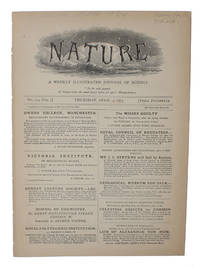
187360133London 1873. Small folio. Extracted with traces from the sewn cords in the original printed wrappers. In "Nature" No. 179 Vol. 7 April 13. Entire issue offered. Front wrapper detached otherwise fine and clean. Housed in a portfolio with white paper title-label to front board. Darwin's notice: Pp. 417-18. Entire issue: Pp. 1 cx-cxvi 417-436. <br/><br/><em>First appearance of Darwin's comment to an article in NATURE of March 20 1873 containing his view on the origin of certain instincts. "THE writer of the interesting article in NATURE of March 20 doubts whether my belief “that many of the most wonderful instincts have been acquired independently of habit through the preservation of useful variations of pre existing instincts†means more than “that in a great many instances we cannot conceive how the instincts originated.†This in one sense is perfectly true but what I wished to bring prominently forward was simply that in certain cases instincts had not been acquired through the experience of their utility with continued practice during successive generations. I had in my mind the case of neuter insects which never leave offspring to inherit the teachings of experience and which are themselves the offspring of parents which possess quite different instincts. The Hive-bee is the best known instance as neither the queen nor the drones construct cells secrete wax collect honey &c." From the present paper. Freeman 1760. </em> unknown
189970827New York: D. Appleton and Comapny 1899. Hardcover. Very Good . 365 pp; the Authorized Edition; in red cloth boards with gilt stamping on spine which is clean and bright; has bookplate pasted to front-paste down THIS IS VOLUME I ONLY. <br/><br/> D. Appleton and Comapny hardcover
1882141041Ernst Günthers Verlag, Leipzig 1882. Titelblatt, VI, 90 Seiten. Breitrandiges, unaufgeschnittenes Exemplar. (Teils etwas fleckig. Umschlag mit kleinem Besitzerstempel). 23x15 cm
1876122438Stuttgart. Verlag von Paul Moser 1876. XII, 403 Seiten. Geprägter, schwarzer Original-Leinwand-Einband der Zeit. (Einband an den Kanten teils berieben. Papier teils fleckig). 21x14 cm