1 161 résultats
18799263EB1879. London J. Murray 1879. 8°. Porträt-Frontispiz 2 ganzseitige Holzschnitte im Text IV 216 S. Grüner Original-Leinenband mit goldgeprätem Rückentitel leicht berieben. Buchblock nach S. IV wenig angeplatzt. Stellenweise Bleistiftmarkierungen oder -anmerkungen im Text. Durchgehend schwach gebräunt. Sonst in schöner Erhaltung. Dieses Exemplar wurde mit zahlreichen maschinengeschriebenen Fußnoten sowie einem selbst angelegten Index in deutscher Sprache versehen die sauber eingeklebt in den Buchblock integriert wurden. unknown
188022990New York: D. Appleton and Company 1880. First American Edition. Hardcover. Very good. Title on spine: The Life of Erasmus Darwin. 8vo pp. iv 216 publisher's ads bound in publisher's brown cloth decorated in gilt and black. Previous owner's signature on front flyleaf; paper over front hinge is cracked and hinge is slightly wobbly otherwise clean and sound with slight wear to extremities. A scientific biography of Erasmus Darwin by Krause a German biologist with a prefatory note by Darwin's grandson Charles. Freeman #1320. D. Appleton and Company hardcover
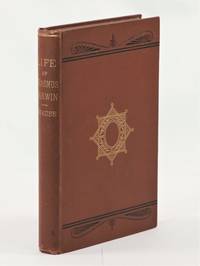
1880121686New York: D. Appleton and Co 1880. First U. S. Edition. Hardcover. Ex library-good. iv 216 8 p. 20 cm. Frontispiece portrait and two b&w drawing. Brown cloth hardcover with gold and black impressing. Repaired spine ends newer endpapers. Ex lib with ink stamps on text block edges and blind stamps on title and two following leaves. <br/><br/>A biography of Erasmus Darwin 1731-1802 by his grandson Charles Darwin and the German biologist Ernst Krause first published in 1879. Ernst Krause wrote a paper on the scientific works Erasmus Darwin which was published in the German language journal Kosmos in February of that year. This was translated into English by William Sweetland Dallas as "The Scientific Works of Erasmus Darwin" beginning on p. 130 of this edition. Charles Darwin added a "preliminary notice" based on material that was in the possession of his family. D. Appleton and Co hardcover
188199041881 plaquette (booklet) in-octavo, dos muet (spine - no title) gris-vert, couverture imprimée (front cover printed), gouttière non coupée (fored-edge uncut), sans illustration (no illustration), légères rousseurs (light redness marks), 80 pages, 1881 à Paris Octave Doin Editeur,
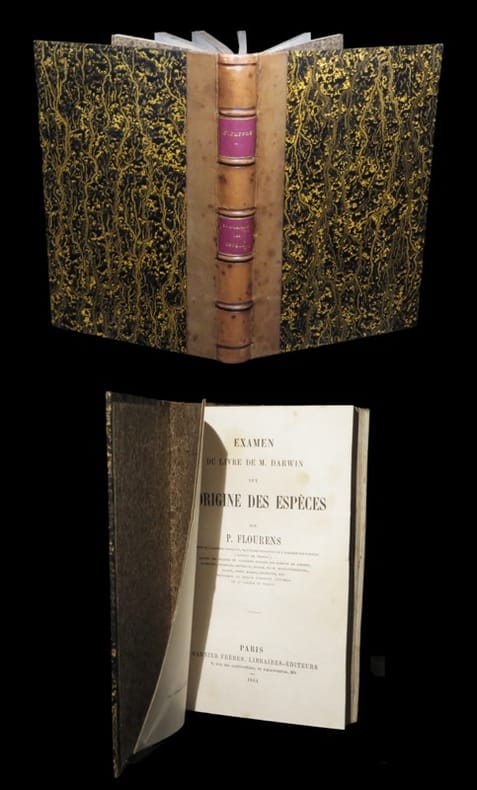
186131742Paris, Garnier Frères, 1864. Un vol. au format in-12 (188 x 123 mm) de vii - 170 pp. et 1 f. n.fol. Reliure de l'époque de demi-veau glacé fauve, dos à nerfs orné de filets gras en noir, filets maigres dorés, pièce de titre de maroquin bordeaux, titre doré, tranches mouchetées.
1861317421861. Paris Garnier FrÂres 1864. Un vol. au format in-12 188 x 123 mm de vii - 170 pp. et 1 f. n.fol. Reliure de l'ÂŽpoque de demi-veau glacÂŽ fauve dos ˆ nerfs ornÂŽ de filets gras en noir filets maigres dorÂŽs piÂce de titre de maroquin bordeaux titre dorÂŽ tranches mouchetÂŽes. Edition originale. Reliure prÂŽsentant quelques t‰ches. Quelques rousseurs dans le t‰che. Petit t‰che allant en s'estompant en marge des premiers feuillets. Du reste bonne condition. Peu courant. b42961 unknown
188645683New York: D. Appleton and Company 1886. Very Good. New York: D. Appleton and Company 1886. Later Printing. Octavo 20 cm; 1vi374pp2ads; illus. with seven 7 plates collated complete. Boards in publisher's maroon cloth with black decoration and gilt stamping to spine. Dark top stain. Board margins and corners rubbed and bumped with shelfwear and minor scratching to spine. Binding slightly cocked but firm. Top stain faded and dust-soiled. Interior clean with brief pencil and minor exposed binding at some signatures. Signature beginning with page 259 detached at all threads except the bottom so sits slightly proud. Overall a Very Good copy. <br /> <br /> While working on Descent of Man Darwin became interested in emotional expression across species. In animals he believed expressions were a part of their purposeful action and not connected to emotion. Humans however were very emotional. He examines reactions and expressions in human subjects to different stimuli like "low spirits" of grief and anxiety and "high spirits" like love. Though for Darwin the most intriguing and peculiar reaction to emotion was blushing. So much so that he dedicates an entire chapter to it and comes to the conclusion "It appears that the mental powers of infants are not as yet sufficiently developed to allow of their blushing. Hence also it is that idiots rarely blush. D. Appleton and Company unknown
187212London: John Murray. Albemarle St. 1872. First edition first state. Hardcover. Fair. Octavo. vi 374pp 4 ads. Bound in green cloth. 7 heliotype plates complete showing photographs of human emotion 3 of which are fold out. Plates are in nice condition without tearing or foxing. Additional in-text illustrations. Joints are cracked stain on front cover chips out of bottom of spine. Lacking half-title. First edition first state Freeman F1142. A worn copy which would benefit from a rebinding. John Murray. Albemarle St. hardcover
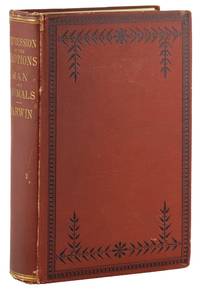
1873000935Appleton 1873 Bound in red brick cloth decorated with double black borders and circular device in each corner 374 pp. plus 14 pp. ads 21 illustrations 7 heliotype plates 3 folding. One folding plate with a small split at the fold. Spine decorations in gilt which are quite bright. Beautiful copy with traces of rubbing at extremities. Appleton hardcover
1883feb02671<p>1883. First Italian Edition of Fertilisation of Orchids by Charles Dariwn.<br /><br />I diversi apparecchi col mezzo dei quali le orchidee vengono fecondate dagli insetti</p><p>Used book For more details and availability please contact me</p> Torino hardcover
1862feb02637<p>1862. First German Edition of Fertilisation of Orchids by Charles Darwin.<br /><br />Über die Einrichtungen zur Befruchtung Britischer und ausländischer Orhideen durch Insekten</p><p>Used book For more details and availability please contact me</p> E. Sclnveizerbart'sche Verlagshandlung hardcover
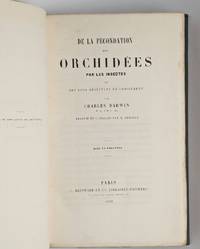
1870feb02700<p>1891. First French Edition of Fertilisation of Orchids by Charles Darwin.<br /><br />De la fécondation des orchidées par les insectes et des bons résultats du croisement</p><p>Used book For more details and availability please contact me</p> C. Reinwald hardcover
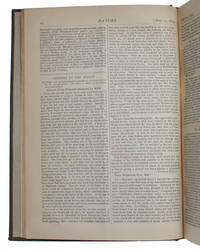
187460115London and New York, Macmillan and Co., 1874. Royal8vo. In a bit later full green cloth. In ""Nature. A Weekly Illustrated Journal of Science"", Vol. 10, May 1874 - October 1874. Stamp to title-page and ex-libris pasted on to pasted down front end-paper. Stamps to front free end paper. Traces from book block having been bended. Darwin's paper: Pp. 24-25. [Entire volume: XI, (1), 534 pp].
187460115London and New York Macmillan and Co. 1874. Royal8vo. In a bit later full green cloth. In "Nature. A Weekly Illustrated Journal of Science" Vol. 10 May 1874 - October 1874. Stamp to title-page and ex-libris pasted on to pasted down front end-paper. Stamps to front free end paper. Traces from book block having been bended. Darwin's paper: Pp. 24-25. Entire volume: XI 1 534 pp. <br/><br/><em>First appearance of Darwin's paper on Primrose flowers. Primrose flowers and the flowers of related members of the Primulaceae are often removed from their stalks and scattered on the ground by green finches apparently consuming the ovaries and nectaries - here first described by Darwin. Freeman 1771 </em> hardcover
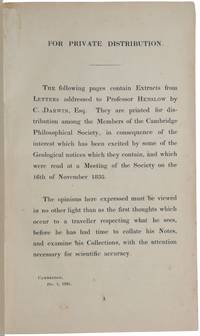
18356395Cambridge: the University Press for the Cambridge Philosophical Society 1835. First edition. <p>First edition very rare of Darwin's first separately printed work - the thirty-one-page pamphlet in which John Stevens Henslow Cambridge Regius Professor of Botany and the mentor who had placed him aboard the Beagle printed extracts from ten of Darwin's letters from South America for private distribution to the Cambridge Philosophical Society on 1 December 1835. Darwin was then in the South Pacific and would not learn for six months that the pamphlet existed. Extracts had already been read aloud - at the Cambridge Philosophical Society on 16 November and two days later at the Geological Society of London by Adam Sedgwick with Charles Lyell serving his first term as President in the audience. By the time the Beagle docked at Falmouth in October 1836 his reputation had been made in his absence. This is the document by which Darwin was first introduced to the scientific community - twenty-four years before the Origin of Species a career before the books that would carry his name around the world.</p>. The Pamphlet that Made Darwin's Reputation before He Knew It Existed. <p>First edition very rare of Darwin's first separately printed work - the thirty-one-page pamphlet in which John Stevens Henslow Cambridge Regius Professor of Botany Darwin's mentor and the man who had secured him his berth on the Beagle printed selected passages from Darwin's letters home for private distribution to the Fellows of the Cambridge Philosophical Society on 1 December 1835. Darwin was then in the South Pacific had just called at Tahiti and would not learn for almost half a year that the pamphlet existed. He did not see a copy until October 1836 when he was back in England. In those intervening months the pamphlet circulated rapidly through the British geological establishment and the verdict was already being returned. This is the document by which the public naturalist of the following quarter-century was first introduced to the scientific community - twenty-four years before the Origin of Species thirty-six before the Descent of Man and a career before the books which would carry his name around the world. It is his first separately printed work and the first of the ninety-five entries in Freeman's bibliography.</p> <br /> <br /> <p>The pamphlet was the printed form of extracts that had already been read aloud. On 16 November 1835 at the Cambridge Philosophical Society's meeting chaired by the president the Rev. Dr William Clark Henslow read extracts from ten of Darwin's letters from South America with remarks contributed by Adam Sedgwick. Two days later at the Geological Society of London in Somerset House Sedgwick read further extracts and introduced them as a very great mass of information connected with almost every branch of natural history - from which he would for the present occasion confine himself to the geology. The Athenaeum summarised the Geological Society session in its number of 21 November and by Caroline Darwin's transcription of that report Sedgwick had given specific notice of her brother's observations on the tertiary formation of Patagonia & Chili & on the changes of level between land & sea and of the description of the Uspallata Pass with its tertiary and igneous alternations and its veins of true granite gold and other metals. Charles Lyell then serving his first term as President of the Geological Society 1835-1837 was in the audience for this reading; so was Henslow's friend Leonard Jenyns the Cambridgeshire naturalist who had himself been offered and declined the Beagle berth four years earlier. By the time the Beagle docked at Falmouth in early October 1836 Darwin's scientific reputation in Britain had been made in his absence.</p> <br /> <br /> <p>Henslow was then thirty-nine a Regius Professor of Botany who had previously held the chair of mineralogy and was in several respects the architect of Cambridge natural science in the 1830s: he had been a founder of the Cambridge Philosophical Society in 1819 had taught the botany course that Darwin took at Christ's College for three years running had conducted the Saturday field excursions at which Darwin had done most of his undergraduate natural-history apprenticeship and had presided over the Friday Evening scientific soirées in his own drawing-room at which Darwin as an undergraduate met Sedgwick Whewell Peacock and the senior figures of the University's scientific community. Darwin himself in the Autobiography of 1876 described the friendship with Henslow as the circumstance that had influenced his whole career more than any other and remembered being called by some of the dons "the man who walks with Henslow." When in August 1831 the Beaufort-Peacock-FitzRoy search for a gentleman naturalist to sail on the Beagle reached Henslow's desk - Peacock writing from Cambridge on behalf of his friend Francis Beaufort Hydrographer of the Navy - Henslow first considered going himself declined on account of his wife and family and having first offered and been declined by Leonard Jenyns wrote the letter of recommendation that determined the rest of Darwin's life.</p> <br /> <br /> <p>Darwin sailed from Plymouth on 27 December 1831 as the self-funded naturalist of the Beagle's second survey voyage at a salary of nothing and at the age of twenty-two. Henslow had proposed him for the berth - the best qualified person he knew of - and in the five years following was the recipient of Darwin's scientific letters from the field ten of which survive as the source of the present extracts. The topics the letters ranged over were already those of the later career: the geology of the South American coast from Patagonia to the equator fossil mammals from the pampas the Megatherium bones that Richard Owen would soon describe the gradual uplift of the Chilean shore that Darwin had witnessed directly in the Concepción earthquake of February 1835 the transect across the Andes from Mendoza to the Pacific at which he had found marine shells at twelve thousand feet and petrified trees standing upright through successive sandstones. The emphasis is geological throughout. The South American palaeontology that would drive his incipient evolutionary thinking is present only in outline and the word species does not yet appear as a theoretical term. But the habit of sustained observation under a unifying theory - Charles Lyell's uniformitarian Principles of Geology whose three volumes Darwin had taken with him on the Beagle and whose second volume had reached him at Montevideo in 1832 - is already formed and the pamphlet is the first public trace of its formation.</p> <br /> <br /> <p>The immediate precipitating occasion was a field-geological one. Darwin's long letter of April 1835 describing the cross-Cordillera transect at the Puquenas and Portillo passes and the upright petrified trees at Uspallata had reached Henslow at Cambridge in the autumn of 1835 and had been at once seen by Sedgwick to be a finding of the first importance. After the 16 November Cambridge reading and the 18 November Geological Society reading the Council of the Cambridge Philosophical Society resolved on 30 November that the printing of certain extracts from Mr Darwin's correspondence be submitted to Mr Whewell Mr Peacock and Prof. Henslow - William Whewell Fellow of Trinity College who had resigned the chair of mineralogy in 1832 and two years earlier had coined the word scientist George Peacock Fellow and tutor at Trinity who would be appointed Lowndean Professor of Astronomy two years later and Henslow himself. The pamphlet was in press the following day. Its preface dated 1 December 1835 and signed by Henslow explains the occasion and carries a disclaimer that must be read as the botanist's gentle protection of his absent correspondent: the opinions expressed are presented only as first thoughts of a traveller respecting what he sees before he has had time to collate his notes and examine his collections with the attention necessary for scientific accuracy.</p> <br /> <br /> <p>Darwin for his part was for some weeks horrified. The first hint of the pamphlet reached him at the Cape of Good Hope on 1 June 1836 in a letter of 29 January from his youngest sister Catherine mentioning in passing the little books with the Extracts from your Letters. He replied from the Cape on 3 June confessing himself "a good deal horrified" by the sentence protesting that he had written to Henslow in the same careless manner as to his own family and that to print what had been written without care or accuracy was to play with edge tools. He could only quote the Spaniard's proverb - no hay remedio there is no remedy. The horror was converted into a different feeling when on the next leg northwards a November 1835 letter from his sister Susan caught up with him at Ascension Island in mid-July with the news that Sedgwick himself had predicted he would have a great name among the naturalists of Europe. Darwin later recalled the effect of reading Sedgwick's estimate on a volcanic island in the middle of the Atlantic: he had clambered over the mountains of Ascension with a bounding step and made the volcanic rocks resound under his geological hammer.</p> <br /> <br /> <p>The reader of the 1835 pamphlet however encounters a Darwin who is still entirely a geologist. His first theoretical book would be a geological one - The Structure and Distribution of Coral Reefs 1842 developed from the theory he had worked out in the South Pacific of the subsidence that had produced the oceanic atolls; his second and third the geological volumes of the Beagle series 1844 1846 would remain within the Lyellian framework. The transition from the Lyellian geologist of 1835 to the evolutionary biologist of 1859 is the subject of the two decades between the pamphlet and the Origin of Species. The present pamphlet is where that career begins in print and it begins as the career of a field geologist already competent enough for Sedgwick at Cambridge and Lyell in London to take his observations seriously the moment they arrived. The evolutionary Darwin who would reach French readers in Clémence Royer's translation of 1862 German readers in H. G. Bronn's of the same year American readers in Asa Gray's editions from 1860 and eventually Japanese readers in Tachibana SenzaburÅ's of 1896 begins his printed career as the geological Darwin whose Andes transect is the climax of the letters excerpted here.</p> <br /> <br /> <p>Its influence in its own year was out of all proportion to its size. It was most consequentially through the pamphlet that Charles Lyell took Darwin seriously as a geologist. Presiding over the Geological Society from the chair at Somerset House on 18 November 1835 Lyell heard Darwin's Chilean and Andean observations as the first empirical vindication of the Principles of Geology from a working field geologist in the Southern Hemisphere: direct observation of ongoing elevation of the land along the Chilean coast of marine shells at twelve thousand feet in the Andes of tertiary formations at altitudes where on the Lyellian account one would expect to find them. Lyell wrote to Henslow early in 1836 asking for every scrap of further Darwin material that came in. When the Beagle finally docked at Falmouth in October 1836 Lyell called on Darwin within a fortnight of his arrival in London. The friendship that followed - Lyell's unreserved support for Darwin's early geological work of 1838-1846 Lyell's reluctant acceptance in 1859 of the argument of the Origin after twenty years of friendly resistance to it Darwin's description of Lyell in the Autobiography as the man to whom he owed more scientifically than any other - begins at this reading of the pamphlet in November 1835.</p> <br /> <br /> <p>Henslow for his part sent copies to the Darwin family on Christmas Day 1835 with a note hoping that Darwin would soon be back to take his position among the first Naturalists of the day. Dr Robert Waring Darwin the traveller's father who had had doubts about his son's career in natural history read it through in one sitting. Caroline Darwin wrote to her brother on 29 December: their father "did not move from his seat till he had read every word" had been very much gratified had liked the simple clear way in which the information was conveyed and had particularly admired the frank and unhackneyed manner of his son's writing. He wrote at once to Henslow to thank him observing that his son's letters carried their own natural good-humoured energy. Earlier at the end of November their sister Susan had also forwarded the news that Sedgwick writing to Dr Butler at Shrewsbury had reported that the former schoolboy was doing admirably in South America and would take his place among the naturalists of Europe: a prediction carrying particular weight in a household that had once worried its son might become an idle man. Dr Darwin gave copies of the pamphlet to friends and relatives; Henslow sent six to Samuel Butler headmaster at Shrewsbury where Darwin had been at school; Tom Eyton and William Darwin Fox received further copies. By the end of January 1836 the pamphlet was already circulating well beyond the membership of the Cambridge Philosophical Society for whom it had been produced.</p> <br /> <br /> <p>Henslow's selection is quotation not summary. It runs through ten of Darwin's letters from the voyage from 18 May 1832 written at Botafogo near Rio de Janeiro four months after leaving England to 18 April 1835 the long letter from ValparaÃso describing the double transect of the Andes. A further letter of 12 August 1835 from Lima was received by Henslow too late for inclusion. The sequence moves from the tropical forests of Brazil through the pampas and Patagonia to Tierra del Fuego and the Falklands; up the Chilean coast; and across the Andes. Embedded in the geology and the zoology are the first printed passages of Darwin as a writer - the observations of the Fuegian Yahgan in contrast to the anglicised Jemmy Button aboard the Beagle; the description at Rio de Janeiro of the young naturalist whose servant Syms Covington had just been taught to skin birds and quadrupeds; the ironic grumble from Montevideo that Alcide d'Orbigny might collect the cream of the good things first; the note again from Montevideo of Juan Manuel de Rosas's war of extermination against the Indians; and everywhere the sustained geological attention that would be elaborated for the next decade in the Beagle geological volumes. It is the voice of the mature Darwin in formation.</p> <br /> <br /> <p>The edition is among the rarest of Darwin items. Freeman states that fewer than one hundred copies were printed and that although it has always been assumed that the pamphlet was issued to members of the Cambridge Philosophical Society in December 1835 he had not seen a copy with a dated ownership inscription or accession stamp for that year; the surviving evidence for a December 1835 issue is a letter from Dr Robert Waring Darwin to Henslow of 28 December 1835. A proof copy with some twenty pencil corrections appeared at Sotheby's on 13 March 1973 lot 404; since then according to American Book Prices Current only four copies have sold at auction the most recent at Christie's New York on 19 June 2014 sale 2861 $221000. One of the recorded auction copies had been presented by Henslow himself to the Ashmolean Natural History Society at Oxford. Institutional holdings are concentrated in Cambridge the Cambridge Philosophical Society's own copy the University Library and Christ's College where Darwin had been an undergraduate with further copies at the British Library the American Philosophical Society and Down House where Darwin's own copy is preserved. A close facsimile was issued by the Cambridge Philosophical Society in 1960 with a new preface by Sydney Smith reproducing the Society's minutes of 16 and 30 November 1835 to mark the centenary of the Origin of Species; that reprint and the original are easily distinguished and cause no confusion.</p> <br /> <br /> <p>References: Freeman 1; Norman 583; Garrison-Morton 8920. Standard scholarly treatment of the pamphlet's production and reception is in Frederick Burkhardt ed. The Correspondence of Charles Darwin vol. 1: 1821-1836 Cambridge 1985 pp. 468-472 and 507-511; see also Janet Browne Charles Darwin: Voyaging New York 1995 pp. 340-343 and Susannah Gibson The Spirit of Inquiry: How One Extraordinary Society Shaped Modern Science Oxford 2019 pp. 86-92.</p> <br /> <br /> <br/> <br/> <br /> <p>8vo 217 × 142 mm: pp. 1-3 4-31 1 blank; a single gathering of 16 leaves signatures A-Bâ¸; printed by the University Press Cambridge on wove paper edges untrimmed. Original plain pale grey paper wrappers as issued sewn without printed lettering. A remarkably fresh copy of a famously fragile pamphlet: wrappers bright with only light age-toning and a few faint surface marks; the preface leaf lightly foxed at the head; the text block clean and crisp throughout.</p> . [the University Press for the Cambridge Philosophical Society unknown
1899000217Appleton 1899 Spine slightly darkened small paper label at tail of spine from previous owner not ex-lib trace of edgewear at spine extremities. Faint spot on front cover. Contents fine. Red cloth. authorized edition Appleton hardcover
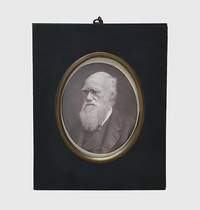
1878178890London: Samson Low Marston Searle and Rivington 1878. Capturing the evolution of Darwin A prime example of Darwin's personal iconography as an elder statesman of science. This photograph is taken from Lock & Whitfield's Men of Mark series - a portrait gallery of prominent Victorian individuals - and refashioned for open display. By 1878 the 69-year-old's fame was widespread. Despite his increasing retirement at Down House many continued to seek him out including Gladstone in 1877. As his son Francis recalled "He did not realise that people would know him from his photograph and I remember him at the Crystal Palace aquarium saying in uneasy voice that somebody had been looking at him & he supposed he must have been recognized" Van Whye. Men of Mark was issued in monthly parts comprising three portrait plates and biographical notices for 1s 6d. Darwin appeared in part 36 in December 1878. This image was later used as the frontispiece to the third edition in French of the Descent of Man. Photographic portrait 114 x 92 mm after a Woodburytype original by Lock & Whitfield mounted within contemporary wood frame with glazing and metal oval border 210 x 132 mm. Minimal finger-soiling slight scuffing to frame: in very good condition. Van Whye The Complete Photographs of Darwin 1878a.1. unknown
18841300273Leipzig, Veit, 1884. 119, (1) S. Lwd (Deckel m. Etikett, Rücken laienhaft überklebt, beschabt, Vorsätze leimschattig, Sign. a. Titel, mehrf. gestempelt).
1882451781882. <p>Darwin Charles 1809-82. Funeral of Mr. Darwin. Westminster Abbey Wednesday April 26th 1882 at 12 o'clock precisely . . . G. G. Bradley Dean. Printed card black-bordered with the Dean's seal in black wax in the left margin and the letters "C. H." in red ink on either side of the seal. N.p. 1882. 92 x 122 mm. Fine.</p> <p> Darwin had died at Down House on 19 April 1882 expecting to be buried in the local churchyard. His fame and reputation were such however that Huxley Galton and others felt it would be appropriate to have him buried at Westminster Abbey one of the highest honors that can be bestowed on a British citizen. As Desmond and Moore put it "getting a freethinker into the Abbey was not easy" Darwin p. 666. But Huxley stepped in supported in Parliament by Darwin's neighbor Sir John Lubbock and by a press campaign led by The Standard. The Reverend George Granville Bradley Dean of Westminster Abbey was happy to acquiesce.</p> <p> The Chapter House to which our card allows admission is where those who were to follow the coffin into the Abbey assembled: "On that grey day committees adjourned judges put on mourning dress and Parliament emptied as members trooped across the road. From embassies scientific societies and countless ordinary homes they came. Under leaden skies they converged on the Abbey anticipating the awe and spectacle of a state occasion. In the Chapter House where Parliament had once met the elders of science State and Church the nobility of birth and talent stood waiting to file though the cloisters behind the coffin. They were "the greatest gathering of intellect that was ever brought together in our country" said one' Desmond and Moore p. 672. Darwin was laid to rest beneath the monument to Newton at the north end of the choir screen. </p> . unknown
1882451781882. <p>Darwin Charles 1809-82. Funeral of Mr. Darwin. Westminster Abbey Wednesday April 26th 1882 at 12 o'clock precisely . . . G. G. Bradley Dean. Printed card black-bordered with the Dean's seal in black wax in the left margin and the letters "C. H." in red ink on either side of the seal. N.p. 1882. 92 x 122 mm. Fine.</p> <p> Darwin had died at Down House on 19 April 1882 expecting to be buried in the local churchyard. His fame and reputation were such however that Huxley Galton and others felt it would be appropriate to have him buried at Westminster Abbey one of the highest honors that can be bestowed on a British citizen. As Desmond and Moore put it "getting a freethinker into the Abbey was not easy" Darwin p. 666. But Huxley stepped in supported in Parliament by Darwin's neighbor Sir John Lubbock and by a press campaign led by The Standard. The Reverend George Granville Bradley Dean of Westminster Abbey was happy to acquiesce.</p> <p> The Chapter House to which our card allows admission is where those who were to follow the coffin into the Abbey assembled: "On that grey day committees adjourned judges put on mourning dress and Parliament emptied as members trooped across the road. From embassies scientific societies and countless ordinary homes they came. Under leaden skies they converged on the Abbey anticipating the awe and spectacle of a state occasion. In the Chapter House where Parliament had once met the elders of science State and Church the nobility of birth and talent stood waiting to file though the cloisters behind the coffin. They were "the greatest gathering of intellect that was ever brought together in our country" said one' Desmond and Moore p. 672. Darwin was laid to rest beneath the monument to Newton at the north end of the choir screen. </p> . unknown books
187750988Paris, C. Reinwald et Cie, 1877. 8vo. Uncut, unopened in the original publisher's embossed full green cloth with gilt lettering to spine. Small red label pasted on to top left corner of inner front board. Light brownspots throughout. XV, (1), 496, (2) pp.
187750988Paris C. Reinwald et Cie 1877. 8vo. Uncut unopened in the original publisher's embossed full green cloth with gilt lettering to spine. Small red label pasted on to top left corner of inner front board. Light brownspots throughout. XV 1 496 2 pp. <br/><br/><em>The rare first French translation of Darwin's work the first edition being published the year before in 1876 on cross and self-fertilization - a continuation of his "Fertilisation of Orchids". "It was too technical and too detailed to command a wide sale" which is why it was published in a rather small number.It was translated into French German and italian in Darwin's lifetime.Freeman 1265 </em> hardcover
1878GL020251878 x, 400, 104 p., 38 figs, 5 (1 col.) pls, 2 folded maps, cloth (somewhat rubbed). From the series Ch. Darwin's gesammelte Werke.
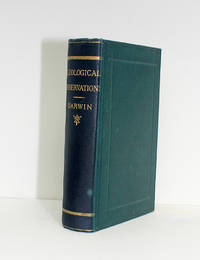
189167780D. Appleton and Company 1891. Hardcover. Used very good. Very good condition. Published by D. Appleton in 1891 no additional printings indicated. Bound in brown cloth gold lettering on spine blindstamped black decoration on front cover; same blindstamped pattern on back cover but not black; 648pp plus 10-page list of publisher's current offerings; folding maps at page 40 and page185 5 folding plates prior to Appendix plate 1 is in color. CONDITION: Cover has slight rubbing 1/4x1/2" spot of gray paint on back cover; signature and date in old script inside front cover a little pencil writing on front free endpaper won't quite erase no other marks; foldout map at page 181 has a 6" tear. Overall very good condition. We are a small family business selling fine new and pre-owned books online since 1999. We provide professional service and individual attention to your order daily shipments and sturdy packaging. FREE TRACKING ON ALL SHIPMENTS WITHIN USA. D. Appleton and Company , hardcover
1891028589UK: Smith Elder 1891. 3rd Edition . Cloth. Very Good/No Jacket. 8vo - over 7¾" - 9¾" tall. 3rd Edition 1891. 2 folding maps and 5 folding plates Originally published 1842-6 in 3 volumes - Coral Reefs Volcanic Islands and South America this volume combining the latter two parts. Book is very good and bright. In Original green cloth with light rubbing to edges. Nice clean contents. Name to endpaper. Pockets are holding well at the rear with light edge creasing to page near it. More digital images can be taken upon request. RefA1234 <br/> <br/> Smith Elder hardcover