1 159 résultats
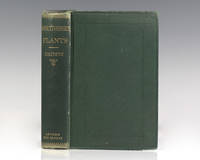
1889339498New York: D. Appleton & Company. Very Good with no dust jacket. 1889. Cloth. Wear and bumping to edges of boards. Former owner's name on front fly-leaf. Otherwise clean and solid. ; B&W Illustrations; 8vo; 462 pages . D. Appleton & Company hardcover
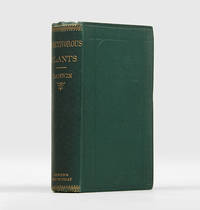
1893A42549London: John Murray 1893. xiv 377 30 woodcuts in text. . HB. 8vo orig. cloth gt to spine. Gift inscription dated 1906 and small ink ownership stamp to fly-leaf and name in ink to top of title page. A very good clean and bright copy. Second edition revised by Francis Darwin sixth thousand. The second edition was first published in 1888.Freeman 1227. John Murray hardcover

1875132980London: John Murray 1875. First edition of this classic work by Darwin. Octavo original green cloth with gilt titles to the spine woodcut illustrations by Darwin and his sons George and Francis Darwin. In very good condition. Bookplate and Henry Southeran's bookseller ticket to the pastedown. Darwin states in the opening pages to this comprehensive account: "During the summer of 1860 I was surprised by finding how large a number of insects were caught by the leaves of the common sun-dew Drosera rotundifolia on a heath in Sussex. I had heard that insects were thus caught but knew nothing further on the subject." The book chronicles Darwin's experiments with various carnivorous plants in which he carefully studied their feeding mechanisms Darwin tried several methods to stimulate the plants into activating their trap mechanisms including feeding them meat and glass blowing on them and prodding them with hair. He found that only the movement of an animal would cause the plants to react and concluded that this was an evolutionary adaptation to conserve energy for prey and to ignore stimuli that were not likely to be nutritious. He also discovered that while some plants have distinct trap-like structures others produce sticky fluids to ensnare their prey and concluded that this was an example of natural selection pressure resulting in various methods for food capture. John Murray hardcover
1875250355<p>x 462 pages. Ex-Lib with Hill Library Saint Paul on the title page. Binding shows some wear and between some signatures is loose so the book lays flat. One signature is loose.<br /></p><p>No indication of thousand print number or errata slip agrees with Freeman 1217 first edition.</p> John Murray hardcover
189300286189London: John Murray 1893 Green/gilt cloth clean tight. With illustrations. Second Edition Sixth Thousand. Advertisments Preface to The Second Edition. Francis Darwin July 1888 xii List of Chief Additions to Second Edition. 377 pgs Index. List of Works Published by Mr Murry 32 ps. slight scuffing at spine. A nice copy. Second Edition. Cloth. Very Good. John Murray hardcover
1875119518London: John Murray 1875. First edition first issue. "These meticulous studies form a minor contribution to the evolutionary series by the study of the adaptations of such plants to impoverished conditions. The book was published on 2 July 1875 in a standard binding without inserted advertisements. It is stated that 3000 were printed of which 2700 were sold to the trade at once. This cannot be strictly true because both the second and third thousands of the same year stated their thousands on the title pages" Freeman. Octavo. 30 wood-engraved illustrations in the text. Original green bead-grain cloth neatly rebacked with the original gilt lettered and decorated spine laid down corners refurbished blind-panelled covers brown coated endpapers. Attractive contemporary armorial bookplate of Alfred Crease Coxhead; only slight rubbing to extremities inner hinges cracked but sound a few leaves at the beginning with brown staining probably from a pressed flower. A particularly bright copy. Freeman 1217. hardcover
187520274New York: D. Appleton and Company 1875. First US edition. Hardcover. Near fine. 8vo. x462pp. followed by 8pp of publisher's ads. Original brick-colored cloth blocked in gilt on the spine and in black on the covers. Pale yellow coated endpapers. Illustrated. Index.<br /> <p><br /> Some wear to the hinges and boards else a near fine bright copy superior in condition to most. <br /> <p><br /> Freeman 1220. The American edition was printed form stereos of the first English edition.<br /> <p>. D. Appleton and Company hardcover
1875CDAR013London: John Murray 1875 First edition first issue. One of 1000 copies. Original publisher's green cloth covers ruled in blind spine decorated and lettered in gilt. An excellent copy with light wear and rubbing to the extremities slight fraying to spine ends small former ownership ink signature to title in the month of publication. . First Edition. Hard Cover. Near Fine. London: John Murray hardcover books
187520274New York: D. Appleton and Company 1875. First US edition. Hardcover. Near fine. 8vo. x462pp. followed by 8pp of publisher's ads. Original brick-colored cloth blocked in gilt on the spine and in black on the covers. Pale yellow coated endpapers. Illustrated. Index.<br/> <br/>Some wear to the hinges and boards else a near fine bright copy superior in condition to most. <br/> <br/>Freeman 1220. The American edition was printed form stereos of the first English edition. D. Appleton and Company hardcover books
18930000378London: John Murray 1893. Original Cloth. Very Good. 2nd Edition Sixth thousand. 8vo 18.8 x 11.9 cm. Original green cloth binding as for first edition. Collation: xiv 377 pp. numerous drawings. The binding is very good witn only minor rubbing along edges and corners. Text is very good. Moisture residual on free end papers. Hinges with paper c~racked. This edition was revised by Sir Francis Darwin who had done a number of his own experiments with insectivorous plants. Freeman 1227. <br/><br/>This edition was revised by Sir Francis Darwin who had done a number of his own experiments with insectivorous plants. Freeman 1227. John Murray hardcover books
187568936New York:: D. Appleton and Company 1875. First American edition. publisher's rust cloth stamped in gold and black. Small ownership stamp and signature; very light use to extremities; tight and sound. . 8vo. Engraved text illustrations. Freeman 1220. D. Appleton and Company, hardcover
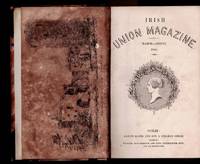
184532226AB1845. First Edition. Two Volumes bound in one. Dublin Martin Keene and Son 1845. Octavo. Frontispiece-Engraving "The ruins of Leix Castle Queens Co. - From a Sketch by Chidley Coote Esq." engraved titlepage 468 pages including Index / Followed by Volume II now titled "The Irish Monthly Magazine" - September - February Dublin 1846: 494 pages. Hardcover / Original half-leather with gilt lettering and original spinelabel. Very good condition with only minor signs of wear. An extraordinay Volume very rare with the Literary Notices on Charles Darwin's "Journal of Researches into the Natural History and Geology of the Countries visited during the Voyages of H.M.S.Beagle round the world second edition. With several interesting articles political poetic and literary. Among which is also "Mary Mansfield Or Ireland Ten Years Since". The Volume published at the outbreak of the Famine is the last reflection of an already shaken country which is entering a fate-altering few years. The Union Magazine - Volume I All published under this title Following articles are included in this very rare 1845-Volume: 1. The Position and Prospects of Ireland in 1845 2. Mesmerism - Miss Martineau's Letters 3. Memoir if Leix Castle Queens Country related to the Frontispiece 4. An Irish Queer Fellow - Peregrin Glass 5. Mary Mansfield Or Ireland Ten Years Since a continuation story through several issues of this Volume including chapters titled "The Ghost" "The Trial" etc. 6. Narrative of some Military Events in Scinde Beeloochistan and Afghanistan during the Years 1839 1840 1841 1842 and 1843 by John H.Hall Esq. H.M.'s 40th Regiment Nephew of the Late Captain Basil Hall continued through several issues 7. A Free and Easy Translation of the First Scene of the Andrian of P.Terentius 8. To L.E.L. in 1828 A fancy Sketch 9. The Irish Poor Law / Poor Laws Limerick Union 10. "Sketches of Character" - by the "Elderly Gentleman" 11. "The Country and the Town" 12. "A Pinch of Snuff from Dean Swift's Box" with a page of Illustration of Jonathan Swift's Snuff Box 13. 'Tis a Hundred Years Since" 14. "The Difficulties of a Young Clergyman in Times of Division" - London 1844 15. "A Report to the Lord Bishop of Meath on the State of Elementary Schools in the Diocese and the Opinions of the Clergy respecting the question of National Education" By the Rev. Edward A. Stopford Archdeacon of Meath; with a Correspondence between the Lord Bishop of Meath and the Home Secretary on the Subject of the Report Grant and Bolton Dublin 1845 16. "On National Schools - A Tract for the Times in Ireland - By an Ulster Clergyman" - W.Curry Jun. and Co. Dublin 1845" 17. "The Irish Art Union" 18. "Luna by Day" by Jean Paul Fr.Richter 19. An Anglo-Latin Account of a Steam Journey from Dublin to London in 1845 A short Poem in Latin 20. Foreign Travellers and many more articles hardcover
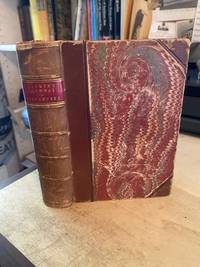
1896002387S.-Peterburg St. Petersburg: Tipografiia A. A. Porokhovshchikova 1896. Late 19th-century Edition. Very good. Late 19th-century edition; 8 1/2 x 6; pp. 3 6-232 2 I-XXIV; rebound in 1/4 cloth and marbled paper over boards; small rubbed spots to corners; thin strip from remnants of original wraps along hinge on title page and a few scattered spots; illustrated with 24 wood-engraved plates; very good condition. A beautifully-illustrated edition of Darwin's work on the domestication of animals and plants it was first published in Russian in November of 1867 two months before the actual English-language edition as the translator - philosopher and paleontologist Vladimir Kovalevskii - had personally corresponded with Darwin and had translated and prepared the text for the Russian publication well in advance. No copies in OCLC or in the trade as of December 2018. Tipografiia A. A. Porokhovshchikova hardcover
1896002387S.-Peterburg St. Petersburg: Tipografiia A. A. Porokhovshchikova 1896. Late 19th-century Edition. Very good. Late 19th-century edition; 8 1/2 x 6; pp. 3 6-232 2 I-XXIV; rebound in 1/4 cloth and marbled paper over boards; small rubbed spots to corners; thin strip from remnants of original wraps along hinge on title page and a few scattered spots; illustrated with 24 wood-engraved plates; very good condition. A beautifully-illustrated edition of Darwin's work on the domestication of animals and plants it was first published in Russian in November of 1867 two months before the actual English-language edition as the translator - philosopher and paleontologist Vladimir Kovalevskii - had personally corresponded with Darwin and had translated and prepared the text for the Russian publication well in advance. No copies in OCLC or in the trade as of December 2018. Tipografiia A. A. Porokhovshchikova hardcover books
186635466Breslau, Verlag von Eduard Trewendt, 1866. 8°, 372 S., 53 S.; Mit 4 Abb. berühmter Zuchttiere; Tabellen, Zeichnungen, Bibl.Ex., Bezahlung per PayPal möglich, we accept PayPal, Stempel u. Nr. a. Vorsatz od. u. Titel, Nr. a. Rücken bzw. Einband, Einb. ger. beschabt u. ger. bestoßen u. angeschmutzt, fingerspurig, Stockflecken, altersbed. Bräunungen, ger. Gebr.sp., Halbleder
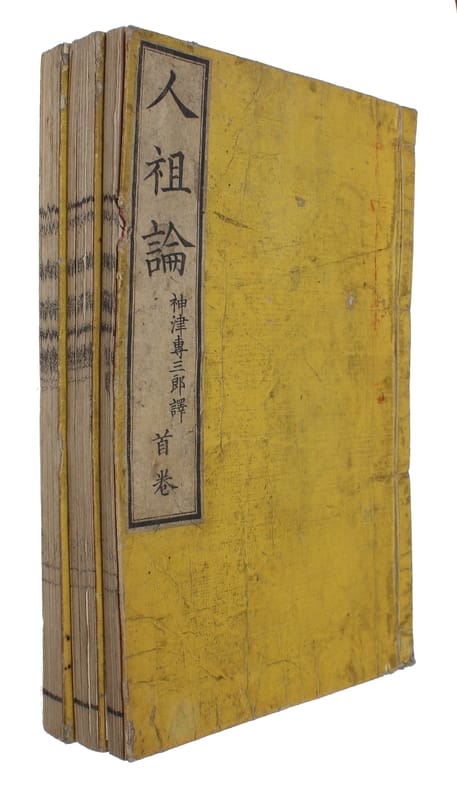
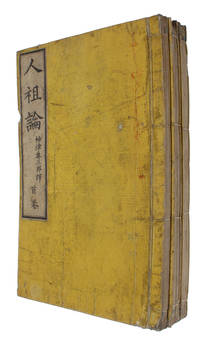
188160016Tokyo, Ichibe Yamanaka., Meiji 14. (1881). 8vo. 3 volumes, all in the contemporary (original?) yellow wrappers (Traditional Fukuro Toji binding/wrappers). Extremities with wear and with light soiling, promarily affecting vol. 1. Title in brush and ink to text-block foot. A few ex-ownership stamps. Folding plate with repair. A fine set. 46 ff" 70 ff. + 9 plates of which 1 is folded" 72 ff. ""Vol. I contains prefaces to 1st and 2d editions of Descent of man Nos 936 & 944"" vol. II contains chapter 1 and vol. III chapter 2. All published, intended to form 9 vols containing chapters 1-7 and 21."" (Darwin-Online).
188160016Tokyo Ichibe Yamanaka. Meiji 14. 1881. 8vo. 3 volumes all in the contemporary original yellow wrappers Traditional Fukuro Toji binding/wrappers. Extremities with wear and with light soiling promarily affecting vol. 1. Title in brush and ink to text-block foot. A few ex-ownership stamps. Folding plate with repair. A fine set. 46 ff; 70 ff. 9 plates of which 1 is folded; 72 ff. "Vol. I contains prefaces to 1st and 2d editions of Descent of man Nos 936 & 944; vol. II contains chapter 1 and vol. III chapter 2. All published intended to form 9 vols containing chapters 1-7 and 21." Darwin-Online. <br/><br/><em>The exceedingly rare first translation of Darwin's Descent of Man and the first partial translation of Origin of Species constituting the very first translation of any of Darwin's work into Japanese and arguably being the most influential - albeit in a different way than could be expected - of all Darwin-translations. "The first translation of a book by Darwin was published in 1881: a translation of The Descent of Man titled as Jinsoron On the Ancestors of Man; Darwin 1881. The translator was a scholar of education Kozu Senzaburo . In spite of its title the book was actually a hybrid which included a mixture of chapters of the Descent namely chapters 1-7 and 21 together with other texts: the Historical Sketch that Darwin appended to the third edition of the Origin 1861 and some sections taken from Thomas Huxley's Evidence as to Man's Place in Nature Kaneko 2000. So this book can also be described as the first publication including a partial translation of a text from the Origin" Taizo Translating "natural selection" in Japanese: from "shizen tota" to "shizen sentaku" and backDarwin's theories had a profound influence on Japan and Japanese culture but in a slightly different way than in the West: Darwinism was marked as social and political principles primarily embraced by social thinkers philosophers and politicians to advocate the superiority of Japanese culture and society and military and not by biologist and zoologist. "It was as if Darwin's famous oceanic journey and the meticulous research into the animal and plant kingdoms that he spent his life undertaking had all been staged as an elaborate excuse for composing a theory whose true object was Victorian society and the fate of the world's modern nations." Golley Darwinism in Japan: The Birth of Ecology.The popularity of Darwin's works and theories became immensly popular in Japan: "Curiously there are more versions of "The Origin" in Japanese than in any other language. The earliest were literary with subsequent translations becoming more scientific as the Japanese developed a technical language for biology." Glick The Comparatice Reception of Darwinism P. XXIIDarwin's work had in Japan - as in the rest of the world - profound influence on the academic disciplines of zoology and biology however in Japan the most immediate influence was not on these subjects but on social thinkers: ". it exerted great influence on Japanese social thinkers and social activists. After learning of Darwin's theory Hiroyuki Kato the first president of Tokyo Imperial University published his New Theory of Human Rights and advocated social evolution theory social Darwinism emphasizing the inevitable struggle for existence in human society. He criticized the burgeoning Freedom and People's right movement. Conversely Siusui Kautoku a socialist and Japanese translator of the Communist Manifesto wrote articles on Darwinism such as "Darwin and Marx" 1904. In this and other articles he criticized kato's theory on Social Darwinism insisting that Darwinism does not contradict socialism. The well known anarchist Sakae Osugi published the third translation of On the Origin of Species in 1914 and later his translation of peter Kropotokin's Mutial Aid: A Factor of Evolution. Osugi spread the idea of mutual aid as the philosophical base of Anarcho-syndicalism." Tsuyoshi The Japanese Lysenkoism and its Historical Backgrounds p. 9 "Charles Darwin's theory of evolution was introduced to Japan in 1877 Morse 1936/1877 during Japan's push to gain military modernity through study of western sciences and technologies and the culture from which they had arisen. In the ensuing decades the theory of evolution was applied as a kind of social scientific tool i.e. social Spencerism or social Darwinism Sakura 1998:341; Unoura 1999. Sakura 1998 suggests that the theory of evolution did not have much biological application in Japan. Instead Japanese applied the idea of 'the survival of the fittest' which was a misreading of Darwin's natural selection theory to society and to individuals in the struggle for existence in Japan's new international circumstances see also Gluck 1985: 13 265.However at least by the second decade of the 1900s and by the time that Imanishi Kinji entered the Kyoto Imperial University the curricula in the natural and earth sciences were largely based on German language sources and later on English language texts. These exposed students to something very different from a social Darwinist approach in these sciences. New sources that allow us to follow" ASQUITH Sources for Imanishi Kinji's views of sociality and evolutionary outcomes p. 1."After 1895 the year of China's defeat in the Sino-Japanese War Spencer's slogan "the survival of the fittest" entered Chinese and Japanese writings as "the superior win the inferior lose." Concerned with evolutionary theory in terms of the survival of China rather than the origin of species Chinese intellectuals saw the issue as a complex problem involving the evolution of institutions ideas and attitudes. Indeed they concluded that the secret source of Western power and the rise of Japan was their mutual belief in modern science and the theory of evolutionary progress. According to Japanese scholars traditional Japanese culture was not congenial to Weastern science because the Japanese view of the relationship between the human world and the divine world was totally different from that of Western philosophers. Japanese philosophers envisioned a harmonious relationship between heaven and earth rather than conflict. Traditionally nature was something to be seen through the eyes of a poet rather than as the passive object of scientific investigations. The traditional Japanese vision of harmony in nature might have been uncongenial to a theory based on natural selection but Darwinism was eagerly adopted by Japanese thinkers who saw it as a scientific retionalization for Japan's intense efforts to become a modernized military and industial power. Whereas European and American scientists and theologians became embroiled in disputes about the evolutionary relationship between humans and other animals Japanese debates about the meaning of Darwinism primarily dealt with the national and international implications of natural selection and the struggle for survival. Late nineteenth-century Japanese commentators were likely to refer to Darwinism as an "eternal and unchangeable natural law" that justified militaristic nationalism directed by supposedly superior elites". Magner A History of the Life Sciences Revised and Expanded p. 349"Between 1877 and 1888 only four works on the subject of biological evolution were published in Japan. During these same eleven years by contrast at least twenty Japanese translations of Herbert Spencer's loosely "Darwinian" social theories made their appearance. The social sciences dominated the subject and when Darwin's original The Origin of Species Seibutsu shigen finally appeared in translation in 1896 it was published by a press specializing in economics. It is not surprising then that by the early 20th century when Darwin's work began to make an impact as a biological rather than a "social" theory the terms "evolution" shinka "the struggle for existence" seizon kyôsô and "survival of the fittest" tekisha seizon had been indelibly marked as social and political principles. It was as if Darwin's famous oceanic journey and the meticulous research into the animal and plant kingdoms that he spent his life undertaking had all been staged as an elaborate excuse for composing a theory whose true object was Victorian society and the fate of the world's modern nations." Golley Darwinism in Japan: The Birth of Ecology.Freeman 1099c </em> unknown
1874Lucy116<p>This volume is tight sturdy and unsoiled. The lettering on the spine is in gold and still very bright and readable. The pages inside show no foxing. There is an ownership signature on the Front free endpaper. A handsome tight volume with not a lot of problems. Just very sadly missing volume 2.</p> Harper Bros hardcover
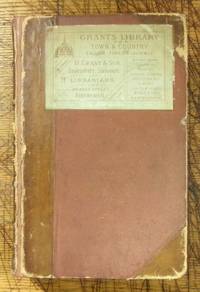
1860132John Murray 1860. Hard Cover. Good. Second edition of the journals from Darwin's 5 year voyage on the HMS Beagle. It has been rebacked with leather preserving the original quarter leather boards and spine which had become separated. Original endpapers have some foxing and ghosting. Pastedown on front cover advertising for R Grant and son of Edinburgh. Text is clean and unmarked but there appears to be faint remainder spray on the edges. It was the observations on this trip which began when Darwin was 22 that paved the way for his theory of natural selection and evolution. John Murray unknown
184559290John Murray London 1845. Second Edition. Hardcover Half Leather. Good Condition. Size: 12mo - between 6¾ - 7¾" tall. viii 520pp. Front hinge cracking. Minor wear to spine with slight loss to top. Slight foxing front/rear pages but body of book mostly clean and unfoxed. Previous owner's book-plate laid in. Covers worn. Corners bumped. Illustrated. Quantity Available: 1. Shipped Weight: Under 1 kilogram. Category: Natural History & Resources; 19th century; Geography & Maps. Pictures of this item not already displayed here available upon request. Inventory No: 59290. . John Murray hardcover
1900mon0001600312T.Nelson & Sons 1900. Hardcover. Good. . T.Nelson & Sons hardcover
1897138073New York: D. Appleton & Company 1897. Authorized Edition. Fine Binding. Very Good in boards. Light rubbing at spine crown/heel. D. Appleton & Company unknown
1860009716London: John Murray 1860. Bound in full green calf with raised bands on the spine red leather label with "Darwin's Journal" in gilt five remaining compartments gilt decorated borders and floral emblemsgilt ruled borders to both boards. Gilt armorial of "The Royal Naval School" on the front board.xvxvi 519 pages. Illustrated with woodcuts in the text5 X 7.6 inches. Externally rubbed to edges spine ends and corners leather worn at corners which are a little stubbed. Sound and solid binding inside the hinges are firm and intact with no splitting along the endpapers.There is a Royal Naval School presentation label on the front pastedwon.Light scuffing to the leather.A few marks to the endpapers. Occasional spotting to first and last leaves otherwise the pages are all quite clean throughout. Second edition Tenth Thousand. Full Leather. Very Good/No Jacket. John Murray Hardcover
1890B6800London: T. Nelson and Sons. 1890. Slight toning interior otherwise clean and crisp. Binding: Full original purple cloth boards. Upper with blind rules stamp and lettering title gilt-stamped in center. Publisher’s stamp in blind on lower. Spine with gilt lettering stamp and blind rules. Bevelled edges. Brown paste-in and free endpapers. Notes: A fine example of this journal written about Darwin’s five-year voyage on the Beagle from 1831 to 1836 the publication of which established him as both an eminent geologist and a popular author. “Darwin's journal encompasses every observable detail of the animals birds and plants he encountered on the five-year voyage. It includes minute descriptions and even sketches of the movements and habits of hitherto unfamiliar species. Accompanying the entries are his own conclusions analyses and classificatory notes that demonstrate his skill and talent as a naturalist.†With frontispiece protected by tissue guard and a profusion of other plates many double-page. <br><br>Charles Robert Darwin 1809 – 1882 was an English naturalist geologist and biologist renown for his contributions to the understanding of evolutionary biology and he has been described as one of the most influential figures in human history. His proposition that all species of life have descended from a common ancestor is now generally accepted and considered a fundamental concept in science. In a joint publication with Alfred Russel Wallace he introduced his scientific theory that this branching pattern of evolution resulted from a process that he called natural selection in which the struggle for existence has a similar effect to the artificial selection involved in selective breeding. <br>The Voyage of the Beagle is the title most commonly given to the present volume first published in 1839 as Journal and Remarks which quickly brought him considerable fame and respect. This was the third volume of The Narrative of the Voyages of H.M. Ships Adventure and Beagle the other volumes of which were written or edited by the commanders of the ships. Journal and Remarks covers Darwin's part in the second survey expedition of the ship HMS Beagle. Due to the popularity of Darwin's account the publisher reissued it later in 1839 as Darwin's Journal of Researches and the revised second edition published in 1845 used this title. In 1890 the publisher John Murray issued a new illustrated edition of the Journal. <br> <br> Size: 8vo.202x136 mm Pages: Blank 2. Half title. Blank 2. Frontispiece. Title. Blank. Preface vii-x. Contents. Blank. P. 13-615. Blank. Category: Book Science & Technology; T. Nelson and Sons. hardcover
190067603Ward Lock & Co. 1900. Hardcover. Collectable very good. VG condition. Red cloth hardcover with gold lettering on spine and front cover decorative gold spine edges published by Ward Lock & Co no publication date ca. 1900 in the Minverva Library vol 2 photo of Darwin as frontispiece with protective tissue 492pp ads. Very slight cover wear page edges not quite pristine old bookplate inside front cover interior clean and unmarked. We are a small family business selling fine new and pre-owned books online since 1999. We provide professional service and individual attention to your order daily shipments and sturdy packaging. FREE TRACKING ON ALL SHIPMENTS WITHIN USA. Ward, Lock & Co., hardcover