96 résultats
1812154897Paris: Chez Deterville 1812. hardcover. very good. 4 volumes. Illustrated with 154 splendid copperplates many folding and and an additional folding hand-colored geognostical map of Paris and vicinity. Each volume several parts with distinct pagination. 4to bound in early calf-backed boards with red leather labels spines are brittle and somewhat damaged at edges uncut edges. Paris: Chez Deterville 1812. First edition. Internally excellent copy with wide- margins and only faint scattered foxing.<br/> <br/> Through the method of reconstruction of what ancient mammals must have looked like on the basis of bone and other fossil remnants "Cuvier created the science of paleontology in the modern sense. At the same time he largely reformed the system of zoological classification by introducing fossil animals into it" Nordenskold. "His concept of geological revolutions which he believed to be a regular and natural part of earth's history was used to explain the mass extinction of species from previous opochs" Norman 566. "A landmark in the history of science" Horblit 20b.<br/> <br/> Chez Deterville unknown
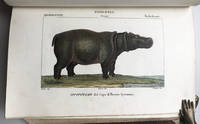
1837Flo442<p>Complete set of the plate volumes from the first Italian edition of the monumental French <em>Dictionary of Natural Sciences </em></p><p>1240 finely engraved plates with splendid hand colouring numbered 1 to 1200 but with multiple bis plates</p><p>The plates by Jean-Gabriel Prêtre worms and zoophytes shells insects and crustaceans birds mammals fish herpetology and Pierre Jean Francois Turpin botany. Newly engraved by Italian engravers Corsi Verico Cignozzi Luigi Giarre Stangli Bozza Zignoni etc.</p><p>Includes many extinct fossil species and dinosaurs as well as recently extinct species such as the Bubal Hartebeest Alcelaphus buselaphus buselaphus auroch Bos urus quagga Equus quagga quagga Cuban red macaw Ara tricolor etc.</p><p>Several critically endangered species such as the Screwhorn antelope Addax nasomaculatus and European eel Anguilla anguilla as well as endangered species including the Chinese forest musk deer Moschus berezovskii Indian rhino Rhinoceros unicornis Orang utan Pongo pygmaeus silvery gibbon Hylobates moloch polar bear Ursus maritimus white-fronted spider monkey Ateles belzebuth Green sea turtle Chelonia mydas etc.</p><p>The original published in France from 1816-1830 was the work of well-known scholars including Frédéric Georges Cuvier Antoine Laurent de Jussieu Charles Dumont de Sainte-Croix André Marie Constant Duméril Anselme Gaëtan Desmarest Hippolyte Cloquet Henri-Marie Ducrotay de Blainville etc. This Italian translation was published in Florence from 1830 to 1850.</p><p>All the plates directed by Pierre Jean Francois Turpin 1775-1840 one of the greatest botanical artists of the Napoleonic era along with Redoute and Bessa. When serving in the French army in Haiti in 1794 Turpin met botanist Pierre Antoine Poiteau and switched careers. His skill as an artist was recognized by botanists such as Poiret Humboldt Duhamel du Monceau and Candolle. Turpin provided the majority of the plates for <em>Flore Medicale.</em> Turpin drew all the botanical plates in this work along with his son who died tragically at age 18.</p><p>Jean-Gabriel Prêtre 1768-1849 was a Swiss-French natural history painter who illustrated a large number of books for Cuvier Louis Pierre Vieillot René Primevère Lesson Comte de Lacépède Richard Achille and many other French zoologists.</p><p>Half morocco spines with gilt title and volume labels in leather marble paper boards with a wood-grain pattern boards scuffed and worn. Some spotting to the index text pages at the front of each volume but most plates clean and bright on very white paper the fine stipple engravings with vivid colour. A few plates with childish colouring a few with large spots of foxing or age toning and one torn with loss of lower 3cm. Ex-libris bookplates of Periclis Staderini in all volumes. Bindings have been treated with a protective celloluse coating.</p> V. Batelli e Figli hardcover
182557403Paris: Dufour et E. D'Ocagne 1825. Third edition. Quarto 32cm. Seven volumes complete in modern half black morocco green cloth over boards titled in gilt on spines and fronts; modern marbled endpapers; vol. I: vi194340pp; vol. II part I: ivIV2371229-232pp; vol. II part 2: iv239-648pp; vol. III: iv412pp; vol. IV: iv514pp; vol. V part 1: iv4051pp; vol. V part 2: iv 5471pp; 277 engraved plates including frontispiece one plate with hand color and 2 maps 1 letterpress folding table. Straight and sound with occasional scattered browning and soil a few page corners neatly restored one plate margin trimmed close to image area but largely clean and bright: Very Good. Third edition of the work in which Cuvier demonstrated the reality of extinction through detailed examination of fossils; a cornerstone work in paleontology biology and geology. Earlier editions appeared in 1812 and 1821-24. When Cuvier began his research in the late eighteenth century it was generally believed that no species had ever gone extinct. "Taking for his field the little-known fossil quadrupeds and applying to them the principles of comparative anatomy Cuvier astonished the world by reconstructing prehistoric forms of animal life whose existence had never been suspected" Glass Temkin & Straus Forerunners of Darwin 253. He established extinction as a fact demonstrated that the age of the earth was greater than six thousand years and did much to establish the fields of comparative anatomy and paleontology. <br /> <br /> However Cuvier forcefully opposed pre-Darwinian theories of evolution. In the introduction to Ossemens Fossiles later published separately as Discours sur les révolutions de la surface du globe 1826 Cuvier argued in favor of catastrophism-the theory that violent catastrophes like the Biblical flood had caused extinction events and shaped geological features. This theory left room for contemporaries to infer a divine force that caused catastrophes and created new species; thus his research "provided a safety valve . . . between the push of geology and the drag of theology" Forerunners 255. His theories were in part disproven by Darwin and Lyell who demonstrated that both species and geological formations undergo gradual change over time; but Cuvier's ideas about catastrophism were vindicated by more recent research into mass extinction events caused by volanic eruptions and asteroids. This edition not in Ward/Carozzi. Dufour et E. D'Ocagne unknown
18173707077Paris: Deterville 1817. Some foxing to the plates. Four volumes octavo 15 engraved plates by C.-L. Laurillard a handsome set with all four half-titles in original quarter calf over mottled papered boards gilt double spine labels in red & green. <p><p>First edition of this germinal work of natural history with three volumes by Cuvier himself and the fourth an important study of insects by his friend and colleague Latreille.</p> <p>Recognised as the father of comparative anatomy Cuvier published widely throughout his lifetime but this was his most famous and influential work and contained the results of all his previous research on the structures of living and fossil animals. It was based upon his vast knowledge of zoological anatomies and in it he applied Linnæus' system of nomenclature and classification to the whole animal kingdom in the process establishing his four great classes: vertebrate molluscous articulate and radiated.</p> <p>Cuvier's work is a benchmark for many reasons not least for the third volume present here which is actually the work of Pierre André Latreille Professor of Entomology at the Paris Museum: Latreille's contribution was not only a significant contribution to his field but he had earlier been heavily involved in characterising the insects collected on the Baudin voyage to Australia and the Pacific. In the present volume Latreille sought to update the foundation work of scholars including Fabricius within Cuvier's framework; as a result Latreille included here many Australian insects including two the 'Rhipcera' and the 'Heleus' noted for the first time.</p> <p>Cuvier born in 1769 was invited by Geoffroy Saint-Hilaire to come to Paris in 1795. He took an appointment at the newly-formed Muséum nationale d'histoire naturelle where he remained until his death from cholera in 1832. He had first publicly canvassed his new quadripartite schema of the animal kingdom in an 1812 presentation to the Academy of Sciences but it was in this work that he first detailed how this proposed division worked in practice. Here each of the classes is discussed in a separate volume with volumes I II and IV by Cuvier himself; his organizations of fish families in particular 'were so soundly based that they have become orders or suborders in present classification' DSB.</p> <p>Throughout his career Cuvier held to the premise of Le Règne Animal that the four branches were fundamentally different and that any similarities between them were due entirely to common functions rather than common ancestry. He did not believe that is that there was any evolutionary adaptation a stance which put him in open conflict with his contemporaries such as Buffon Lamarck and Geoffroy. This led to the famous debate between Cuvier and Geoffroy at the Académie Royale des Sciences in Paris in 1830.</p> <p>Cuvier's towering position in the French natural sciences should be seen in the context of a very cynical view of his ambitions towards intellectual ownership of the science on Freycinet's voyage an idea explored in correspondence between Faujas de Saint Fond and Louis de Freycinet.</p> </p> . Deterville unknown
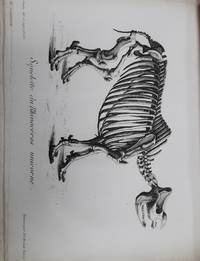
1812A37982Paris: Chez Deterville 1812. 157 engraved plates some folding including a large folding hand-coloured map. . HB. 4 vols 4to 283x215mm orig. paper covered boards heavily rubbed/worn spines chipped gilt rules and leather title labels to spines; wide margins with edges uncut; some foxing and browning a few short marginal tears; one folding plate damaged - creased and torn with loss to several figures; 6cm tear to inner margin of another large folding plate.Pagination: Vol. I: 8 vi 120 20 viii 278 2 23 1; Vol. II: 4 10 12 21 1 33 1 30 24 20 6 140 43 1 20 4; Vol. III: 4 3 1 8 174 21 1 14 75 1 20 7 1 8 2 16 21 1 4 20; Vol. IV: 7 1 5 3 66 38 10 2 72 18 20 30 9 1 27 1 43 1 40 2 59 1 26 38 32 37 1 16. Scarce first edition of a work which laid the foundation of vertebrate paleontology Horblit One Hundred Books 20b. The separately paginated memoirs many of which first appeared in 'Ann. Mus. Hist. Nat. Paris' are here reissued in revised form prefaced by the important 'Discours preliminaire'. Georges Cuvier 1769-1832 was an outstanding French naturalist who helped to found the fields of vertebrate paleontology and comparative anatomy. He was professor of comparative anatomy at the Mus�um d�Histoire Naturelle Paris. As Martin J. S. Rudwick states 'It is difficult to overestimate the huge impact of Cuvier on zoology paleontology and geology.' Significant and highly influential results of Cuvier's palaeontological and geological research were presented in a series of essays published in these four volumes Recherches sur les ossemens fossiles de quadrupe`ds Paris 1812. Rudwick notes that Cuvier �called himself �a new species of antiquarian� who was using fossil bones instead of human artifacts as historical evidence. He therefore argued that naturalists such as himself could and should aspire to �burst the limits of time� � just as astronomers such as Pierre-Simon de Laplace to whom he dedicated his Ossemens fossiles had already �burst the limits of space". Vol. 1 includes Discours pr�liminaire in which Cuvier introduced the idea of geological �revolutions� to explain mass extinctions of prehistoric species. Other papers include an essay on an Egyptian ibis mummy brought from Thebes during Napoleon's campaign in Egypt; and with Alexandre Brogniart 1770-1847 an updated version of Cuvier's important stratigraphical memoir of 1810 Essai sur la G�ographie Min�ralogique des Environs de Paris which contributed to the concept of faunal succession in rock strata of different periods. In Vol. 2 Cuvier describes species of pachyderms found in recent alluvial deposits including elephants mastodons rhinoceros hippopotamus and tapir. In Vol. 3 Cuvier's recalls the challenges of reconstruing fossils of different species. Vol. 4 concerns fossil horses and pigs bears hyenas and big cats and concludes by describing fossil sloths crocodiles turtles and marine dinosaurs.Nissen ZBI 1011; BMNH Cat. I p. 409. Chez Deterville hardcover
1827139121London: Whittaker 1827. First. hardcover. very good. 5 volumes. 196 plates out of 210 with 76 colored by hand. Handsomely bound in contemporary 3/4 green morocco lightly worn some scattered foxing. London: George Whittaker 1827. First English edition. Very good .<br/> <br/> A near fine set with light scattered foxing of this classic zoological book- a standard for the first half of the nineteenth century.<br/> <br/> Whittaker unknown
1817elala537Paris: Deterville 1817. 1817. 4 Volumes. 8vo. pp. xxxvii 540; xviii 532; xxix 653; viii 255. with half-titles. 15 engraved plates by Pierron after Laurillard. 10 folding engraved plates from another work bound in at end. contemporary quarter sheep gilt backs spines somewhat worn several joints cracked scattered foxing. bookplate 1825 ownership entry 1834 & rubberstamp on title of A.Chambion on titles. First Edition of Cuviers most comprehensive work which embodied the whole of his previous researches on the structure of living and fossil animals and laid the foundations of modern comparative anatomy. Here Cuvier introduced his famous classification system according to which the animal kingdom is divided into four main groups vertebrata mollusca articulata insects lobsters and radiata all remaining types. "This type theory is Cuviers greatest contribution in the sphere of systematization and represents although in a somewhat modified form the basis of all subsequent animal classification." Nordenskiöld Opposing the current view that the structure of an animal determined its functions and habits Cuvier maintained that an animals structure was due to its functions and habits. Throughj the exact study of the anatomy of living and fossil species he could reconstruct extinct forms from a few surviving bones. At the end of Volume IV pp. 95-170 is an important annotated bibliography of zoological literature. Brit. Museum Cat. of Natural History I 410. Brunet II 457 incorrectly citing date 1816. Casey Wood 307. Dibner Heralds of Science 195. Nissen 1013. Nordenskiöld History of Biology pp. 339-41. Printing and the Mind of Man 276. Sparrow Milestones of Science 42 Plate 134 pp. 31-32. Waller 11796. Wellcome II 423 incomplete. cfGarrison & Morton 327. 1st Edition. Hardcover. Paris: Deterville , 1817. Hardcover
1837099074L. Henderson 1837. First of This Edition. Half Leather. Very Good. 8 vols. with 576 colored plates - 4 vols. of text and 4 vols. of plates. Binding appears to have been done c. 1920's. All the title pages show moderate foxing. L. Henderson hardcover
182918430Paris: Déterville and Crochard 1829. SECOND EDITION. With 20 full-page etched plates. Contemporary gilt green sheep-backed marbled boards. Ownership stamps of J.E. van der Dussen. A fine set. Second edition enlarged of this landmark in the history of zoology and comparative anatomy the most comprehensive biological work since Linnaeus. “Cuvier’s valuable work represented the fruits of a lifetime’s study of living and fossil animals. In his day Cuvier exerted an enormous influence on science. He played a leading part in the development of the science of palaeontology and stimulated the study of comparative anatomy†G&M. <br /> “It is in his classification of the animal kingdom into four main groups Vertebrata Mollusca Articulata and Radiata that he is so notably succeeded in giving a lead that has been followed by all his successors. . .Cuvier was the first to apply analyses and comparison to the entire animal kingdom. He also saw that this homogeneity in an individual should enable a competent naturalist to reconstruct a complete animal from any significant part of its anatomy†PMM.<br /> See PMM 276; Garrison-Morton 327; Dibner 195. Déterville and Crochard unknown
180547764Paris: De L'Imprimerie Impériale 1805. First complete French edition. Hardcover. vg- to vg. Quartos. Vol.1: xcvii 528pp 31pp. Vol.2: 460pp 84pp. Black leather over dark blue marbled paper boards. Gilt lettering and ruling on the spines. The first full French translation of compiled research from the Asiatic Society of Bengal originally published in English as the periodical journal "Asiatick Researches" from 1788- 1839. <br /> <br /> The text throughout contains a vast array of information in various realms of scientific historical philosophical religious and/or cultural topics from different authors. Volume 1 contains a total of 33 plates of copperplate engravings including 2 fold-out while volume 2 contains 11 plates plus 2 folding tables one one which a table of Persian grammatical influence on North India printed on blue-toned Arches papers measuring 22 1/4 x 28". Some of these plates contain illustrations while others contain geometric figures mathematical calculations astrological charts and samples of texts in various Asian scripts including Sanskrit Arabic and Chinese. In addition to the numbered plates there are many other un-numbered examples in-text as well as statistical tables some full page. The text throughout is accompanied by copious scholarly footnotes. Of special note is a sections of beautifully rendered plates containing images of various Hindu deities. Also includes a large fold out steel-plate engraved Hindu Zodiac with 27 images. The final section of volume one contains corrections and additions followed by tables of meteorological data also included in vol.2. <br /> <br /> This French edition notably has been revised and supplemented with various additional notes from a number of distinguished French scholars and scientists of the era including zoologist Georges Cuvier 1769 – 1832 mathematician and astronomer Jean Baptiste Joseph Delambre 1749 – 1822 naturalist Jean-Baptiste Lamarck 1744 -1829 and entomologist Guillaume-Antoine Olivier 1756-1814. <br /> <br /> Text in French.<br /> <br /> Bindings with some light rubbing and/or bumping to extremities. Light scratches to the covers. Interiors with minor sporadic foxing and/or water stains to the margins of a few pages throughout although in general the pages are surprisingly clean and vibrant. Book blocks quite tight. Bindings in very good- interiors in very good condition overall. About the society:<br /> The "The Asiatic Society of Bengal" now simply known as the Asiatic Society was founded in Calcutta in 1784 by British scholar philologist and civil civil Sir William Jones 1746-1794 in the early years of the British Raj. Its purpose as set forth was the furthering of Oriental research of all kinds as well as the collection of manuscripts and other relevant materials. It began publishing the work and research of its members all distinguished scholars in its periodical journal "Asiatick Researches". A museum set up to house and display its holdings as well as act as a hub or research was established in 1814. At first only Europeans could become members but starting in 1829 Indian were allowed to join as well. De L'Imprimerie Impériale hardcover
1834deckert33736bc5G. Henderson 1834-1837. Hardcover. Good. 3/4 leather boards with marble maroon and gold title labels on spine 4 volumes of text and 4 volumes and color amazing amount of plates book showing wear about edges but all tight pages all vg G. Henderson hardcover
181720421Paris:: Chez Deterville 1817. First edition. contemporary quarter sheep gilt and marbled boards. Old stamped ownership signature on each front free endpaper; some light rubbing to the bindings. A very attractive set. 8vo. 15 engraved plates. PMM 276. Half-titles present. Chez Deterville, hardcover
18461948<p>Paris: Crochard et Cie 1846. Second expanded edition.</p><p><strong>PIONEERING ESTABLISHMENT OF THE SCIENCE OF COMPARATIVE ANATOMY.</strong></p><p>Eight volumes in 9 bindings 8 1/2 inches tall Vol. 4 is in 2 parts. Green quarter leather binding with gilt titles and compartments marbled paper covered boards patterned endpapers bookplate of NSR Maluf to each volume Vol. I i-xxxiii lithographic facsimile of letter from Cuvier 587 pp 1; Vol. II i-viii 726 pp; Vol. III 4 i-iv 760 pp; Vol. IV pt 1 i-xxvii 618 pp 4; Vol. IV pt 2 i-iv 691 pp 1; Vol. V i-viii 503 pp folding table; Vol. VI i-vii 557 pp 1 folding table; Vol. VII i-vii 1 656 pp; Vol. VIII i-xii. 848 pp. Covers corners spine ends worn light browning to pages the first blank and usually the half title of each volume have top edge corners clipped presumably to remove a signature not affecting text. Bindings tight pages unmarked very good in custom archival mylar covers. <strong>CONTENTS:</strong> Vol. I contains the principal discussion of Cuvier's famous theory of the correlation of parts- the functional relationship of each bodily organ to every other organ. Also considered are the organs of movement of vertebrate animals; Vol. II addresses the organs of movement of invertebrate animals and the osteology of the head; Vol. III considers the nervous system and sense organs; Vol. IV reviews the organs of mastication salivation and swallowing in vertebrate animals; Vol. V reviews the feeding organs of invertebrate animals; Vol. VI explores the nutritive fluid its reservoirs and the organs that set it in motion in the four types of the animal kingdom; Volume 7 the description of the organs of elaboration and purification of the nutritive fluid through respiration and urinary secretion; and Volume 8 the organs of generation and secretions the swim bladder of the fish and the organs of vocalization.</p><p><strong>GEORGES CUVIER </strong>1769 – 1832 was a French naturalist and zoologist sometimes referred to as the "founding father of paleontology". Cuvier was a major figure in natural sciences research in the early 19th century and was instrumental in establishing the fields of comparative anatomy and paleontology through his work in comparing living animals with fossils. He expanded Linnaean taxonomy by grouping classes into phyla and incorporating both fossils and living species into the classification. He laid the foundations for a method of analysis and comparison applied to the entire animal kingdom and a new branch of natural history was born thanks to his scientific collaboration with Geoffroy Saint-Hilaire. This was based on the theory that anatomical and physiological characteristics of animals are molded by their environment. He established four major families: vertebrates mollusks arthropods and radiates. He was the first to apply the concept of an ecosystem viewing it as a vast network in which species interact with one another.</p><p><strong>GARRISON-MORTON </strong>No. 311 "Cuvier played a leading part in the development of paleontology and stimulated the study of comparative anatomy. He ranks with von Baer as one of the founders of modern morphology. The posthumous second edition offered here revised and expanded by Georges Cuvier's younger brother Georges-Frédéric Cuvier to 8 vols. appeared from 1835-1846."</p> Crochard et Cie hardcover
183774593G. Hendserson London 1837. hardback. very good condition rebound in brown cloth 2 volumes of text in one volume and 2 volumes of plates oin the other volume. no dust jackets. shipping via USPS G. Hendserson, London hardcover
182740223Paris 1827. <p>Cuvier Georges 1769-1832. Letter signed to Samuel H. Christie 1784-1865. Paris 29 October 1827. 1 sheet on letterhead of the Académie Royale des Sciences. 222 x 169 mm. Trimmed at head affecting printed letterhead but not the manuscript text. Very good.</p> <p>From the great French naturalist and zoologist Baron Cuvier whose work helped to establish the modern sciences of paleontology and comparative anatomy to British mathematician and physicist Samuel Hunter Christie who made important contributions to the study of magnetism. Cuvier was perpetual secretary of the Académie des sciences and his letter to Christie acknowledging Christie's donation of several of his papers on magnetism to the Académie is written in that capacity. "L'Académie Monsieur a reçu les ouvrages que vous avez bien voulu lui adresser extraits des transactions philosophiques . . . J'ai l'honneur de vous offrir les remerciemens de l'Académie et de vous témoigner en son nom tout le prix qu'elle attache à ces publications . . ." The Academy Sir received the books that you kindly send him excerpts from Philosophical Transactions. . . I am pleased to offer the thanks of the Academy and to express to you on its behalf of all the value it attaches to these publications . . . </p> . unknown
1828221328Paris "au jardin du Roi 1828. In ink on reccto on single folded sheet; with conjugate blank. 1 vols. 8vo. Bookseller's small printed slip affixed to lower left split at fold neatly repaired. In ink on reccto on single folded sheet; with conjugate blank. 1 vols. 8vo. Cuvier the great naturalist and Lutheran who managed to reconcile his beliefs in the Bible with his scientific findings. His work was extremely popular with Christian evangelists in the English-speaking world. This fine letter demonstrates his committment to his religion:<br /> <br /> "L'esperance de pouvoir être utile aux protestants dans les fonctions qui viennent de m'être confiées est le seul motif qui me les ait fait accepter. Je serai charmé de m'entretenir avec Messieurs du consistoire sur ce que votre communion peut avoir à désirer. Je regrette seulement d'avoir à leur proposer un voyage aussi long que celui du jardin du Roi mais c'est le seul endroit ou je puisse les recevoir commodement."<br /> <br /> English translation: "My only motive for accepting the duties which have just been conferred on me is the hope that I can be of some use to protestants. I'll be happy to speak with the gentlemen of the Consistory on whatever subject your communion wants. I only regret that I have to propose such a long voyage as that of the Jardin du Roi . unknown
183211194Paris: Académie royale des sciences de l'Institut de France 1832. First Edition Thus. Original Wraps. Near Fine. First Edition Thus. Original Wraps. One of the last Eloges he wrote. Scarce generally very scarce as found here completely unsophisticated. "Davy's widow Jane Davy began the biographical process just over a month after his death in Geneva on 29 May 1829 when she set about collecting materials for her husband's biography initially for the éloge to be delivered by Georges Cuvier 1769-1832 to the Académie Royale des Sciences in Paris. In November 1819 Davy had been elected one of the eight foreign associates of the Académie the supreme accolade for a European man of science. That Jane Davy chose to concentrate on the Académie rather than the Royal Society of London of which Davy had been President between 1820 and 1827 suggests both the influence of her sense of European identity as well as some ill will on her part towards the Society." James Frank A.J.L. Constructing Humphry Davy's Biographical Image. Light toning fading to wrappers and rubbing else tight bright and clean. Burgundy paper wrapper white paper label black ink lettering uncut. 4to. 37pp. xxxvii. In French. Académie royale des sciences de l'Institut de France unknown
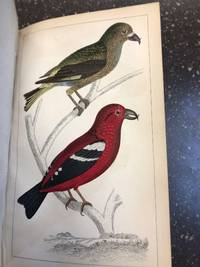
18481346834Edinburgh and London: A. Fullarton and Co c. 1848. Hardcover. Octavo Two Volumes. In Very Good condition. Bound in contemporary three-quarter dark green leather and marbled paper boards. Boards show some shelf wear and soiling bumping to corners and light chipping to marbled paper on cover edges. Splitting to leather along joints on both volumes and mild wear to spines of both. Text block has mild age-toning to pages throughout and three instances of damage from stored newsprint to Vol. II. All seventy-two hand-colored illustrated plates present as called for. Both frontispieces present. CX Consignment. Shelved in Case 10.<br /> <br /> <br> <br> CONTENTS: Vol. I. 536 pages -- Vol. II. 541 pages. 1346834. Shelved Dupont Bookstore. A. Fullarton and Co hardcover