1 472 résultats
16-3425Paris: Fortin Masson & Co. 1836-1849. 4to. 17 x 26.5 cm. Contemporary morocco-backed boards spines tooled in gilt worn several with detached covers.10 sections bound in 19 vols. additional engraved titles with portrait 994 engraved plates of 995 called for by Nissen lacking one in reptile volume after Deshayes Milne Edwards Oudart E. Travies Werner and others many hand-colored or color-printed several folding one loose tissue guards spotting and occasional browning Anker 111; Nissen 213; Wood p.307 Sitwell Fine Bird Books 1700-1900 p.89.Cuvier's work was the "most influential exposition of the typological approach to animal classification representing the greatest body of zoological facts that had yet been assembled" Norman. This third edition referred to as the "Disciples Edition" as it was edited and arranged by Cuvier's pupils originally appeared in 262 livraisons. Paris: Fortin, Masson, & Co., [1836-1849] hardcover
94473, s.d. (c. 1821), in-4, 331 pp, 1 table depl, Demi-basane olive de l'époque, dos lisse orné de fleurons romantiques, Manuscrit rédigé à l'encre d'une écriture soignée, entièrement réglé, reproduisant l'intégralité du célèbre Discours préliminaire de Georges Cuvier (1769-1832). Le copiste y a ajouté des extraits de plusieurs publications soutenant l'hypothèse du catastrophisme développée par le naturaliste : il y aurait eu autant de cataclysmes que d'âges fossiles, chaque espèce disparaissant de la surface de la terre lors de ces bouleversements, dont le dernier coïnciderait avec le Déluge de la Bible L'auteur du manuscrit a ici reproduit Discours préliminaire tel qu'il est paru en 1821, en ouverture de la seconde édition des Recherches sur les ossemens fossiles (Paris, Dufour, d'Ocagne, 1821). Ce texte important avait été publié pour la première fois avec le premier volume de l'édition originale de 1812. Il sera l'objet en 1825 d'un tiré à part sous le titre de Discours sur les révolutions de la surface du globe. Extraits ajoutés : - De Cuvier : "Les déluges d'Ogygès et de Deucalion sont-ils des évènements réels ou particuliers, ou des traditions altérées du Déluge universel?" (p. 267-275). Cette note est extraite de la Collection des auteurs classiques latins publiée par Lemaire, en tête du volume consacré à Ovide (t. 16, 8e livraison. 1821). - De Picot : "Réflexions sur le discours précédent. Sur les indices que la géologie et l'histoire des peuples fournissent relativement à l'antiquité du monde" (p. 279-287). Extrait de l'Ami de la religion et du roi, 19 décembre 1821, t. 30, n° 768. - De Lemontey, Cuvier, Brogniart... "Extraits sur différentes espèces de quadrupèdes fossiles" (288 et suiv.) : mastodonte, éléphant fossile, hippopotame, rhinocéros, félin, cerf, boeuf, baleine, tortues, etc. Cea beau document, qui relaie l'explication du fixisme, et donc du créationnisme, est enrichi d'un billet autographe signé de G. Cuvier du 17 juillet 1830, inséré en tête du volume : "Maillol laissera passer M. Werner avec deux poissons et deux oiseaux qu'il est en charge de peindre" [Jean-Charles Werner, peintre du Muséum, qui fut notamment chargé de réaliser la très belle illustration de l'Histoire naturelle des poissons de Cuvier et Valenciennes]. Ex-libris armorié de Mr de Badts de Cugnac sur le contreplat. Dos décollé et lacune en tête. Bel état intérieur. Couverture rigide
1812154897Paris: Chez Deterville 1812. hardcover. very good. 4 volumes. Illustrated with 154 splendid copperplates many folding and and an additional folding hand-colored geognostical map of Paris and vicinity. Each volume several parts with distinct pagination. 4to bound in early calf-backed boards with red leather labels spines are brittle and somewhat damaged at edges uncut edges. Paris: Chez Deterville 1812. First edition. Internally excellent copy with wide- margins and only faint scattered foxing.<br/> <br/> Through the method of reconstruction of what ancient mammals must have looked like on the basis of bone and other fossil remnants "Cuvier created the science of paleontology in the modern sense. At the same time he largely reformed the system of zoological classification by introducing fossil animals into it" Nordenskold. "His concept of geological revolutions which he believed to be a regular and natural part of earth's history was used to explain the mass extinction of species from previous opochs" Norman 566. "A landmark in the history of science" Horblit 20b.<br/> <br/> Chez Deterville unknown
182594468Paris, G. Dufour & E. d'Ocagne, 1825, in-4, 5 tomes en 7 vol, portrait-front, 279 pl, Demi-basane racinée de l'époque, dos lisses ornés de roulettes et de fleurons, Troisième édition, augmentée, des Recherches sur les ossements fossiles, parues pour la première fois en 1812. Les planches gravées sur cuivre, dont de nombreuses dépliantes, comprennent des figures d'ossements et de fossiles, 3 cartes et des coupes stratigraphiques de géognosie parisienne (dont 1 grande dépliante, 1 carte à simple page aquarellée et 1 très grande carte dépliante aquarellée). Ouvrage fondamental de la paléontologie dans lequel Georges Cuvier (1769-1832) s'est attaché à reproduire les animaux disparus à partir des collections ostéologiques du Muséum. Il ouvre sur le célèbre Discours préliminaire, "Discours sur les évolutions de la surface du globe", titre sous lequel il est publié à part la même année : cette exposition fixe définitivement les idées créationnistes de Cuvier, qui défend la thèse que tous les fossiles ont été créés par les catastrophes du passé; autrement dit, il y aurait eu autant de cataclysmes que d'âges fossiles, chaque espèce disparaissant de la surface de la terre lors de ces bouleversements, dont le dernier coïnciderait avec le Déluge de la Bible. Cuvier est considéré comme le fondateur de la paléontologie et de l'anatomie comparée. Il a été le premier à appliquer la notion d'équilibre à la nature, en l'envisageant comme un immense réseau au sein duquel les espèces dépendaient les unes des autres. Cet esprit brillant, qui rédigea plus de 300 articles scientifiques et publia plusieurs monographies majeures, endossa plusieurs fonctions importantes : celles de professeur au Collège de France et au Muséum, de secrétaire perpétuel de l'Académie des Sciences ou encore d'inspecteur général de l'Instruction publique. Pourtant, sa croyance dans la préexistence des germes ne le disposait pas à admettre l'idée transformiste. À l'inverse, il tira avantage de sa gloire académique pour défendre la théorie créationniste : il s'opposa à Lamarck, qu'il railla jusque dans son éloge funèbre (1832), et à Geoffroy Saint-Hilaire, son ancien ami, avec lequel il entra dans une controverse violente. Provenance : Jules de Vaucelle, avec ex-libris armoriés sur les contreplats. Bon exemplaire. Charnières frottées, rousseurs éparses. Nissen ZBI n° 1011. Couverture rigide
75559Paris Deterville 1817. Four volumes in four. 8vo 21.0 x 13.4 cm. 2072 pp. I: xxxvii 540; II: xviii 532; III: xxix 653; IV: viii 255; 15 engraved plates. Uniform contemporary full mottled calf. Spines rich gilt with floral vignettes and ornamental straight and stippled bands; two red morocco labels with gilt title. Boards with elaborate gilt borders. Edges gilt-lined; gilt inner dentelles. Marbled endpapers. Marbled edges. = Superbly bound first edition of this ground-breaking work by the French zoologist and anatomist Georges Jean Léopold Dagobert Cuvier 1769-1832 which lays the foundation for comparative zoology and phylogeny. Cuvier "laid the foundations of comparative anatomy. . It is in his classification of the animal kingdom into four main groups Vertebrata Mollusca Articulata and Radiata that he so notably succeeded in giving a lead that has been followed by all his successors. In contradiction to the current view that the structure of an animal determined its functions and habits Cuvier held that an animal's structure was due to its functions and habits. . He also saw that . homogeneity in an individual should enable a competent naturalist to reconstruct a complete animal from any significant part of its anatomy" PMM. Provenance: on the front pastedowns the modest armorial bookplate of Amable Guillaume Prosper Brugière Baron de Barante 1782-1866 a French statesman and historian his ancestors and his heirs. Associated with the centre-left he was described in France as "the first man to call himself without any embarrassment or restriction a Liberal" Wikipedia. The French poet Anatole France called him an "Homme de beaucoup de tact de sens et de finesse". A very beautiful and attractive copy. Cat. BMNH p. 410; Nissen ZBI 1013; PMM 276; Casey Wood p. 307. hardcover
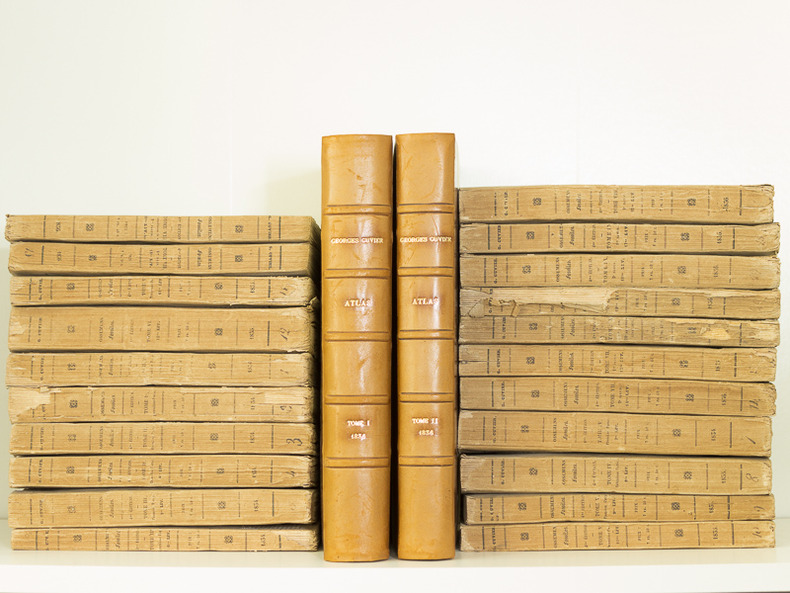
183481161834 Paris: Edmond dOcagne, Baillière, Levrault, Crochard, Roret, 1834-1836. Complet en 10 vol. in-8 (13 x 21 cm) de texte et 2 vol. in-4 (22 x 27,5 cm) datlas. I/ 2 ff. n. chiff., xxiv-587 pp. + 2 tab. dép.; II/ 2 ff. n. chiff., 500 pp.; III/ 2 ff. n. chiff., 435-[1] pp.; IV/ 2 ff. n. chiff., iv-691 pp.; V/ 2 ff. n. chiff., 687-[1] pp.; VI/ 2 ff. n. chiff., 452 pp.; VII/ 2 ff. n. chiff., 535-[1] pp.; VIII/ 2 ff. n. chiff., 462-[1] pp. [tome VIII, 1ère partie], 2 ff. n. chiff., 332 pp. [tome VIII, 2ème partie]; IX/ 2 ff. n. chiff., 501 pp., 1 f. n. chiff.; X/ 2 ff. n. chiff., 494 pp., 1 f. n. chiff.;Atlas I/ 2 ff. n. chiff. [faux-titre, titre], 1 portr. grav., 94 pp. [explications des planches], 161 pl. grav. chiff. 1 à 161; Atlas II/ 106-[1] pp. [faux-titre, titre, explications des planches, impressum], 100 pl. grav. chiff. 162 à 260 (y c. 219 bis, pl.253 chiff. 255), 1 carte dép. chiff. pl. A, 17 pl. lith. chiff. pl. B à S.Quatrième et plus complète édition de cet écrit fondamental sur la paléontologie des vertébrés composé par le célèbre naturaliste Georges Cuvier (1769-1832) et édité par son frère Frédéric. Cette somme est illustrée dun portait de Cuvier gravé par Lorichon et de 261 planches dossements dessinées par Cuvier, Laurillard, Huet, et gravées par Couet, Canu, Coutant, Sauvage, la plupart dépliantes et regroupant toutes de nombreuses figures. À cela sajoutent une carte géognostique des environs de Paris, dépliante et rehaussée en couleurs, 1 pl. dép. représentant des coupes géognostiques des terrains de Paris, 6 pl. lithographiées de coupes de terrain, 1 carte en couleurs des bassins géognostiques de Paris et de Londres, ainsi que 9 pl. lith. de divers fossiles. Sobres et élégantes reliures de lépoque en demi-basane glacée olive à petits coins. Dos à quatre nerfs plats marqués de filets dorés et bordés de pointillés. Auteur, titre et tomaison en capitales dorées. Roulette végétale en queue. Ex-dono manuscrit sur toutes les pages de gardes: «donné par Mr Adolphe dEichthal / Paris 1845». Adolphe dEichthal, né en 1805 à Nancy et mort en 1895 à Paris, financier et politicien, sera notamment président de lassociation pour lavancement des sciences dans les années 1870.Rousseurs éparses. Dechirrures aux pp. 87 à 96 du tome III. Reliure et planches en très bon état. Désirable exemplaire de ce mythique ouvrage de sciences naturelles bien complet de toutes les planches.
183441646Quatrième édition, revue et complétée au moyen de Notes additionnelles et d'un Supplément laissés par l'Auteur, 21 vol. in-8 br. et 2 vol. in-4 reliure moderne demi-basane à coins blonde, dos à 5 nerfs, Edmond d'Ocagne, J.B. Baillière, Crochard, Levrault, Roret, 1834 - 1836, ; T. I 1e P. : 16 pp. (Prospectus) et 256 pp. ; T. I 2e P. : pp. 257-587 ; T. II 1e P. : 2 ff. , 240 pp. ; T. II 2e P. : pp. 241-500 ; T. III 1e P. : 271 pp. ; T. III 2e P. : pp. 273-435 ; T. IV 1e P : 2 ff. , iv-368 pp. ; T. IV 2e P. : pp. 369-691 ; T. V. 1e P. : 3 ff., 240 pp. ; T. V. 2e P. : pp. 261-464 ; T. V. 3e P. : pp. 465-687 et 1 f. d'errata ; T. VI : 452 pp. ; T. VII 1e P. : 256 pp. ; T. VII 2e P. : pp. 257-533 ; T. VIII 1e P. : 2 ff., 272 pp. ; T. VIII Complément 1e P.. : pp. 255-463 et 2 ff. ; T. VIII 2e P. : 332 pp. : T. IX 1e P. : : 240 pp. ; T. IX 2e P. : pp. 241-501 et 1 f. d'errata ; T. X 1e P. : 256 pp. ; T. X 2e P. : pp. 257-497 ; Atlas Tome I : 2 ff., 88 pp. (explication des planches, manquent les explications des pl. 155 - partiellement - à 161) , 161 planches numérotées ; Atlas Tome II : 106 pp. (explication des planches), 1 f. n.ch., 100 planches numérotées de 162 à 260, avec 219 bis, et 18 planches numérotées de A à S (pas de planche I)
1837Flo442<p>Complete set of the plate volumes from the first Italian edition of the monumental French <em>Dictionary of Natural Sciences </em></p><p>1240 finely engraved plates with splendid hand colouring numbered 1 to 1200 but with multiple bis plates</p><p>The plates by Jean-Gabriel Prêtre worms and zoophytes shells insects and crustaceans birds mammals fish herpetology and Pierre Jean Francois Turpin botany. Newly engraved by Italian engravers Corsi Verico Cignozzi Luigi Giarre Stangli Bozza Zignoni etc.</p><p>Includes many extinct fossil species and dinosaurs as well as recently extinct species such as the Bubal Hartebeest Alcelaphus buselaphus buselaphus auroch Bos urus quagga Equus quagga quagga Cuban red macaw Ara tricolor etc.</p><p>Several critically endangered species such as the Screwhorn antelope Addax nasomaculatus and European eel Anguilla anguilla as well as endangered species including the Chinese forest musk deer Moschus berezovskii Indian rhino Rhinoceros unicornis Orang utan Pongo pygmaeus silvery gibbon Hylobates moloch polar bear Ursus maritimus white-fronted spider monkey Ateles belzebuth Green sea turtle Chelonia mydas etc.</p><p>The original published in France from 1816-1830 was the work of well-known scholars including Frédéric Georges Cuvier Antoine Laurent de Jussieu Charles Dumont de Sainte-Croix André Marie Constant Duméril Anselme Gaëtan Desmarest Hippolyte Cloquet Henri-Marie Ducrotay de Blainville etc. This Italian translation was published in Florence from 1830 to 1850.</p><p>All the plates directed by Pierre Jean Francois Turpin 1775-1840 one of the greatest botanical artists of the Napoleonic era along with Redoute and Bessa. When serving in the French army in Haiti in 1794 Turpin met botanist Pierre Antoine Poiteau and switched careers. His skill as an artist was recognized by botanists such as Poiret Humboldt Duhamel du Monceau and Candolle. Turpin provided the majority of the plates for <em>Flore Medicale.</em> Turpin drew all the botanical plates in this work along with his son who died tragically at age 18.</p><p>Jean-Gabriel Prêtre 1768-1849 was a Swiss-French natural history painter who illustrated a large number of books for Cuvier Louis Pierre Vieillot René Primevère Lesson Comte de Lacépède Richard Achille and many other French zoologists.</p><p>Half morocco spines with gilt title and volume labels in leather marble paper boards with a wood-grain pattern boards scuffed and worn. Some spotting to the index text pages at the front of each volume but most plates clean and bright on very white paper the fine stipple engravings with vivid colour. A few plates with childish colouring a few with large spots of foxing or age toning and one torn with loss of lower 3cm. Ex-libris bookplates of Periclis Staderini in all volumes. Bindings have been treated with a protective celloluse coating.</p> V. Batelli e Figli hardcover
182557403Paris: Dufour et E. D'Ocagne 1825. Third edition. Quarto 32cm. Seven volumes complete in modern half black morocco green cloth over boards titled in gilt on spines and fronts; modern marbled endpapers; vol. I: vi194340pp; vol. II part I: ivIV2371229-232pp; vol. II part 2: iv239-648pp; vol. III: iv412pp; vol. IV: iv514pp; vol. V part 1: iv4051pp; vol. V part 2: iv 5471pp; 277 engraved plates including frontispiece one plate with hand color and 2 maps 1 letterpress folding table. Straight and sound with occasional scattered browning and soil a few page corners neatly restored one plate margin trimmed close to image area but largely clean and bright: Very Good. Third edition of the work in which Cuvier demonstrated the reality of extinction through detailed examination of fossils; a cornerstone work in paleontology biology and geology. Earlier editions appeared in 1812 and 1821-24. When Cuvier began his research in the late eighteenth century it was generally believed that no species had ever gone extinct. "Taking for his field the little-known fossil quadrupeds and applying to them the principles of comparative anatomy Cuvier astonished the world by reconstructing prehistoric forms of animal life whose existence had never been suspected" Glass Temkin & Straus Forerunners of Darwin 253. He established extinction as a fact demonstrated that the age of the earth was greater than six thousand years and did much to establish the fields of comparative anatomy and paleontology. <br /> <br /> However Cuvier forcefully opposed pre-Darwinian theories of evolution. In the introduction to Ossemens Fossiles later published separately as Discours sur les révolutions de la surface du globe 1826 Cuvier argued in favor of catastrophism-the theory that violent catastrophes like the Biblical flood had caused extinction events and shaped geological features. This theory left room for contemporaries to infer a divine force that caused catastrophes and created new species; thus his research "provided a safety valve . . . between the push of geology and the drag of theology" Forerunners 255. His theories were in part disproven by Darwin and Lyell who demonstrated that both species and geological formations undergo gradual change over time; but Cuvier's ideas about catastrophism were vindicated by more recent research into mass extinction events caused by volanic eruptions and asteroids. This edition not in Ward/Carozzi. Dufour et E. D'Ocagne unknown
18173707077Paris: Deterville 1817. Some foxing to the plates. Four volumes octavo 15 engraved plates by C.-L. Laurillard a handsome set with all four half-titles in original quarter calf over mottled papered boards gilt double spine labels in red & green. <p><p>First edition of this germinal work of natural history with three volumes by Cuvier himself and the fourth an important study of insects by his friend and colleague Latreille.</p> <p>Recognised as the father of comparative anatomy Cuvier published widely throughout his lifetime but this was his most famous and influential work and contained the results of all his previous research on the structures of living and fossil animals. It was based upon his vast knowledge of zoological anatomies and in it he applied Linnæus' system of nomenclature and classification to the whole animal kingdom in the process establishing his four great classes: vertebrate molluscous articulate and radiated.</p> <p>Cuvier's work is a benchmark for many reasons not least for the third volume present here which is actually the work of Pierre André Latreille Professor of Entomology at the Paris Museum: Latreille's contribution was not only a significant contribution to his field but he had earlier been heavily involved in characterising the insects collected on the Baudin voyage to Australia and the Pacific. In the present volume Latreille sought to update the foundation work of scholars including Fabricius within Cuvier's framework; as a result Latreille included here many Australian insects including two the 'Rhipcera' and the 'Heleus' noted for the first time.</p> <p>Cuvier born in 1769 was invited by Geoffroy Saint-Hilaire to come to Paris in 1795. He took an appointment at the newly-formed Muséum nationale d'histoire naturelle where he remained until his death from cholera in 1832. He had first publicly canvassed his new quadripartite schema of the animal kingdom in an 1812 presentation to the Academy of Sciences but it was in this work that he first detailed how this proposed division worked in practice. Here each of the classes is discussed in a separate volume with volumes I II and IV by Cuvier himself; his organizations of fish families in particular 'were so soundly based that they have become orders or suborders in present classification' DSB.</p> <p>Throughout his career Cuvier held to the premise of Le Règne Animal that the four branches were fundamentally different and that any similarities between them were due entirely to common functions rather than common ancestry. He did not believe that is that there was any evolutionary adaptation a stance which put him in open conflict with his contemporaries such as Buffon Lamarck and Geoffroy. This led to the famous debate between Cuvier and Geoffroy at the Académie Royale des Sciences in Paris in 1830.</p> <p>Cuvier's towering position in the French natural sciences should be seen in the context of a very cynical view of his ambitions towards intellectual ownership of the science on Freycinet's voyage an idea explored in correspondence between Faujas de Saint Fond and Louis de Freycinet.</p> </p> . Deterville unknown
1812A37982Paris: Chez Deterville 1812. 157 engraved plates some folding including a large folding hand-coloured map. . HB. 4 vols 4to 283x215mm orig. paper covered boards heavily rubbed/worn spines chipped gilt rules and leather title labels to spines; wide margins with edges uncut; some foxing and browning a few short marginal tears; one folding plate damaged - creased and torn with loss to several figures; 6cm tear to inner margin of another large folding plate.Pagination: Vol. I: 8 vi 120 20 viii 278 2 23 1; Vol. II: 4 10 12 21 1 33 1 30 24 20 6 140 43 1 20 4; Vol. III: 4 3 1 8 174 21 1 14 75 1 20 7 1 8 2 16 21 1 4 20; Vol. IV: 7 1 5 3 66 38 10 2 72 18 20 30 9 1 27 1 43 1 40 2 59 1 26 38 32 37 1 16. Scarce first edition of a work which laid the foundation of vertebrate paleontology Horblit One Hundred Books 20b. The separately paginated memoirs many of which first appeared in 'Ann. Mus. Hist. Nat. Paris' are here reissued in revised form prefaced by the important 'Discours preliminaire'. Georges Cuvier 1769-1832 was an outstanding French naturalist who helped to found the fields of vertebrate paleontology and comparative anatomy. He was professor of comparative anatomy at the Mus�um d�Histoire Naturelle Paris. As Martin J. S. Rudwick states 'It is difficult to overestimate the huge impact of Cuvier on zoology paleontology and geology.' Significant and highly influential results of Cuvier's palaeontological and geological research were presented in a series of essays published in these four volumes Recherches sur les ossemens fossiles de quadrupe`ds Paris 1812. Rudwick notes that Cuvier �called himself �a new species of antiquarian� who was using fossil bones instead of human artifacts as historical evidence. He therefore argued that naturalists such as himself could and should aspire to �burst the limits of time� � just as astronomers such as Pierre-Simon de Laplace to whom he dedicated his Ossemens fossiles had already �burst the limits of space". Vol. 1 includes Discours pr�liminaire in which Cuvier introduced the idea of geological �revolutions� to explain mass extinctions of prehistoric species. Other papers include an essay on an Egyptian ibis mummy brought from Thebes during Napoleon's campaign in Egypt; and with Alexandre Brogniart 1770-1847 an updated version of Cuvier's important stratigraphical memoir of 1810 Essai sur la G�ographie Min�ralogique des Environs de Paris which contributed to the concept of faunal succession in rock strata of different periods. In Vol. 2 Cuvier describes species of pachyderms found in recent alluvial deposits including elephants mastodons rhinoceros hippopotamus and tapir. In Vol. 3 Cuvier's recalls the challenges of reconstruing fossils of different species. Vol. 4 concerns fossil horses and pigs bears hyenas and big cats and concludes by describing fossil sloths crocodiles turtles and marine dinosaurs.Nissen ZBI 1011; BMNH Cat. I p. 409. Chez Deterville hardcover
2820Firenze, Per V. Batelli e Figli, 1837. 4 vol. de pl. (140 x 237) de 305 pl., X, IV + 304 pl., X + 312 pl., X + 301 pl., XIV pp. Demi-vélin ivoire, dos lisses ornés de chaînettes dorées, pièce de titre de basane havane. Plats, bords, coins et étiquettes frottés. Les volumes sont désolidarisés des reliures, un remontage du corps des ouvrages s’impose. En revanche les planches sont en superbe état.
67319Paris A. Belin 1819-1832. Large folio approximately 53 x 35 cm. 30 hand-coloured lithographed plates with explanatory text leaves. Not bound as issued. = A magnificent publication with fine large plates of mammals from all over the world. The authors Geoffroy Saint-Hilaire 1772-1844 and Fréderic Cuvier 1769-1832 were the leading authorities in mammalogy in the first half of the 19th century and the "Histoire naturelle des mammifères" is widely regarded as their magnum opus. From this work these are the deer including old world and new world species for instance the moose. Several species have the young faon and female biche much different from the male and often they are included on separate sheets. The following are included: le chevreuil Faone femelle; femelle; mâle; cerf-cochon biche; mâle; biche de la presqu'ile de Malaca; cerf-noir du Bengale ou hippélaphe; le cerf de Wallach et le cerf du Bengale each on a separate plate; l'axis femelle; mâle La biche de la Louisiane et le cerf a dagues de l'Amerique Septemtrionale each on a separate plate; Le cerf de Virginie also: "dans son plumage d'hyver; and the faon du cerf de Virginie probably listed in the work as faon du cerf de Louisiàne"; Le cerf commun also: biche et son faon; Le daim et son petite; variété blanche; daim fauve; daim variété noire; Le renne femelle; l'elan de l'Amerique septentrionale ou l'original also poile de hiver; mazame; biche aux pieds techetés ou biche des Mariannes; chevrotain de Java ou kanchil male et femelle each on a separate plate; cerf du Canada biche. All with text leaves except the last. Not included is the wapiti which was among the last plates issued. There is no cerf de la Louisianne pelage hiver called for in the indexes instead there is the unrecorded cerf de Virginie pelage hiver. Probably both are the same; the name in the plate caption being different from the one in the text. It is not clear which of the two is wrong as both are now regarded as the same species. All plates and text as issued without stamps annotations or other markings. All text leaves and all plates uncut untrimmed resulting in very big margins. Due to these large margins some edges a bit frayed or with minor tears. The plates are hardly spotted if at all a few are mildly toned; some text leaves are somewhat spotted but mainly in the margins. Generally this set is in a very good condition. Brunet II p. 1536; Nissen ZBI 1525; Casey Wood p. 354. unknown
1827139121London: Whittaker 1827. First. hardcover. very good. 5 volumes. 196 plates out of 210 with 76 colored by hand. Handsomely bound in contemporary 3/4 green morocco lightly worn some scattered foxing. London: George Whittaker 1827. First English edition. Very good .<br/> <br/> A near fine set with light scattered foxing of this classic zoological book- a standard for the first half of the nineteenth century.<br/> <br/> Whittaker unknown
20631Paris, Fortin Masson, 1840. (1832 - 1840). Deux volumes in-plano (56 x 41,5 cms), 2 ff. (Titre et Rapport fait à l'Académie des sciences par Duméril et Geoffroy-Saint-Hilaire) suivi de 90 planches doubles montées sur onglets. Marges de la première planche restaurées, des rousseurs plus ou moins prononcées, petites mouillures à certaines planches sans gravité, quelques déchirures marginales restaurées, un manque de papier marginale sans atteinte à la gravure. Demi-basane verte d'époque , dos lisse. Importantes érafllures, usures aux coiffes, 2 mors fendus sur 8 et 20 cms.
87028(Paris, Baudoin, an VI - 1798), in-8, pp. 441 à 638, Basane maroquinée verte à la bradel du milieu du XIXe s, Extrait annoté de la main du célèbre naturaliste George Cuvier (1769-1832), pour la correction et l'augmentation de son texte sur les insectes et les vers, paru dans le Tableau élémentaire d'histoire naturelle, chez Baudouin en 1798. L'attribution de ces notes inédites, rédigées à l'encre brune, est certifiée par la comparaison graphologique et est soutenue par la mention dorée en tête du dos ("Des insectes et des vers avec annotations autographes"). Une faible partie consiste en des reprises typographiques (en tête de volume). La plupart des annotations occupent les derniers feuillets (pages 627 à 630): elles comprennent des lignes et paragraphes écrits par Cuvier, contiennent des phrases biffées et des petites corrections de texte. Elles se placent soit sur les pages imprimées elles-mêmes, soit sur des feuillets interfoliés (trois en tout), lorsque le commentaire est trop important pour tenir dans la marge. Le baron a ainsi ajouté plusieurs lignes concernant les arénicoles, dans la section des "vers pourvus d'épines ou de soies", avec une description de l'arénicole des pêcheurs - lumbricus marinus selon la taxonomie de Linné (entre les pages 626 et 627) ; une description, en marge, des térébelles (p. 628) ; des compléments d'information sur les serpules (entre 628 et 629) ; ou encore quelques lignes supplémentaires au sujet des néréides (p. 630). Le Tableau élémentaire d'histoire naturelle est le premier ouvrage important de Cuvier sur la zoologie, fondé sur le cours qu'il fit à l'école du Panthéon l'année précédente. Il forme la base de ses futurs traités, notamment Le règne animal distribué d'après son organisation (1817). Coiffes usées. Couverture rigide
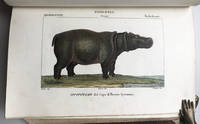
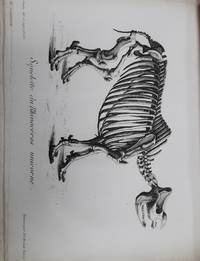
51-5714Paris Déterville 1812. 4 volumes. 4to. 21 x 27cm Later qtr goatskin with matching brown marbled boards. With 152 engraved plates of 154. Fine condition.Contents: T. 1. Discours preÌliminaire et la geÌographie mineÌralogique des environs de Paris.t. 2. Pachydermes des couches meubles et des terrains d'alluvion.t. 3. Os fossiles des environs de Paris.t. 4. Ruminans les onguiculeÌs et les reptiles fossiles .Vol. 1 includes Discours préliminaire in which Cuvier introduced the idea of geological ‘revolutions’ to explain mass extinctions of prehistoric species. Other papers include an essay on an Egyptian ibis mummy brought from Thebes during Napoleon's campaign in Egypt; and with Alexandre Brogniart 1770-1847 an updated version of Cuvier's important stratigraphical memoir of 1810 Essai sur la Géographie Minéralogique des Environs de Paris which contributed to the concept of faunal succession in rock strata of different periods. In Vol. 2 Cuvier describes species of pachyderms found in recent alluvial deposits including elephants mastodons rhinoceros hippopotamus and tapir. In Vol. 3 Cuvier's recalls the challenges of reconstruing fossils of different species. Vol. 4 concerns fossil horses and pigs bears hyenas and big cats and concludes by describing fossil sloths crocodiles turtles and marine dinosaurs.OCLC Number988198; Nissen ZBI 1011; BMNH Cat. I p. 409.Near the end of the eighteenth century scholars disputed whether fossils represented life forms that no longer existed or whether—as the Comte de Buffon at the Jardin des Plantes in Paris believed—the fossils found in Europe and America represented animals that had migrated to the tropics. Buffon argued that God would not have let his creations go extinct. In 1796 Cuvier presented a paper to the National Institute of Sciences and Arts in Paris in which he compared the anatomy of living and fossil elephants thus proving extinction to be a fact as the fossil elephants had not been seen by recent humans. In the following years Cuvier continued to document the extinction of animals such as the giant ground sloth the Irish elk and the American mastodon.Cuvier's research on extinct forms led him to investigate the causes of extinction. He proposed a catastrophist geological history of the earth. Édition originale de cet ouvrage important dans le domaine de la paléontologie. L'illustration se compose de 152 planches gravées sur 154 d'après les dessins de Cuvier et une très grande carte dépliante en couleurs "Carte géognostique des environs de Paris" Il s'agit d'un recueil d'articles que Cuvier fit paraître de 1795 à 1812 dans de nombreuses revues et en particulier dans les Annales du Muséum. Il s'ouvre sur un Discours préliminaire dans lequel l'auteur expose ses idées sur les cataclysmes qui ont bouleversé la terre en particulier le dernier qui coïncide avec le Déluge de la Bible. En français dans le texte 224. cartonnages frottés et usés manque 2 planches quelques feuillets et planches détachés intérieur très frais. Expertise by: François Giard Paris, Déterville, 1812 hardcover
94465Paris, Baudouin, Crochard, Fantin, An VIII-XIV [1800-1805], in-8, 5 vol, 7 tabl. depl, 52 pl, Demi-basane olive de l'époque, dos lisses et fleuronnés, tranches rouges mouchetées, 9 tableaux, sur 7 planches dépliantes. 52 planches gravées sur cuivre. Première édition. Grâce à la qualité de son travail d'observation, Cuvier (1769-1832) a posé les bases d'une méthode d'analyse et de comparaison à l'ensemble du règne animal et a établi l'Anatomie Comparée : cette science, nouvelle branche de l'histoire naturelle, est née grâce à la collaboration scientifique avec Geoffroy Saint-Hilaire, son ami d'alors. Sa méthode d'analyse et de comparaison à l'ensemble du règne animal le conduit à une classification reposant sur l'idée que les critères anatomiques et physiologiques des animaux sont dus à leur fonction et habitats et non l'inverse. Il décrit ainsi quatre grandes familles : les animaux vertébrés, les mollusques, les articulés et les radiaires. Ses leçons ont été recueillies par Constant Duméril (1774-1860), collaborateur et élève préféré de Cuvier. Duméril fut le premier à enseigner l'anatomie comparée en France. Il remplaça Lacépède à la chaire d'ichtyologie et d'herpétologie du Muséum d'histoire naturelle de Paris et enseigna à la chaire de pathologie interne à la faculté de médecine de Paris. Avec l'aide de son fils, Auguste, il créa à Paris, le premier vivarium pour reptiles au Jardin des plantes de Paris. Toute sa carrière durant, il n'aura de cesse de publier études et descriptions d'herpétologie et d'insectes. Dos épidermés. Rousseurs, quelques pages brunies. Couverture rigide
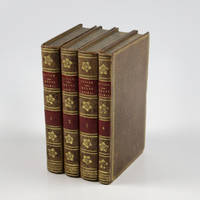
1817elala537Paris: Deterville 1817. 1817. 4 Volumes. 8vo. pp. xxxvii 540; xviii 532; xxix 653; viii 255. with half-titles. 15 engraved plates by Pierron after Laurillard. 10 folding engraved plates from another work bound in at end. contemporary quarter sheep gilt backs spines somewhat worn several joints cracked scattered foxing. bookplate 1825 ownership entry 1834 & rubberstamp on title of A.Chambion on titles. First Edition of Cuviers most comprehensive work which embodied the whole of his previous researches on the structure of living and fossil animals and laid the foundations of modern comparative anatomy. Here Cuvier introduced his famous classification system according to which the animal kingdom is divided into four main groups vertebrata mollusca articulata insects lobsters and radiata all remaining types. "This type theory is Cuviers greatest contribution in the sphere of systematization and represents although in a somewhat modified form the basis of all subsequent animal classification." Nordenskiöld Opposing the current view that the structure of an animal determined its functions and habits Cuvier maintained that an animals structure was due to its functions and habits. Throughj the exact study of the anatomy of living and fossil species he could reconstruct extinct forms from a few surviving bones. At the end of Volume IV pp. 95-170 is an important annotated bibliography of zoological literature. Brit. Museum Cat. of Natural History I 410. Brunet II 457 incorrectly citing date 1816. Casey Wood 307. Dibner Heralds of Science 195. Nissen 1013. Nordenskiöld History of Biology pp. 339-41. Printing and the Mind of Man 276. Sparrow Milestones of Science 42 Plate 134 pp. 31-32. Waller 11796. Wellcome II 423 incomplete. cfGarrison & Morton 327. 1st Edition. Hardcover. Paris: Deterville , 1817. Hardcover
179829881Paris, Baudouin, An 6 (1798). 8vo. Nice cont. full mottled calf. Richly gilt back. Light wear to lower part of back and a small hole in leather at lower hinge. Red leather titlelabel. XVI,710 pp. and 14 engraved plates with many figs. A large clean copy.
179829881Paris Baudouin An 6 1798. 8vo. Nice cont. full mottled calf. Richly gilt back. Light wear to lower part of back and a small hole in leather at lower hinge. Red leather titlelabel. XVI710 pp. and 14 engraved plates with many figs. A large clean copy. <br/><br/><em>First edition of Cuvier’s first work on comparative zoology being one of the foundational texts of modern zoology and comparative anatomy. "Cuvier’s Tableau élémentaire – his first separate work – contains the first general statement of his natural classification of the animal kingdom" Norman. The book thus constitutes the first systematic expression of a theory that would dominate zoological thought in the early nineteenth century. For later theorists it provided the essential morphological basis for tracing evolutionary continuity between extinct and living species. Based on the course of lectures delivered at the École du Panthéon Cuvier’s â€Tableau élémentaire presents for the first time his natural classification of the animal kingdom establishing the four great divisions of the animal world: Vertebrata Mollusca Articulata and Radiata – according to anatomical structure rather than superficial resemblance. It was from these studies of structural affinity between living forms that Cuvier developed the principles of comparative anatomy which in turn laid the groundwork for palaeontology as a scientific discipline. Milestone of Science No. 44 Wood p. 307. </em> hardcover
1618BIBLIO-18290F.G. Levrault Strasbourg ; Le Normant Paris first edition thus 1816-1830. 60 vols 19th century cloth with red leather spine-panels small 8vo 20 cm. averaging approximately 550 pp per volume. A scarce set comprising the 60 text volumes of this massive and well-regarded work but without the 12 volumes of plates and one of portraits. Vastly expanded and revised from the 1804-06 edition which had run to 6 volumes only the Dictionnaire was under the general editorship of Frederic Cuvier and included contributions from many of the leading scientists of the day; the articles on physics and chemistry for example being written by Lacroix Fourcroy and Chevreul. A later plan to revise and update this 1816-1830 Dictionnaire progressed no further than the issue of a single supplementary volume A-Aye in 1840. An ex-library set with the text complete and in reasonable condition but many bindings in need of repair. Most volumes have wear with some loss to the head and tail of the spines and the majority have some rubbing to the leather spine-panel; subject to this about 38 volumes are Good about 14 volumes have one or both boards detached or are split along one or both joints and about 8 volumes have loss of part or all of the spines. Textblocks are all intact complete and generally Good save for some usually light foxing. Each title-page has a small old library stamp of the Geological Society and a manuscript inscription at the foot noting the Fund through which the volume was bought; each half-title has a small library mar; each front pastedown endpaper has a label setting out the library regulations and "Geological Society" is gilt-blocked at the foort of each spine. Overall Good for the contents save for the library marks and Fair for the bindings. F.G. Levrault, Strasbourg ; Le Normant, Paris, first edition thus, 1816-1830 hardcover
1837099074L. Henderson 1837. First of This Edition. Half Leather. Very Good. 8 vols. with 576 colored plates - 4 vols. of text and 4 vols. of plates. Binding appears to have been done c. 1920's. All the title pages show moderate foxing. L. Henderson hardcover
80369Paris Crochard 1835-1846. 8° T.1: XXXIII 587; T.2: VIII 726 S.; T.3: IV 760 S.; T.4-1: XXII 628 S. Tabellen; T.4-2: 691S.; T.5: VIII 503 S. Falttafel; T.6: VII 559 S. 1 Falttaf.; T.7: VII 656 S.; T.8: XII 848 S. HLdr. d. Zeit Deckel berieben etwas fleckig Bd. I Rücken am Kopf eingerissen. Vorsätze mit Leimschatten.min. stockfleckig min wasserfleckig einige Blätter eselohrig. Zweite Ausgabe. - Wellcome II 423. - Nissen ZBI 1008. Die EA erschien von 1798–1805. - Georges Léopold Chrétien Frédéric Dagobert Baron de Cuvier eigentlich Jean-Léopold-Nicholas Frédéric Cuvier; 1769-1832 in Paris französischer Naturforscher und Mitbegründer der Zoologie als vergleichende Anatomie. Georges Cuvier gilt als wissenschaftlicher Begründer der Paläontologie und machte die vergleichende Anatomie zu einer Forschungsdisziplin. Er untersuchte die Anatomie verschiedener Lebewesen und verglich systematisch alle Ähnlichkeiten und Unterschiede. Diese Studien ermöglichten ihm aus der Existenz einiger Knochen die Gestalt anderer Knochen und die zugehörigen Muskeln abzuleiten. So gelang ihm schließlich die Rekonstruktion eines ganzen Tierkörpers aus nur wenigen Teilen. 010 Paris, Crochard, 1835-1846 unknown
183594469Paris, Crochard, 1835-1846, in-8, 8 tomes en 9 vol, 2 tabl. depl, Demi-veau fauve de l'époque, dos lisses, ornés de filets dorés et à froid, pièces de titre et de tomaison noires, Seconde édition de cet ouvrage capital qui fut publié pour la première fois entre 1800 et 1805, en 5 volumes. Elle est ici corrigée, refondue et augmentée par Georges Louis Duvernoy, professeur au Collège de France, et par le collaborateur et élève préféré de Cuvier, Constant Duméril, qui fut le premier à enseigner l'anatomie comparée en France. Grâce à la qualité de son travail d'observation, Georges Cuvier (1769-1832) a posé les bases d'une méthode d'analyse et de comparaison à l'ensemble du règne animal et a établi l'Anatomie Comparée : cette science, nouvelle branche de l'histoire naturelle, est née grâce à la collaboration scientifique avec Geoffroy Saint-Hilaire, son ami d'alors. Sa méthode d'analyse et de comparaison à l'ensemble du règne animal le conduit à une classification reposant sur l'idée que les critères anatomiques et physiologiques des animaux sont dus à leur fonction et habitats et non l'inverse. Il décrit ainsi quatre grandes familles : les animaux vertébrés, les mollusques, les articulés et les radiaires. Cuvier est considéré comme le fondateur de la paléontologie et de l'anatomie comparée. Il a été le premier à appliquer la notion d'équilibre à la nature, en l'envisageant comme un immense réseau au sein duquel les espèces dépendaient les unes des autres. Cet esprit brillant, qui rédigea plus de 300 articles scientifiques et publia plusieurs monographies majeures, endossa plusieurs fonctions importantes : celles de professeur au Collège de France et au Muséum, de secrétaire perpétuel de l'Académie des Sciences ou encore d'inspecteur général de l'Instruction publique. Pourtant, sa croyance dans la préexistence des germes ne le disposait pas à admettre l'idée transformiste. À l'inverse, il tira avantage de sa gloire académique pour défendre la théorie créationniste : il s'opposa à Lamarck, qu'il railla jusque dans son éloge funèbre (1832), et à Geoffroy Saint-Hilaire, qu'il affronta dans le débat sur l'unité de la composition. Le tome 1 contient les généralités et les organes du mouvement des animaux vertébrés ; le tome 2, les organes du mouvement des animaux sans vertèbres, et l'ostéologie de la tête ; le tome 3, le système nerveux et les organes des sens ; le tome 4, les organes de la mastication, de l'insalivation et de la déglutition des animaux vertébrés ; le tome 5, les organes de l'alimentation des mollusques, des animaux articulés et des zoophytes ; le tome 6, la description du fluide nourricier, de ses réservoirs et des organes qui le mettent en mouvement dans les quatre types du règne animal ; le tome 7, la description des organes de l'élaboration et de dépuration du fluide nourricier, par la respiration et la sécrétion urinaire; et le tome 8, les organes de la génération et des sécrétions, avec une leçon complémentaire des organes de relations. Wellcome II, 423. Wood, 307. Couverture rigide