Cuvier, GeorgesBiblio.com
1 492 résultats
0274201054.Gpaperback. Good. Access codes and supplements are not guaranteed with used items. May be an ex-library book. paperback
1021061980.Ghardcover. Good. Access codes and supplements are not guaranteed with used items. May be an ex-library book. hardcover
1359130381.Ghardcover. Good. Access codes and supplements are not guaranteed with used items. May be an ex-library book. hardcover
1146578431.Gpaperback. Good. Access codes and supplements are not guaranteed with used items. May be an ex-library book. paperback
2012187641.Gpaperback. Good. Access codes and supplements are not guaranteed with used items. May be an ex-library book. paperback
201218765X.Gpaperback. Good. Access codes and supplements are not guaranteed with used items. May be an ex-library book. paperback
2012187668.Gpaperback. Good. Access codes and supplements are not guaranteed with used items. May be an ex-library book. paperback
1020716029.Ghardcover. Good. Access codes and supplements are not guaranteed with used items. May be an ex-library book. hardcover
1022832816.Gpaperback. Good. Access codes and supplements are not guaranteed with used items. May be an ex-library book. paperback
38526Paris ca. 1815. Single sheet 21.2 x 14.5 cm of thick paper. An oval engraved portrait. Engraved surface ca 15 x 10 cm. = Portrait by the famous French engraver and cartographer Ambroise Tardieu 1788-1841. "Today he is best remembered for the over 800 engraved portraits produced during his career many of which render famous scientists from that period" Curtis Shuh's bibliography of mineralogy. This portrait shows Cuvier 1769-1832 the famous French "polygraphe" founder of vertebrate palaeontology member of the Académie Française and Secretary to the Academy of Sciences. He also established the Mollusca as a class and therefore he is the founder of malacology. On this portrait Cuvier can be seen wearing a Napoleonic Legion d'honneur medal. Provenance: library stamp of the Dr. F. A. Leesenberg Kupferstich- und Portrait-Sammlung on verso. Some light foxing otherwise a very good copy with broad margins. unknown
184042750London: George A. Doo 1840. George A. Doo unknown
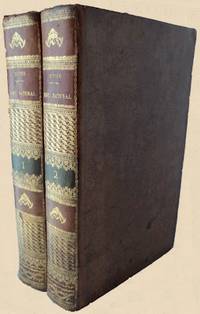
1006JC059<p>POR Mr. CUVIER. TRADUZIDO EM PORTUGUEZ E OFFERECIDO A S. A. R. O PRINCIPE R. N. S. POR ANTONIO D'ALMEIDA CAVALLEIRO DA ORDEM DE CHRISTO CIRURGIÃO DA REAL CAMARA LENTE D'OPERAÇOENS NO HOSPITAL REAL DE S. JOZE EM LISBOA E MEMBRO EFFECTIVO DO REAL COLLEGIO DOS CIRURGIOENS DE LONDRES. LONDRES: IMPRESSO POR H. BRYER BRIDGE STREET BLACKFRIARS. Anno 1815.</p>_x000d_<p>Obra em 2 volumes. In 8.º de 21x12 cm. Com xix 458 e 424 xxix págs. Encadernações da época inteiras de pele com finos ferros a ouro nas lombadas.</p>_x000d_<p>Profusamente ilustrado com 14 litografias. O 2º volume apresenta um carimbo oleográfico de posse na folha de rosto. As folhas de rosto de ambos os volumes com leves vestígios de acidulação.</p>_x000d_<p>Ilustrações. No 1º volume: 7 estampas litografadas de J. Walker com aspectos anatómicos que permitem a classificação dos mamíferos e aves. 1 tabela desdobrável com a classificação geral das classes dos animais 1 tabela desdobrável com a classificação dos mamíferos 1 tabela desdobrável com a classificação das aves 1 tabela desdobrável com a classificação dos répteis 1 tabela desdobrável com a classificação dos peixes. No 2º volume: 7 estampas litografadas de J. Walker com aspectos anatómicos que permitem a classificação de outros animais tais como insectos e inclusivamente dos corais. 1 tabela desdobrável com a classificação dos moluscos 1 tabela desdobrável coma classificação dos insectos 1 tabela com a classificação dos crustáceos 1 tabela desdobrável com a classificação dos zoófitos incluindo os corais. No final da obra apresentam-se 3 índices das classes ordens e géneros respectivamente em língua portuguesa em nomes latinos e em língua francesa.</p>_x000d_<p>A importância desta obra reside exactamente nestes índices e em toda a nomenclatura portuguesa introduzida na obra que foi da inteira responsabilidade de Félix de Avelar Brotero. Deste modo a obra possui dois prefácios: o prefácio do tradutor António d´Almeida e o prefácio do nomenclador português Avelar Brotero que por ordem superior foi encarregado de juntar os nomes portugueses aos nomes franceses e latinos tarefa segundo o mesmo muito difícil devido ao estado da ciência em Portugal e ao período das Invasões Napoleónicas de que resultava não existirem nem obras portuguesas nem zoólogos em Portugal para esta tarefa. A ciência portuguesa tinha-se baseado no profundo conhecimento prático das espécies trazidas das colónias e na sua acumulação em colecções sendo arrumadas o melhor possível dentro das classificações lineanas. Nesta obra Brotero afirma que reviu corrigiu e anotou esta obra de Cuvier procurando não desfigurar a versão portuguesa com galicismos e efectuando uma investigação aos vocabulários portugueses. Esta obra de Zoologia publicada em 1797-98 em França foi a mais reputada na sua época tendo portanto a sua tradução para português resultado do interesse de António d´Almeida durante o período que residiu em Londres e do patrocínio régio através do embaixador português em Inglaterra - o Conde do Funchal que requereu os serviços de Félix Avelar Brotero.</p>_x000d_<p>Inocêncio I 83 e II 262 ANTONIO DE ALMEIDA Comendador da Ordem de Cristo Cirurgião da Real Câmara Lente de operações no Hospital Real de S. José Membro do Real Colégio dos Cirurgiões de Londres etc. - Ignoro por agora o que diz respeito à sua naturalidade e data do nascimento constando-me apenas que era da província da Beira filho do Doutor José Diogo e de sua mulher D. Ana de Almeida. Morreu no Campo Grande próximo de Lisboa a 30 de Julho de 1822. Quadro Elementar da Historia dos Animauis por Mr. Cuvier traduzido em portuguez. Londres por H. Bryer 1815. 8.º gr. 2 volumes com estampas. - Esta tradução foi empreendida por conselho e a instâncias do Conde do Funchal embaixador em Londres onde Almeida também se achava naquele tempo. A nomenclatura portuguesa é toda do Doutor Brotero que dela se encarregou por ordem superior como ele próprio adverte em uma prefação colocada no princípio do tomo I.</p>_x000d_<p>BROTERO: Afora estes trabalhos é sua a Nomenclatura portuguesa que fez para o Quadro elementar da Hist. natural dos Animaes de Cuvier traduzido por A. de Almeida.</p>_x000d_<p>EN 2 volumes. In octavo. 21x12 cm. xix-458 and 424-xxix pp.</p>_x000d_<p>Contemporary full leather binding with fine gold tooling on the spines.</p>_x000d_<p>Profusely illustrated with 14 lithographs. The 2nd volume has an oleographic ownership stamp on the title page. The title pages of both volumes with light traces of acidulation.</p>_x000d_<p>Illustrations. In the 1st volume: 7 lithographed prints by J. Walker with anatomical aspects allowing the classification of mammals and birds. 1 fold-out table with the general classification of the classes of animals 1 fold-out table with the classification of mammals 1 fold-out table with the classification of birds 1 fold-out table with the classification of reptiles 1 fold-out table with the classification of fishes. In the 2nd volume: 7 lithographed prints by J. Walker with anatomical aspects that allow the classification of other animals such as insects and even corals. 1 fold-out table with the classification of molluscs 1 fold-out table with the classification of insects 1 table with the classification of crustaceans 1 fold-out table with the classification of zoophytes including corals. At the end of the book there are three indexes of classes orders and types in Portuguese Latin names and French respectively.</p>_x000d_<p>The importance of this work lies exactly in these indexes and in all the Portuguese nomenclature introduced in the work which was entirely the responsibility of Félix de Avelar Brotero. Thus the work has two prefaces: the preface by the translator António d"Almeida and the preface by the Portuguese nomenclator Avelar Brotero who 'by superior order was charged with joining the Portuguese names to the French and Latin names' a task according to him very difficult due to the state of science in Portugal and the period of the Napoleonic Invasions which resulted in there being neither Portuguese works nor zoologists in Portugal for this task. Portuguese science had been based on a deep practical knowledge of the species brought from the colonies and their accumulation in collections being 'arranged' as best as possible within the Linean classifications. In this work Brotero states that he revised corrected and annotated Cuvier"s work trying not to disfigure the Portuguese version with Gallicisms and carrying out research into Portuguese vocabularies. This work of Zoology published in 1797-98 in France was the most reputed in its time and its translation into Portuguese resulted from the interest of António d"Almeida during the period he lived in London and from the royal patronage through the Portuguese ambassador in England - the Count of Funchal - who requested the services of Félix Avelar Brotero.</p>_x000d_<p>Inocencio I 83 and II 262 'ANTONIO DE ALMEIDA Commander of the Order of Christ Surgeon of the Royal Chamber Professor of Operations at the Royal Hospital of St. Joseph Member of the Royal College of Surgeons of London etc. - I don"t know for the moment what concerns his birthplace and date of birth but I only know that he was from the province of Beira son of Doctor José Diogo and his wife D. Ana de Almeida. He died in Campo Grande near Lisbon on July 30th 1822. Quadro Elementar da Historia dos Animais by Mr. Cuvier translated into Portuguese. London by H. Bryer 1815. 8th gr. 2 volumes with prints. - This translation was undertaken on the advice and at the instigation of the Count of Funchal ambassador in London where Almeida was also at the time. The Portuguese nomenclature is all by Dr. Brotero who was in charge of it by superior order as he himself warns in a foreword placed at the beginning of volume I.</p>_x000d_<p>BROTERO: Besides these works is his Portuguese Nomenclature which he made for the elementary Table of the Natural History of Animals by Cuvier translated by A. de Almeida.</p>_x000d_<p>Referências/References:</p>_x000d_<p>Inocencio I 83 and II 262. Cordier BI. 1817. Pritzel 5637. Stafleu-C. 5038. Sousa da Câmara 1738. 'Estimada e pouco vulgar Esteemed and unusual.'</p> M-16-D-31 hardcover
1020605979.Ghardcover. Good. Access codes and supplements are not guaranteed with used items. May be an ex-library book. hardcover
102042639X.Ghardcover. Good. Access codes and supplements are not guaranteed with used items. May be an ex-library book. hardcover
102232084X.Gpaperback. Good. Access codes and supplements are not guaranteed with used items. May be an ex-library book. paperback
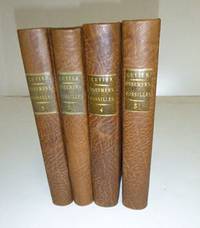
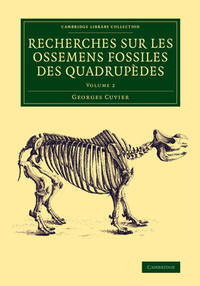
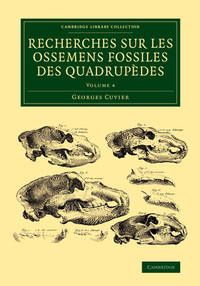
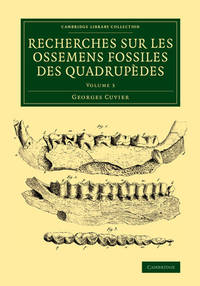
51-5714Paris Déterville 1812. 4 volumes. 4to. 21 x 27cm Later qtr goatskin with matching brown marbled boards. With 152 engraved plates of 154. Fine condition.Contents: T. 1. Discours preÌliminaire et la geÌographie mineÌralogique des environs de Paris.t. 2. Pachydermes des couches meubles et des terrains d'alluvion.t. 3. Os fossiles des environs de Paris.t. 4. Ruminans les onguiculeÌs et les reptiles fossiles .Vol. 1 includes Discours préliminaire in which Cuvier introduced the idea of geological ‘revolutions’ to explain mass extinctions of prehistoric species. Other papers include an essay on an Egyptian ibis mummy brought from Thebes during Napoleon's campaign in Egypt; and with Alexandre Brogniart 1770-1847 an updated version of Cuvier's important stratigraphical memoir of 1810 Essai sur la Géographie Minéralogique des Environs de Paris which contributed to the concept of faunal succession in rock strata of different periods. In Vol. 2 Cuvier describes species of pachyderms found in recent alluvial deposits including elephants mastodons rhinoceros hippopotamus and tapir. In Vol. 3 Cuvier's recalls the challenges of reconstruing fossils of different species. Vol. 4 concerns fossil horses and pigs bears hyenas and big cats and concludes by describing fossil sloths crocodiles turtles and marine dinosaurs.OCLC Number988198; Nissen ZBI 1011; BMNH Cat. I p. 409.Near the end of the eighteenth century scholars disputed whether fossils represented life forms that no longer existed or whether—as the Comte de Buffon at the Jardin des Plantes in Paris believed—the fossils found in Europe and America represented animals that had migrated to the tropics. Buffon argued that God would not have let his creations go extinct. In 1796 Cuvier presented a paper to the National Institute of Sciences and Arts in Paris in which he compared the anatomy of living and fossil elephants thus proving extinction to be a fact as the fossil elephants had not been seen by recent humans. In the following years Cuvier continued to document the extinction of animals such as the giant ground sloth the Irish elk and the American mastodon.Cuvier's research on extinct forms led him to investigate the causes of extinction. He proposed a catastrophist geological history of the earth. Édition originale de cet ouvrage important dans le domaine de la paléontologie. L'illustration se compose de 152 planches gravées sur 154 d'après les dessins de Cuvier et une très grande carte dépliante en couleurs "Carte géognostique des environs de Paris" Il s'agit d'un recueil d'articles que Cuvier fit paraître de 1795 à 1812 dans de nombreuses revues et en particulier dans les Annales du Muséum. Il s'ouvre sur un Discours préliminaire dans lequel l'auteur expose ses idées sur les cataclysmes qui ont bouleversé la terre en particulier le dernier qui coïncide avec le Déluge de la Bible. En français dans le texte 224. cartonnages frottés et usés manque 2 planches quelques feuillets et planches détachés intérieur très frais. Expertise by: François Giard Paris, Déterville, 1812 hardcover
1024772209.Ghardcover. Good. Access codes and supplements are not guaranteed with used items. May be an ex-library book. hardcover
aauphy990265Cambridge University Press. paperback. NEW. 7x0x10. Cambridge University Press paperback
1108083765.Gpaperback. Good. Access codes and supplements are not guaranteed with used items. May be an ex-library book. paperback
1108083781.Gpaperback. Good. Access codes and supplements are not guaranteed with used items. May be an ex-library book. paperback
1108083773.Gpaperback. Good. Access codes and supplements are not guaranteed with used items. May be an ex-library book. paperback
1108083757.Gpaperback. Good. Access codes and supplements are not guaranteed with used items. May be an ex-library book. paperback
0270982035.Ghardcover. Good. Access codes and supplements are not guaranteed with used items. May be an ex-library book. hardcover
1010803204.Ghardcover. Good. Access codes and supplements are not guaranteed with used items. May be an ex-library book. hardcover
1019131152.Ghardcover. Good. Access codes and supplements are not guaranteed with used items. May be an ex-library book. hardcover