Cuvier, GeorgesBiblio.com

96 résultats
184042750London: George A. Doo 1840. George A. Doo unknown
1804815London: Alexander Tilloch 1804. 1st Edition. BOUND FIRST EDITION OF A LETTER ON THE ATOMIC THEORY IN CHEMISTRY FROM JOHN DALTON to Alexander Tilloch founder of the journal in which this paper is published. Also included are papers of import by Gay-Lussac Biot and Cuvier.<br /> <br /> John Dalton 1766-1844 was an English chemist meteorologist and physicist best known for his pioneering work in the development of modern atomic theory the atomic theory in chemistry.<br /> <br /> "Dalton applied the Laws of Conservation of Mass and Definite Composition to explain his Atomic Theory. He developed the chemical theory in 1803 and told Thomas Thomson University of Edinburgh about it in 1804" Greenberg A Chemical History 172. <br /> <br /> This paper is Dalton's response to a conclusion the chemist and professor Thomas Thomson leveled regarding Dalton's Atomic Theory; specifically: in the 2nd edition of his influential A System of Chemistry Thomson wrote "that air is a chemical compound"; he then offered four reasons for his conclusion. <br /> Dalton believed that he had already well-proven "the absurdity of the notion of atmospherical air being a chemical compound of azotic and oxygens gases" Dalton On the Supposed 19 1804 p. 79. The object of the Dalton paper offered here then is to show the "insufficiency" of Thomson's four reasons; to do so Dalton debunks each of Thomson's four ‘reasons' one by one.<br /> <br /> ALSO INCLUDED: An exceedingly rare first edition in English of Jean-Baptiste Biot's paper "Account of an Aerostatic Voyage" describing his landmark balloon ascent with Louis-Joseph Gay-Lussac. The scientific readings that Biot and Gay-Lussac took during their ascent established that the Earth's magnetic field extends into the atmosphere. "The ascent was notable in that it was undertaken entirely for scientific purposes. The primary purpose was to find whether the magnetic intensity of the earth decreased at great altitudes as had been suggested by Horace de Saussure's experiments in the Alps. From their experiments in which they timed the oscillations of a magnetized needle at various altitudes Biot and Gay-Lussac concluded that up to 4000 meters there was not change" DSB II p. 134-135. <br /> <br /> ALSO INCLUDED: "Osteological Description of the one-horned Rhinoceros" is the first English edition of the first part of an important paper by the celebrated zoologist and naturalist Georges Cuvier on the one-horned rhinoceros one-horned Indian rhinoceros; Rhinoceros unicornis. It has been said that Georges Cuvier possessed one of the finest minds in history. Almost single-handedly he founded vertebrate paleontology as a scientific discipline and created the comparative method of organismal biology an incredibly powerful tool. It was Cuvier who firmly established the fact of the extinction of past life forms. CONDITION & DETAILS: London: Alexander Tilloch. Complete volume. 8vo. 8.25 x 5.25 inches. 4 400 pages. Illustration: Nine copper-engraved plates with light to moderate age toning and foxing. Tightly and very solidly bound in contemporary quarter calf over marbled boards. Gilt-lettered and ruled at the spine. The leather on spine is a bit scuffed and the spine tips are rubbed. Binding is tight and sturdy and overall in very good condition. Interior: Title page is moderately foxed. Light to moderate foxing from preliminaries through page 20; moderate foxing on the final few plates. The remainder of interior including all papers of import is very clean. Very good condition. Alexander Tilloch hardcover
1833H5151Paris: H. Fournier 1833. First printing. Hardcover. Very Good. First edition 1833 bound in somewhat later deep red morocco backed red cloth boards 369 pp with half title frontispiece and single page table at rear. Very good moderate foxing throughout. Rare on the market. H. Fournier hardcover
182740223Paris 1827. <p>Cuvier Georges 1769-1832. Letter signed to Samuel H. Christie 1784-1865. Paris 29 October 1827. 1 sheet on letterhead of the Académie Royale des Sciences. 222 x 169 mm. Trimmed at head affecting printed letterhead but not the manuscript text. Very good.</p> <p>From the great French naturalist and zoologist Baron Cuvier whose work helped to establish the modern sciences of paleontology and comparative anatomy to British mathematician and physicist Samuel Hunter Christie who made important contributions to the study of magnetism. Cuvier was perpetual secretary of the Académie des sciences and his letter to Christie acknowledging Christie's donation of several of his papers on magnetism to the Académie is written in that capacity. "L'Académie Monsieur a reçu les ouvrages que vous avez bien voulu lui adresser extraits des transactions philosophiques . . . J'ai l'honneur de vous offrir les remerciemens de l'Académie et de vous témoigner en son nom tout le prix qu'elle attache à ces publications . . ." The Academy Sir received the books that you kindly send him excerpts from Philosophical Transactions. . . I am pleased to offer the thanks of the Academy and to express to you on its behalf of all the value it attaches to these publications . . . </p> . unknown
1802003258London: T.N. Longman & O. Rees 1802. Ink shelf numbers on spines; bookplates; several ink stamps; tears in two tables partly repaired with archival tape; lacking half-titles. First Edition in English. Buckram. Good. T.N. Longman & O. Rees Hardcover
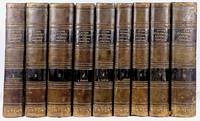
18461948<p>Paris: Crochard et Cie 1846. Second expanded edition.</p><p><strong>PIONEERING ESTABLISHMENT OF THE SCIENCE OF COMPARATIVE ANATOMY.</strong></p><p>Eight volumes in 9 bindings 8 1/2 inches tall Vol. 4 is in 2 parts. Green quarter leather binding with gilt titles and compartments marbled paper covered boards patterned endpapers bookplate of NSR Maluf to each volume Vol. I i-xxxiii lithographic facsimile of letter from Cuvier 587 pp 1; Vol. II i-viii 726 pp; Vol. III 4 i-iv 760 pp; Vol. IV pt 1 i-xxvii 618 pp 4; Vol. IV pt 2 i-iv 691 pp 1; Vol. V i-viii 503 pp folding table; Vol. VI i-vii 557 pp 1 folding table; Vol. VII i-vii 1 656 pp; Vol. VIII i-xii. 848 pp. Covers corners spine ends worn light browning to pages the first blank and usually the half title of each volume have top edge corners clipped presumably to remove a signature not affecting text. Bindings tight pages unmarked very good in custom archival mylar covers. <strong>CONTENTS:</strong> Vol. I contains the principal discussion of Cuvier's famous theory of the correlation of parts- the functional relationship of each bodily organ to every other organ. Also considered are the organs of movement of vertebrate animals; Vol. II addresses the organs of movement of invertebrate animals and the osteology of the head; Vol. III considers the nervous system and sense organs; Vol. IV reviews the organs of mastication salivation and swallowing in vertebrate animals; Vol. V reviews the feeding organs of invertebrate animals; Vol. VI explores the nutritive fluid its reservoirs and the organs that set it in motion in the four types of the animal kingdom; Volume 7 the description of the organs of elaboration and purification of the nutritive fluid through respiration and urinary secretion; and Volume 8 the organs of generation and secretions the swim bladder of the fish and the organs of vocalization.</p><p><strong>GEORGES CUVIER </strong>1769 – 1832 was a French naturalist and zoologist sometimes referred to as the "founding father of paleontology". Cuvier was a major figure in natural sciences research in the early 19th century and was instrumental in establishing the fields of comparative anatomy and paleontology through his work in comparing living animals with fossils. He expanded Linnaean taxonomy by grouping classes into phyla and incorporating both fossils and living species into the classification. He laid the foundations for a method of analysis and comparison applied to the entire animal kingdom and a new branch of natural history was born thanks to his scientific collaboration with Geoffroy Saint-Hilaire. This was based on the theory that anatomical and physiological characteristics of animals are molded by their environment. He established four major families: vertebrates mollusks arthropods and radiates. He was the first to apply the concept of an ecosystem viewing it as a vast network in which species interact with one another.</p><p><strong>GARRISON-MORTON </strong>No. 311 "Cuvier played a leading part in the development of paleontology and stimulated the study of comparative anatomy. He ranks with von Baer as one of the founders of modern morphology. The posthumous second edition offered here revised and expanded by Georges Cuvier's younger brother Georges-Frédéric Cuvier to 8 vols. appeared from 1835-1846."</p> Crochard et Cie hardcover
183910877<p>Crochard et Cie Libraires 1839 Book. Good. Hardcover. 3/4 leather. Marbled boards with 3/4 leather all rubbed red spine label with gilt trim. Binding and hinges quite secure no repair or noted no splitting or cracking of the leather. Foxing throughout - from light at times to quite heavy at others but pages are quite supple and easily handled. Brief notes in pencil on ffep. Text in French.</p> Crochard et Cie Libraires hardcover
1817elala537Paris: Deterville 1817. 1817. 4 Volumes. 8vo. pp. xxxvii 540; xviii 532; xxix 653; viii 255. with half-titles. 15 engraved plates by Pierron after Laurillard. 10 folding engraved plates from another work bound in at end. contemporary quarter sheep gilt backs spines somewhat worn several joints cracked scattered foxing. bookplate 1825 ownership entry 1834 & rubberstamp on title of A.Chambion on titles. First Edition of Cuviers most comprehensive work which embodied the whole of his previous researches on the structure of living and fossil animals and laid the foundations of modern comparative anatomy. Here Cuvier introduced his famous classification system according to which the animal kingdom is divided into four main groups vertebrata mollusca articulata insects lobsters and radiata all remaining types. "This type theory is Cuviers greatest contribution in the sphere of systematization and represents although in a somewhat modified form the basis of all subsequent animal classification." Nordenskiöld Opposing the current view that the structure of an animal determined its functions and habits Cuvier maintained that an animals structure was due to its functions and habits. Throughj the exact study of the anatomy of living and fossil species he could reconstruct extinct forms from a few surviving bones. At the end of Volume IV pp. 95-170 is an important annotated bibliography of zoological literature. Brit. Museum Cat. of Natural History I 410. Brunet II 457 incorrectly citing date 1816. Casey Wood 307. Dibner Heralds of Science 195. Nissen 1013. Nordenskiöld History of Biology pp. 339-41. Printing and the Mind of Man 276. Sparrow Milestones of Science 42 Plate 134 pp. 31-32. Waller 11796. Wellcome II 423 incomplete. cfGarrison & Morton 327. 1st Edition. Hardcover. Paris: Deterville , 1817. Hardcover
182918430Paris: Déterville and Crochard 1829. SECOND EDITION. With 20 full-page etched plates. Contemporary gilt green sheep-backed marbled boards. Ownership stamps of J.E. van der Dussen. A fine set. Second edition enlarged of this landmark in the history of zoology and comparative anatomy the most comprehensive biological work since Linnaeus. “Cuvier’s valuable work represented the fruits of a lifetime’s study of living and fossil animals. In his day Cuvier exerted an enormous influence on science. He played a leading part in the development of the science of palaeontology and stimulated the study of comparative anatomy†G&M. <br /> “It is in his classification of the animal kingdom into four main groups Vertebrata Mollusca Articulata and Radiata that he is so notably succeeded in giving a lead that has been followed by all his successors. . .Cuvier was the first to apply analyses and comparison to the entire animal kingdom. He also saw that this homogeneity in an individual should enable a competent naturalist to reconstruct a complete animal from any significant part of its anatomy†PMM.<br /> See PMM 276; Garrison-Morton 327; Dibner 195. Déterville and Crochard unknown
18173707077Paris: Deterville 1817. Some foxing to the plates. Four volumes octavo 15 engraved plates by C.-L. Laurillard a handsome set with all four half-titles in original quarter calf over mottled papered boards gilt double spine labels in red & green. <p><p>First edition of this germinal work of natural history with three volumes by Cuvier himself and the fourth an important study of insects by his friend and colleague Latreille.</p> <p>Recognised as the father of comparative anatomy Cuvier published widely throughout his lifetime but this was his most famous and influential work and contained the results of all his previous research on the structures of living and fossil animals. It was based upon his vast knowledge of zoological anatomies and in it he applied Linnæus' system of nomenclature and classification to the whole animal kingdom in the process establishing his four great classes: vertebrate molluscous articulate and radiated.</p> <p>Cuvier's work is a benchmark for many reasons not least for the third volume present here which is actually the work of Pierre André Latreille Professor of Entomology at the Paris Museum: Latreille's contribution was not only a significant contribution to his field but he had earlier been heavily involved in characterising the insects collected on the Baudin voyage to Australia and the Pacific. In the present volume Latreille sought to update the foundation work of scholars including Fabricius within Cuvier's framework; as a result Latreille included here many Australian insects including two the 'Rhipcera' and the 'Heleus' noted for the first time.</p> <p>Cuvier born in 1769 was invited by Geoffroy Saint-Hilaire to come to Paris in 1795. He took an appointment at the newly-formed Muséum nationale d'histoire naturelle where he remained until his death from cholera in 1832. He had first publicly canvassed his new quadripartite schema of the animal kingdom in an 1812 presentation to the Academy of Sciences but it was in this work that he first detailed how this proposed division worked in practice. Here each of the classes is discussed in a separate volume with volumes I II and IV by Cuvier himself; his organizations of fish families in particular 'were so soundly based that they have become orders or suborders in present classification' DSB.</p> <p>Throughout his career Cuvier held to the premise of Le Règne Animal that the four branches were fundamentally different and that any similarities between them were due entirely to common functions rather than common ancestry. He did not believe that is that there was any evolutionary adaptation a stance which put him in open conflict with his contemporaries such as Buffon Lamarck and Geoffroy. This led to the famous debate between Cuvier and Geoffroy at the Académie Royale des Sciences in Paris in 1830.</p> <p>Cuvier's towering position in the French natural sciences should be seen in the context of a very cynical view of his ambitions towards intellectual ownership of the science on Freycinet's voyage an idea explored in correspondence between Faujas de Saint Fond and Louis de Freycinet.</p> </p> . Deterville unknown
183629867AB1836. 3 Bände. Bruxelles L. Hauman 1836. 8°. Mit 24 gest. Tafeln. Halbleinenbände der Zeit. Vgl. Nissen 1013 für die erste Ausgabe. - Dritte Ausgabe erschien erstmals 1817 in Paris. - Papier durchgehend gebräunt und stockfleckig. Einbände berieben und bestossen. unknown
181720421Paris:: Chez Deterville 1817. First edition. contemporary quarter sheep gilt and marbled boards. Old stamped ownership signature on each front free endpaper; some light rubbing to the bindings. A very attractive set. 8vo. 15 engraved plates. PMM 276. Half-titles present. Chez Deterville, hardcover
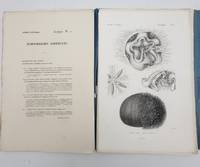
1840354997Paris.: Fortin Masson. circa 1840. 25 loose lithograph plates with caption sheets in the publishers printed card stock slipcase. Very good a little wear to slipcase. 28.5x18.5 cm. Plates are numbered 1-25 but lacking number 19 however 11a and 11b are included for a total of 25 plates as called for on the label. Scarce. weight: 1.0 lb. 25 black and white lithograph plates with captions on facing Fortin Masson. unknown
182639285Baudouin Frères Paris 1826. Ouvres complétes de Buffon Complément tomes 1 & 4 only. V.g./No Jacket. Quarter leather binding Tidy copies slight edge wear to boards. Baudouin Frères, Paris hardcover
182619716Paris:: Chez Baudouin Freres 1826-1828. First edition. contemporary quarter calf and marbled boards; gilt spines; all edges marbled. Some scattered inoffensive foxing; very light use to the attractive bindings. 8vo. Chez Baudouin Freres, hardcover
1822k011A.801GB: William Blackwood Edinburgh 1822. Frontispiece and 5 plates all heavily spotted/browned.Some spotting to title page and next leaf. Main text is very clean and tight. Endpapers and edges marbled. Contemporary full leather with gold monogram and crown on front cover. Gold on lack title label. Covers and spine are clean. Spine has been reglued and is starting to lift again. Book is in very good minus condition with minor but noticeable signs of wear and/or age. . 4th Edition. Hardback. VG-/No DW. William Blackwood (Edinburgh) Hardcover
1822008238Edinburgh : Strand London.: William Blackwood; and T Cadell 1822. 4th Edition . Hardcover. Good. 8vo - over 7¾ - 9¾" tall. JAMESON Professor. In contemporary full calf gilt edge tooling joints going edges rubbed. Spine gilt tooling raised bands gilt titles to torn green calf label edges worn. Internally frontis 5 vi-xxiii 1 1 2-454 pp 5 plates frontis ink ms ownership name to tp R. Bill London 1822 and then ms ink notes throughout in his educated hand to text and margins many pages extra sized and folded for his notes short repaired margin tear at C1. <br/> <br/> William Blackwood; and T Cadell hardcover
181839541New York: Kirk & Mercein 1818. 1st US edition. Fair/No Jacket. Half leather binding Front hinge separating. Bookplate ofe Anne Morris Stout. An appendix in Latin presents Leibnitz's Protogaea and other matters such as "Configuration of the country lying south of Lake Erie". New York: Kirk & Mercein hardcover
182256359Edinburgh: William Blackwood. Very Good-. 1822. Fourth Edition. Hardcover. Contemporary or later half leather elaborate gilt spine. Heavily rubbed with fray to spine ends. PO entry scattered underlining foxing mostly confined to outer pages. Frontis and 5 numbered plates at rear. Xxiii 454pp 5 plates. ; 8vo 8" - 9" tall . William Blackwood hardcover
181770532Edinburgh: William Blackwood / Baldwin Cradock and Joy 1817. Third edition with additions. Leather Bound. Very Good -. 348pp. Octavo 21.5cm. Full leather; stamped with an elaborate blind stamped diamond pattern and gilt border on covers. Title stamped in gilt on spine. Raised bands. Marbled endpapers. A bit of soiling scuffing and sunning to boards. Foot of spine is badly bumped and scuffed exposing underlying boards. Elaborate bookplate on front pastedown along with a bookseller's ticket. Binding is quite tight. A foundational text in the field of paleontology. William Blackwood / Baldwin, Cradock, and Joy unknown