690 résultats
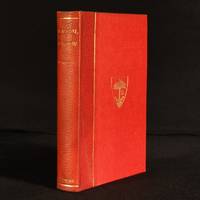
1959543192London: Her Majesty's Stationery Office 1959. Very good condition red gilt embossed hardcover no dust jacket with gilt edged page block and complementary patterned pastedowns and endpapers. Copy of government report on Nyasaland in presentation binding to Mr E.T. Williams member of the commisson of inquiry signed by the chairman Patrick Devlin and includes later correspondence by the two and a newspaper clipping. Sir Edgar Williams was a British historian and Army military intelligence officer in World War II. He later became an esteemed scholar in Oxford. LW. Hardcover. Very Good/No Dust Jacket. Used. Her Majesty's Stationery Office Hardcover
46748108-nnew. unknown
46748108like new. unknown
1913940P1Glasgow: James Maclehose and Sons 1913. First edition. Leather. Very Good. 9.5" by 6.5". Various. A limited edition work exploring the religious history of Glasgow a smart illustrated volume signed by the publisher. A limited edition this being one of sixty copies made on handmade paper signed by the publisher to the verso of the half-title.'Mediaeval Glasgow' explores the vast history of the city and shows the important part that Glasgow has played in the national history. The volume focuses on religious history each chapter being dedicated to a Bishop Pope or Archbishop. These include Bishop Jocelyn Pope Nicholas V Archbishop Robert Blackadder Archbishop James Beaton II and more across a total of fourteen chapter. Illustrated with a frontispiece sixteen plates and the occasional in-text engraving. Collated complete.Written by Reverend James Primrose. In the original publisher's quarter morocco binding with cloth to the boards. Externally smart. Gilt to the spine is a little rubbed. Small chip to the front joint. Light marks and a little discolouration to the leather. Hinges have been reinforced with tape. Internally firmly bound. Pages are bright and clean. Very Good James Maclehose and Sons hardcover
2022__1789909058Edward Elgar 2022. Hardcover. New. 544 pages. 9.63x6.63x0.59 inches. Edward Elgar hardcover
1659M13858Roterodami:: ex officinâ Arnoldi Leers 1659. 1659. Two parts in one. 15 cm. 12mo. 2 125 1 pp. Complete. Printer's woodcut device on title; title margin trimmed. Original paste-paper over boards; simple repairs to spine with old manuscript title added spine worn some internal waterstaining to bottom edge. Shelf-mark on p. 1 lower margin. Title margin trimmed. Good. First edition. Published in two parts Primerose "deals with the care of the newborn infant and the feeding of infants" and the second part is devoted to the problem of infantile diseases and mortality especially of rickets. "Primerose was one of those who still regarded the ancient medical writers as the Law and the Prophets and his book is little more than a compilation from them mixed with more of ignorant custom and superstition than one can find in any single ancient writer unless perhaps in Artius; though Primerose it must be said does sometimes acknowledge that a custom or opinion mentioned is superstitious. He quotes from Galen the salting of the newborn baby which he says has now become obsolete. He advices amongst other methods of ablution washing the baby in its own urine; and as another alternative he mentions warm beer. The nurse's milk is still to be tested by the nail test of Soranus or by a hair or mirror or dish used in the same way as the nail to estimate the quality of the milk by its viscidity." Still p. 248. / "The son of Gilbert Primrose he was born at St. Jean d'Angely now in Charente-Inferieure France. He studied at the University of Bordeaux there graduated M.A. and then proceeded to Montpellier where he took the degree of M.D. in 1617 and attended the lectures of John Varandaeus professor of physic." / "He was incorporated M.D. at Oxford in March 1628. On 9 December 1629 at Dr. Argent's house in London he was examined for admission to the license of the College of Physicians William Harvey being one of his examiners manuscript annals. He passed and was admitted the following day. He settled in Kingston-upon-Hull and there practised his profession. He died in December 1659 at Hull where he was buried in Holy Trinity Church." Wikip. REFERENCES: Grulee 551; Hirsch IV p. 627; Krivatsy NLM 9294; Waller 7642. See: Munk's Coll. of Phys. i. 197; Joseph Foster Alumni oxonienses: the members of the University of Oxford 1500-1714 Oxford & London: Parker and Co. 1891-92; Jean Astruc Memoires pour servir a l'Histoire de la Faculte de medecine de Montpellier 1767 edited by Anne-Charles Lorry; Geoffrey Davenport Ian McDonald Caroline Moss-Gibbons The Royal College of Physicians and Its Collections: An Illustrated History 2001 p. 142; DNB; George Frederic Still The History of Paediatrics 1931. ex officinâ Arnoldi Leers, 1659. hardcover books
2021SBS-9781645340485AcademiQ 2021. Hardcover. New. AcademiQ hardcover
2021SBS-9781645340485AcademiQ 2021. Hardcover. New. AcademiQ hardcover
2021SBS-9781645340539AcademiQ 2021. Hardcover. New. AcademiQ hardcover
2021SBS-9781645340539AcademiQ 2021. Hardcover. New. AcademiQ hardcover
2021SBS-9781645340546AcademiQ 2021. Hardcover. New. AcademiQ hardcover
2021SBS-9781645340546AcademiQ 2021. Hardcover. New. AcademiQ hardcover
Bulino misura: mm 245 x 158 Pittore ed incisore italiano, secondogenito di una famiglia di artisti. La sua formazione avvenne nell'ambiente manieristico sia fiorentino che romano che precede l'accademia carraccesca. In tutte le sue opere pittoriche troviamo come caratteri tipici la tendenza decorativa e un virtuosismo accademico strettamente legato a contenuti letterari e retorici. Eccetto rari momenti in cui tornò nella sua città natale egli si formò e svolse la sua attività principalmente a Roma nella bottega di Cornelis Cort per poi guardare al lavoro di Agostino Carracci, degli Zuccari e del Villamena. In incisione, egli ne realizzerà circa duecento tra il 1568 e il 1612, riproduce sculture antiche, opere di Raffaello, Michelangelo e artisti contemporanei. Diventato Direttore dell’Accademia di San Luca, è oggi ricordato per affreschi in palazzi e chiese di Roma. In questa stampa, tratta dalla serie Le quattro stagioni da un invenzione di Polidoro da Caravaggio, l'artista realizza all'interno di una nicchia architettonica, l'allegoria della Primavera. Viene rappresentata come una donna nuda, leggermente coperta da un drappo morbido e fluttuante. Il suo capo è abbellito da ghirlande e ha gli occhi fissi e ammiccanti verso lo spettatore. Nella mano sinistra regge copiose ghirlande e attraverso l'abile uso della tecnica, sembra scendere ed uscire da questa struttura architettonica appoggiandosi alle nubi, gonfie e riccamente contrastate. In alto al centro è iscritto in titolo e in basso il monogramma. Monogrammata anche a penna, in basso a sinistra. Impressione eccellente. Ottimo stato di conservazione. Rifilata alla battuta del rame. Filigrana: "stella a sei punte" Bibliografia: Bartsch XVII.84.101; Manescalchi 133.
2003x-0415264537Routledge 2003. Hardcover. New. reprint edition. 72 pages. 8.74x6.30x0.39 inches. Routledge hardcover
2024x-0367861364Routledge 2024. Hardcover. New. 592 pages. 9.69x6.88x1.18 inches. Routledge hardcover
AA.VV. (Angeloni, Italo Mario - Benelli, Sem - Colla, Guido - Foà, Pio - Geymonat, Ermanno - Scoffone, Riccardo: testi) L'Arte nella Fotografia (Prima Esposizione Internazionale di Fotografia Ottica e Cinematografia - Primavera 1923 - Torino). Milano-Roma, Casa Editrice d'Arte Bestetti and Tumminelli 1924 italian, in quarto pp. 54+(158) in "carta ruvida avorio Roma - Made in Italy"con barbe=212 ed. s.d. (ma 1924) con tiratura limitata a 1300 copie (esemplare N. 166) del catalogo della Prima Esposizione Internazionale di Fotografia Ottica e Cinematografia, Torino, Palazzo del Giornale (al Valentino, oggi raso al suolo), Primavera (maggio-giuno) 1923. IV/ 54+(158) in "carta ruvida avorio Roma - Made in Italy" con barbe=212/ rilegatura in mezza tela blu marine con piatti rifiniti in carrta ruvida beige con titoli e ornati in rosso mattone e dorati al primo piatto. Illustrazioni fotografiche in b/n applicate nel testo e in b/n e a colori nelle tavole f.t.. Firma ad inchiostro nero in frontespizio (Sem Benelli?). Stato mediocre (usura della copertina, in particolare all'angolo inferiore destro del primo piatto che presenta una rottura di una certa entità - copertina brunita, polverosa e con qualche gora). Indice: Dedica; Sem Benelli (Torino, maggio 1924) - Comitato d'Onore - Comitato Generale - Giunta Esecutiva - Comitato Francese - Copmmissioni - Giurie - Come l'esposizione ebbe origine e si sviluppò; Guido Colla, Segretario della Giunta Esecutiva, Torino, febbraio 1924 (La Sede - Gli Espositori - I mezzi finanziari - L'Esposizione e le Manifestazioni che l'accompagnarono - I lavori delle Giurie - Risultnze finanziarie)-Donatori - Relazione della Giuria Superiore; Prof. Pio Foà, Presidente della Giuria Superiore e Senatore del Regno, e Riccardo Scoffone, Segretario Generale, Torino, 7 luglio 1923 - Concorso Cinematografico; Segretario e Avv. Ermanno Geymonat - Premiazioni - La Fotografia Artistica alla Prima Esposizione Internazionale, Torino, maggio-giugno 1923; Italo Mario Angeloni, Ala di Stura, agosto 1923 - Indici (Indice del testo - Indice delle illustrazioni) - Illustrazioni. Autori delle fotografie: A. Enrie, Torino - L. Vaghi, Parma - E. Sommariva, Milano - F. Masino, Torino - E. O. Hoppé, Londra - N. Perscheid, Londra - E. Massaglia, Torino - S. Bricarelli, Torino - Wadenoyen, Cardiff - C. Schenker, Berlino - C. Scarabello, Torino - W. Prochnow, Berlino - E. Sommariva, Milano - J. Brozik, Praga - M. Adam, Londra - A. M. Schein, Vienna - A. Riess, Berlino - I. Pokés, Praga - G. Dall'Armi, Torino - N. Perscheid, Berlino - F. Stock, Berlino - H. Lambert, Bath - C. De Marchi, Milano - C. Scarabello, Torino - R. Scoffone, Torino - Bassano, Londra - G. B. Vercellone, Torino - C. Schiapparelli, Torino - H. Zink, Colonia - A. Schneeberger, Praga - Binder, Berlino - E. Spitzer, Vienna - Castagneri-Sfrai, Milano - C. Baravalle, Torino - R. Scoffone, Torino - Drtikol, Praga - A. Bologna, Torino - R. Padouk, Praga - Nunes Vais, Firenze - Scmidt, Berlino - Rude, Cristiania - A. Miska, Praga - Atelier Riess, Berlino - Barberis, Torino - E. Massaglia, Torino - M. Crimella-Sfrai, Milano - H. Zink, Colonia - G. Dall'Armi, Torino - A. Schellens, Eindhoven - G. Casalegno, Torino - Sciutto, Genova - Bettini, Roma - C. Verschnur, Rossum - P. Oneglio, Torino - Weinberg, Groninga - F.lli Alinari S. A. Idea, Firenze - I. M. Angeloni - Castagneri-Sfrai, Milano - Brasil, Londra - D'Alessandri, Roma - V. Aragozzini, Milano - A. Badodi, Milano - Pozzini, Riva s. Garda - R. Bianchi, Monza - Callegari, Roma.
1886100335AB1886. London Given at the Foreign Office 1886. 27.7 cm x 38.2 cm. 1 sheet. Original Softcover. Excellent condition with only minor signs of external wear. Signed by Archibald Philip Primrose 5th Earl of Rosebery. Fantastic and important document of british foreign office history. Archibald Philip Primrose 5th Earl of Rosebery 1st Earl of Midlothian KG KT PC FRS FBA 7 May 1847 21 May 1929 was a British Liberal politician who served as Prime Minister of the United Kingdom from March 1894 to June 1895. Between the death of his father in 1851 and the death of his grandfather the 4th Earl of Rosebery in 1868 he was known by the courtesy title of Lord Dalmeny. Rosebery first came to national attention in 1879 by sponsoring the successful Midlothian campaign of William Ewart Gladstone. He briefly was in charge of Scottish affairs. His most successful performance in office came as chairman of the London County Council in 1889. He entered the cabinet in 1885 and served twice as foreign minister paying special attention to French and German affairs. He succeeded Gladstone as prime minister and leader of the Liberal Party in 1894; the Liberals lost the 1895 election. He resigned the party leadership in 1896 and never again held political office. Rosebery was widely known as a brilliant orator an outstanding sportsman and marksman a writer and historian connoisseur and collector. All of these activities attracted him more than politics which grew boring and unattractive. Furthermore he drifted to the right of the Liberal party and became a bitter critic of its policies. Winston Churchill observing that he never adapted to democratic electoral competition quipped: "He would not stoop; he did not conquer." Rosebery was a Liberal Imperialist who favoured strong national defence and imperialism abroad and social reform at home while being solidly anti-socialist. Historians judge him a failure as foreign minister and as prime minister. At Eton Rosebery notably attacked Charles I of England for his despotism and went on to praise his Whig forebears his ancestor James Stanhope 1st Earl Stanhope was a minister to George I of Great Britain. Benjamin Disraeli often met with Rosebery in the 1870s to try to recruit him for his party but this proved futile. Disraeli's major rival William Ewart Gladstone also pursued Rosebery with considerable success. As part of the Liberal plan to get Gladstone to be MP for Midlothian Rosebery sponsored and largely ran the Midlothian Campaign of 1879. He based this on what he had observed in elections in the United States. Gladstone spoke from open-deck trains and gathered mass support. In 1880 he was duly elected Member for Midlothian and returned to the premiership. Rosebery served as Foreign Secretary in Gladstone's brief third ministry in 1886. He served as the first chairman of the London County Council set up by the Conservatives in 1889. Rosebery Avenue in Clerkenwell is named after him. He served as President of the first day of the 1890 Co-operative Congress. Rosebery's second period as Foreign Secretary 18921894 predominantly involved quarrels with France over Uganda. To quote his hero Napoleon Rosebery thought that "the Master of Egypt is the Master of India"; thus he pursued the policy of expansion in Africa. Rosebery helped Gladstone's Second Home Rule Bill in the House of Lords; nevertheless it was defeated overwhelmingly in the autumn of 1893. The first bill had been defeated in the House of Commons in 1886. Rosebery became a leader of the Liberal Imperialist faction of the Liberal Party and when Gladstone retired in 1894 Rosebery succeeded him as Prime Minister much to the disgust of Sir William Harcourt the Chancellor of the Exchequer and leader of the more left-wing Liberals. Rosebery's selection was largely because Queen Victoria disliked most of the other leading Liberals. Rosebery was in the Lords but Harcourt controlled the Commons where he often undercut the prime minister. Rosebery was the only one of the ten Prime Ministers to serve during Queen Victoria's reign who was born after her accession to the throne in 1837. Rosebery's government was largely unsuccessful as in the Armenian crisis of 1895-96. He spoke out for a strongly pro-Armenian and anti-Turkish policy. Gladstone a prime minister in retirement called on Britain to intervene alone. The added pressure weakened Rosebery. His designs in foreign policy such as expansion of the fleet were defeated by disagreements within the Liberal Party. He angered all the European powers. The Unionist-dominated House of Lords stopped the whole of the Liberals' domestic legislation. The strongest figure in the cabinet was Rosebery's rival Harcourt.citation needed He and his son Lewis were perennial critics of Rosebery's policies. There were two future prime ministers in the Cabinet Home Secretary H. H. Asquith and Secretary of State for War Henry Campbell-Bannerman. Rosebery rapidly lost interest in running the government. In the last year of his premiership he was increasingly haggard: he suffered insomnia due to the continual dissension in his Cabinet. On 21 June 1895 the government lost a vote in committee on army supply by just seven votes. While this might have been treated merely as a vote of no confidence in Secretary for War Campbell-Bannerman Rosebery chose to treat it as a vote of censure on his government. On 22 June he and his ministers tendered their resignations to the Queen who invited the Unionist leader Lord Salisbury to form a government. The following month the Unionists won a crushing victory in the 1895 general election and held power for ten years 18951905 under Salisbury and Arthur Balfour. Rosebery remained the Liberal leader for another year then permanently retired from politics. Wikipedia paperback
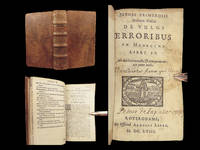
165827985<p><strong>1658 Medicine 1ed Primrose Errors v William Harvey Tobacco Napoleon III interest</strong></p><p>James Primrose was a 17th-century English physician who is best remembered for his opposition to William Harvey. One of Primrose's most important works was his '<em>Treatise on Errors in Medicine</em>' first published in 1638. In this work Primrose identifies many of what he considered to be inaccuracies in medicine. It contains descriptions on melancholy pregnancy and childbirth epilepsy with attention even given to the medical effects of tobacco!</p><p>Item number: #27985</p><p>Price: $599</p><p>PRIMROSE James</p><p><strong><em>Iacobi Primerosii doctoris medici. De Vulgi erroribus in medicina libri IV</em></strong></p><p>Roterodami: ex officina Arnoldi Leers 1658. First only Leers edition.</p><p><u>Details</u>:</p><p><!-- if !supportLists-->· <!--endif-->Collation: Complete</p><p><!-- if !supportLists-->o <!--endif-->20 561 1</p><p><!-- if !supportLists-->o <!--endif-->P. 433-456 duplicated</p><p><!-- if !supportLists-->· <!--endif-->Language: Latin</p><p><!-- if !supportLists-->· <!--endif-->Provenance:</p><p><!-- if !supportLists-->o <!--endif--><strong>Armorial Bookplate – Victor de Laprade</strong></p><p><!--endif--><strong>Victor de Laprade 1812–1883 was a 19th-century French poet and literary critic. He served as a professor of French literature at Lyon until he was fired for publishing a satirical poem that was highly critical of Napoleon III and the Second Empire. Laprade's prose criticisms consist of classical and metaphysical studies as well as wide-ranging commentary on European literature. He disliked irony and skepticism which probably lead him to underrate 18th-century literature. He was also elected to the National Assembly as a conservative in 1871.</strong></p><p><!-- if !supportLists-->o <!--endif-->Handwritten – <em>Petrus De Laplasse</em></p><p><!-- if !supportLists-->· <!--endif-->Binding: Leather; tight and secure</p><p><!-- if !supportLists-->· <!--endif-->Size: ~5.25in X 3in 13cm x 8cm</p><p>Our Guarantee:</p><p>Very Fast. Very Safe. Free Shipping Worldwide.</p><p>Customer satisfaction is our priority! Notify us with 7 days of receiving and we will offer a full refund without reservation!</p><p><u>Photos available upon request. </u></p> ex officina Arnoldi Leers hardcover
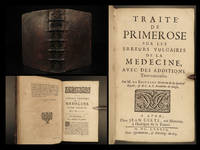
168920278<p><b>1689 1ed James Primrose Errors in Medicine Harvey Melancholy Tobacco Epilepsy</b></p><p>James Primrose was a 17th-century English physician who is best remembered for his opposition to William Harvey. One of Primrose's most important works was his '<i>Treatise on Errors in Medicine</i>'. In this work Primrose identifies many of what he considered to be inaccuracies in medicine. It contains descriptions on melancholy pregnancy and childbirth epilepsy with attention even given to the medical effects of tobacco! </p><p>Item number: #20278</p><p>Price: $599</p><p>PRIMROSE James</p><p><b><i>TraiteÌ de Primerose sur les erreurs vulgaires de la medecine</i></b></p><p>Lyon Jean Certe 1689. First edition.</p><p><br /></p><p><u>Details</u>:</p><p>· Collation: Complete with all pages</p><p>o 24 860</p><p>· Language: French</p><p>· Binding: Leather; secure</p><p>· Size: ~7.25in X 4.75in 18.5cm x 12cm</p><p>Our Guarantee:</p><p>Very Fast. Very Safe. Free Shipping Worldwide.</p><p>Customer satisfaction is our priority! Notify us with 7 days of receiving and we will offer a full refund without reservation!</p><p>20278</p><p>Photos available upon request. </p> Jean Certe hardcover
1950250221New York 1950. unbound. 1 page 6.75 x 5 inches New York City no date circa 1950. This extremely rare letter was written to William Vandenberg and mentions Victor Gottlieb in full: "The housekeeper did not understand when you are staying but fortunately found out from Victor Gottlieb. Will be at my number from mid-day until 3 pm. Please call me. Sincerely William Primrose." Most likely written in 1950 when all three icons appeared together as part of a concert at Carnegie Hall. Natural folds; traces of pencil notations in the top margin. Very good condition.<br/><br/> One of the greatest violists best known for his tremendous technique and early association with Arturo Toscanini. He left the NBC Symphony Orchestra in 1941 for a commission with Bella Bartok who died before its completion. As one of the most sought after violists he insisted on collaborating with the likes of Micha Elman Jascha Heifetz and Fritz Kreisler etc.<br/><br/> unknown books
1950250221New York 1950. unbound. 1 page 6.75 x 5 inches New York City no date circa 1950. This extremely rare letter was written to William Vandenberg and mentions Victor Gottlieb in full: "The housekeeper did not understand when you are staying but fortunately found out from Victor Gottlieb. Will be at my number from mid-day until 3 pm. Please call me. Sincerely William Primrose." Most likely written in 1950 when all three icons appeared together as part of a concert at Carnegie Hall. Natural folds; traces of pencil notations in the top margin. Very good condition.<br/> <br/> One of the greatest violists best known for his tremendous technique and early association with Arturo Toscanini. He left the NBC Symphony Orchestra in 1941 for a commission with Bella Bartok who died before its completion. As one of the most sought after violists he insisted on collaborating with the likes of Micha Elman Jascha Heifetz and Fritz Kreisler etc.<br/> <br/> unknown
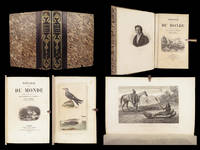
183928746<p>Very Good. First edition. Paris: P. Pourrat Frères 1839. Two volumes octavo. Bound in matching 19th-century quarter calf over marbled boards with gilt-decorated spines. Secure binding internally clean aside from even age toning and mild foxing. A complete copy featuring 41 full-page engravings illustrating ethnographic scenes animals and botanical specimens encountered during the French scientific expedition of the La Coquille from 1822 to 1825. Authored by René Primevère Lesson ship's surgeon and naturalist this narrative is foundational in French maritime and scientific literature covering a route through South America Oceania and Southeast Asia. Includes observations on indigenous cultures and biodiversity including detailed coverage of Brazil Tahiti Port Jackson New Guinea and Mauritius. Plates are clean impressions on thick stock. A desirable and historically significant work from the early 19th-century era of scientific exploration. QUESTIONS AND PHOTO REQUESTS WELCOME.</p> P. Pourrat Frères hardcover
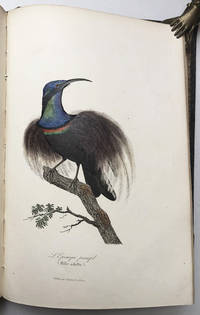
1839Flo441<p>Very good copy of the plates volume only from Lesson's supplement to Buffon's massive Natural History</p><p>Complete with 118 fine handcoloured stipple-engraved plates 70 mammals and 48 birds</p><p>Many of the plates depict extinct or endangered species.</p><p>Includes the red panda or lesser panda Ailurus fulgens endangered on a plate with a hog badger Arctonyx collaris.</p><p>Includes three extinct species: Tasmanian tiger Thylacinus cynocephalus South Island kokako Callaeas cinereus and Delalande's coua Coua delalandei.</p><p>Nine critically endangered species: Spix's macaw Cyanopsitta spixii screwhorn antelope Addax nasomaculatus Indri or babakoto Indri indri red ruffed lemur Varecia rubra Talaud bear cuscus Ailurops melanotis Short-tailed chinchilla Chinchilla chinchilla Javan rhinoceros Rhinoceros sondaicus midget buffalo Bubalus depressicornis and North Atlantic right whale Eubalaena glacialis.</p><p>11 endangered species: red panda or lesser panda Ailurus fulgens Western barred bandicoot Perameles bougainville Bornean orangutan Pongo pygmaeus purple-faced langur Trachypithecus vetulus wild dog or dhole Cuon alpinus banded hare-wallaby or munning Lagostrophus fasciatus Malayan tapir Tapirus indicus South Asian river dolphin Platanista gangetic Sei whale Balaenoptera borealis Micronesian scrubfowl Megapodius laperouse Kuhl's lorikeet Vini kuhlii and New Zealand kaka Nestor meridionalis.</p><p>René Primevère Lesson 1794-1849 was a French surgeon naturalist ornithologist and director of the Rochefort zoological garden. A medical officer in the royal navy he was second surgeon aboard the <em>Coquille</em> on Duperrey's scientific expedition from 1822 to 1825. He is most famous for his works on hummingbirds <em>Histoire Naturelle des Oiseaux-Mouches </em>and<em> Histoire Naturelle des Colibris</em> 1830-31.</p><p>Red morocco spine decorated in black and gilt blue marble boards leather rubbed and boards scuffed and worn at edges. Lacks title page complete with 118 fine engraved plates all with delicate handcolour. A few plates with faint spotting. No artist or engraver information on the plates but many Australian species some copied from Charles Alexandre Lesueur's illustrations to Peron and Freycinet's <em>Voyage of Discovery</em> 1807.</p> Pourrat Freres hardcover