"VEBLEN, THORSTEIN.Livre Rare Book

1 156 résultats
190848625(Boston, Stanford University Press), 1908. 8vo. Two offprints in the original printed wrappers. Offprints from ""Quarterly Journal of Economics"", Vol. XXII, August & Vol. XXIII, November 1908. Vol. XXII: Backwrapper detached, a few small nicks to extremities. Vol. XXIII: Front wrapper detached. Fine and clean. Pp. 517-42"" Pp. 103-136.
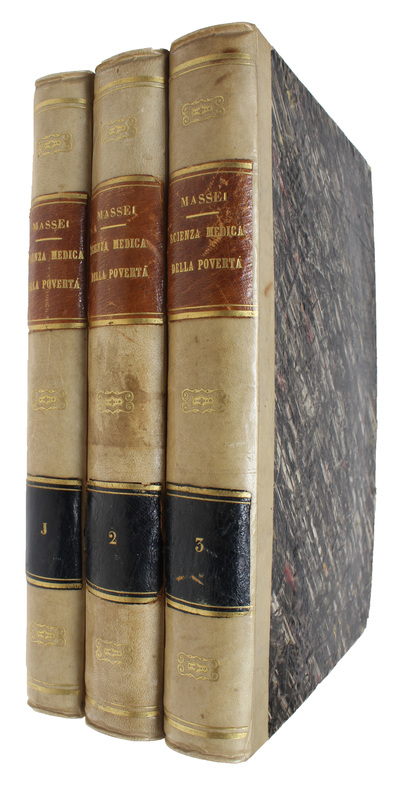
185849019Firenze, M. Cellini, 1858. 8vo. In three uniform contemporary half vellum over marbled boards with black and red title label to spine amd gilt ornamentation. Occassional brown spots throughout, otherwise fine. XXVI, 383, (2) pp. IV, 550, (2) pp. IV, 498, (2) pp.
180850887Innsbruck, Schiffner, 1808. 8vo. Contemporary full calf. Extremities with wear and upper part of spine lacking small part of leather. Internally very fine and clean. 62 pp.
26243A Paris, De l'Imprimerie de Sébastien Jorry, 1768. Frontispice by Jean Massard after Charles Eisen representing the young Dauphin, the future Louis XVI, running after the shadow of his father, the Dauphin Louis, who died in 1765. xxxiv, 586, (2) pp. 8vo. Contemporary marbled calf, spine richly gilt with raised bands, label with gilt lettering, marbled edges, gilt triple fillet on sides, very lightly rubbed. INED 2163 (edition 1790 in 2 volumes in 12mo); Higgs 4522; Goldsmiths 11087 (the 1774 edition); Kress S.4524; not in Mattioli; Einaudi A.348 (the 1774 edition); Lichtenberger, Le Socialisme au XVIIIe Siècle, pp. 391-393. First edition of the major work by the Abbé Gros de Besplas, the preacher of Louis XV. While property, society and religion were subjected to violent attacks in the writings of the philosophes, only very few "abbé's" introduced the subject of political economy into their sermons, some even to the point where they were called to order by the ecclesiastical authorites. Among them, the Abbé Gros de Besplas, while not believing in the utility of important and profound reform, argued that public welfare, of which religion and the monarch were the principle guards, follows from possession of the "necessary", a certain abundance, and being subjected to work. Gros de Besplas strongly condamns celibacy, mendicity and "le luxe" which, he feels, must be suppressed by means of heavy taxes, deplores the fallow land for want of instruments and machines in the hands of those who work the land, and argues for a more even distribution of land in "accord avec la justice". The subjects of the monarch, or any ruler, have four important rights: the right to life, the right to be free, the right to own property, and the right to be protected. From this Gros de Besplas arrives at a socialist theory of property: the property of land belongs to society as it can not belong to any particular man. To his politically moderate ideas Gros de Besplan attaches more radical ideas concerning property.The engraved frontispiece is preceded by a leaf which contains verso an "Explication du Frontispiece." Rare: only Higgs and Kress have the original edition.
4571A Soissons, et se trouve à Paris, Chez P.G. Simon, 1764. With woodcut device on title. (2), 76 pp. 8vo. Modern marbled boards, red label with gilt lettering (Laurenchet). Kress 6201; Einaudi 3362; Higgs 3306; Mattioli 1971; INED 2877 (edition 1765); Weulersse, i, xxvii; not in Goldsmiths; Granier, Bibliographie Charitable, 1330; not in Dada. Very rare first edition. Guillaume François Le Trosne (1728-1780) joined the physiocrats in 1764, contributing articles to their journals, and writing works defending their ideas. 'He became one of the most lucid exponents of the physiocratic doctrine; his views express most clearly the evolution of the school. At first an enthusiastic, inflexible adept of the abstract physiocratic system, he nevertheless evidenced a preference for practical questions, as reflected in his La liberté du commerce des grains, toujours utile et jamais nuisible (Paris, 1765).In this work, Le Trosne condemns the vagabond as a parasite on, and an enemy of, society. 'Only in politics did he remain absolutely faithful to absolutism ..... and hostile to democracy, that 'bizarre and monstrous' government which he doubtless pictured in the form of the violent popular demonstrations against the dealer in wheat or as personified by the vagabonds who had set fire to one of the farms of the magistrate' (ESS). Discusses the current situation in France, measures, legal and otherwise, taken to combat or remedy the situation, discusses the distinction to be made between vagabonds and beggars, and discusses possible solutions, one of which is condamning vagabonds to the galleys, and ends with a project for beggars and ways to combat mendicity. 'Ils provoquent le renchérissement de la main-d'oeuvre, car leur oisiveté diminue le nombre des travailleurs; ils favorisent encore l'augmentation des tailles' (INED: They cause the increase of cost of manpower, of labour, as their idleness reduces the number of workers; they rather favor the increase of the "tailles" (a tax)" (our translation)).
191144948New York, Macmillan, 1911. 8vo. In the original full cloth. Library-label (University Club of Chicago) pasted on to pasted down front free end-paper. Wear and soiling to extremities. Text on spine faded and ""F1"" wirtten in white to spine. Cloth loosend to back of spine and a 2 cm long tear to the middle of spine. Book-block, however, firmly attached. Internally fine and clean. XXII, (2), 505 pp.
193237334London, Macmillan & Co., 1932. 8vo. Orig. full brown cloth w. gilt lettering to spine. Orig. brown dust-jacket w. wear and a bit of loss to corners and capitals. Otherwise and excellent and clean copy w. only some occasinal minor brownspotting. XIV, 247 pp.
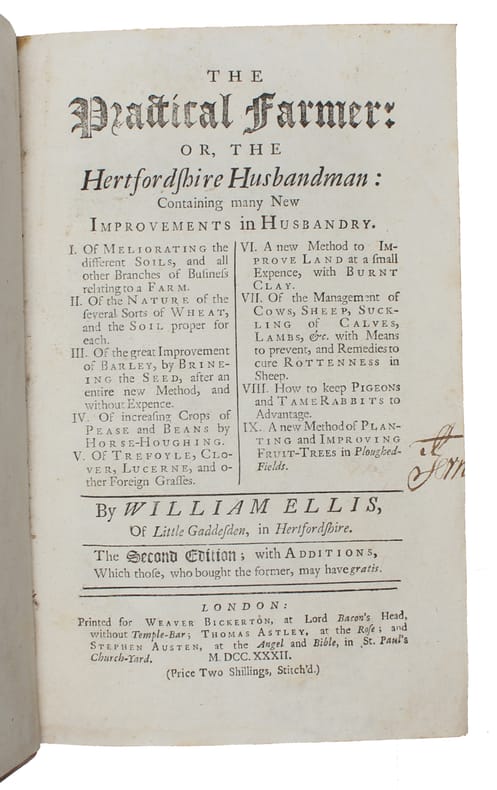
173260891London, Weaver Bickerton, 1732. 8vo. In contemporary full calf with five raised bands and richly gilt spine and gilt boarders to boards. Traces from small paper-label pasted on to top of spine. Light miscolouring and a few scratches to boards. Previous owner's name to title-page in contemporary hand. IV, 5-171, (7), 54, (8) pp.
4449A Paris, Chez Ganeau, Bauche, les Frères Estienne, d'Houry, 1767. With numerous (over 200) illustrations in the text and 2 folding engraved plates. 3 volumes. (4), xvi, 959, (1, blank) pp.; (4), 919, (1, blank) pp.; (4), 909, (1, approbation, privilège du roi) pp. Folio. Contemporary marbled calf, spines with raised bands, labels with gilt lettering, bindings expertly repaired. Kress 6417; Goldsmiths 10261; Higgs 3976; Musset-Pathay 437; this edition not in Einaudi; Vicaire, Gastronomie, 173, Thiebaud, Chasse, 202-204. The best and entirely revised edition by De la Marre, incorporting the new discoveries by Duhamel and others. This was by far the most popular and important work on domestic economy in the 18th century, dealing with domestic chemistry, the keeping and caring of domestic animals, recipes for food and home-made medicine, beauty and health suggestions. It is of course also an attractive and illustrated dictionary on agriculture, gardening, botany, huntig, breading of animals, bee-keeping, vineyards, gastronomy, hunting, and so forth and alphabetically arranged. The work enables a person to be completely self-supporting and to produce for a market.'Le Dictionnaire oeconomique a joui d'une grande réputation. Il est même encore estimé aujourd'hui. Mais il faut considérer cet ouvrage dans deux états differens, tel qu'il était en 1709, lorsqu'il sortit des mains de l'auteur, agé alors de 76 ans, et tel qu'il parut en 1767 par les soins de M. de la Marre. Cette édition est préférable à la première et à celles qui ont paru entre ces deux époques, parceque l'éditeur a eu soin de la corriger et de l'enrichir des découvertes de Duhamel, etc.' (Musset-Pathay, who has a large article on Chomel and his work on page 300-301).
26333Avignon, 1758. 59, [1] blank pp. 8vo in 8s and 4s. Uncut in original grey stiff wrappers; paper spine label. Mars 48; OCLC lists just a microform copy; INED 2080; not in Kress, Goldsmiths' or Einaudi. First edition, uncommon of Goudar's response to l'abbé Soumille's proposals, expressed in a number of pamphlets, on the mechanisation of agriculture, especially the introduction of multiple seeding machinery. Goudar argues against it because this would lead to depopulation of the land. "Of the pre-physiocratic French writers who approached the population problem in terms of agricultural values and reforms, Ange Goudar (1720-1791) was the most important" (Joseph J. Spengler, French Predecessors of Malthus, p. 57-69 with elaborate discussion of Goudar and his works.)
194436929New York & London, Harper & Brothers Publishers, (1944). Royal 8vo. Orig. full green cloth w. gilt lettering to spine. A bit of bumping to capitals and corners, but a nice, clean and fresh copy in the original dust-jacket, which is usually lacking. D-j. w. a bit of wear to extremities, but overall unusually fine. Not price-clipped. LIX, (1), 1483 pp.
178448219Perth, Robert Morison, 1784. 8vo. contemporary full calf with red leather title-label and gilt lines to spine, forming 6 compartments. Signed by Robert Morison. Extremities with wear back board with nicks and discolouring. Internally fine and clean. (16), 349, (2), 302-317 pp.
175360551Paris, Estienne et Fils, 1753. 4to. In a nice comtemporary full calf binding with five raised bands to spine. Red leather title-label with gilt lettering to spine. Compartments with gilt ornamentation. Small paper-label pasted on to upper compartment indicating the library number from an estate library. Ex-libris pasted on to pasted down front end-paper. A fine and clean copy. (blank), (4), XII, 280, 206, (2), (blank) pp.
173560740Amsterdam, Changuion, 1735. 8vo. In contemporary full sprinkled calf with five raised bands with richly gilt spine. Gilt frame to boards and edges of boards gilt. Small paper label pasted on to upper compartment of spine. Extremities with wear, boards with scratches and missing small part of the leather. Internally very fine and clean. (14), 251 pp.
192646180Oslo, Grøndahl & Søns, 1926. 8vo. In the original modest boards with cloth to spine. Red library stamp to front board and top of first page. Otherwise fine and clean. 40 pp.
175354770Paris, Estienne et Fils 1753. 4to. In a nice comtemporary full sprinked calf binding with five raised bands to spine. Red leather title-label with gilt lettering to spine. Comportments with gilt ornamentation. Binding with a few repairs. Small white paper-label pasted on to top left corner of pasted down front free end-paper and small stamp to top right corner of half-title. A [blank], (4), XII, 280, 206, (2), [blank] pp.
16641A Leyde, & se vend à Leipsick, en Foire, Chez J.F. Bassompierre, Fils, 1768-1774. With engraved portrait-frontispiece and five folding tables. 3 volumes. xii, 608 pp.; iv, 635, (1) pp.; xvi, 800 pp. 8vo. Contemporary marbled calf, spines gilt with raised bands, red labels with gilt lettering, red edges, a bit rubbed. Not in Kress; not in Goldsmiths; not in Einaudi; not in Humpert; INED 496 (vols 1-2 only); Higgs 2422; Leblanc 240; Carpenter, Economic Bestsellers, XX.9. Improved, revised and augmented edition, with the third volume. Baron Bielfeld was personal advisor to Frederick II of Prussia and mentor to Prince Ferdinand. His Institutions aims at examining the foundations of the modern state and at outlining a science of government. His perspective is economic as well as political; his leanings are towards policies of free trade, granting timely independence to colonies, and the fight against poverty. He traces a history of political arithmetic citing Graunt, Petty, Süssmilch and the English and French 'calculateurs', and examines the sources of the wealth of nations, devoting particular attention to trade, and mentioning the effects of American lands and resources on Spain and Britain.'Cet ouvrage est écrit à l'usage des gouvernants. Il concerne l'art de règner. Bielfeld veut réduire la politique en système, la transformer en une science qui puisse être enseignée. Il divise ses Institutions Politiques en deux parties: 1: Tout ce qui regarde l'intérieur d'un État: cadre législatifs et politiques, finances, manufactures, commerce, navigation, armée, marine ....; 2: Tout ce qui concerne la politique étrangère et les rapports d'un État avec les autres puissances' (Leblanc).'This is essentially a cameralistic guide for rulers. Bielfeld, although a German, first published his books in French; he relied in large measure upon the French data and writers' (Spengler, French predecessors of Malthus, p. 79). The Supplément aux Institutions Politiques pour cette nouvelle édition is to be found in the second volume covering the pages 557-628."This Cameralistic treatise is by a Prussian state official. It was more successful outside Germany than any other Cameralistic work, presumably because it was written in the international language of the Eighteenth Century -- French" (Carpenter, Economic Bestsellers, XX.9).
18538A Paris, Chez l'Auteur, A Geneve, Chez Franç. Dufart, 1787. With 2 folding tables and 2 folding engraved plates. (8), 125, (1, errata), (2, prospectus) pp. 4to. Contemporary marbled calf, spine gilt with raised bands, very lightly rubbed, upper cover with a stain. Kress B.1204; Goldsmiths 13438; INED 1715; not in Einaudi; Biblioteca Mansutti, 564; Bibliothèque de la Compagnie d'Assurances Utrecht, i, p. 619. First edition and very rare. Du Villard de Durand, born in Geneva of an ancient French Huguenot family, was head of the statistical department of population in the office of the French ministry of the Interior. His treatise on the theory of loans repayable by constant or variable annuities was published under the auspices of the 'Académie Royale des Sciences' in Paris, with a preface by Condorcet recommanding it. In this work one also finds a demographic analysis to determine the appropriate rate on a loan which the borrower undertakes te repay in equal instalments over his lifetime.'He attempts to measure the desirability of an investment by using the expected rate of return. He also shows how one may find the period for which a given investment may give the maximum rate of return' (R.D. Theocharis, Early Developments in Mathematical Economics, p. 85). - With a name and a number in an old hand written on half-title. Rare and an important contribution to the history of mathematical economics.
181862961Kjøbenhavn, Schultziske Officin, (1818). 8vo. In a bit later full cloth binding with gilt lettering to front board. Ex-libris (Axel Helper) pasted on to verso of front board. Previous owner's name to title-page. Occassional brownspotting throughout and vague dampsstain to last two works. 38, 4, 29 pp.
17043A Londres, 1775. With 1 folding map and 4 folding tables. viii, 293, (1) pp. 8vo. Contemporary marbled calf, spine gilt in compartments, red morocco label with gilt lettering, gilt triple fillets on sides, red edges. Kress 7170; Goldsmiths 11330; Einaudi 5517; INED 4798; Higgs 6403; Peignot, Livres Condamnés, i, p. 141. First edition. Severely prosecuted attack on the Fermiers-Généraux, forbidden already in 1776. 'Diatribe sanglante contre les fermiers généraux et les abus scandaleux de leurs agents. L'auteur met en scene un malheureux dont les 'suppôts de la ferme' ont ruiné la famille et fait périr le père de chagrin' (INED). According to a manuscript note in the Kress copy: '..... l'on croit que cette sanglante diatribe des fermiers généraux a été composée, imprimée et répandue sous les auspices du ministère actuel (celui de Turgot & Malesherbes).'This, in fact, is the first edition of a work which became better known under the title "L'Ami du Peuple François, ou Mémoire adressée à Mr. Turgot, ....." published at Limoges one year later (1776). Even the motto in both works is identical: "Ni Ferme ni regie: l'une et l'autre font la perte des Etats." The present work contains the same text as the "L'Ami du Peuple" (upto page 84, and then the pages 256-269) and contains in addition much detailed information about the taxes. It was probably deemed to complex or technical and was published again in 1776 as "L'Ami du Peuple François" this time omitting the detailed information about the taxes. The work suggests Turgot to abolish the tax system in use as it is injust and odious, of relatively little profit to the king but very profitable for the taxfarmers and hard-pressing on the population. The work describes in detail the various taxes in existence, their effects, the cruel practises of the taxfarmers, the uneven division of the taxes and the disastrous effects.It is told in the form of a story: the anonymous author recounts the story of his father and his family and how they were, little by little, driven to complete ruin. His father, responsible for the collecting of taxes in his village, is thrown in jail and his possessions confiscated by the taxfarmers because of his inability to raise the requested taxes from the other taxable inhabitants of his village.
16502A Paris, Chez J.B. Coignard & De Bure, 1746. With numerous tables in the text, and 1 folding table. 2 parts in 1 volume. xxi, (3, approbation, privilège du Roi, Fautes à corriger dans la première partie; Fautes à corriger dans les Variations des Prix), 220 pp.; 188 pp. 4to. Contemporary marbled calf, spine gilt with raised bands, red label with gilt lettering, somewhat rubbed and worn. Kress 4804; Goldsmiths 8235; Einaudi 1687; INED 1643; Stourm 42. First edition. Very interesting for the medieval history, giving details on money and extensive information on prices for various commodities, including cornprices, for the period 1202-1746. The Physiocrats used his work often and abundently for statistical details: 'Dupré de Saint Maur, leur guide habituel en matière de statistique .....' (Weulersse, ii, p. 622.)'This work would, perhaps, have been more properly placed along with works on prices. It is full of elaborate researches with respect to the value of money at different periods; and contains tables exhibiting the successive variations in the quantity of silver in the coins, and the prices of a great variety of commodities from the early part of the 13th down to near the middle of the 18th century. Dr. Smith has borne testimony to "the diligence and fidelity" with which M. de Saint Maur has formed his table of prices' (McCulloch, p. 188).
16503A Paris, Chez J.B. Coignard & De Bure, 1746. With numerous tables in the text, and 1 folding table. 2 parts in 1 volume. xxi, (3, approbation, privilège du Roi, Fautes à corriger dans la première partie; Fautes à corriger dans les Variations des Prix), 220 pp.; 188 pp. 4to. Contemporary marbled calf, spine gilt with raised bands, label with gilt lettering. Kress 4804; Goldsmiths 8235; Einaudi 1687; INED 1643; Stourm 42. First edition. Very interesting for the medieval history, giving details on money and extensive information on prices for various commodities, including cornprices, for the period 1202-1746. The Physiocrats used his work often and abundently for statistical details: 'Dupré de Saint Maur, leur guide habituel en matière de statistique .....' (Weulersse, ii, p. 622.)'This work would, perhaps, have been more properly placed along with works on prices. It is full of elaborate researches with respect to the value of money at different periods; and contains tables exhibiting the successive variations in the quantity of silver in the coins, and the prices of a great variety of commodities from the early part of the 13th down to near the middle of the 18th century. Dr. Smith has borne testimony to "the diligence and fidelity" with which M. de Saint Maur has formed his table of prices.' (McCulloch, p. 188). - A very fine copy.
26339A Londres, 1767. 2 volumes. (4), 496 pp.; (4), 528 pp. 8vo. Contemporary marbled calf, spine richly gilt with raised bands, labels with gilt lettering, sprinkled edges, marbled endpapers, some minor defects to joints but a very nice copy. Conlon 67:1044; Einaudi 3420; Goldsmiths 10377; Higgs 4251; INED 2930; Kress 6459. Usually described as the first edition, this probably is the second edition, preceded, in the same year, by an edition set from different type, having a different pagination and collation, and with errata. It still remains a scarce and important book by this predecessor of Marx. The Théorie des Loix civiles is Linguet's Magnum Opus in which he refocused earlier reflections on history, retrospective cultural anthropology, law, political economy, and public administration, and integrated them into a theory of the origins of society, the organization of its institutions and cultural superstructures, and the dynamics and directions of its development. It is a refutation of Montesquieu and the Physiocrats, and one of the major achievements of early socialist thinking. Linguet's book was highly praised by Marx, particularly because of the thesis Linguet developed in the second book, 'On the Origin of Laws.' Linguet wrecked Montesquieu's illusory 'Esprit des Lois' with a single word: the 'esprit des lois is property.' 'Moreover, occupying himself almost entirely with the fate of living people, workers and peasants, and analyzing the mechanism of their condition, Linguet stands much nearer to the modern industrial socialists than to the first French socialist school, and he is one of the few writers before 1789 of whom could be said with good reason that he is more a predecessor of Karl Marx than an ancestor of Fourier or Cabet!' (Lichtenberger, Le Socialisme au XVIIIe siècle, pp. 288-305).In Linguet's perception that economic facts are more important in the life of the individual than political background Linguet was far in advance of any other thinker of his age. When in his Théorie des Loix civiles, perhaps his most important work, he declared that men could not be really free if "they must go upon their knees to a rich man to gain from him permission to increase his wealth," he was crudely foreshadowing the doctrine of surplus value. His fame died before him, but his ideas had an important influence on Karl Marx (see Encyclopedia of the Social Sciences, vol 9, pp. 488-489).
26118Bourg (Ain), Chez Janinet, Imprimeur-Libraire du Roi, 1819. 64 pp. 8vo. Stab-sewn in original pale yellow covers, a bit frayed at edges. Not in Kress; not in Goldsmiths; not in Einaudi; not in Mattioli; Louandre & Bourquelot, iv, p. 153 for other works by the author but not this one; Quérard, iii, p. 451, listing the third edition published in 1821. First edition. The author, inhabitant of Treffort in the department l'Ain, was a prolific philantropist. In this curious work he exposes with much details a revolutionary financial project which he would like to see implemented in all civilized nations. The gist of the project is no less than the abolition of all taxes: they will be replaced by a voluntary contribution: "C'est sur l'orgueil, le luxe et l'amour-propre que je vais proposer d'établir un impôt." The method is simple and clear: no-one is allowed to decorate his horses, carriages, clothes, furniture, harness, etc. etc. unless a license has been bought. Granier's argument is based on human nature: if something is dear to someone, he will want it; if it distinguishes it is appreciated and desired, and the more it is wanted. Hence, many will pay to be able to obtain what they want and what will distinguish them from others. Granier also deals with possible objections to his project, gives calculations of income generated through his project, and exposes clearly the unjust and uneven division of taxes in existence: a day-worker pays 15 % taxes on his glass of wine, whereas those who can afford to purchase wine "en gros" pay only 5%!Granier is the author of various other works: Moyen d'améliorer l'état social en diminuant l'excès de la fréquentation des cafés, billards, ...., Moyen d'éteindre la mendicité, d'améliorer le sort des pauvres .... and of Moyen pour produire spontanément et à peu de frais un moteur capable de suppléer aux pompes de feu ..... A very nice copy, a bit spotted, uncut.
23858A Paris, Chez l'Auteur, Février 1825. 15 works bound in one volume. (4), 120 (misnumbered 119) pp.; one dedication leaf, 38 pp.; 20 pp.; 28 pp.; 119, (1) pp.; (2) pp.; 4 pp.; 23, (1) pp.; 55, (1) pp.; 31, (1) pp.; 24 pp.; (2), xvi, 236, 96 (Appendice) pp. + 4 leaves with tables numbered 111-117; 8 pp.; 15, (1) pp.; 86 pp. 8vo. Contemporary half calf, marbled boards, blue label to spine reading 'Chambres des Députés, session 1825. Objects DIV Tom II', and red label reading 'Réduction de la Rente par Armand Seguin', at foot of spine the number '12' gilt stamped. I: Kress C.1553; Goldsmiths 24599; not in Einaudi. II: Kress C.1554; Goldsmiths 24600; not in Einaudi. III: Kress C.1551; Goldsmiths 24598; not in Einaudi.IV: Kress C.1550; Goldsmiths 24597; not in Einaudi.V: Kress S.5636; not in Goldsmiths; not in Einaudi.VI: Kress C.1548; not in Goldsmiths; not in Einaudi.VII: Kress C.1557; not Goldsmiths; not in Einaudi.VIII: Kress C.1547; not in Goldsmiths; not in Einaudi.IX: Kress C.1549; Goldsmiths 24596; not in Einaudi.X: Kress C.1552; not in Goldsmiths; not in Einaudi.XI: Kress C.1556; Goldsmiths 24602; not in Einaudi.XII: Kress C.1788; not in Goldsmiths; not in Einaudi.XIII: Not in Kress; not in Goldsmiths; not in Einaudi.XIV: Kress C.1583; not in Goldsmiths; not in Einaudi.XV: Kress C.1407; not in Goldsmiths; not in Einaudi.All first or only editions with the exception of number 11.Armand Séguin made a fortune by winning the contract to supply the French revolutionary armies with boot leather. Napoleon, who had no love for profiteers, tried to reduce his fortune through taxes and fines but failed. Séguin survived the Empire and the Restoration and lived thereafter the life of an eccentric, Balzacian rentier, devoting most of his intellectual energies after 1815 to the composition of pamphlets on government finance. He is best known for his memoirs on heat and respiration and as Lavoisier's assistant from 1789 to the latter's death in 1794. - Second work with a printed dedication leaf, the fifth work with a handwritten and signed dedication, the work by Delon (number 13) has a somewhat larger size and has been folded to fit into the volume.