(BENEKENDORF, Karl Friedrich von)Antiquariat.de

21 158 résultats
1776269431Berlin, Pauli, 1776-84. 4to. Pappbände d. Zeit mit 4 (von 7) Rückenschildern (fleckig, berieben u. bestoßen, Vorsatzpapier meist von den Deckeln gelöst, Band 8 mit Wasserschaden, Vorderdeckelbezug fehlt). [2 Warenabbildungen]
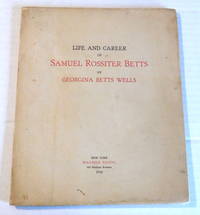
193496603New York: Maurice Sloog 1934. 1934. Very good. - Small quarto 9-3/4 inches high by 7-1/2 inches wide. Softcover bound in printed cream wraps titled in black & red on the front cover. The covers are soiled with darkened edges and a few tiny stains. 38 & 1 pages illustrated with 2 black & white plates consisting of portraits of Betts and his wife. There is a crease to the top corner and top edge of the first few leaves with some minor faint dampstaining to the the top of Betts' portrait and the following page. Very good. <p>Limited edition of 350 numbered copies printed by the Argonne Press.<p>RARE in commerce.<p>A United States Congressman from New York Samuel Rossiter Betts 1786-1868 served as a United States District Judge of the U.S. District Court for the Southern District of New York. A graduate of Williams College Betts studied law with Thomas P. Grosvenor in Hudson NY and entered private practice in Monticello. After serving as Judge advocate of volunteers during the War of 1812 and a subsequent position as a judge advocate of general court Martial for New York's militia Betts was elected to Congress. He subsequently resumed private practice and then served on the Supreme Court of New York before being appointed to the United States District Court for the Southern District of New York by John Quincy Adams. New York: Maurice Sloog, 1934. paperback
187726792Brooklyn: R.M. Whiting & Co. 1877. 1877. Very good. - sc Octavo. Disbound lacking the covers. 326 pages plus appendices consisting of 266 pages comprising The Charter of 1854; plus 15 pages; and 36 pages. The title page is detached and chipped at the edges and the first and last signatures are loose though present. There is a short tear and creasing to the bottom edge of the last few leaves. A complete copy of this rare book which would be well-worth rebinding. Brooklyn: R.M. Whiting & Co., 1877. unknown
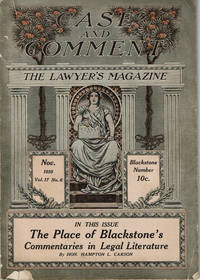
191036749New York: Lawyers Co-operative Publishing Co. 1910. 1910. Good. - Octavo softcover bound in pictorial wrappers. The binding is chipped with dampstaining to the rear cover. There are pieces out of the head & tail of the spine & the top & lower ends of the front cover are detached. Pages 269 to 322 plus 18 pages of ads. Black-and-white illustrations and pictorial ads. There is light rippling from humidity to the top corners of the pages with dampstaining to the last page & the inside rear cover. There is some creasing & occasional soiling. Good. <p>This issue concerns the life and work of eighteen-century lawyer and member of Parliament Sir William Blackstone who according to the editor's opening essay "idealized English law and made it rational". The featured article is "The Place of Blackstone's Commentaries in Legal Literature" by Hampton L. Carson.<p>Scarce. (New York: Lawyers Co-operative Publishing Co.), 1910. paperback
18836Londres, 1775. 2 volumes in 1. (1), 155, (1) pp.; 275, (3) pp. 8vo. Contemporary marbled calf, spine gilt with raised bands, red morocco label with gilt lettering, small damage to joint at the foot of the volume. First work: Kress 7193; not in Goldsmiths; not in Einaudi; this edition not in INED; cf: Camus 1566; Peinot, Livres Condamnés, i, p. 43 (with wrong date). Third edition, published in the same year as the first edition, first edition with this title. Pierre-François Boncerf, French writer on agrarian subjects. While a clerk in the ministry of finance under Turgot he published a pamphlet, Les inconvénients des droits féodaux. According to Palgrave the work was published with the consent of Turgot. In it he attacked the contemporary system of feudal dues as ruinous to those who pay them, of little advantage to its benificiaries and contrary to the principles of freedom. The solemn condemnation of the pamphlet by the parlement of Paris, which the king vetoed, and the ensuing controversy in the press, in which Voltaire took a prominent part, established Boncerf's reputation and resulted in the translation of the work into many European languages. The pages 70-end contain the relevant texts by Montesquieu. The first edition was published anonymously, the second edition under the assumed name M. Francaleu. Second work: Higgs 6537; INED 3188 (1831 edition); Martin & Walter 24430; not in Goldsmiths (see 11518 for the second edition).First edition. Philosophical and political study on despotism and its effects it pretents to refute the theories of Rousseau while the author in reality attacks straight forward the government. Of actual value seems again his remark 'La nation finit toujours par être plus puissante que le tyran lorsque le pouvoir arbitraire parvenu à son dernier délire a dissous tous les liens de l'opinion et épuisé les ressources que la terre offre à ceux qui la cultivent en liberté. Ainsi les hommes se vengent tôt ou tard.' 'Dans cet insolent libelle, intitulé Essai sur le Despotisme, sous couleur de réfuter les théories de Jean-Jacques sur la bonté naturelle de l'homme, l'auteur s'attaquait de front aux pouvoirs' (Duc de Castries, Mirabeau, p. 105). Important work proclaiming democratic ideas and openly attacking despotism: 'Après cette vue philosophique générale, l'ouvrage s'attaquait seulement au 'despotisme d'un seul'' (Duc de Castries, op.cit)
27235A Franckfort, Chez Joseph-André Vanebben, 1745. [8], 96 pp. Small 8vo. Modern half calf, corners, marbled boards, gilt lettering to spine. Querard 516: Conlon 45:606; INED 738; Goldsmiths' 8184; Kress S.3721; not in Einaudi; not in Mattioli. Scarce first edition of this interesting contribution to "the heated and prolonged debate on luxury that took place during the eighteenth century (which can be) best understood as part of the age's growing awareness of fundamental transformations taking place in its socio-economic order. Some of the period's most important and influential thinkers joined in this debate, engaging in what amounted to a comprehensive reevaluation of socioeconomic, political and economic thinking. (.....) This is undoubtedly one of the reasons why the debate on luxury resonated so widely and deeply. At its very inception, it called into question the nature and survival of traditional values in an evolving commercial civilization" (Encyclopedia of the Enlightenment, vol 2, p. 440.) L'auteur, né à Pondichery en 1690, mort à Paris en 1757, "distingue entre le luxe de génie qui est utile, et le luxe de moeurs, celui de la table, des habits et des meubles, qui est néfaste" (INED.)The "Letter" is followed by Examen du IXe chapitre de l'Essai politique sur le Commerce (by Melon), Lequel renferme une espece d'Apologie du Luxe, followed by Fragmens d'un Auteur Grec, trouvés depuis peu dans la Bibliothèque d'Oxfort, & traduits en François, which also deals with the topic of "luxe", and followed by Dialogue pourquoi il est si difficle aux personnes d'un certain mérite de s'avancer dans le monde.Boureau Deslandes Lettre sur le luxe, "written for the Académie royale des sciences de Paris and royal academies of St. Petersburg, London, Edinburgh, Bologna, Prussia, and Sweden, revealed his growing concerns that Frenchmen failed as subjects and citizens. The Lettre begins: "Luxury is a pernicious thing in a state." Boureau Deslandes defined luxury as "an agreeable or brilliant superfluity, that adds to postmortem the indispensable needs of life: they are goods, advantages that one can absolutely do without, but that one procures for oneself out of vanity, due to an intemperance of taste, often because of a strong attachment to what is in style; finally, it is an excess where the price or value depends solely on imagination, and that has nothing in itself to do with reality." He distinguished between two kinds of luxury: luxe de genie and luxe de moeurs. The first was a positive luxury that allowed for the progress of culture, and the development of beauty and perfection; the other led to the corruption of taste and morality. Boureau Deslandes lauded the "noblest" examples of art, painting, literature, philosophy, and science that attested to the "perfection" of culture and the "honor of the state." Such products contrasted against the luxe de table, luxe d'habits, luxe de meubles and "ridiculous" excesses that inundated the market. "France," he argued, "is now a country of decoration," where "simple mores conforming to nature are banished." Extravagance, he described, was most apparent in Paris, where trends in furniture and jewelry changed three times a year. Luxury, he continued, created disorder in the state by confounding orders and ranks. Clothes, fashion, and tastes tended toward uniformity until one failed to distinguish "those who by birth or by employment must necessarily be distinguished." Worse, useless commodities "ruined health" and "rendered men less strong, less courageous, less able to continue work." This luxe, Boureau- Deslandes warned, "prepared the liveliest nation for death"" (Takeda, Junko Thérèse. Between Crown and Commerce: Marseille and the Early Modern Mediterranean, p. 191 ff.) - A bit browned.
176055347No place, no publ., 1760. Small8vo. Contemp. Full mottled calf. Richly gilt spine. Titlelabel with gilt lettering. A paperlabel pasted on lower part of spine. Stamp on title-page. Title-page in red and black. (4),196 pp. Clean and fine, printed on good paper.
No place, no publ., 1760. Small8vo. Contemp. Full mottled calf. Richly gilt spine. Titlelabel with gilt lettering. A paperlabel pasted on lower part of spine. Stamp on title-page. Title-page in red and black. (4),196 pp. Clean and fine, printed on good paper.
1981A118617Canberra: A. G. P. S. 1981. 1st edition. Fine. tall octavo. softback with stiff wrappers vii 174pp. appends. bibliog. index Policy monograph No. 1 A. G. P. S. unknown
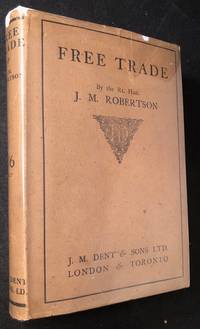
19193402New York: J.M. Dent & Sons 1919. First Edition. Hardcover. Very Good /Very Good. 5 X 7 1/2 Inches. 221 3 PP. Original red cloth boards clean and tight. Light offsetting to endpapers. DJ a bit worn at edges with a few small chips to top-edge. Robertson's now classic case for the elimination of taxes on imported goods in order to increase trade among countries as well as reduce the cost of goods for the average man. Housed in incredibly scarce original DJ with "3/6 NET" price on spine. J.M. Dent & Sons hardcover
187527012Philadelphia PA: Henry Carey Baird & Co. 1875. 1875. Good. - Octavo softcover bound in printed cream self-wrappers sewn with cream cord. 15 pages plus a 1-page publisher's catalog. The page corners are bumped with creases to the top page corners. There is some light staining to the title page & catalog. Good. <p>First edition.<p>A defense of the economic ideas of Henry C. Carey possibly written by his nephew Henry Carey Baird who popularized his ideas DAB.<p>Rare. WorldCat locates four copies in the U.S. and one in Europe. Philadelphia [PA}: Henry Carey Baird & Co., 1875. paperback
15622A Paris, Chez A.A. Renouard, 1822. 2 volumes. (4), 350 pp.; (4), 332 pp. 8vo. Contemporary half calf, spines gilt in compartments, gilt lettering, paper covered boards, corners. Not in Kress (cf.: 7197); not in INED (cf.: 1075); Goldsmiths 23385; Einaudi 1038. 'Chastellux's analysis of American society was both more searching and influential. A member of the French Academy, one of the founders of the social sciences, and major general on Rochambeau's staff, he was easily the foremost intellectual in the French forces in America. In ..... De la Félicité, he had sought to determine whether "society is susceptible, if not of perfection, at least amelioration," that is, of an increase in human felicity. (.....) The only possible answer was in social reform. The function of government, he posited, was to achieve "the greatest happiness of the greatest number." Man must create through the free and enlightened use of his reason a liberal government midway between the extremes of pure democracy and pure absolutism, based upon a true understanding of economic principles (Physiocracy), which would guarantee a high standard of living, adequate leisure, and the right to private property. In this work Chastellux had cited America as an example of man's ability to progress through liberty, reason, equality and agriculturism" (See at length: D. Echeverria, Mirage in the West, p. 110-14). - Somewhat paperspotted, handwritten ownership's entry "Ges. Gobin jeune" on verso front free flyleaf.
17918A Amsterdam, Chez M.-M. Rey, 1776. 2 volumes in 1. (4), xxii, 272, (2) pp.; (2), 247, (3) pp. 8vo. Contemporary marbled calf, spines gilt with raised bands. Kress 7197; Goldsmiths 11375; INED 1075; Echeverria & Wilkie 776/6; not in Sabin; not in JFBL; R. Darnton, The Corpus of Clandestine Literature in France 1769-1789, 258. Second edition, the work had been first launched in Amsterdam in 1772 before a French publisher dared to bring it on the market in France. That French publication was simultaneously with the present publication. 'Chastellux's analysis of American society was both more searching and influential. A member of the French Academy, one of the founders of the social sciences, and major general on Rochambeau's staff, he was easily the foremost intellectual in the French forces in America. In an earlier work, De la Félicité, he had sought to determine whether "society is susceptible, if not of perfection, at least amelioration," that is, of an increase in human felicity. (.....) The only possible answer was in social reform. The function of government, he posited, was to achieve "the greatest hapiness of the greatest number." Man must create through the free and enlightened use of his reason a liberal government midway between the extremes of pure democracy and pure absolutism, based upon a true understanding of economic principles (Physiocracy), which would guarantee a high standard of living, adequate leisure, and the right to private property. In this earlier work Chastellux had cited America as an example of man's ability to progress through liberty, reason, equality and agriculturism" (See at length: D. Echeverria, Mirage in the West, p. 110-14).
17155Londres (Paris?), 1751. 3 parts in 1 volume. (6), 112 pp.; 175 pp.; 171 pp. 12mo. Contemporary marbled calf, spine gilt in compartments, gilt fillet on sides, marbled edges, spine somewhat rubbed, slightly damaged at head and foot. Stourm 81; Conlon 51:499; INED 1094 (one part only); not in Kress; not in Goldsmiths; not in Einaudi. First edition. Legal and historical work dealing with Machault's plans to tax the ecclesiastical properties. The clergy maintained that they were exempt from tax and that whatever they paid was a voluntary gift. Chauvelin maintains that the clergy can not be exempt from taxes if the king thinks he ought to ask a contribution from them. The issue was hotly debated at the time, as the long list of works cited by Stourm shows. The work was condamned, Machault's plans failed and the exempt position of the clergy was maintained upto the revolution.
18038A Paris, Chez Briasson, 1740. xlviii, 238, (2), (239)-293 (misnumbered 269), (5) pp. 8vo. Contemporary marbled calf, spine gilt with raised bands and gilt lettering, all edges red. Kress 4491; Goldsmiths 7783; Einaudi 1037; Conlon 40:387; not in Mattioli. First edition of this history concerning the money of the Romans and antiquity, their finances, revenue, counterfeits and counterfeiting practices, forgery of antiquities, etc. The work by Chassepol (or Chassipol) is followed by the Dissertation written by Guillaume Beauvais.'Ce petit traité fut commandé par Colbert, desireux de connaître le système financier des Romains. On y trouve quelques faits précieux' (Coquelin & Guillaumin, i, p. 335). - From the Bibliothèque de Mr. le Baron Zangiacomi and the Bibliothèque de Mr. Laumonier.
1858DEMO010017IChicago: Democratic Press 1858. First edition. printed wrappers. Fine. 8vo 56 pages sewn in complete blue wrappers. Rare <br/><br/>With a Full Statement of Her System of Railroads & General Synopsis. Byrd 2887 -cites 4 copies; ANTE-FIRE IMPRINTS 302 Democratic Press unknown
18174Bruxelles (Chartres), 1788. (8), 174, (2) pp. 8vo. Modern half morocco. Renouvin, Assemblées provinciales, 235; Goldsmiths 13526; not in INED; not in Kress; not in Einaudi; not in Mattioli; not in Granier; not in Dada. First edition, very rare. 'Le seul résumé commode que les contemporains aient pu avoir entre les mains' (Renouvin). Survey of reports and results of the provincial assemblees in various provinces during the years 1778-1788, divided into the various subjects dealt with, such as: impositions - cadastre - grandes routes - commerce & manufactures - agriculture - mendicité - projets de bien public - etc.The author deals with economics and administration in a reforming spirit, close to the physiocratic ideas. Deals also with taxes, commerce, manufactures, agriculture, mendicity and public assistance. According to Goldsmiths the 'province' is Artois.
192029305Milan: Credito Italiano 1920. 1920. Very good. - Small quarto 9-3/4 inches high by 7-5/8 inches wide hardcover bound in natural vellum titled in black & with a vignette in black on each front cover. Yapp edges & cotton ties further enhance the binding. There is some light staining to the Vol. 1 covers with a short tear to the rear yapp. xiv & 238 pages plus 39 folding black-and-white plates in decorative green frames; and xiv & 1 leaf plus a folding plate & 255 tipped-in black-and-white plates in decorative green frames. There is minor staining to the bottom margins of a few of the Vol. 2 pages. Very good. <p>The folding plates in Volume 1 are views of Italian cities. The tipped-in plates in Volume 2 pertain to various industries--mining metallurgical electrical chemical automobile aviation etc.--and to other sectors of the economy such as agriculture shipyards hotels transport and communications. Milan: Credito Italiano, 1920. hardcover
16499A Londres et se vend à Paris, Chez la veuve Delormel & Fils, 1757. Together 4 works bound in 1 volume. (4), 60, 107, (1) pp.; xxiv, 224 pp.; 109, (1) pp.; 67, (1) pp. and 1 table. 8vo. Contemporary polished calf, spine richly gilt, raised bands, gilt triple fillets on sides, red label with gilt lettering, a very nice copy. First work: Kress 6086-7; Goldsmiths 9873; INED 1276; Higgs 3017. First issue of the first edition. In this vehemently written work, the fermiers-généraux were accused of corruption. It caused the author's imprisonment in the Bastille. The volume was printed by Lambert and distributed by Ormancy, who also were arrested. Four years after its publication the book was still sold secretly at high prices.Second work: Not in Kress; Conlon 75:640 (claiming two volumes).First edition.Of importance for the history of the years preceding the Revolution.Third work: Conlon 82:401.First edition.Fourth work: INED 620; Conlon 57:547.First edition.
16498A La Haye, 1764. Together 3 volumes in 1. (4), 60, 107, (1) pp.; (2), 26 pp.; 24 pp. 8vo. Contemporary marbled calf, spine gilt in compartments, red label with gilt lettering, red edges, lightly worn, some spots. First work: Kress 6086; Goldsmiths 9873; INED 1276; Higgs 3017; Conlon 63:751. First issue of the first edition. In this vehemently written work, the fermiers-généraux were accused of corruption. It caused the author's imprisonment in the Bastille. The volume was printed by Lambert and distributed by Ormancy, who also were arrested. Four years after its publication the book was still sold secretly at high prices. Second work: Not in Kress; Goldsmiths 10025; Higgs 3018; INED 4797; Conlon 63:752.First edition.According to Goldsmiths this is not by Darigrand, but a reply to Darigrand's work, INED also believes this work to be written by another, anonymous, author, Conlon lists it under Darigrand.Third work: Not in Kress; Goldsmiths 10020; Higgs 3268; INED 4778; Conlon 64:441.First edition.Loosely inserted: ARRET de la cour du parlement de Rouen, qui ordonne que la brochure intitulée: Réponse à l'auteur de l'anti-financier, fera lacerée & brulé par l'exécuteur de la Haute-Justice, au pied du grand escalier de palais; enjoint à ceux qui en auroient des exemplaires, de les apporter au Greffe de la Cour, pour y être pareillement lacérés & brulés, &c. Du 9 Avril 1764. (Drop-head title). A Rouen, Chez J.J. le Boullenger, (1764).Not in Kress; Goldsmiths 10017; Higgs 3252.
19572536(Nürnberg), 1957. 138 S. Mit Textillustr. OLn.
16502A Paris, Chez J.B. Coignard & De Bure, 1746. With numerous tables in the text, and 1 folding table. 2 parts in 1 volume. xxi, (3, approbation, privilège du Roi, Fautes à corriger dans la première partie; Fautes à corriger dans les Variations des Prix), 220 pp.; 188 pp. 4to. Contemporary marbled calf, spine gilt with raised bands, red label with gilt lettering, somewhat rubbed and worn. Kress 4804; Goldsmiths 8235; Einaudi 1687; INED 1643; Stourm 42. First edition. Very interesting for the medieval history, giving details on money and extensive information on prices for various commodities, including cornprices, for the period 1202-1746. The Physiocrats used his work often and abundently for statistical details: 'Dupré de Saint Maur, leur guide habituel en matière de statistique .....' (Weulersse, ii, p. 622.)'This work would, perhaps, have been more properly placed along with works on prices. It is full of elaborate researches with respect to the value of money at different periods; and contains tables exhibiting the successive variations in the quantity of silver in the coins, and the prices of a great variety of commodities from the early part of the 13th down to near the middle of the 18th century. Dr. Smith has borne testimony to "the diligence and fidelity" with which M. de Saint Maur has formed his table of prices' (McCulloch, p. 188).
16503A Paris, Chez J.B. Coignard & De Bure, 1746. With numerous tables in the text, and 1 folding table. 2 parts in 1 volume. xxi, (3, approbation, privilège du Roi, Fautes à corriger dans la première partie; Fautes à corriger dans les Variations des Prix), 220 pp.; 188 pp. 4to. Contemporary marbled calf, spine gilt with raised bands, label with gilt lettering. Kress 4804; Goldsmiths 8235; Einaudi 1687; INED 1643; Stourm 42. First edition. Very interesting for the medieval history, giving details on money and extensive information on prices for various commodities, including cornprices, for the period 1202-1746. The Physiocrats used his work often and abundently for statistical details: 'Dupré de Saint Maur, leur guide habituel en matière de statistique .....' (Weulersse, ii, p. 622.)'This work would, perhaps, have been more properly placed along with works on prices. It is full of elaborate researches with respect to the value of money at different periods; and contains tables exhibiting the successive variations in the quantity of silver in the coins, and the prices of a great variety of commodities from the early part of the 13th down to near the middle of the 18th century. Dr. Smith has borne testimony to "the diligence and fidelity" with which M. de Saint Maur has formed his table of prices.' (McCulloch, p. 188). - A very fine copy.
27078A Paris, Chez Jean-Baptiste Coignard, 1720. With 6 engraved plates, four of which are folding and including a plan of Lima. Two parts in one volume. xxxv, [1, blank], 282, 244, [2] pp. 12mo. Nineteenth-century half morocco, spine with raised bands and gilt lettering, marbled boards. European Americana 720/78; Sabin 21437; James Ford Bell Library D354; Gove, The Imaginary Voyage in Prose Fiction, p. 233; Conlon 20:394; not in Echeverria & Wilkie; Goldsmiths' 5610; not in Kress or Einaudi. First edition of this scarce book which, although suggesting to be an account of a voyage to South America, is actually a work of fiction. Durret himself claims that it was based on an account by the "Sieur Bachelier" to which he only added notes and of which improved the style. This however is not correct, the work is by Durret. "Chapter 17 of the first part and chapter 19 contain descriptions of Santa Catharina and Brazil in general. The letter is signed "Durret," but the account is by Bachelier, a surgeon. Father Labat believes this was an imaginary voyage" (Borba de Moreas, i, p. 281)."Récit, selon Barbier, plein de bévues et de contradictions, car D. l'aurait fait sans sortir de chez lui. Détails sur les moeurs, et sur les coutumes nuptiales de Malte, du Maroc, des Canaries, du Brézil, du Chili, du Pérou, de Madagascar, etc." (INED 1678.)"Contains useful information on the products of the South American coast" (James Ford Bell Library). - Title page cut short at foot and outer margin.
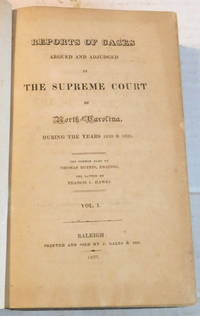
182398090Raleigh: Printed and Sold by J. Gales & Son 1823. 1823. Very good. INCLUDES SEVERAL CASES REGARDING SOUTHERN SLAVES - Octavo 8-1/2 inches high by 5-1/4 inches wide. Hardcover bound in a full calf binding titled on a leather label on the spine. An additional leather label with the number "8" is mounted on the spine. The covers are rubbed and scuffed with a few small stains. The spine is chipped with pieces out near the head and the bottom label is missing. The pagination is as follows: pages i-vi 2 1-269 1-3 and 271-526. The hinges are cracked and the first and last few pages are lightly darkened and foxed. Very good. <p>First edition. According to a statement in the catalog of the Lillian Goldman Law Library of Yale University "The 1st 240 pages of volume 1 reported by Thomas Ruffin; the remainder of volume 1.reported by Francis L. Hawks.<p>It is not surprising that a number of the cases reported here involve slaves. Trotter v. Howard was "an action of trover for a negro girl". Lynch v. Ashe "was an action of detinue for certain slaves". Tate v. O'Neal was a case involving "Some degree of discretion in the punishment of slaves" It "was an action brought against the Defendant and two others for beating the slave of the Plaintiff". The case of the State v. Ben the slave involved a 1741 act in which "a slave tried for a capital crime may be convicted on the testimony of a slave". The murder of one Samuel Skinner was the subject the State v. Poll and Lavinia slaves.<p>Thomas Ruffin 1787-1870 was a justice of the North Carolina Supreme Court and was chief justice from 1833 to 1852.<p>Francis L. Hawks 1798-1866 was an American writer historian and Episcopal priest who who practiced law briefly in North Carolina.<p>The book is from the library of Ovide Dupre 1844-1903 and is signed by him on the front pastedown. Dupre was a French Huguenot who was born in Opelousas Louisiana. He was a graduate of the University of North Carolina and was admitted to the Bar of that state. He practiced law for a few years in Raleigh. In the 1870's he moved to New York City where he had a successful career as a lawyer.<p>In addition to Dupre's distinguished signature there is a later owner's signature penned on the front endpaper and pastedown. Raleigh: Printed and Sold by J. Gales & Son, 1823. hardcover