487 résultats
1800225275England 1800. Watercolor drawing. 31.8 x 45.7 cm. 12-1/2 x 18 inches. Framed and matted. Watercolor drawing. 31.8 x 45.7 cm. 12-1/2 x 18 inches. Superb hilltop view of the old port in this village in North Devon showing several large frigates anchored in the bay sloops moored in the harbor cattle grazing on the slopes sea and sky in the distance. unknown books
18508857Paris 1850. Pencil pen and wash drawing with numerous detailed measurements. A fascinating and beautiful drawing--or "rendu"--of an ancient Roman sarcophagus.<br/> <br/>A fine drawing from an architectural student at the Ecole des Beaux-Arts in Paris the most influential architectural school in existence during much of the 18th century the whole of the 19th century and the first part of the 20th century. 'Students were eligible for the Ecole if they were at least fifteen years old or under thirty. They began with the seconde classe in which they competed in the concours d'émulation. These alternated between an esquisse --a rough sketch for which up to twelve hours was allowed--and a rendu --the large-scale finished drawing for which one to three months were allowed.Two to four years were usually required for a student to accumulate enough credits to enter the première classe. The same system was followed again usually for two to three years after which the student should have accumulated enough credits to compete for the Grand Prix de Rome. The winner of the Grand Prix was entitled to five years study under the auspices of the French Academy in Rome. For each of his first three years he was required to submit an analytical study of an ancient monument. For his fourth year he had to submit a complete reconstruction of a major classical work. For his fifth year he was required to submit an original work designed to a program of his own invention. "This study of the sarcophagus of Lucius Cornelius Scipio Barbatus was part of an Ecole de Beaux Arts student's portfolio. The sarcophagus was one of many in the Scipio family tomb on the Via Appia just outside of Roma and it dates from c. 290 B.C. The obituary text reads English "Lucius Cornelius Scipio Barbatus son of Gnaeus a valiant gentleman and wise whose fine form matched his bravery very well was aedile consul and censor among you he conquered Taurasia and Cisauna in fact Samnium he overcame all the Lucanian lands and brought back hostages."<br/> <br/>Arthur Drexler The Architecture of the Ecole des Beaux-Arts. New York MoMA 1977. unknown books
18306526London 1830. Aquatints coloured by hand. A fine complete series of four anonymous prints of hunting scenes possibly after the Alkens.<br/> <br/>The style and naming of these prints suggests an Alken origin for the series. Siltzer records a number of series by the Alken family in which the first plate is titled "Unkennelling." This title appears to be unique to them and supports the supposition that the present series are after the Alkens. Henry Thomas Alken was born into what became an artistic dynasty. He studied under the miniature painter J. T. Barber and exhibited his first picture a miniature portrait at the Royal Academy when he was sixteen. From about 1816 onwards he "produced an unending stream of paintings drawings and engravings of every type of field and other sporting activity. He is best remembered for his hunting prints many of which he engraved himself until the late 1830s.To many sporting art is "Alken" and to describe his work or ability is quite unnecessary." Charles Lane British Racing Prints pp. 75-76<br/> <br/>Cf. Siltzer pp.57-76. unknown books
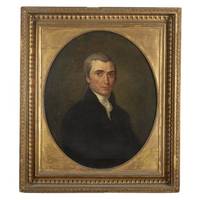
1815690611815. 25 inches x 20 inches. 25 inches x 20 inches. A Great Nineteenth-Century Pennsylvania Jurist American School 19th Century. Read John Meredith 1797-1874. Portrait of John Meredith Read. Philadelphia c.1815. 25" x 20" image size. Oil on canvas in ornate nineteenth-century gilded wood frame. Some minor nicks and chips to frame gilding slightly dulled otherwise fine. $3000. Read was elected to the Pennsylvania House of Representatives in 1822 and 1823 and served as City Solicitor of Philadelphia from 1830 to 1833. He was appointed District Attorney of the Eastern District of Pennsylvania in 1837 and held the office until 1845. Read became Justice of the Supreme Court of Pennsylvania in 1858 and Chief Justice of the Supreme Court of Pennsylvania in 1872. Read gained an international reputation for the depth of his knowledge eloquence and masterly arguments in the courtroom. Active in politics Read was an early supporter and organizer of the Republican Party. This portrait belonged to the Philadelphia Bar Association. Founded in 1802 it is the oldest association of lawyers in the United States. Its library where this portrait was last displayed was renamed the Theodore F. Jenkins Memorial Law Library in 1967. unknown books
183426035Italy 1834. Pen-and-ink watercolour and gouache painted black border titled and dated in white gouache in the lower margin within the border. Lovely 19th-century watercolour of Palermo.<br/> <br/>Catering to the foreigners flocking to the region on the Grand Tour this lovely watercolour shows the town of Palermo with its beautiful hills and mountains in the background with a large fort in the harbour with a British and French ship beside it. The sky is awash in pinks and blues displaying the incredible light of the region. unknown books
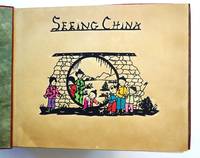
006911Chefoo China: Women's Bible School American Presbyterian Mission No Date circa 1930. Near Fine pages with light toning. Oblong folio 10" x 13 3/4". Bound in beautiful red pictorial embossed silk over limp boards string-tied 28 pp of cut-out illustrations in black and white many with colorful silk inlays with tissue guards publisher's 1 page explanatory leaf laid in also an original 6 1/2" x 10 1/2" cut-out with colorful silk inlays and string hanger readt-to-hang laid in. Cut-out chapter headings are Travel and Transportation Customs and Habits Chinese Birth-Year Cycle latest date 1935 Occupations The Eight Immortals Myths and Legends Chinese Recipes Chinese Children Chinese Junks and The Magician. Well over 100 cut-outs in all including the bonus laid in cut-out and SCARCE THUS. First Edition. String Tied. Near Fine/No Jacket As Issued. Oblong Folio . Women's Bible School, American Presbyterian Mission Paperback books
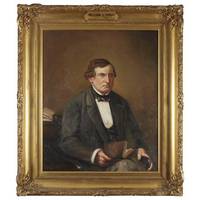
1876690691876. 39-1/2" x 31-1/4. 39-1/2" x 31-1/4" A Notable Nineteenth-Century Philadelphia Lawyer and Democratic Politician American School 19th Century. Hirst William L. 1804-1876. Portrait of William L. Hirst. 31-1/4" x 39-1/2" image size. Oil on canvas in ornate nineteenth-century gilded wood frame. Some minor nicks and chips to frame gilding slightly dulled otherwise fine. $3750. Hirst had a thriving private law practice and was active in Democratic politics. In 1853 Hirst was elected President of the Democratic State Convention. He was an early proponent of the City of Philadelphia consolidation. This portrait belonged to the Philadelphia Bar Association. Founded in 1802 it is the oldest association of lawyers in the United States. Its library where this portrait was last displayed was renamed the Theodore F. Jenkins Memorial Law Library in 1967. unknown books
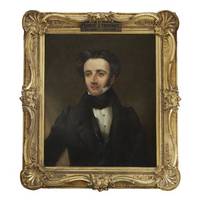
1837690621837. 29 inches x 24 1/4 inches. 29 inches x 24 1/4 inches. An Important Nineteenth-Century Pennsylvania Jurist American School 19th Century. Troubat Francis Joseph 1802-1868. Portrait of Francis Joseph Troubat. Philadelphia c.1837. 29" x 24-1/4" image size. Oil on canvas in ornate nineteenth-century gilded wood frame small plaque reading "Francis J. Troubat/ Born 1802-Died 1868" to head of frame. Some minor nicks and chips to frame gilding slightly dulled otherwise fine. $5000. A prolific writer of legal texts Troubat is best known as the co-author with William W. Haly of The Practice in Civil Actions and Proceedings in the Supreme Court of Pennsylvania in the District Court and Court of Common Pleas for the City and County of Philadelphia and in the Courts of the United States 1837. This portrait belonged to the Philadelphia Bar Association. Founded in 1802 it is the oldest association of lawyers in the United States. Its library where this portrait was last displayed was renamed the Theodore F. Jenkins Memorial Law Library in 1967. unknown books
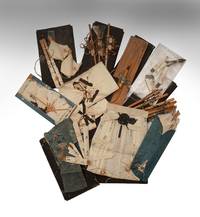
7079Various formats and sizes. Japan: ca. 1787-96. The Ogasawara School founded in the 12th century laid the foundations of etiquette for the aristocratic and samurai classes throughout Japan for many centuries. The school specialized in teaching horsemanship archery mounted archery and samurai etiquette on and off the battlefield. Over the centuries the school transitioned itself to focus on a system of courtly manners along with skills in archery for ceremonial rituals. The school continues today supervised by the 31st generation leader Kiyotada Ogasawara. The Imperial House of Japan uses Ogasawara etiquette. This fascinating collection is made up of miniature models or samples of materials and objects required and used at formal Ogasawara events in the late 18th century as well as a number of manuscript documents. We begin with ten black paper four-sided folding envelopes each labeled and containing the items below. These envelopes are constructed of thick but flexible paper with string ties. The labels describe the contents of each envelope and have seals and signatures of either "Hisanobu" or "Nobumichi": 1. a miniature paper model of a horo which is worn on the back of a samurai's armor. Our horo is made of folded paper with a silk brocade adornment. Measurements are given in manuscript. With this is a model of the bag to carry the horo; 2. miniature fabric samples of pleated trousers a man's formal kimono and vest along with samples of neatly wrapped objects elaborately tied which were to be carried. They include a sword a fan and a bolt of precious brocade; 3. three miniature tachi swords each for a specific occasion. Our sample tachi are made of wood and have thick thread attachments; 4. two kinds of miniature torches taimatsu along with their holders; 5. a most remarkable miniature wooden bow mounted on a wooden board. A quiver utsubo again made of wood and decorated in gold brocade is also mounted; 6. Six miniature examples of maku gushi poles to hold banners. They are joined by ropes here represented by fine decorative cord; 7. four samples of real hair cut off and tied during genpuku the Japanese coming-of-age ceremony; 8. a miniature target - an opened fan - mounted on a board for the hikime-no-gi the archery ritual; 9. two elaborate folded paper model sacks to protect the bow when it rains kasa yumi bukuro; and 10. seven strands of hay and 12 braided strips of paper kamioki which were used in ceremonies for two- and three-year-old aristocratic and samurai male children. These are accompanied by 69 examples of very complex ceremonial origami or origata. Origata as compared to recreational origami was developed amongst the higher class of samurai who stressed formal manners and a sense of decorum. It is a method of how to wrap gifts with very precious handmade papers used for gift-giving and ceremonies in order to maintain sound human relations. Each is folded in it own way and labeled with its intended contents for example an obi belt confectioneries a brush for calligraphy shark skin for sword handles incense wood a tooth-cleaning stick a fan Chinese silk thread hair ornaments gold dust sumi ink cake perfume belts for inner garments face powder tabi socks various sizes of fine writing paper feathers from hawks and cranes for arrows etc. Some examples of highly complex ornamental ties are also present. Finally there are about 20 contemporary letters all concerned with various aspects of Ogasawara etiquette including gastronomic matters. There is a stiff thick-paper folded cover for a gift signed "Ogasawara Taizen taifu Nagamasa." There is also a packet of miscellaneous related papers. In fine condition and a remarkable survival. unknown books
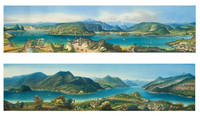
185020181Italy 1850. Pair of views gouache over faint etched line black gouache border. Period gilt and faux bois frames. Two splendid panoramic views of Lake Como and Lake Maggiore.<br/> <br/>Catering to the foreigners flocking to the region on The Grand Tour this pair of hand-painted prints beautifully depict the famed picturesque lakes with rich bands of blue highlighting the water and sky with the surrounding hills and mountains dotted with luxurious villas. In the view of Lake Maggiore we see from a very high vantage point the Borromean Islands: Isola Bella Isola Madre and Isola dei Pescatoriwith their extraordinary gardens. The view of Lake Como looks north up the lake towards Switzerland from above Bellagio which occupies the point at which the lake divides in two. The paintings are clearly intended as a pair the images being almost identical in size with matching black painted margins. The prints are as issued with black labels covering the original printed titles. unknown books
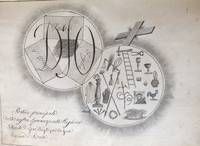
18242952Genoa 1824. <p>Manuscript on laid paper 4to 236 x 176 mm. 126 leaves foliated 3 1-3 1 4-42 1 43-51 1 52-61 1 62-103 1 104-118 complete. The numbered leaves containing one hundred and eighteen emblematic drawings all full-page explanations written on versos the unnumbered leaves containing the title 3 and 1/2-page introduction and section titles; most of the illustrations in landscape format. Calligraphic title text in brown ink in a neat cursive hand; the drawings in graphite pen-and-ink and gray wash a few with details in brown ink each within rule border with numbering at top gutter edge. Corner repairs to ff. 1-10 tears into ff. 9 and 104 a few other short marginal tears or fraying to edges ff. 100 and 101 with gutters reinforced on versos occasional minor offsetting or soiling. Late 19th-century half parchment and brown glazed paper manuscript title label on spine. <br /><br />An illustrated manuscript course of religious instruction for Deaf children by a pioneer of Deaf education in Italy using an original emblematic visual "language." <br /><br />By the early nineteenth century pre-modern misconceptions concerning the learning abilities of Deaf children had been largely exposed as false by such eighteenth-century pedagogues as the abbé Sicard and Charles-Michel de l'Epée in France each of whom founded schools for the Deaf and contributed to the development of a standardized sign language or Samuel Heinicke in Germany who implemented a different method of communication for the Deaf centered on oral speech. In Italy the most influential figure in the education of Deaf children was Ottavio Assarotti. As a young man Assarotti entered the order of the Piarists the Scuole pie. Founded in 1617 the Piarists' principal mission was and remains the provision of free education to poor and especially disabled children. After several years teaching theology and philosophy Assarotti set those disciplines aside to devote himself full-time to the development of an instructional program for Deaf children. Assarotti's method consisted in teaching the children not only reading writing and sign language but also a full range of humanist disciplines including science the arts and foreign languages. In 1805 he obtained financial support from Napoleon to found a school which after some delays was finally opened in 1811 in the former Bridgettine convent. After Napoleon's defeat the growing school received renewed support from King Vittorio Emmanuele I and its fame spread throughout Europe. <br /><br />"Assarotti made great use of sign language in his teaching . Directors of nearly all Italian institutes for deaf students flocked to learn from him and carried his method back with them. Pope Gregory XVI sent the new directors of the Rome Institute Padri Ralli and Gioazzini to study in Genoa with Assarotti. Upon their return to Rome they too used his techniques. How is it possible that a man so renowned and successful in his own time did not earn so much as one line of recognition in the historical accounts of other countries Perhaps the answer lies in the fact that Assarotti left no traces in written form of his philosophy and method. Had he done so not only would he have gained respect and notoriety outside Italy but perhaps the critical events soon to follow the subsequent dominance of "oralism" over sign language in Italy would have taken a different course ." Radutsky p. 245.<br /><br />In fact Assarotti wrote and may have published several texts for his pupils listed in DBI but not found in OCLC or ICCU. The present unpublished work was probably prepared for the use of instructors in the school. It contains a pictorial religious course of instruction using a complex but precise symbolic system to explain Christian doctrine and liturgy including the most abstract theological concepts. All the elements in the drawings are identified in captions of varying lengths and in various layouts. Names or words are often incorporated as visual elements of the emblems. While somewhat primitive the drawings' unique iconography is evocative and some have a powerful dreamlike quality.<br /><br />In the Middle Ages the Deaf were barred from the sacraments - and hence from marriage and any kind of normal life - because of the belief that they could not understand the word of God. While these strictures were loosened in 1571 thanks to Luther's influence prejudice against Deaf persons' abilities to achieve salvation subsisted partly because it was thought that they could not perform Confession. Hence the importance to early educators of the hearing-disabled of providing their pupils with comprehensive religious instruction as an essential foundation of their integration into society.<br /><br />The unnamed author of the introduction writing in the third person describes Assarotti's school and praises his religious zeal humanity and his understanding that Deaf people who had been previously "abandoned by society" are fully competent and indeed capable of the highest intellectual and spiritual attainment. The emblems the author explains will present to the Deaf student an easy transition from familiar material objects to those objects which are less material and from there to the most immaterial concepts of all. In doing so he or she will eventually absorb the entire Christian doctrine. The figures are described as Assarotti's own egli . ha inventato le figure che formano questo Libro . but whether the actual drawings are in his hand is uncertain. The introduction concludes with an explanation of the most frequently recurring emblematic figures. God is represented by a circle containing three rectangles which touch the circle and each other representing the Divine Trinity: flames emanate from the God the Father and Jesus rectangles toward the one representing the Holy Spirit a concept which is explained in the text as the reciprocal love between the two other Divine Persons. Jesus the man as opposed to his divine nature is shown by another circle helpfully inscribed "Uomo / Jesu' Cristo" and humans or human souls are represented by hearts although the meaning of the heart emblem varies throughout the manuscript. Further symbols introduced later are explained on the versos of the drawings.<br /><br />Contrasting with the approbation granted his pedagogical achievements Assarotti's religious views linked to the most mystical wing of the Ligurian Jansenists met with resistance from the church hierarchy and some of his theological writings were not approved for publication. The drawings of this manuscript provide a glimpse of an abstract mysticism which would certainly have been at odds with Catholic orthodoxy.<br /><br />The work is in five parts titled: Faith Fede ff. 4-42; Laws Legge 43-51; Prayer Preghiera 52-61; Sanctification Sanctificazione 62-103 and Virtue Vertù 104-118. The first part is a visual exposition of the Credo starting with God's attributes: his ubiquity is represented by the God and Jesus circles overlapping above a symbol of the world earth and heavens with the word DIO written repeatedly across the page; his omniscience by the God symbol at top sending down rays of light at center a man sitting under a tree and below that a well captioned "Abyss." Creation is a delightful drawing of fish in the seas flanking a mound representing the earth on top of which cavort animals under trees and within which are three large hearts linked to a central pole at the top and illustrating the three reasons that God created man: so that they might know love and enjoy him. The Church of Jesus Christ is an architectural drawing of a fortress. Heaven is a light emanating rays while Hell is a large vat whose opening is locked and barred. Virtuous souls are flaming hearts each with an open eye since they see God; sinful souls are spotted hearts with wilted stems instead of flames. These blemished hearts recur throughout the book for example behind bars in the vat of Hell; enchained by a similarly spotted Devil; in a genealogical tree descended from Adam and Eve; or clustered above Hell on Judgment Day opposite a crowd of pure haloed hearts trumpets sounding above and lightning striking the damned while divine light bathes the saved.<br /><br />The section on Laws contains various allegorical representations of the Ten Commandments. While some drawings amount to schematic tables demonstrating the relationships between theological concepts others are more pictorial. Reflecting no doubt Assarotti's personal mysticism all aspects of the divinity are abstract: there are no angels Madonnas or images of Christ. Crosses are shown but there are no Crucifixions and Christ's Passion appears as a circle containing the Arma Christi. The church hierarchy is represented by a papal tiara mitres and stoles. Human figures appear predominantly in the drawings of the sacraments and in representations of sin. In contrast with the invisibility of the divine Satin is personified as a grimacing devil and the seven deadly sins appear as animals and monsters poised above poisonous emissions from Hell's chimneys. <br /><br />That Assarotti's school used such manuscripts for teaching is supported by the existence of another manuscript very similar in content but lacking the title and two leaves offered by the Austrian antiquarian book firm Inlibris. Cf. Dizionario Biografico degli Italiani art. Antonella Dolci 4:433-4; E. Radutsky "The Education of Deaf People in Italy and the Use of Italian Sign Language" in Van Cleve ed. Deaf History Unveiled 1993 237-5; Rauthgundis Kurrer Gehörlose im Wandel der Zeit doctoral dissertation University of Munich 2013 available as a pdf online pp. 30-33.</p> unknown books
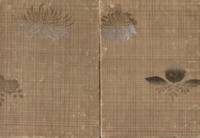
86003001Edo c.1700-50 n.p. Brown & silver covered boards very clean 7 double-page b.w. erotic woodblock illustrations mounted on mica flecked paper 18 x 25 cm. accordion folded illustration size: 31 x 12 cm. FIRST & ONLY UNRECORDED COPY! . . . . A VERY RARE UNRECORDED EARLY BOOK . . . A BIZARRE & UNIQUE EROTIC BOOK . . . UNSIGNED BUT CLEARLY THE WORK OF A MASTER ARTIST . BY SUKENOBU OR HIS :SCHOOL: . A unique and hitherto unfound odd and most unusual erotic book of the early-mid-18th century. One of the most bizarre erotic books ever done in Japan. . The graphically explicit work portrays men and women with genitals on their foreheads engaged in heterosexual and homosexual intercourse. There is no other book with such unusual and strange illustrations. . . THE TITLE: THE LEGEND OF AMANJAKU or AMAN NO JAKU: Chinese Title: TIAN XIE GUI YUN . THE MEANING OF AMANJAKU: Japanese Buddhist literature is abundant with variations on the theme of "Aman-No-Jaku" aka. "Amanjaku" "Manojaku" commonly understood to be a "Heavenly Evil Spirit." . This spirit or demon-like creature in Japanese folklore is usually depicted as being a male during the day and female at night. The demon is usually depicted as a kind of small Oni devil and is thought to be able to provoke a person's darkest desires and instigate him into perpetrating wicked deeds. . Amanjaku is also depicted in Chinese and Japanese mythology the AMANOJAKU is a changeling a water spirit that infiltrates the human world to play cruel tricks on people by reading their minds and twisting their requests or desires to be used against them. . The "AMANOJAKU" is also known the "Lord of the River" and in Japan serves Bishamonten one of the four Deva kings of Buddhism as a minor demon. See Wikipedia below. . In Japanese the term "Amanojaku" also refers to a person who is deliberately contradictory someone who argues for the sake of arguing or can be used in common Japanese conversation to refer to someone who is a "Perverted Demon." . THE ILLUSTRATIONS: THE BUDDHIST THEME:. This work is unusual in that the genitals of common people are located on their foreheads. A symbolist meaning can be in Buddhist concept that sex and sexual hedonism is openly on the minds of 'lay' people. The Buddha and his disciples on the other hand do not have sex organs on their foreheads meaning their organs are covered and in a different usual location. This can symbolize 'self control' over such biological energies. Devout Buddhist disregard sex as a pleasurable pastime and devote themselves to monastic focus. By contrast "lay" people are distracted with hedonistic pleasure a path away from rather than towards the Dharma or teachings of Buddhism. . In a sense this work illustrates the overwhelming force of evil or the "Amanojaku" and how it distracts people from the "Righteous Path" towards the Dharma and the ultimate goal of attaining Nirvana. It can be posited that this work is designed to give understanding to "lay" people by way of visual example of what forces direct their energies away from the Buddhist teachings in an effort to redirect them towards the "Righteous Path" and life style. . EXCEPTIONALLY RARE UNIQUE WORK: . The work is exceptionally RARE unusual and erotic there are no other example showing genitals on the foreheads of any other Japanese book cited anywhere in the bibliographic literature or record. . This work is certainly RARE in subject content and quantity. Though it was woodblock printed and unsigned which was usual for Japanese erotic works which were banned by the Shogun we have not found anything similar or recorded anywhere in the bibliography. Being woodblock printed one assumes there are other copies in existence. The average printing from woodblocks were somewhere between 100-200 copies. However in this instance no others exist. We have the strong feeling the book could have been the production of a famous Japanese illustrator and perhaps financed by a Buddhist temple again there are no known facts about this rarity. . THE EROTIC ILLUSTRATIONS: . Number 1: This work begins showing the Buddha flanked by two of his disciple monks. The title is written in four Japanese Kanji in Kambun & Chinese characters. The Buddha and his two disciples listen to two elderly Buddhist believers: one is a male he has and erect penis on his forehead. The other is a woman she has a vagina on her forehead. Neither the Buddha nor his two disciples monks show genitals on their foreheads. The couple have come to consult with the Buddha about their grievances. . Number 2: Shows a man and a woman in a Tatami matted room both wear lovely 18th century decorated Kimono. They embrace each other and are engaged in making love from their foreheads which show an erect penis and testicles inserted into the woman's forehead where her vagina is located. Adjacent to the young couple is an older woman who has become aroused by the adjacent couple's making love. The old woman uses a dildo tied to a post which she hugs while inserting the dildo into the vagina on her forehead. . Number 3: Shows a couple laying on a blanket their Kimono pulled down and opened and used as a top cover. They engage in love-making and kiss. The man has an erect penis on his forehead the woman a vagina on hers. There is some used Chirishi toilet paper just above her head on the floor used to wipe the love fluids. There is a folded package of yet unused Chirishi in readiness. Chishiri shown in Japanese Shunga erotic prints prints & paintings is an 'erotic symbol' indicative of sexual excitement with lots of love fluids flowing. Ergo the need for paper to clean up the results of erotic love-making. . Number 4 shows an adult man with an erect penis on his forehead penetrating the anus of a younger man who's smaller but erect penis is seen on his forehead as he faces his lover. The younger man has no pubic hair yet indicating his youth. . Adjacent to these two men is a woman in the next room. The door is open she is a secret voyeur of the two men. Her vagina is also on her forehead. A Shogi board and two bowls for stones is located in the front left of the illustration. Gay activities in Japanese society were accepted as a norm and were not especially unusual. However to find graphic examples in Japanese erotic books are exceptionally rare and seldom found. . Number 5: Depicts a fully clothed man on his knees he bends over a sleeping woman. He has a very large erect penis and begins to penetrate a woman with her vagina on her forehead. She is fully clothed and sleeping on a wooden "pillow" which supports her elaborate hair coiffeur. . Number 6: Depicts a lively scene of two men and a woman. One man with a very large and erect penis pulls the woman's arm toward him while she fends him off with a straight arm to his head. A second excited man also with a large and erect penis on his forehead masturbates and ejaculates in ecstasy. The woman has a vagina on her forehead. The scene is likely an intended rape of a young girl. She looks away in an effort not to allow him to pull her close enough to insert his penis into her exposed vagina. . Number 7: Illustrating a lonely old man in bed. He has an erect penis on his forehead and holds a kind of pot with a large opening. He faces down and inserts his penis into the pot for gratification. . THE TEXT: The text in Shunga erotic Japanese books & prints is often an erotic dialogue describing the erotic action. Often these words are onomatopoetic mimicking the sounds of people in orgasm or making comments about making love or the pleasure and good feelings. The size and hardness of the penis or the flavor and the juices of the vagina and its supple feelings of euphoria when engaged in love-making. All wear 18thcentury period Kimono. . MODE AND FASHION OF THE MID-18TH CENTURY: The room furnishing and Kimono of the participants in this work all wear 18th century period Kimono with period decorations. The style of Kimono and room screens reflect this period. . BINDING AND MOUNTING: Binding: The book has probably been rebound sometime after the 1750's with a more recent thin brown decorated paper with a silver chrysanthemum and a Mon family crest with gold and black on both front and rear covers. Each cover has a distinctly different kind of illustration but of the same theme. The corners and edges are a bit worn some loss to the paper as usual for a work from this period. . Mounting: At an earlier time each page was expertly mounted on a stiff Washi hand-made Japanese paper into an accordion folded book. Each illustration is bordered with a rare and stunning crushed oyster-shell powder mixed with rice-glue and overlaid on the border paper. The stunning effect is a rare shimmering pearl-like color and hue with a remarkable effect. This rare and largely unknown effect has been used for print backgrounds by some of the later masters. . This was no ordinary mounting and appropriate for an exceptionally and most unusual RARE book ! . Contents: By and large the contents are clean solid with a two old worm holes for the first 6 of 7 pages. These are small and towards the edge and does not detract from the overall quality of the illustration. On page 7 there are a few center margin old minor worm holes. All of these have been restored when the prints were laid down on the thick Washi paper creating book format. The work is otherwise solid and firm. There are a few 'rubs' on the old Washi paper which was made from very soft Kozo fibers common to any item of this period on this on handmade papers of the period. . CONDITION OF THE WOODBLOCK PRINTS: . These are very early black and white woodcut prints. Each print has an excellent and vivid impression key blocks are black and superbly printed with strong images. The paper is old and has the patina of paper from that age the usual minor mild surface rubbing or thumbing in the lower corners which is common. . We tend to be overly critical of any flaws found on our books and believe it is better to overly describe rather than avoid such discussion any imperfections. Suffice to say by and large this is an excellent item in very nice condition something that any collector or museum would be proud to own. Please review photos posted to our website. . R A R I T Y OF SUBJECT: The placement of the genitals on the forehead gives one a lot of room to theorize on the meaning of such artistic expression. In our 50 years of experience in dealing Japanese woodblock printed books and painted original art this is the first and only example with such imaginative and symbolist expression. With the beginning of the work showing the Buddha and his two disciples lacking any genitals on their foreheads one can simply assume that in a Buddhist way they have given up carnal desire as represented by common people who's foreheads display genitals perhaps meaning that sex is on their minds or they simply view others as sexual objects eager to make love and engage in carnal thoughts and activities. Obviously seeing an erect penis on some man whiles others see what he thinks and feels is an insight to his innermost thoughts and desires. In all cases in this book the men all show an erect penis. The women are a bit more difficult to fathom. Their vaginas are simply visible on their foreheads and no fluids are visible or other evidence of their carnal desire or sexually excited stated. All of the men have public hair adjacent to their sex organs while all women are lacking any pubic hair completely. This is an erotic symbolism giving full view to women's genitals. . "BANNED" or "PROHIBITED" BOOKS: Shun Pon Haru Bon: In the case of this item it is very likely that it was printed in a much smaller discreet quantity than the 200 copies possible off the blocks. Due to the "banned" nature of such books there is no date publisher nor place cited. One is simply left to determine the date and artist by stylistic analysis. It is well-known that during the Tokugawa period 1603-1868 erotic prints and books were "BANNED" or "PROHIBITED" by decree of the Shogun. One of the influencing factors was that during this period some Shoguns were changing their views and being influenced by Christians who entered Japan during this period. The Shogun did not want foreigners and Jesuit missionaries to think that Japan was a crass and base nation. Naturally foreigners soon learned that prostitution was rampant and so this strange logic from the Shogun never had much affect on the Christians and surely not on the Japanese. . The Shogun enforced severe punishments for persons involved in drawing printing carving blocks and publishing erotic books and prints. With out the "Kiwame" or censor's approval seal all such items were "Banned" outright by the Shogun decree. . While these "Prohibited" books and prints were widely circulated in an "underground" society there are ample examples of famous artists taking on commissions to produce erotic books and prints fun or profit. The record and bibliography is loaded with these examples. "Banning" such erotic works simply meant that the number printed were limited to smaller numbers and distribution was done under the table discretely circulating such books privately among collectors. During these times it was not necessary for artists to sign their such artistic creations by-and-large the population had a very good idea who the artist was by being familiar with their style and other works it was simply a "public secret" who the artist was. Often the artist poked fun at the Shogun with political jokes and assumed names to confound any chance of being discovered by the authorities. . Over the centuries this knowledge decreased and is now the domain of the art historian or scholar to identify and determine the actual artist. Stylistic analysis remains the standard method for unsigned works. . THE ARTIST/SCHOOLS: While there are no signatures or seals indicating the artist's name or even his alternate Go studio name we believe this work is part of the "Primitives and First Century of Ukiyo-e School 1660-1765" period. See Lane below. The women's coiffeur is very similar to those found in this period as well as the drawing style technique and genre. It is this cataloger's opinion that this work was likely the creation of one of the Moronobu School masters. Perhaps done by Sukenobu Yoshikiyo Morishige Sugimura Moronobu Kiyonobu Masanobu or others from this period. We believe this work was likely done from around 1710-1750. It was also likely that it was done by one of the artists listed below. . LIKELY ARTIST ATTRIBUTION: . MORONOBU SUKENOBU SCHOOL: Nishikawa Sukenobu 1671 -August 20 1750 often called simply "Sukenobu" was a Japanese printmaker from Kyoto. He was unusual for a Ukiyo-e in being based in the imperial capital of Kyoto. He did prints of actors but gained note for his works concerning women. His Hyakunin Joro Shinasadame: Appreciating 100 Women in two volumes published in 1723 depicted women of all classes from the empress to prostitutes and received favorable results His Hyakunin Joro Shinasadame: Appreciating 100 women in two volumes published in 1723 depicted women of all classes from the empress to prostitutes and received favorable results Leading members of this school were: Nishikawa Sukenobu the founder; Nishikawa Suketada; Kawashima Nobukiyo; Nishikawa Terunobu; and Takagi Sadatake. . NISHIKAWA MORONOBU SCHOOL: Nishikawa Moronobu 1618-July 25 1694 was a Japanese painter and printmaker known for his advancement of the Ukiyo-e woodcut style starting in the 1670s. Leading members of the MORONOBU school were: Nishikawa Moronobu the founder; Hishikawa Morofusa; Hishikawa Moroyoshi; Hishikawa Moronaga; Hishikawa Moroshige; Hishikawa Morohira; and Tamazaki Ryujo. . BIBLIOGRAPHY: . This title is NOT listed in any of the below resources: SHIBUI Kiyoshi. UKIYO-E NAISHI. BIBLIOGRAPHY OF JAPANESE EROTIC ILLUSTRATED WOODBLOCK PRINTED BOOKS. H. KERLEN. CATALOGUE OF PRE-MEIJI JAPANESE BOOKS & MAPS IN PUBLIC COLLECTIONS IN THE NETHERLANDS. Richard Lane: IMAGES FROM THE FLOATING WORLD THE JAPANESE PRINT; pages 28 40-60 show examples of the Ukiyo-e primitives 1660-1765 especially the Moronobu school pp.60-88 et al. . NOT LISTED IN: . KSM SHIBUI Kiyoshi: UKIYO-E NAISI. BIBLIOGRAPHY OF JAPANESE EROTIC ILLUSTRATED WOODBLOCK PRINTED BOOKS. Modern Reading: UKIYO-E NAISHI KERLEN H.: CATALOGUE OF PRE-MEIJI JAPANESE BOOKS & MAPS IN PUBLIC COLLECTIONS IN THE NETHERLANDS. Not in any other usual bibliographies on Japanese E-hon woodblock printed books. . See: WIKIPEDIA: http://en.wikipedia.org/wiki/Amanjaku . hardcover books