Rajasthani School, 19th centuryBiblio.com
852 résultats
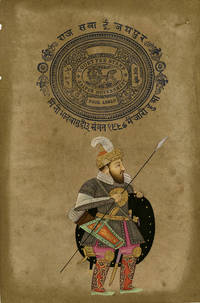
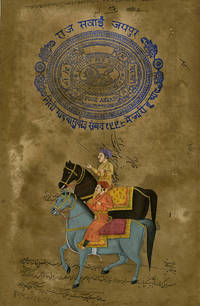
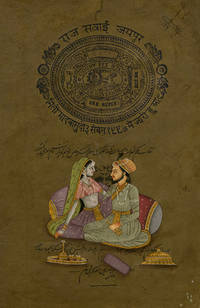
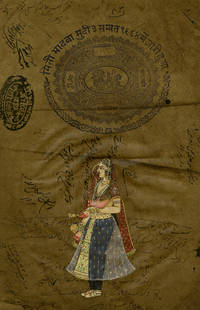
189013371890. Ink and gouache with gold heightening on fibrous brown laid paper with a Jaipur Court Fee tax stamp in gray ink and the 1889 Jaipur State Council stamp in black ink 13 1/4 x 8 3/4 inches 335 x 222 mm. Toning handling creases and minor scattered surface soiling throughout. There are scattered coeval Hindi inscriptions in ink on the recto. "A ragamala translated from Sanskrit as "garland of ragas" is a series of paintings depicting a range of musical melodies known as ragas. Its root word raga means color mood and delight and the depiction of these moods was a favored subject in later Indian court paintings. The celebration of music in painting is a distinctly Indian preoccupation. Ragamalas were first identified as a specific painting genre in the second half of the fifteenth century but their ancestry can be traced to the fifth- to seventh-century Brihaddeshi treatise which states: "A raga is called by the learned that kind of composition which is adorned with musical notes . . . which have the effect of coloring the hearts of men." Often the mood or raga is also written as poetry on the margins of the painting. These works thus evocatively express the intersections of painting poetry and music in Indian court art." <br /> <br /> -The Metropolitan Museum of Art Exhibition Overview Ragamala: Picturing Sound December 2014.<br /> <br /> The first revenue stamps in India were issued in the mid-nineteenth century during the Raj and they are still being issued to this day. Apart from issues for the whole of India many princely states provinces and other states also had or still have their own revenue stamp issues. Before independence Indian revenue stamps were closely modeled on similar designs from Great Britain as is the case with this carriage motif stamp from Jaipur. The stamps were issued to denote various denominations including rupees and annas. An anna or Änna was a currency unit formerly used in British India equal to 1â„16 of a rupee. It was subdivided into four old Paisa or twelve pies thus there were 192 pies in a rupee. When the rupee was decimalized and subdivided into 100 new paise one anna was therefore equivalent to 6.25 paise. This particular stamp was used as evidence of court taxes remitted for property dealings. unknown
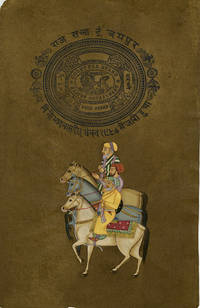
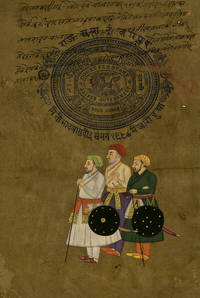
189013351890. Ink and gouache with gold heightening on fibrous brown laid paper with a Jaipur Court Fee tax stamp in black ink 13 3/8 x 8 3/4 inches 340 x 222 mm. Toning handling creases and minor scattered surface soiling throughout. Scattered coeval Hindi inscriptions in ink on the verso as well as the embossed blindstamp of the Treasury of Jaipur. The first revenue stamps in India were issued in the mid-nineteenth century during the Raj and they are still being issued to this day. Apart from issues for the whole of India many princely states provinces and other states also had or still have their own revenue stamp issues. <br /> <br /> Before independence Indian revenue stamps were closely modeled on similar designs from Great Britain as is the case with this carriage motif stamp from Jaipur. The stamps were issued to denote various denominations including rupees and annas. An anna or Änna was a currency unit formerly used in British India equal to 1â„16 of a rupee. It was subdivided into four old Paisa or twelve pies thus there were 192 pies in a rupee. When the rupee was decimalized and subdivided into 100 new paise one anna was therefore equivalent to 6.25 paise. This particular stamp was used as evidence of court taxes remitted for property dealings. unknown
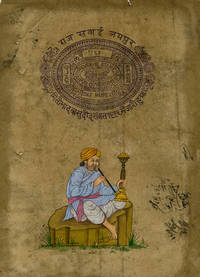
189013421890. Ink and gouache with gold heightening on fibrous brown laid paper with a Jaipur Court Fee tax stamp in black ink on the recto as well as the Jaipur City Council blindstamp 13 5/8 x 8 7/8 inches 345 x 226 mm. Toning handling creases and minor scattered surface soiling throughout. There are scattered coeval inscriptions in ink on the recto and verso. The first revenue stamps in India were issued in the mid-nineteenth century during the Raj and they are still being issued to this day. Apart from issues for the whole of India many princely states provinces and other states also had or still have their own revenue stamp issues. Before independence Indian revenue stamps were closely modeled on similar designs from Great Britain as is the case with this carriage motif stamp from Jaipur. <br /> <br /> The stamps were issued to denote various denominations including rupees and annas. An anna or Änna was a currency unit formerly used in British India equal to 1â„16 of a rupee. It was subdivided into four old Paisa or twelve pies thus there were 192 pies in a rupee. When the rupee was decimalized and subdivided into 100 new paise one anna was therefore equivalent to 6.25 paise. This particular stamp was used as evidence of court taxes remitted for property dealings. unknown
18712437Charterhouse School 1871. Hardcover. Very good. Dates: 1871-1877 and 1910. Small 4to. 37 ff. mostly with newspaper clippings neatly pasted in on both sides 4 ff. in manuscript "Summary of Scores" from 1871-1877 and 1910. Several leaves excised; it is possible that the present album had been re-purposed. On a few of the stubs appear fragmentary MS notations suggesting that the notebook may have once been divided alphabetically. We find on certain stubs "Ai" followed immediately by "Ao" and then several leaves later: "Her. - Hes" followed by "Io." Binding rebacked with smooth calf. In very good condition. Highly interesting homemade album of Cricket Scores available nowhere else specifically documenting the triumphs of three young members of the Blomfield family namely: E.G. Edward George C.J. Charles James and R.T. Reginald Theodore. One wonders if the present album was created in order to promote friendly competition between the brothers two of whom went to Haileybury School and one went to Charterhouse; all three went up to Oxford. There are scores and game synopsis of matches were between Haileybury Charterhouse Marylebone Cricket Club MCC Westminster Trinity College Oxon. Exeter Oxon. and more. One of the more interesting features about the album is that it provides a fascinating record of one family's love of the game:<br /> <br /> ¶ Edward George 1853-1885 entered Charterhouse School London in 1865 and transfer upon the School's removal to Godalming in 1872; in 1873 he went to Trinity College Oxon. where he earned a B.A. in 1877 and M.A. in 1879; thereafter he served as Curate of St. Mary's Portsea until 1883 and then Vicar of St. Mark's Woolston until his death in London in 1885.<br /> <br /> ¶ Charles James 1855-1928 went to Haileybury School; he underwent military training at Sandhurst and served as an army officer in India Sudan and Natal. He attained the rank of Major General before his retirement in 1917. NB: this individual is not to be confused with a noted architect of the same name b. 1862 d. 1932. <br /> <br /> ¶ Reginald Theodore 1856-1942 also went to Haileybury School; he earned his B.A. from Exeter Oxon. in 1880 and M.A. in 1884. He became an architect and was knighted in 1919. He is remembered mainly for his work designing British war memorials. <br /> <br /> ¶ The parents of the three young men were Rev. George John and his first cousin Isabella Blomfield of Bow Devonshire whose own father Charles James Blomfield was Bishop of London. <br /> <br /> ¶ At the end is a "Summary of Scores" for the years 1871-1877. Following this in a different hand is the year 1910; although the initial of the last name "Blomfield" remains the same the other initials belong to Reginald Thomas and his two sons Henry George and Austin. <br /> <br /> ¶ See Stedman Charterhouse Register 1872-1900 passim. CATALOGUER'S NOTE: We are grateful to Catherine Smith Archivist of Charterhouse School for much useful information concerning the Blomfield Family. hardcover
18723630680Hamburg, Nolte & Köhler, 1861 - 1867, 1872. 4to. Zusammen etwa 840 S. Hlwdbde (Papier teilweise etwas braun- und fingerfleckig, Jahrgang 12 ohne den Jahrgangstitel mit Inhaltsverzeichnis, Jahrgangstitel zu Jahrgang 13 am Ende des Jahrgangs eingeheftet).
1860313321Albany 1860. 62 vintage albumen prints comprising 60 oval gem portraits 1-1/2 x 1 inches 1 larger oval portrait 2-1/8 x 1-5/8 inches and 1 full-length 3-1/2 x 2-1/2 inches. 2 vols. 8vo. Contemporary brown morocco autograph album stamped in gilt and blindW.B. Sprague blindstamp on ffep. A few portrait photos damaged or loose 2 inscriptions are without photos. 62 vintage albumen prints comprising 60 oval gem portraits 1-1/2 x 1 inches 1 larger oval portrait 2-1/8 x 1-5/8 inches and 1 full-length 3-1/2 x 2-1/2 inches. 2 vols. 8vo. A photographic yearbook from the Albany Law School class of 1860 assembled by student Horatio Colony 1835-1917.<br /> Opened in 1851 Albany Law School is the oldest independent law school in the United States. Many of its students in the 1850s and '60s became prominent lawyers and judges.<br /> As is the custom with the professionally produced college photograph yearbooks produced by George Kendall Warren starting in the late 1850s each photograph is inscribed beneath by the sitter with his name and hometown. The album opens with professors Ira Harris Amasa Parker Amos Dean Nathaniel Harris and Levi Chamberlain. Some notable students include Alexander P. Ketchum who became a Colonel and Chief Appraiser of the Port of New York; Clayton H. Delano 1836-1920 who served eight terms as the Town of Ticonderoga's Supervisor and was elected twice to the New York State Assembly; and William S. Opdyke general counsel of the Delaware and Hudson Company. <br /> Horatio Colony 1835-1917 whose picture appears last and is unfortunately obscured by damage assembled this album. The photograph of Levi Chamberlain is inscribed to "Horatio friend and pupil." He was admitted to the bar in New Hampshire and New York in 1860; in 1869 he along with his brother George took over the management of the family business the Faulkner and Colony Woolen Mill. He held several other civic and local government positions before his death in an automobile accident in 1917. His son Horatio Jr. 1900-1977 a poet and novelist established the Colony family home as a museum upon his death.<br /> <br /> With: Autograph album containing autographs of acquaintances and some notable figures including Amos Bronson Alcott "A. Bronson Alcott" and Octavius Frothingham "O.B. Frothingham". In near matching black morocco autograph album stamped in blind and gilt extremities rubbed. With later inscription of C.W. Lawbert on front free endpaper. unknown
1830WRCAM45869Philadelphia 1830. Seven volumes. Illustrated. Contemporary three-quarter calf and marbled boards spines gilt leather labels. Hinges cracked; spine on volume seven heavily worn. Library label at foot of each spine. Bookplate on front pastedowns. Internally clean. Good plus. A complete run of this periodical published by the American Sunday School Union. The magazine was intended to spread news and information regarding Sunday schools the setting up and operating of such schools and new educational methods. The goal of the American Sunday School Union was to establish a Sunday school in every possible community in order to spread the gospel. At this time the association was also advocating free public education in order that the Sunday schools could be primarily focused on religious rather than general education. Important for the history of American education and the rise of the free school movement. A nice run of this periodical. hardcover books
18963033Johns Hopkins Press; Baltimore; 1896. 1896 Printed wraps 9 x 5 3/4 inches 35 pp. Very good mild edgewear; slight longitudinal crease covers and book block; slight ruffling right lower corner; mild browning of paper due to inherent quality of paper used not brittle; otherwise pages clean and binding tight. Rare indeed. Defects described in detail; this is a very nice copy. Contents: Faculty including William H. Welch William Osler William S. Halsted Howard A. Kelly Franklin P. Mall John S. Billings Simon Flexner William S. Thayer Students third year second year first year Endowment Requirements for Admission General Plan of Instruction Laboratories and Clinical Opportunities Courses of Instruction Anatomy Physiology Physiological Chemistry Pharmacology and Toxicology Pathology and Bacteriology Medicine Surgery Obstetrics Gynecology Special Departments of Practical Medicine and Surgery Dermatology Diseases of Children Diseases of the Nervous System Genito-Urinary Diseases Laryngology Ophthalmology and Otology Psychiatry History and Literature of Medicine Hygiene Legal Medicine Special Lectures Examinations Charges for Tuition Appendix The Mary Elizabeth Garrett Fund The Women's Medical School Fund. In the fourth year medical students attended Ward Classes as part of their General Medicine training: "The students will make the visit with Professor Osler on three days of the week at 9 a.m. and in this way will be enabled to study in a routine manner the progress of the cases. Special instruction will be given in the methods of treating diseases." 3214004. Soft cover. Very Good. Johns Hopkins Press; Baltimore; 1896. paperback
189013391890. Ink and gouache with yellow heightening on fibrous brown laid paper with a Jaipur Court Fee tax stamp in purple ink on the recto and the Jaipur State Council Stamp dated June 5 1894 and the 1889 Jaipur State Council stamp in black ink on the verso 12 1/2 x 9 inches 318 x 230 mm. Toning handling creases and minor scattered surface soiling throughout. There are scattered coeval Hindi inscriptions in ink on the recto. The first revenue stamps in India were issued in the mid-nineteenth century during the Raj and they are still being issued to this day. Apart from issues for the whole of India many princely states provinces and other states also had or still have their own revenue stamp issues. Before independence Indian revenue stamps were closely modeled on similar designs from Great Britain as is the case with this carriage motif stamp from Jaipur. <br /> <br /> The stamps were issued to denote various denominations including rupees and annas. An anna or Änna was a currency unit formerly used in British India equal to 1â„16 of a rupee. It was subdivided into four old Paisa or twelve pies thus there were 192 pies in a rupee. When the rupee was decimalized and subdivided into 100 new paise one anna was therefore equivalent to 6.25 paise. This particular stamp was used as evidence of court taxes remitted for property dealings. unknown
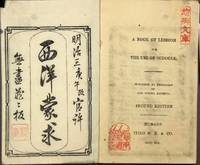
187221891Numadz i.e. Numazu Japan: Itiro W. N. & Co. Meiji 4th published by permission of the school Kaiseijo 1872. Second and last edition small 8vo approx. 7" x 4¾" pp. 2 42 plus printed pastedowns the first the title page in Japanese 3 red chopmarks on title pages one of them Shogo who amassed I am told a famous collection of language books in Tokyo text in Roman letter throughout and printed from metal type; original blue wrappers sewn in Japanese manner printed paper label on upper cover; externally worn and with some limpness to the wrappers all else very good and sound. A Critical Bibliography of Materials for English Studies in Japan. Collected by Osaka Women's University 1962 no. 97. The text contains 7 brief histories including Columbus Discovers America History of Isaac Newton Washington's Regard for his Mother and Alfred and his Mother. Harvard only in OCLC. Itiro W. N. & Co., Meiji 4th [published by permission of the school Kaiseijo] unknown
18712437Charterhouse School 1871. Hardcover. Very good. Dates: 1871-1877 and 1910. Small 4to. 37 ff. mostly with newspaper clippings neatly pasted in on both sides 4 ff. in manuscript "Summary of Scores" from 1871-1877 and 1910. Several leaves excised; it is possible that the present album had been re-purposed. On a few of the stubs appear fragmentary MS notations suggesting that the notebook may have once been divided alphabetically. We find on certain stubs "Ai" followed immediately by "Ao" and then several leaves later: "Her. - Hes" followed by "Io." Binding rebacked with smooth calf. In very good condition. Highly interesting homemade album of Cricket Scores available nowhere else specifically documenting the triumphs of three young members of the Blomfield family namely: E.G. Edward George C.J. Charles James and R.T. Reginald Theodore. One wonders if the present album was created in order to promote friendly competition between the brothers two of whom went to Haileybury School and one went to Charterhouse; all three went up to Oxford. There are scores and game synopsis of matches were between Haileybury Charterhouse Marylebone Cricket Club MCC Westminster Trinity College Oxon. Exeter Oxon. and more. One of the more interesting features about the album is that it provides a fascinating record of one family's love of the game:<br/><br/>¶ Edward George 1853-1885 entered Charterhouse School London in 1865 and transfer upon the School's removal to Godalming in 1872; in 1873 he went to Trinity College Oxon. where he earned a B.A. in 1877 and M.A. in 1879; thereafter he served as Curate of St. Mary's Portsea until 1883 and then Vicar of St. Mark's Woolston until his death in London in 1885.<br/><br/>¶ Charles James 1855-1928 went to Haileybury School; he underwent military training at Sandhurst and served as an army officer in India Sudan and Natal. He attained the rank of Major General before his retirement in 1917. NB: this individual is not to be confused with a noted architect of the same name b. 1862 d. 1932. <br/><br/>¶ Reginald Theodore 1856-1942 also went to Haileybury School; he earned his B.A. from Exeter Oxon. in 1880 and M.A. in 1884. He became an architect and was knighted in 1919. He is remembered mainly for his work designing British war memorials. <br/><br/>¶ The parents of the three young men were Rev. George John and his first cousin Isabella Blomfield of Bow Devonshire whose own father Charles James Blomfield was Bishop of London. <br/><br/>¶ At the end is a "Summary of Scores" for the years 1871-1877. Following this in a different hand is the year 1910; although the initial of the last name "Blomfield" remains the same the other initials belong to Reginald Thomas and his two sons Henry George and Austin. <br/><br/>¶ See Stedman Charterhouse Register 1872-1900 passim. CATALOGUER'S NOTE: We are grateful to Catherine Smith Archivist of Charterhouse School for much useful information concerning the Blomfield Family. hardcover books
189013431890. Ink and gouache with gold heightening on fibrous brown laid paper with a Jaipur Court Fee tax stamp in blue ink on the recto as well as the Jaipur City Council blindstamp 13 1/4 x 8 1/2 inches 335 x 215 mm. Toning handling creases and minor scattered surface soiling throughout. There are scattered coeval inscriptions in ink on the recto and verso. The first revenue stamps in India were issued in the mid-nineteenth century during the Raj and they are still being issued to this day. Apart from issues for the whole of India many princely states provinces and other states also had or still have their own revenue stamp issues. Before independence Indian revenue stamps were closely modeled on similar designs from Great Britain as is the case with this carriage motif stamp from Jaipur. <br /> <br /> The stamps were issued to denote various denominations including rupees and annas. An anna or Änna was a currency unit formerly used in British India equal to 1â„16 of a rupee. It was subdivided into four old Paisa or twelve pies thus there were 192 pies in a rupee. When the rupee was decimalized and subdivided into 100 new paise one anna was therefore equivalent to 6.25 paise. This particular stamp was used as evidence of court taxes remitted for property dealings. unknown
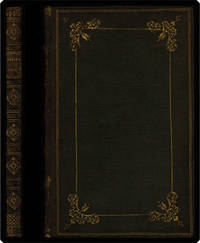
181439223Londini: Ex officinâ Johannis Nichols et Sociorum 1814. Small 8vo 18.5cm 7.25". Frontis. port. 1 f. 62 pp. <br><br>John Colet 14671519 Dean of St. Paul's seems in 1508 to have begun to think about "applying his patrimony to education by the reconstitution of St Paul's Cathedral school in new premises reflecting a preoccupation with education as prerequisite for spiritual regeneration" DNB online. He "opened the doors to St Pauls School in 1509 to educate boys 'from all nacions and countres indifferently' St. Paul's School website.<br>Â Â Â Â Elegantly bound and handsomely printed this is the first edition of this collection for use of the boys of the school and is comprised of "Preces quotidianae ut celebrantur in scholâ Paulina" and "Catechismus cum ordine Confirmationis." The prayers were first published in 1642 and are in Latin while the catechism is in Greek on versos of leaves and Latin opposite on rectos. The engraved frontispiece portrait of Colet is by John Taylor Wedgwood 17831856 a cousin of Josiah Wedgwood.<br>Â Â Â Â Provenance: Late 19th-century bookplate of the Rev. George H. Culshaw; most recently in the library of American collector Albert A. Howard small booklabel "AHA" at rear.<br>Â Â Â Â Binding: Contemporary green straight-grain goat spine gilt extra; both boards with a gilt double-rule outer border and an inner center frame of single gilt rule with large gilt corner devices. Board edges with a gilt roll; narrow turn-ins with a different gilt roll. All edges gilt.<br>Â Â Â Â Searches of WorldCat locate only six U.S. libraries IU NjNbT PPiT IEN NNC NNG reporting ownership. Binding as above; spine sunned to olive front cover with scuff sometime well disguised boards showing signs of having been bent some time ago. Bookplate and label as above. A very few light spots of foxing pages overall clean and crisp. Very good condition. => A very attractive book. Ex officinâ Johannis Nichols et Sociorum hardcover books
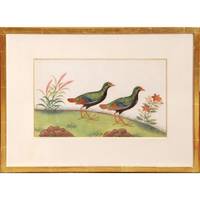
185072325ca 1850. Chinese rice paper. Size: 170 x 280 mm Framed size: 315 x 425 mm Good condition. unknown
188021937Librarie De L'Art 1880 Introduction de J. Comyns Carr. London, Librarie De L'Art, (c. 1880), in-folio, vélin à la Bradel biseauté estampé à froid d'un décor aux amours à l'or fin.
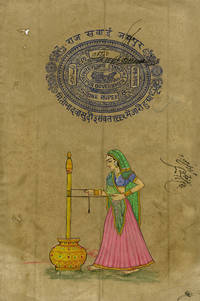
189013411890. Ink and gouache with gold heightening on fibrous brown laid paper with a Jaipur Court Fee tax stamp in purple ink on the recto 13 1/4 x 8 7/8 inches 336 x 226 mm. Toning handling creases and minor scattered surface soiling throughout. There are scattered coeval inscriptions in ink on the recto and verso. A traditional Indian butter churn is operated by rapidly pulling a rope which turns a paddled spindle. The paddles churn cows milk inside a large jar until milk solids form. Ghee is made from cow milk butter which is treated with low heat until the water evaporates leaving behind milk solids. The solids are skimmed off or strained if needed. Ghee is a staple food on the Indian subcontinent and as a cooking oil it is the most widely used food in India apart from wheat and rice. Because of its exalted status at Hindu weddings ghee is expensive and in high demand. Male wedding guests are expected to compete with each other to see who can eat the most of it; consuming two pounds or more at a sitting is considered a proof of virility. <br /> <br /> On the stamp:<br /> <br /> The first revenue stamps in India were issued in the mid-nineteenth century during the Raj and they are still being issued to this day. Apart from issues for the whole of India many princely states provinces and other states also had or still have their own revenue stamp issues. Before independence Indian revenue stamps were closely modeled on similar designs from Great Britain as is the case with this carriage motif stamp from Jaipur. The stamps were issued to denote various denominations including rupees and annas. An anna or Änna was a currency unit formerly used in British India equal to 1â„16 of a rupee. It was subdivided into four old Paisa or twelve pies thus there were 192 pies in a rupee. When the rupee was decimalized and subdivided into 100 new paise one anna was therefore equivalent to 6.25 paise. This particular stamp was used as evidence of court taxes remitted for property dealings. unknown
189013331890. Ink and gouache with gold heightening on brown laid paper with a Jaipur Court Fee tax stamp in black ink 13 3/8 x 8 3/4 inches 340 x 222 mm. Toning handling creases and minor scattered surface soiling throughout. Scattered coeval Hindi inscriptions in ink on the recto and verso. The first revenue stamps in India were issued in the mid-nineteenth century during the Raj and they are still being issued to this day. Apart from issues for the whole of India many princely states provinces and other states also had or still have their own revenue stamp issues. <br /> <br /> Before independence Indian revenue stamps were closely modeled on similar designs from Great Britain as is the case with this carriage motif stamp from Jaipur. The stamps were issued to denote various denominations including rupees and annas. An anna or Änna was a currency unit formerly used in British India equal to 1â„16 of a rupee. It was subdivided into four old Paisa or twelve pies thus there were 192 pies in a rupee. When the rupee was decimalized and subdivided into 100 new paise one anna was therefore equivalent to 6.25 paise. This particular stamp was used as evidence of court taxes remitted for property dealings. unknown
189013341890. Ink and gouache with gold heightening on brown laid paper with a Jaipur Court Fee tax stamp in black ink 12 5/8 x 8 9/16 inches 320 x 217 mm. Toning handling creases and minor scattered surface soiling throughout. Scattered coeval Hindi inscriptions in ink on the recto and verso. The first revenue stamps in India were issued in the mid-nineteenth century during the Raj and they are still being issued to this day. Apart from issues for the whole of India many princely states provinces and other states also had or still have their own revenue stamp issues. <br /> <br /> Before independence Indian revenue stamps were closely modeled on similar designs from Great Britain as is the case with this carriage motif stamp from Jaipur. The stamps were issued to denote various denominations including rupees and annas. An anna or Änna was a currency unit formerly used in British India equal to 1â„16 of a rupee. It was subdivided into four old Paisa or twelve pies thus there were 192 pies in a rupee. When the rupee was decimalized and subdivided into 100 new paise one anna was therefore equivalent to 6.25 paise. This particular stamp was used as evidence of court taxes remitted for property dealings. unknown
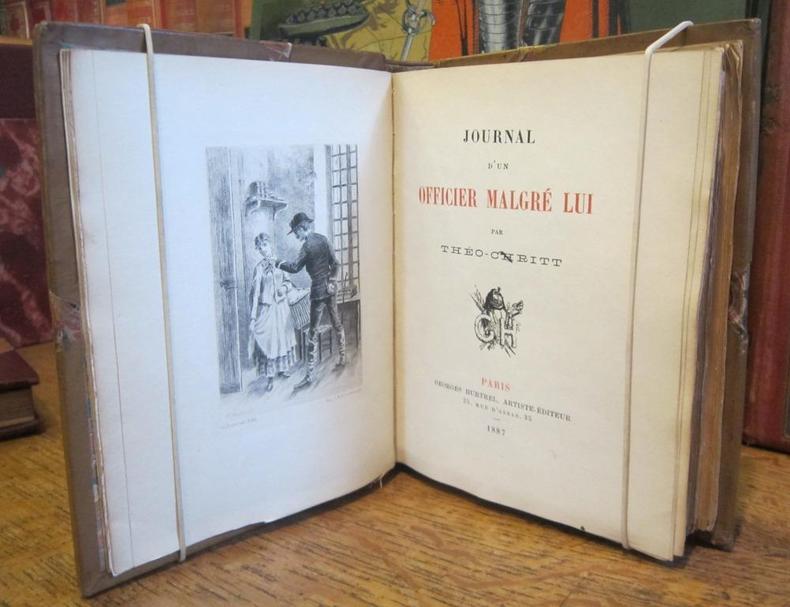
1887000311Paris Hurtrel 1887
18192110502151100336Not Available 1819. Soft Cover. Fine. Number of books: 1 Not Available paperback
1882ZB981331NY: Columbia University Press 1882-1915. volumes 4-36 lacks volume 10 an uninterrupted run of complete volumes bound ex library else text clean & bindings tight. - If you are reading this this item is actually physically in our stock and ready for shipment once ordered. We are not bookjackers. Buyer is responsible for any additional duties taxes or fees required by recipient's country. Photos available upon request. NY: Columbia University Press unknown
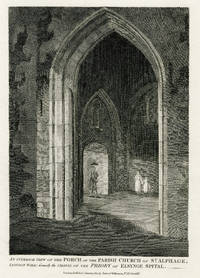
1815952London: Robert Wilkinson 1815. Etching and engraving on wove paper with an "1809" watermark 13 1/2 x 10 inches 342 x 252 mm full margins. In very good condition with some age related toning and light spots of discoloration in the lower sheet quadrant. Damaged in the Blitz and largely demolished in the 1960s what remains of St Mary Elsing includes these doorways which still stand looking back towards London Wall. The ruins include tall arches which once formed the base of the tower. There is also a low wall with an arched recess which may have been used to house a tomb. Robert Wilkinson unknown
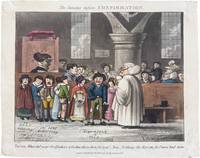
18501887London: Thomas McLean 1850. Lithograph and engraving with hand coloring in watercolor on fibrous cream wove paper 8 13/16 x 11 1/8 inches 223 x 281 mm with unevenly trimmed wide margins. In good condition with minor toning and one vertical tear at the lower-center sheet edge which extends approximately 1/8 inch into the image area. Four circular areas of adhesive on the verso at each of the four corners on the verso from a former mount. Thomas McLean unknown
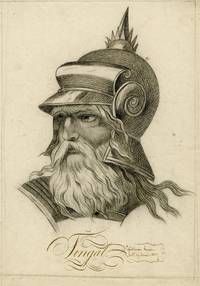
183310261833. Black chalk and graphite on lightweight cream wove paper 16 1/8 x 11 1/4 inches 410 x 286 mm the full sheet. Signed titled and dated in sepia ink in the lower-center sheet area. With horizontal folds approximately 1-inch from the sheet edge at each of the four sheets. The drawing appears to have been folded at the sheet edges to fit into a frame. "Inscribed Guillaume hameau del. 29 Janvier 1883." Finn mac Cumail or mac Umaill often anglicized Finn McCool or MacCool is a hero in Irish mythology as well as in later Scottish and Manx folklore. He is the leader of the Fianna bands of young roving hunter-warriors as well as being a seer and poet. He is said to have a magic thumb that bestows him with great wisdom. He is often depicted hunting with his hounds Bran and Sceólang and fighting with his spear and sword. Fionn MacCumhail was transformed into the character "Fingal" in James Macpherson's poem cycle Ossian 1760 which Macpherson claimed was translated out of discovered Ossianic poetry written in the Scottish Gaelic language. <br /> <br /> Fionn MacCumhail features heavily in modern Irish literature. Most notably he makes several appearances in James Joyce's Finnegans Wake 1939 and some have posited that the title taken from the street ballad "Finnegan's Wake" may also be a blend of "Finn again is awake" referring to his eventual awakening to defend Ireland. unknown
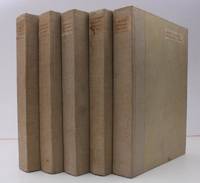
181936358For Harrow School by Philip Lee Warner 1918-1920. 5 vols. of 6 roy. 8vo. First Edition on laid paper with numerous mounted portraits toned in sepia; ivory boards oatmeal holland backs upper boards and backstrips with printed paper labels gilt tops uncut blue silk markers boards mildly dust-soiled else a very good bright clean crisp run. One of the finest and most comprehensive of the public school WWI rolls of honour. The run comprises Vol. I: 23 August 1914 to 20 March 1915; Vol. II: 31 March 1915 to 11 September 1915; Vol. III: 13 September 1915 to 3 July 1916; 5 July 1916 to 11 April 1917; Vol. V: 11 April 1917 to 10 April 1918. A crisp run tragically wanting the sixth and final volume. SCARCE IN THIS CONDITION. For Harrow School by Philip Lee Warner, hardcover